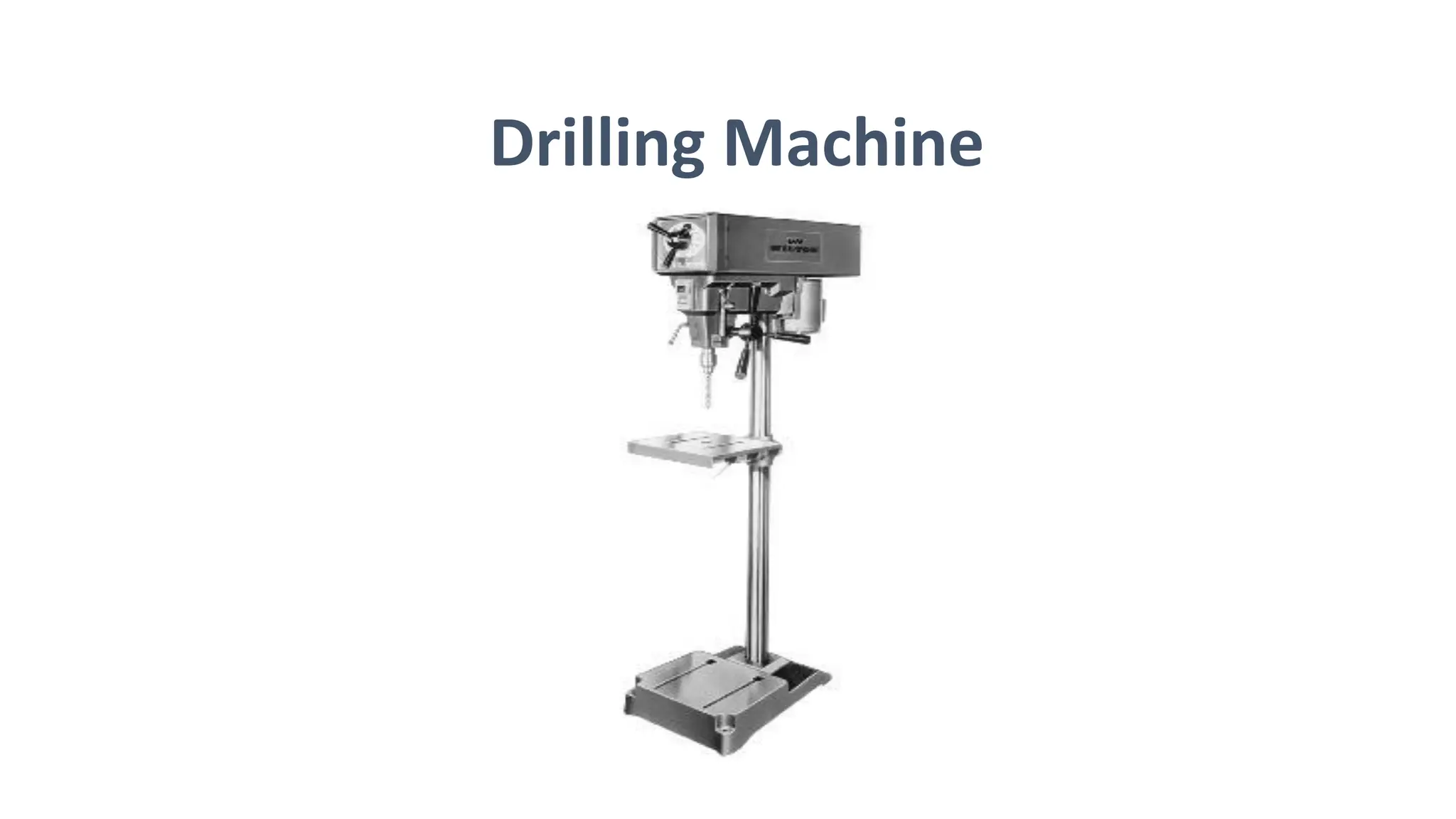
Drilling Machine
⚫ Drilling is the operation of producing circular hole in the
work-piece by using a rotating cutter.
⚫ The machine used for drilling is called drilling machine
⚫ It is the simplest and accurate machine used in production
shop.
⚫ The work piece is held stationary i.e Clamped in position
and the drill rotates to make a hole
⚫ A Drilling machine is also referred to as Drill Press
Introduction
Classification
Portable drilling machine
Sensitive drilling machine
Upright drilling machine
Radial drilling machine
▪ Simple
▪ Universal
Gang Drilling machine
Multiple spindle drilling machine
Deep Hole drilling machine
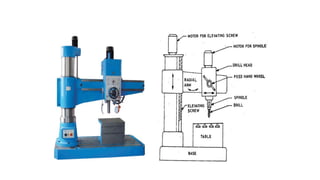
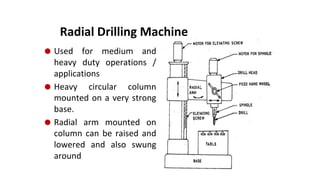
Radial Drilling Machine
⚫ Used for medium and
heavy duty operations /
applications
⚫ Heavy circular column
mounted on a very strong
base.
⚫ Radial arm mounted on
column can be raised and
lowered and also swung
around
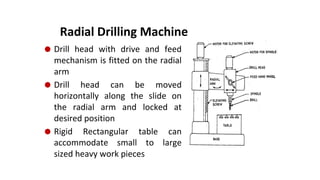
Radial Drilling Machine
⚫ Drill head with drive and feed
mechanism is fitted on the radial
arm
⚫ Drill head can be moved
horizontally along the slide on
the radial arm and locked at
desired position
⚫ Rigid Rectangular table can
accommodate small to large
sized heavy work pieces
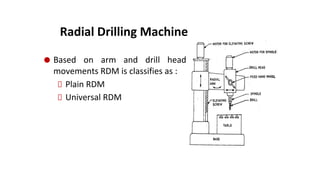
⚫ Based on arm and drill head
movements RDM is classifies as :
Plain RDM
Universal RDM
Radial Drilling Machine
⚫ Plain radial Drilling machine has : Vertical Movement of
arm + Radial swing of arm + Horizontal movement of
Drill head
⚫ Universal Drilling machine has : Vertical Movement of
arm + Radial swing of arm + Horizontal movement of
Drill head + Drill head tilt on two horizontal axis
Radial Drilling Machine
Types of Drill Bits
• According to material :
✔ High speed steel – most common
✔ Cemented carbides
- Without or with coating
- In the form of brazed, clamped or solid
• According to size
✔ Large twist drills of diameter around 40 mm
✔ Micro drills of diameter 25 to 500 μm
✔ Medium range (most widely used) diameter
ranges between 3 mm to 25mm.
Types of Drill Bits
• According to number of flutes
✔ Two fluted – most common
✔ Single flute – e.g., gun drill (robust)
✔ Three or four flutes – called slot drill
• According to helix angle of the flutes
✔ Usual – 200
to 350
– most common
✔ Large helix : 450
to 600
suitable for deep holes and
softer work materials
✔ Small helix : for harder / stronger materials
✔ Zero helix : spade drills for high production drilling,
micro-drilling and hard work materials.
• According to length – to – diameter ratio
✔ Deep hole drill; e.g. crank shaft drill, gun drill etc.
✔ General type : L/φ ≅ 6 to 10
✔ Small length : e.g. Centre drill
Types of Drill Bits
• According to shank
✔ Straight shank – small size drill being held in drill
chuck
✔ Taper shank – medium to large size drills being fitted
into the spindle nose directly or through taper
sockets
Types of Drill Bits
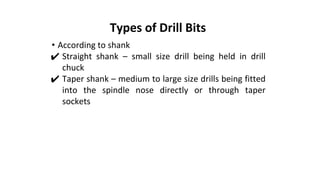
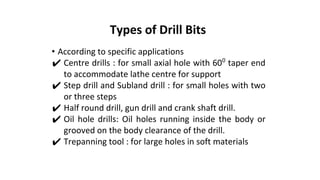
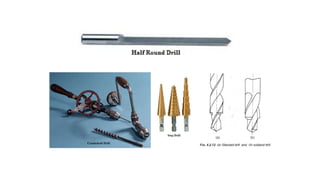
• According to specific applications
✔ Centre drills : for small axial hole with 600
taper end
to accommodate lathe centre for support
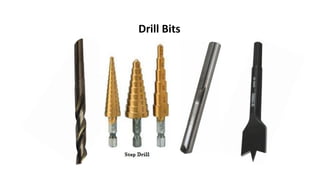
✔ Step drill and Subland drill : for small holes with two
or three steps
✔ Half round drill, gun drill and crank shaft drill.
✔ Oil hole drills: Oil holes running inside the body or
grooved on the body clearance of the drill.
✔ Trepanning tool : for large holes in soft materials
Types of Drill Bits
Drill Bits
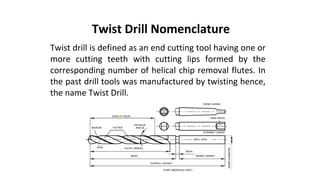
Twist drill is defined as an end cutting tool having one or
more cutting teeth with cutting lips formed by the
corresponding number of helical chip removal flutes. In
the past drill tools was manufactured by twisting hence,
the name Twist Drill.
Twist Drill Nomenclature
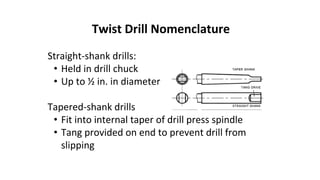
Straight-shank drills:
• Held in drill chuck
• Up to ½ in. in diameter
Tapered-shank drills
• Fit into internal taper of drill press spindle
• Tang provided on end to prevent drill from
slipping
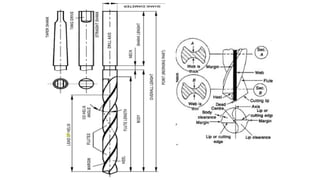
Twist Drill Nomenclature
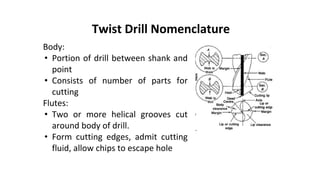
Body:
• Portion of drill between shank and
point
• Consists of number of parts for
cutting
Flutes:
• Two or more helical grooves cut
around body of drill.
• Form cutting edges, admit cutting
fluid, allow chips to escape hole
Twist Drill Nomenclature
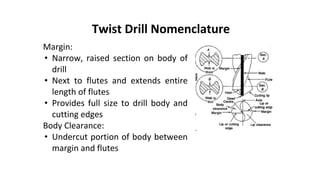
Margin:
• Narrow, raised section on body of
drill
• Next to flutes and extends entire
length of flutes
• Provides full size to drill body and
cutting edges
Body Clearance:
• Undercut portion of body between
margin and flutes
Twist Drill Nomenclature
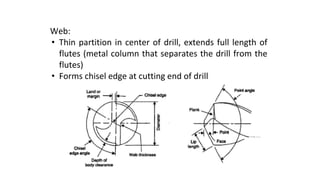
Web:
• Thin partition in center of drill, extends full length of
flutes (metal column that separates the drill from the
flutes)
• Forms chisel edge at cutting end of drill
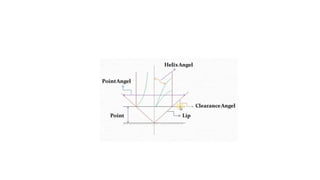
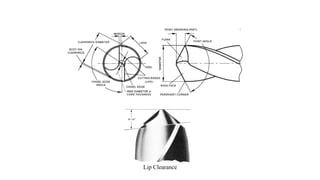
Cutting Unit: The unit that cuts away the material while
drilling holes.
Cutting unit of the drill consist of 2 or more cutting edges.
It consist of
• Point of a drill: Cone shaped surface at the cutting end.
• Heel: Edge formed by the intersection of flute and the
body clearance
• Lip (cutting edge): Edges formed by the intersection of
flanks and faces.
• Lip clearance: Is the relief ground on point of drill
extending from cutting lips back to the heel
Lip Clearance
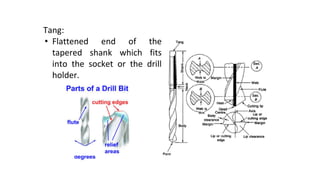
Tang:
• Flattened end of the
tapered shank which fits
into the socket or the drill
holder.
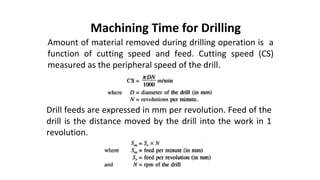
Machining Time for Drilling
Amount of material removed during drilling operation is a
function of cutting speed and feed. Cutting speed (CS)
measured as the peripheral speed of the drill.
Drill feeds are expressed in mm per revolution. Feed of the
drill is the distance moved by the drill into the work in 1
revolution.
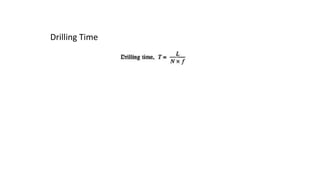
Drilling Time

Drilling.pdf .

  • 1.
  • 2.
    ⚫ Drilling isthe operation of producing circular hole in the work-piece by using a rotating cutter. ⚫ The machine used for drilling is called drilling machine ⚫ It is the simplest and accurate machine used in production shop. ⚫ The work piece is held stationary i.e Clamped in position and the drill rotates to make a hole ⚫ A Drilling machine is also referred to as Drill Press Introduction
  • 3.
    Classification Portable drilling machine Sensitivedrilling machine Upright drilling machine Radial drilling machine ▪ Simple ▪ Universal Gang Drilling machine Multiple spindle drilling machine Deep Hole drilling machine
  • 5.
    Radial Drilling Machine ⚫Used for medium and heavy duty operations / applications ⚫ Heavy circular column mounted on a very strong base. ⚫ Radial arm mounted on column can be raised and lowered and also swung around
  • 6.
    Radial Drilling Machine ⚫Drill head with drive and feed mechanism is fitted on the radial arm ⚫ Drill head can be moved horizontally along the slide on the radial arm and locked at desired position ⚫ Rigid Rectangular table can accommodate small to large sized heavy work pieces
  • 7.
    ⚫ Based onarm and drill head movements RDM is classifies as : Plain RDM Universal RDM Radial Drilling Machine
  • 8.
    ⚫ Plain radialDrilling machine has : Vertical Movement of arm + Radial swing of arm + Horizontal movement of Drill head ⚫ Universal Drilling machine has : Vertical Movement of arm + Radial swing of arm + Horizontal movement of Drill head + Drill head tilt on two horizontal axis Radial Drilling Machine
  • 9.
    Types of DrillBits • According to material : ✔ High speed steel – most common ✔ Cemented carbides - Without or with coating - In the form of brazed, clamped or solid • According to size ✔ Large twist drills of diameter around 40 mm ✔ Micro drills of diameter 25 to 500 μm ✔ Medium range (most widely used) diameter ranges between 3 mm to 25mm.
  • 10.
    Types of DrillBits • According to number of flutes ✔ Two fluted – most common ✔ Single flute – e.g., gun drill (robust) ✔ Three or four flutes – called slot drill
  • 11.
    • According tohelix angle of the flutes ✔ Usual – 200 to 350 – most common ✔ Large helix : 450 to 600 suitable for deep holes and softer work materials ✔ Small helix : for harder / stronger materials ✔ Zero helix : spade drills for high production drilling, micro-drilling and hard work materials. • According to length – to – diameter ratio ✔ Deep hole drill; e.g. crank shaft drill, gun drill etc. ✔ General type : L/φ ≅ 6 to 10 ✔ Small length : e.g. Centre drill Types of Drill Bits
  • 12.
    • According toshank ✔ Straight shank – small size drill being held in drill chuck ✔ Taper shank – medium to large size drills being fitted into the spindle nose directly or through taper sockets Types of Drill Bits
  • 13.
    • According tospecific applications ✔ Centre drills : for small axial hole with 600 taper end to accommodate lathe centre for support ✔ Step drill and Subland drill : for small holes with two or three steps ✔ Half round drill, gun drill and crank shaft drill. ✔ Oil hole drills: Oil holes running inside the body or grooved on the body clearance of the drill. ✔ Trepanning tool : for large holes in soft materials Types of Drill Bits
  • 15.
  • 18.
    Twist drill isdefined as an end cutting tool having one or more cutting teeth with cutting lips formed by the corresponding number of helical chip removal flutes. In the past drill tools was manufactured by twisting hence, the name Twist Drill. Twist Drill Nomenclature
  • 19.
    Straight-shank drills: • Heldin drill chuck • Up to ½ in. in diameter Tapered-shank drills • Fit into internal taper of drill press spindle • Tang provided on end to prevent drill from slipping Twist Drill Nomenclature
  • 20.
    Body: • Portion ofdrill between shank and point • Consists of number of parts for cutting Flutes: • Two or more helical grooves cut around body of drill. • Form cutting edges, admit cutting fluid, allow chips to escape hole Twist Drill Nomenclature
  • 21.
    Margin: • Narrow, raisedsection on body of drill • Next to flutes and extends entire length of flutes • Provides full size to drill body and cutting edges Body Clearance: • Undercut portion of body between margin and flutes Twist Drill Nomenclature
  • 22.
    Web: • Thin partitionin center of drill, extends full length of flutes (metal column that separates the drill from the flutes) • Forms chisel edge at cutting end of drill
  • 23.
    Cutting Unit: Theunit that cuts away the material while drilling holes. Cutting unit of the drill consist of 2 or more cutting edges. It consist of • Point of a drill: Cone shaped surface at the cutting end. • Heel: Edge formed by the intersection of flute and the body clearance • Lip (cutting edge): Edges formed by the intersection of flanks and faces. • Lip clearance: Is the relief ground on point of drill extending from cutting lips back to the heel
  • 24.
  • 25.
    Tang: • Flattened endof the tapered shank which fits into the socket or the drill holder.
  • 26.
    Machining Time forDrilling Amount of material removed during drilling operation is a function of cutting speed and feed. Cutting speed (CS) measured as the peripheral speed of the drill. Drill feeds are expressed in mm per revolution. Feed of the drill is the distance moved by the drill into the work in 1 revolution.
  • 27.