RIVETED JOINTS
 COMPLIED BY SHEHBAZ ALI
 Semester: 4th
 Baluchistan UET,Khuzdar, Baluchistan
 BOOK : Machine Design by R.K Rajpoot
Introduction
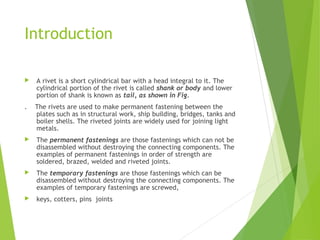
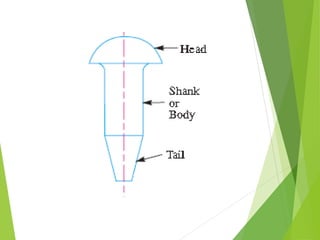
 A rivet is a short cylindrical bar with a head integral to it. The
cylindrical portion of the rivet is called shank or body and lower
portion of shank is known as tail, as shown in Fig.
. The rivets are used to make permanent fastening between the
plates such as in structural work, ship building, bridges, tanks and
boiler shells. The riveted joints are widely used for joining light
metals.
 The permanent fastenings are those fastenings which can not be
disassembled without destroying the connecting components. The
examples of permanent fastenings in order of strength are
soldered, brazed, welded and riveted joints.
 The temporary fastenings are those fastenings which can be
disassembled without destroying the connecting components. The
examples of temporary fastenings are screwed,
 keys, cotters, pins joints
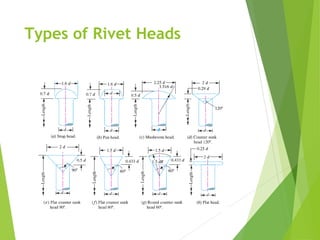
Types of Rivet Heads
Types of Riveted Joints
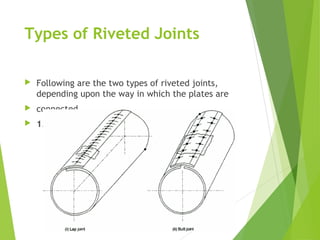
 Following are the two types of riveted joints,
depending upon the way in which the plates are
 connected.
 1. Lap joint, and 2. Butt joint.
 Lap Joint
 A lap joint is that in which one plate overlaps the
other and the two plates are then riveted together.
 Butt Joint
 A butt joint is that in which the main plates are kept
in alignment butting (i.e. touching) each other and a
cover plate is placed either on one side or on both
sides of the main plates. The cover plate is then
riveted together with the main plates. Butt joints are
of the following two types :
 1. Single strap butt joint, and 2. Double strap butt
joint.
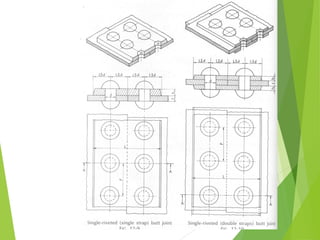
 In a single strap butt joint, the
edges of the main plates butt against
each other and only one cover plate is
placed on one side of the main plates
and then riveted together.
 In a double strap butt joint, the
edges of the main plates butt against
each other and two cover plates are
placed on both sides of the main
plates and then riveted together.
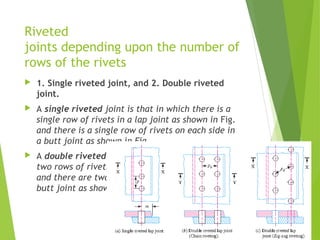
Riveted
joints depending upon the number of
rows of the rivets
 1. Single riveted joint, and 2. Double riveted
joint.
 A single riveted joint is that in which there is a
single row of rivets in a lap joint as shown in Fig.
and there is a single row of rivets on each side in
a butt joint as shown in Fig. .
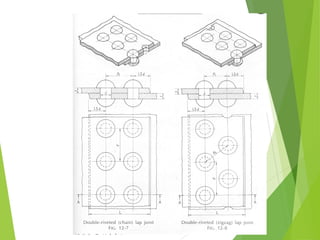
 A double riveted joint is that in which there are
two rows of rivets in a lap joint as shown in Fig.
and there are two rows of rivets on each side in a
butt joint as shown in Fig
Important Terms Used in
Riveted Joints
 1. Pitch. It is the distance from the centre of one rivet
to the centre of the next rivet measured parallel to the
seam as shown in Fig. It is usually denoted by p.
 2. Back pitch. It is the perpendicular distance between
the centre lines of the successive rows as shown in Fig. It
is usually denoted by pb.
 3. Diagonal pitch. It is the distance between the centres
of the rivets in adjacent rows of zig-zag riveted joint as
shown in Fig. It is usually denoted by pd.
 4. Margin or marginal pitch. It is the distance between
the centre of rivet hole to the nearest edge of the plate
as shown in Fig. It is usually denoted by m.
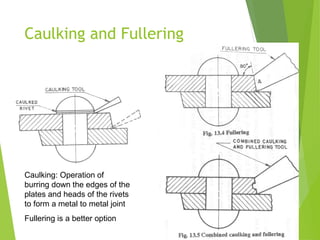
Caulking and Fullering
Caulking: Operation of
burring down the edges of the
plates and heads of the rivets
to form a metal to metal joint
Fullering is a better option
Failures of a Riveted Joint
 Tearing of the plate at an edge.
 A joint may fail due to tearing of the plate at an
edge as shown in Fig. This can be avoided by
keeping the margin, m = 1.5d, where d is the
diameter of the rivet hole.
Tearing of the plate across
a row of rivets.
 The resistance offered by the plate against tearing is known as tearing
resistance or tearing
 strength or tearing value of the plate.
 Let p = Pitch of the rivets,
 d = Diameter of the rivet hole,
 t = Thickness of the plate, and
 σt = Permissible tensile stress for the plate material.
 We know that tearing area per pitch length,
 At = (p – d ) t
 ∴ Tearing resistance or pull required to tear off the plate per pitch
length,
 Pt = At.σt = (p – d)t.σt
 When the tearing resistance (Pt) is greater than the applied load (P) per
pitch length, then this type of failure will not occur.
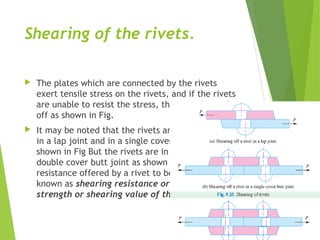
Shearing of the rivets.
 The plates which are connected by the rivets
exert tensile stress on the rivets, and if the rivets
are unable to resist the stress, they are sheared
off as shown in Fig.
 It may be noted that the rivets are in *single shear
in a lap joint and in a single cover butt joint, as
shown in Fig But the rivets are in double shear in a
double cover butt joint as shown in Fig. The
resistance offered by a rivet to be sheared off is
known as shearing resistance or shearing
strength or shearing value of the rivet
Shearing off a rivet in double cover butt joint.
Let d = Diameter of the rivet hole,
τ = Safe permissible shear stress for the rivet material, and
n = Number of rivets per pitch length.
We know that shearing area,
 As =4π× d ²...(In single shear)
 = 2 ×4π× d ² ...(Theoretically, in double shear)
 = 1.875 ×4π× d ² )
 ∴ Shearing resistance or pull required to shear off the rivet
per pitch length,
 Ps = n ×4π× d ² × τ ...(In single shear)
 = n × 2 ×4π× d ² × τ ...(Theoretically, in double shear)
Crushing of the plate or
rivets.
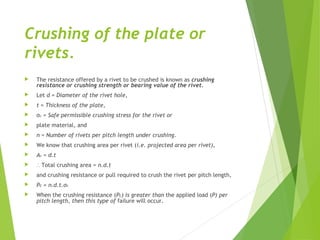
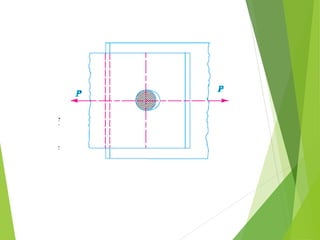
 The resistance offered by a rivet to be crushed is known as crushing
resistance or crushing strength or bearing value of the rivet.
 Let d = Diameter of the rivet hole,
 t = Thickness of the plate,
 σc = Safe permissible crushing stress for the rivet or
 plate material, and
 n = Number of rivets per pitch length under crushing.
 We know that crushing area per rivet (i.e. projected area per rivet),
 Ac = d.t
 ∴ Total crushing area = n.d.t
 and crushing resistance or pull required to crush the rivet per pitch length,
 Pc = n.d.t.σc
 When the crushing resistance (Pc) is greater than the applied load (P) per
pitch length, then this type of failure will occur.
Efficiency of a Riveted Joint
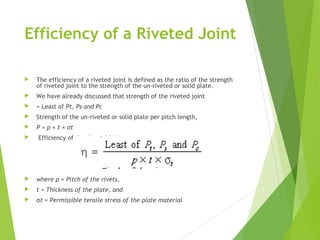
 The efficiency of a riveted joint is defined as the ratio of the strength
of riveted joint to the strength of the un-riveted or solid plate.
 We have already discussed that strength of the riveted joint
 = Least of Pt, Ps and Pc
 Strength of the un-riveted or solid plate per pitch length,
 P = p × t × σt
 Efficiency of the riveted joint,
 where p = Pitch of the rivets,
 t = Thickness of the plate, and
 σt = Permissible tensile stress of the plate material
Riveted joints 200708

Riveted joints 200708

  • 1.
    RIVETED JOINTS  COMPLIEDBY SHEHBAZ ALI  Semester: 4th  Baluchistan UET,Khuzdar, Baluchistan  BOOK : Machine Design by R.K Rajpoot
  • 2.
    Introduction  A rivetis a short cylindrical bar with a head integral to it. The cylindrical portion of the rivet is called shank or body and lower portion of shank is known as tail, as shown in Fig. . The rivets are used to make permanent fastening between the plates such as in structural work, ship building, bridges, tanks and boiler shells. The riveted joints are widely used for joining light metals.  The permanent fastenings are those fastenings which can not be disassembled without destroying the connecting components. The examples of permanent fastenings in order of strength are soldered, brazed, welded and riveted joints.  The temporary fastenings are those fastenings which can be disassembled without destroying the connecting components. The examples of temporary fastenings are screwed,  keys, cotters, pins joints
  • 4.
  • 5.
    Types of RivetedJoints  Following are the two types of riveted joints, depending upon the way in which the plates are  connected.  1. Lap joint, and 2. Butt joint.
  • 6.
     Lap Joint A lap joint is that in which one plate overlaps the other and the two plates are then riveted together.  Butt Joint  A butt joint is that in which the main plates are kept in alignment butting (i.e. touching) each other and a cover plate is placed either on one side or on both sides of the main plates. The cover plate is then riveted together with the main plates. Butt joints are of the following two types :  1. Single strap butt joint, and 2. Double strap butt joint.
  • 7.
     In asingle strap butt joint, the edges of the main plates butt against each other and only one cover plate is placed on one side of the main plates and then riveted together.  In a double strap butt joint, the edges of the main plates butt against each other and two cover plates are placed on both sides of the main plates and then riveted together.
  • 8.
    Riveted joints depending uponthe number of rows of the rivets  1. Single riveted joint, and 2. Double riveted joint.  A single riveted joint is that in which there is a single row of rivets in a lap joint as shown in Fig. and there is a single row of rivets on each side in a butt joint as shown in Fig. .  A double riveted joint is that in which there are two rows of rivets in a lap joint as shown in Fig. and there are two rows of rivets on each side in a butt joint as shown in Fig
  • 9.
    Important Terms Usedin Riveted Joints  1. Pitch. It is the distance from the centre of one rivet to the centre of the next rivet measured parallel to the seam as shown in Fig. It is usually denoted by p.  2. Back pitch. It is the perpendicular distance between the centre lines of the successive rows as shown in Fig. It is usually denoted by pb.  3. Diagonal pitch. It is the distance between the centres of the rivets in adjacent rows of zig-zag riveted joint as shown in Fig. It is usually denoted by pd.  4. Margin or marginal pitch. It is the distance between the centre of rivet hole to the nearest edge of the plate as shown in Fig. It is usually denoted by m.
  • 10.
    Caulking and Fullering Caulking:Operation of burring down the edges of the plates and heads of the rivets to form a metal to metal joint Fullering is a better option
  • 11.
    Failures of aRiveted Joint  Tearing of the plate at an edge.  A joint may fail due to tearing of the plate at an edge as shown in Fig. This can be avoided by keeping the margin, m = 1.5d, where d is the diameter of the rivet hole.
  • 12.
    Tearing of theplate across a row of rivets.  The resistance offered by the plate against tearing is known as tearing resistance or tearing  strength or tearing value of the plate.  Let p = Pitch of the rivets,  d = Diameter of the rivet hole,  t = Thickness of the plate, and  σt = Permissible tensile stress for the plate material.  We know that tearing area per pitch length,  At = (p – d ) t  ∴ Tearing resistance or pull required to tear off the plate per pitch length,  Pt = At.σt = (p – d)t.σt  When the tearing resistance (Pt) is greater than the applied load (P) per pitch length, then this type of failure will not occur.
  • 13.
    Shearing of therivets.  The plates which are connected by the rivets exert tensile stress on the rivets, and if the rivets are unable to resist the stress, they are sheared off as shown in Fig.  It may be noted that the rivets are in *single shear in a lap joint and in a single cover butt joint, as shown in Fig But the rivets are in double shear in a double cover butt joint as shown in Fig. The resistance offered by a rivet to be sheared off is known as shearing resistance or shearing strength or shearing value of the rivet
  • 14.
    Shearing off arivet in double cover butt joint. Let d = Diameter of the rivet hole, τ = Safe permissible shear stress for the rivet material, and n = Number of rivets per pitch length. We know that shearing area,  As =4π× d ²...(In single shear)  = 2 ×4π× d ² ...(Theoretically, in double shear)  = 1.875 ×4π× d ² )  ∴ Shearing resistance or pull required to shear off the rivet per pitch length,  Ps = n ×4π× d ² × τ ...(In single shear)  = n × 2 ×4π× d ² × τ ...(Theoretically, in double shear)
  • 15.
    Crushing of theplate or rivets.  The resistance offered by a rivet to be crushed is known as crushing resistance or crushing strength or bearing value of the rivet.  Let d = Diameter of the rivet hole,  t = Thickness of the plate,  σc = Safe permissible crushing stress for the rivet or  plate material, and  n = Number of rivets per pitch length under crushing.  We know that crushing area per rivet (i.e. projected area per rivet),  Ac = d.t  ∴ Total crushing area = n.d.t  and crushing resistance or pull required to crush the rivet per pitch length,  Pc = n.d.t.σc  When the crushing resistance (Pc) is greater than the applied load (P) per pitch length, then this type of failure will occur.
  • 17.
    Efficiency of aRiveted Joint  The efficiency of a riveted joint is defined as the ratio of the strength of riveted joint to the strength of the un-riveted or solid plate.  We have already discussed that strength of the riveted joint  = Least of Pt, Ps and Pc  Strength of the un-riveted or solid plate per pitch length,  P = p × t × σt  Efficiency of the riveted joint,  where p = Pitch of the rivets,  t = Thickness of the plate, and  σt = Permissible tensile stress of the plate material