GRINDING WHEEL 
SPECIFICATONS 
PRESENTATION BY:- 
YASHRAJ V. PATIL
DEFINITION:- 
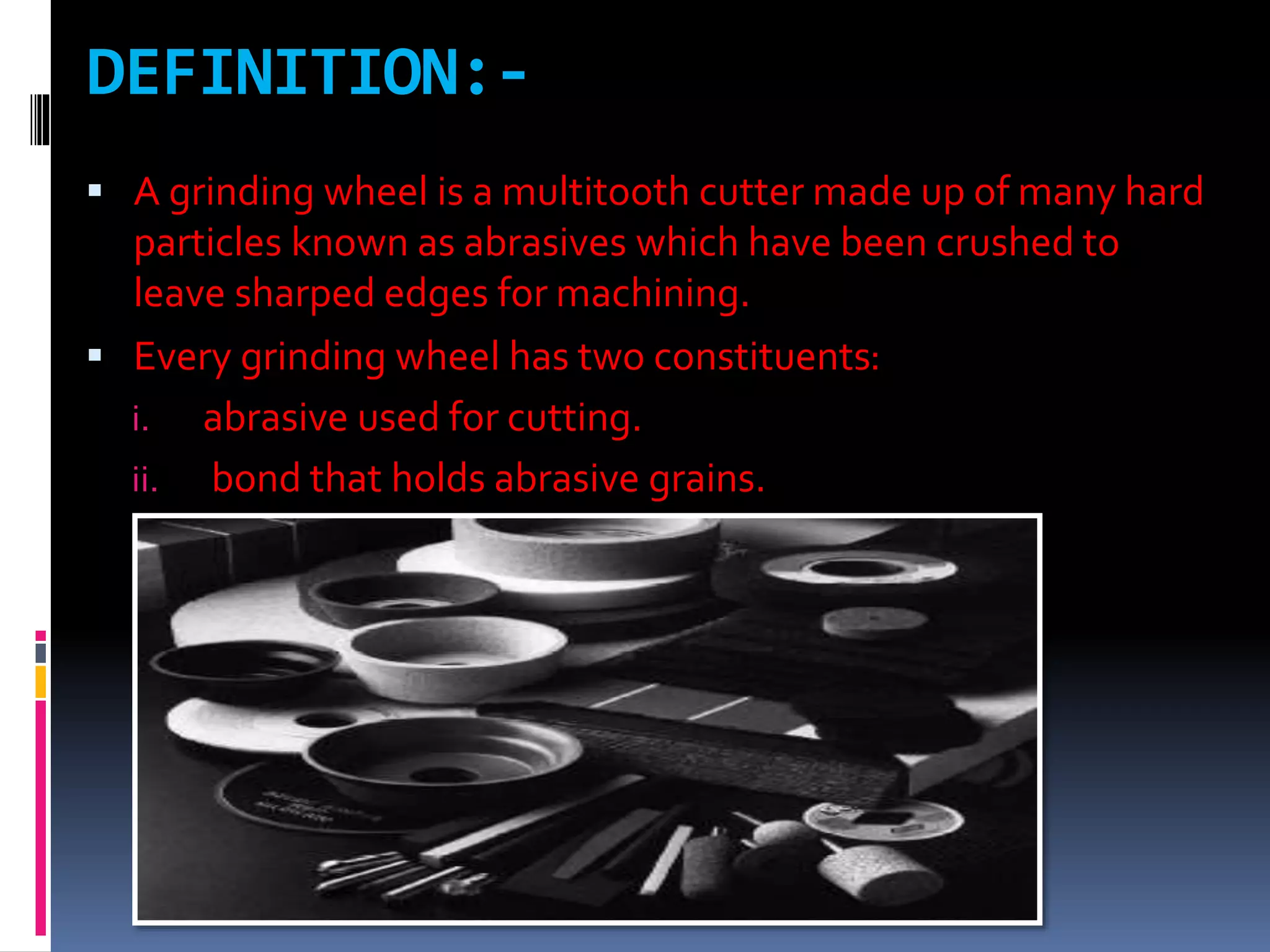
 A grinding wheel is a multitooth cutter made up of many hard 
particles known as abrasives which have been crushed to 
leave sharped edges for machining. 
 Every grinding wheel has two constituents: 
i. abrasive used for cutting. 
ii. bond that holds abrasive grains.
BASIC FUNCTIONS OF A 
GRINDING WHEEL:- 
1. Removal of stock 
2. Generation of cylindrical, flat and curved surfaces 
3. Production of highly finished surfaces 
4. Cutting off operations 
5. Production of sharp edges and points.
CONSTRUCTION OF GRINDING 
WHEEL:- 
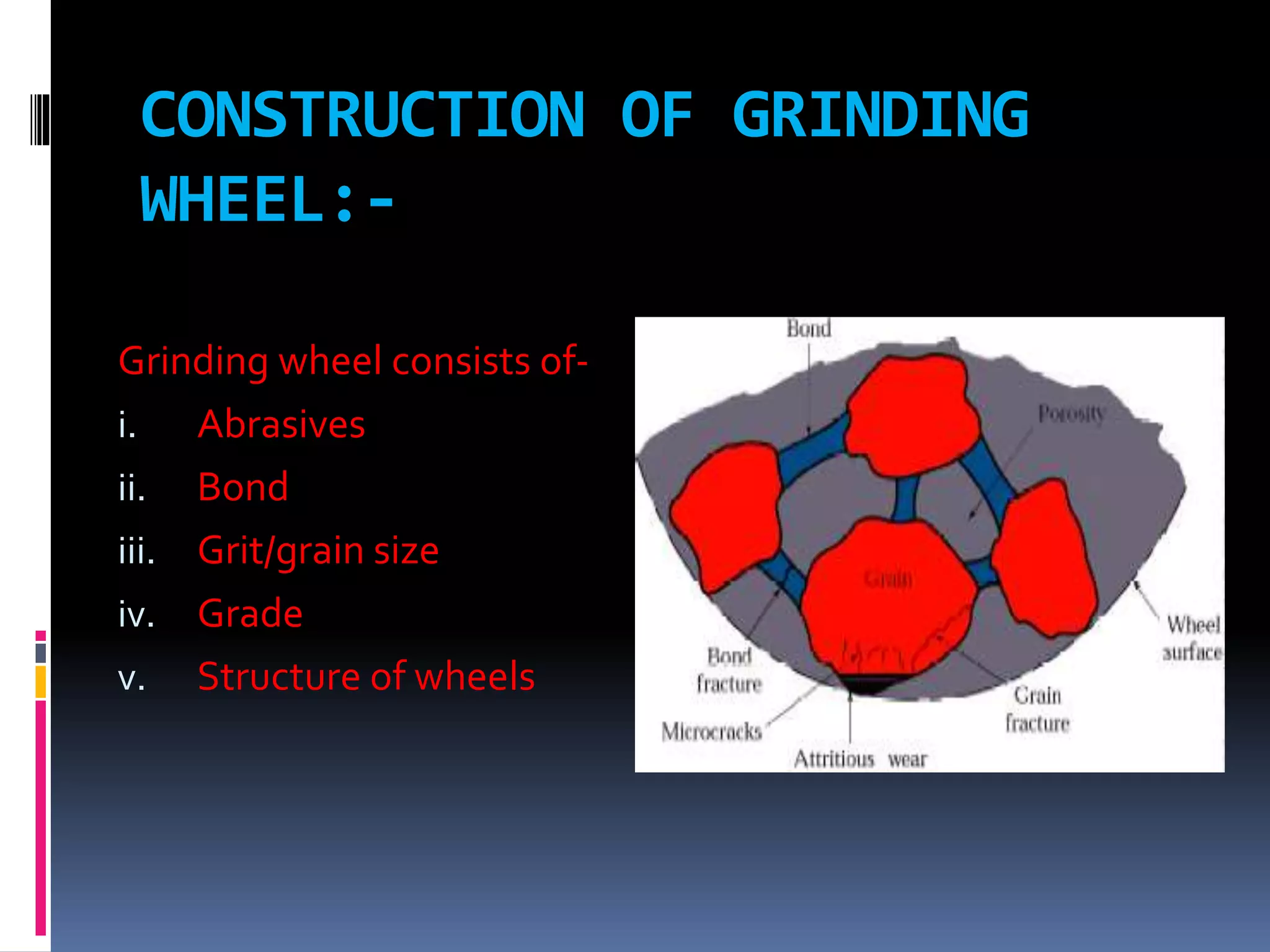
Grinding wheel consists of-i. 
Abrasives 
ii. Bond 
iii. Grit/grain size 
iv. Grade 
v. Structure of wheels
ABRASIVES:- 
 An abrasive is a hard and tough substance, having sharp 
edges. It cuts or wears away materials softer than itself. 
 Important properties of abrasives are penetration 
hardness, fracture resistance and wear resistance.
TYPES OF ABRASIVES:- 
 Natural abrasives- they are obtained from nature. 
Natural abrasives are sand stone, emergy/corundum, 
diamond and garnet. 
 Artificial/synthetic abrasives- they are manufactured to 
have well defined and controlled properties of hardness, 
roughness and type of structure. Artificial o synthetic 
abrasives are silicon carbide(SiC), aluminium 
oxide(Al2O3)
BOND:- 
 The bond is an adhesive substance which cements or 
holds the abrasive grains together to form a grinding 
wheel. 
 Depending upon the application, bond imparts the 
qualities of hardness or softness to the grinding wheel. 
 The choice or selection of the bond depends upon the 
accuracy, the required surface finish and the nature of 
grinding operation.
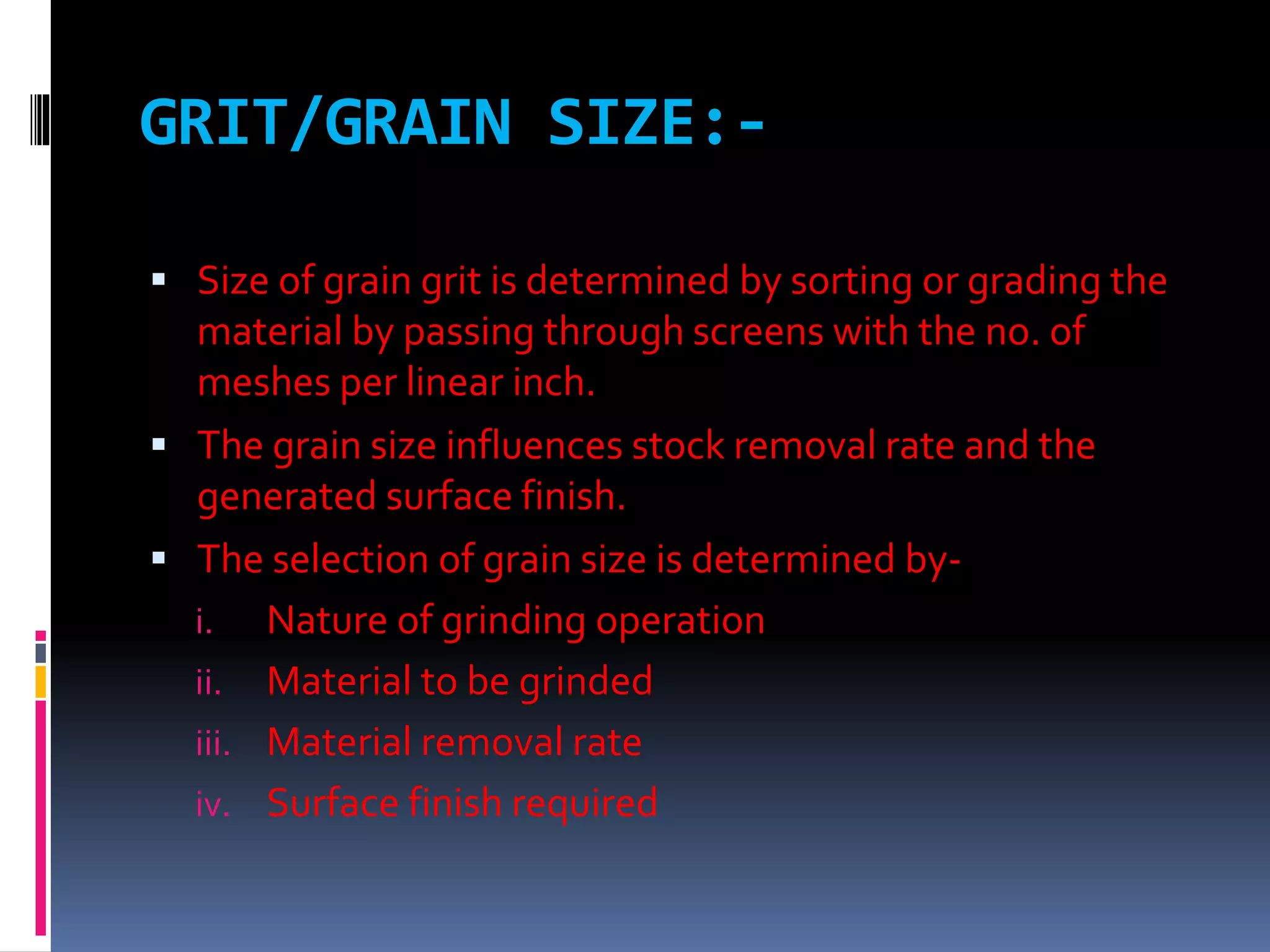
GRIT/GRAIN SIZE:- 
 Size of grain grit is determined by sorting or grading the 
material by passing through screens with the no. of 
meshes per linear inch. 
 The grain size influences stock removal rate and the 
generated surface finish. 
 The selection of grain size is determined by-i. 
Nature of grinding operation 
ii. Material to be grinded 
iii. Material removal rate 
iv. Surface finish required
SR. NO. SIZE TYPE APPLICATIONS 
1. 10,12,14,16,20,24 Coarse Rapid material removal 
2. 30,36,46,54,60 Medium Stock removal and finish 
both 
3. 80,100,120,150,180 Fine Less stock removal, high 
surface finish 
4. 220,240,280,320,400,500, 
600 
Very fine Very high surface finish, 
grinding hard materials
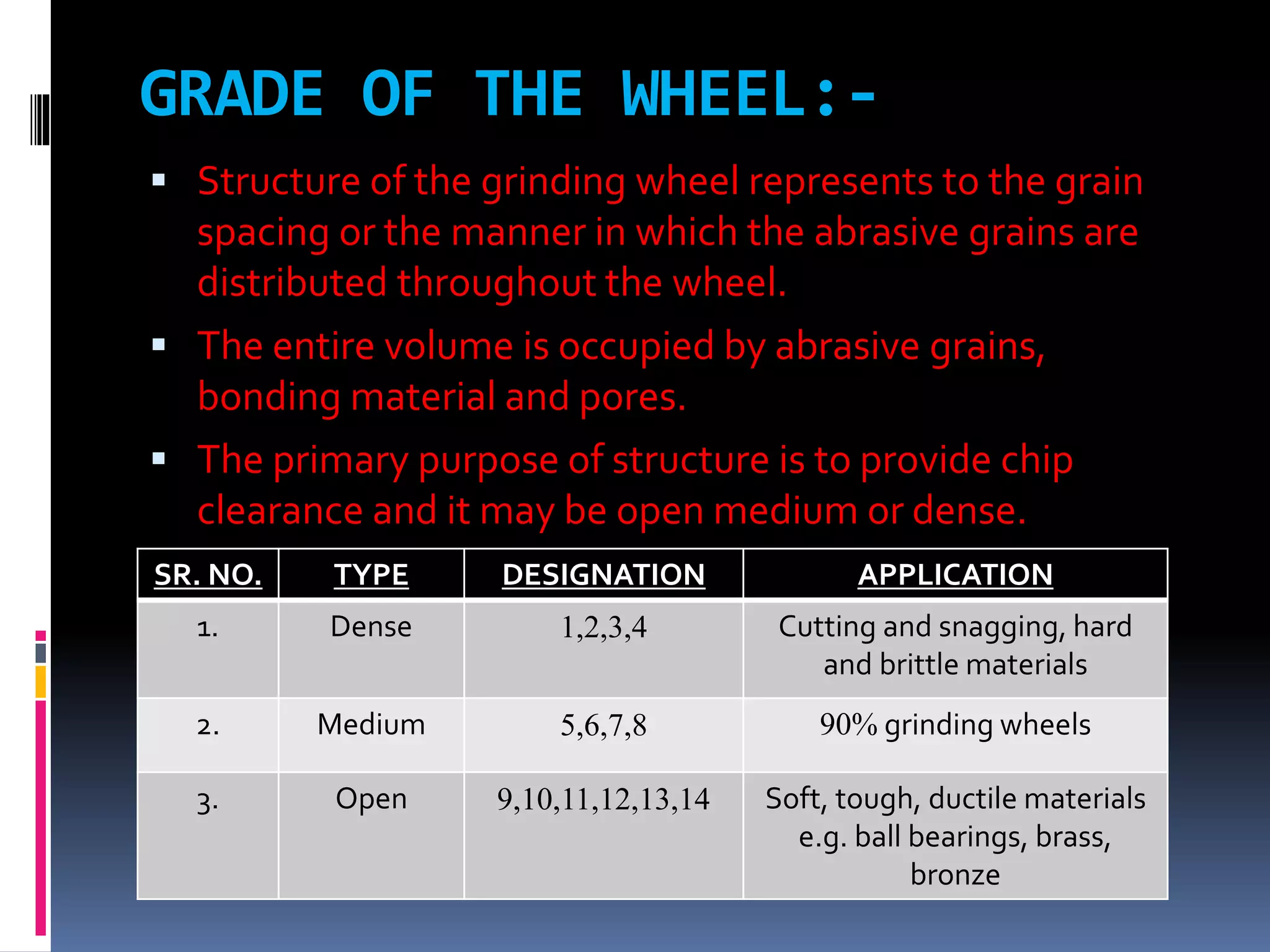
GRADE OF THE WHEEL:- 
 Structure of the grinding wheel represents to the grain 
spacing or the manner in which the abrasive grains are 
distributed throughout the wheel. 
 The entire volume is occupied by abrasive grains, 
bonding material and pores. 
 The primary purpose of structure is to provide chip 
clearance and it may be open medium or dense. 
SR. NO. TYPE DESIGNATION APPLICATION 
1. Dense 1,2,3,4 Cutting and snagging, hard 
and brittle materials 
2. Medium 5,6,7,8 90% grinding wheels 
3. Open 9,10,11,12,13,14 Soft, tough, ductile materials 
e.g. ball bearings, brass, 
bronze
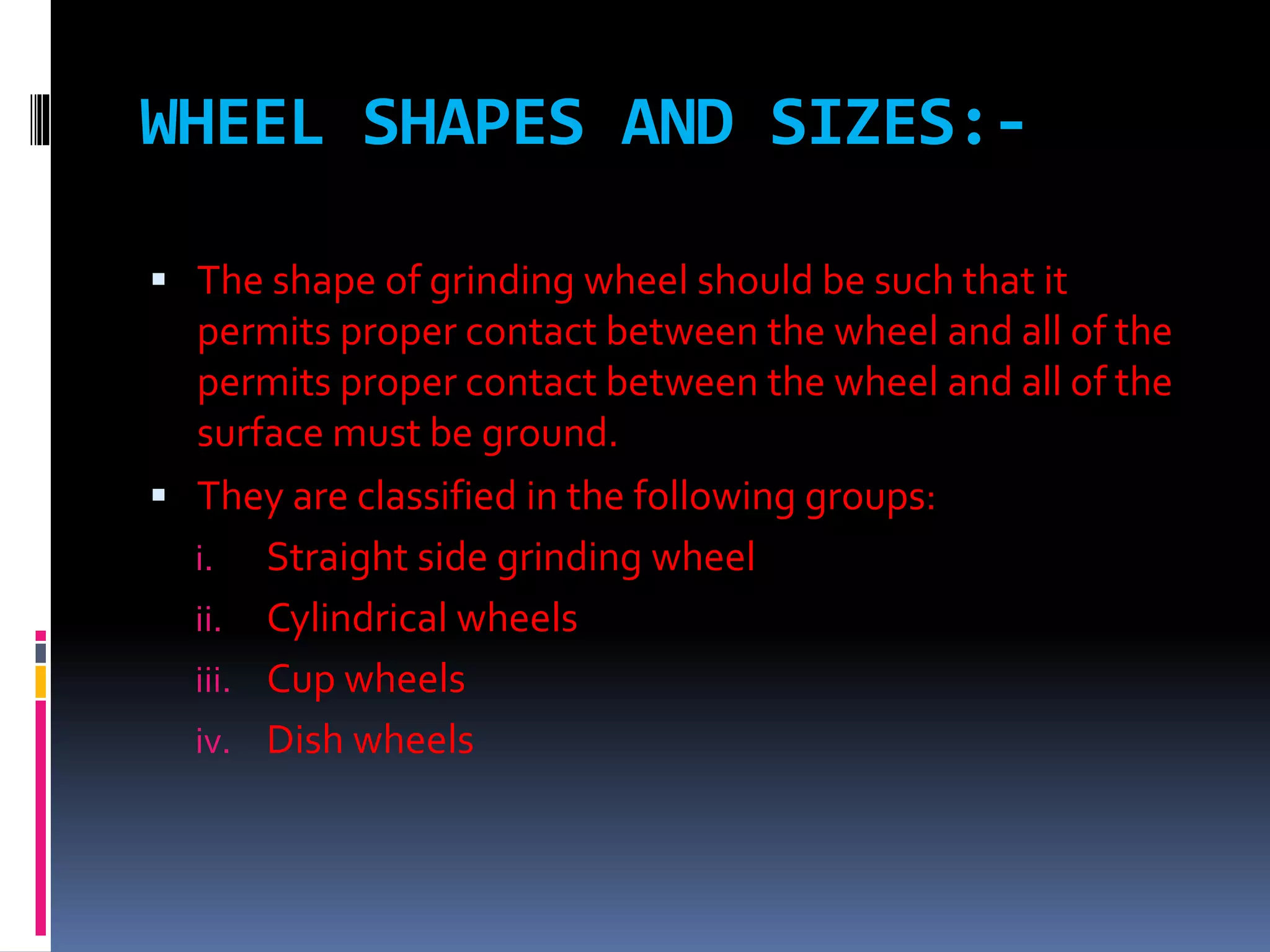
WHEEL SHAPES AND SIZES:- 
 The shape of grinding wheel should be such that it 
permits proper contact between the wheel and all of the 
surface must be ground. 
 They are classified in the following groups: 
i. Straight side grinding wheel 
ii. Cylindrical wheels 
iii. Cup wheels 
iv. Dish wheels
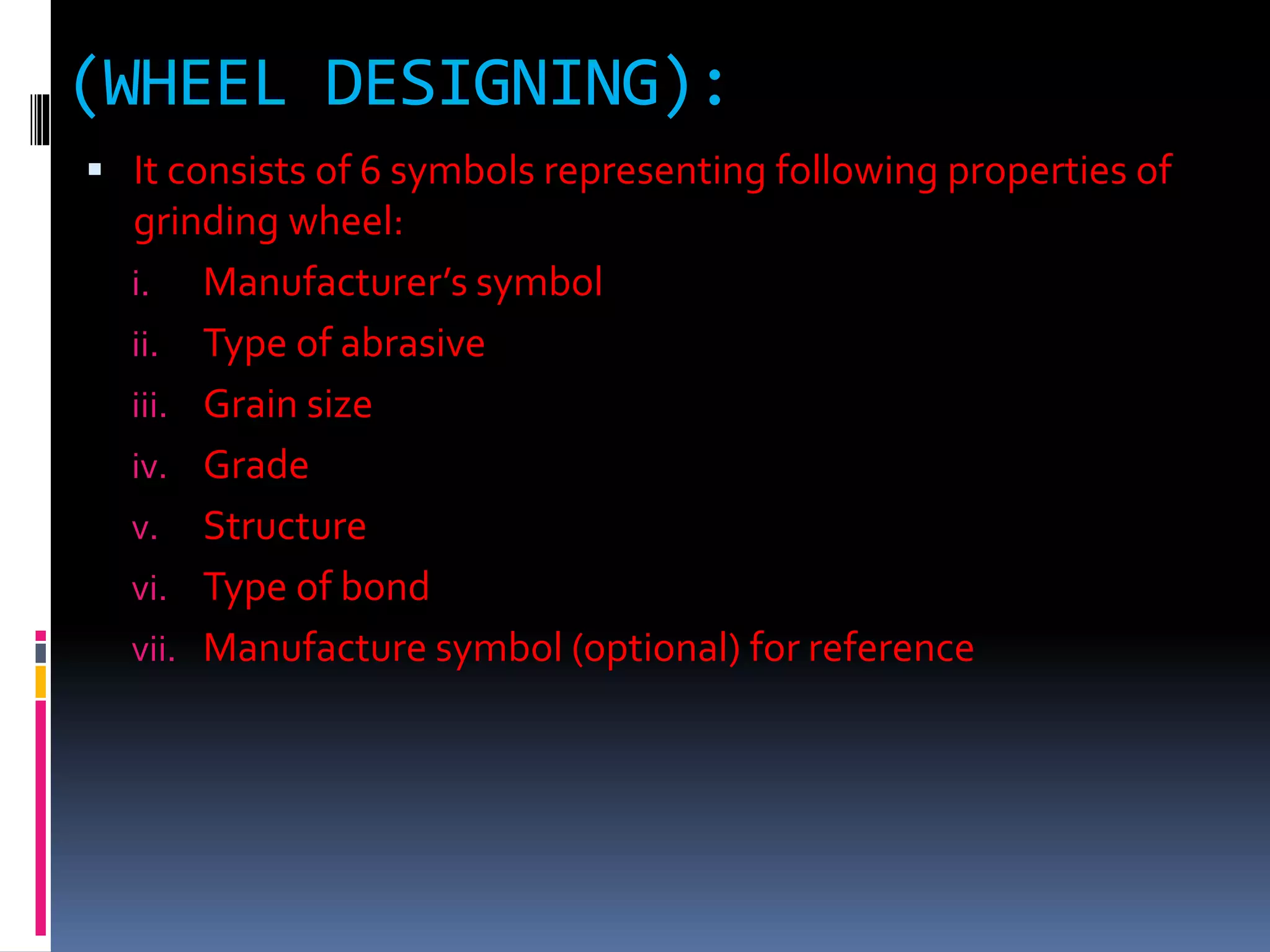
(WHEEL DESIGNING): 
 It consists of 6 symbols representing following properties of 
grinding wheel: 
i. Manufacturer’s symbol 
ii. Type of abrasive 
iii. Grain size 
iv. Grade 
v. Structure 
vi. Type of bond 
vii. Manufacture symbol (optional) for reference
Example of a wheel specification: 
51 A 36 L 5 V 40 
51 Manufacturer’s symbol indicating type of abrasive 
A Abrasive (aluminium oxide) 
36 Grain size(medium) 
L Grade(medium) 
5 Structure(dense) 
V Bond(vitrified) 
40 Manufacture symbol (suffix) optional
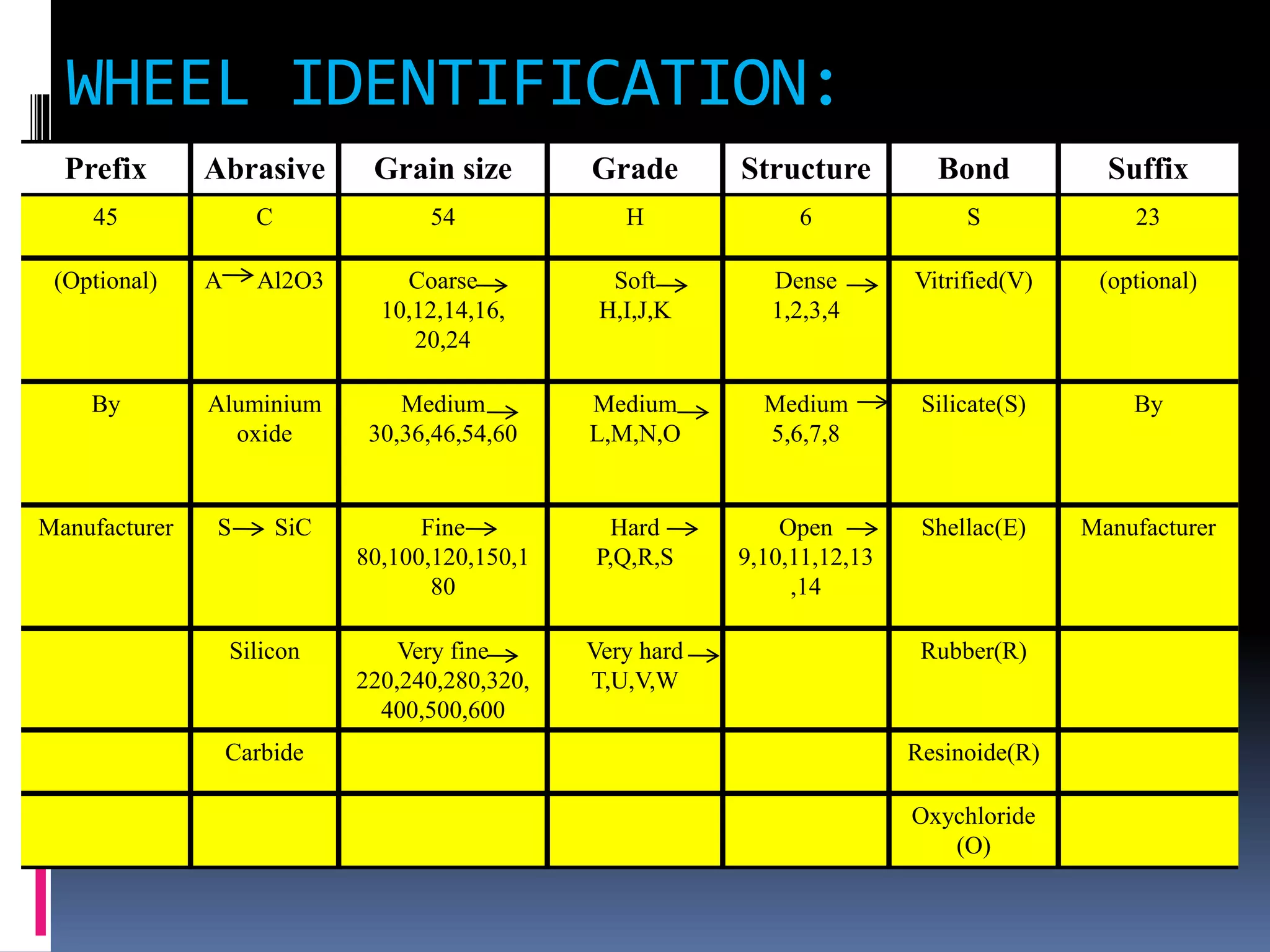
WHEEL IDENTIFICATION: 
Prefix Abrasive Grain size Grade Structure Bond Suffix 
45 C 54 H 6 S 23 
(Optional) A Al2O3 Coarse 
10,12,14,16, 
20,24 
Soft 
H,I,J,K 
Dense 
1,2,3,4 
Vitrified(V) (optional) 
By Aluminium 
oxide 
Medium 
30,36,46,54,60 
Medium 
L,M,N,O 
Medium 
5,6,7,8 
Silicate(S) By 
Manufacturer S SiC Fine 
80,100,120,150,1 
80 
Hard 
P,Q,R,S 
Open 
9,10,11,12,13 
,14 
Shellac(E) Manufacturer 
Silicon Very fine 
220,240,280,320, 
400,500,600 
Very hard 
T,U,V,W 
Rubber(R) 
Carbide Resinoide(R) 
Oxychloride 
(O)
GRINDING WHEEL SPECIFICATIONS

GRINDING WHEEL SPECIFICATIONS

  • 1.
    GRINDING WHEEL SPECIFICATONS PRESENTATION BY:- YASHRAJ V. PATIL
  • 2.
    DEFINITION:-  Agrinding wheel is a multitooth cutter made up of many hard particles known as abrasives which have been crushed to leave sharped edges for machining.  Every grinding wheel has two constituents: i. abrasive used for cutting. ii. bond that holds abrasive grains.
  • 3.
    BASIC FUNCTIONS OFA GRINDING WHEEL:- 1. Removal of stock 2. Generation of cylindrical, flat and curved surfaces 3. Production of highly finished surfaces 4. Cutting off operations 5. Production of sharp edges and points.
  • 4.
    CONSTRUCTION OF GRINDING WHEEL:- Grinding wheel consists of-i. Abrasives ii. Bond iii. Grit/grain size iv. Grade v. Structure of wheels
  • 5.
    ABRASIVES:-  Anabrasive is a hard and tough substance, having sharp edges. It cuts or wears away materials softer than itself.  Important properties of abrasives are penetration hardness, fracture resistance and wear resistance.
  • 6.
    TYPES OF ABRASIVES:-  Natural abrasives- they are obtained from nature. Natural abrasives are sand stone, emergy/corundum, diamond and garnet.  Artificial/synthetic abrasives- they are manufactured to have well defined and controlled properties of hardness, roughness and type of structure. Artificial o synthetic abrasives are silicon carbide(SiC), aluminium oxide(Al2O3)
  • 7.
    BOND:-  Thebond is an adhesive substance which cements or holds the abrasive grains together to form a grinding wheel.  Depending upon the application, bond imparts the qualities of hardness or softness to the grinding wheel.  The choice or selection of the bond depends upon the accuracy, the required surface finish and the nature of grinding operation.
  • 9.
    GRIT/GRAIN SIZE:- Size of grain grit is determined by sorting or grading the material by passing through screens with the no. of meshes per linear inch.  The grain size influences stock removal rate and the generated surface finish.  The selection of grain size is determined by-i. Nature of grinding operation ii. Material to be grinded iii. Material removal rate iv. Surface finish required
  • 10.
    SR. NO. SIZETYPE APPLICATIONS 1. 10,12,14,16,20,24 Coarse Rapid material removal 2. 30,36,46,54,60 Medium Stock removal and finish both 3. 80,100,120,150,180 Fine Less stock removal, high surface finish 4. 220,240,280,320,400,500, 600 Very fine Very high surface finish, grinding hard materials
  • 11.
    GRADE OF THEWHEEL:-  Structure of the grinding wheel represents to the grain spacing or the manner in which the abrasive grains are distributed throughout the wheel.  The entire volume is occupied by abrasive grains, bonding material and pores.  The primary purpose of structure is to provide chip clearance and it may be open medium or dense. SR. NO. TYPE DESIGNATION APPLICATION 1. Dense 1,2,3,4 Cutting and snagging, hard and brittle materials 2. Medium 5,6,7,8 90% grinding wheels 3. Open 9,10,11,12,13,14 Soft, tough, ductile materials e.g. ball bearings, brass, bronze
  • 12.
    WHEEL SHAPES ANDSIZES:-  The shape of grinding wheel should be such that it permits proper contact between the wheel and all of the permits proper contact between the wheel and all of the surface must be ground.  They are classified in the following groups: i. Straight side grinding wheel ii. Cylindrical wheels iii. Cup wheels iv. Dish wheels
  • 14.
    (WHEEL DESIGNING): It consists of 6 symbols representing following properties of grinding wheel: i. Manufacturer’s symbol ii. Type of abrasive iii. Grain size iv. Grade v. Structure vi. Type of bond vii. Manufacture symbol (optional) for reference
  • 15.
    Example of awheel specification: 51 A 36 L 5 V 40 51 Manufacturer’s symbol indicating type of abrasive A Abrasive (aluminium oxide) 36 Grain size(medium) L Grade(medium) 5 Structure(dense) V Bond(vitrified) 40 Manufacture symbol (suffix) optional
  • 16.
    WHEEL IDENTIFICATION: PrefixAbrasive Grain size Grade Structure Bond Suffix 45 C 54 H 6 S 23 (Optional) A Al2O3 Coarse 10,12,14,16, 20,24 Soft H,I,J,K Dense 1,2,3,4 Vitrified(V) (optional) By Aluminium oxide Medium 30,36,46,54,60 Medium L,M,N,O Medium 5,6,7,8 Silicate(S) By Manufacturer S SiC Fine 80,100,120,150,1 80 Hard P,Q,R,S Open 9,10,11,12,13 ,14 Shellac(E) Manufacturer Silicon Very fine 220,240,280,320, 400,500,600 Very hard T,U,V,W Rubber(R) Carbide Resinoide(R) Oxychloride (O)