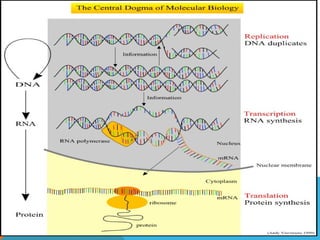
DNA
M
ICROARRAY:
A
RECOM
BINANT DNA
M
ETHOD
Array - is an orderly arrangement of samples where
matching of known and unknown samples is done.
Microarray: A microarray is a multiplex lab-on-a-chip. It is
a 2D array on a solid substrate (glass slide or silicon thin-
film cell) It assays large amounts of biological material and
allows parallel molecular profiling of clinical samples at the
DNA, RNA, and protein level.
History
 The concept and methodology of microarrays was first
illustrated in antibody microarrays by Tse Wen Chang
in 1983
 Multi-tumor tissue block" in 1986 by H.Battifora
 Originally used in the Brown Laboratory at Stanford
University in late 1990s
 Steadily developed since Patrick Brown and his
colleagues first published their work in 1995
Need For Microarrays
 Conventional investigation of tissues was labour intensive,
too expensive and time consuming to be applied to the
characterisation of hundreds or thousands of genes or
gene clusters associated with distinct tumour entities or
other diseases.
 Thus, there was a need for techniques that could facilitate
research on
• large series of tissues
• in parallel
• in a single experiment
DNA Microarray
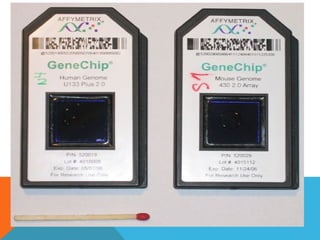
 DNA chip or Biochip or Gene chip.
 Analyze thousands of genes in one experiment
 commercially prepared small plates of glass (or silicon or
nylon) about 2 or 3 cm square, coated with probes
 is composed of pieces of DNA ranging from 20 to 5000
base pairs concentrated on specific areas.
Used to measure the expression levels of large numbers
of genes simultaneously or to genotype multiple regions of
a genome.
Each DNA spot contains picomoles of a specific DNA
sequence/ gene, known as probes. Each spot may
contain a few million copies of identical probe molecule.
Definitions:
Target -the nucleic acid (cDNA) sample who’s identity
and quantity are being measured.
Fluorophore –usually green and red labels attached to
the target to enable visualizing expression.
Microarray -works as reverse hybridization method
converting from mRNA to cDNA 3’-5’ with TTTT…end.
Probe–an attached nucleic acid with a known sequence
(the DNA chip).
Principle
 The core principle behind microarray is hybridization
between two DNA strands.
 Fluorescent labelled target sequences that bind to a probe
sequence generate a signal that depends on the strength
of the hybridization determined by the number of paired
bases.
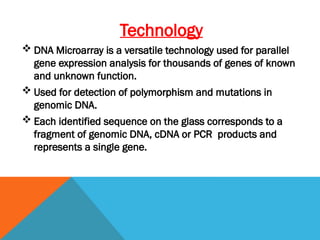
Technology
 DNA Microarray is a versatile technology used for parallel
gene expression analysis for thousands of genes of known
and unknown function.
 Used for detection of polymorphism and mutations in
genomic DNA.
 Each identified sequence on the glass corresponds to a
fragment of genomic DNA, cDNA or PCR products and
represents a single gene.
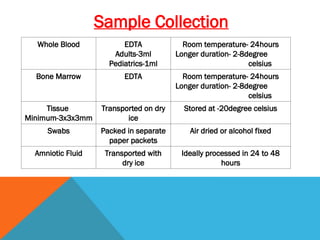
Sample Collection
Whole Blood EDTA
Adults-3ml
Pediatrics-1ml
Room temperature- 24hours
Longer duration- 2-8degree
celsius
Bone Marrow EDTA Room temperature- 24hours
Longer duration- 2-8degree
celsius
Tissue
Minimum-3x3x3mm
Transported on dry
ice
Stored at -20degree celsius
Swabs Packed in separate
paper packets
Air dried or alcohol fixed
Amniotic Fluid Transported with
dry ice
Ideally processed in 24 to 48
hours
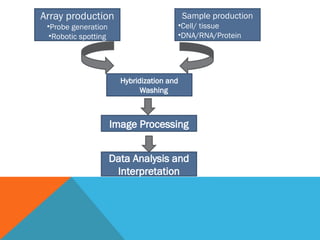
Array production
•Probe generation
•Robotic spotting
Sample production
•Cell/ tissue
•DNA/RNA/Protein
Hybridization and
Washing
Image Processing
Data Analysis and
Interpretation
ARRAY PRODUCTION
ARRAY PRODUCTION
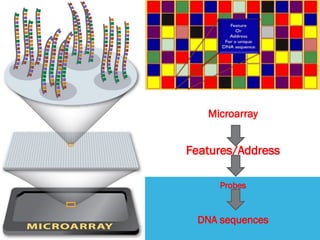
Microarray
Features/Address
Probes
DNA sequences
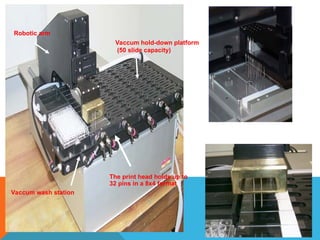
ARRAYING ROBOT
Vaccum wash station
The print head holds up to
32 pins in a 8x4 format
Vaccum hold-down platform
(50 slide capacity)
Robotic arm
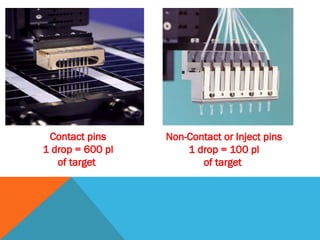
Contact pins
1 drop = 600 pl
of target
Non-Contact or Inject pins
1 drop = 100 pl
of target
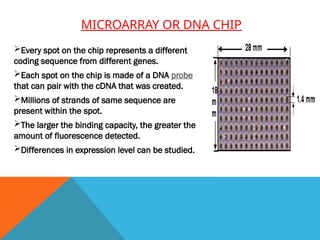
MICROARRAY OR DNA CHIP
Every spot on the chip represents a different
coding sequence from different genes.
Each spot on the chip is made of a DNA probe
that can pair with the cDNA that was created.
Millions of strands of same sequence are
present within the spot.
The larger the binding capacity, the greater the
amount of fluorescence detected.
Differences in expression level can be studied.
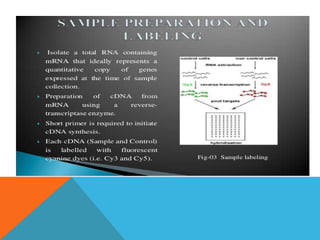
SAMPLE PROCESSING
SAMPLE PROCESSING
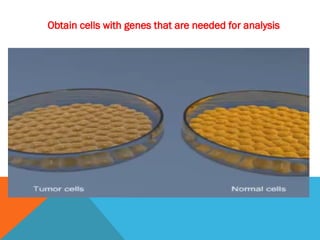
Obtain cells with genes that are needed for analysis
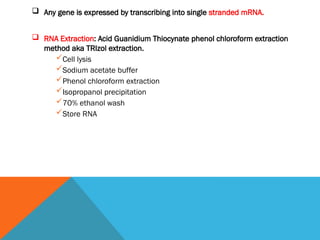
 Any gene is expressed by transcribing into single stranded mRNA.
 RNA Extraction: Acid Guanidium Thiocynate phenol chloroform extraction
method aka TRIzol extraction.
Cell lysis
Sodium acetate buffer
Phenol chloroform extraction
Isopropanol precipitation
70% ethanol wash
Store RNA
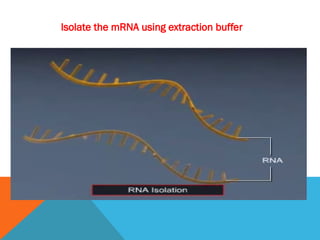
Isolate the mRNA using extraction buffer
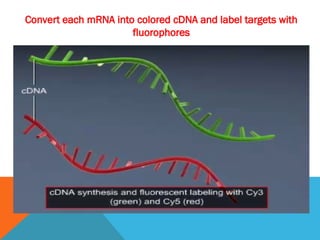
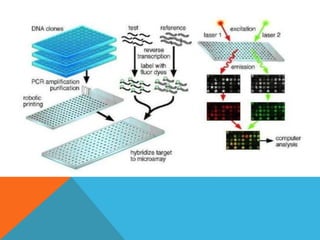
Convert each mRNA into colored cDNA and label targets with
fluorophores
HYBRIDIZATION
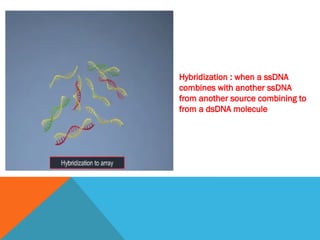
Hybridization : when a ssDNA
combines with another ssDNA
from another source combining to
from a dsDNA molecule
Hybridization
To combine the complementary subunits of macromolecule.
A sample volume of 50 to 500ul is sandwiched between a cover slip and
DNA Microarray.
Incubation for 16 to 19 hours
Washing : Removing the excess sample through buffer washes.
Slides are dried by centrifugation or airflow.
Image Processing
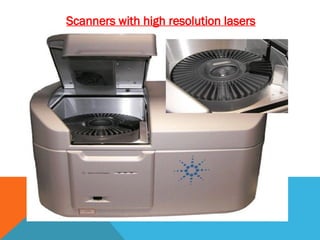
Scanning instrument
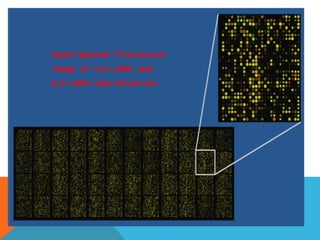
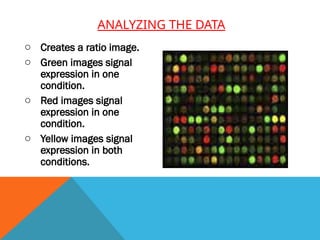
Spots will appear red to green to yellow (yellow for admixtures
of red and green fluorescence)
The slide with the microarray chip is placed inside a dark box
where it is scanned with a high resolution laser that detects the
bound fluorescent labels.
Scanners with high resolution lasers
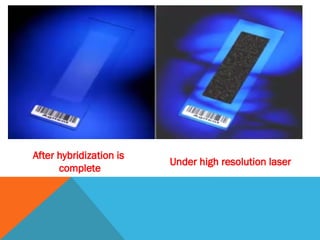
After hybridization is
complete
Under high resolution laser
Superimposed fluorescent
image of Cy3-cDNA and
Cy5-cDNA hybridization
ANALYZING THE DATA
o Creates a ratio image.
o Green images signal
expression in one
condition.
o Red images signal
expression in one
condition.
o Yellow images signal
expression in both
conditions.
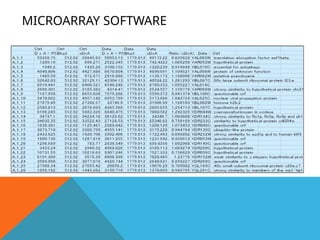
MICROARRAY SOFTWARE
MICROARRAY POTENTIAL APPLICATIONS
Biological discovery
 new and better molecular diagnostics
 new molecular targets for therapy
 Mutation and polymorphism detection
Recent examples
 molecular diagnosis of leukemia, breast cancer, ...
 appropriate treatment for genetic signature
 potential new drug targets
Measure differential gene expression
• Response to environmental factors e.g. treatment, cell
stimulation in-vitro, response to environmental factors, effect of
drugs after treatment
• Diseased vs. Normal tissues
• Profiling tumors
• Gene regulation during development
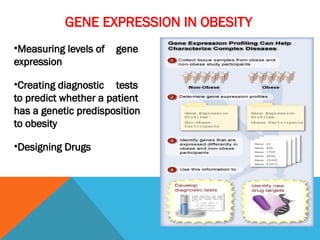
GENE EXPRESSION IN OBESITY
•Measuring levels of gene
expression
•Creating diagnostic tests
to predict whether a patient
has a genetic predisposition
to obesity
•Designing Drugs
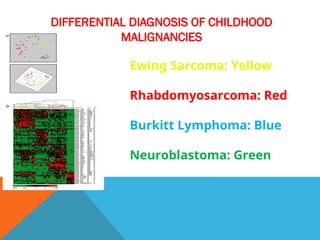
DIFFERENTIAL DIAGNOSIS OF CHILDHOOD
MALIGNANCIES
Ewing Sarcoma: Yellow
Rhabdomyosarcoma: Red
Burkitt Lymphoma: Blue
Neuroblastoma: Green
MICROARRAY LIMITATIONS
RESOURCES:
1. Schena, M., Shalon, D., Heller, R., Chai, A., Brown, P.O. & Davis, R.O. (1996) Parallel
human genome analysis: Microarray-based expression monitoring of 1000 genes. Proc.
Natl. Acad. Sci. U.S.A. 93, 10614-10619. MEDLINE
2. Lipshutz, R.J., Fodor, S.P.A., Gingeras, T.R. & Lockhart, D.J. (1999) High density
synthetic oligonucleotide arrays. Nat. Genet. 21, 20-24. MEDLINE
3. Lowe David, Underwood James; Recent Advances in Histopathology:The Royal society
of medicine press;2004
4. Nazar M.T. Jawhar; Tissue Microarray: A rapidly evolving diagnostic and research
tool;Ann Saudi Med. 2009 Mar-Apr; 29(2): 123–127
5. Simon R1, Mirlacher M, Sauter G.;Immunohistochemical analysis of tissue microarrays;
Methods Mol Biol.2010;664:113-26
6. Rashmil Saxena, BFA Sunil Badve; Tissue Microarray – Construction and Quality
Assurance, Part II: The Potentials and Pitfalls


DNA Microarray , its applications, principle

  • 1.
  • 3.
    Array - isan orderly arrangement of samples where matching of known and unknown samples is done. Microarray: A microarray is a multiplex lab-on-a-chip. It is a 2D array on a solid substrate (glass slide or silicon thin- film cell) It assays large amounts of biological material and allows parallel molecular profiling of clinical samples at the DNA, RNA, and protein level.
  • 4.
    History  The conceptand methodology of microarrays was first illustrated in antibody microarrays by Tse Wen Chang in 1983  Multi-tumor tissue block" in 1986 by H.Battifora  Originally used in the Brown Laboratory at Stanford University in late 1990s  Steadily developed since Patrick Brown and his colleagues first published their work in 1995
  • 5.
    Need For Microarrays Conventional investigation of tissues was labour intensive, too expensive and time consuming to be applied to the characterisation of hundreds or thousands of genes or gene clusters associated with distinct tumour entities or other diseases.  Thus, there was a need for techniques that could facilitate research on • large series of tissues • in parallel • in a single experiment
  • 6.
    DNA Microarray  DNAchip or Biochip or Gene chip.  Analyze thousands of genes in one experiment  commercially prepared small plates of glass (or silicon or nylon) about 2 or 3 cm square, coated with probes  is composed of pieces of DNA ranging from 20 to 5000 base pairs concentrated on specific areas.
  • 7.
    Used to measurethe expression levels of large numbers of genes simultaneously or to genotype multiple regions of a genome. Each DNA spot contains picomoles of a specific DNA sequence/ gene, known as probes. Each spot may contain a few million copies of identical probe molecule.
  • 8.
    Definitions: Target -the nucleicacid (cDNA) sample who’s identity and quantity are being measured. Fluorophore –usually green and red labels attached to the target to enable visualizing expression. Microarray -works as reverse hybridization method converting from mRNA to cDNA 3’-5’ with TTTT…end. Probe–an attached nucleic acid with a known sequence (the DNA chip).
  • 9.
    Principle  The coreprinciple behind microarray is hybridization between two DNA strands.  Fluorescent labelled target sequences that bind to a probe sequence generate a signal that depends on the strength of the hybridization determined by the number of paired bases.
  • 10.
    Technology  DNA Microarrayis a versatile technology used for parallel gene expression analysis for thousands of genes of known and unknown function.  Used for detection of polymorphism and mutations in genomic DNA.  Each identified sequence on the glass corresponds to a fragment of genomic DNA, cDNA or PCR products and represents a single gene.
  • 11.
    Sample Collection Whole BloodEDTA Adults-3ml Pediatrics-1ml Room temperature- 24hours Longer duration- 2-8degree celsius Bone Marrow EDTA Room temperature- 24hours Longer duration- 2-8degree celsius Tissue Minimum-3x3x3mm Transported on dry ice Stored at -20degree celsius Swabs Packed in separate paper packets Air dried or alcohol fixed Amniotic Fluid Transported with dry ice Ideally processed in 24 to 48 hours
  • 12.
    Array production •Probe generation •Roboticspotting Sample production •Cell/ tissue •DNA/RNA/Protein Hybridization and Washing Image Processing Data Analysis and Interpretation
  • 13.
  • 15.
  • 16.
    ARRAYING ROBOT Vaccum washstation The print head holds up to 32 pins in a 8x4 format Vaccum hold-down platform (50 slide capacity) Robotic arm
  • 17.
    Contact pins 1 drop= 600 pl of target Non-Contact or Inject pins 1 drop = 100 pl of target
  • 18.
    MICROARRAY OR DNACHIP Every spot on the chip represents a different coding sequence from different genes. Each spot on the chip is made of a DNA probe that can pair with the cDNA that was created. Millions of strands of same sequence are present within the spot. The larger the binding capacity, the greater the amount of fluorescence detected. Differences in expression level can be studied.
  • 19.
  • 21.
    Obtain cells withgenes that are needed for analysis
  • 22.
     Any geneis expressed by transcribing into single stranded mRNA.  RNA Extraction: Acid Guanidium Thiocynate phenol chloroform extraction method aka TRIzol extraction. Cell lysis Sodium acetate buffer Phenol chloroform extraction Isopropanol precipitation 70% ethanol wash Store RNA
  • 23.
    Isolate the mRNAusing extraction buffer
  • 24.
    Convert each mRNAinto colored cDNA and label targets with fluorophores
  • 25.
  • 26.
    Hybridization : whena ssDNA combines with another ssDNA from another source combining to from a dsDNA molecule
  • 27.
    Hybridization To combine thecomplementary subunits of macromolecule. A sample volume of 50 to 500ul is sandwiched between a cover slip and DNA Microarray. Incubation for 16 to 19 hours Washing : Removing the excess sample through buffer washes. Slides are dried by centrifugation or airflow.
  • 29.
    Image Processing Scanning instrument Spotswill appear red to green to yellow (yellow for admixtures of red and green fluorescence) The slide with the microarray chip is placed inside a dark box where it is scanned with a high resolution laser that detects the bound fluorescent labels.
  • 30.
    Scanners with highresolution lasers
  • 31.
  • 32.
    Superimposed fluorescent image ofCy3-cDNA and Cy5-cDNA hybridization
  • 33.
    ANALYZING THE DATA oCreates a ratio image. o Green images signal expression in one condition. o Red images signal expression in one condition. o Yellow images signal expression in both conditions.
  • 34.
  • 35.
    MICROARRAY POTENTIAL APPLICATIONS Biologicaldiscovery  new and better molecular diagnostics  new molecular targets for therapy  Mutation and polymorphism detection Recent examples  molecular diagnosis of leukemia, breast cancer, ...  appropriate treatment for genetic signature  potential new drug targets
  • 36.
    Measure differential geneexpression • Response to environmental factors e.g. treatment, cell stimulation in-vitro, response to environmental factors, effect of drugs after treatment • Diseased vs. Normal tissues • Profiling tumors • Gene regulation during development
  • 37.
    GENE EXPRESSION INOBESITY •Measuring levels of gene expression •Creating diagnostic tests to predict whether a patient has a genetic predisposition to obesity •Designing Drugs
  • 38.
    DIFFERENTIAL DIAGNOSIS OFCHILDHOOD MALIGNANCIES Ewing Sarcoma: Yellow Rhabdomyosarcoma: Red Burkitt Lymphoma: Blue Neuroblastoma: Green
  • 39.
  • 40.
    RESOURCES: 1. Schena, M.,Shalon, D., Heller, R., Chai, A., Brown, P.O. & Davis, R.O. (1996) Parallel human genome analysis: Microarray-based expression monitoring of 1000 genes. Proc. Natl. Acad. Sci. U.S.A. 93, 10614-10619. MEDLINE 2. Lipshutz, R.J., Fodor, S.P.A., Gingeras, T.R. & Lockhart, D.J. (1999) High density synthetic oligonucleotide arrays. Nat. Genet. 21, 20-24. MEDLINE 3. Lowe David, Underwood James; Recent Advances in Histopathology:The Royal society of medicine press;2004 4. Nazar M.T. Jawhar; Tissue Microarray: A rapidly evolving diagnostic and research tool;Ann Saudi Med. 2009 Mar-Apr; 29(2): 123–127 5. Simon R1, Mirlacher M, Sauter G.;Immunohistochemical analysis of tissue microarrays; Methods Mol Biol.2010;664:113-26 6. Rashmil Saxena, BFA Sunil Badve; Tissue Microarray – Construction and Quality Assurance, Part II: The Potentials and Pitfalls