Adeno –associated Virus
BY
A.MANOJ KUMAR
Adeno-associated virus
• It was first discovered as a contaminant in an
adenoviral isolate in 1965.
• It is a small, non-enveloped virus packaging a linear single
stranded DNA belonging to Parvovirus family.
• It is naturally replication defective thus requiring a helper
virus (usually adenovirus or herpes virus) for productive
infection.
• In human cells, the provirus integrates predominantly into a
4-kb region (AAVS1) on chromosome19. Subsequent infection
by adenovirus or herpes virus can ‘rescue’ the provirus and
induce lytic infection.
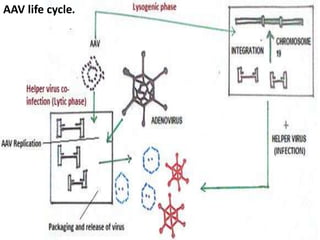
AAV life cycle.
AAV life cycle
• AAV life cycle comprises two phases-lytic and lysogeny.
• In the presence of helper virus, AAV undergoes lytic phase
comprising genome replication, expression of viral genes and
production of virions .
• In the absence of helper virus, it undergoes lysogenic phase
and integrates into the host cell’s genome as a latent provirus.
This latent genome undergoes replication by subsequent
infection with helper virus.
• Both the stages of life cycle of AAV are controlled by
complex interactions between the AAV genome and helper
virus, AAV and host proteins.
Adeno-associated viral genome
The AAV genome is small (about 5 kb) and comprises a
central region containing rep (replicase) and cap (capsid)
genes flanked by 145 base inverted terminal repeats (ITRs).
The rep gene is involved in viral replication and
integration whereas cap gene encodes viral capsid proteins.
ITRs are required for replication, transcription, proviral
integration and rescue.
In earlier AAV vectors, foreign DNA replaced the cap region
and was expressed under the control of an endogenous AAV promoter.
The transgene expression was inefficient using heterologous promoters
due to inhibition of their activity by Rep protein.
Rep interference with endogenous promoters resulted in
cytotoxic effects of the virus. To overcome the above limitations, such
vectors in which both genes were deleted and the transgene was
expressed from either an endogenous or a heterologous promoter, were
developed.
In vitro manipulation of AAV is facilitated by cloning the
inverted terminal repeats in a plasmid vector and inserting the
transgene between them. Transfection of this construct into cells along
with a helper plasmid produced recombinant viral particles.
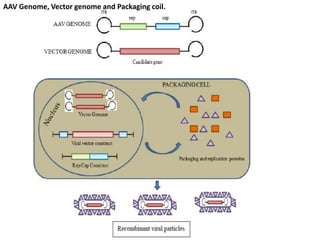
AAV Genome, Vector genome and Packaging coil.
Recombinant AAV (rAAV) is used as an expression
cassette containing a reporter or candidate gene of interest.
The foreign gene replaces all of the viral genes
present in a wild type virus.
Only the inverted terminal repeats are left to
function as the essential replication/packaging signal.
Recombinant AAV (rAAV) is used as an expression
cassette containing a reporter or candidate gene of
interest.
The foreign gene replaces all of the viral genes
present in a wild type virus.
Only the inverted terminal repeats are left to
function as the essential replication/packaging signal.
Advantages
• Stable and have a wide host range
• Lack of initiating an immune response
• The dependence of AAV on a heterologous
helper virus provides higher control over vector replication,
making AAV vectors safer for use in gene therapy
• Potential of targeted/site-specific integration
• Non-pathogenic
Disadvantages
• AAV uses concatemeric replication intermediates
• They must be closely screened as they are often
contaminated with adenovirus or Herpes Virus.
• Insert size is limited (4Kb)
• Difficult generation of high virus titres
THANK YOU...

Adeno-associated vector

  • 1.
  • 2.
    Adeno-associated virus • Itwas first discovered as a contaminant in an adenoviral isolate in 1965. • It is a small, non-enveloped virus packaging a linear single stranded DNA belonging to Parvovirus family. • It is naturally replication defective thus requiring a helper virus (usually adenovirus or herpes virus) for productive infection. • In human cells, the provirus integrates predominantly into a 4-kb region (AAVS1) on chromosome19. Subsequent infection by adenovirus or herpes virus can ‘rescue’ the provirus and induce lytic infection.
  • 3.
  • 4.
    AAV life cycle •AAV life cycle comprises two phases-lytic and lysogeny. • In the presence of helper virus, AAV undergoes lytic phase comprising genome replication, expression of viral genes and production of virions . • In the absence of helper virus, it undergoes lysogenic phase and integrates into the host cell’s genome as a latent provirus. This latent genome undergoes replication by subsequent infection with helper virus. • Both the stages of life cycle of AAV are controlled by complex interactions between the AAV genome and helper virus, AAV and host proteins.
  • 5.
    Adeno-associated viral genome TheAAV genome is small (about 5 kb) and comprises a central region containing rep (replicase) and cap (capsid) genes flanked by 145 base inverted terminal repeats (ITRs). The rep gene is involved in viral replication and integration whereas cap gene encodes viral capsid proteins. ITRs are required for replication, transcription, proviral integration and rescue.
  • 6.
    In earlier AAVvectors, foreign DNA replaced the cap region and was expressed under the control of an endogenous AAV promoter. The transgene expression was inefficient using heterologous promoters due to inhibition of their activity by Rep protein. Rep interference with endogenous promoters resulted in cytotoxic effects of the virus. To overcome the above limitations, such vectors in which both genes were deleted and the transgene was expressed from either an endogenous or a heterologous promoter, were developed. In vitro manipulation of AAV is facilitated by cloning the inverted terminal repeats in a plasmid vector and inserting the transgene between them. Transfection of this construct into cells along with a helper plasmid produced recombinant viral particles.
  • 7.
    AAV Genome, Vectorgenome and Packaging coil.
  • 8.
    Recombinant AAV (rAAV)is used as an expression cassette containing a reporter or candidate gene of interest. The foreign gene replaces all of the viral genes present in a wild type virus. Only the inverted terminal repeats are left to function as the essential replication/packaging signal.
  • 9.
    Recombinant AAV (rAAV)is used as an expression cassette containing a reporter or candidate gene of interest. The foreign gene replaces all of the viral genes present in a wild type virus. Only the inverted terminal repeats are left to function as the essential replication/packaging signal.
  • 10.
    Advantages • Stable andhave a wide host range • Lack of initiating an immune response • The dependence of AAV on a heterologous helper virus provides higher control over vector replication, making AAV vectors safer for use in gene therapy • Potential of targeted/site-specific integration • Non-pathogenic Disadvantages • AAV uses concatemeric replication intermediates • They must be closely screened as they are often contaminated with adenovirus or Herpes Virus. • Insert size is limited (4Kb) • Difficult generation of high virus titres
  • 11.