


MICROARRAY
PROFILING
Ujjwal sirohi
PhD scholar
SVPUAT@sirohiujjwal
Principle
Types
Steps involved
Applications
drawbacks
 DNA microarrays are solid supports,
usually of glass or silicon, upon which DNA
is attached in an organized grid fashion.
Each spot of DNA, called a probe,
represents a single gene.
 There are several synonyms of DNA
microarrays such as DNA chips, gene chips,
DNA arrays, gene arrays and biochips.
 The use of miniaturized microarrays for gene
expression profiling was first reported in 1995,
and a complete eukaryotic genome
(Saccharomyces cerevisiae) on a microarray
was published in 1997 by Pat Brown's group.
 the probe refers to the DNA sequence bound
to the solid-surface support in the microarray,
whereas the target is the unknown sequence
of interest.
principle
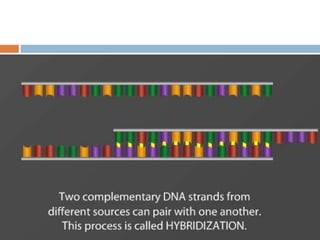
 Hybridization : The property of complementary
nucleic acid sequences is to specifically pair
with each other by forming hydrogen bonds
between complementary nucleotide base
pairs.
 Standard Watson-Crick base pairing (i.e. A-T,
G-C & A-U for DNA & RNA) between target
and the probe is the underlining principle of
DNA microarray.
types
 DNA microarrays, such as cDNA microarrays,
oligonucleotide microarrays, BAC microarrays and
SNP microarrays
 MMChips, for surveillance of microRNA populations
 Protein microarrays
 Peptide microarrays (for detailed analyses or
optimization of protein–protein interactions)
 Tissue microarrays
 Cellular microarrays (also called transfection
microarrays)
 Chemical compound microarrays
 Antibody microarrays
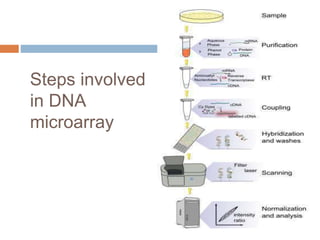
Steps involved
in DNA
microarray
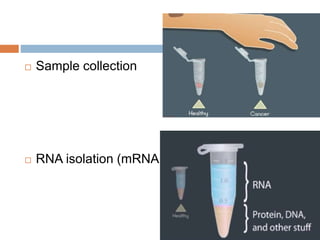
 Sample collection
 RNA isolation (mRNA)
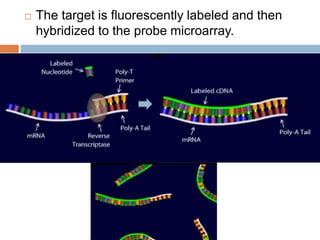
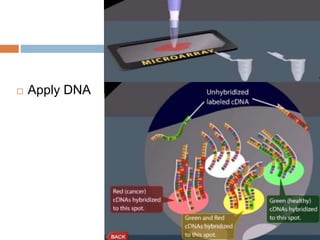
 The target is fluorescently labeled and then
hybridized to the probe microarray.
 Apply DNA
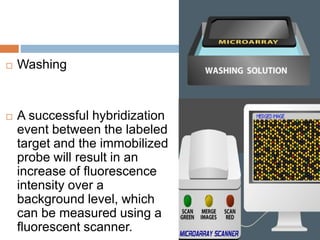
 Washing
 A successful hybridization
event between the labeled
target and the immobilized
probe will result in an
increase of fluorescence
intensity over a
background level, which
can be measured using a
fluorescent scanner.
signals
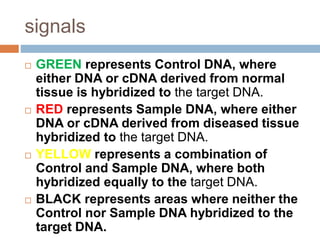
 GREEN represents Control DNA, where
either DNA or cDNA derived from normal
tissue is hybridized to the target DNA.
 RED represents Sample DNA, where either
DNA or cDNA derived from diseased tissue
hybridized to the target DNA.
 YELLOW represents a combination of
Control and Sample DNA, where both
hybridized equally to the target DNA.
 BLACK represents areas where neither the
Control nor Sample DNA hybridized to the
target DNA.
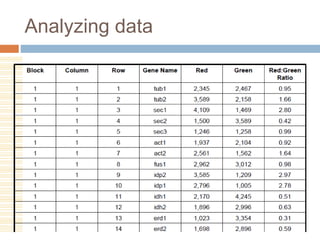
Analyzing data
Types of DNA microarray
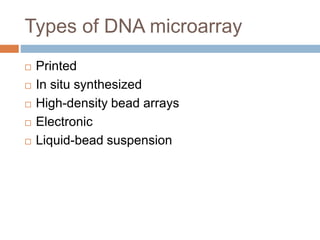
 Printed
 In situ synthesized
 High-density bead arrays
 Electronic
 Liquid-bead suspension
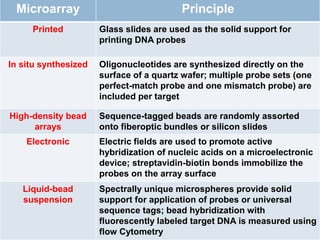
Microarray Principle
Printed Glass slides are used as the solid support for
printing DNA probes
In situ synthesized Oligonucleotides are synthesized directly on the
surface of a quartz wafer; multiple probe sets (one
perfect-match probe and one mismatch probe) are
included per target
High-density bead
arrays
Sequence-tagged beads are randomly assorted
onto fiberoptic bundles or silicon slides
Electronic Electric fields are used to promote active
hybridization of nucleic acids on a microelectronic
device; streptavidin-biotin bonds immobilize the
probes on the array surface
Liquid-bead
suspension
Spectrally unique microspheres provide solid
support for application of probes or universal
sequence tags; bead hybridization with
fluorescently labeled target DNA is measured using
flow Cytometry
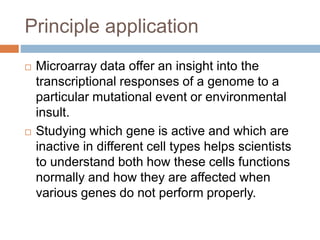
Principle application
 Microarray data offer an insight into the
transcriptional responses of a genome to a
particular mutational event or environmental
insult.
 Studying which gene is active and which are
inactive in different cell types helps scientists
to understand both how these cells functions
normally and how they are affected when
various genes do not perform properly.
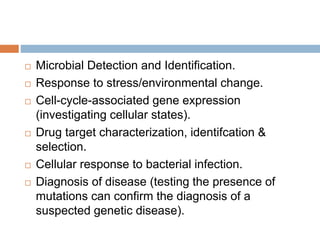
 Microbial Detection and Identification.
 Response to stress/environmental change.
 Cell-cycle-associated gene expression
(investigating cellular states).
 Drug target characterization, identifcation &
selection.
 Cellular response to bacterial infection.
 Diagnosis of disease (testing the presence of
mutations can confirm the diagnosis of a
suspected genetic disease).
drawbacks
 DNA probes generally have a high sensitivity but
suffer in specificity.
 21 to 34% of probes did not match the intended target
and/or were contaminated.
 decreased specificity can is disadvantageous when
trying to discriminate among highly similar target
sequences and unacceptable for clinical diagnostic
applications.
 length of probes typically used ranges from 25 to 80
bp but may be as long as 150 bp for gene expression
microarrays.
 the strength of the hybridization signal and the
sensitivity increase with an increasing length of the
probe but longer probes have higher melting
temperatures and greater mismatch tolerance, leading
to decreased specificity.
 Compared to real-time PCR, microarray
analysis requires additional manipulations
including hybridization and washing, which
increase the contamination risk and the
amount of hands-on time needed, both steps
backwards in diagnostic molecular
microbiology.
 The quality and amount of RNA remains a major
challenge in the microarray experiments. The amount
of obtained tissue and the complexity of the tissue
sample itself limit the quality and quantity of RNA that
can be isolated. Therefore, clinical studies that are
published using the microarray approach are
performed in settings where biological samples are
abundant and easily obtainable.
 In some respects, the microarray will be eclipsed by
next-generation sequencing (NGS), specifically,
whole transcriptome shotgun sequencing. But the
microarray will remain indispensible for many
applications particularly in screens of large sample
sets.
Thank you
@sirohiujjwal

Microarray profiling by ujjwal sirohi

  • 1.
  • 2.
     DNA microarraysare solid supports, usually of glass or silicon, upon which DNA is attached in an organized grid fashion. Each spot of DNA, called a probe, represents a single gene.  There are several synonyms of DNA microarrays such as DNA chips, gene chips, DNA arrays, gene arrays and biochips.
  • 3.
     The useof miniaturized microarrays for gene expression profiling was first reported in 1995, and a complete eukaryotic genome (Saccharomyces cerevisiae) on a microarray was published in 1997 by Pat Brown's group.  the probe refers to the DNA sequence bound to the solid-surface support in the microarray, whereas the target is the unknown sequence of interest.
  • 4.
    principle  Hybridization :The property of complementary nucleic acid sequences is to specifically pair with each other by forming hydrogen bonds between complementary nucleotide base pairs.  Standard Watson-Crick base pairing (i.e. A-T, G-C & A-U for DNA & RNA) between target and the probe is the underlining principle of DNA microarray.
  • 5.
    types  DNA microarrays,such as cDNA microarrays, oligonucleotide microarrays, BAC microarrays and SNP microarrays  MMChips, for surveillance of microRNA populations  Protein microarrays  Peptide microarrays (for detailed analyses or optimization of protein–protein interactions)  Tissue microarrays  Cellular microarrays (also called transfection microarrays)  Chemical compound microarrays  Antibody microarrays
  • 6.
  • 7.
     Sample collection RNA isolation (mRNA)
  • 8.
     The targetis fluorescently labeled and then hybridized to the probe microarray.
  • 10.
  • 11.
     Washing  Asuccessful hybridization event between the labeled target and the immobilized probe will result in an increase of fluorescence intensity over a background level, which can be measured using a fluorescent scanner.
  • 12.
    signals  GREEN representsControl DNA, where either DNA or cDNA derived from normal tissue is hybridized to the target DNA.  RED represents Sample DNA, where either DNA or cDNA derived from diseased tissue hybridized to the target DNA.  YELLOW represents a combination of Control and Sample DNA, where both hybridized equally to the target DNA.  BLACK represents areas where neither the Control nor Sample DNA hybridized to the target DNA.
  • 13.
  • 14.
    Types of DNAmicroarray  Printed  In situ synthesized  High-density bead arrays  Electronic  Liquid-bead suspension
  • 15.
    Microarray Principle Printed Glassslides are used as the solid support for printing DNA probes In situ synthesized Oligonucleotides are synthesized directly on the surface of a quartz wafer; multiple probe sets (one perfect-match probe and one mismatch probe) are included per target High-density bead arrays Sequence-tagged beads are randomly assorted onto fiberoptic bundles or silicon slides Electronic Electric fields are used to promote active hybridization of nucleic acids on a microelectronic device; streptavidin-biotin bonds immobilize the probes on the array surface Liquid-bead suspension Spectrally unique microspheres provide solid support for application of probes or universal sequence tags; bead hybridization with fluorescently labeled target DNA is measured using flow Cytometry
  • 16.
    Principle application  Microarraydata offer an insight into the transcriptional responses of a genome to a particular mutational event or environmental insult.  Studying which gene is active and which are inactive in different cell types helps scientists to understand both how these cells functions normally and how they are affected when various genes do not perform properly.
  • 17.
     Microbial Detectionand Identification.  Response to stress/environmental change.  Cell-cycle-associated gene expression (investigating cellular states).  Drug target characterization, identifcation & selection.  Cellular response to bacterial infection.  Diagnosis of disease (testing the presence of mutations can confirm the diagnosis of a suspected genetic disease).
  • 18.
    drawbacks  DNA probesgenerally have a high sensitivity but suffer in specificity.  21 to 34% of probes did not match the intended target and/or were contaminated.  decreased specificity can is disadvantageous when trying to discriminate among highly similar target sequences and unacceptable for clinical diagnostic applications.  length of probes typically used ranges from 25 to 80 bp but may be as long as 150 bp for gene expression microarrays.  the strength of the hybridization signal and the sensitivity increase with an increasing length of the probe but longer probes have higher melting temperatures and greater mismatch tolerance, leading to decreased specificity.
  • 19.
     Compared toreal-time PCR, microarray analysis requires additional manipulations including hybridization and washing, which increase the contamination risk and the amount of hands-on time needed, both steps backwards in diagnostic molecular microbiology.
  • 20.
     The qualityand amount of RNA remains a major challenge in the microarray experiments. The amount of obtained tissue and the complexity of the tissue sample itself limit the quality and quantity of RNA that can be isolated. Therefore, clinical studies that are published using the microarray approach are performed in settings where biological samples are abundant and easily obtainable.  In some respects, the microarray will be eclipsed by next-generation sequencing (NGS), specifically, whole transcriptome shotgun sequencing. But the microarray will remain indispensible for many applications particularly in screens of large sample sets.
  • 21.