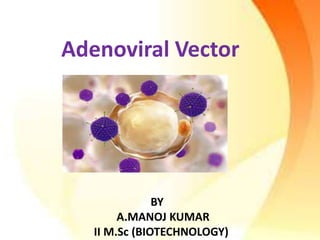

Adenoviral Vector
BY
A.MANOJ KUMAR
II M.Sc (BIOTECHNOLOGY)
Viral Vector
virus particles has been modified to use
as a carrier of nucleic acid into a cell, termed
as viral vectors.
Viral vectors are highly efficient in
transferring target DNA/RNA segment to the
host cells with high specificity.
Wild type virus are modified by deleting
the non-essential genes and incorporating
exogenous nucleic acid segments to construct
a viral vector.
Viral vectors have wide application in
gene therapy and targeted drug delivery
systems.
Adenoviruses
• Adenoviruses are medium-sized (90-100
nm), non-enveloped viruses containing
linear, double-stranded DNA of approximately
36 kb.
• 57 immunologically distinct types (7
subgenera) of adenoviruses cause human
infections.
• They are unusually stable to physical or
chemical agents and adverse pH conditions
for long-term survival outside the body.
• There are six early-transcription units, most of
which are essential for viral replication, and a major
late transcript that encodes capsid.
• They result in transient expression in dividing cells
as they do not integrate efficiently into the genome,
but prolonged expression can be achieved in post-
mitotic cells, like neurons.
• Adenovirusesare mostly attractive as gene therapy
vectors, because the virions are taken up efficiently
by cells in vivo. Adenovirus-derived vaccines have
been used in humans with no reported side-effects.
Life cycle
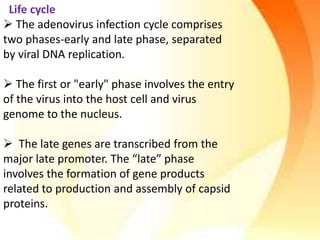
 The adenovirus infection cycle comprises
two phases-early and late phase, separated
by viral DNA replication.
 The first or "early" phase involves the entry
of the virus into the host cell and virus
genome to the nucleus.
 The late genes are transcribed from the
major late promoter. The “late” phase
involves the formation of gene products
related to production and assembly of capsid
proteins.
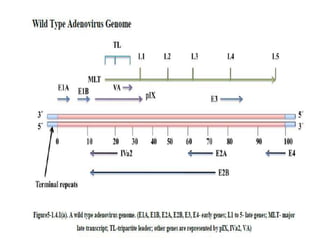
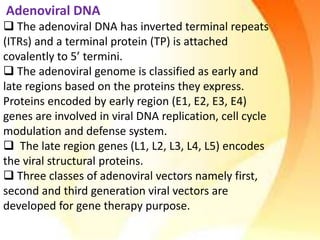
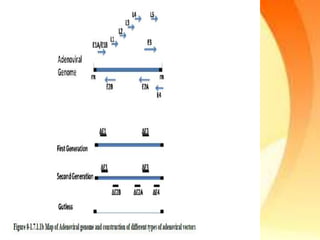
Adenoviral DNA
 The adenoviral DNA has inverted terminal repeats
(ITRs) and a terminal protein (TP) is attached
covalently to 5’ termini.
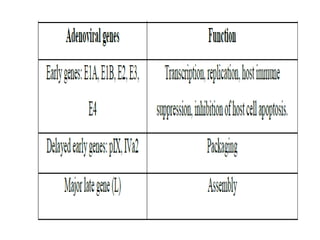
 The adenoviral genome is classified as early and
late regions based on the proteins they express.
Proteins encoded by early region (E1, E2, E3, E4)
genes are involved in viral DNA replication, cell cycle
modulation and defense system.
 The late region genes (L1, L2, L3, L4, L5) encodes
the viral structural proteins.
 Three classes of adenoviral vectors namely first,
second and third generation viral vectors are
developed for gene therapy purpose.
Construction of Adenoviral vectors
First generation adenoviral Vectors
These vectors are constructed by replacing the
E1/E3 expression cassette and inserting our candidate
gene of 3-4kb size. E1 encodes proteins responsible
for expressions of other viral genes required for viral
growth.
So cell lines that can provide E1 proteins in
trans are required for the replication of the E1 deleted
viral vectors.
Advantages:
• They are human viruses produced at very high titers
in culture.
• They can infect a wide range of human cell types
including non- dividing cells.
• They enter into cells by receptor mediated
endocytosis with a very high transduction
efficiency reaching upto 100% in vitro
• Their large size enables them to accept large
inserts.
Disadvantages:
• Expression of foreign gene is for short
period of time as they do not integrate into
the chromosome.
• These vectors may generate immune
response causing chronic inflammation.
Second generation adenoviral Vectors
These vectors have been developed to overcome these
difficulties. Here of E1/E2 or E3/E4 expression cassettes are
called deleted and replaced. The E1/E2 or E3/E4 proteins are
required for viral DNA replication. Similar to first generation
viral vector, cell lines which can complement both E1and E2
or E3 and E4 are needed. It can carry DNA insert upto 10.5kb
Advantages:
• It has improved safety and increased transgene expression.
Disadvantages:
• These viral vectors are associated with immunological
problems.
• Construction of these vectors is difficult.
Third generation adenoviral Vectors
These vectors are otherwise called as gutless
adenovirus.
These are also known as helper dependent
adenovirus as they lack all the coding sequences and
require helper virus which carries all the coding
sequences.
Helper virus for example AAV, or artificially
disabled viruses provide the viral functions needed for
successful infection like viral DNA replication, viral
assembly and infection of new cells etc.
The size of insert DNA can be 36kb and hence
called as high capacity adenoviruses. They carry only
5’ inverted terminal repeats (ITR) and 3’ packaging
signals (ψ).
Advantages:
• These are non-integrative and high-capacity
vectors.
• It can be produced in high titer and the
construction of these vector is easy.
• It shows longer stability and reduced
immune response.
Disadvantages:
• Helper virus contamination contamination
can cause diseases like conjunctivitis,
pharyngitis, cold and respiratory disease.
Advantages of Adenoviral vectors
• High transduction efficiency
• Insert size up to 8 kilobases
• Generation of high virus titres
• High level of expression in a wide variety of
cell types
• No mutagenic effects due to lack of random
integration into the host genome.
Disadvantages of Adenoviral vectors
• Transient expression due to lack of
integration into the host.
• Pathogenic to humans.
THANK YOU…

Adenoviral vector

  • 1.
  • 2.
    Viral Vector virus particleshas been modified to use as a carrier of nucleic acid into a cell, termed as viral vectors. Viral vectors are highly efficient in transferring target DNA/RNA segment to the host cells with high specificity. Wild type virus are modified by deleting the non-essential genes and incorporating exogenous nucleic acid segments to construct a viral vector. Viral vectors have wide application in gene therapy and targeted drug delivery systems.
  • 3.
    Adenoviruses • Adenoviruses aremedium-sized (90-100 nm), non-enveloped viruses containing linear, double-stranded DNA of approximately 36 kb. • 57 immunologically distinct types (7 subgenera) of adenoviruses cause human infections. • They are unusually stable to physical or chemical agents and adverse pH conditions for long-term survival outside the body.
  • 4.
    • There aresix early-transcription units, most of which are essential for viral replication, and a major late transcript that encodes capsid. • They result in transient expression in dividing cells as they do not integrate efficiently into the genome, but prolonged expression can be achieved in post- mitotic cells, like neurons. • Adenovirusesare mostly attractive as gene therapy vectors, because the virions are taken up efficiently by cells in vivo. Adenovirus-derived vaccines have been used in humans with no reported side-effects.
  • 5.
    Life cycle  Theadenovirus infection cycle comprises two phases-early and late phase, separated by viral DNA replication.  The first or "early" phase involves the entry of the virus into the host cell and virus genome to the nucleus.  The late genes are transcribed from the major late promoter. The “late” phase involves the formation of gene products related to production and assembly of capsid proteins.
  • 8.
    Adenoviral DNA  Theadenoviral DNA has inverted terminal repeats (ITRs) and a terminal protein (TP) is attached covalently to 5’ termini.  The adenoviral genome is classified as early and late regions based on the proteins they express. Proteins encoded by early region (E1, E2, E3, E4) genes are involved in viral DNA replication, cell cycle modulation and defense system.  The late region genes (L1, L2, L3, L4, L5) encodes the viral structural proteins.  Three classes of adenoviral vectors namely first, second and third generation viral vectors are developed for gene therapy purpose.
  • 10.
    Construction of Adenoviralvectors First generation adenoviral Vectors These vectors are constructed by replacing the E1/E3 expression cassette and inserting our candidate gene of 3-4kb size. E1 encodes proteins responsible for expressions of other viral genes required for viral growth. So cell lines that can provide E1 proteins in trans are required for the replication of the E1 deleted viral vectors. Advantages: • They are human viruses produced at very high titers in culture. • They can infect a wide range of human cell types including non- dividing cells.
  • 11.
    • They enterinto cells by receptor mediated endocytosis with a very high transduction efficiency reaching upto 100% in vitro • Their large size enables them to accept large inserts. Disadvantages: • Expression of foreign gene is for short period of time as they do not integrate into the chromosome. • These vectors may generate immune response causing chronic inflammation.
  • 12.
    Second generation adenoviralVectors These vectors have been developed to overcome these difficulties. Here of E1/E2 or E3/E4 expression cassettes are called deleted and replaced. The E1/E2 or E3/E4 proteins are required for viral DNA replication. Similar to first generation viral vector, cell lines which can complement both E1and E2 or E3 and E4 are needed. It can carry DNA insert upto 10.5kb Advantages: • It has improved safety and increased transgene expression. Disadvantages: • These viral vectors are associated with immunological problems. • Construction of these vectors is difficult.
  • 13.
    Third generation adenoviralVectors These vectors are otherwise called as gutless adenovirus. These are also known as helper dependent adenovirus as they lack all the coding sequences and require helper virus which carries all the coding sequences. Helper virus for example AAV, or artificially disabled viruses provide the viral functions needed for successful infection like viral DNA replication, viral assembly and infection of new cells etc. The size of insert DNA can be 36kb and hence called as high capacity adenoviruses. They carry only 5’ inverted terminal repeats (ITR) and 3’ packaging signals (ψ).
  • 14.
    Advantages: • These arenon-integrative and high-capacity vectors. • It can be produced in high titer and the construction of these vector is easy. • It shows longer stability and reduced immune response. Disadvantages: • Helper virus contamination contamination can cause diseases like conjunctivitis, pharyngitis, cold and respiratory disease.
  • 15.
    Advantages of Adenoviralvectors • High transduction efficiency • Insert size up to 8 kilobases • Generation of high virus titres • High level of expression in a wide variety of cell types • No mutagenic effects due to lack of random integration into the host genome. Disadvantages of Adenoviral vectors • Transient expression due to lack of integration into the host. • Pathogenic to humans.
  • 16.