DNAand
Genetics
The Structure of DNA
Chromosomes are made of proteins and
deoxyribonucleic acid, or DNA.
DNA is an organism’s genetic material.
A gene is a segment of DNA on a
chromosome.
Strands of DNA in a chromosome are tightly
coiled, like a coiled spring. This coiling makes it
possible for more genes to fit in a small space.
The Structure of DNA
A Complex Molecule
The shape of DNA is like a twisted ladder. It is
called a double helix.
A Complex Molecule
Rosalind Franklin discovered that DNA is 2
chains of molecules in a spiral form.
A Complex Molecule
Watson and Crick further studied the DNA
model.
A Complex Molecule
Watson and Crick discovered that each side of
the ladder is make of a sugar-phosphate
molecule.
A Complex Molecule
4 Nucleotides shape DNA
DNA has a twisted-ladder shape that is caused
by molecules called nucleotides.
A nucleotide
is a molecule
made of a
nitrogen base,
a sugar, and a
phosphate
group.
4 Nucleotides shape DNA
Sugar-phosphate groups form the sides of the
DNA ladder.
The nitrogen
bases bond
and form the
rungs of the
ladder.
4 Nucleotides shape DNA
Cells contain DNA in chromosomes. So, every
time a cell divides, all chromosomes must be
copied for the new cell.
The new DNA is identical to existing DNA.
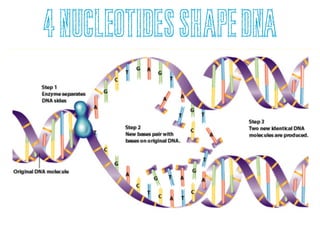
Replication is the process of copying a DNA
molecule to make another DNA molecule.
4 Nucleotides shape DNA

In the first part of replication, the strands
separate in many places and the nitrogen bases
are exposed.
4 Nucleotides shape DNA

Nucleotides move into place and form new
nitrogen base pairs. This produces two identical
strands of DNA.
4 Nucleotides shape DNA
?
Junk DNA

All genes are segments of DNA on a
chromosome. However, about 97 percent of
DNA on human chromosomes is not part of
any gene.
Segments of DNA that are not parts of genes
are often called junk DNA. It is not known
whether junk DNA has functions that are
important to cells.
Junk DNA
http://en.wikipedia.org/wiki/Noncoding_DNA

http://en.wikipedia.org/wiki/Noncoding_DNA
Junk DNA

http://www.icr.org/article/3396/
Junk DNA
Junk DNA
http://www.discovery.org/a/9941
The Role of RNA in making proteins
Proteins are made with the help of ribonucleic
acid.
Ribonucleic acid (RNA) is a type of nucleic acid
that carries the code for making proteins from
the nucleus to the cytoplasm.
RNA also carries amino acids around inside a
cell and forms a part of ribosomes.
The Role of RNA in making proteins
RNA, like DNA, is made of nucleotides. But
RNA is single stranded, while DNA is doublestranded.
RNA has the nitrogen base uracil (U), while
DNA has thymine (T).
The Role of RNA in making proteins
The first step in making a protein is to make
mRNA from DNA. The process of making
mRNA from DNA is called transcription.
During transcription, mRNA nucleotides pair
up with DNA nucleotides.
Completed mRNA can move into the
cytoplasm.
The Role of RNA in making proteins

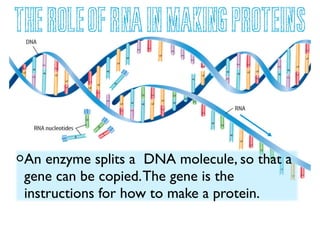
An enzyme splits a DNA molecule, so that a
gene can be copied. The gene is the
instructions for how to make a protein.
The Role of RNA in making proteins

The free floating nitrogen bases in the
nucleus match with a nitrogen base on the
split DNA.
The Role of RNA in making proteins

The partnering is the same as when DNA is
copied except that Adenine matches with
Uracil.
The Role of RNA in making proteins

The nitrogen bases pair up on the split DNA
temporarily until a complete gene is copied.
The Role of RNA in making proteins

The newly made mRNA will now detach
from the DNA and leave the nucleus.
3 Types of RNA
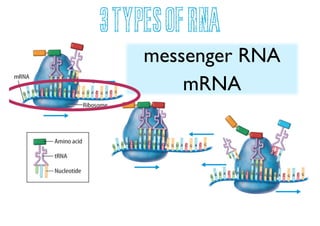
The three types of RNA are messenger RNA
(mRNA), transfer RNA (tRNA), and ribosomal
RNA (rRNA).
They work together to make proteins.
The process of making a protein from RNA is
called translation.
3 Types of RNA
messenger RNA
mRNA
3 Types of RNA
ribosomal RNA
rRNA
3 Types of RNA
transfer RNA
tRNA
Translating the RNA Code
Making a protein from mRNA is like using a
secret code.
Proteins are made of amino acids. The order of
the nitrogen bases in mRNA determines the
order of the amino acids in a protein.
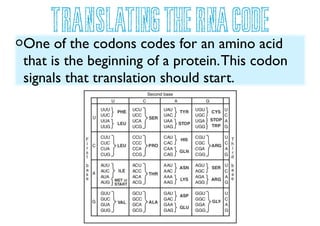
Three nitrogen bases on mRNA form the code
for one amino acid.
Translating the RNA Code

Each series of three nitrogen bases on mRNA
is called a codon.
Translating the RNA Code
There are 64 codons, but only 20 amino acids.
Translating the RNA Code
Some of the codons code for the same amino
acid.
Translating the RNA Code

One of the codons codes for an amino acid
that is the beginning of a protein. This codon
signals that translation should start.
Translating the RNA Code

Three of the codons do not code for any
amino acid. Instead, they code for the end of a
protein. They signal that translation should
stop.
Translating the RNA Code
3 Types of RNA

3 nitrogen
bases on
mRNA
Another
temporarily
tRNA bonds.
match to 3
bases on the
tRNA.
The amino acids that are attached to
the tRNA bond, beginning to form the
protein.
Translating the RNA Code
Mutations

A change in the nucleotide sequence of a gene
is called a mutation.
Sometimes, mistakes happen during
replication. Most mistakes are corrected
before replication is finished.
An uncorrected mistake can result in a
mutation.
Mutations can be caused by exposure to Xrays, ultraviolet light, radioactive materials, and
some kinds of chemicals.
Types of Mutations
There are several types of DNA mutations.
In a deletion mutation, one or more nitrogen
bases are left out of the DNA sequence.
In an insertion mutation, one or more nitrogen
bases are added to the DNA.
In a substitution mutation, one nitrogen base is
replaced by a different nitrogen base.
Types of Mutations
Types of Mutations
Each type of mutation changes the sequence of
nitrogen base pairs.
A change can cause a mutated gene to code
for a protein that is different from a normal
gene.
Some mutated genes do not code for any
protein.
For example, a cell might lose the ability to
make one of the proteins it needs.
Results of a Mutation
The effects of a mutation depend on where in
the DNA sequence the mutation happens and
the type of mutation.
Proteins express traits. Because mutations can
change proteins, they can cause traits to
change.
Some mutations in human DNA cause genetic
disorders.
Results of a Mutation
With more research, scientists hope to find
cures and treatments for genetic disorders.
Not all mutations have negative effects.
Some mutations do not change proteins, so
they do not affect traits.
Other mutations can cause a trait to change in
a way that benefits an organism.

DNA and Genetics

  • 1.
  • 2.
    The Structure ofDNA Chromosomes are made of proteins and deoxyribonucleic acid, or DNA. DNA is an organism’s genetic material. A gene is a segment of DNA on a chromosome. Strands of DNA in a chromosome are tightly coiled, like a coiled spring. This coiling makes it possible for more genes to fit in a small space.
  • 3.
  • 4.
    A Complex Molecule Theshape of DNA is like a twisted ladder. It is called a double helix.
  • 5.
    A Complex Molecule RosalindFranklin discovered that DNA is 2 chains of molecules in a spiral form.
  • 6.
    A Complex Molecule Watsonand Crick further studied the DNA model.
  • 7.
    A Complex Molecule Watsonand Crick discovered that each side of the ladder is make of a sugar-phosphate molecule.
  • 8.
  • 9.
    4 Nucleotides shapeDNA DNA has a twisted-ladder shape that is caused by molecules called nucleotides. A nucleotide is a molecule made of a nitrogen base, a sugar, and a phosphate group.
  • 10.
    4 Nucleotides shapeDNA Sugar-phosphate groups form the sides of the DNA ladder. The nitrogen bases bond and form the rungs of the ladder.
  • 11.
    4 Nucleotides shapeDNA Cells contain DNA in chromosomes. So, every time a cell divides, all chromosomes must be copied for the new cell. The new DNA is identical to existing DNA. Replication is the process of copying a DNA molecule to make another DNA molecule.
  • 12.
    4 Nucleotides shapeDNA In the first part of replication, the strands separate in many places and the nitrogen bases are exposed.
  • 13.
    4 Nucleotides shapeDNA Nucleotides move into place and form new nitrogen base pairs. This produces two identical strands of DNA.
  • 14.
  • 15.
  • 16.
    ? Junk DNA All genesare segments of DNA on a chromosome. However, about 97 percent of DNA on human chromosomes is not part of any gene. Segments of DNA that are not parts of genes are often called junk DNA. It is not known whether junk DNA has functions that are important to cells.
  • 17.
  • 18.
  • 19.
  • 20.
  • 21.
    The Role ofRNA in making proteins Proteins are made with the help of ribonucleic acid. Ribonucleic acid (RNA) is a type of nucleic acid that carries the code for making proteins from the nucleus to the cytoplasm. RNA also carries amino acids around inside a cell and forms a part of ribosomes.
  • 22.
    The Role ofRNA in making proteins RNA, like DNA, is made of nucleotides. But RNA is single stranded, while DNA is doublestranded. RNA has the nitrogen base uracil (U), while DNA has thymine (T).
  • 24.
    The Role ofRNA in making proteins The first step in making a protein is to make mRNA from DNA. The process of making mRNA from DNA is called transcription. During transcription, mRNA nucleotides pair up with DNA nucleotides. Completed mRNA can move into the cytoplasm.
  • 25.
    The Role ofRNA in making proteins An enzyme splits a DNA molecule, so that a gene can be copied. The gene is the instructions for how to make a protein.
  • 26.
    The Role ofRNA in making proteins The free floating nitrogen bases in the nucleus match with a nitrogen base on the split DNA.
  • 27.
    The Role ofRNA in making proteins The partnering is the same as when DNA is copied except that Adenine matches with Uracil.
  • 28.
    The Role ofRNA in making proteins The nitrogen bases pair up on the split DNA temporarily until a complete gene is copied.
  • 29.
    The Role ofRNA in making proteins The newly made mRNA will now detach from the DNA and leave the nucleus.
  • 31.
    3 Types ofRNA The three types of RNA are messenger RNA (mRNA), transfer RNA (tRNA), and ribosomal RNA (rRNA). They work together to make proteins. The process of making a protein from RNA is called translation.
  • 32.
    3 Types ofRNA messenger RNA mRNA
  • 33.
    3 Types ofRNA ribosomal RNA rRNA
  • 34.
    3 Types ofRNA transfer RNA tRNA
  • 35.
    Translating the RNACode Making a protein from mRNA is like using a secret code. Proteins are made of amino acids. The order of the nitrogen bases in mRNA determines the order of the amino acids in a protein. Three nitrogen bases on mRNA form the code for one amino acid.
  • 36.
    Translating the RNACode Each series of three nitrogen bases on mRNA is called a codon.
  • 37.
    Translating the RNACode There are 64 codons, but only 20 amino acids.
  • 38.
    Translating the RNACode Some of the codons code for the same amino acid.
  • 39.
    Translating the RNACode One of the codons codes for an amino acid that is the beginning of a protein. This codon signals that translation should start.
  • 40.
    Translating the RNACode Three of the codons do not code for any amino acid. Instead, they code for the end of a protein. They signal that translation should stop.
  • 41.
  • 42.
    3 Types ofRNA 3 nitrogen bases on mRNA Another temporarily tRNA bonds. match to 3 bases on the tRNA. The amino acids that are attached to the tRNA bond, beginning to form the protein.
  • 43.
  • 45.
    Mutations A change inthe nucleotide sequence of a gene is called a mutation. Sometimes, mistakes happen during replication. Most mistakes are corrected before replication is finished. An uncorrected mistake can result in a mutation. Mutations can be caused by exposure to Xrays, ultraviolet light, radioactive materials, and some kinds of chemicals.
  • 46.
    Types of Mutations Thereare several types of DNA mutations. In a deletion mutation, one or more nitrogen bases are left out of the DNA sequence. In an insertion mutation, one or more nitrogen bases are added to the DNA. In a substitution mutation, one nitrogen base is replaced by a different nitrogen base.
  • 47.
  • 48.
    Types of Mutations Eachtype of mutation changes the sequence of nitrogen base pairs. A change can cause a mutated gene to code for a protein that is different from a normal gene. Some mutated genes do not code for any protein. For example, a cell might lose the ability to make one of the proteins it needs.
  • 49.
    Results of aMutation The effects of a mutation depend on where in the DNA sequence the mutation happens and the type of mutation. Proteins express traits. Because mutations can change proteins, they can cause traits to change. Some mutations in human DNA cause genetic disorders.
  • 50.
    Results of aMutation
  • 51.
    Results of aMutation With more research, scientists hope to find cures and treatments for genetic disorders. Not all mutations have negative effects. Some mutations do not change proteins, so they do not affect traits. Other mutations can cause a trait to change in a way that benefits an organism.