The Human
Body Recipe
DNA:
• DeoxyriboNucliec Acid •
01
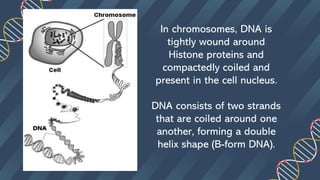
In chromosomes, DNA is
tightly wound around
Histone proteins and
compactedly coiled and
present in the cell nucleus.
DNA consists of two strands
that are coiled around one
another, forming a double
helix shape (B-form DNA).
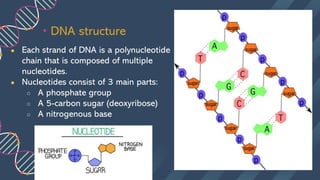
● Each strand of DNA is a polynucleotide
chain that is composed of multiple
nucleotides.
● Nucleotides consist of 3 main parts:
○ A phosphate group
○ A 5-carbon sugar (deoxyribose)
○ A nitrogenous base
• DNA structure
Although Nucleotides come together (join) through
covalent bonds in the backbone, the two strands of DNA
interact through non-covalent hydrogen bonds between the
bases.
Each base forms multiple hydrogen bonds with its
complementary base on the opposite strand.
Base pair
How can these non-covalent hydrgen bonds help us?
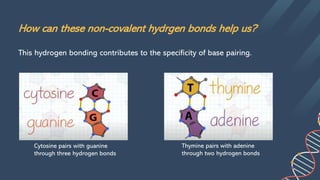
This hydrogen bonding contributes to the specificity of base pairing.
Cytosine pairs with guanine
through three hydrogen bonds
Thymine pairs with adenine
through two hydrogen bonds
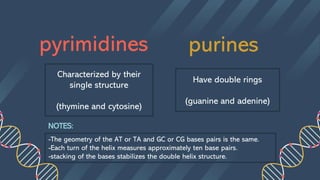
Have double rings
(guanine and adenine)
pyrimidines purines
Characterized by their
single structure
(thymine and cytosine)
-The geometry of the AT or TA and GC or CG bases pairs is the same.
-Each turn of the helix measures approximately ten base pairs.
-stacking of the bases stabilizes the double helix structure.
NOTES:
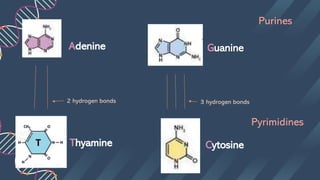
Adenine
Cytosine
Guanine
Thyamine
3 hydrogen bonds
2 hydrogen bonds
Purines
Pyrimidines
Pi-Pi interactions:
they form in the aromatic rings of the bases
stack next to eacth other and share electron
probabilities.
Major and minor grooves:
Two repeating and alternating spaces formed by
the regularity of helical shape.
Major grooves: contains base
pair specific information
Minor grooves: contains base
pair non-specific information
It’s the time for questions! :
Q. What two parts of a nucleotide do not change throughout the structure of DNA?
answer choices
Five-Carbon Sugar and Nitrogen Base
Phosphate Group and Nitrogen Base
Five-Carbon Sugar and Phosphate Group
All components remain the same throughout the DNA structure
Q. Nitrogenous bases are joined by which type of bond?
answer choices
polar bonds
ionic bonds
covalent bonds
hydrogen bonds
Q. Which shows the correct complementary base pairing for
DNA?
answer choices
C-A, T-G
A-G, C-T
C-G, U-A
T-A, G-C
Q. Which of the following units are repeatedly joined together to
form a strand of DNA?
answer choices
amino acids
nucleotides
fatty acids
polysaccharides
Q.A five-carbon sugar found in DNA.
answer choices
ribose
guanine
deoxyribose
Helicase
Q. Pyrimidines are:
Thymine and cytosine
Thymine and adenine
Adenine and guanine
Guanine and cytosine

DNA structure.pptx

  • 1.
  • 2.
  • 4.
    In chromosomes, DNAis tightly wound around Histone proteins and compactedly coiled and present in the cell nucleus. DNA consists of two strands that are coiled around one another, forming a double helix shape (B-form DNA).
  • 5.
    ● Each strandof DNA is a polynucleotide chain that is composed of multiple nucleotides. ● Nucleotides consist of 3 main parts: ○ A phosphate group ○ A 5-carbon sugar (deoxyribose) ○ A nitrogenous base • DNA structure
  • 6.
    Although Nucleotides cometogether (join) through covalent bonds in the backbone, the two strands of DNA interact through non-covalent hydrogen bonds between the bases. Each base forms multiple hydrogen bonds with its complementary base on the opposite strand. Base pair
  • 7.
    How can thesenon-covalent hydrgen bonds help us? This hydrogen bonding contributes to the specificity of base pairing. Cytosine pairs with guanine through three hydrogen bonds Thymine pairs with adenine through two hydrogen bonds
  • 8.
    Have double rings (guanineand adenine) pyrimidines purines Characterized by their single structure (thymine and cytosine) -The geometry of the AT or TA and GC or CG bases pairs is the same. -Each turn of the helix measures approximately ten base pairs. -stacking of the bases stabilizes the double helix structure. NOTES:
  • 9.
    Adenine Cytosine Guanine Thyamine 3 hydrogen bonds 2hydrogen bonds Purines Pyrimidines
  • 10.
    Pi-Pi interactions: they formin the aromatic rings of the bases stack next to eacth other and share electron probabilities. Major and minor grooves: Two repeating and alternating spaces formed by the regularity of helical shape. Major grooves: contains base pair specific information Minor grooves: contains base pair non-specific information
  • 11.
    It’s the timefor questions! : Q. What two parts of a nucleotide do not change throughout the structure of DNA? answer choices Five-Carbon Sugar and Nitrogen Base Phosphate Group and Nitrogen Base Five-Carbon Sugar and Phosphate Group All components remain the same throughout the DNA structure Q. Nitrogenous bases are joined by which type of bond? answer choices polar bonds ionic bonds covalent bonds hydrogen bonds
  • 12.
    Q. Which showsthe correct complementary base pairing for DNA? answer choices C-A, T-G A-G, C-T C-G, U-A T-A, G-C Q. Which of the following units are repeatedly joined together to form a strand of DNA? answer choices amino acids nucleotides fatty acids polysaccharides
  • 13.
    Q.A five-carbon sugarfound in DNA. answer choices ribose guanine deoxyribose Helicase Q. Pyrimidines are: Thymine and cytosine Thymine and adenine Adenine and guanine Guanine and cytosine