A general term that refers to any
pattern of inheritance in which traits do
not segregate in accordance with
Mendel’s laws.
A form of intermediate inheritance in
which one allele for a specific trait is not
completely dominant over the other allele.
This results in a combined phenotype.
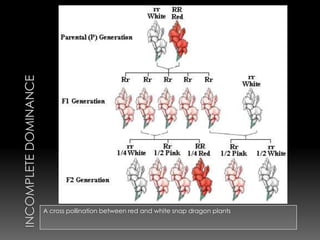
A cross pollination between red and white snap dragon plants
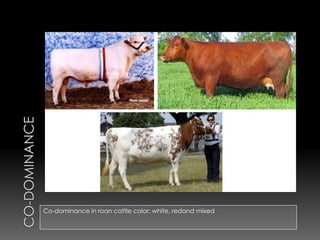
A cross between organisms with two
different phenotypes produces offspring
with a third phenotype in which both of the
parental traits appear together.
Co-dominance in roan cattle color: white, redand mixed
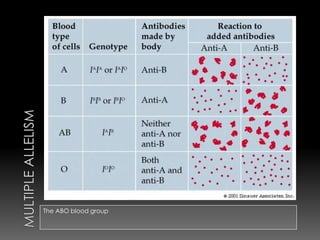
A set of three or more alleles, or
alternative states of a gene, only two of
which can be present in a diploid
organism.
The ABO blood group
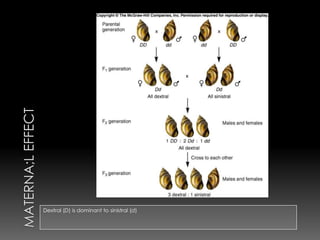
The genotype of mother directly
determines phenotype of offspring.
Explained by the accumulation of gene
products mother provides to developing
eggs
Dextral (D) is dominant to sinistral (d)
Modification occurs to a nuclear gene
or chromosome. This occurs during
spermatogenesis, oogenesis, and early
stages of embryogenesis
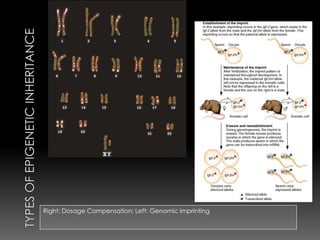
 Dosage Compensation: Males and
  females of many species have different
  numbers of certain sex chromosomes
 Genomic Imprinting: involves the
  physical marking of a segment of DNA
Right: Dosage Compensation; Left: Genomic Imprinting
The transmission of genes that occur
outside the nucleus. It is found in most
eukaryotes and is commonly known to occur
in cytoplasmic organelles such as
mitochondria and chloroplasts or from cellular
parasites like viruses or bacteria
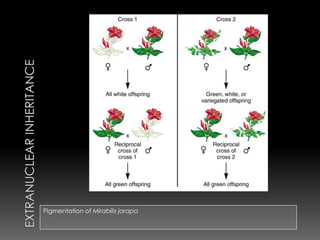
Pigmentation of Mirabilis jarapa
Non mendelian inheritance

Non mendelian inheritance

  • 2.
    A general termthat refers to any pattern of inheritance in which traits do not segregate in accordance with Mendel’s laws.
  • 4.
    A form ofintermediate inheritance in which one allele for a specific trait is not completely dominant over the other allele. This results in a combined phenotype.
  • 5.
    A cross pollinationbetween red and white snap dragon plants
  • 7.
    A cross betweenorganisms with two different phenotypes produces offspring with a third phenotype in which both of the parental traits appear together.
  • 8.
    Co-dominance in roancattle color: white, redand mixed
  • 10.
    A set ofthree or more alleles, or alternative states of a gene, only two of which can be present in a diploid organism.
  • 11.
  • 14.
    The genotype ofmother directly determines phenotype of offspring. Explained by the accumulation of gene products mother provides to developing eggs
  • 15.
    Dextral (D) isdominant to sinistral (d)
  • 17.
    Modification occurs toa nuclear gene or chromosome. This occurs during spermatogenesis, oogenesis, and early stages of embryogenesis
  • 18.
     Dosage Compensation:Males and females of many species have different numbers of certain sex chromosomes  Genomic Imprinting: involves the physical marking of a segment of DNA
  • 19.
    Right: Dosage Compensation;Left: Genomic Imprinting
  • 21.
    The transmission ofgenes that occur outside the nucleus. It is found in most eukaryotes and is commonly known to occur in cytoplasmic organelles such as mitochondria and chloroplasts or from cellular parasites like viruses or bacteria
  • 22.