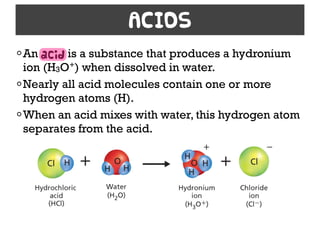
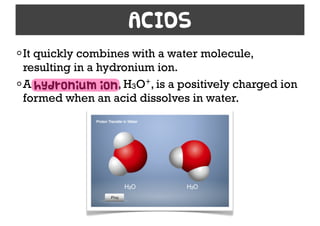
Acids and bases are defined by whether they produce hydronium (H3O+) or hydroxide (OH-) ions when dissolved in water. Acids have a pH below 7 and produce more H3O+ ions, bases have a pH above 7 and produce more OH- ions, and neutral solutions have an equal concentration of both ions and a pH of 7. The pH scale quantifies exactly how acidic or basic a solution is, with each unit of pH representing a tenfold change in hydronium ion concentration. pH can be measured approximately with indicators or more precisely with a pH meter. Common acids and bases have various uses from food preparation to cleaning products.




![BALANCE OF HYDRONIUM &
HYDROXIDE IONS
Acids [H3O+] > [OH-]
Neutral [H3O+] = [OH -]
Bases [H3O+] < [OH -]
[ ] square brackets mean concentration](https://image.slidesharecdn.com/13-131024041915-phpapp01/85/Acid-and-Base-Solutions-13-320.jpg)


