Mendel
&
his peas
early ideas about heredity
• Long ago, people thought that an organism’s

characteristics, or traits, were determined in
the same way that paint colors can be mixed.
People assumed this because offspring often
resemble both parents. This is known as
blending inheritance.
• Today, scientists know that heredity is more

complex.
early ideas about heredity
• Heredity is the passing of traits from parents to

offspring.
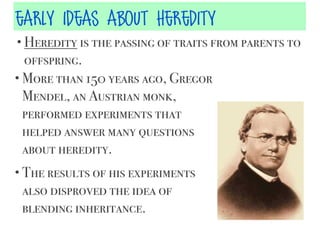
• More than 150 years ago, Gregor
Mendel, an Austrian monk,
performed experiments that
helped answer many questions
about heredity.
• The results of his experiments

also disproved the idea of
blending inheritance.
early ideas about heredity
• Mendel’s research into the questions of

heredity gave scientists a basic understanding
of genetics.
• Genetics is the study of
how traits are passed
from parents to
offspring.
• Because of his research,

Mendel is known as the
“father of genetics”.
early ideas about heredity
• Mendel was fascinated by the question "What is

responsible for the variation in plants and
animals?"
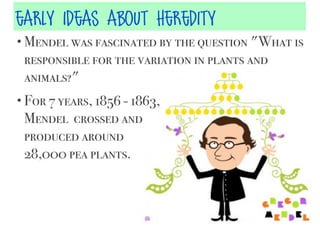
• For 7 years, 1856 - 1863,

Mendel crossed and
produced around 
28,000 pea plants. 
Mendel’s Experimental Method
• During the 1850s, Mendel studied genetics by

doing controlled breeding experiments with pea
plants. Pea plants were ideal for genetics
studies because:
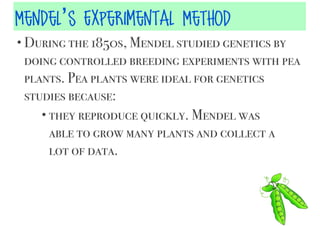
• they reproduce quickly. Mendel was
able to grow many plants and collect a
lot of data.
Mendel’s Experimental Method
• During the 1850s, Mendel studied genetics by

doing controlled breeding experiments with pea
plants. Pea plants were ideal for genetics
studies because:
• they have easily observed traits, such
as flower color and pea shape. Mendel
was able to observe whether or not a
trait was passed from one generation to
the next.
Mendel’s Experimental Method
• During the 1850s, Mendel studied genetics by

doing controlled breeding experiments with pea
plants. Pea plants were ideal for genetics
studies because:
• Mendel could control which pairs of
plants reproduced. He was able to find
out which traits came from which plant
pairs.
Pollination in Pea Plants
• To observe how a trait was inherited, Mendel

controlled which plants pollinated other
plants.
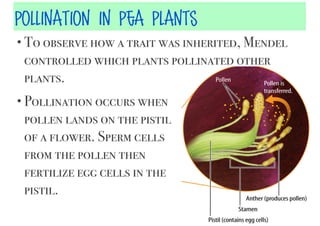
• Pollination occurs when

pollen lands on the pistil
of a flower. Sperm cells
from the pollen then
fertilize egg cells in the
pistil.
Pollination in Pea Plants
• Self-pollination occurs when pollen from one

plant lands on the pistil of a flower on the same
plant.
• Cross-pollination occurs when pollen from one

plant reaches the pistil of a flower on a
different plant.
• Mendel allowed one group of flowers to self-

pollinate. With another group, he crosspollinated the plants himself.
Mendel’s Self Pollination
• Mendel began his experiments with plants that

were true-breeding for the trait that he would
test.
• When a true-breeding plant self-pollinates, it

always produces offspring with traits that
match the parent.
• For example, when a true-breeding pea plant

with wrinkled seeds self-pollinates, it produces
only plants with wrinkled seeds.
Mendel’s Cross Pollination
• By cross-pollinating plants himself, Mendel was

able to select which plants pollinated other
plants.
• Mendel cross-pollinated hundreds of plants

for each set of traits he wanted to learn more
about.
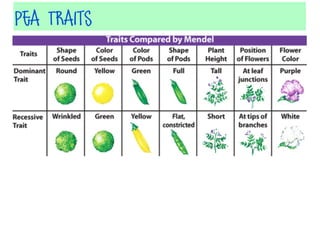
• The traits included flower color (purple or

white), seed color (green or yellow), and seed
shape (round or wrinkled).
Pea Traits
Mendel’s Cross Pollination
• With each cross-pollination, Mendel recorded

the traits that appeared in the offspring.
• By testing such a large number of plants,

Mendel was able to predict which crosses
would produce which traits.
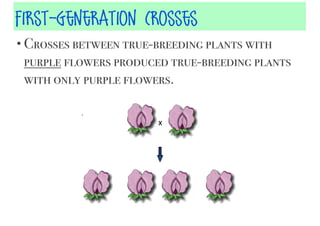
First-Generation Crosses
• Crosses between true-breeding plants with

purple flowers produced true-breeding plants
with only purple flowers.
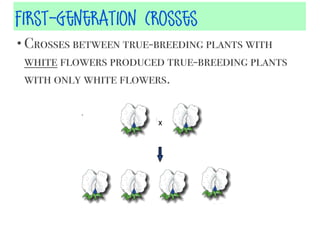
First-Generation Crosses
• Crosses between true-breeding plants with

white flowers produced true-breeding plants
with only white flowers.
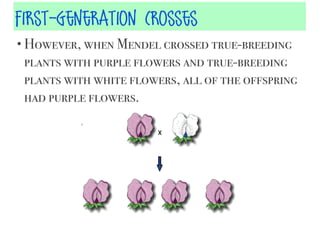
First-Generation Crosses
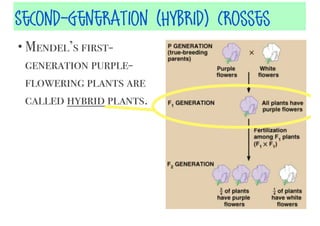
• However, when Mendel crossed true-breeding

plants with purple flowers and true-breeding
plants with white flowers, all of the offspring
had purple flowers.
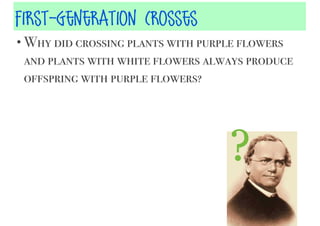
First-Generation Crosses
• Why did crossing plants with purple flowers

and plants with white flowers always produce
offspring with purple flowers?

?
First-Generation Crosses
• Why did crossing plants with purple flowers

and plants with white flowers always produce
offspring with purple flowers?
• Why were there no white flowers?

? ?
First-Generation Crosses
• Why did crossing plants with purple flowers

and plants with white flowers always produce
offspring with purple flowers?
• Why were there no white flowers?
• Why didn’t the cross produce offspring with

pink flowers—a combination of
white and purple?

? ?
?
First-Generation Crosses
• Why did crossing plants with purple flowers

and plants with white flowers always produce
offspring with purple flowers?
• Why were there no white flowers?
• Why didn’t the cross produce offspring with

pink flowers—a combination of
white and purple?
• Mendel carried out more

experiments to answer these
questions.

? ?
? ?

?
Second-Generation (HyBrid) Crosses
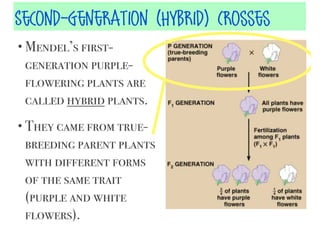
• Mendel’s first-

generation purpleflowering plants are
called hybrid plants.
Second-Generation (HyBrid) Crosses
• Mendel’s first-

generation purpleflowering plants are
called hybrid plants.
• They came from true-

breeding parent plants
with different forms
of the same trait
(purple and white
flowers).
Second-Generation (HyBrid) Crosses
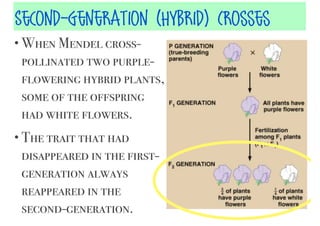
• When Mendel cross-

pollinated two purpleflowering hybrid plants,
some of the offspring
had white flowers.
• The trait that had

disappeared in the firstgeneration always
reappeared in the
second-generation.
Second-Generation (HyBrid) Crosses
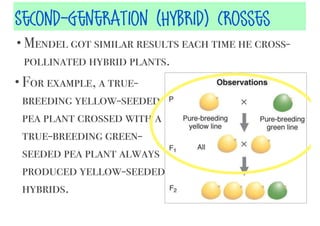
• Mendel got similar results each time he cross-

pollinated hybrid plants.
• For example, a truebreeding yellow-seeded
pea plant crossed with a
true-breeding greenseeded pea plant always
produced yellow-seeded
hybrids.
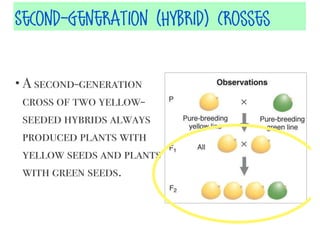
Second-Generation (HyBrid) Crosses
• A second-generation

cross of two yellowseeded hybrids always
produced plants with
yellow seeds and plants
with green seeds.
More HyBrid Crosses
• Mendel cross-pollinated many hybrid plants. He

counted and recorded the traits of offspring.
He analyzed these data and noticed patterns.
More HyBrid Crosses
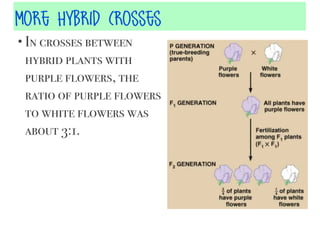
• In crosses between

hybrid plants with
purple flowers, the
ratio of purple flowers
to white flowers was
about 3:1.
More HyBrid Crosses
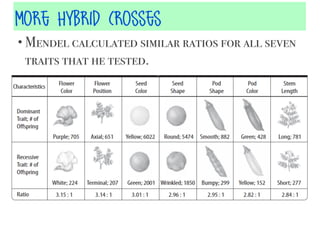
• Mendel calculated similar ratios for all seven

traits that he tested.
Mendel’s Conclusions
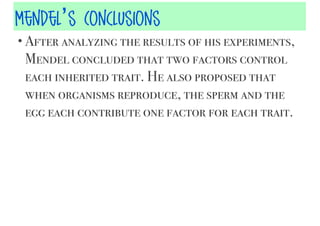
• After analyzing the results of his experiments,

Mendel concluded that two factors control
each inherited trait. He also proposed that
when organisms reproduce, the sperm and the
egg each contribute one factor for each trait.
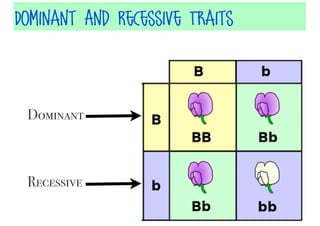
Dominant And Recessive Traits
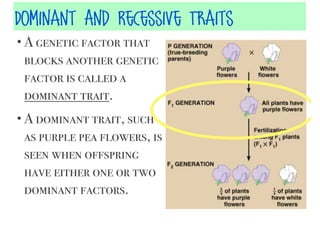
• A genetic factor that

blocks another genetic
factor is called a
dominant trait.
• A dominant trait, such

as purple pea flowers, is
seen when offspring
have either one or two
dominant factors.
Dominant And Recessive Traits
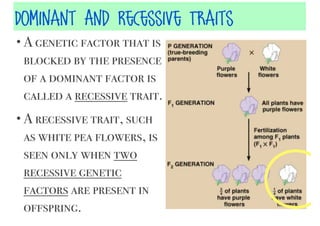
• A genetic factor that is

blocked by the presence
of a dominant factor is
called a recessive trait.
• A recessive trait, such

as white pea flowers, is
seen only when two
recessive genetic
factors are present in
offspring.
Dominant And Recessive Traits

Dominant

Recessive

Mendel and his Peas

  • 1.
  • 2.
    early ideas aboutheredity • Long ago, people thought that an organism’s characteristics, or traits, were determined in the same way that paint colors can be mixed. People assumed this because offspring often resemble both parents. This is known as blending inheritance. • Today, scientists know that heredity is more complex.
  • 3.
    early ideas aboutheredity • Heredity is the passing of traits from parents to offspring. • More than 150 years ago, Gregor Mendel, an Austrian monk, performed experiments that helped answer many questions about heredity. • The results of his experiments also disproved the idea of blending inheritance.
  • 4.
    early ideas aboutheredity • Mendel’s research into the questions of heredity gave scientists a basic understanding of genetics. • Genetics is the study of how traits are passed from parents to offspring. • Because of his research, Mendel is known as the “father of genetics”.
  • 5.
    early ideas aboutheredity • Mendel was fascinated by the question "What is responsible for the variation in plants and animals?" • For 7 years, 1856 - 1863, Mendel crossed and produced around  28,000 pea plants. 
  • 6.
    Mendel’s Experimental Method •During the 1850s, Mendel studied genetics by doing controlled breeding experiments with pea plants. Pea plants were ideal for genetics studies because: • they reproduce quickly. Mendel was able to grow many plants and collect a lot of data.
  • 7.
    Mendel’s Experimental Method •During the 1850s, Mendel studied genetics by doing controlled breeding experiments with pea plants. Pea plants were ideal for genetics studies because: • they have easily observed traits, such as flower color and pea shape. Mendel was able to observe whether or not a trait was passed from one generation to the next.
  • 8.
    Mendel’s Experimental Method •During the 1850s, Mendel studied genetics by doing controlled breeding experiments with pea plants. Pea plants were ideal for genetics studies because: • Mendel could control which pairs of plants reproduced. He was able to find out which traits came from which plant pairs.
  • 9.
    Pollination in PeaPlants • To observe how a trait was inherited, Mendel controlled which plants pollinated other plants. • Pollination occurs when pollen lands on the pistil of a flower. Sperm cells from the pollen then fertilize egg cells in the pistil.
  • 10.
    Pollination in PeaPlants • Self-pollination occurs when pollen from one plant lands on the pistil of a flower on the same plant. • Cross-pollination occurs when pollen from one plant reaches the pistil of a flower on a different plant. • Mendel allowed one group of flowers to self- pollinate. With another group, he crosspollinated the plants himself.
  • 11.
    Mendel’s Self Pollination •Mendel began his experiments with plants that were true-breeding for the trait that he would test. • When a true-breeding plant self-pollinates, it always produces offspring with traits that match the parent. • For example, when a true-breeding pea plant with wrinkled seeds self-pollinates, it produces only plants with wrinkled seeds.
  • 12.
    Mendel’s Cross Pollination •By cross-pollinating plants himself, Mendel was able to select which plants pollinated other plants. • Mendel cross-pollinated hundreds of plants for each set of traits he wanted to learn more about. • The traits included flower color (purple or white), seed color (green or yellow), and seed shape (round or wrinkled).
  • 13.
  • 14.
    Mendel’s Cross Pollination •With each cross-pollination, Mendel recorded the traits that appeared in the offspring. • By testing such a large number of plants, Mendel was able to predict which crosses would produce which traits.
  • 15.
    First-Generation Crosses • Crossesbetween true-breeding plants with purple flowers produced true-breeding plants with only purple flowers.
  • 16.
    First-Generation Crosses • Crossesbetween true-breeding plants with white flowers produced true-breeding plants with only white flowers.
  • 17.
    First-Generation Crosses • However,when Mendel crossed true-breeding plants with purple flowers and true-breeding plants with white flowers, all of the offspring had purple flowers.
  • 18.
    First-Generation Crosses • Whydid crossing plants with purple flowers and plants with white flowers always produce offspring with purple flowers? ?
  • 19.
    First-Generation Crosses • Whydid crossing plants with purple flowers and plants with white flowers always produce offspring with purple flowers? • Why were there no white flowers? ? ?
  • 20.
    First-Generation Crosses • Whydid crossing plants with purple flowers and plants with white flowers always produce offspring with purple flowers? • Why were there no white flowers? • Why didn’t the cross produce offspring with pink flowers—a combination of white and purple? ? ? ?
  • 21.
    First-Generation Crosses • Whydid crossing plants with purple flowers and plants with white flowers always produce offspring with purple flowers? • Why were there no white flowers? • Why didn’t the cross produce offspring with pink flowers—a combination of white and purple? • Mendel carried out more experiments to answer these questions. ? ? ? ? ?
  • 22.
    Second-Generation (HyBrid) Crosses •Mendel’s first- generation purpleflowering plants are called hybrid plants.
  • 23.
    Second-Generation (HyBrid) Crosses •Mendel’s first- generation purpleflowering plants are called hybrid plants. • They came from true- breeding parent plants with different forms of the same trait (purple and white flowers).
  • 24.
    Second-Generation (HyBrid) Crosses •When Mendel cross- pollinated two purpleflowering hybrid plants, some of the offspring had white flowers. • The trait that had disappeared in the firstgeneration always reappeared in the second-generation.
  • 25.
    Second-Generation (HyBrid) Crosses •Mendel got similar results each time he cross- pollinated hybrid plants. • For example, a truebreeding yellow-seeded pea plant crossed with a true-breeding greenseeded pea plant always produced yellow-seeded hybrids.
  • 26.
    Second-Generation (HyBrid) Crosses •A second-generation cross of two yellowseeded hybrids always produced plants with yellow seeds and plants with green seeds.
  • 27.
    More HyBrid Crosses •Mendel cross-pollinated many hybrid plants. He counted and recorded the traits of offspring. He analyzed these data and noticed patterns.
  • 28.
    More HyBrid Crosses •In crosses between hybrid plants with purple flowers, the ratio of purple flowers to white flowers was about 3:1.
  • 29.
    More HyBrid Crosses •Mendel calculated similar ratios for all seven traits that he tested.
  • 30.
    Mendel’s Conclusions • Afteranalyzing the results of his experiments, Mendel concluded that two factors control each inherited trait. He also proposed that when organisms reproduce, the sperm and the egg each contribute one factor for each trait.
  • 31.
    Dominant And RecessiveTraits • A genetic factor that blocks another genetic factor is called a dominant trait. • A dominant trait, such as purple pea flowers, is seen when offspring have either one or two dominant factors.
  • 32.
    Dominant And RecessiveTraits • A genetic factor that is blocked by the presence of a dominant factor is called a recessive trait. • A recessive trait, such as white pea flowers, is seen only when two recessive genetic factors are present in offspring.
  • 33.
    Dominant And RecessiveTraits Dominant Recessive