ExcretorySystem
TheExcretorySystem
TheExcretorySystem
•
Your body does not use all the food that you
take in.
•
The unused food parts are waste products.
•
These wastes are processed by the
excretory system.
•
The excretory system collects and
eliminates wastes from the body and
regulates the level of fluid in the body.
FunctionsoftheExcretorySystem
•
The digestive system collects waste
products in the intestines.
•
The circulatory system collects waste
products in the blood.
Collection and Elimination
FunctionsoftheExcretorySystem
•
When the trash cans in your home are full of
waste, you must take the trash outside. The
waste in your body also must be removed.
•
Waste that is not removed, or eliminated,
from your body can become toxic, or
poisonous, and damage your organs.
Collection and Elimination
FunctionsoftheExcretorySystem
•
The excretory system also regulates the
level of fluids in the body.
•
Recall that water is an essential nutrient for
your body. Some of the water in your body is
lost when waste is eliminated.
Regulation of LIquids
FunctionsoftheExcretorySystem
•
The excretory system controls how much
water leaves the body through elimination.
This ensures that neither too much nor too
little water is lost.
Regulation of LIquids
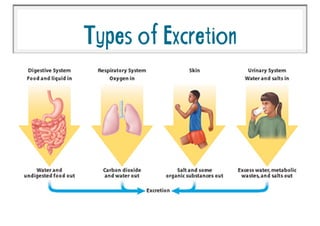
TypesofExcretion
•
Your body excretes, or eliminates, different
substances from different body systems.
•
The excretory system is made of four body
systems.
TypesofExcretion
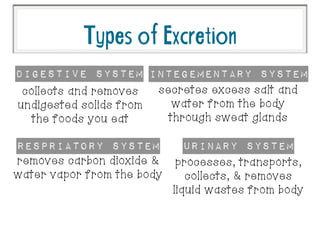
Digestive System
collects and removes
undigested solids from
the foods you eat
Urinary System
processes, transports,
collects, & removes
liquid wastes from body
Respriatory System
removes carbon dioxide &
water vapor from the body
secretes excess salt and
water from the body
through sweat glands
Integementary System
TypesofExcretion
OrgansofExcretorySystem
•
The urinary system processes, stores, and
removes liquid wastes from the body. It
helps maintain homeostasis.
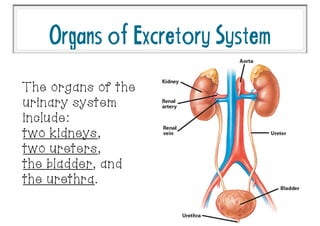
OrgansofExcretorySystem
The organs of the
urinary system
include:
two kidneys,
two ureters,
the bladder, and
the urethra.
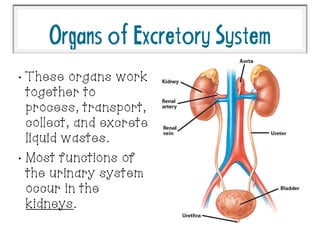
OrgansofExcretorySystem
•
These organs work
together to
process, transport,
collect, and excrete
liquid wastes.
•
Most functions of
the urinary system
occur in the
kidneys.
Kidneys
•
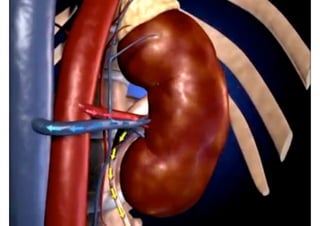
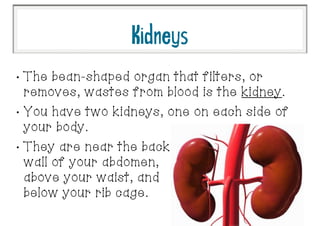
The bean-shaped organ that filters, or
removes, wastes from blood is the kidney.
•
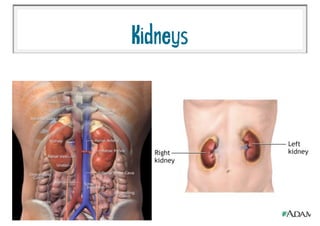
You have two kidneys, one on each side of
your body.
•
They are near the back
wall of your abdomen,
above your waist, and
below your rib cage.
Kidneys
•
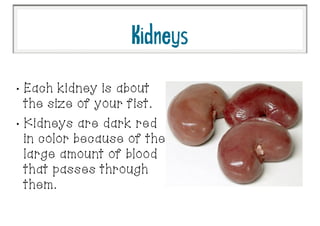
Each kidney is about
the size of your fist.
•
Kidneys are dark red
in color because of the
large amount of blood
that passes through
them.
Kidneys
•
The kidneys have several functions.
•
Here we focus on the role of the kidneys in
the urinary system. But the kidneys have
other important functions.
•
They produce hormones that stimulate the
production of red blood cells.
•
They also control blood pressure and help
control calcium levels in the body.
Kidney Function
Kidneys
Kidneys
•
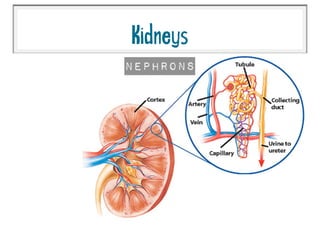
The kidneys contain blood vessels and
nephrons.
•
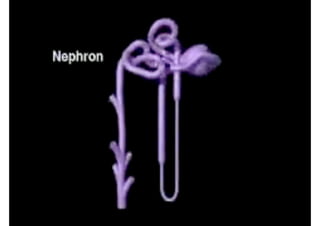
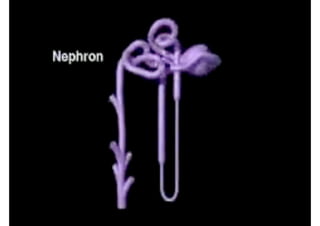
Nephrons are networks of capillaries and
small tubes, or tubules, where filtration of
blood occurs.
•
Each kidney contains about one million
nephrons.
Nephrons
Kidneys
Nephrons
•
Blood contains waste products, salts, and
sometimes toxins from cells that need to be
removed from the body.
•
As blood passes through the kidneys, they
filter these products from the blood.
•
When blood is filtered, a fluid called urine is
produced.
•
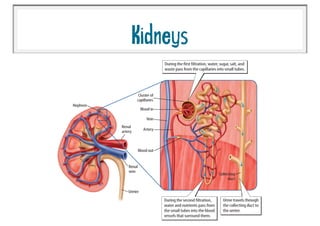
The kidneys filter the blood and produce
urine in two stages.
Urine
Kidneys
•
Blood is constantly circulating and filtering
through the kidneys.
•
In one day, the kidneys filter about 180 L of
blood plasma, or the liquid part of blood. That
is enough liquid to fill ninety 2-L bottles.
•
You have about 3 L of blood plasma in your
body. This means that your kidneys filter
your entire blood supply about 60 times each
day.
First Filtration
Kidneys
•
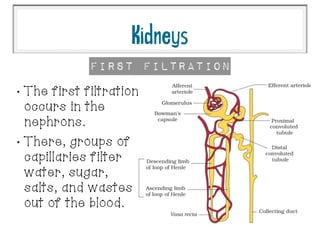
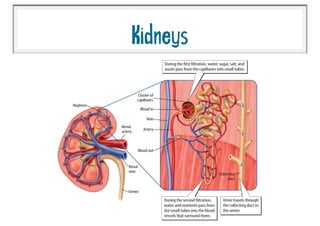
The first filtration
occurs in the
nephrons.
•
There, groups of
capillaries filter
water, sugar,
salts, and wastes
out of the blood.
First Filtration
Kidneys
Kidneys
Kidneys
•
What would happen if all of the liquid from
the first filtration were excreted?
•
Your body would quickly dehydrate, and
important nutrients would be lost.
•
To regain some of this water, the kidneys
filter the liquid collected in the first filtration
again.
Second Filtration
Kidneys
Second Filtration
Kidneys
•
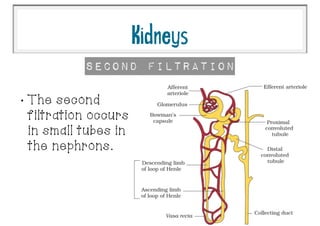
The second
filtration occurs
in small tubes in
the nephrons.
•
During the second filtration, up to 99
percent of the water and nutrients from
the first filtration are separated out and
reabsorbed into the blood.
•
The remaining liquid and waste products
form urine.
•
On average, an adult excretes about 1.5 L
of urine per day.
Second Filtration
Kidneys
Kidneys
Kidneys
•
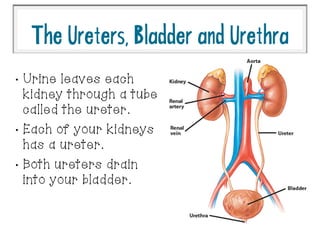
Urine leaves each
kidney through a tube
called the ureter.
•
Each of your kidneys
has a ureter.
•
Both ureters drain
into your bladder.
TheUreters,BladderandUrethra
•
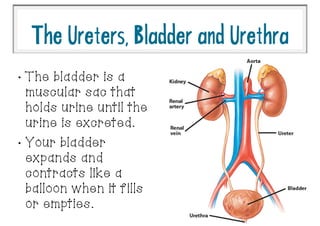
The bladder is a
muscular sac that
holds urine until the
urine is excreted.
•
Your bladder
expands and
contracts like a
balloon when it fills
or empties.
TheUreters,BladderandUrethra
•
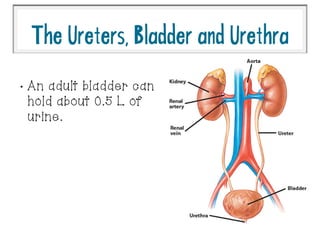
An adult bladder can
hold about 0.5 L of
urine.
TheUreters,BladderandUrethra
•
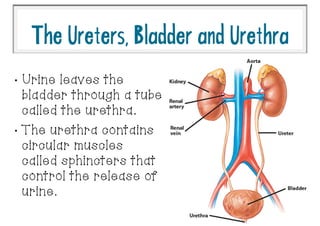
Urine leaves the
bladder through a tube
called the urethra.
•
The urethra contains
circular muscles
called sphincters that
control the release of
urine.
TheUreters,BladderandUrethra
•
The nephrons are damaged and the ability
of the kidneys to filter blood is reduced.
•
In the beginning stages, there might not be
symptoms.
•
Possible causes: diabetes, high blood
pressure, poisons, trauma
UrinaryDisorders
Kidney Disease
•
Infections usually occur in the bladder or
urethra but can be in the kidneys and
ureters.
•
Symptoms might include burning during
urination, small and frequent urination,
and blood in urine.
•
Possible causes: bacteria in the urinary
system
UrinaryDisorders
Urinary Tract InFection
•
Kidney stones are solid substances that
form in the kidneys.
•
The most common type is made of calcium.
•
Stones that pass through the urinary
system can be very painful.
•
Possible causes: calcium buildup in the
kidneys
UrinaryDisorders
Kidney Stones
•
Urine is released from the bladder
involuntarily.
•
These problems occur in women more
often than in men.
•
Possible causes: urinary tract infections,
muscle weakness, prostate enlargement
UrinaryDisorders
Bladder Control Problems
•
The excretory system filters wastes from
the blood.
•
The blood is part of the circulatory
system. A buildup of wastes in the
circulatory system would be toxic to your
body.
TheExcretorySystemandHomeostasis
•
Homeostasis is also maintained by the
removal of wastes from the digestive
system.
•
Wastes would damage your body if the
excretory system did not remove them
from the digestive system.
TheExcretorySystemandHomeostasis
•
The excretory system also interacts with
the nervous system.
•
The hypothalamus is an area of the brain
that helps to maintain homeostasis.
TheExcretorySystemandHomeostasis
•
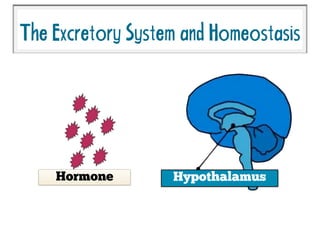
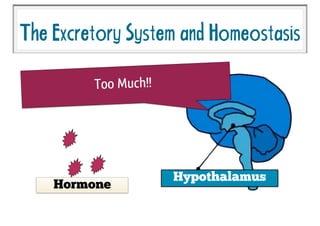
One function of the hypothalamus is to
control the secretion of some hormones.
•
One hormone causes the tubules of the
kidneys to absorb more water from the
blood.
•
This helps the body control fluid levels.
Water is kept in the blood instead of being
excreted in the urine.
TheExcretorySystemandHomeostasis
HypothalamusHormone
TheExcretorySystemandHomeostasis
Hypothalamus
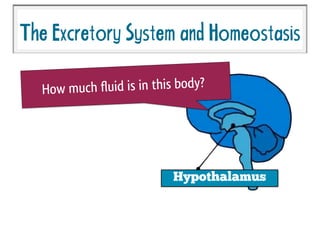
How much fluid is in this body?
TheExcretorySystemandHomeostasis
Hypothalamus
Too Much!!
Hormone
TheExcretorySystemandHomeostasis
Hypothalamus
Too Much!!
Hormone
•
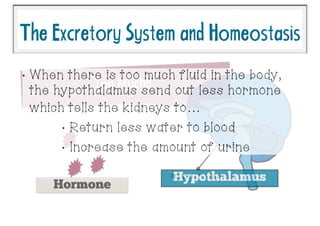
When there is too much fluid in the body,
the hypothalamus send out less hormone
which tells the kidneys to…
•
Return less water to blood
•
Increase the amount of urine
TheExcretorySystemandHomeostasis
Hypothalamus
Not enough!!
Hormone
TheExcretorySystemandHomeostasis
Hypothalamus
Too Much!!
Hormone
•
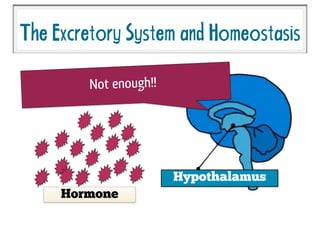
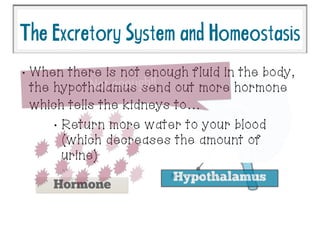
When there is not enough fluid in the body,
the hypothalamus send out more hormone
which tells the kidneys to…
•
Return more water to your blood
(which decreases the amount of
urine)
Not enough!!

Excretory system

  • 1.
  • 2.
  • 3.
    TheExcretorySystem • Your body doesnot use all the food that you take in. • The unused food parts are waste products. • These wastes are processed by the excretory system. • The excretory system collects and eliminates wastes from the body and regulates the level of fluid in the body.
  • 4.
    FunctionsoftheExcretorySystem • The digestive systemcollects waste products in the intestines. • The circulatory system collects waste products in the blood. Collection and Elimination
  • 5.
    FunctionsoftheExcretorySystem • When the trashcans in your home are full of waste, you must take the trash outside. The waste in your body also must be removed. • Waste that is not removed, or eliminated, from your body can become toxic, or poisonous, and damage your organs. Collection and Elimination
  • 6.
    FunctionsoftheExcretorySystem • The excretory systemalso regulates the level of fluids in the body. • Recall that water is an essential nutrient for your body. Some of the water in your body is lost when waste is eliminated. Regulation of LIquids
  • 7.
    FunctionsoftheExcretorySystem • The excretory systemcontrols how much water leaves the body through elimination. This ensures that neither too much nor too little water is lost. Regulation of LIquids
  • 8.
    TypesofExcretion • Your body excretes,or eliminates, different substances from different body systems. • The excretory system is made of four body systems.
  • 9.
    TypesofExcretion Digestive System collects andremoves undigested solids from the foods you eat Urinary System processes, transports, collects, & removes liquid wastes from body Respriatory System removes carbon dioxide & water vapor from the body secretes excess salt and water from the body through sweat glands Integementary System
  • 10.
  • 11.
    OrgansofExcretorySystem • The urinary systemprocesses, stores, and removes liquid wastes from the body. It helps maintain homeostasis.
  • 12.
    OrgansofExcretorySystem The organs ofthe urinary system include: two kidneys, two ureters, the bladder, and the urethra.
  • 13.
    OrgansofExcretorySystem • These organs work togetherto process, transport, collect, and excrete liquid wastes. • Most functions of the urinary system occur in the kidneys.
  • 15.
    Kidneys • The bean-shaped organthat filters, or removes, wastes from blood is the kidney. • You have two kidneys, one on each side of your body. • They are near the back wall of your abdomen, above your waist, and below your rib cage.
  • 16.
  • 17.
    • Each kidney isabout the size of your fist. • Kidneys are dark red in color because of the large amount of blood that passes through them. Kidneys
  • 18.
    • The kidneys haveseveral functions. • Here we focus on the role of the kidneys in the urinary system. But the kidneys have other important functions. • They produce hormones that stimulate the production of red blood cells. • They also control blood pressure and help control calcium levels in the body. Kidney Function Kidneys
  • 19.
    Kidneys • The kidneys containblood vessels and nephrons. • Nephrons are networks of capillaries and small tubes, or tubules, where filtration of blood occurs. • Each kidney contains about one million nephrons. Nephrons
  • 20.
  • 21.
    • Blood contains wasteproducts, salts, and sometimes toxins from cells that need to be removed from the body. • As blood passes through the kidneys, they filter these products from the blood. • When blood is filtered, a fluid called urine is produced. • The kidneys filter the blood and produce urine in two stages. Urine Kidneys
  • 22.
    • Blood is constantlycirculating and filtering through the kidneys. • In one day, the kidneys filter about 180 L of blood plasma, or the liquid part of blood. That is enough liquid to fill ninety 2-L bottles. • You have about 3 L of blood plasma in your body. This means that your kidneys filter your entire blood supply about 60 times each day. First Filtration Kidneys
  • 23.
    • The first filtration occursin the nephrons. • There, groups of capillaries filter water, sugar, salts, and wastes out of the blood. First Filtration Kidneys
  • 24.
  • 25.
  • 26.
    • What would happenif all of the liquid from the first filtration were excreted? • Your body would quickly dehydrate, and important nutrients would be lost. • To regain some of this water, the kidneys filter the liquid collected in the first filtration again. Second Filtration Kidneys
  • 27.
    Second Filtration Kidneys • The second filtrationoccurs in small tubes in the nephrons.
  • 28.
    • During the secondfiltration, up to 99 percent of the water and nutrients from the first filtration are separated out and reabsorbed into the blood. • The remaining liquid and waste products form urine. • On average, an adult excretes about 1.5 L of urine per day. Second Filtration Kidneys
  • 29.
  • 30.
  • 31.
    • Urine leaves each kidneythrough a tube called the ureter. • Each of your kidneys has a ureter. • Both ureters drain into your bladder. TheUreters,BladderandUrethra
  • 32.
    • The bladder isa muscular sac that holds urine until the urine is excreted. • Your bladder expands and contracts like a balloon when it fills or empties. TheUreters,BladderandUrethra
  • 33.
    • An adult bladdercan hold about 0.5 L of urine. TheUreters,BladderandUrethra
  • 34.
    • Urine leaves the bladderthrough a tube called the urethra. • The urethra contains circular muscles called sphincters that control the release of urine. TheUreters,BladderandUrethra
  • 35.
    • The nephrons aredamaged and the ability of the kidneys to filter blood is reduced. • In the beginning stages, there might not be symptoms. • Possible causes: diabetes, high blood pressure, poisons, trauma UrinaryDisorders Kidney Disease
  • 36.
    • Infections usually occurin the bladder or urethra but can be in the kidneys and ureters. • Symptoms might include burning during urination, small and frequent urination, and blood in urine. • Possible causes: bacteria in the urinary system UrinaryDisorders Urinary Tract InFection
  • 37.
    • Kidney stones aresolid substances that form in the kidneys. • The most common type is made of calcium. • Stones that pass through the urinary system can be very painful. • Possible causes: calcium buildup in the kidneys UrinaryDisorders Kidney Stones
  • 38.
    • Urine is releasedfrom the bladder involuntarily. • These problems occur in women more often than in men. • Possible causes: urinary tract infections, muscle weakness, prostate enlargement UrinaryDisorders Bladder Control Problems
  • 39.
    • The excretory systemfilters wastes from the blood. • The blood is part of the circulatory system. A buildup of wastes in the circulatory system would be toxic to your body. TheExcretorySystemandHomeostasis
  • 40.
    • Homeostasis is alsomaintained by the removal of wastes from the digestive system. • Wastes would damage your body if the excretory system did not remove them from the digestive system. TheExcretorySystemandHomeostasis
  • 41.
    • The excretory systemalso interacts with the nervous system. • The hypothalamus is an area of the brain that helps to maintain homeostasis. TheExcretorySystemandHomeostasis
  • 42.
    • One function ofthe hypothalamus is to control the secretion of some hormones. • One hormone causes the tubules of the kidneys to absorb more water from the blood. • This helps the body control fluid levels. Water is kept in the blood instead of being excreted in the urine. TheExcretorySystemandHomeostasis
  • 43.
  • 44.
  • 45.
  • 46.
    TheExcretorySystemandHomeostasis Hypothalamus Too Much!! Hormone • When thereis too much fluid in the body, the hypothalamus send out less hormone which tells the kidneys to… • Return less water to blood • Increase the amount of urine
  • 47.
  • 48.
    TheExcretorySystemandHomeostasis Hypothalamus Too Much!! Hormone • When thereis not enough fluid in the body, the hypothalamus send out more hormone which tells the kidneys to… • Return more water to your blood (which decreases the amount of urine) Not enough!!