Cells
and
Life
Understanding Cells
English scientist Robert Hooke first identified
cells over 300 years ago while looking at cork
under a microscope he built.
Understanding Cells
Cork is actually made of water-resistant cells that
separate the outer bark from the delicate interior bark.
Understanding Cells
• Cork has a unique set of properties not
found in any other naturally existing
material. It is:

• impermeable to gas and liquid
• lightweight
• rot resistant
• fire resistant
• termite resistant
• soft
• buoyant
Understanding Cells

• In the cork Hooke saw small openings similar
to a bee’s honeycomb. The openings
reminded him of the small rooms, called
cells, where monks lived.

• Hooke named these small structures cells.
Cell Theory
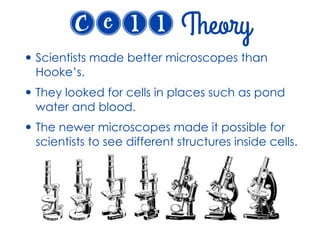
• Scientists made better microscopes than
Hooke’s.

• They looked for cells in places such as pond
water and blood.

• The newer microscopes made it possible for

scientists to see different structures inside cells.
Cell Theory
• A scientist named Matthias Schleiden
looked at plant cells.

• Another scientist, Theodore
studied animal cells.

Schwann,

• Later, Rudolf Virchow said all cells come
from cells that already exist.

• The observations made by these scientists
became known as the cell theory.
Cell Theory
The Cell Theory states:
1. All living things are made of one or more
cells.
2. The cell is the smallest unit of life.
3. All new cells come from pre-existing cells.
Basic Cell Substances
• The cell theory raised more questions for

scientists. Scientists began to look into what
cells are made of.

• Cells are made of smaller parts called

macromolecules that form when many
small molecules join together.

• Macromolecules cannot function without
one of the most important substances in
cells - water.
Basic Cell Substances
• The main ingredient in every cell is water.

Making up more than 70 percent of a cell.

• Water also surrounds cells, helping to

insulate your body. This helps your body
maintain a stable internal environment, or
homeostasis.

• Water also is useful because it can dissolve
other substances, such as salt.

• For substances to move into and out of a
cell, they must be dissolved in a liquid.
Macromolecules in Cells
• All cells contain other substances besides
water that help cells do what they do.

• There are four types of macromolecules in
cells. They are nucleic acids, proteins,
lipids, and carbohydrates.

• Each type of macromolecule has its own
function in a cell. These functions range
from growth and communication to
movement and storage.
Macromolecules in Cells
Nucleic Acids

• Both deoxyribonucleic acid (DNA) and

ribonucleic acid (RNA) are nucleic acids.

• Nucleic acids are important because they
contain the genetic material of a cell. This
information is passed from parents to
offspring.

• Nucleic acids are macromolecules formed
when long chains of molecules called
nucleotides join together.
Macromolecules in Cells
Nucleic Acids

DNA
Macromolecules in Cells
Nucleic Acids

DNA
Macromolecules in Cells
Nucleic Acids

DNA
Macromolecules in Cells
Nucleic Acids

DNA
Macromolecules in Cells
Nucleic Acids

DNA
Macromolecules in Cells
Nucleic Acids

DNA

RNA
Macromolecules in Cells
Nucleic Acids

• DNA includes instructions for cell growth, for
cell reproduction, and for cell processes
that enable a cell to respond to its
environment.

• DNA is used to make RNA. RNA is used to
make proteins.

• The order of nucleotides in DNA and RNA is
important. A change in the order of the
nucleotides can change the information in
a cell.
Macromolecules in Cells
Proteins

• The macromolecules necessary for almost
everything cells do are proteins.

• A protein is a macromolecule made of
long chains of amino acid molecules.

• RNA contains instructions for joining amino
acids together to build the protein.
Macromolecules in Cells
Proteins

Amino
Acids
Macromolecules in Cells
Proteins

Chain
of
Amino
Acids
Macromolecules in Cells
Proteins

Chain
of
Amino
Acids
Macromolecules in Cells
Proteins
• A protein can contain 100 to 10,000’s
amino acids.

• Cells have hundreds of proteins.
• Each protein has its own function. For

example some:
• help cells communicate with other cells
• move substances around inside cells
• help to break down nutrients in food
• make up supporting structures (like hair,
horns, and feathers)
Macromolecules in Cells
Lipids

• A lipid is a large macromolecule that does

not dissolve in water. Because lipids do not
dissolve in water, they protect cells.

• Lipids also are a large part of the cell
membrane.

• Lipids store energy for cells and help with
cell communication.

• Cholesterol and vitamin A are lipids.
Macromolecules in Cells
Lipids

Cell Membrane
Macromolecules in Cells
Carbohydrates

• One sugar molecule, two sugar molecules,
or a long chain of sugar molecules make
up carbohydrates.

• Carbohydrates store energy, provide

structural support for cells, and help cells
communicate.
Macromolecules in Cells
Carbohydrates

• Sugars and starches are carbohydrates that
store energy. Fruits contain sugars. Bread
and pasta are mostly starch.

• The energy stored in sugars and starches

can be released quickly through chemical
reactions in cells.

• Cellulose is a carbohydrate in the cell walls
of plants.
Macromolecules in Cells
Carbohydrate

Sugars
Macromolecules in Cells
Carbohydrate

Starch chain of glucose
Macromolecules in Cells
Carbohydrate

Cellulose

many chains of glucose
bunched together

Cells and Life

  • 1.
  • 2.
    Understanding Cells English scientistRobert Hooke first identified cells over 300 years ago while looking at cork under a microscope he built.
  • 3.
    Understanding Cells Cork isactually made of water-resistant cells that separate the outer bark from the delicate interior bark.
  • 4.
    Understanding Cells • Corkhas a unique set of properties not found in any other naturally existing material. It is: • impermeable to gas and liquid • lightweight • rot resistant • fire resistant • termite resistant • soft • buoyant
  • 5.
    Understanding Cells • Inthe cork Hooke saw small openings similar to a bee’s honeycomb. The openings reminded him of the small rooms, called cells, where monks lived. • Hooke named these small structures cells.
  • 6.
    Cell Theory • Scientistsmade better microscopes than Hooke’s. • They looked for cells in places such as pond water and blood. • The newer microscopes made it possible for scientists to see different structures inside cells.
  • 7.
    Cell Theory • Ascientist named Matthias Schleiden looked at plant cells. • Another scientist, Theodore studied animal cells. Schwann, • Later, Rudolf Virchow said all cells come from cells that already exist. • The observations made by these scientists became known as the cell theory.
  • 8.
    Cell Theory The CellTheory states: 1. All living things are made of one or more cells. 2. The cell is the smallest unit of life. 3. All new cells come from pre-existing cells.
  • 10.
    Basic Cell Substances •The cell theory raised more questions for scientists. Scientists began to look into what cells are made of. • Cells are made of smaller parts called macromolecules that form when many small molecules join together. • Macromolecules cannot function without one of the most important substances in cells - water.
  • 11.
    Basic Cell Substances •The main ingredient in every cell is water. Making up more than 70 percent of a cell. • Water also surrounds cells, helping to insulate your body. This helps your body maintain a stable internal environment, or homeostasis. • Water also is useful because it can dissolve other substances, such as salt. • For substances to move into and out of a cell, they must be dissolved in a liquid.
  • 12.
    Macromolecules in Cells •All cells contain other substances besides water that help cells do what they do. • There are four types of macromolecules in cells. They are nucleic acids, proteins, lipids, and carbohydrates. • Each type of macromolecule has its own function in a cell. These functions range from growth and communication to movement and storage.
  • 13.
    Macromolecules in Cells NucleicAcids • Both deoxyribonucleic acid (DNA) and ribonucleic acid (RNA) are nucleic acids. • Nucleic acids are important because they contain the genetic material of a cell. This information is passed from parents to offspring. • Nucleic acids are macromolecules formed when long chains of molecules called nucleotides join together.
  • 14.
  • 15.
  • 16.
  • 17.
  • 18.
  • 19.
  • 20.
    Macromolecules in Cells NucleicAcids • DNA includes instructions for cell growth, for cell reproduction, and for cell processes that enable a cell to respond to its environment. • DNA is used to make RNA. RNA is used to make proteins. • The order of nucleotides in DNA and RNA is important. A change in the order of the nucleotides can change the information in a cell.
  • 21.
    Macromolecules in Cells Proteins •The macromolecules necessary for almost everything cells do are proteins. • A protein is a macromolecule made of long chains of amino acid molecules. • RNA contains instructions for joining amino acids together to build the protein.
  • 22.
  • 23.
  • 24.
  • 25.
    Macromolecules in Cells Proteins •A protein can contain 100 to 10,000’s amino acids. • Cells have hundreds of proteins. • Each protein has its own function. For example some: • help cells communicate with other cells • move substances around inside cells • help to break down nutrients in food • make up supporting structures (like hair, horns, and feathers)
  • 26.
    Macromolecules in Cells Lipids •A lipid is a large macromolecule that does not dissolve in water. Because lipids do not dissolve in water, they protect cells. • Lipids also are a large part of the cell membrane. • Lipids store energy for cells and help with cell communication. • Cholesterol and vitamin A are lipids.
  • 27.
  • 28.
    Macromolecules in Cells Carbohydrates •One sugar molecule, two sugar molecules, or a long chain of sugar molecules make up carbohydrates. • Carbohydrates store energy, provide structural support for cells, and help cells communicate.
  • 29.
    Macromolecules in Cells Carbohydrates •Sugars and starches are carbohydrates that store energy. Fruits contain sugars. Bread and pasta are mostly starch. • The energy stored in sugars and starches can be released quickly through chemical reactions in cells. • Cellulose is a carbohydrate in the cell walls of plants.
  • 30.
  • 31.
  • 32.
    Macromolecules in Cells Carbohydrate Cellulose manychains of glucose bunched together