Protein Synthesis- CENTRAL DOGMA OF LIFE
PROTEIN SYNTHESIS
is the creation of proteins by cells
that uses DNA, RNA, and various
enzymes. It generally includes
transcription, translation, and post-
translational events, such as protein
folding, modifications, and
proteolysis.
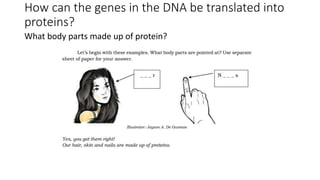
How can the genes in the DNA be translated into
proteins?
What body parts made up of protein?
What are proteins?
They are composed of amino acids linked together by peptide bonds.
What are the roles and functions of proteins?
channels in membranes – control the movement of molecules in
and out of the cell
structural molecules – for example, making up hair or muscle in
animals
hormones – to regulate the activity of cells
antibodies – in the immune system
enzymes – to act as catalysts in biological systems.
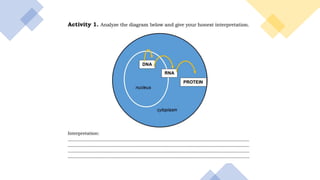
DNA (deoxyribonucleic acid) and RNA (ribonucleic acid) work together to
produce proteins from genetic codes. Genetic codes are found in DNA or
RNA which is made up of nucleotide bases usually in three’s (triplet) that
code for the amino acids making up the proteins.
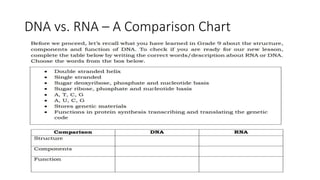
DNA vs. RNA – A Comparison Chart
Nucleic Acid: DNA and RNA
Nucleic acid is a large molecule
composed of carbon, hydrogen, oxygen,
nitrogen and phosphorus. The building
blocks of nucleic acids are nucleotides –
the DNA and RNA. The nucleotide consists
of a phosphate group, a sugar, and a
nitrogen base.
Deoxyribonucleic Acid (DNA)
is made of two linked strands that wind around each other
to resemble a twisted ladder — a shape known as a double helix.
Each strand has a backbone made of alternating sugar
(deoxyribose) and phosphate groups.
Attached to each sugar is one of four bases: adenine (A),
cytosine (C), guanine (G) or thymine (T).
DNA contains the instructions needed for an organism to
develop, survive and reproduce. To carry out these functions,
DNA sequences must be converted into messages that can be
used to produce proteins, which are the complex molecules that
do most of the work in our bodies.
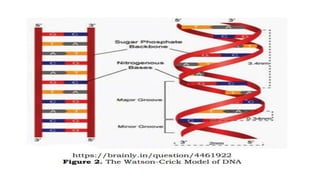
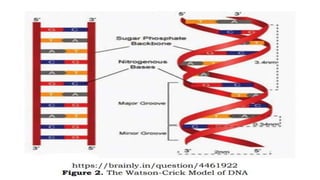
As shown in figure 2, the DNA (Deoxyribonucleic
Acid) has two strands of nucleotides joined together
to form a twisted ladder called double helix. It is
found in the nucleus of every cell. It contains a
deoxyribose sugar phosphate backbone, and adenine,
guanine, cytosine, thymine bases. The base pairing in
DNA is AT (adenine-thymine) and GC (guanine-
cytosine).
The DNA consists of an equal amount of the
four nucleotides that are important to the
operation and cell production. Each nucleotide
contains three different components: 1. one
phosphorus with four oxygen ( a phosphate
group); 2. a five-carbon sugar (deoxyribose); and
3. a nitrogen-containing base (either a single-
ringed pyrimidine or a doubleringed purine)
The DNA is located inside the nucleus of the
cell as shown in figure 1. It is a tightly coiled
molecule that contains genes. The genes
determine all the features found in a living cells
such as structure of the hair, complexion, color of
the eyes etc. the molecule is a very large chain of
repeating units called polymer, which are large,
carbon-based molecules formed by monomers
Ribonucleic acid (RNA)
is a molecule that is present in the majority of living
organisms and viruses.
It is made up of nucleotides, which are ribose sugars
attached to nitrogenous bases and phosphate groups.
The nitrogenous bases include adenine, guanine,
uracil, and cytosine.
RNA mostly exists in the single-stranded form, but
there are special RNA viruses that are double-stranded.
To create proteins via translation. RNA carries genetic
information that is translated by ribosomes into various
proteins necessary for cellular processes. mRNA, rRNA, and
tRNA are the three main types of RNA involved in protein
synthesis.
RNA (Ribonucleic Acid is single stranded. It is
found in the ribosomes. RNA is used to transfer
the genetic code from the nucleus to the
ribosomes to make proteins. It has ribose sugar,
phosphate backbone and adenine, guanine,
cytosine, uracil bases. The base pairing in RNA is
AU (adenine-uracil) and GC (guanine-
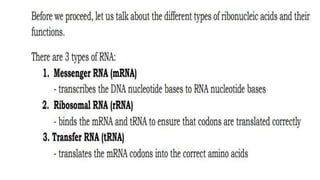
cytosine).The major types of RNA include:
messenger (mRNA), ribosomal RNA (rRNA), and
transfer RNA (tRNA).
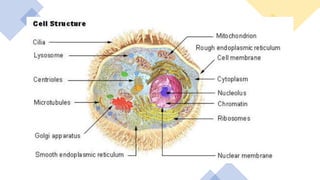
A cell consists of three parts:
the cell membrane, the nucleus,
and, between the two,
the cytoplasm. Within the
cytoplasm lie intricate
arrangements of fine fibers and
hundreds or even thousands of
miniscule but distinct structures
Cell membrane
Every cell in the body is enclosed by a cell
(Plasma) membrane. The cell membrane separates the
material outside the cell, extracellular, from the material
inside the cell, intracellular. It maintains the integrity of a
cell and controls passage of materials into and out of
the cell. All materials within a cell must have access to
the cell membrane (the cell's boundary) for the needed
exchange.
The cell membrane is a double layer of
phospholipid molecules. Proteins in the cell membrane
provide structural support, form channels for passage of
materials, act as receptor sites, function
as carrier molecules, and provide identification markers.
Nucleus and Nucleolus
The nucleus, formed by a nuclear
membrane around a fluid nucleoplasm, is the
control center of the cell. Threads
of chromatin in the nucleus
contain deoxyribonucleic acid (DNA),
the genetic material of the cell. The nucleolus is
a dense region of ribonucleic acid (RNA) in the
nucleus and is the site of ribosome formation.
The nucleus determines how the cell will
function, as well as the basic structure of that
cell.
Cytoplasm
The cytoplasm is the gel-like fluid inside the
cell. It is the medium for chemical reaction. It
provides a platform upon which other
organelles can operate within the cell. All of the
functions for cell expansion, growth and
replication are carried out in the cytoplasm of a
cell. Within the cytoplasm, materials move
by diffusion, a physical process that can work
only for short distances.
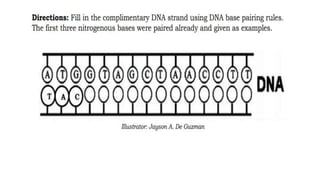
What is the complementary base pairing
rule for DNA?
• Complementary base pairs refer to the nitrogenous bases adenine, thymine, cytosine, and guanine. in a double strand of
DNA, adenine will always pair with its complement thymine and cytosine will always pair with its complement guanine.
• What is a base pair in genetics?
• A base pair in genetics refers to complementary nitrogenous bases that are paired in a double strand of DNA. Here,
adenine is with thymine and cytosine with guanine.
• How are complementary bases in DNA held together?
• DNA complementary bases are held together by hydrogen bonds. An attraction exists between the hydrogen molecules in
the complementary bases.
• Why is complementary base pairing important for DNA replication?
• DNA replication is a necessary step in the cell cycle. In order for cells to divide, they must have a complete set of
chromosomes for each cell. Replication, following the complementary base pair rules, is necessary to make sure both
copies are ready.
• What is an example of complementary base pair?
• An example of a base pair found in a double helix of DNA would be adenine bonding with thymine. Another example is
cytosine bonding with guanine.
THE CENTRAL DOGMA OF LIFE
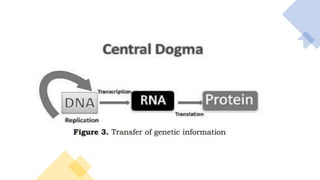
The central dogma of molecular biology is a theory stating
that genetic information flows only in one direction, from DNA, to
RNA, to protein, or RNA directly to protein.
The central dogma states that the pattern of information
that occurs most frequently in our cells is:
From existing DNA to make new DNA (DNA
replication?) From DNA to make new RNA
(transcription) From RNA to make new proteins (translation).
THE CENTRAL DOGMA OF LIFE
Replication
One of the accepted features of the Watson and Crick
model (consists of two helical strands twisted around each other in a double
helix. Each strand, the authors explain, contains a chain of repeating units called
nucleotides, where each nucleotide contains a sugar, a phosphate group, and a
base.) is that the DNA could be copied. The bases attached to
the strands of DNA will pair only in one way based on the
standard rules of base pairing. According to Watson and Crick,
a single DNA strand can serve as a template for new strand.
When the DNA is copied during the cell cycle, the process is
called replication. The central dogma of the transfer of genetic
information is outlined below.
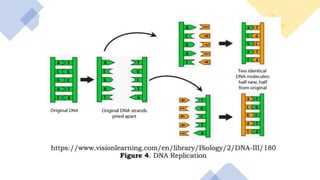
Enzymes and other proteins are responsible for the
process of DNA replication. An enzyme begins the
process by unzipping the double helix to separate the
strands of DNA. Some proteins hold the strands apart,
which serve as templates. The floating free nucleotides
in the nucleus will be paired with the nucleotide of the
existing DNA strand. The DNA polymerase (group of
enzymes) is responsible to bond the new nucleotide
together. When the complete process is done, it forms
two complete molecules of DNA, each exactly the same
as the original double strand.
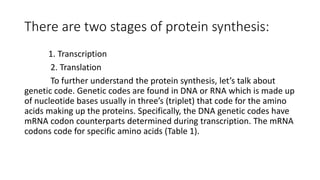
There are two stages of protein synthesis:
1. Transcription
2. Translation
To further understand the protein synthesis, let’s talk about
genetic code. Genetic codes are found in DNA or RNA which is made up
of nucleotide bases usually in three’s (triplet) that code for the amino
acids making up the proteins. Specifically, the DNA genetic codes have
mRNA codon counterparts determined during transcription. The mRNA
codons code for specific amino acids (Table 1).
TRANSCRIPTION
TRANSCRIPTION
Transcription occurs inside the nucleus, and it is the first step in gene
expression.
Transcription is the name given to the process in which DNA is
copied to make a complementary strand of RNA. This RNA copy,
called messenger RNA (mRNA), carries the genetic information
needed to make proteins in a cell. It carries the information from the
DNA in the nucleus of the cell to the cytoplasm, where proteins are
made. In transcription stage of protein synthesis, the DNA unzips
through the help of enzymes called RNA polymerases. They combine
nucleotides to form an RNA strand (using one of the DNA strands as a
template).
Steps of Transcription
Transcription can be broken into five stages:
pre-initiation,
initiation,
promoter clearance,
elongation, and
termination:
Pre-initiation.
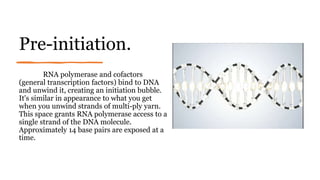
RNA polymerase and cofactors
(general transcription factors) bind to DNA
and unwind it, creating an initiation bubble.
It's similar in appearance to what you get
when you unwind strands of multi-ply yarn.
This space grants RNA polymerase access to a
single strand of the DNA molecule.
Approximately 14 base pairs are exposed at a
time.
Initiation
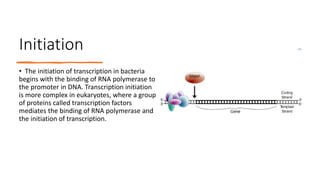
• The initiation of transcription in bacteria
begins with the binding of RNA polymerase to
the promoter in DNA. Transcription initiation
is more complex in eukaryotes, where a group
of proteins called transcription factors
mediates the binding of RNA polymerase and
the initiation of transcription.
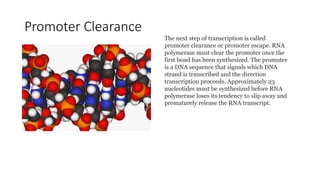
Promoter Clearance
The next step of transcription is called
promoter clearance or promoter escape. RNA
polymerase must clear the promoter once the
first bond has been synthesized. The promoter
is a DNA sequence that signals which DNA
strand is transcribed and the direction
transcription proceeds. Approximately 23
nucleotides must be synthesized before RNA
polymerase loses its tendency to slip away and
prematurely release the RNA transcript.
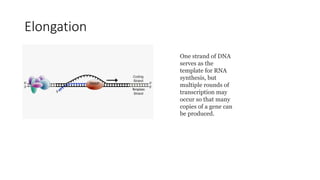
Elongation
One strand of DNA
serves as the
template for RNA
synthesis, but
multiple rounds of
transcription may
occur so that many
copies of a gene can
be produced.
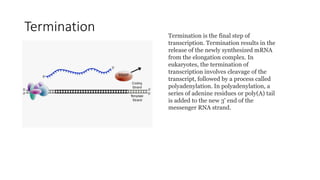
Termination Termination is the final step of
transcription. Termination results in the
release of the newly synthesized mRNA
from the elongation complex. In
eukaryotes, the termination of
transcription involves cleavage of the
transcript, followed by a process called
polyadenylation. In polyadenylation, a
series of adenine residues or poly(A) tail
is added to the new 3' end of the
messenger RNA strand.
CELL REPLICATION.pptx

CELL REPLICATION.pptx

  • 1.
  • 2.
    PROTEIN SYNTHESIS is thecreation of proteins by cells that uses DNA, RNA, and various enzymes. It generally includes transcription, translation, and post- translational events, such as protein folding, modifications, and proteolysis.
  • 3.
    How can thegenes in the DNA be translated into proteins? What body parts made up of protein?
  • 4.
    What are proteins? Theyare composed of amino acids linked together by peptide bonds. What are the roles and functions of proteins? channels in membranes – control the movement of molecules in and out of the cell structural molecules – for example, making up hair or muscle in animals hormones – to regulate the activity of cells antibodies – in the immune system enzymes – to act as catalysts in biological systems. DNA (deoxyribonucleic acid) and RNA (ribonucleic acid) work together to produce proteins from genetic codes. Genetic codes are found in DNA or RNA which is made up of nucleotide bases usually in three’s (triplet) that code for the amino acids making up the proteins.
  • 5.
    DNA vs. RNA– A Comparison Chart
  • 6.
    Nucleic Acid: DNAand RNA Nucleic acid is a large molecule composed of carbon, hydrogen, oxygen, nitrogen and phosphorus. The building blocks of nucleic acids are nucleotides – the DNA and RNA. The nucleotide consists of a phosphate group, a sugar, and a nitrogen base.
  • 7.
    Deoxyribonucleic Acid (DNA) ismade of two linked strands that wind around each other to resemble a twisted ladder — a shape known as a double helix. Each strand has a backbone made of alternating sugar (deoxyribose) and phosphate groups. Attached to each sugar is one of four bases: adenine (A), cytosine (C), guanine (G) or thymine (T). DNA contains the instructions needed for an organism to develop, survive and reproduce. To carry out these functions, DNA sequences must be converted into messages that can be used to produce proteins, which are the complex molecules that do most of the work in our bodies.
  • 8.
    As shown infigure 2, the DNA (Deoxyribonucleic Acid) has two strands of nucleotides joined together to form a twisted ladder called double helix. It is found in the nucleus of every cell. It contains a deoxyribose sugar phosphate backbone, and adenine, guanine, cytosine, thymine bases. The base pairing in DNA is AT (adenine-thymine) and GC (guanine- cytosine).
  • 10.
    The DNA consistsof an equal amount of the four nucleotides that are important to the operation and cell production. Each nucleotide contains three different components: 1. one phosphorus with four oxygen ( a phosphate group); 2. a five-carbon sugar (deoxyribose); and 3. a nitrogen-containing base (either a single- ringed pyrimidine or a doubleringed purine)
  • 11.
    The DNA islocated inside the nucleus of the cell as shown in figure 1. It is a tightly coiled molecule that contains genes. The genes determine all the features found in a living cells such as structure of the hair, complexion, color of the eyes etc. the molecule is a very large chain of repeating units called polymer, which are large, carbon-based molecules formed by monomers
  • 12.
    Ribonucleic acid (RNA) isa molecule that is present in the majority of living organisms and viruses. It is made up of nucleotides, which are ribose sugars attached to nitrogenous bases and phosphate groups. The nitrogenous bases include adenine, guanine, uracil, and cytosine. RNA mostly exists in the single-stranded form, but there are special RNA viruses that are double-stranded. To create proteins via translation. RNA carries genetic information that is translated by ribosomes into various proteins necessary for cellular processes. mRNA, rRNA, and tRNA are the three main types of RNA involved in protein synthesis.
  • 13.
    RNA (Ribonucleic Acidis single stranded. It is found in the ribosomes. RNA is used to transfer the genetic code from the nucleus to the ribosomes to make proteins. It has ribose sugar, phosphate backbone and adenine, guanine, cytosine, uracil bases. The base pairing in RNA is AU (adenine-uracil) and GC (guanine- cytosine).The major types of RNA include: messenger (mRNA), ribosomal RNA (rRNA), and transfer RNA (tRNA).
  • 16.
    A cell consistsof three parts: the cell membrane, the nucleus, and, between the two, the cytoplasm. Within the cytoplasm lie intricate arrangements of fine fibers and hundreds or even thousands of miniscule but distinct structures
  • 17.
    Cell membrane Every cellin the body is enclosed by a cell (Plasma) membrane. The cell membrane separates the material outside the cell, extracellular, from the material inside the cell, intracellular. It maintains the integrity of a cell and controls passage of materials into and out of the cell. All materials within a cell must have access to the cell membrane (the cell's boundary) for the needed exchange. The cell membrane is a double layer of phospholipid molecules. Proteins in the cell membrane provide structural support, form channels for passage of materials, act as receptor sites, function as carrier molecules, and provide identification markers.
  • 18.
    Nucleus and Nucleolus Thenucleus, formed by a nuclear membrane around a fluid nucleoplasm, is the control center of the cell. Threads of chromatin in the nucleus contain deoxyribonucleic acid (DNA), the genetic material of the cell. The nucleolus is a dense region of ribonucleic acid (RNA) in the nucleus and is the site of ribosome formation. The nucleus determines how the cell will function, as well as the basic structure of that cell.
  • 19.
    Cytoplasm The cytoplasm isthe gel-like fluid inside the cell. It is the medium for chemical reaction. It provides a platform upon which other organelles can operate within the cell. All of the functions for cell expansion, growth and replication are carried out in the cytoplasm of a cell. Within the cytoplasm, materials move by diffusion, a physical process that can work only for short distances.
  • 21.
    What is thecomplementary base pairing rule for DNA? • Complementary base pairs refer to the nitrogenous bases adenine, thymine, cytosine, and guanine. in a double strand of DNA, adenine will always pair with its complement thymine and cytosine will always pair with its complement guanine. • What is a base pair in genetics? • A base pair in genetics refers to complementary nitrogenous bases that are paired in a double strand of DNA. Here, adenine is with thymine and cytosine with guanine. • How are complementary bases in DNA held together? • DNA complementary bases are held together by hydrogen bonds. An attraction exists between the hydrogen molecules in the complementary bases. • Why is complementary base pairing important for DNA replication? • DNA replication is a necessary step in the cell cycle. In order for cells to divide, they must have a complete set of chromosomes for each cell. Replication, following the complementary base pair rules, is necessary to make sure both copies are ready. • What is an example of complementary base pair? • An example of a base pair found in a double helix of DNA would be adenine bonding with thymine. Another example is cytosine bonding with guanine.
  • 23.
    THE CENTRAL DOGMAOF LIFE The central dogma of molecular biology is a theory stating that genetic information flows only in one direction, from DNA, to RNA, to protein, or RNA directly to protein. The central dogma states that the pattern of information that occurs most frequently in our cells is: From existing DNA to make new DNA (DNA replication?) From DNA to make new RNA (transcription) From RNA to make new proteins (translation).
  • 24.
    THE CENTRAL DOGMAOF LIFE Replication One of the accepted features of the Watson and Crick model (consists of two helical strands twisted around each other in a double helix. Each strand, the authors explain, contains a chain of repeating units called nucleotides, where each nucleotide contains a sugar, a phosphate group, and a base.) is that the DNA could be copied. The bases attached to the strands of DNA will pair only in one way based on the standard rules of base pairing. According to Watson and Crick, a single DNA strand can serve as a template for new strand. When the DNA is copied during the cell cycle, the process is called replication. The central dogma of the transfer of genetic information is outlined below.
  • 26.
    Enzymes and otherproteins are responsible for the process of DNA replication. An enzyme begins the process by unzipping the double helix to separate the strands of DNA. Some proteins hold the strands apart, which serve as templates. The floating free nucleotides in the nucleus will be paired with the nucleotide of the existing DNA strand. The DNA polymerase (group of enzymes) is responsible to bond the new nucleotide together. When the complete process is done, it forms two complete molecules of DNA, each exactly the same as the original double strand.
  • 28.
    There are twostages of protein synthesis: 1. Transcription 2. Translation To further understand the protein synthesis, let’s talk about genetic code. Genetic codes are found in DNA or RNA which is made up of nucleotide bases usually in three’s (triplet) that code for the amino acids making up the proteins. Specifically, the DNA genetic codes have mRNA codon counterparts determined during transcription. The mRNA codons code for specific amino acids (Table 1).
  • 29.
  • 30.
    TRANSCRIPTION Transcription occurs insidethe nucleus, and it is the first step in gene expression. Transcription is the name given to the process in which DNA is copied to make a complementary strand of RNA. This RNA copy, called messenger RNA (mRNA), carries the genetic information needed to make proteins in a cell. It carries the information from the DNA in the nucleus of the cell to the cytoplasm, where proteins are made. In transcription stage of protein synthesis, the DNA unzips through the help of enzymes called RNA polymerases. They combine nucleotides to form an RNA strand (using one of the DNA strands as a template).
  • 31.
    Steps of Transcription Transcriptioncan be broken into five stages: pre-initiation, initiation, promoter clearance, elongation, and termination:
  • 32.
    Pre-initiation. RNA polymerase andcofactors (general transcription factors) bind to DNA and unwind it, creating an initiation bubble. It's similar in appearance to what you get when you unwind strands of multi-ply yarn. This space grants RNA polymerase access to a single strand of the DNA molecule. Approximately 14 base pairs are exposed at a time.
  • 33.
    Initiation • The initiationof transcription in bacteria begins with the binding of RNA polymerase to the promoter in DNA. Transcription initiation is more complex in eukaryotes, where a group of proteins called transcription factors mediates the binding of RNA polymerase and the initiation of transcription.
  • 34.
    Promoter Clearance The nextstep of transcription is called promoter clearance or promoter escape. RNA polymerase must clear the promoter once the first bond has been synthesized. The promoter is a DNA sequence that signals which DNA strand is transcribed and the direction transcription proceeds. Approximately 23 nucleotides must be synthesized before RNA polymerase loses its tendency to slip away and prematurely release the RNA transcript.
  • 35.
    Elongation One strand ofDNA serves as the template for RNA synthesis, but multiple rounds of transcription may occur so that many copies of a gene can be produced.
  • 36.
    Termination Termination isthe final step of transcription. Termination results in the release of the newly synthesized mRNA from the elongation complex. In eukaryotes, the termination of transcription involves cleavage of the transcript, followed by a process called polyadenylation. In polyadenylation, a series of adenine residues or poly(A) tail is added to the new 3' end of the messenger RNA strand.