Usman
M.Phil Zoology Section B
Topic Of Presentation
NATURAL SELECTION
AND ITS TYPES
Natural selection described by
Charles Darwin.
Basic and fundamental
mechanism of the theory of
evolution.
The term was introduced in "On
The Origin of Species," in 1859.
The Natural Selection is a process, by which
organisms are better adapted to their
environment tend to survive and produce more
offspring.
A Natural Selection is a process that results in
the survival and reproductive success of
individuals or groups best adjusted to their
environment.
What is Natural Selection?
The process of natural selection relies
on a few Important Factors
Variation within a species is
necessary
Individuals must vary in
appearance or behavior
The variable traits must be
inherited by offspring
Factors
Competition
Since food and resources are limited
The offspring have to compete to survive
Darwin called it Struggle For Existence
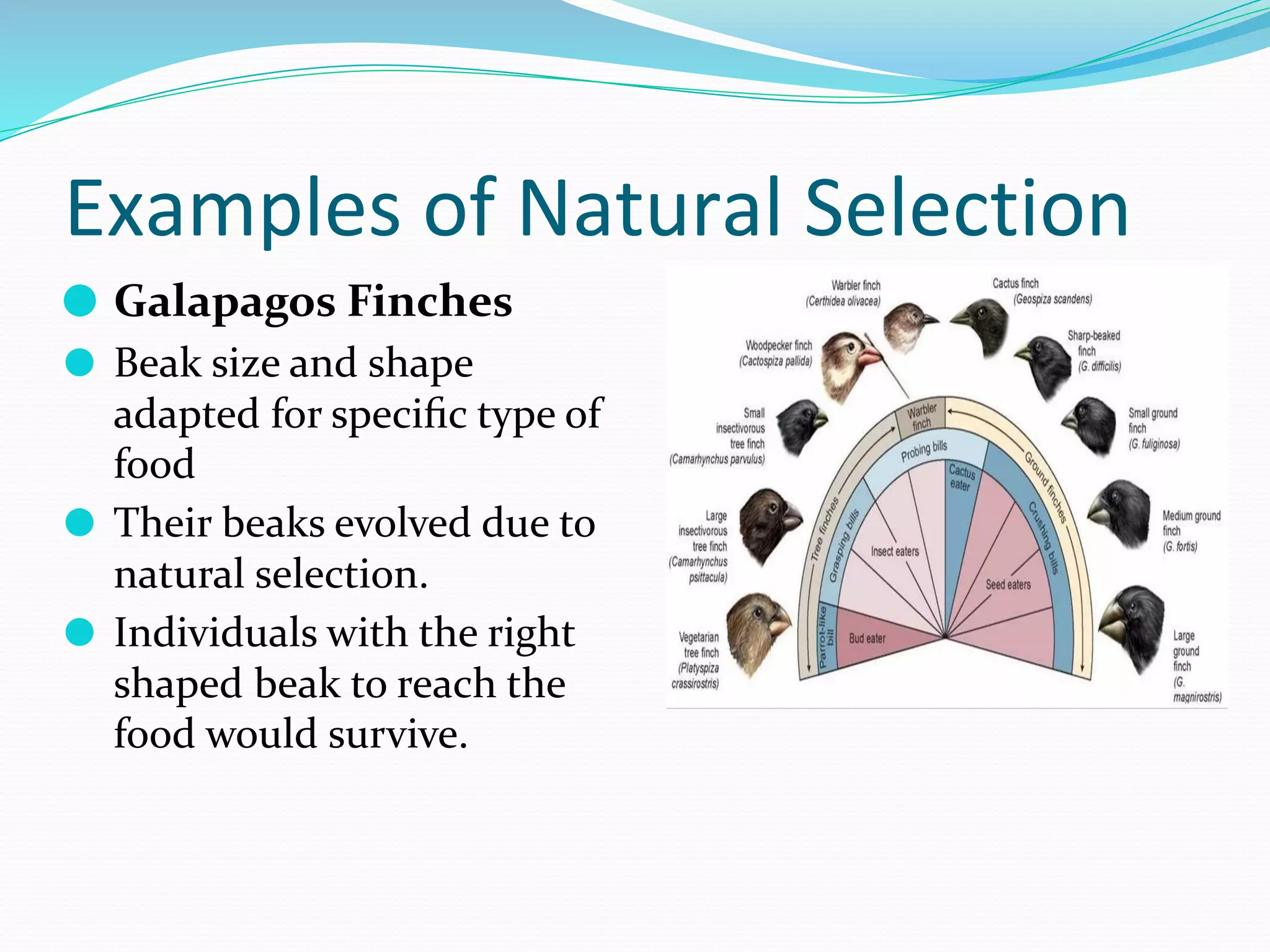
⚫ Galapagos Finches
⚫ Beak size and shape
adapted for specific type of
food
⚫ Their beaks evolved due to
natural selection.
⚫ Individuals with the right
shaped beak to reach the
food would survive.
There are the following types of natural
selection which affect the phenotypes of
individuals are:
Directional Selection
Disruptive Selection
Stabilizing Selection
Types of Natural Selection
⚫ A type of Natural Selection
in which the phenotype of
the species tends toward
one extreme.
⚫ Occurs when natural
selection favors one
extreme of continuous
variation.
⚫ The favored extreme will
become more common .
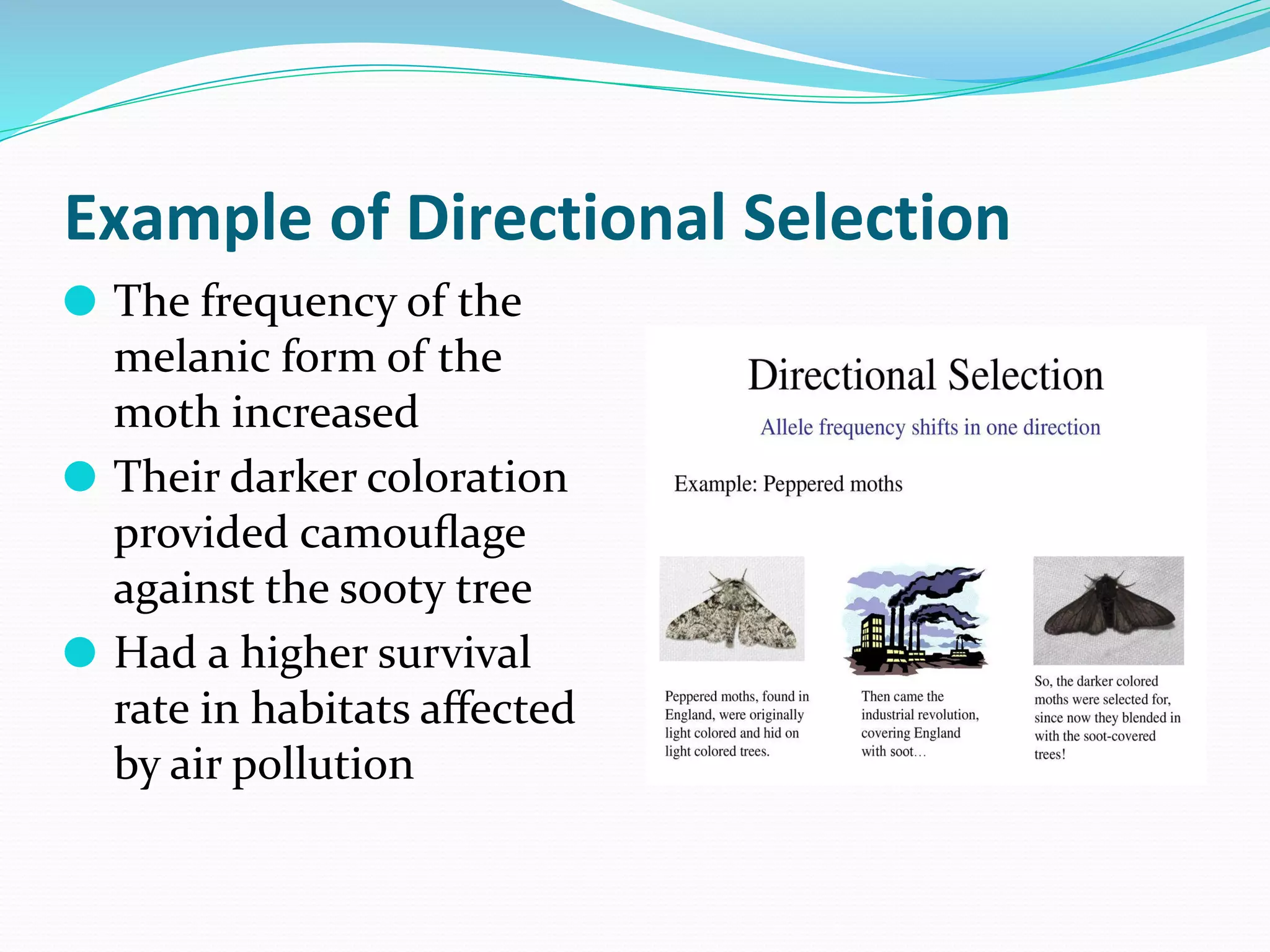
⚫ The frequency of the
melanic form of the
moth increased
⚫ Their darker coloration
provided camouflage
against the sooty tree
⚫ Had a higher survival
rate in habitats affected
by air pollution
⚫ A type of natural selection
that removes individuals
from the center of a
phenotypic distribution and
causes the distribution to
become bimodal.
⚫ Occurs when natural
selection favors both
extremes of continuous
variation.
⚫ The two extreme variations
will become more common.
⚫ Light-colored oysters are
more coloration
⚫ allow organism to match
its background
⚫ Dark-colored oysters blend
into the shadows cast by
the rocks
⚫ Intermediate-colored
oysters would be most
heavily preyed upon by the
crabs
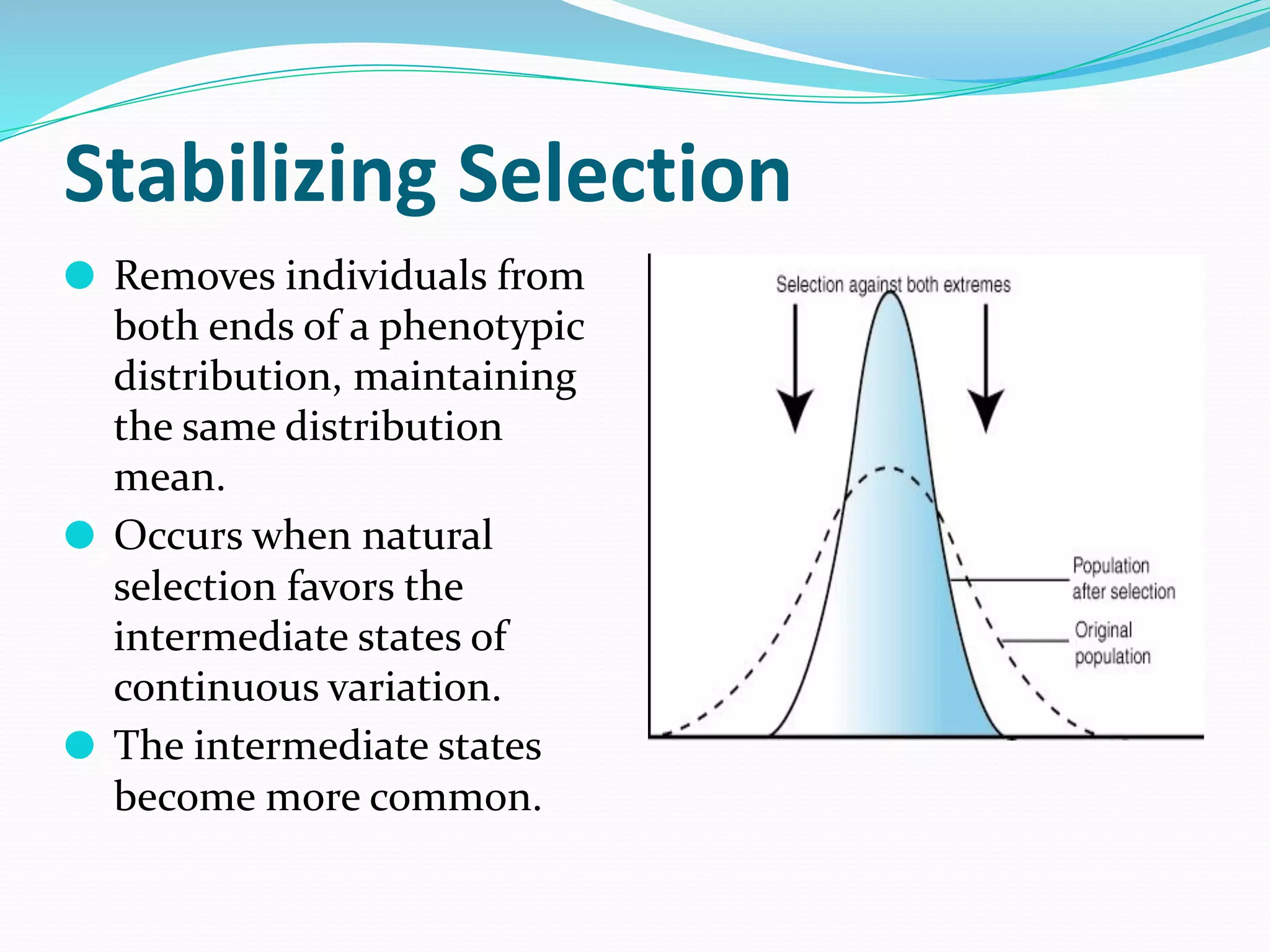
⚫ Removes individuals from
both ends of a phenotypic
distribution, maintaining
the same distribution
mean.
⚫ Occurs when natural
selection favors the
intermediate states of
continuous variation.
⚫ The intermediate states
become more common.
⚫ Very light-colored or very
dark-colored oysters might
be more frequently preyed
upon by shore birds
⚫ Because they are more
obvious on the oyster bar
⚫ The intermediate colored
oysters become more
common
The different genders in a species exert forces on
each other that changes their appearance or traits.
✔ Natural selection favors traits that maximize
✔ The ability of an individual to compete
✔ Attract mates
✔ The ability to produce offspring
⚫
Sexual Selection
⚫ The peacocks with the
showier feathers are able to
attract mates
⚫ Peacocks can fold up their
tails, in danger of predator
⚫ Peahens are much duller
and more camouflaged
⚫ They are the ones who
guard the eggs and chicks
⚫ Survival of the next
generation is very
important
A type of selection that involves altruistic
behavior
Occurs when natural selection favors a trait that
benefits related members of a group
✔ The protection of offspring
✔ Parent acts to preserve the gene pool of offspring
✔ At the expense of itself.
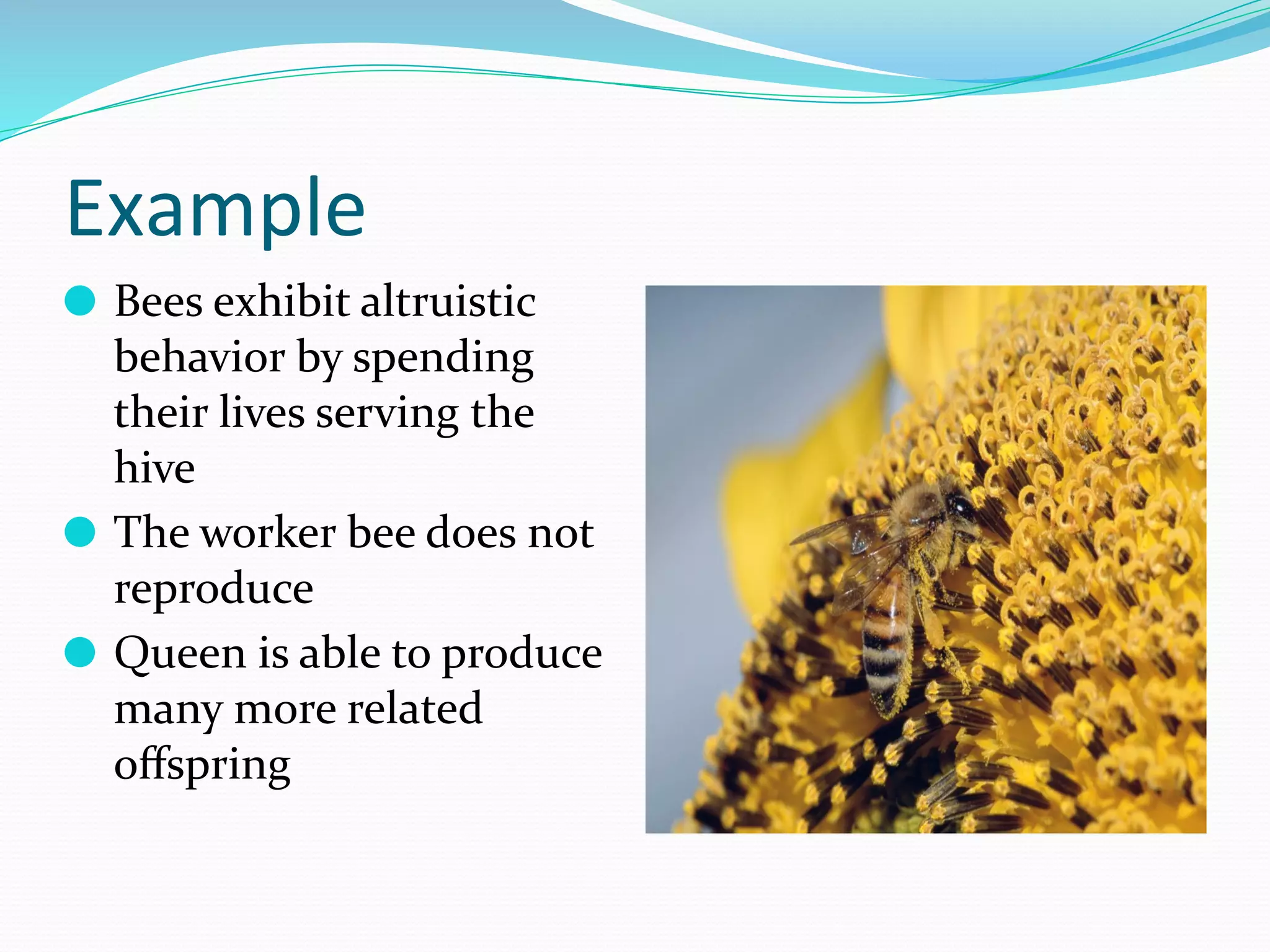
⚫ Bees exhibit altruistic
behavior by spending
their lives serving the
hive
⚫ The worker bee does not
reproduce
⚫ Queen is able to produce
many more related
offspring
⚫ Andersson, M. and L. W. Simmons. 2006. Sexual selection and mate choice. Trends Ecol.
Evol., 21: 154-165.
⚫ Brunnander, B. 2007. What is natural selection. Biol. Philos., 22: 231-246.
⚫ Gavrilets, S. 2004. Fitness Landscapes and the Origin of Species. Princeton Univ. Press,
41:978-691.
⚫ Haldane, J. B. S. 1992. The Cost of Natural Selection. Curr. Sci., 14: 612-625.
⚫ Mayr, E. 1997. The objects of selection. Proc. Natl. Acad. Sci., 94: 2091-2094.
⚫ Pust, J. 2001. Natural selection explanation and origin essentialism. Can. J. Philos., 31:
201-220.
⚫ Williams, G. C. 1966. Adaptation and Natural Selection. Princeton Univ. Press, 8: 86-93.
⚫ Lenski, R. E. 2017. What is adaptation by natural selection. PLoS One, 13: 100-105.
Natural Selection and its types

Natural Selection and its types

  • 2.
    Usman M.Phil Zoology SectionB Topic Of Presentation NATURAL SELECTION AND ITS TYPES
  • 3.
    Natural selection describedby Charles Darwin. Basic and fundamental mechanism of the theory of evolution. The term was introduced in "On The Origin of Species," in 1859.
  • 4.
    The Natural Selectionis a process, by which organisms are better adapted to their environment tend to survive and produce more offspring. A Natural Selection is a process that results in the survival and reproductive success of individuals or groups best adjusted to their environment. What is Natural Selection?
  • 5.
    The process ofnatural selection relies on a few Important Factors Variation within a species is necessary Individuals must vary in appearance or behavior The variable traits must be inherited by offspring Factors
  • 6.
    Competition Since food andresources are limited The offspring have to compete to survive Darwin called it Struggle For Existence
  • 7.
    ⚫ Galapagos Finches ⚫Beak size and shape adapted for specific type of food ⚫ Their beaks evolved due to natural selection. ⚫ Individuals with the right shaped beak to reach the food would survive.
  • 8.
    There are thefollowing types of natural selection which affect the phenotypes of individuals are: Directional Selection Disruptive Selection Stabilizing Selection Types of Natural Selection
  • 9.
    ⚫ A typeof Natural Selection in which the phenotype of the species tends toward one extreme. ⚫ Occurs when natural selection favors one extreme of continuous variation. ⚫ The favored extreme will become more common .
  • 10.
    ⚫ The frequencyof the melanic form of the moth increased ⚫ Their darker coloration provided camouflage against the sooty tree ⚫ Had a higher survival rate in habitats affected by air pollution
  • 11.
    ⚫ A typeof natural selection that removes individuals from the center of a phenotypic distribution and causes the distribution to become bimodal. ⚫ Occurs when natural selection favors both extremes of continuous variation. ⚫ The two extreme variations will become more common.
  • 12.
    ⚫ Light-colored oystersare more coloration ⚫ allow organism to match its background ⚫ Dark-colored oysters blend into the shadows cast by the rocks ⚫ Intermediate-colored oysters would be most heavily preyed upon by the crabs
  • 13.
    ⚫ Removes individualsfrom both ends of a phenotypic distribution, maintaining the same distribution mean. ⚫ Occurs when natural selection favors the intermediate states of continuous variation. ⚫ The intermediate states become more common.
  • 14.
    ⚫ Very light-coloredor very dark-colored oysters might be more frequently preyed upon by shore birds ⚫ Because they are more obvious on the oyster bar ⚫ The intermediate colored oysters become more common
  • 15.
    The different gendersin a species exert forces on each other that changes their appearance or traits. ✔ Natural selection favors traits that maximize ✔ The ability of an individual to compete ✔ Attract mates ✔ The ability to produce offspring ⚫ Sexual Selection
  • 16.
    ⚫ The peacockswith the showier feathers are able to attract mates ⚫ Peacocks can fold up their tails, in danger of predator ⚫ Peahens are much duller and more camouflaged ⚫ They are the ones who guard the eggs and chicks ⚫ Survival of the next generation is very important
  • 17.
    A type ofselection that involves altruistic behavior Occurs when natural selection favors a trait that benefits related members of a group ✔ The protection of offspring ✔ Parent acts to preserve the gene pool of offspring ✔ At the expense of itself.
  • 18.
    ⚫ Bees exhibitaltruistic behavior by spending their lives serving the hive ⚫ The worker bee does not reproduce ⚫ Queen is able to produce many more related offspring
  • 19.
    ⚫ Andersson, M.and L. W. Simmons. 2006. Sexual selection and mate choice. Trends Ecol. Evol., 21: 154-165. ⚫ Brunnander, B. 2007. What is natural selection. Biol. Philos., 22: 231-246. ⚫ Gavrilets, S. 2004. Fitness Landscapes and the Origin of Species. Princeton Univ. Press, 41:978-691. ⚫ Haldane, J. B. S. 1992. The Cost of Natural Selection. Curr. Sci., 14: 612-625. ⚫ Mayr, E. 1997. The objects of selection. Proc. Natl. Acad. Sci., 94: 2091-2094. ⚫ Pust, J. 2001. Natural selection explanation and origin essentialism. Can. J. Philos., 31: 201-220. ⚫ Williams, G. C. 1966. Adaptation and Natural Selection. Princeton Univ. Press, 8: 86-93. ⚫ Lenski, R. E. 2017. What is adaptation by natural selection. PLoS One, 13: 100-105.