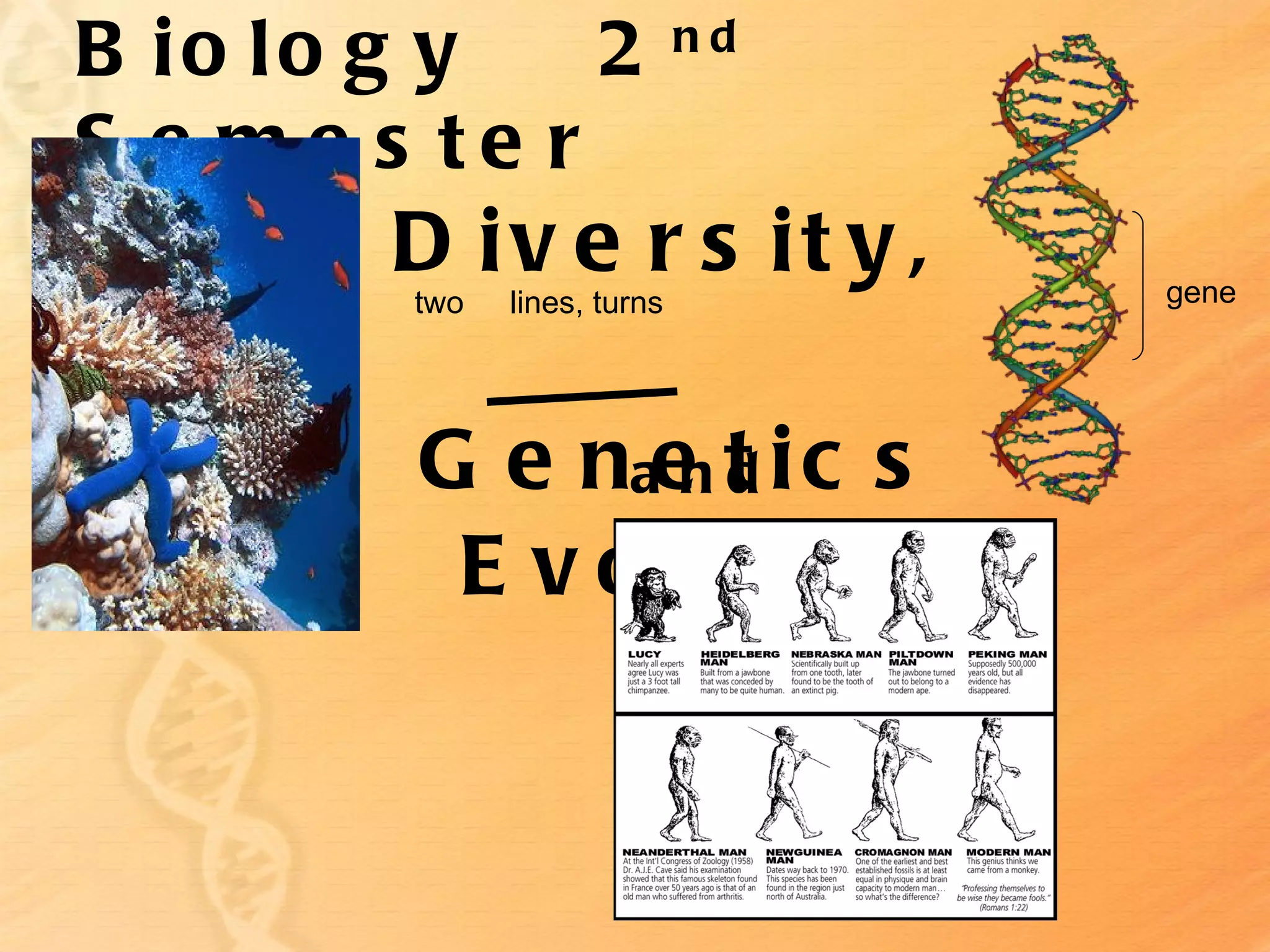

B io lo g y   2              nd

S e me s te r
        D iv e r s it y ,
        two   lines, turns        gene


         G e nae t i c s
                nd
          E v o lu t io n
Big Ideas / Major
Understandings:
What determines structure and function of
 cells?


              The DNA molecule
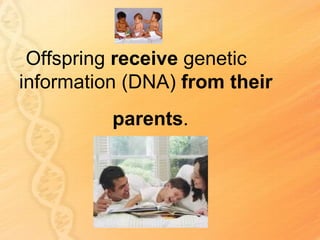
Offspring receive genetic
information (DNA) from their
          parents.
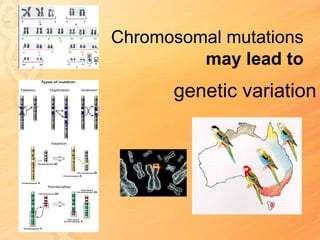
Chromosomal mutations
         may lead to
      genetic variation
Unity and Diversity
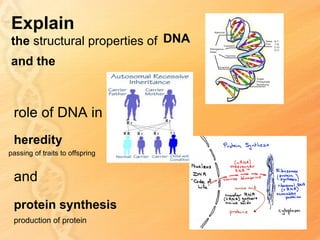
Explain
the structural properties of DNA
and the


 role of DNA in
 heredity
passing of traits to offspring


 and
 protein synthesis
 production of protein
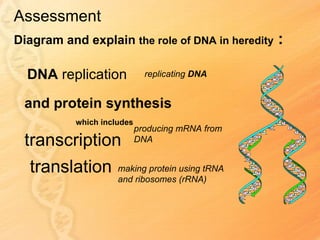
Assessment
Diagram and explain the role of DNA in heredity   :

  DNA replication             replicating DNA


 and protein synthesis
           which includes
                            producing mRNA from
 transcription              DNA


  translation making protein using tRNA
                     and ribosomes (rRNA)
Explain
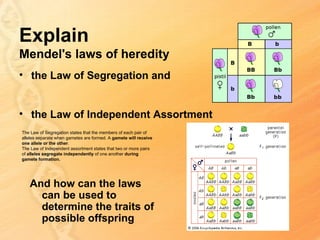
Mendel's laws of heredity
• the Law of Segregation and


• the Law of Independent Assortment
The Law of Segregation states that the members of each pair of
alleles separate when gametes are formed. A gamete will receive
one allele or the other.
The Law of Independent assortment states that two or more pairs
of alleles segregate independently of one another during
gamete formation.


   And how can the laws
     can be used to
     determine the traits of
     possible offspring
Assessment
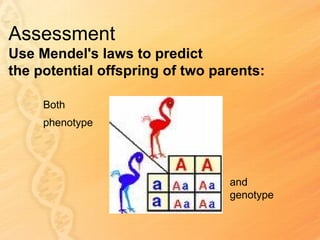
Use Mendel's laws to predict
the potential offspring of two parents:

     Both
     phenotype


                                 and
                                 genotype
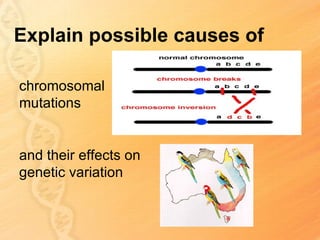
Explain possible causes of

chromosomal
mutations


and their effects on
genetic variation
Assessment
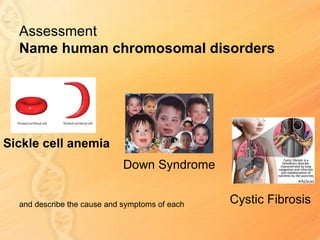
  Name human chromosomal disorders


Sickle cell anemia
                             Down Syndrome


  and describe the cause and symptoms of each   Cystic Fibrosis
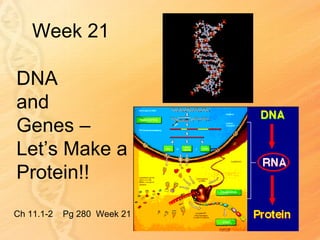
Week 21

DNA
and
Genes –
Let’s Make a
Protein!!
Ch 11.1-2   Pg 280 Week 21
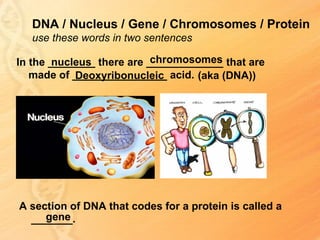
DNA / Nucleus / Gene / Chromosomes / Protein
   use these words in two sentences

        nucleus            chromosomes
In the ________ there are _____________ that are
   made of ________________ acid. (aka (DNA))
            Deoxyribonucleic


A section of DNA that codes for a protein is called a
     gene
  _______.
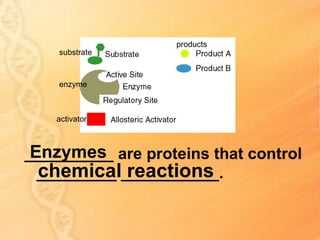
products
    substrate


    enzyme


    activator


 Enzymes
__________ are proteins that control
  chemical reactions
  _________ ___________.
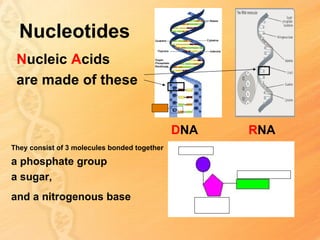
Nucleotides
 Nucleic Acids
 are made of these


                                              DNA   RNA
They consist of 3 molecules bonded together

a phosphate group
a sugar,
and a nitrogenous base
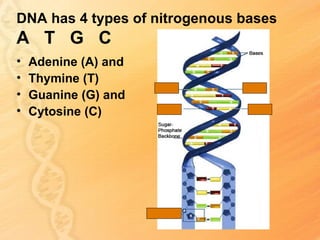
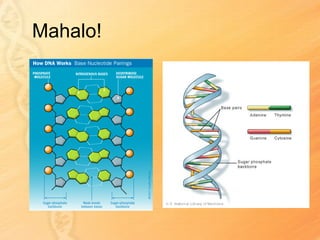
DNA has 4 types of nitrogenous bases
A T G C
•   Adenine (A) and
•   Thymine (T)
•   Guanine (G) and
•   Cytosine (C)
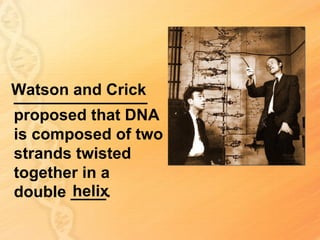
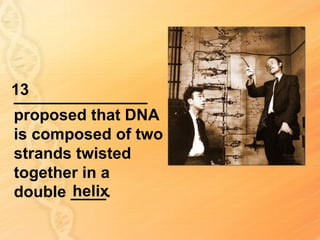
Watson and Crick
_______________
proposed that DNA
is composed of two
strands twisted
together in a
       helix
double ____.
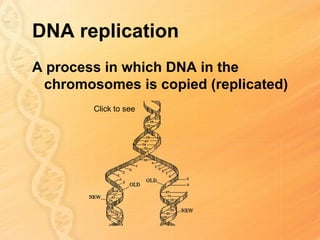
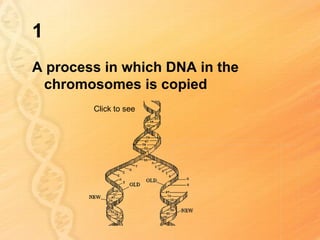
DNA replication
A process in which DNA in the
 chromosomes is copied (replicated)
        Click to see
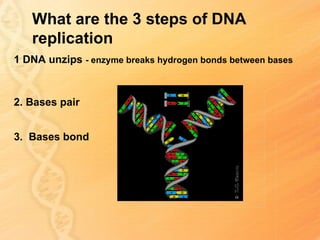
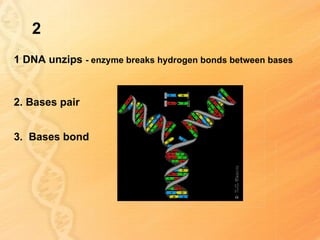
What are the 3 steps of DNA
   replication
1 DNA unzips - enzyme breaks hydrogen bonds between bases


2. Bases pair


3. Bases bond
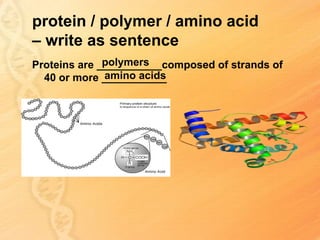
protein / polymer / amino acid
– write as sentence
              polymers
Proteins are ___________composed of strands of
              amino acids
  40 or more ___________
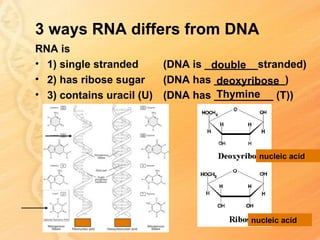
3 ways RNA differs from DNA
RNA is
• 1) single stranded     (DNA is _________stranded)
                                  double
• 2) has ribose sugar    (DNA has ____________)
                                   deoxyribose
                                   Thymine
• 3) contains uracil (U) (DNA has __________ (T))


                                          nucleic acid


                                        nucleic acid
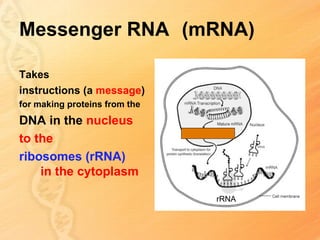
Messenger RNA (mRNA)

Takes
instructions (a message)
for making proteins from the
DNA in the nucleus
to the
ribosomes (rRNA)
    in the cytoplasm

                               rRNA
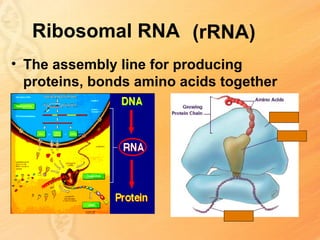
Ribosomal RNA (rRNA)
• The assembly line for producing
  proteins, bonds amino acids together
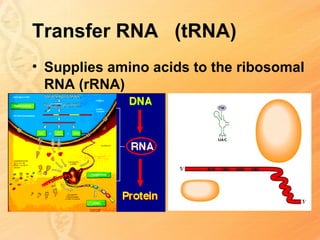
Transfer RNA (tRNA)
• Supplies amino acids to the ribosomal
  RNA (rRNA)
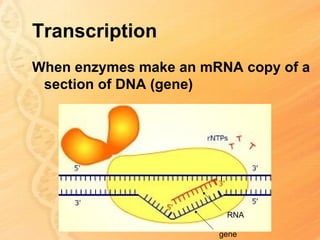
Transcription
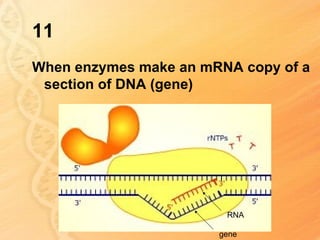
When enzymes make an mRNA copy of a
 section of DNA (gene)


                        RNA

                       gene
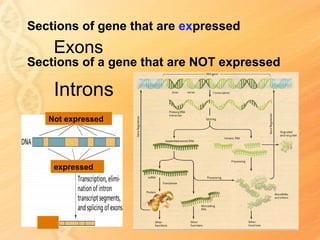
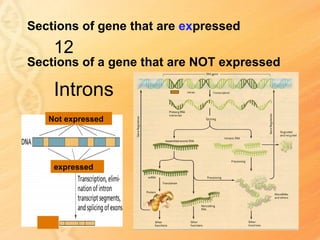
Sections of gene that are expressed
    Exons
Sections of a gene that are NOT expressed

    Introns
   Not expressed


    expressed
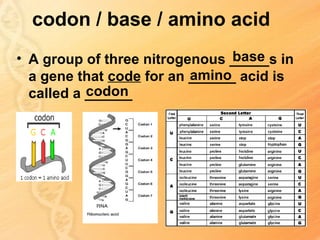
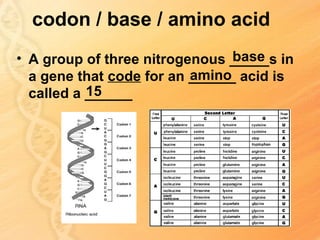
codon / base / amino acid
                                base
• A group of three nitrogenous _____s in
                          amino
  a gene that code for an ______ acid is
           codon
  called a ______
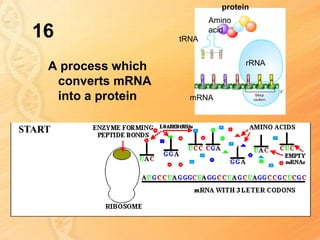
protein
                                   Amino
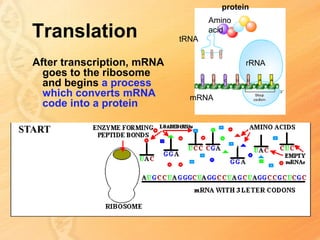
Translation                 tRNA
                                   acid


After transcription, mRNA                  rRNA
  goes to the ribosome
  and begins a process
  which converts mRNA         mRNA
  code into a protein
AND NOW THE QUIZ
1
A process in which DNA in the
 chromosomes is copied
        Click to see
2
1 DNA unzips - enzyme breaks hydrogen bonds between bases


2. Bases pair


3. Bases bond
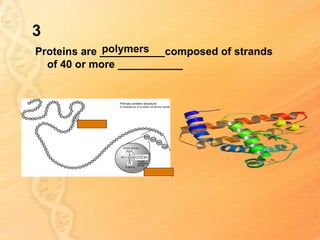
3
             polymers
Proteins are ___________composed of strands
  of 40 or more ___________
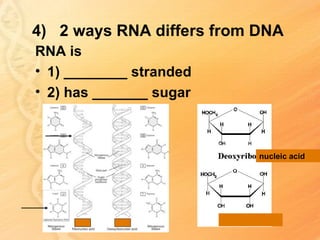
4) 2 ways RNA differs from DNA
RNA is
• 1) ________ stranded
• 2) has _______ sugar


                           nucleic acid
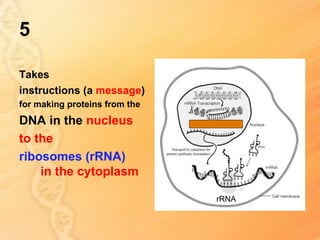
5

Takes
instructions (a message)
for making proteins from the
DNA in the nucleus
to the
ribosomes (rRNA)
    in the cytoplasm

                               rRNA
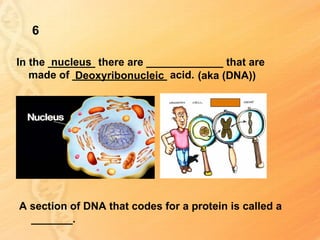
6

        nucleus
In the ________ there are _____________ that are
   made of ________________ acid. (aka (DNA))
            Deoxyribonucleic


A section of DNA that codes for a protein is called a
  _______.
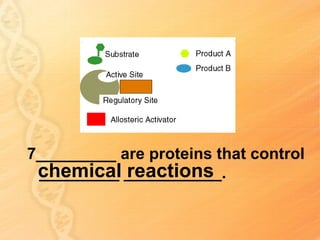
7_________ are proteins that control
 chemical ___________.
 _________ reactions
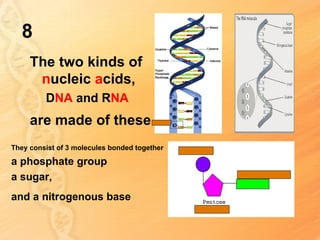
8
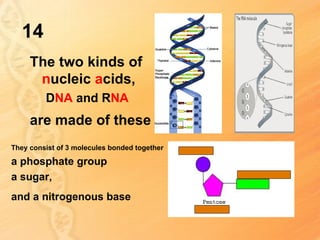
     The two kinds of
      nucleic acids,
         DNA and RNA
     are made of these
They consist of 3 molecules bonded together

a phosphate group
a sugar,
and a nitrogenous base
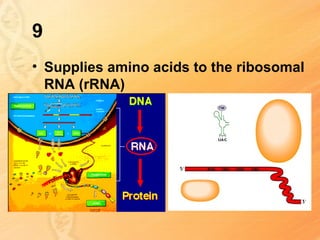
9
• Supplies amino acids to the ribosomal
  RNA (rRNA)
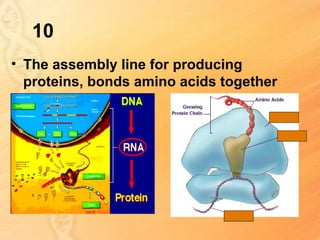
10
• The assembly line for producing
  proteins, bonds amino acids together
11
When enzymes make an mRNA copy of a
 section of DNA (gene)


                        RNA

                       gene
Sections of gene that are expressed
    12
Sections of a gene that are NOT expressed

    Introns
   Not expressed


    expressed
13
_______________
proposed that DNA
is composed of two
strands twisted
together in a
       helix
double ____.
14
     The two kinds of
      nucleic acids,
         DNA and RNA
     are made of these
They consist of 3 molecules bonded together

a phosphate group
a sugar,
and a nitrogenous base
codon / base / amino acid
                                base
• A group of three nitrogenous _____s in
                          amino
  a gene that code for an ______ acid is
           15
  called a ______
protein
                          Amino
16                 tRNA
                          acid


                                  rRNA
 A process which
  converts mRNA
  into a protein     mRNA
Mahalo!

B21 big ideas protein synthesis ppt

  • 1.
    B io log y 2 nd S e me s te r D iv e r s it y , two lines, turns gene G e nae t i c s nd E v o lu t io n
  • 2.
    Big Ideas /Major Understandings:
  • 3.
    What determines structureand function of cells? The DNA molecule
  • 4.
    Offspring receive genetic information(DNA) from their parents.
  • 5.
    Chromosomal mutations may lead to genetic variation
  • 6.
  • 7.
    Explain the structural propertiesof DNA and the role of DNA in heredity passing of traits to offspring and protein synthesis production of protein
  • 8.
    Assessment Diagram and explainthe role of DNA in heredity : DNA replication replicating DNA and protein synthesis which includes producing mRNA from transcription DNA translation making protein using tRNA and ribosomes (rRNA)
  • 9.
    Explain Mendel's laws ofheredity • the Law of Segregation and • the Law of Independent Assortment The Law of Segregation states that the members of each pair of alleles separate when gametes are formed. A gamete will receive one allele or the other. The Law of Independent assortment states that two or more pairs of alleles segregate independently of one another during gamete formation. And how can the laws can be used to determine the traits of possible offspring
  • 10.
    Assessment Use Mendel's lawsto predict the potential offspring of two parents: Both phenotype and genotype
  • 11.
    Explain possible causesof chromosomal mutations and their effects on genetic variation
  • 12.
    Assessment Namehuman chromosomal disorders Sickle cell anemia Down Syndrome and describe the cause and symptoms of each Cystic Fibrosis
  • 13.
    Week 21 DNA and Genes – Let’sMake a Protein!! Ch 11.1-2 Pg 280 Week 21
  • 14.
    DNA / Nucleus/ Gene / Chromosomes / Protein use these words in two sentences nucleus chromosomes In the ________ there are _____________ that are made of ________________ acid. (aka (DNA)) Deoxyribonucleic A section of DNA that codes for a protein is called a gene _______.
  • 15.
    products substrate enzyme activator Enzymes __________ are proteins that control chemical reactions _________ ___________.
  • 16.
    Nucleotides Nucleic Acids are made of these DNA RNA They consist of 3 molecules bonded together a phosphate group a sugar, and a nitrogenous base
  • 17.
    DNA has 4types of nitrogenous bases A T G C • Adenine (A) and • Thymine (T) • Guanine (G) and • Cytosine (C)
  • 18.
    Watson and Crick _______________ proposedthat DNA is composed of two strands twisted together in a helix double ____.
  • 19.
    DNA replication A processin which DNA in the chromosomes is copied (replicated) Click to see
  • 20.
    What are the3 steps of DNA replication 1 DNA unzips - enzyme breaks hydrogen bonds between bases 2. Bases pair 3. Bases bond
  • 21.
    protein / polymer/ amino acid – write as sentence polymers Proteins are ___________composed of strands of amino acids 40 or more ___________
  • 22.
    3 ways RNAdiffers from DNA RNA is • 1) single stranded (DNA is _________stranded) double • 2) has ribose sugar (DNA has ____________) deoxyribose Thymine • 3) contains uracil (U) (DNA has __________ (T)) nucleic acid nucleic acid
  • 23.
    Messenger RNA (mRNA) Takes instructions(a message) for making proteins from the DNA in the nucleus to the ribosomes (rRNA) in the cytoplasm rRNA
  • 24.
    Ribosomal RNA (rRNA) •The assembly line for producing proteins, bonds amino acids together
  • 25.
    Transfer RNA (tRNA) •Supplies amino acids to the ribosomal RNA (rRNA)
  • 26.
    Transcription When enzymes makean mRNA copy of a section of DNA (gene) RNA gene
  • 27.
    Sections of genethat are expressed Exons Sections of a gene that are NOT expressed Introns Not expressed expressed
  • 28.
    codon / base/ amino acid base • A group of three nitrogenous _____s in amino a gene that code for an ______ acid is codon called a ______
  • 29.
    protein Amino Translation tRNA acid After transcription, mRNA rRNA goes to the ribosome and begins a process which converts mRNA mRNA code into a protein
  • 30.
  • 31.
    1 A process inwhich DNA in the chromosomes is copied Click to see
  • 32.
    2 1 DNA unzips- enzyme breaks hydrogen bonds between bases 2. Bases pair 3. Bases bond
  • 33.
    3 polymers Proteins are ___________composed of strands of 40 or more ___________
  • 34.
    4) 2 waysRNA differs from DNA RNA is • 1) ________ stranded • 2) has _______ sugar nucleic acid
  • 35.
    5 Takes instructions (a message) formaking proteins from the DNA in the nucleus to the ribosomes (rRNA) in the cytoplasm rRNA
  • 36.
    6 nucleus In the ________ there are _____________ that are made of ________________ acid. (aka (DNA)) Deoxyribonucleic A section of DNA that codes for a protein is called a _______.
  • 37.
    7_________ are proteinsthat control chemical ___________. _________ reactions
  • 38.
    8 The two kinds of nucleic acids, DNA and RNA are made of these They consist of 3 molecules bonded together a phosphate group a sugar, and a nitrogenous base
  • 39.
    9 • Supplies aminoacids to the ribosomal RNA (rRNA)
  • 40.
    10 • The assemblyline for producing proteins, bonds amino acids together
  • 41.
    11 When enzymes makean mRNA copy of a section of DNA (gene) RNA gene
  • 42.
    Sections of genethat are expressed 12 Sections of a gene that are NOT expressed Introns Not expressed expressed
  • 43.
    13 _______________ proposed that DNA iscomposed of two strands twisted together in a helix double ____.
  • 44.
    14 The two kinds of nucleic acids, DNA and RNA are made of these They consist of 3 molecules bonded together a phosphate group a sugar, and a nitrogenous base
  • 45.
    codon / base/ amino acid base • A group of three nitrogenous _____s in amino a gene that code for an ______ acid is 15 called a ______
  • 46.
    protein Amino 16 tRNA acid rRNA A process which converts mRNA into a protein mRNA
  • 47.