Recombinant DNA Technology
Dr. Farhana Atia
Assistant Professor
Department of Biochemistry
Nilphamari Medical College, Nilphamari
Email: farhana.atia@gmail.com
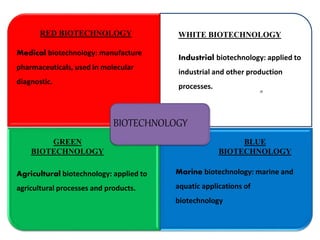
RED BIOTECHNOLOGY WHITE BIOTECHNOLOGY
GREEN
BIOTECHNOLOGY
BLUE
BIOTECHNOLOGY
Medical biotechnology: manufacture
pharmaceuticals, used in molecular
diagnostic.
Industrial biotechnology: applied to
industrial and other production
processes.
Agricultural biotechnology: applied to
agricultural processes and products.
Marine biotechnology: marine and
aquatic applications of
biotechnology
BIOTECHNOLOGY
Medical Biotechnology
Medical Biotechnology is the use of living cells and
cell materials to research and produce
pharmaceutical and diagnostic products that help
to treat and prevent human diseases.
Applications
1.Pharmacology: Insulin, GH, antibiotic, clotting
factor, antibody production
2.Gene therapy: Somatic/ germ line
3.Stem cells
4.Tissue engineering
• Stem cell therapy: Bone marrow transplants,
replacing damaged heart tissue after a heart
attack and replacing damaged nerve tissue in
spinal cord injury.
• A form of regenerative medicine, tissue
engineering is the creation of human tissue
outside the body for later replacement.
Recombinant DNA technology
• Manipulation of genetic material (DNA) in the
laboratory involving
– isolation & end to end joining of DNA sequences
– from very different sources
– to make chimeric molecules
are collectively referred to as rDNA technology.
• Other terms are
Gene manipulation Genetic engineering
Gene cloning Genetic modifications
Tools & techniques involved in rDNA technology
• Restriction enzymes (DNA
cutting)
• DNA ligase (joining)
• Cloning (DNA amplification)
– Host cell (factories)
– Vector (vehicle)
• Gene transfer method
(Transformation,
Conjugation, direct transfer,
electroporation)
• Library (collection
of clones)
• Probes
• Isolation &
purification of NA
• Blotting &
hybridization
• DNA sequencing
• PCR
Restriction enzyme
• Endonuclease
– Cut DNA at specific DNA sequences within the
molecule
– Into unique, short pieces in a sequence specific
manner (not randomly)
• Named after the bacterium from which they are
isolated. [EcoRI- from E. Coli]
• Each enzyme recognizes & cleaves a specific &
double stranded DNA sequence
– 4-7 bp long
– Palindrome: same sequence from 5΄3΄ direction
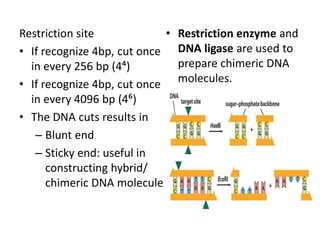
Restriction site
• If recognize 4bp, cut once
in every 256 bp (4⁴)
• If recognize 4bp, cut once
in every 4096 bp (4⁶)
• The DNA cuts results in
– Blunt end
– Sticky end: useful in
constructing hybrid/
chimeric DNA molecule
• Restriction enzyme and
DNA ligase are used to
prepare chimeric DNA
molecules.
Library
A library- is a collection of recombinant clones
– Genomic library: prepared from total DNA of a cell
line or tissue
– cDNA library: only expressed DNA [cDNA copies of
mRNA] in a tissue
DNA cloning
• Production of a large number of identical copies of
DNA of interest by introducing that foreign DNA into a
replicating cell.
• Cloning vector
– DNA molecule to which the target DNA is joined
– Plasmid (present in all bacteria), Virus (phages)
– Artificial- cosmid, BAC, YAC
• Essential properties of vector
– Autonomously replicated within host cell
– Contain at least one specific restriction site
– Carry gene for selection (antibiotic resistance gene)
Steps of cloning
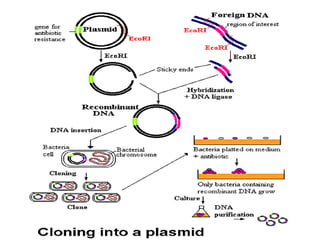
1. Restriction enzymes (e.g. EcoRI) cut the DNA to
be amplified
2. Bacterial plasmids (circular DNA additional to a
bacteria’s regular DNA) are cut with the same
restriction enzyme producing complementary
sticky end
3. DNA ligase joins the DNA fragment of plasmid
& DNA of interest to form a rDNA molecule
4. The recombinant plasmid is introduced into
host bacteria by transformation
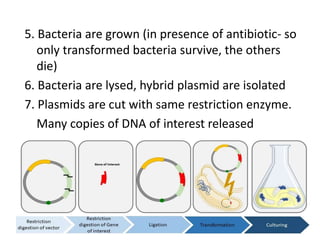
5. Bacteria are grown (in presence of antibiotic- so
only transformed bacteria survive, the others
die)
6. Bacteria are lysed, hybrid plasmid are isolated
7. Plasmids are cut with same restriction enzyme.
Many copies of DNA of interest released
Probes
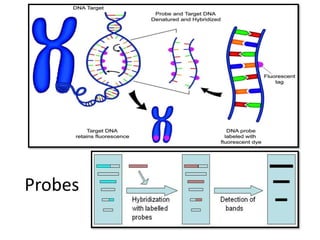
• Probe is a molecule used to detect the presence of
a specific fragment of a DNA or RNA.
• Short piece (15-20 NT) of ssDNA or RNA, labeled
with a radioisotope [³²P]or fluorescent dye
• Complementary to a sequence of the DNA of
interest/ target DNA
• Used to screen a library for a complementary
sequence in the coding region of the gene.
• If the sequence match exactly, probes will hybridize
Probes
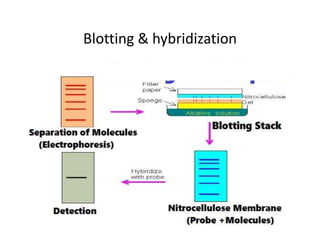
Blotting & hybridization
• Blotting is a process of immobilization of sample
nucleic acids on solid support (nitrocellulose
membrane)
• The blotted nucleic acids are then used as targets in
the hybridization experiments for specific detection
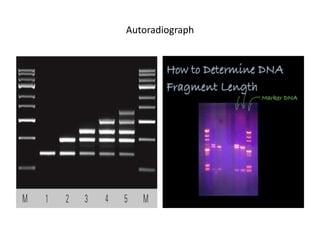
• Autoradiography allow visualization of specific
DNA/RNA fragments
• Types-
– Southern blot (for DNA)
– Northern blot (for RNA)
– Western blot (for protein)
Blotting & hybridization
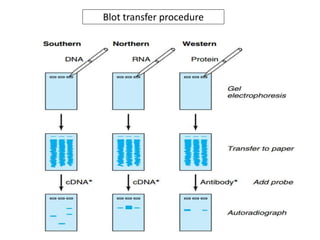
1. Southern blot: A method of transferring DNA
from an agarose gel to nitrocellulose filter, on
which the DNA can be detected by a suitable
probe [cDNA or RNA]
2. Northern blot: A method of transferring RNA
from an agarose gel to nitrocellulose filter, on
which the RNA can be detected by a suitable
probe [cDNA or RNA]
3. Western blot: A method of transferring protein
to a nitrocellulose filter, on which the protein
can be detected by a suitable probe [antobody]
Blot transfer procedure
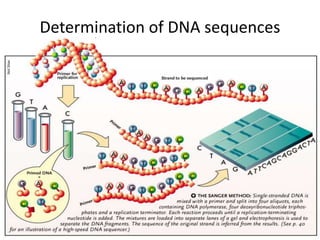
Determination of DNA sequences
Polymerase chain reaction
• PCR is a enzymatic, test tube method of
amplifying a target sequence of DNA
• PCR can amplify
– Very small quantity of DNA (1 part in million)
– DNA from any source: bacterial, viral, plant
– Very rapidly (each cycle 5-10 min; 20 cycle made
10⁶ copies
– DNA from a single cell, hair follicle, spermatozoon
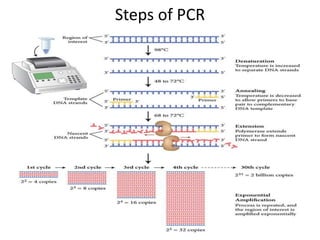
Steps of PCR
• Use DNA polymerase from Thermus Aquaticus [TaqP].
Heat stable, so not denatured at 70-80⁰C.
• Primer construction [20-35 NT] according to flanking
sequence
1. Denaturation of DNA [94⁰C]
2. Annealing of primers to ssDNA [54⁰C]
3. Chain extension by DNA-P [72⁰C]
New dsDNA molecules can be denatured & copied
repeatedly
Steps of PCR
Autoradiograph
Uses of PCR
• Forensic analysis of DNA sample
• To detect infectious agent [latent virus-HIV]
• To make prenatal genetic diagnosis
• To detect allelic polymorphism
• To establish precise tissue types for transplants
• To study evolution, using DNA from archeological
samples
• Quantitate RNA analysis [RT-PCR]
• To score in vivo protein DNA occupancy using
chromatin immuno-precipitation assay to facilitate NGS
[next generation occupancy]
New uses are developed every year.
Polymorphism
• Change in genotype that does not affect phenotype or
may change phenotype that is harmless.
• Primarily occur in non-coding sequence [only 2%
genome encode protein in human]
• Genome of any 2 unrelated people are 99.5% identical
Important tool in
– genome mapping
– localization of genes for genetic disorders
– determination the risk for disease
– paternity testing, criminal identification
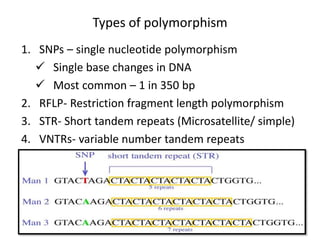
Types of polymorphism
1. SNPs – single nucleotide polymorphism
 Single base changes in DNA
 Most common – 1 in 350 bp
2. RFLP- Restriction fragment length polymorphism
3. STR- Short tandem repeats (Microsatellite/ simple)
4. VNTRs- variable number tandem repeats
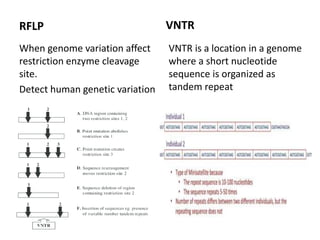
RFLP
When genome variation affect
restriction enzyme cleavage
site.
Detect human genetic variation
VNTR
VNTR is a location in a genome
where a short nucleotide
sequence is organized as
tandem repeat
Applications of rDNA technology
• Helps in gene mapping, thus localizes specific gene
on chromosome
• Understanding molecular basis of a number of
disease. e.g.- Familial hypercholesterolemia, sickle
cell disease, thalassaemia, cystic fibrosis, muscular
dystrophy and also some complex multifactorial
diseases (heart disease, cancer, DM)
• Commercial preparation of protein & hormone-
insulin, growth hormone, TPA, blood clotting
factor, interferon, interleukin
• Production of human enzyme used in therapy of
storage disease (e.g. Pompe’s, Gaucher’s disease)
• Preparation of several vaccines (Hepatitis B)
• DNA based diagnostic test can identify structural
variants (point mutation), dysfunctional & absent
genes (sickle cell disease, AIDS)
• This technology is used both to diagnose existing
disease as well as to predict the risk of developing a
specific disease and individual response to
pharmacological therapeutics
• Special techniques have lead remarkable advances in
forensic medicine
• Make platform for sequencing of genomic DNA
• Gene therapy cure a number of inherited disorder
& disease caused by somatic mutations (sickle cell
disease, thalassemia, Duchene muscular
dystrophy)
• Used in a number of analytic techniques- PCR,
RFLP, DNA typing, Southern b, northern b, western
blotting
• Trans genesis- of plant & animal to make more
resistant to disease & infection
• Huge application in agricultural & livestock
industries
Recombinant DNA Technology

Recombinant DNA Technology

  • 1.
    Recombinant DNA Technology Dr.Farhana Atia Assistant Professor Department of Biochemistry Nilphamari Medical College, Nilphamari Email: farhana.atia@gmail.com
  • 2.
    RED BIOTECHNOLOGY WHITEBIOTECHNOLOGY GREEN BIOTECHNOLOGY BLUE BIOTECHNOLOGY Medical biotechnology: manufacture pharmaceuticals, used in molecular diagnostic. Industrial biotechnology: applied to industrial and other production processes. Agricultural biotechnology: applied to agricultural processes and products. Marine biotechnology: marine and aquatic applications of biotechnology BIOTECHNOLOGY
  • 3.
    Medical Biotechnology Medical Biotechnologyis the use of living cells and cell materials to research and produce pharmaceutical and diagnostic products that help to treat and prevent human diseases. Applications 1.Pharmacology: Insulin, GH, antibiotic, clotting factor, antibody production 2.Gene therapy: Somatic/ germ line 3.Stem cells 4.Tissue engineering
  • 4.
    • Stem celltherapy: Bone marrow transplants, replacing damaged heart tissue after a heart attack and replacing damaged nerve tissue in spinal cord injury. • A form of regenerative medicine, tissue engineering is the creation of human tissue outside the body for later replacement.
  • 5.
    Recombinant DNA technology •Manipulation of genetic material (DNA) in the laboratory involving – isolation & end to end joining of DNA sequences – from very different sources – to make chimeric molecules are collectively referred to as rDNA technology. • Other terms are Gene manipulation Genetic engineering Gene cloning Genetic modifications
  • 6.
    Tools & techniquesinvolved in rDNA technology • Restriction enzymes (DNA cutting) • DNA ligase (joining) • Cloning (DNA amplification) – Host cell (factories) – Vector (vehicle) • Gene transfer method (Transformation, Conjugation, direct transfer, electroporation) • Library (collection of clones) • Probes • Isolation & purification of NA • Blotting & hybridization • DNA sequencing • PCR
  • 7.
    Restriction enzyme • Endonuclease –Cut DNA at specific DNA sequences within the molecule – Into unique, short pieces in a sequence specific manner (not randomly) • Named after the bacterium from which they are isolated. [EcoRI- from E. Coli] • Each enzyme recognizes & cleaves a specific & double stranded DNA sequence – 4-7 bp long – Palindrome: same sequence from 5΄3΄ direction
  • 8.
    Restriction site • Ifrecognize 4bp, cut once in every 256 bp (4⁴) • If recognize 4bp, cut once in every 4096 bp (4⁶) • The DNA cuts results in – Blunt end – Sticky end: useful in constructing hybrid/ chimeric DNA molecule • Restriction enzyme and DNA ligase are used to prepare chimeric DNA molecules.
  • 9.
    Library A library- isa collection of recombinant clones – Genomic library: prepared from total DNA of a cell line or tissue – cDNA library: only expressed DNA [cDNA copies of mRNA] in a tissue
  • 10.
    DNA cloning • Productionof a large number of identical copies of DNA of interest by introducing that foreign DNA into a replicating cell. • Cloning vector – DNA molecule to which the target DNA is joined – Plasmid (present in all bacteria), Virus (phages) – Artificial- cosmid, BAC, YAC • Essential properties of vector – Autonomously replicated within host cell – Contain at least one specific restriction site – Carry gene for selection (antibiotic resistance gene)
  • 11.
    Steps of cloning 1.Restriction enzymes (e.g. EcoRI) cut the DNA to be amplified 2. Bacterial plasmids (circular DNA additional to a bacteria’s regular DNA) are cut with the same restriction enzyme producing complementary sticky end 3. DNA ligase joins the DNA fragment of plasmid & DNA of interest to form a rDNA molecule 4. The recombinant plasmid is introduced into host bacteria by transformation
  • 12.
    5. Bacteria aregrown (in presence of antibiotic- so only transformed bacteria survive, the others die) 6. Bacteria are lysed, hybrid plasmid are isolated 7. Plasmids are cut with same restriction enzyme. Many copies of DNA of interest released
  • 14.
    Probes • Probe isa molecule used to detect the presence of a specific fragment of a DNA or RNA. • Short piece (15-20 NT) of ssDNA or RNA, labeled with a radioisotope [³²P]or fluorescent dye • Complementary to a sequence of the DNA of interest/ target DNA • Used to screen a library for a complementary sequence in the coding region of the gene. • If the sequence match exactly, probes will hybridize
  • 15.
  • 16.
    Blotting & hybridization •Blotting is a process of immobilization of sample nucleic acids on solid support (nitrocellulose membrane) • The blotted nucleic acids are then used as targets in the hybridization experiments for specific detection • Autoradiography allow visualization of specific DNA/RNA fragments • Types- – Southern blot (for DNA) – Northern blot (for RNA) – Western blot (for protein)
  • 17.
  • 18.
    1. Southern blot:A method of transferring DNA from an agarose gel to nitrocellulose filter, on which the DNA can be detected by a suitable probe [cDNA or RNA] 2. Northern blot: A method of transferring RNA from an agarose gel to nitrocellulose filter, on which the RNA can be detected by a suitable probe [cDNA or RNA] 3. Western blot: A method of transferring protein to a nitrocellulose filter, on which the protein can be detected by a suitable probe [antobody]
  • 19.
  • 20.
  • 21.
    Polymerase chain reaction •PCR is a enzymatic, test tube method of amplifying a target sequence of DNA • PCR can amplify – Very small quantity of DNA (1 part in million) – DNA from any source: bacterial, viral, plant – Very rapidly (each cycle 5-10 min; 20 cycle made 10⁶ copies – DNA from a single cell, hair follicle, spermatozoon
  • 22.
    Steps of PCR •Use DNA polymerase from Thermus Aquaticus [TaqP]. Heat stable, so not denatured at 70-80⁰C. • Primer construction [20-35 NT] according to flanking sequence 1. Denaturation of DNA [94⁰C] 2. Annealing of primers to ssDNA [54⁰C] 3. Chain extension by DNA-P [72⁰C] New dsDNA molecules can be denatured & copied repeatedly
  • 23.
  • 24.
  • 25.
    Uses of PCR •Forensic analysis of DNA sample • To detect infectious agent [latent virus-HIV] • To make prenatal genetic diagnosis • To detect allelic polymorphism • To establish precise tissue types for transplants • To study evolution, using DNA from archeological samples • Quantitate RNA analysis [RT-PCR] • To score in vivo protein DNA occupancy using chromatin immuno-precipitation assay to facilitate NGS [next generation occupancy] New uses are developed every year.
  • 26.
    Polymorphism • Change ingenotype that does not affect phenotype or may change phenotype that is harmless. • Primarily occur in non-coding sequence [only 2% genome encode protein in human] • Genome of any 2 unrelated people are 99.5% identical Important tool in – genome mapping – localization of genes for genetic disorders – determination the risk for disease – paternity testing, criminal identification
  • 27.
    Types of polymorphism 1.SNPs – single nucleotide polymorphism  Single base changes in DNA  Most common – 1 in 350 bp 2. RFLP- Restriction fragment length polymorphism 3. STR- Short tandem repeats (Microsatellite/ simple) 4. VNTRs- variable number tandem repeats
  • 28.
    RFLP When genome variationaffect restriction enzyme cleavage site. Detect human genetic variation VNTR VNTR is a location in a genome where a short nucleotide sequence is organized as tandem repeat
  • 29.
    Applications of rDNAtechnology • Helps in gene mapping, thus localizes specific gene on chromosome • Understanding molecular basis of a number of disease. e.g.- Familial hypercholesterolemia, sickle cell disease, thalassaemia, cystic fibrosis, muscular dystrophy and also some complex multifactorial diseases (heart disease, cancer, DM) • Commercial preparation of protein & hormone- insulin, growth hormone, TPA, blood clotting factor, interferon, interleukin
  • 30.
    • Production ofhuman enzyme used in therapy of storage disease (e.g. Pompe’s, Gaucher’s disease) • Preparation of several vaccines (Hepatitis B) • DNA based diagnostic test can identify structural variants (point mutation), dysfunctional & absent genes (sickle cell disease, AIDS) • This technology is used both to diagnose existing disease as well as to predict the risk of developing a specific disease and individual response to pharmacological therapeutics • Special techniques have lead remarkable advances in forensic medicine
  • 31.
    • Make platformfor sequencing of genomic DNA • Gene therapy cure a number of inherited disorder & disease caused by somatic mutations (sickle cell disease, thalassemia, Duchene muscular dystrophy) • Used in a number of analytic techniques- PCR, RFLP, DNA typing, Southern b, northern b, western blotting • Trans genesis- of plant & animal to make more resistant to disease & infection • Huge application in agricultural & livestock industries