

Prof (Dr) Viyatprajna Acharya, MD, PhD
www.drvpacharya.com
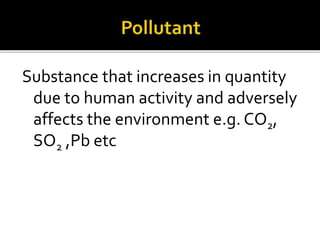
Substance that increases in quantity
due to human activity and adversely
affects the environment e.g. CO2,
SO2 ,Pb etc
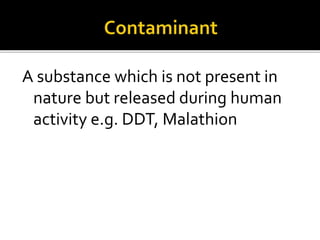
A substance which is not present in
nature but released during human
activity e.g. DDT, Malathion
AIR POLLUTANTS
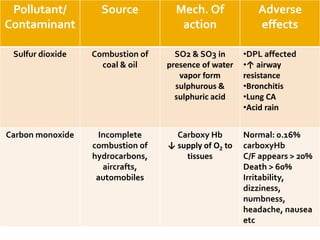
Pollutant/
Contaminant
Source Mech. Of
action
Adverse
effects
Sulfur dioxide Combustion of
coal & oil
SO2 & SO3 in
presence of water
vapor form
sulphurous &
sulphuric acid
•DPL affected
•↑ airway
resistance
•Bronchitis
•Lung CA
•Acid rain
Carbon monoxide Incomplete
combustion of
hydrocarbons,
aircrafts,
automobiles
Carboxy Hb
↓ supply of O2 to
tissues
Normal: 0.16%
carboxyHb
C/F appears > 20%
Death > 60%
Irritability,
dizziness,
numbness,
headache, nausea
etc
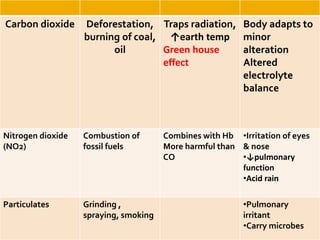
Carbon dioxide Deforestation,
burning of coal,
oil
Traps radiation,
↑earth temp
Green house
effect
Body adapts to
minor
alteration
Altered
electrolyte
balance
Nitrogen dioxide
(NO2)
Combustion of
fossil fuels
Combines with Hb
More harmful than
CO
•Irritation of eyes
& nose
•↓pulmonary
function
•Acid rain
Particulates Grinding ,
spraying, smoking
•Pulmonary
irritant
•Carry microbes
INDOOR POLLUTANTS
 Passive cigarette smoking- 3 times more
dangerous
 Formaldehyde
 Radon gas
 CFC
 Benzene
 Mercury
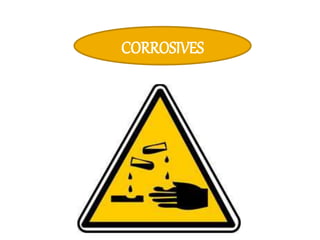
CORROSIVES
 Strong acids- Circulatory collapse, spasm of
glottis
 Strong alkalies- dehydrate & coagulate
proteins
 Salts- ZnCl2, KCN, Chromate
 Causes tissue anoxia by chelating ferric ions
of Cytochrome oxidase (IV)
 Suicide,Terrorists, factories dealing with
Prussic acid or KCN, ingestion of Amygdalin
 Antidote- Dicobalt edatate (Kelocyanor),
Sodium nitrite, Sod. thiosulfate
 Chemical irritants- P, Cl, Br, I
 Metallic irritants-As, Sb, Hg, Cu, Pb,
Zn, Ag
 Organic irritants- Castor, calotropis,
croton
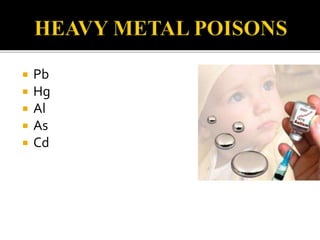
 Pb
 Hg
 Al
 As
 Cd
Source: Paint
Exhaust of automobiles (TEL)
Lead pipes
Newspaper, xerox, printing
Batteries, soldering
radiator
 Cumulative poison
o 90%- bones
o 9%- blood
o 1%- brain
 > 10 mg/dl in children & > 25 mg/dl in adults –
Poisoning
 Crosses placenta
 Secreted in milk
 > 70 mg/dl- acute toxicity
Pregnancy: Miscarriage, still birth, premature birth
Children: MR, learning disabilities, behavioural
problems, hyper excitability, seizures
Anemia, abdominal colic, loss of appetite
Adult: neurologic damage, encephalopathy, mania
etc
Anemia, abdominal colic, Nephropathy
Blue line in gums
Basophilic stippling of RBCs (agglutination of
ribosomes)
Globin synthesis affected
Pb inhibits ALA synthase & dehydratase
 Lead level in blood
 Measurement of ALA in urine or serum
 Free erythrocyte protoporphyrin
 Calcium dodecyl edatate
 Penicillamine
 BAL
 Dimercaptosuccinic acid
 Elemental
 Inorganic
 Organic
 Elemental: Pulmonary edema,
encephalopathy
Chronic– Erethism- oral lesions, tremors,
hatter’s shake, Mercuriolentis, psycho.
Changes
 Inorganic: Gingivitis, gastritis, vomiting, pulm
edema
 Chronic– Erethism, CRF (Alice inWonderland)
 Organic source: Minamata disease
Triad : Dysarthria, ataxia, visual field
constriction
www.drvpacharya.com

Environmental Biochemistry.pptx

  • 1.
    Prof (Dr) ViyatprajnaAcharya, MD, PhD www.drvpacharya.com
  • 2.
    Substance that increasesin quantity due to human activity and adversely affects the environment e.g. CO2, SO2 ,Pb etc
  • 3.
    A substance whichis not present in nature but released during human activity e.g. DDT, Malathion
  • 4.
  • 5.
    Pollutant/ Contaminant Source Mech. Of action Adverse effects Sulfurdioxide Combustion of coal & oil SO2 & SO3 in presence of water vapor form sulphurous & sulphuric acid •DPL affected •↑ airway resistance •Bronchitis •Lung CA •Acid rain Carbon monoxide Incomplete combustion of hydrocarbons, aircrafts, automobiles Carboxy Hb ↓ supply of O2 to tissues Normal: 0.16% carboxyHb C/F appears > 20% Death > 60% Irritability, dizziness, numbness, headache, nausea etc
  • 6.
    Carbon dioxide Deforestation, burningof coal, oil Traps radiation, ↑earth temp Green house effect Body adapts to minor alteration Altered electrolyte balance Nitrogen dioxide (NO2) Combustion of fossil fuels Combines with Hb More harmful than CO •Irritation of eyes & nose •↓pulmonary function •Acid rain Particulates Grinding , spraying, smoking •Pulmonary irritant •Carry microbes
  • 7.
  • 8.
     Passive cigarettesmoking- 3 times more dangerous  Formaldehyde  Radon gas  CFC  Benzene  Mercury
  • 9.
  • 10.
     Strong acids-Circulatory collapse, spasm of glottis  Strong alkalies- dehydrate & coagulate proteins  Salts- ZnCl2, KCN, Chromate
  • 11.
     Causes tissueanoxia by chelating ferric ions of Cytochrome oxidase (IV)  Suicide,Terrorists, factories dealing with Prussic acid or KCN, ingestion of Amygdalin  Antidote- Dicobalt edatate (Kelocyanor), Sodium nitrite, Sod. thiosulfate
  • 12.
     Chemical irritants-P, Cl, Br, I  Metallic irritants-As, Sb, Hg, Cu, Pb, Zn, Ag  Organic irritants- Castor, calotropis, croton
  • 13.
     Pb  Hg Al  As  Cd
  • 14.
    Source: Paint Exhaust ofautomobiles (TEL) Lead pipes Newspaper, xerox, printing Batteries, soldering radiator
  • 15.
     Cumulative poison o90%- bones o 9%- blood o 1%- brain  > 10 mg/dl in children & > 25 mg/dl in adults – Poisoning  Crosses placenta  Secreted in milk  > 70 mg/dl- acute toxicity
  • 16.
    Pregnancy: Miscarriage, stillbirth, premature birth Children: MR, learning disabilities, behavioural problems, hyper excitability, seizures Anemia, abdominal colic, loss of appetite Adult: neurologic damage, encephalopathy, mania etc Anemia, abdominal colic, Nephropathy Blue line in gums Basophilic stippling of RBCs (agglutination of ribosomes) Globin synthesis affected Pb inhibits ALA synthase & dehydratase
  • 17.
     Lead levelin blood  Measurement of ALA in urine or serum  Free erythrocyte protoporphyrin
  • 18.
     Calcium dodecyledatate  Penicillamine  BAL  Dimercaptosuccinic acid
  • 19.
  • 20.
     Elemental: Pulmonaryedema, encephalopathy Chronic– Erethism- oral lesions, tremors, hatter’s shake, Mercuriolentis, psycho. Changes  Inorganic: Gingivitis, gastritis, vomiting, pulm edema  Chronic– Erethism, CRF (Alice inWonderland)
  • 21.
     Organic source:Minamata disease Triad : Dysarthria, ataxia, visual field constriction
  • 22.