Advance single nucleotides
polymorphism (SNP) detection
methods
Presented By: Aneela Rafiq
Introduction
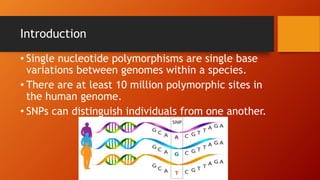
• Single nucleotide polymorphisms are single base
variations between genomes within a species.
• There are at least 10 million polymorphic sites in
the human genome.
• SNPs can distinguish individuals from one another.
Technology for Global SNP Discovery
• SNP in every 1,000 bp of DNA when two human
genomes are compared.
• Restriction Fragment Length Polymorphisms
(RFLPs) were the first SNPs .
• But very laborious strategy.
Cont…
• late 1990’s, several favorable factors came
together to make global SNP discovery a
reality.
1. human genome project
2. cost and efficiency of DNA sequencing
improved
3. bioinformatics tools
4. the SNP consortium (TSC)
Technology for Targeted
SNP Discovery
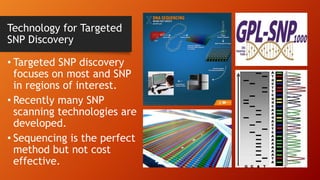
• Targeted SNP discovery
focuses on most and SNP
in regions of interest.
• Recently many SNP
scanning technologies are
developed.
• Sequencing is the perfect
method but not cost
effective.
Denaturing Gradient Gel Electrophoresis
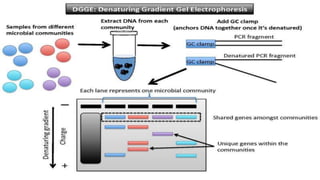
• Denaturation is highly depend on DNA
sequence.
In many cases a single nucleotide
change the melting point.
And change melting point shows unique
position on gel
Complete Instrument of DGGE
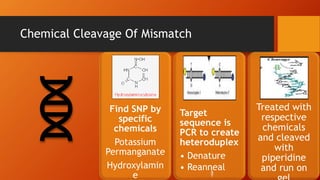
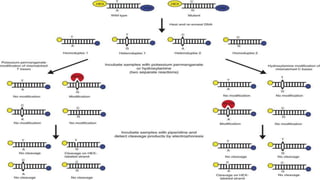
Chemical Cleavage Of Mismatch
Find SNP by
specific
chemicals
Potassium
Permanganate
Hydroxylamin
e
Target
sequence is
PCR to create
heteroduplex
• Denature
• Reanneal
Treated with
respective
chemicals
and cleaved
with
piperidine
and run on
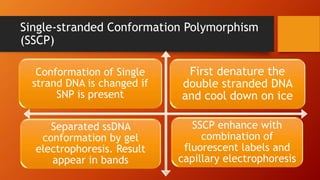
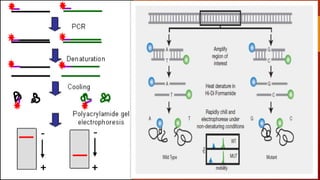
Single-stranded Conformation Polymorphism
(SSCP)
Conformation of Single
strand DNA is changed if
SNP is present
First denature the
double stranded DNA
and cool down on ice
Separated ssDNA
conformation by gel
electrophoresis. Result
appear in bands
SSCP enhance with
combination of
fluorescent labels and
capillary electrophoresis
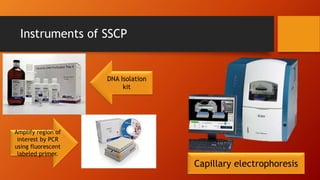
Instruments of SSCP
Capillary electrophoresis
Amplify region of
interest by PCR
using fluorescent
labeled primer.
DNA Isolation
kit
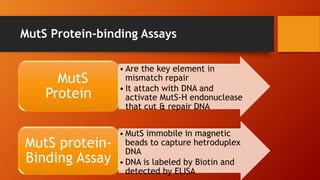
MutS Protein-binding Assays
• Are the key element in
mismatch repair
• It attach with DNA and
activate MutS-H endonuclease
that cut & repair DNA
MutS
Protein
• MutS immobile in magnetic
beads to capture hetroduplex
DNA
• DNA is labeled by Biotin and
detected by ELISA
MutS protein-
Binding Assay
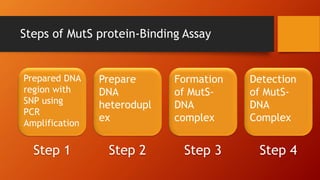
Steps of MutS protein-Binding Assay
Prepared DNA
region with
SNP using
PCR
Amplification
Step 1
Prepare
DNA
heterodupl
ex
Step 2
Formation
of MutS-
DNA
complex
Step 3
Detection
of MutS-
DNA
Complex
Step 4
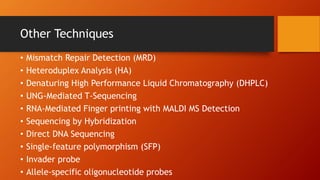
Other Techniques
• Mismatch Repair Detection (MRD)
• Heteroduplex Analysis (HA)
• Denaturing High Performance Liquid Chromatography (DHPLC)
• UNG-Mediated T-Sequencing
• RNA-Mediated Finger printing with MALDI MS Detection
• Sequencing by Hybridization
• Direct DNA Sequencing
• Single-feature polymorphism (SFP)
• Invader probe
• Allele-specific oligonucleotide probes
Cont…
• PCR-based methods
• Allele specific primers
• Sequence Polymorphism-Derived (SPD) markers
• Targeting induced local lesions in genomes
(TILLinG)
• Minisequencing primers
• Allele-specific ligation probes
Applications
• Agriculture
• Example of Rice, Maize, canola, barley, sugar
beet etc.
• Aquaculture
• Example of Catfish
Cont…
• Pharmacogenetics
• Example of CYP2C19
variants
• Research
• Example of all Above
Thank you

SNP Detection Methods and applications

  • 1.
    Advance single nucleotides polymorphism(SNP) detection methods Presented By: Aneela Rafiq
  • 2.
    Introduction • Single nucleotidepolymorphisms are single base variations between genomes within a species. • There are at least 10 million polymorphic sites in the human genome. • SNPs can distinguish individuals from one another.
  • 3.
    Technology for GlobalSNP Discovery • SNP in every 1,000 bp of DNA when two human genomes are compared. • Restriction Fragment Length Polymorphisms (RFLPs) were the first SNPs . • But very laborious strategy.
  • 4.
    Cont… • late 1990’s,several favorable factors came together to make global SNP discovery a reality. 1. human genome project 2. cost and efficiency of DNA sequencing improved 3. bioinformatics tools 4. the SNP consortium (TSC)
  • 5.
    Technology for Targeted SNPDiscovery • Targeted SNP discovery focuses on most and SNP in regions of interest. • Recently many SNP scanning technologies are developed. • Sequencing is the perfect method but not cost effective.
  • 6.
    Denaturing Gradient GelElectrophoresis • Denaturation is highly depend on DNA sequence. In many cases a single nucleotide change the melting point. And change melting point shows unique position on gel
  • 9.
  • 10.
    Chemical Cleavage OfMismatch Find SNP by specific chemicals Potassium Permanganate Hydroxylamin e Target sequence is PCR to create heteroduplex • Denature • Reanneal Treated with respective chemicals and cleaved with piperidine and run on
  • 12.
    Single-stranded Conformation Polymorphism (SSCP) Conformationof Single strand DNA is changed if SNP is present First denature the double stranded DNA and cool down on ice Separated ssDNA conformation by gel electrophoresis. Result appear in bands SSCP enhance with combination of fluorescent labels and capillary electrophoresis
  • 14.
    Instruments of SSCP Capillaryelectrophoresis Amplify region of interest by PCR using fluorescent labeled primer. DNA Isolation kit
  • 15.
    MutS Protein-binding Assays •Are the key element in mismatch repair • It attach with DNA and activate MutS-H endonuclease that cut & repair DNA MutS Protein • MutS immobile in magnetic beads to capture hetroduplex DNA • DNA is labeled by Biotin and detected by ELISA MutS protein- Binding Assay
  • 16.
    Steps of MutSprotein-Binding Assay Prepared DNA region with SNP using PCR Amplification Step 1 Prepare DNA heterodupl ex Step 2 Formation of MutS- DNA complex Step 3 Detection of MutS- DNA Complex Step 4
  • 17.
    Other Techniques • MismatchRepair Detection (MRD) • Heteroduplex Analysis (HA) • Denaturing High Performance Liquid Chromatography (DHPLC) • UNG-Mediated T-Sequencing • RNA-Mediated Finger printing with MALDI MS Detection • Sequencing by Hybridization • Direct DNA Sequencing • Single-feature polymorphism (SFP) • Invader probe • Allele-specific oligonucleotide probes
  • 18.
    Cont… • PCR-based methods •Allele specific primers • Sequence Polymorphism-Derived (SPD) markers • Targeting induced local lesions in genomes (TILLinG) • Minisequencing primers • Allele-specific ligation probes
  • 19.
    Applications • Agriculture • Exampleof Rice, Maize, canola, barley, sugar beet etc. • Aquaculture • Example of Catfish
  • 20.
    Cont… • Pharmacogenetics • Exampleof CYP2C19 variants • Research • Example of all Above
  • 21.