Learning objectives
• Introductionto biomolecules
• Why carbohydrates in medical science?
• Classification of carbohydrates/Nomenclature
• Isomerism in carbohydrates
• Reactions of monosaccharides
• Disaccharides
• Polysaccharides
• Other biochemically important carbohydrates
3.
Introduction to Biomolecules
•A biomolecule is any organic molecule synthesized by living organisms that
participates in or is essential for biological processes.
• Produced by or in living organisms
• Mainly organic (C, H, O, N, etc.)
• Occurs naturally in cells or tissues
• Participates in biochemical pathways
• Biomolecules often show specific 3D structures, optical activity, and
chirality — features that determine their biological function
• Carbohydrates, Protein, lipids, Nucleic acids, vitamins- Biomolecules
• Most abundant biomolecule on Earth is carbohydrate, specifically
cellulose- accounts for about half of the total organic carbon in the
biosphere.
•
4.
WHY CARBOHYDRATES???
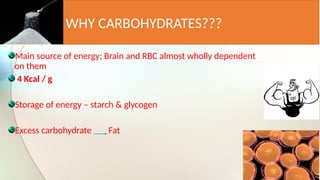
Main sourceof energy; Brain and RBC almost wholly dependent
on them
4 Kcal / g
Storage of energy – starch & glycogen
Excess carbohydrate Fat
5.
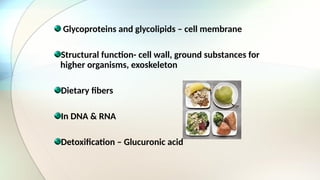
Glycoproteins and glycolipids– cell membrane
Structural function- cell wall, ground substances for
higher organisms, exoskeleton
Dietary fibers
In DNA & RNA
Detoxification – Glucuronic acid
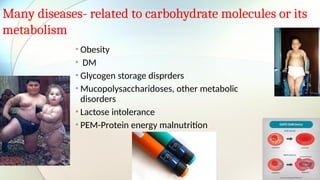
Many diseases- relatedto carbohydrate molecules or its
metabolism
• Obesity
• DM
• Glycogen storage disprders
• Mucopolysaccharidoses, other metabolic
disorders
• Lactose intolerance
• PEM-Protein energy malnutrition
8.
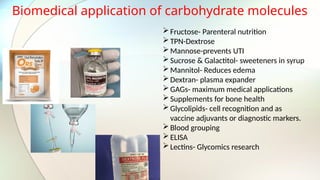
Biomedical application ofcarbohydrate molecules
Fructose- Parenteral nutrition
TPN-Dextrose
Mannose-prevents UTI
Sucrose & Galactitol- sweeteners in syrup
Mannitol- Reduces edema
Dextran- plasma expander
GAGs- maximum medical applications
Supplements for bone health
Glycolipids- cell recognition and as
vaccine adjuvants or diagnostic markers.
Blood grouping
ELISA
Lectins- Glycomics research
9.
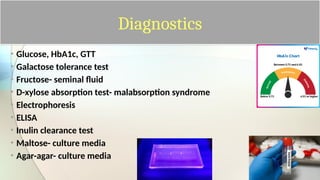
Diagnostics
• Glucose, HbA1c,GTT
• Galactose tolerance test
• Fructose- seminal fluid
• D-xylose absorption test- malabsorption syndrome
• Electrophoresis
• ELISA
• Inulin clearance test
• Maltose- culture media
• Agar-agar- culture media
Carbohydrates= Hydrates ofcarbon
• As the name implies, consist of carbon, hydrogen,
and oxygen.
• Hydrate=(water) hydrogen and oxygen.
• The basic formula for carbohydrates is CH2O,
meaning that there is one carbon atom, two
hydrogen atoms, and one oxygen atom as the ratio in
the structure of carbohydrates
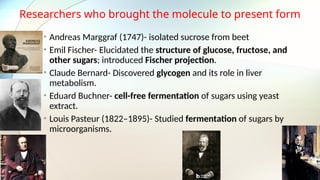
Researchers who broughtthe molecule to present form
• Andreas Marggraf (1747)- isolated sucrose from beet
• Emil Fischer- Elucidated the structure of glucose, fructose, and
other sugars; introduced Fischer projection.
• Claude Bernard- Discovered glycogen and its role in liver
metabolism.
• Eduard Buchner- cell-free fermentation of sugars using yeast
extract.
• Louis Pasteur (1822–1895)- Studied fermentation of sugars by
microorganisms.
14.
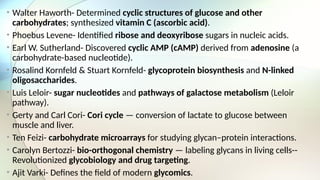
• Walter Haworth-Determined cyclic structures of glucose and other
carbohydrates; synthesized vitamin C (ascorbic acid).
• Phoebus Levene- Identified ribose and deoxyribose sugars in nucleic acids.
• Earl W. Sutherland- Discovered cyclic AMP (cAMP) derived from adenosine (a
carbohydrate-based nucleotide).
• Rosalind Kornfeld & Stuart Kornfeld- glycoprotein biosynthesis and N-linked
oligosaccharides.
• Luis Leloir- sugar nucleotides and pathways of galactose metabolism (Leloir
pathway).
• Gerty and Carl Cori- Cori cycle — conversion of lactate to glucose between
muscle and liver.
• Ten Feizi- carbohydrate microarrays for studying glycan–protein interactions.
• Carolyn Bertozzi- bio-orthogonal chemistry — labeling glycans in living cells--
Revolutionized glycobiology and drug targeting.
• Ajit Varki- Defines the field of modern glycomics.
15.
Saccharides (Gr. Saccharon= sugar)/ Sharkara (Sanskrit)
Classified based on number of sugar units:
Monosaccharides (1)
Disaccharides (2)
Oligosaccharides (3-10)
Polysaccharide (> 10)
16.
Most of thenames of carbohydrates end in -ose
• Glucose-What plants make
• Maltose- used in making beer (disaccharide)
• Fructose – found in fruit (monosaccharide)
• Sucrose- Table sugar (disaccharide)
• Lactose – In milk (disaccharide)
17.
Monosaccharides
• Simple sugars
•Single polyhydroxy aldehyde or ketone
derivative
• Can’t be hydrolyzed any further
• Most abundant monosaccharide in nature- D-
Glucose
• Building blocks of all carbohydrates
18.
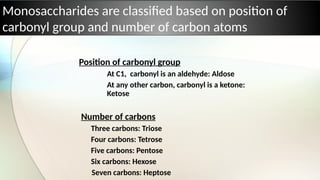
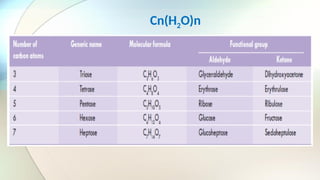
Monosaccharides are classifiedbased on position of
carbonyl group and number of carbon atoms
Position of carbonyl group
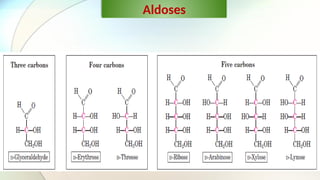
At C1, carbonyl is an aldehyde: Aldose
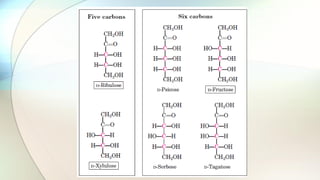
At any other carbon, carbonyl is a ketone:
Ketose
Number of carbons
Three carbons: Triose
Four carbons: Tetrose
Five carbons: Pentose
Six carbons: Hexose
Seven carbons: Heptose
19.
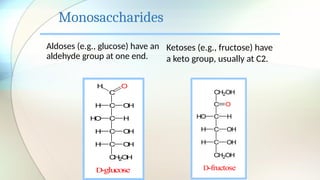
Monosaccharides
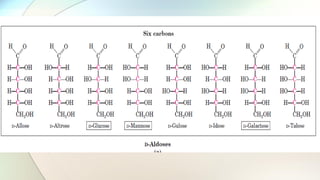
Aldoses (e.g., glucose)have an
aldehyde group at one end.
Ketoses (e.g., fructose) have
a keto group, usually at C2.
C
C O
H
H
C H
H
O
C O
H
H
C O
H
H
C
H
2O
H
D
-glucose
O
H
C H
HO
C OH
H
C OH
H
CH2OH
CH2OH
C O
D-fructose
Trisaccharides
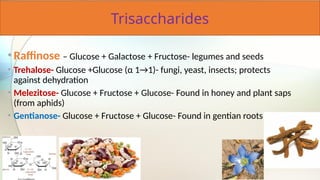
•Raffinose – Glucose+ Galactose + Fructose- legumes and seeds
• Trehalose- Glucose +Glucose (α 1→1)- fungi, yeast, insects; protects
against dehydration
• Melezitose- Glucose + Fructose + Glucose- Found in honey and plant saps
(from aphids)
• Gentianose- Glucose + Fructose + Glucose- Found in gentian roots
27.
Higher Oligosaccharides (Tetrasaccharide
andabove)
Stachyose- beans and soy
Verbascose- legumes
Fructo-oligosaccharides (FOS)- Prebiotics; promote gut flora growth
Mannan-oligosaccharides (MOS)- Used in animal feed; bind pathogens in
the gut
Glycoprotein/Glycolipid Oligosaccharides- Found on cell membranes;
function in cell recognition and signaling
28.
Polysaccharides / Glycans
Poly= Many
Glycans / Complex carbohydrates
Linear (Cellulose)or branched (Glycogen)
High MW
Sparingly soluble in cold water
Form colloidal solution on heating
Not sweetish
2 types
29.
Polysaccharides
Homopolysaccharides Heteropolysaccharides
Same typeof sugar units
• Starch
• Glycogen
• Dextrin
• Inulin
• Cellulose
Different types of sugar units
A. Agar & Agarose
B. Mucopolysaccharides/GAGs
• Heparin
• Chondroitin sulfate
• Hyaluronic acid
• Dermatan sulfate
• Keratan sulfate
• Blood group polysaccharides
30.
Structural arrangement ofmonosaccharide
•Empirical formula- doesn’t give any idea about
the arrangement e.g. Glucose- C6H12O6
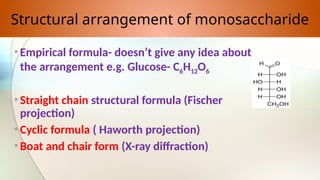
•Straight chain structural formula (Fischer
projection)
•Cyclic formula ( Haworth projection)
•Boat and chair form (X-ray diffraction)
31.
Fischer projection- Linear
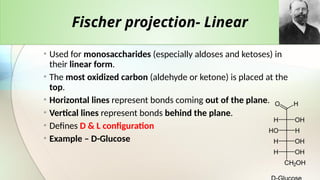
•Used for monosaccharides (especially aldoses and ketoses) in
their linear form.
• The most oxidized carbon (aldehyde or ketone) is placed at the
top.
• Horizontal lines represent bonds coming out of the plane.
• Vertical lines represent bonds behind the plane.
• Defines D & L configuration
• Example – D-Glucose
32.
Cyclic / Haworthprojection
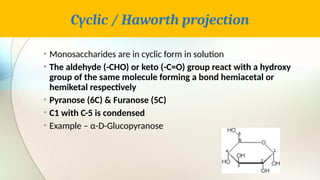
• Monosaccharides are in cyclic form in solution
• The aldehyde (-CHO) or keto (-C=O) group react with a hydroxy
group of the same molecule forming a bond hemiacetal or
hemiketal respectively
• Pyranose (6C) & Furanose (5C)
• C1 with C-5 is condensed
• Example – α-D-Glucopyranose
33.
Boat and chairform
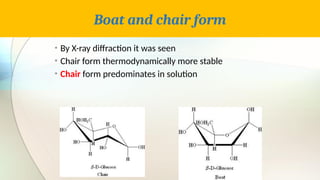
• By X-ray diffraction it was seen
• Chair form thermodynamically more stable
• Chair form predominates in solution
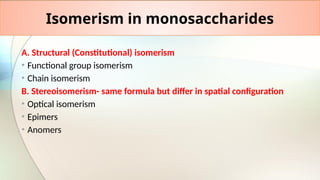
Isomerism in monosaccharides
A.Structural (Constitutional) isomerism
• Functional group isomerism
• Chain isomerism
B. Stereoisomerism- same formula but differ in spatial configuration
• Optical isomerism
• Epimers
• Anomers
36.
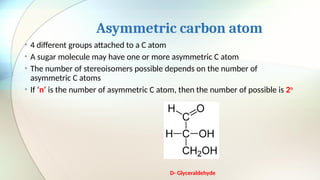
Asymmetric carbon atom
•4 different groups attached to a C atom
• A sugar molecule may have one or more asymmetric C atom
• The number of stereoisomers possible depends on the number of
asymmetric C atoms
• If ‘n’ is the number of asymmetric C atom, then the number of possible is 2n
D- Glyceraldehyde
37.
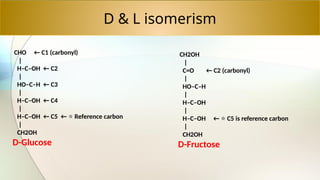
Reference carbon atom
•Also known as reference chiral carbon or asymmetric carbon
• carbon atom farthest from the carbonyl group (–CHO or >C=O) that
is attached to four different groups
• In a Fischer projection,
• If the –OH group on the reference carbon is on the right → D-form
• If the –OH group is on the left → L-form
• Locate the farthest asymmetric C atom, see to which side is the –OH
group
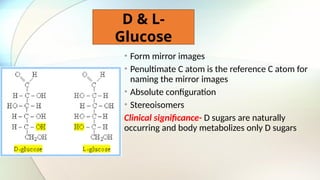
D & L-
Glucose
•Form mirror images
• Penultimate C atom is the reference C atom for
naming the mirror images
• Absolute configuration
• Stereoisomers
Clinical significance- D sugars are naturally
occurring and body metabolizes only D sugars
40.
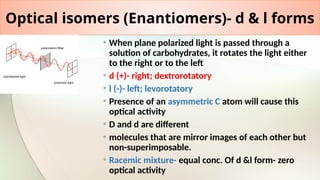
Optical isomers (Enantiomers)-d & l forms
• When plane polarized light is passed through a
solution of carbohydrates, it rotates the light either
to the right or to the left
• d (+)- right; dextrorotatory
• l (-)- left; levorotatory
• Presence of an asymmetric C atom will cause this
optical activity
• D and d are different
• molecules that are mirror images of each other but
non-superimposable.
• Racemic mixture- equal conc. Of d &l form- zero
optical activity
41.
Clinical significance ofoptical isomers
• Specific isomers have medicinal use whereas the other form
may lead to side effects or may have less effectiveness
• Naproxen- One isomer is tt of choice for arthritis and another
leads to liver toxicity
• Ethambutol- one isomer treats TB and another leads to
blindness
42.
Diastereoisomerism of glucose
•For glucose around C2, 3 & 4- 8 isomers can be formed
• Around C-5- 8 isomers
• For C6H12O6- 16 different monosaccharides
• But in human body only 3 are seen- Glucose, galactose and
mannose
• Glucose- Found in blood; Dextrose (D-Glucose) in clinical
practice
• Galactose- Milk sugar & glycoproteins; In liver gets epimerised
to glucose
• Mannose- Glycoproteins, plants; a prebiotic
43.
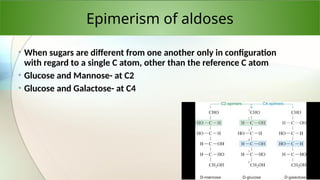
Epimerism of aldoses
•When sugars are different from one another only in configuration
with regard to a single C atom, other than the reference C atom
• Glucose and Mannose- at C2
• Glucose and Galactose- at C4
44.
Anomerism of sugars-α & β forms
• Anomerism is a special type of stereoisomerism seen in
cyclic monosaccharides.
It occurs due to the formation of a new chiral center
(called the anomeric carbon) when the sugar’s open-chain
form cyclizes into a ring.
• When a monosaccharide (like glucose or fructose) forms a
hemiacetal (aldose) or hemiketal (ketose) ring, the
carbonyl carbon (C=O) becomes a new asymmetric carbon.
• This carbon is called the anomeric carbon (C-1 in aldoses,
C-2 in ketoses).
• Depending on the position of the newly attached –OH
group, two forms appear → α and β anomers.
45.
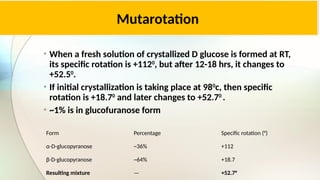
Mutarotation
• When afresh solution of crystallized D glucose is formed at RT,
its specific rotation is +1120
, but after 12-18 hrs, it changes to
+52.50
.
• If initial crystallization is taking place at 980
c, then specific
rotation is +18.70
and later changes to +52.70
.
• ~1% is in glucofuranose form
Form Percentage Specific rotation (°)
α-D-glucopyranose ~36% +112
β-D-glucopyranose ~64% +18.7
Resulting mixture — +52.7°
46.
Fructose- ketohexose
• C2-anomeric C atom
• 4 isomers
• Aldose-ketose isomer of Glucose
• Predominantly Furanose structure
47.
For more PPTon Medical
Biochemistry
www.drvpacharya.com
Editor's Notes
#25 Raffinose = Galactose + Glucose + Fructose👉 It is formed when galactose is added to sucrose (glucose + fructose) via an α-1,6 linkage. Found in plants, especially in seeds and legumes. Humans cannot digest raffinose (lack the enzyme α-galactosidase).
It reaches the large intestine, where bacteria ferment it, producing gas (H₂, CO₂, methane) — hence its association with flatulence.