Colorimetry
Prof Dr Viyatprajna Acharya
MD, PhD
Colorimeter
• Visual colorimeter
• Photoelectric colorimeter
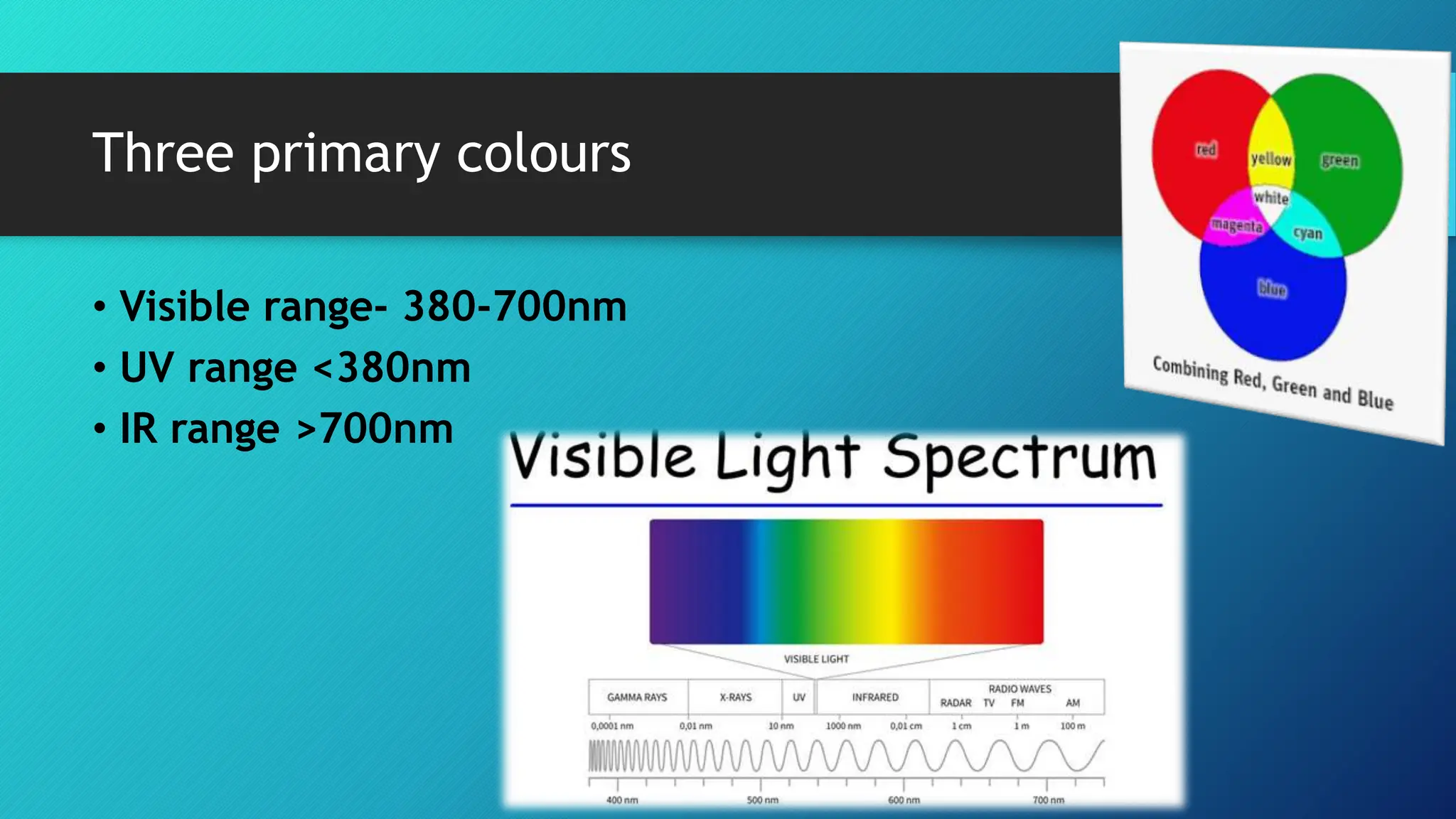
Three primary colours
• Visible range- 380-700nm
• UV range <380nm
• IR range >700nm
Most of the biochemical tests are based on
colours!! How do we see colours??
• As sunlight — which is a combination of all wavelengths —
hits an object, some materials will absorb specific
wavelengths. The wavelengths that aren’t absorbed get
reflected. This reflected light then reaches our eyes and
makes us perceive the reflecting object as being a
particular color.
• Colorimeter measures the colour intensity
• Compared with a known standard
Absorbance Vs Transmittance light
• Inverse relationship
• In colorimeter transmittance light is measured
and calculated for absorbance
• Absorbance is directly proportional to conc. Of
analyte and transmittance is inversely
proportional
• Unit of absorbance is OD (Optical density)
A= -log T
% Transmission (T)= Ie/I0 x100
%Absorbance (A)= Log10 1/T
A= Log10 100/%T
= Log10 100- Log T
= Log10 102- Log T
=2Log10 10- Log T
A= 2- Log %T
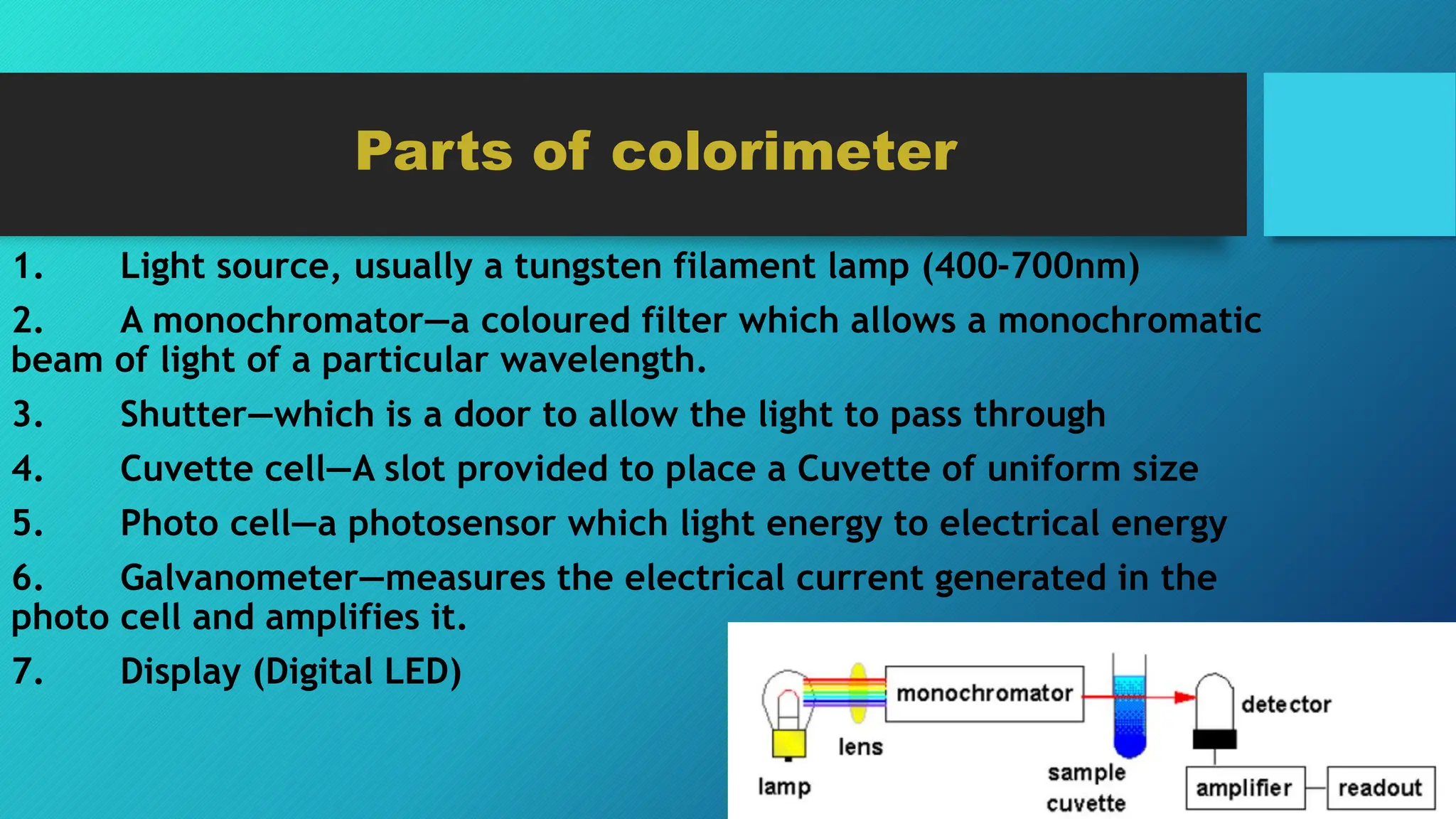
Parts of colorimeter
1. Light source, usually a tungsten filament lamp (400-700nm)
2. A monochromator—a coloured filter which allows a monochromatic
beam of light of a particular wavelength.
3. Shutter—which is a door to allow the light to pass through
4. Cuvette cell—A slot provided to place a Cuvette of uniform size
5. Photo cell—a photosensor which light energy to electrical energy
6. Galvanometer—measures the electrical current generated in the
photo cell and amplifies it.
7. Display (Digital LED)
Principles of colorimetry
• Beer’s law- The amount of light absorbed by a coloured
solution is directly proportional to the concentration of
coloring substance (solute) present in the solution.
A α C
A= absorbance C= Concentration
• Lambert’s law- The amount of light absorbed by a
coloured solution is proportional to the depth or path
length through which the light passes i.e. the
diameter of the cuvette.
A α L
Combined Beer-Lambert’s law
A= k.CL k= constant for the coloured solution
Amount of light absorbed by a coloured solution is directly
proportional to the concentration of the solute if the path
length is constant.
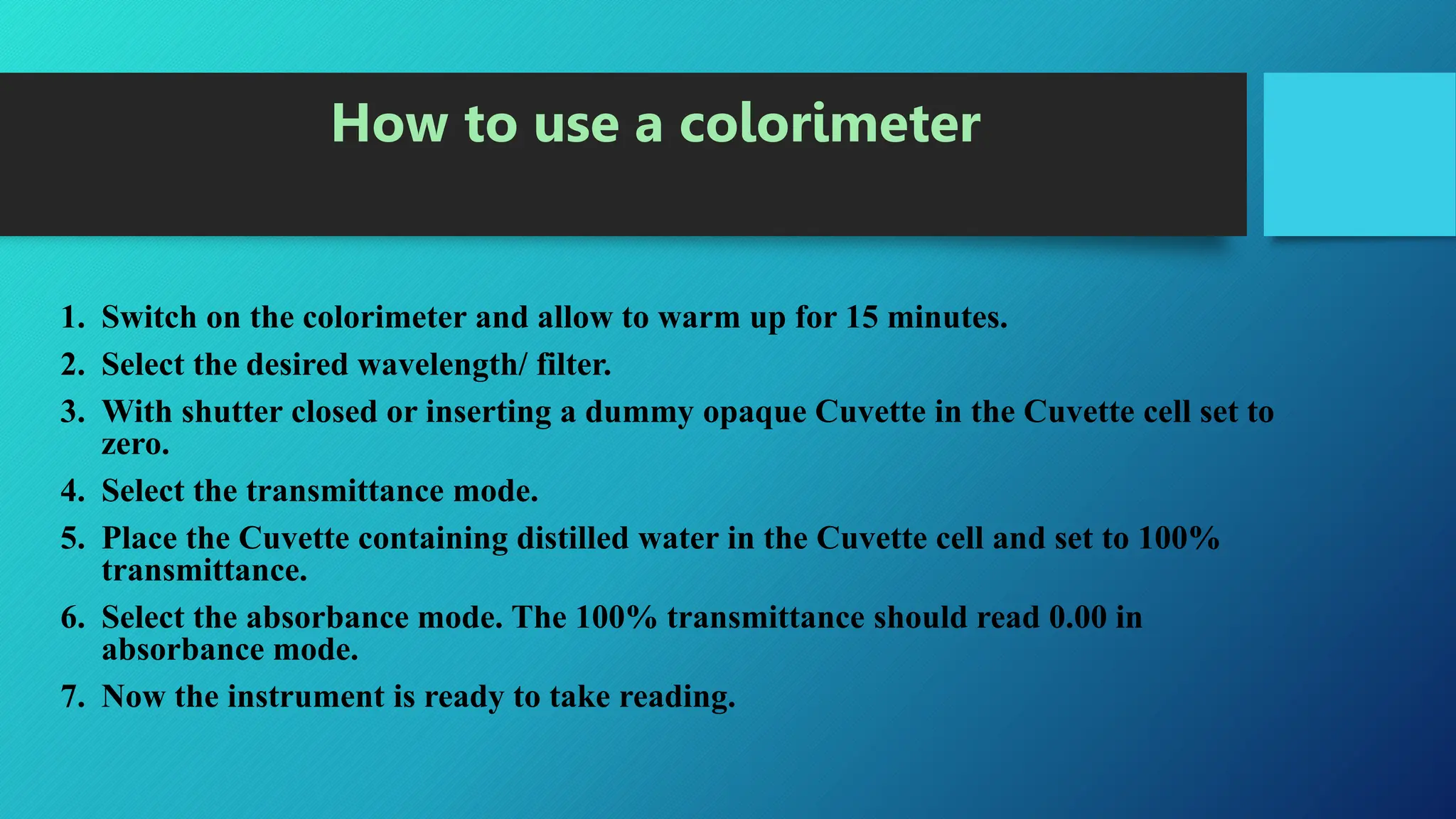
How to use a colorimeter
1. Switch on the colorimeter and allow to warm up for 15 minutes.
2. Select the desired wavelength/ filter.
3. With shutter closed or inserting a dummy opaque Cuvette in the Cuvette cell set to
zero.
4. Select the transmittance mode.
5. Place the Cuvette containing distilled water in the Cuvette cell and set to 100%
transmittance.
6. Select the absorbance mode. The 100% transmittance should read 0.00 in
absorbance mode.
7. Now the instrument is ready to take reading.
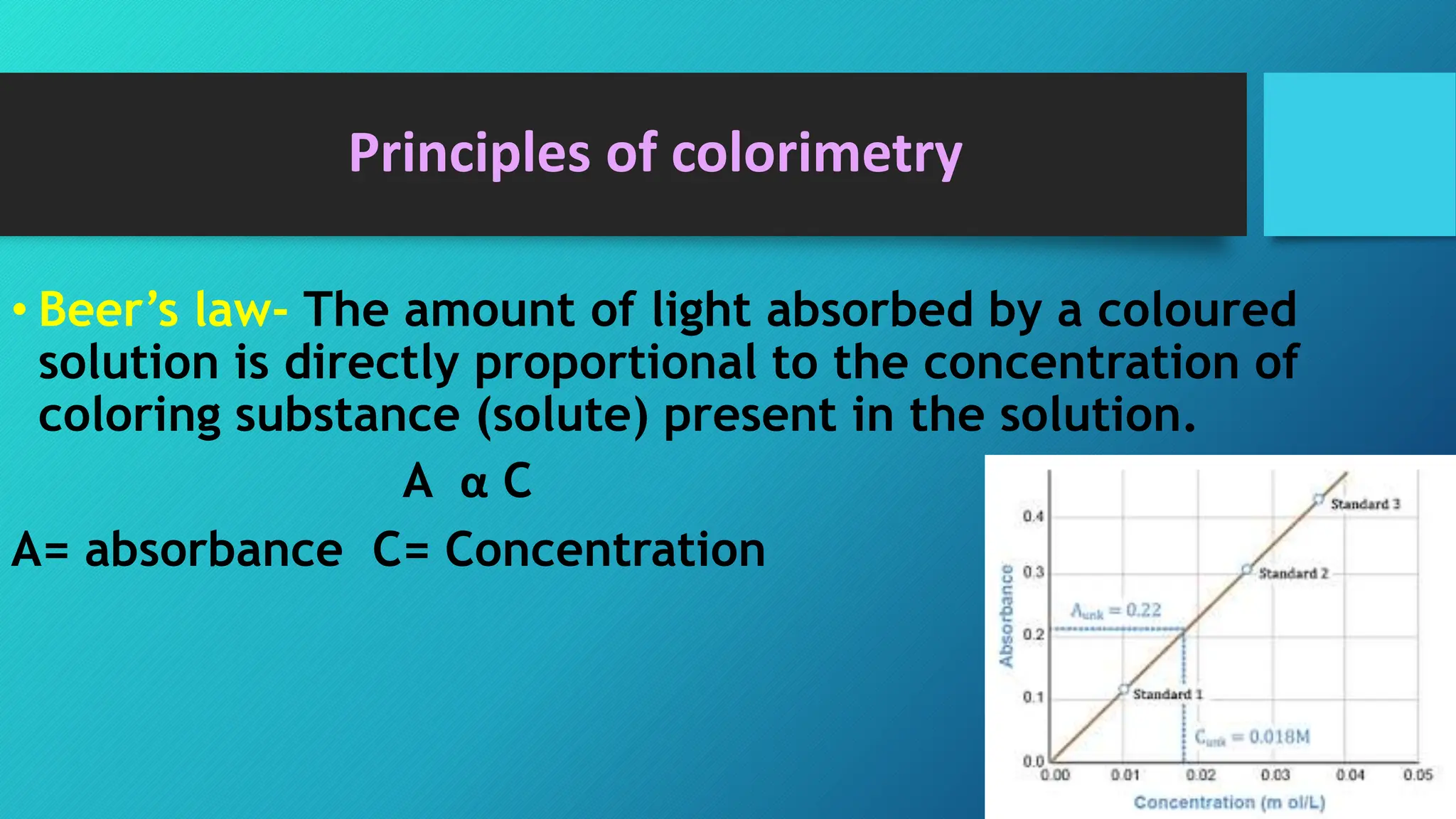
Standard curve preparation
• A series of known concentration of potassium
permanganate solution is taken and their OD is measured
• Graph is plotted
• Unknown solution OD is measured and its concentration
can be extrapolated from the curve
Linearity
• At higher concentrations the curve diverts
• solute molecules can cause different charge distribution on their neighboring
species in the solution. Since UV-visible absorption is an electronic
phenomenon, high concentrations would possibly result in a shift in the
absorption wavelength of the analyte. Some large ions or molecules show
deviations even at very low concentrations. For e.g. methylene blue
absorptivity at 436 nm fails to observe Beer Lambert law even at
concentrations as low as 10μM.
• alter the refractive index (η) of the solution
• Chemical alteration of solute molecules
• Depends on band length chosen too
Quantitative experiments
• 3 test tubes are taken and labeled as B, S & T for blank,
standard and test solution.
• B= Reagent with water
• S= Standard of the parameter to be measured (known
concentration)
• T= Test solution (unknown concentration)
• OD is measured for all three
• Calculation-
100
tan
.




rum
Volumeofse
dard
ofs
Conc
Bod
Sod
Bod
Tod
Spectrophotometer
• Uses a prism or grating
• UV and IR range also can be
measured
• Hydrogen and deuterium lamps are
used- 200-900nm
• More sensitive and accurate
www.drvpacharya.com

Colorimetry.pptx

  • 1.
  • 2.
    Colorimeter • Visual colorimeter •Photoelectric colorimeter
  • 3.
    Three primary colours •Visible range- 380-700nm • UV range <380nm • IR range >700nm
  • 4.
    Most of thebiochemical tests are based on colours!! How do we see colours?? • As sunlight — which is a combination of all wavelengths — hits an object, some materials will absorb specific wavelengths. The wavelengths that aren’t absorbed get reflected. This reflected light then reaches our eyes and makes us perceive the reflecting object as being a particular color. • Colorimeter measures the colour intensity • Compared with a known standard
  • 5.
    Absorbance Vs Transmittancelight • Inverse relationship • In colorimeter transmittance light is measured and calculated for absorbance • Absorbance is directly proportional to conc. Of analyte and transmittance is inversely proportional • Unit of absorbance is OD (Optical density)
  • 6.
  • 7.
    % Transmission (T)=Ie/I0 x100 %Absorbance (A)= Log10 1/T A= Log10 100/%T = Log10 100- Log T = Log10 102- Log T =2Log10 10- Log T A= 2- Log %T
  • 8.
    Parts of colorimeter 1.Light source, usually a tungsten filament lamp (400-700nm) 2. A monochromator—a coloured filter which allows a monochromatic beam of light of a particular wavelength. 3. Shutter—which is a door to allow the light to pass through 4. Cuvette cell—A slot provided to place a Cuvette of uniform size 5. Photo cell—a photosensor which light energy to electrical energy 6. Galvanometer—measures the electrical current generated in the photo cell and amplifies it. 7. Display (Digital LED)
  • 10.
    Principles of colorimetry •Beer’s law- The amount of light absorbed by a coloured solution is directly proportional to the concentration of coloring substance (solute) present in the solution. A α C A= absorbance C= Concentration
  • 11.
    • Lambert’s law-The amount of light absorbed by a coloured solution is proportional to the depth or path length through which the light passes i.e. the diameter of the cuvette. A α L Combined Beer-Lambert’s law A= k.CL k= constant for the coloured solution Amount of light absorbed by a coloured solution is directly proportional to the concentration of the solute if the path length is constant.
  • 12.
    How to usea colorimeter 1. Switch on the colorimeter and allow to warm up for 15 minutes. 2. Select the desired wavelength/ filter. 3. With shutter closed or inserting a dummy opaque Cuvette in the Cuvette cell set to zero. 4. Select the transmittance mode. 5. Place the Cuvette containing distilled water in the Cuvette cell and set to 100% transmittance. 6. Select the absorbance mode. The 100% transmittance should read 0.00 in absorbance mode. 7. Now the instrument is ready to take reading.
  • 13.
    Standard curve preparation •A series of known concentration of potassium permanganate solution is taken and their OD is measured • Graph is plotted • Unknown solution OD is measured and its concentration can be extrapolated from the curve
  • 14.
    Linearity • At higherconcentrations the curve diverts • solute molecules can cause different charge distribution on their neighboring species in the solution. Since UV-visible absorption is an electronic phenomenon, high concentrations would possibly result in a shift in the absorption wavelength of the analyte. Some large ions or molecules show deviations even at very low concentrations. For e.g. methylene blue absorptivity at 436 nm fails to observe Beer Lambert law even at concentrations as low as 10μM. • alter the refractive index (η) of the solution • Chemical alteration of solute molecules • Depends on band length chosen too
  • 15.
    Quantitative experiments • 3test tubes are taken and labeled as B, S & T for blank, standard and test solution. • B= Reagent with water • S= Standard of the parameter to be measured (known concentration) • T= Test solution (unknown concentration) • OD is measured for all three • Calculation- 100 tan .     rum Volumeofse dard ofs Conc Bod Sod Bod Tod
  • 16.
    Spectrophotometer • Uses aprism or grating • UV and IR range also can be measured • Hydrogen and deuterium lamps are used- 200-900nm • More sensitive and accurate
  • 17.