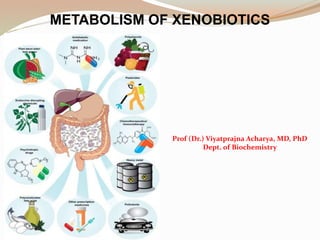
METABOLISM OF XENOBIOTICS
Prof (Dr.) Viyatprajna Acharya, MD, PhD
Dept. of Biochemistry
 XENOS = FOREIGN
 XENOBIOTICS = Foreign chemicals
 Metabolism of xenobiotics = handling of xenobiotics
at cellular level
 Earlier known as detoxification- a misnomer
 Mostly lipophilic- hence can’t be cleared from body
and accumulate.
Pollutant
Substance that increases in quantity
due to human activity and
adversely affects the environment
e.g. CO2, SO2 ,Pb etc
Contaminant
A substance which is not present in
nature but released during human
activity e.g. DDT, Malathion,
plastics
Xenobiotics that we come across
in a single day
 Toothpaste
 Phenyl
 Facewash
 Soap
 Deodorant/ anti-perspirant
 Cosmetics
 Food- pesticides, dyes, additives
 Vehicle effluents
 Industrial pollutants
 The list is endless…..
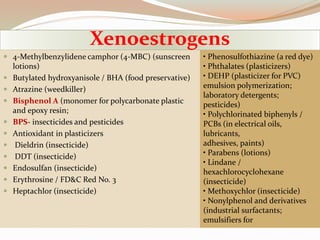
Xenoestrogens
 4-Methylbenzylidene camphor (4-MBC) (sunscreen
lotions)
 Butylated hydroxyanisole / BHA (food preservative)
 Atrazine (weedkiller)
 Bisphenol A (monomer for polycarbonate plastic
and epoxy resin;
 BPS- insecticides and pesticides
 Antioxidant in plasticizers
 Dieldrin (insecticide)
 DDT (insecticide)
 Endosulfan (insecticide)
 Erythrosine / FD&C Red No. 3
 Heptachlor (insecticide)
• Phenosulfothiazine (a red dye)
• Phthalates (plasticizers)
• DEHP (plasticizer for PVC)
emulsion polymerization;
laboratory detergents;
pesticides)
• Polychlorinated biphenyls /
PCBs (in electrical oils,
lubricants,
adhesives, paints)
• Parabens (lotions)
• Lindane /
hexachlorocyclohexane
(insecticide)
• Methoxychlor (insecticide)
• Nonylphenol and derivatives
(industrial surfactants;
emulsifiers for
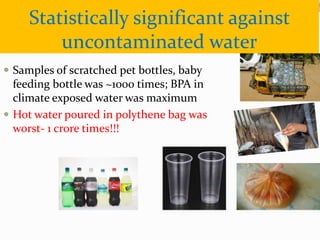
Statistically significant against
uncontaminated water
 Samples of scratched pet bottles, baby
feeding bottle was ~1000 times; BPA in
climate exposed water was maximum
 Hot water poured in polythene bag was
worst- 1 crore times!!!
Metabolism
 Aim is to make xenobiotic inactive or less harmful
 Make them hydrophilic- easy excretion from body
 2 phases
 Site-liver
PHASE-I REACTION
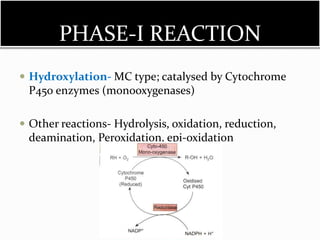
 Hydroxylation- MC type; catalysed by Cytochrome
P450 enzymes (monooxygenases)
 Other reactions- Hydrolysis, oxidation, reduction,
deamination, Peroxidation, epi-oxidation
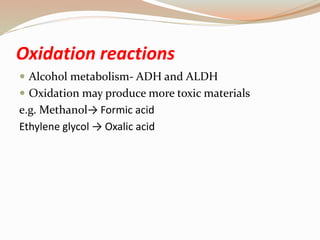
Oxidation reactions
 Alcohol metabolism- ADH and ALDH
 Oxidation may produce more toxic materials
e.g. Methanol→ Formic acid
Ethylene glycol → Oxalic acid
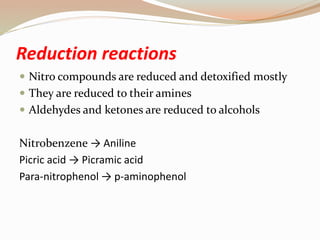
Reduction reactions
 Nitro compounds are reduced and detoxified mostly
 They are reduced to their amines
 Aldehydes and ketones are reduced to alcohols
Nitrobenzene → Aniline
Picric acid → Picramic acid
Para-nitrophenol → p-aminophenol
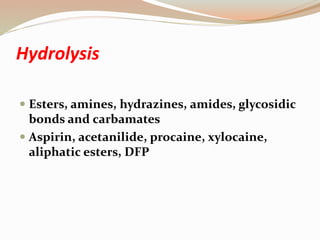
Hydrolysis
 Esters, amines, hydrazines, amides, glycosidic
bonds and carbamates
 Aspirin, acetanilide, procaine, xylocaine,
aliphatic esters, DFP
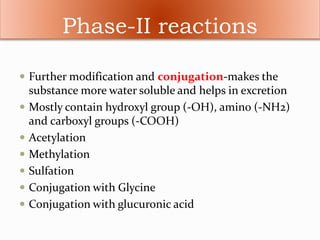
Phase-II reactions
 Further modification and conjugation-makes the
substance more water soluble and helps in excretion
 Mostly contain hydroxyl group (-OH), amino (-NH2)
and carboxyl groups (-COOH)
 Acetylation
 Methylation
 Sulfation
 Conjugation with Glycine
 Conjugation with glucuronic acid
Glucuronidation
 UDP glucuronic acid
 Bilirubin- in presence of glucuronyl transferase BMG
and BDG are produced
 Other products undergoing glucuronidation-
i. Acetylaminofluorene (carcinogen),
ii. Aniline (dye)
iii. Benzoic acid
iv. Phenol
v. Meprobamate
Sulphation
 PAPS- 3-phospho-adenosine-5-phosphosulphate/
active Sulphur is the sulphate donor
 Alcohols, arylamines, phenols are sulphonated
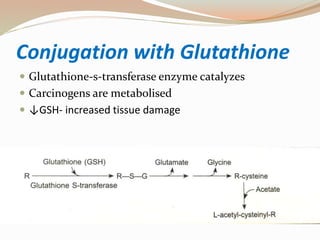
Conjugation with Glutathione
 Glutathione-s-transferase enzyme catalyzes
 Carcinogens are metabolised
 ↓GSH- increased tissue damage
Acetylation
 Acetyl CoA is the acetyl group donor
 Acetyltransferase enzyme
 INH is acetylated before excretion
 Polymorphic forms- Slow and fast acetylators
 Slow acetylators – more toxic effects of INH
Methylation
 S-adenosyl-methionine (SAM)- methyl group donor
 Enzyme –methyltransferase
Phase 3 reactions!!!
 Phase 2 products are further metabolized
 Rare
 Conjugation with GSH
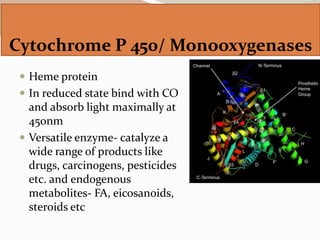
Cytochrome P 450/ Monooxygenases
 Heme protein
 In reduced state bind with CO
and absorb light maximally at
450nm
 Versatile enzyme- catalyze a
wide range of products like
drugs, carcinogens, pesticides
etc. and endogenous
metabolites- FA, eicosanoids,
steroids etc
 Present in ER of liver
 Inducible enzymes
 Phenobarbiturates are the chief stimulators
 Human genome codes for 14 families of Cyt P450
 150 isoforms in different tissues
 6 isoforms of Cyt P450- wide overlapping substrate
specificity
 Cyt P 450- Hydroxylation reaction and uses NADPH
 Ubiquitous in all tissues
 Majority- liver and intestine; 20% of total proteins in
liver microsome
 Adrenal gland- mitochondria also contains- involved
in cholesterol biosynthesis
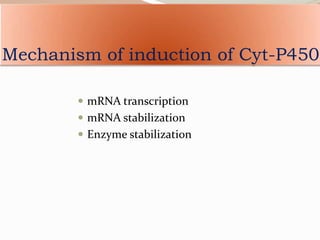
Mechanism of induction of Cyt-P450
 mRNA transcription
 mRNA stabilization
 Enzyme stabilization
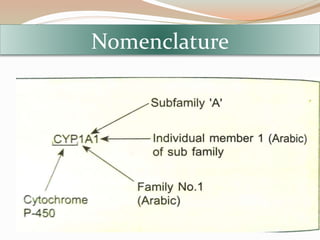
Nomenclature
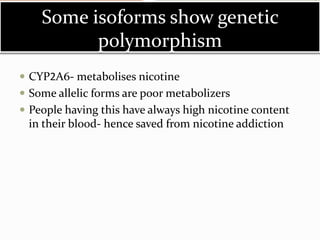
Some isoforms show genetic
polymorphism
 CYP2A6- metabolises nicotine
 Some allelic forms are poor metabolizers
 People having this have always high nicotine content
in their blood- hence saved from nicotine addiction
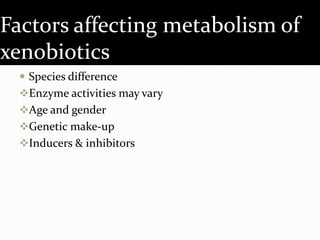
Factors affecting metabolism of
xenobiotics
 Species difference
Enzyme activities may vary
Age and gender
Genetic make-up
Inducers & inhibitors
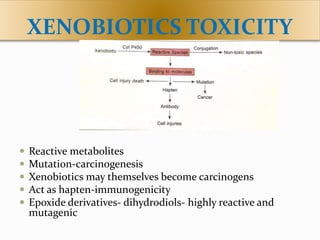
XENOBIOTICS TOXICITY
 Reactive metabolites
 Mutation-carcinogenesis
 Xenobiotics may themselves become carcinogens
 Act as hapten-immunogenicity
 Epoxide derivatives- dihydrodiols- highly reactive and
mutagenic
For more PPT on Medical Biochemistry-
www.drvpacharya.com
For more PPT on
Medical Biochemistry
www.drvpacharya.com