Polymerase Chain Reaction
Introduction
• PCR, polymerase chain reaction, is laboratory
technique (in-vitro) for amplification of a region
of DNA whose sequence is known or which lies
between two regions of known sequence
• PCR use smallest sample of the DNA to be cloned
and amplify it to millions of copies- few hours
• Before PCR, DNA of interest could only be
amplified by over-expression in cells--- with
limited yield
• 1983, Kary Mullis postulated the concept of
PCR ( Nobel Prize in 1993)
• PCR become essential and routine tool in
most biological laboratories
Principle of PCR
• PCR involves primer mediated enzymatic
amplification of DNA
• based on using the ability of DNA polymerase to
synthesize new strand of DNA complementary to
template strand
• Primer needed b/c DNA polymerase add a
nucleotide only onto a preexisting 3′-OH group to
add the first nucleotide
• DNA polymerase then elongate 3 end by adding
more nucleotides to generate an extended region
of double stranded DNA
Components of PCR
• DNA Template: The double stranded DNA (dsDNA) of
interest, separated from the sample (genomic)
• DNA Polymerase: thermostable Taq polymerase not
rapidly denature at high temperatures (98°), function
temperature optimum of about 70°C
• Oligonucleotide primers: Short pieces of single stranded
DNA (often 20-30 base pairs) which are complementary to
the 3’ ends of sense and anti-sense strands- target sequence
• Deoxynucleotide triphosphates: Single units of the bases
A, T, G, and C (dATP, dTTP, dGTP, dCTP) provide the
energy for polymerization and the building blocks for
DNA synthesis
• Buffer system: magnesium and potassium to provide
optimal conditions for DNA denaturation and renaturation;
also important for polymerase activity, stability
1- DNA template
• DNA containing
region to be
sequenced
• Size of target DNA
to be amplified : up
to 3 Kb
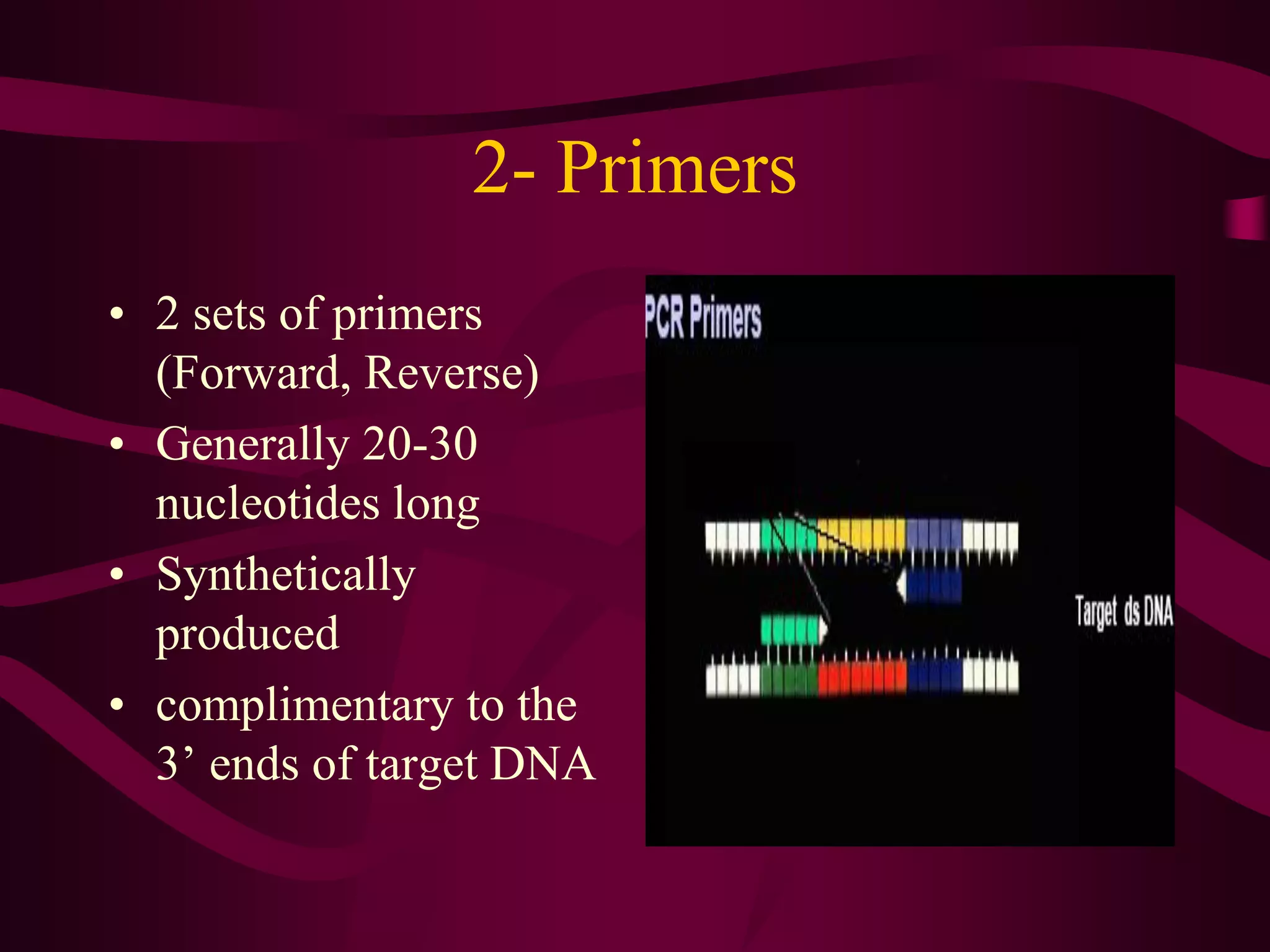
2- Primers
• 2 sets of primers
(Forward, Reverse)
• Generally 20-30
nucleotides long
• Synthetically
produced
• complimentary to the
3’ ends of target DNA
Primers
• Not containing inverted repeat sequences to
avoid formation of internal structures
• 40-60% GC content preferred for better
annealing
3-Enzyme
• Usually Taq Polymerase or anyone of the
natural or Recombinant thermostable
polymerases
• Stable at T0 up to 950 C
• High processivity
Procedure of PCR
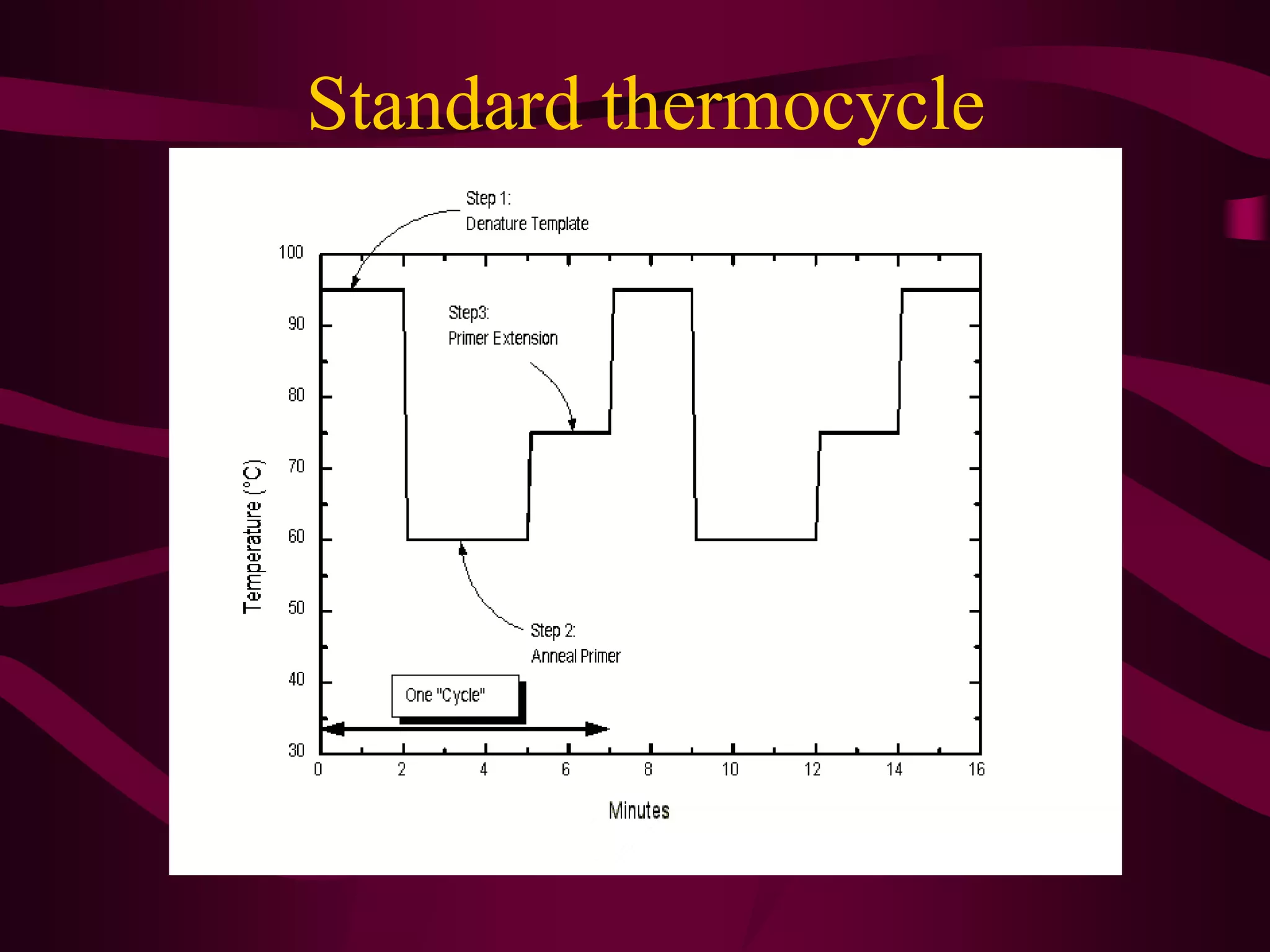
• All PCR components-mixed together- taken through series
of 3 major cyclic reactions conducted in automated, self-
contained thermocycler machine
• Denaturation:
heating- reaction mixture to 94°C for 15-30 seconds
double stranded DNA- denatured to single strands due to
breakage in weak hydrogen bonds
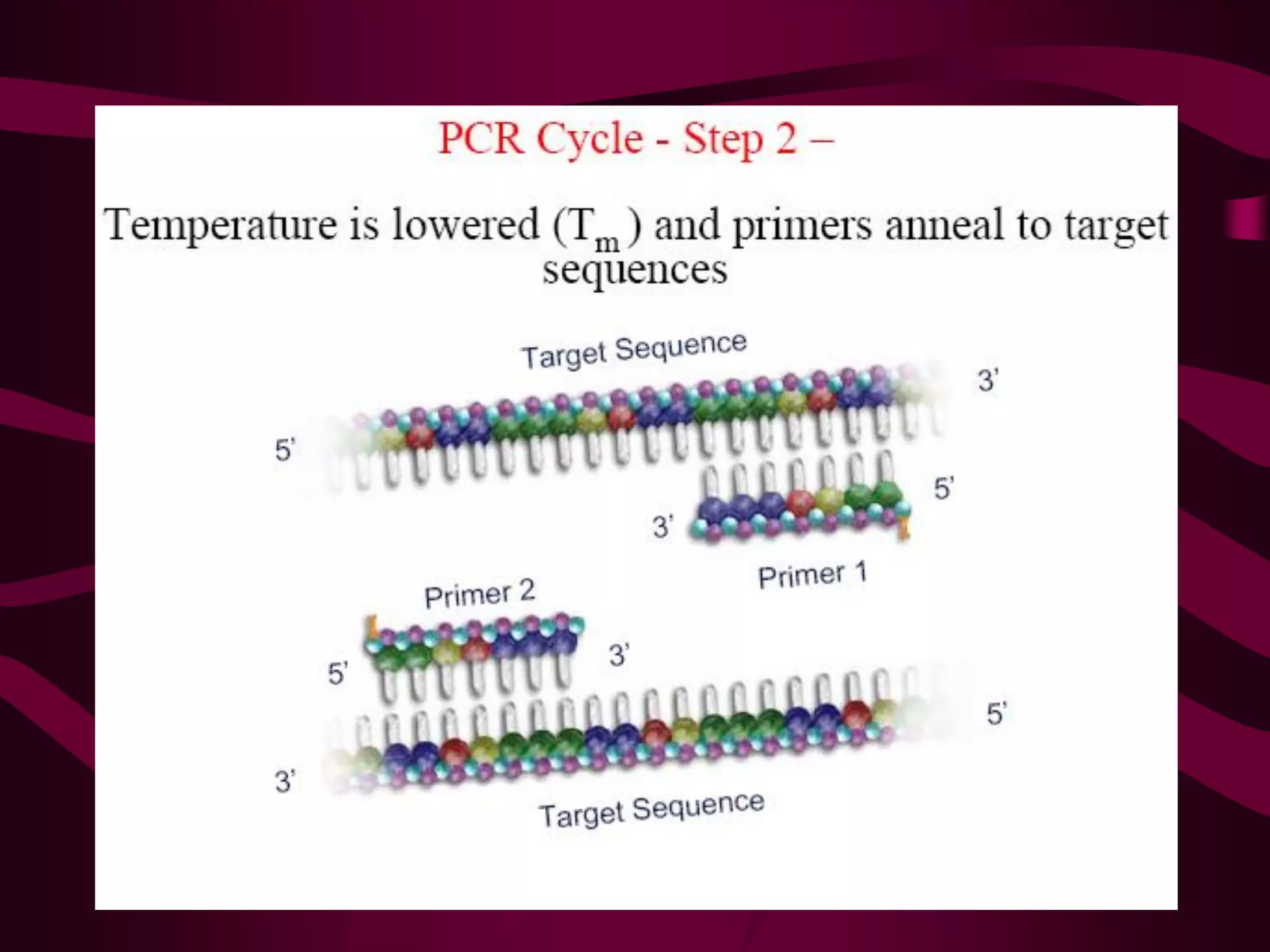
• Annealing:
reaction temperature-rapidly lowered to 50-60°C for 20-40
seconds -allows primers to bind (anneal) to their
complementary sequence in the template DNA
• Elongation/Extension :
• usually occurs at 72-80°C, the polymerase enzyme in
sequence adds bases to 3′ each primer, extending the DNA
sequence in the 5′ to 3′ direction
• optimal conditions, DNA polymerase will add about 1,000
bp/minute
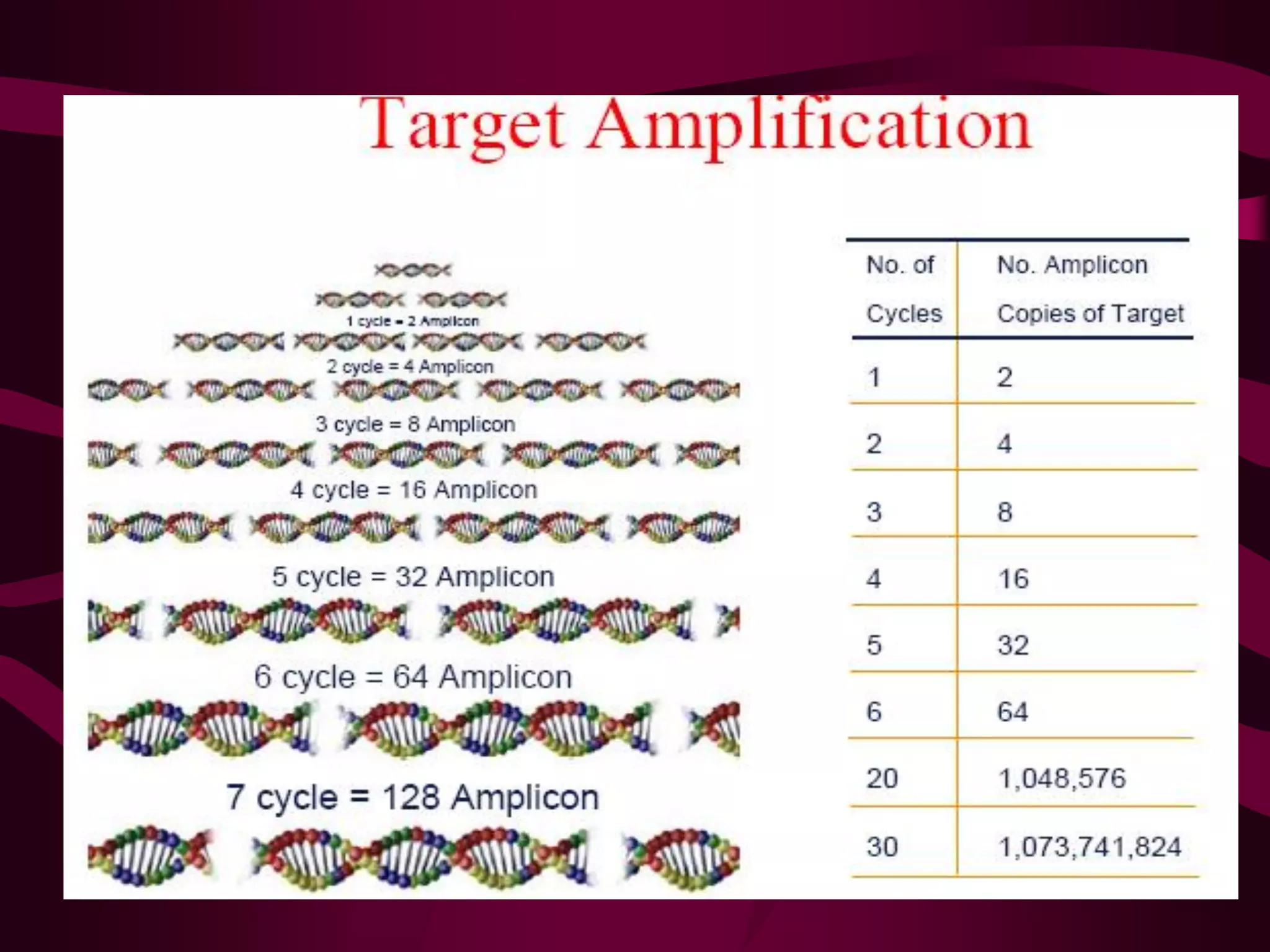
• With one cycle, a single segment of double-stranded DNA
template is amplified into two separate pieces of double-
stranded DNA
• These two pieces are then available for amplification in the
next cycle
• cycles are repeated, more and more copies are generated
Standard thermocycle
Types of PCR
• Real-time PCR
• Quantitative real time PCR (Q-RT PCR)
• Reverse Transcriptase PCR (RT-PCR)
• Multiplex PCR
• Nested PCR
• Long-range PCR
• Single-cell PCR
• Fast-cycling PCR
• Methylation-specific PCR (MSP)
• Hot start PCR
• High-fidelity PCR
• In situ PCR
• Variable Number of Tandem Repeats (VNTR) PCR
• Asymmetric PCR
• Repetitive sequence-based PCR
• Overlap extension PCR
• Assemble PCR
• Intersequence-specific PCR(ISSR)
• Ligation-mediated PCR
• Methylation –specific PCR
• Miniprimer PCR
• Solid phase PCR
• Touch down PCR, etc
Applications of PCR
• Medical Applications:
• Genetic testing for presence of genetic disease mutations
(hemoglobinopathies, cystic fibrosis, other inborn errors of
metabolism)
• Detection of disease causing genes in suspected parents
who act as carriers
• Study of alteration to oncogenes may help in customization
of therapy
• be used as part of a sensitive test for tissue typing, vital to
organ transplantation
• genotyping of embryo
• monitor the gene in gene therapy
• Infectious disease Applications:
• Analyzing clinical specimens for the presence of infectious
agents, including HIV, hepatitis, malaria, tuberulosis etc.
• Detection of new virulent subtypes of organism that is
responsible for epidemics
• Forensic Applications:
• be used as a tool in genetic fingerprinting
• can identify any one person from millions of others in case
of : crime scence, rule out suspects during police
investigation, paternity testing even in case of availibility
of very small amount of specimens ( stains of blood,
semen, hair etc)
• Research and Molecular Genetics:
• In genomic studies:
• compare the genomes of two organisms and identify the
difference between them
• In phylogenetic analysis.
• Minute quantities of DNA from any source such a
fossilized material, hair, bones, mummified tissues
• In study of gene expression analysis, PCR based
mutagenesis
• In Human genome project for aim to complete mapping
and understanding of all genes of human beings
Types of PCR
• Conventional PCR
• Multiplex PCR
• Nested PCR
• RT PCR and qRT PCR
• Quantitative PCR
• Hot Start PCR
• Touch Down PCR
• Assembly PCR
• Colony PCR
• Methylation Specific PCR
• LAMP Assay
Multiplex PCR
• uses several pairs of primers annealing to different target
sequences
• permits the simultaneous analysis of multiple targets in a
single sample
• in testing for genetic mutations, six or more amplifications
might be combined
• standard protocol for DNA Fingerprinting, the targets
assayed are often amplified in groups of 3 or 4
Nested PCR
• used to increase the specificity of DNA amplification
• Two sets of primers are used in two successive reactions
• In the first PCR, one pair of primers is used to generate
DNA products, which may contain products amplified
from non-target areas
• The products from the first PCR are then used as template
in a second PCR, using one ('hemi-nesting') or two
different primers whose binding sites are located (nested)
within the first set, thus increasing specificity
• Nested PCR- often more successful in specifically
amplifying long DNA products than conventional PCR
• but requires more detailed knowledge of the sequence of
the target
Quantitative PCR
• used to measure the specific amount of target DNA (or
RNA) in a sample
• By measuring amplification only within the phase of true
exponential increase, the amount of measured product
more accurately reflects the initial amount of target
• Special thermal cyclers are used that monitor the amount
of product during the amplification
Real-Time PCR (QRT-PCR)
• Quantitative Real-Time PCR (QRT-PCR)
• use fluorescent dyes, such as Sybr Green, or fluorophore-
containing DNA probes, such as TaqMan, to measure the
amount of amplified product as the amplification
progresses
Hot-start PCR
• A technique performed manually by heating the reaction
components to the DNA melting temperature (e.g. 95 °C)
before adding the polymerase
• non-specific amplification at lower temperatures is
prevented
• Alternatively, specialized reagents inhibit the polymerase's
activity at ambient temperature, either by the binding of
an antibody, or by the presence of covalently bound
inhibitors that only dissociate after a high-temperature
activation step
• 'Hot-start/cold-finish PCR' is achieved with new hybrid
polymerases that are inactive at ambient temperature and
are only activated at elevated temperatures
Touchdown PCR
• The annealing temperature is gradually decreased in later
cycles
• The annealing temperature in the early cycles is usually 3–
5 °C above the standard Tm of the primers used, while in
the later cycles it is a similar amount below the Tm
• The initial higher annealing temperature leads to greater
specificity for primer binding, while the lower
temperatures permit more efficient amplification at the end
of the reaction
Assembly PCR
• also known as Polymerase Cycling Assembly or PCA
• the synthesis of long DNA structures by performing PCR
on a pool of long oligonucleotides with short overlapping
segments, to assemble two or more pieces of DNA into
one piece
• involves an initial PCR with primers that have an overlap
and a second PCR using the products as the template that
generates the final full-length product
• This technique may substitute for ligation-based assembly
Colony PCR
• bacterial colonies are screened directly by PCR
• E.g the screen for correct DNA vector constructs
• Colonies are sampled with a sterile pipette tip and a small
quantity of cells transferred into a PCR mix
• To release the DNA from the cells, the PCR is either
started with an extended time at 95 °C
(when standard polymerase is used), or with a shortened
denaturation step at 100 °C and special chimeric DNA
polymerase
COLD-PCR
• co-amplification at lower denaturation temperature-PCR
• a modified protocol that enriches variant alleles from a
mixture of wild type and mutation-containing DNA
RT-PCR (Reverse Transcription PCR)
• used to reverse-transcribe and amplify RNA to cDNA
• PCR is preceded by a reaction using reverse transcriptase,
an enzyme that converts RNA into cDNA
• The two reactions may be combined in a tube with the
initial heating step of PCR being used to inactivate the
transcriptase
• polymerase has RT activity and can carry out the entire
reaction
• RT-PCR is widely used in expression profiling which
detects the expression of a gene
RT-PCR (Reverse Transcription PCR)
• can also be used to obtain sequence of an RNA transcript,
which may aid the determination of the transcription start
and termination sites and facilitate mapping of the location
of exons and introns in a gene sequence
Methylation-specific PCR (MSP)
• used to identify patterns of DNA methylation at cytosine-
guanine (CpG) islands in genomic DNA
• Target DNA is first treated with sodium bisulfite, which
converts unmethylated cytosine bases to uracil, which is
complementary to adenosine in PCR primers
• Two amplifications are then carried out on the bisulfite-
treated DNA
• One primer set anneals to DNA with cytosines
(corresponding to methylated cytosine) and the other set
anneals to DNA with uracil (corresponding to
unmethylated cytosine). MSP used in quantitative PCR
provides quantitative information about the methylation
state of a given CpG island.
LAMP Assay
• Loop mediated isothermal amplification
• Modified type of PCR using 3:6 –primers set
• One of them is loop like primer
• Used Bst polymease enzyme
• (Bacillus stearothermophilus DNA polymerase)
• Using only two tempreatures (63 ºC for 45 min. then 85 ºC
for 5 min.)
• May be carried out in water bath

P6 PCR-Presentation 21.10.pdf

  • 1.
  • 2.
    Introduction • PCR, polymerasechain reaction, is laboratory technique (in-vitro) for amplification of a region of DNA whose sequence is known or which lies between two regions of known sequence • PCR use smallest sample of the DNA to be cloned and amplify it to millions of copies- few hours • Before PCR, DNA of interest could only be amplified by over-expression in cells--- with limited yield
  • 3.
    • 1983, KaryMullis postulated the concept of PCR ( Nobel Prize in 1993) • PCR become essential and routine tool in most biological laboratories
  • 4.
    Principle of PCR •PCR involves primer mediated enzymatic amplification of DNA • based on using the ability of DNA polymerase to synthesize new strand of DNA complementary to template strand • Primer needed b/c DNA polymerase add a nucleotide only onto a preexisting 3′-OH group to add the first nucleotide • DNA polymerase then elongate 3 end by adding more nucleotides to generate an extended region of double stranded DNA
  • 5.
    Components of PCR •DNA Template: The double stranded DNA (dsDNA) of interest, separated from the sample (genomic) • DNA Polymerase: thermostable Taq polymerase not rapidly denature at high temperatures (98°), function temperature optimum of about 70°C • Oligonucleotide primers: Short pieces of single stranded DNA (often 20-30 base pairs) which are complementary to the 3’ ends of sense and anti-sense strands- target sequence • Deoxynucleotide triphosphates: Single units of the bases A, T, G, and C (dATP, dTTP, dGTP, dCTP) provide the energy for polymerization and the building blocks for DNA synthesis • Buffer system: magnesium and potassium to provide optimal conditions for DNA denaturation and renaturation; also important for polymerase activity, stability
  • 6.
    1- DNA template •DNA containing region to be sequenced • Size of target DNA to be amplified : up to 3 Kb
  • 7.
    2- Primers • 2sets of primers (Forward, Reverse) • Generally 20-30 nucleotides long • Synthetically produced • complimentary to the 3’ ends of target DNA
  • 8.
    Primers • Not containinginverted repeat sequences to avoid formation of internal structures • 40-60% GC content preferred for better annealing
  • 9.
    3-Enzyme • Usually TaqPolymerase or anyone of the natural or Recombinant thermostable polymerases • Stable at T0 up to 950 C • High processivity
  • 10.
    Procedure of PCR •All PCR components-mixed together- taken through series of 3 major cyclic reactions conducted in automated, self- contained thermocycler machine • Denaturation: heating- reaction mixture to 94°C for 15-30 seconds double stranded DNA- denatured to single strands due to breakage in weak hydrogen bonds • Annealing: reaction temperature-rapidly lowered to 50-60°C for 20-40 seconds -allows primers to bind (anneal) to their complementary sequence in the template DNA
  • 11.
    • Elongation/Extension : •usually occurs at 72-80°C, the polymerase enzyme in sequence adds bases to 3′ each primer, extending the DNA sequence in the 5′ to 3′ direction • optimal conditions, DNA polymerase will add about 1,000 bp/minute • With one cycle, a single segment of double-stranded DNA template is amplified into two separate pieces of double- stranded DNA • These two pieces are then available for amplification in the next cycle • cycles are repeated, more and more copies are generated
  • 17.
  • 19.
    Types of PCR •Real-time PCR • Quantitative real time PCR (Q-RT PCR) • Reverse Transcriptase PCR (RT-PCR) • Multiplex PCR • Nested PCR • Long-range PCR • Single-cell PCR • Fast-cycling PCR • Methylation-specific PCR (MSP) • Hot start PCR • High-fidelity PCR • In situ PCR
  • 20.
    • Variable Numberof Tandem Repeats (VNTR) PCR • Asymmetric PCR • Repetitive sequence-based PCR • Overlap extension PCR • Assemble PCR • Intersequence-specific PCR(ISSR) • Ligation-mediated PCR • Methylation –specific PCR • Miniprimer PCR • Solid phase PCR • Touch down PCR, etc
  • 21.
    Applications of PCR •Medical Applications: • Genetic testing for presence of genetic disease mutations (hemoglobinopathies, cystic fibrosis, other inborn errors of metabolism) • Detection of disease causing genes in suspected parents who act as carriers • Study of alteration to oncogenes may help in customization of therapy • be used as part of a sensitive test for tissue typing, vital to organ transplantation • genotyping of embryo • monitor the gene in gene therapy
  • 22.
    • Infectious diseaseApplications: • Analyzing clinical specimens for the presence of infectious agents, including HIV, hepatitis, malaria, tuberulosis etc. • Detection of new virulent subtypes of organism that is responsible for epidemics • Forensic Applications: • be used as a tool in genetic fingerprinting • can identify any one person from millions of others in case of : crime scence, rule out suspects during police investigation, paternity testing even in case of availibility of very small amount of specimens ( stains of blood, semen, hair etc)
  • 23.
    • Research andMolecular Genetics: • In genomic studies: • compare the genomes of two organisms and identify the difference between them • In phylogenetic analysis. • Minute quantities of DNA from any source such a fossilized material, hair, bones, mummified tissues • In study of gene expression analysis, PCR based mutagenesis • In Human genome project for aim to complete mapping and understanding of all genes of human beings
  • 24.
    Types of PCR •Conventional PCR • Multiplex PCR • Nested PCR • RT PCR and qRT PCR • Quantitative PCR • Hot Start PCR • Touch Down PCR • Assembly PCR • Colony PCR • Methylation Specific PCR • LAMP Assay
  • 25.
    Multiplex PCR • usesseveral pairs of primers annealing to different target sequences • permits the simultaneous analysis of multiple targets in a single sample • in testing for genetic mutations, six or more amplifications might be combined • standard protocol for DNA Fingerprinting, the targets assayed are often amplified in groups of 3 or 4
  • 26.
    Nested PCR • usedto increase the specificity of DNA amplification • Two sets of primers are used in two successive reactions • In the first PCR, one pair of primers is used to generate DNA products, which may contain products amplified from non-target areas • The products from the first PCR are then used as template in a second PCR, using one ('hemi-nesting') or two different primers whose binding sites are located (nested) within the first set, thus increasing specificity • Nested PCR- often more successful in specifically amplifying long DNA products than conventional PCR • but requires more detailed knowledge of the sequence of the target
  • 27.
    Quantitative PCR • usedto measure the specific amount of target DNA (or RNA) in a sample • By measuring amplification only within the phase of true exponential increase, the amount of measured product more accurately reflects the initial amount of target • Special thermal cyclers are used that monitor the amount of product during the amplification
  • 28.
    Real-Time PCR (QRT-PCR) •Quantitative Real-Time PCR (QRT-PCR) • use fluorescent dyes, such as Sybr Green, or fluorophore- containing DNA probes, such as TaqMan, to measure the amount of amplified product as the amplification progresses
  • 29.
    Hot-start PCR • Atechnique performed manually by heating the reaction components to the DNA melting temperature (e.g. 95 °C) before adding the polymerase • non-specific amplification at lower temperatures is prevented • Alternatively, specialized reagents inhibit the polymerase's activity at ambient temperature, either by the binding of an antibody, or by the presence of covalently bound inhibitors that only dissociate after a high-temperature activation step • 'Hot-start/cold-finish PCR' is achieved with new hybrid polymerases that are inactive at ambient temperature and are only activated at elevated temperatures
  • 30.
    Touchdown PCR • Theannealing temperature is gradually decreased in later cycles • The annealing temperature in the early cycles is usually 3– 5 °C above the standard Tm of the primers used, while in the later cycles it is a similar amount below the Tm • The initial higher annealing temperature leads to greater specificity for primer binding, while the lower temperatures permit more efficient amplification at the end of the reaction
  • 31.
    Assembly PCR • alsoknown as Polymerase Cycling Assembly or PCA • the synthesis of long DNA structures by performing PCR on a pool of long oligonucleotides with short overlapping segments, to assemble two or more pieces of DNA into one piece • involves an initial PCR with primers that have an overlap and a second PCR using the products as the template that generates the final full-length product • This technique may substitute for ligation-based assembly
  • 32.
    Colony PCR • bacterialcolonies are screened directly by PCR • E.g the screen for correct DNA vector constructs • Colonies are sampled with a sterile pipette tip and a small quantity of cells transferred into a PCR mix • To release the DNA from the cells, the PCR is either started with an extended time at 95 °C (when standard polymerase is used), or with a shortened denaturation step at 100 °C and special chimeric DNA polymerase
  • 33.
    COLD-PCR • co-amplification atlower denaturation temperature-PCR • a modified protocol that enriches variant alleles from a mixture of wild type and mutation-containing DNA
  • 34.
    RT-PCR (Reverse TranscriptionPCR) • used to reverse-transcribe and amplify RNA to cDNA • PCR is preceded by a reaction using reverse transcriptase, an enzyme that converts RNA into cDNA • The two reactions may be combined in a tube with the initial heating step of PCR being used to inactivate the transcriptase • polymerase has RT activity and can carry out the entire reaction • RT-PCR is widely used in expression profiling which detects the expression of a gene
  • 35.
    RT-PCR (Reverse TranscriptionPCR) • can also be used to obtain sequence of an RNA transcript, which may aid the determination of the transcription start and termination sites and facilitate mapping of the location of exons and introns in a gene sequence
  • 36.
    Methylation-specific PCR (MSP) •used to identify patterns of DNA methylation at cytosine- guanine (CpG) islands in genomic DNA • Target DNA is first treated with sodium bisulfite, which converts unmethylated cytosine bases to uracil, which is complementary to adenosine in PCR primers • Two amplifications are then carried out on the bisulfite- treated DNA • One primer set anneals to DNA with cytosines (corresponding to methylated cytosine) and the other set anneals to DNA with uracil (corresponding to unmethylated cytosine). MSP used in quantitative PCR provides quantitative information about the methylation state of a given CpG island.
  • 37.
    LAMP Assay • Loopmediated isothermal amplification • Modified type of PCR using 3:6 –primers set • One of them is loop like primer • Used Bst polymease enzyme • (Bacillus stearothermophilus DNA polymerase) • Using only two tempreatures (63 ºC for 45 min. then 85 ºC for 5 min.) • May be carried out in water bath