DIVING & LUNG
DR TINKU JOSEPH
DM Resident
Department of Pulmonary Medicine
AIMS, Kochin
Email-: tinkujoseph2010@gmail.com
Contents
 Scuba Diving –
Introduction
 Equipments
 Gas laws
 Pathologies &
diving injuries.
What Does it Mean? History?
 SCUBA – Self Contained Underwater
Breathing Aparatus
 Long history dating back from 332
BC
 Modern fins, mask and snorkel
tubes were developed by fishermen
from America, Russia, France and
England in the 1920s and 1930s
History continued
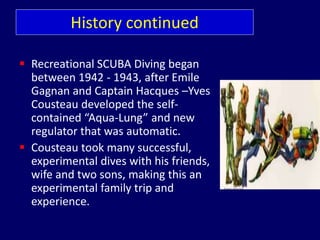
 Recreational SCUBA Diving began
between 1942 - 1943, after Emile
Gagnan and Captain Hacques –Yves
Cousteau developed the self-
contained “Aqua-Lung” and new
regulator that was automatic.
 Cousteau took many successful,
experimental dives with his friends,
wife and two sons, making this an
experimental family trip and
experience.
Introduction
 SCUBA diving accidents are fairly
uncommon.
 In experienced divers have a higher
incident rate of injury.
 Emergencies can occur on the
surface, one meter of water, or at
any depth.
 More serious emergencies usually
follow a dive.
Introduction
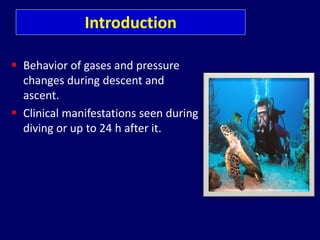
 Behavior of gases and pressure
changes during descent and
ascent.
 Clinical manifestations seen during
diving or up to 24 h after it.
Equipment
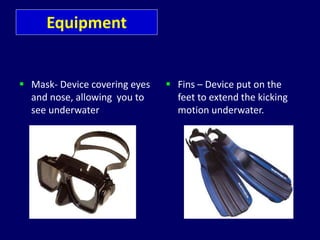
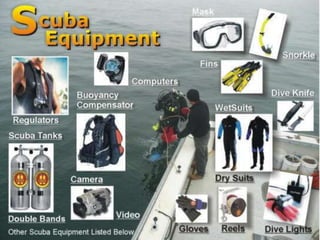
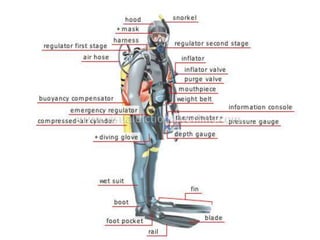
 Mask- Device covering eyes
and nose, allowing you to
see underwater
 Fins – Device put on the
feet to extend the kicking
motion underwater.
Equipment continued
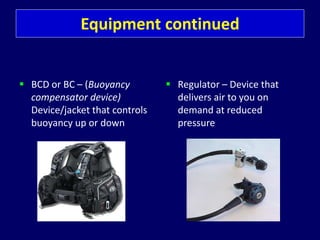
 BCD or BC – (Buoyancy
compensator device)
Device/jacket that controls
buoyancy up or down
 Regulator – Device that
delivers air to you on
demand at reduced
pressure
Equipment continued
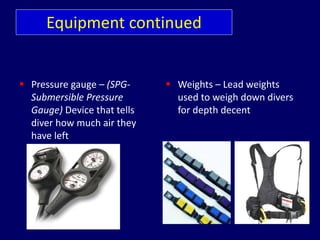
 Pressure gauge – (SPG-
Submersible Pressure
Gauge) Device that tells
diver how much air they
have left
 Weights – Lead weights
used to weigh down divers
for depth decent
Equipment continued
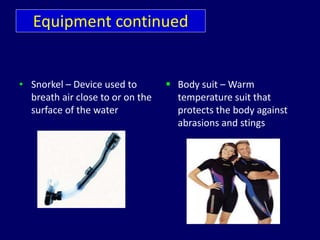
• Snorkel – Device used to
breath air close to or on the
surface of the water
 Body suit – Warm
temperature suit that
protects the body against
abrasions and stings
Equipment continued
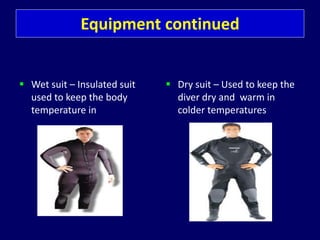
 Wet suit – Insulated suit
used to keep the body
temperature in
 Dry suit – Used to keep the
diver dry and warm in
colder temperatures
Underwater breathing
 Regular breathing makes use of differences in air
pressure
 The water above a diver increases the atmospheric
pressure. Therefore,
 Air must be pressurized to be able to breathe at a
pressure of more than one Atmosphere (air pressure
at sea level).
 (This is also why you have to pop your ears as you descend.)
Physical Principles of Pressure
 Density of the water can be equated to
pressure, which is defined as the weight
or force acting upon a unit area.
 Fresh water exerts a pressure of 62.4
pounds over an area of one square foot
(salt water is 64 pounds). Stated as
pounds per square inch (psi)
 At sea level humans live in an
atmosphere of air, or a mixture of
gases, and they exert a pressure of 14.7
psi.
Gas Laws
Gas Laws
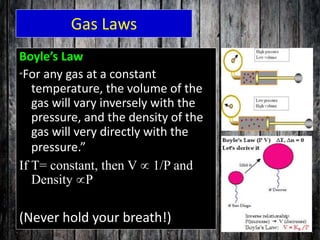
Boyle’s Law
“For any gas at a constant
temperature, the volume of the
gas will vary inversely with the
pressure, and the density of the
gas will very directly with the
pressure.”
If T= constant, then V  1/P and
Density P
(Never hold your breath!)
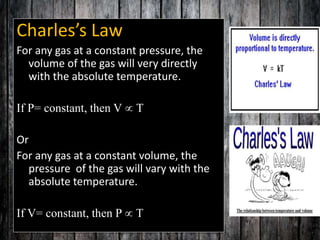
Charles’s Law
For any gas at a constant pressure, the
volume of the gas will very directly
with the absolute temperature.
If P= constant, then V  T
Or
For any gas at a constant volume, the
pressure of the gas will vary with the
absolute temperature.
If V= constant, then P  T
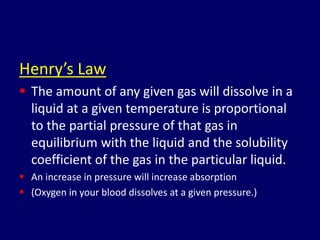
Henry’s Law
 The amount of any given gas will dissolve in a
liquid at a given temperature is proportional
to the partial pressure of that gas in
equilibrium with the liquid and the solubility
coefficient of the gas in the particular liquid.
 An increase in pressure will increase absorption
 (Oxygen in your blood dissolves at a given pressure.)
Henry's Law
 Gas molecules will dissolve into the blood in
proportion to the partial pressure of that gas in the
lungs.
Henry’s Law
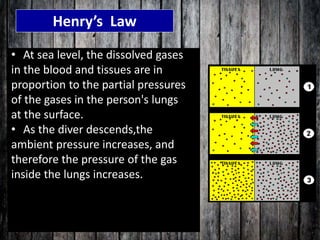
• At sea level, the dissolved gases
in the blood and tissues are in
proportion to the partial pressures
of the gases in the person's lungs
at the surface.
• As the diver descends,the
ambient pressure increases, and
therefore the pressure of the gas
inside the lungs increases.
Main Pathologies
 Barotrauma – Ear, Sinus,
Pulmonary & Air Embolism
 Decompression sickness
 Pulmonary edema
 Pharmacological and toxic
effects of increased partial
pressures of gases
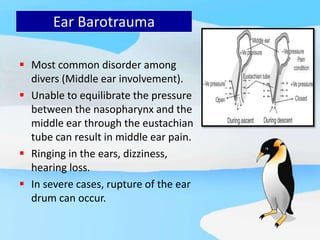
Ear Barotrauma
 Most common disorder among
divers (Middle ear involvement).
 Unable to equilibrate the pressure
between the nasopharynx and the
middle ear through the eustachian
tube can result in middle ear pain.
 Ringing in the ears, dizziness,
hearing loss.
 In severe cases, rupture of the ear
drum can occur.
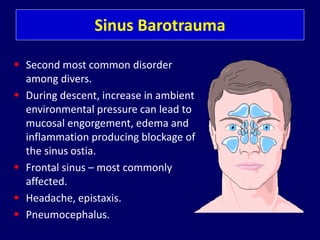
Sinus Barotrauma
 Second most common disorder
among divers.
 During descent, increase in ambient
environmental pressure can lead to
mucosal engorgement, edema and
inflammation producing blockage of
the sinus ostia.
 Frontal sinus – most commonly
affected.
 Headache, epistaxis.
 Pneumocephalus.
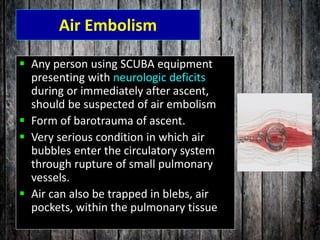
Air Embolism
 Any person using SCUBA equipment
presenting with neurologic deficits
during or immediately after ascent,
should be suspected of air embolism
 Form of barotrauma of ascent.
 Very serious condition in which air
bubbles enter the circulatory system
through rupture of small pulmonary
vessels.
 Air can also be trapped in blebs, air
pockets, within the pulmonary tissue
Air Embolism- Pathophysiology
 Arterial gas embolism is the most serious potential
sequel of pulmonary barotrauma.
 Arterial gas emboli can result from any of three
processes:
1. Passage of gas bubbles into the pulmonary veins
and from there into the systemic circulation
2. Development of venous gas emboli (either from
barotrauma or decompression sickness), which
overwhelm the filtering capacity of the pulmonary
capillaries to appear in the systemic arterial
circulation.
3. Development of venous gas emboli that reach the
arterial circulation "paradoxically" via a functional
right-to-left shunt, such as a patent foramen ovale.
 Reach the systemic arterial circulation.
 Gas emboli typically break up as they reach vascular
branch points.
 Lodge in vessels with diameters ranging from 30 to
60 µm.
 They produce distal ischemia and local activation of
inflammatory cascades.
Air Embolism-Pathophysiology
Air Embolism-Clinical features
 Cardiac-: Dysrhythmias, myocardial
infarction, and/or cardiac arrest (0.5ml
air can cause)
 CNS-: focal motor, sensory, or visual
deficits to seizures, loss of
consciousness, apnea, and death.
 Skin-: cyanotic marbling of the skin, focal
pallor of the tongue.
 Renal-: hematuria, proteinuria, and renal
failure.
 Uterine & GI bleeds
Air Embolism- Treatment
 Immediate administration of 100 percent
oxygen.
 Shift to hyperbaric oxygen facility as soon
as possible.
 Widen the pressure gradient for nitrogen
between the bubble and the circulation.
 Accelerate re-absorption of gas bubbles,
and hydration to decrease vascular
obstruction and augment collateral flow.
Divers Alert Network at (919) 684-9111.
Air Embolism-Treatment
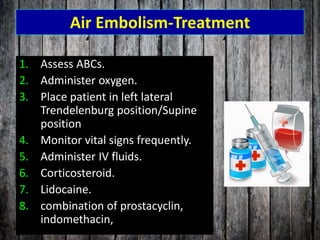
1. Assess ABCs.
2. Administer oxygen.
3. Place patient in left lateral
Trendelenburg position/Supine
position
4. Monitor vital signs frequently.
5. Administer IV fluids.
6. Corticosteroid.
7. Lidocaine.
8. combination of prostacyclin,
indomethacin, and heparin h
Pneumomediastinum
 Alveolar rupture- gas can dissect along the
perivascular sheath into the mediastinum.
 Clinical Features:
 Substernal chest pain.
 Irregular pulse.
 Abnormal heart sounds.
 Reduced blood pressure/narrowing pulse pressure.
 Change in voice.
 May or may not be evidence of cyanosis.
 Crepitation in the neck
 Hamman’s sign
Pneumomediastinum - Treatment
 Administration of high-concentration oxygen via
non-rebreathing face mask
 Treatment generally ranges from observation to
recompression
Pneumothorax
 Relatively uncommon
 Developing in only approximately 10 percent
of episodes of pulmonary barotrauma
 Patients with a history of spontaneous
pneumothorax, bullae, or cystic lung disease
are at increased risk.
Injuries at the Bottom
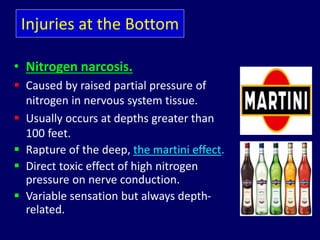
• Nitrogen narcosis.
 Caused by raised partial pressure of
nitrogen in nervous system tissue.
 Usually occurs at depths greater than
100 feet.
 Rapture of the deep, the martini effect.
 Direct toxic effect of high nitrogen
pressure on nerve conduction.
 Variable sensation but always depth-
related.
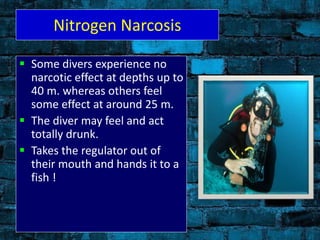
Nitrogen Narcosis
 Some divers experience no
narcotic effect at depths up to
40 m. whereas others feel
some effect at around 25 m.
 The diver may feel and act
totally drunk.
 Takes the regulator out of
their mouth and hands it to a
fish !
Pressure Disorders
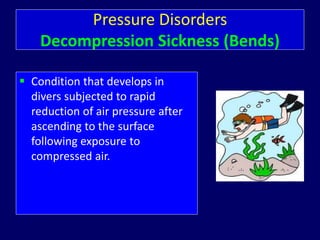
Decompression Sickness (Bends)
 Condition that develops in
divers subjected to rapid
reduction of air pressure after
ascending to the surface
following exposure to
compressed air.
Decompression Sickness (Bends)
 "caisson disease“
 First recognized in 1843 among tunnel
workers following return from the
compressed environment of the
caisson to atmospheric pressure.
 Term "the bends" is frequently applied
to this illness.
 Laborers with decompression sickness
sometimes walked with a slight stoop.
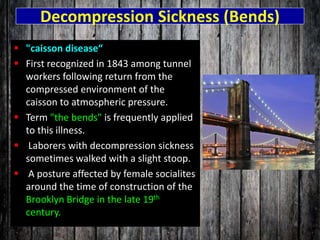
 A posture affected by female socialites
around the time of construction of the
Brooklyn Bridge in the late 19th
century.
 Diver descends -: breathes air under increased
pressure.
 Tissues become loaded with increased quantities
of oxygen and nitrogen as predicted by Henry's
law.
 Diver ascends-: the sum of the gas tensions in the
tissue may exceed the ambient pressure.
 Leads to the liberation of free gas from the tissues
in the form of bubbles.
Pathophysiology
 The liberated gas bubbles can alter organ
function by blocking vessels, rupturing or
compressing tissue, or activating clotting and
inflammatory cascades.
 The volume and location of these bubbles
determine if symptoms occur or not.
 Effects on the body can be direct or indirect.
Pathophysiology
Direct Effects
 Intravascular: blood flow will be
decreased, leading to ischemia or
infarct.
 Extravascular: tissues will be
displaced, which further results in
pressure on neutral tissue
 Audiovestibular: air can diffuse into
the audiovestibular system, causing
vertigo
Indirect Effects
 Surface of air emboli may initiate
platelet aggregation and
intravascular coagulation
 Extravascular plasma loss may lead
to edema
 Electrolyte imbalances may occur
 Lipid emboli are released.
General factors relating to development
 Cold water dives
 Diving in rough water
 Overstaying time at given dive depth
 Dive at 25 m. or greater
 Rapid ascent – panic, inexperience,
unfamiliarity with equipment.
 Flying after diving – 24 hour wait is
recommended.
 Driving to high altitude.
Individual factors relating to development
 Age – older individuals.
 Obesity.
 Fatigue – lack of sleep prior to dive
 Alcohol – consumption prior or after dive
 History of other medical problems .Rt to lft shunt
 COPD, Asthma, prior pneumothorax, thoracic
surgery, IHD, pregnancy, Inguinal hernia,
Panic disorders
Presentation
 Decompression
sickness divided into
two types based on
the presenting signs
and symptoms.
Type I
 Usually referred to as the “bends”.
 Musculoskeletal-: Patient experiences pain (joints).
Caused by expansion of gases present in the joint
space. (Elbow & shoulder)
 Skin manifestations -: pruritus (itch), localized
erythema.
 Lymphatic-: lymphadenopathy and localized edema.
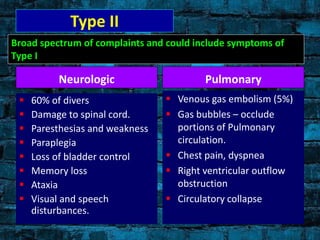
Neurologic
 60% of divers
 Damage to spinal cord.
 Paresthesias and weakness
 Paraplegia
 Loss of bladder control
 Memory loss
 Ataxia
 Visual and speech
disturbances.
Pulmonary
 Venous gas embolism (5%)
 Gas bubbles – occlude
portions of Pulmonary
circulation.
 Chest pain, dyspnea
 Right ventricular outflow
obstruction
 Circulatory collapse
Type II
Broad spectrum of complaints and could include symptoms of
Type I
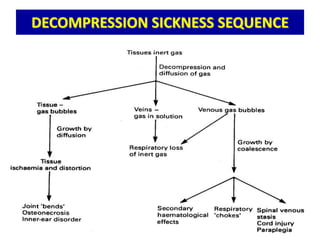
DECOMPRESSION SICKNESS SEQUENCE
General Symptoms of Decompression
Sickness
 Extreme fatigue
 Joint pain
 Headache
 Lower abdominal pain
 Chest pain
 Urinary dysfunction
 Vertigo and ataxia
 Pruritus
 Back pain
 Paresthesias
 Paralysis
 Dysarthria
 Frothy, reddish sputum
 Dyspnea
Treatment
 Hydration
 Administration of 100 percent oxygen
 Positioning the patient in the left lateral decubitus
(Durant's maneuver).
 Mild Trendelenburg (bed angled downward toward
head) position in an effort to restore forward blood
flow by placing the right ventricular outflow tract
inferior to the right ventricular cavity, permitting air
to migrate superiorly to a non obstructing position
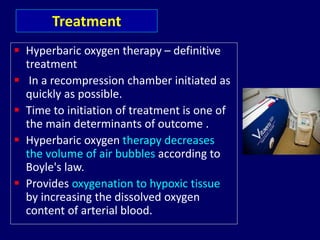
 Hyperbaric oxygen therapy – definitive
treatment
 In a recompression chamber initiated as
quickly as possible.
 Time to initiation of treatment is one of
the main determinants of outcome .
 Hyperbaric oxygen therapy decreases
the volume of air bubbles according to
Boyle's law.
 Provides oxygenation to hypoxic tissue
by increasing the dissolved oxygen
content of arterial blood.
Treatment
 Plasma nitrogen concentration
decreases, increasing the gradient
of nitrogen from bubble to plasma,
thus accelerating the absorption of
bubbles.
 Hyperbaric therapy should be
undertaken for at least four hours.
 Bubble elimination may be poor in
areas of reduced flow where
edema and sludging are present.
HYPERBARIC OXYGEN CHAMBER
Contraindications
 Pregnancy
 Inner ear infection
 Tympanic membrane rupture
 Upper respiratory infection
 Sinus conditions
 Lung disease
 Asthma
 Seizure disorders
 Optic neuritis
 Pneumothorax
POTENTIAL COMPLICATIONS
 HYPERCAPNIA
 ABSORPTIN ATELECTASIS
 DRYING & CRUSTING OF SECRETIONS
 PULMONARY OXYGEN TOXICITY
 -Decreased hypoxemic drive and increased VD in
COPD.
 -Mucosal damage due to lack of humidity
 RETROLENTAL FIBROPLASIA
 CEREBRAL O2 TOXICITY Seizures (hyperbaric)
 FIRE (airway fires)
 IGNITION HAZARD.
 RISK OF RESPIRATORY DEPRESSION IN SOME PATIENTS
WITH COPD IF HIGH CONCENTRATIONS OF OXYGEN
ADMINISTERED (CO2 RETAINERS).
 Complete resolution of
symptoms in Type II
decompression sickness 75% of
cases
 16% - residual symptoms for up
to three months
 Adjunctive therapies-: NSAID,
anticoagulants, and
glucocorticoids.
Treatment
General Assessment of Diving
Emergencies
• Early assessment and treatment.
• Must develop the diving history or
profile. This includes:
1. Time at which the signs and
symptoms occurred
2. Type of breathing apparatus utilized
3. Type of hypothermia protective
garment worn
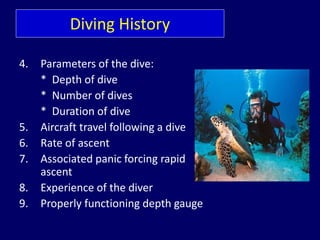
Diving History
4. Parameters of the dive:
* Depth of dive
* Number of dives
* Duration of dive
5. Aircraft travel following a dive
6. Rate of ascent
7. Associated panic forcing rapid
ascent
8. Experience of the diver
9. Properly functioning depth gauge
Diving History
10. Previous medical diseases
11. Old injuries
12. Previous episodes of decompression
illness
13. Use of medication
14. Use of alcohol
• This history will assist in determining if
the diver has incurred a pressure
disorder
Conclusion
 Recreational SCUBA diving continues to
increase in popularity, and diving-related
injuries have increased proportionally.
 Barotrauma is the most common form of
diving-related injury.
 Decompression sickness occurs when a
diver returns to the surface and gas
tensions in the tissue exceed the ambient
pressure, leading to the liberation of free
gas from the tissues in the form of
bubbles.
 The liberated gas bubbles can alter
organ function by blocking blood
vessels, rupturing or compressing
tissue, or activating clotting and
inflammatory cascades.
 Treatment of significant
decompression sickness includes
hydration, administration of 100
percent oxygen, positioning the patient
to improve forward blood flow, and
hyperbaric oxygen therapy.
Conclusion
Diving and Lung -  Dr.Tinku Joseph

Diving and Lung - Dr.Tinku Joseph

  • 1.
    DIVING & LUNG DRTINKU JOSEPH DM Resident Department of Pulmonary Medicine AIMS, Kochin Email-: tinkujoseph2010@gmail.com
  • 2.
    Contents  Scuba Diving– Introduction  Equipments  Gas laws  Pathologies & diving injuries.
  • 3.
    What Does itMean? History?  SCUBA – Self Contained Underwater Breathing Aparatus  Long history dating back from 332 BC  Modern fins, mask and snorkel tubes were developed by fishermen from America, Russia, France and England in the 1920s and 1930s
  • 4.
    History continued  RecreationalSCUBA Diving began between 1942 - 1943, after Emile Gagnan and Captain Hacques –Yves Cousteau developed the self- contained “Aqua-Lung” and new regulator that was automatic.  Cousteau took many successful, experimental dives with his friends, wife and two sons, making this an experimental family trip and experience.
  • 5.
    Introduction  SCUBA divingaccidents are fairly uncommon.  In experienced divers have a higher incident rate of injury.  Emergencies can occur on the surface, one meter of water, or at any depth.  More serious emergencies usually follow a dive.
  • 6.
    Introduction  Behavior ofgases and pressure changes during descent and ascent.  Clinical manifestations seen during diving or up to 24 h after it.
  • 7.
    Equipment  Mask- Devicecovering eyes and nose, allowing you to see underwater  Fins – Device put on the feet to extend the kicking motion underwater.
  • 8.
    Equipment continued  BCDor BC – (Buoyancy compensator device) Device/jacket that controls buoyancy up or down  Regulator – Device that delivers air to you on demand at reduced pressure
  • 9.
    Equipment continued  Pressuregauge – (SPG- Submersible Pressure Gauge) Device that tells diver how much air they have left  Weights – Lead weights used to weigh down divers for depth decent
  • 10.
    Equipment continued • Snorkel– Device used to breath air close to or on the surface of the water  Body suit – Warm temperature suit that protects the body against abrasions and stings
  • 11.
    Equipment continued  Wetsuit – Insulated suit used to keep the body temperature in  Dry suit – Used to keep the diver dry and warm in colder temperatures
  • 14.
    Underwater breathing  Regularbreathing makes use of differences in air pressure  The water above a diver increases the atmospheric pressure. Therefore,  Air must be pressurized to be able to breathe at a pressure of more than one Atmosphere (air pressure at sea level).  (This is also why you have to pop your ears as you descend.)
  • 15.
    Physical Principles ofPressure  Density of the water can be equated to pressure, which is defined as the weight or force acting upon a unit area.  Fresh water exerts a pressure of 62.4 pounds over an area of one square foot (salt water is 64 pounds). Stated as pounds per square inch (psi)  At sea level humans live in an atmosphere of air, or a mixture of gases, and they exert a pressure of 14.7 psi.
  • 16.
  • 17.
    Gas Laws Boyle’s Law “Forany gas at a constant temperature, the volume of the gas will vary inversely with the pressure, and the density of the gas will very directly with the pressure.” If T= constant, then V  1/P and Density P (Never hold your breath!)
  • 18.
    Charles’s Law For anygas at a constant pressure, the volume of the gas will very directly with the absolute temperature. If P= constant, then V  T Or For any gas at a constant volume, the pressure of the gas will vary with the absolute temperature. If V= constant, then P  T
  • 19.
    Henry’s Law  Theamount of any given gas will dissolve in a liquid at a given temperature is proportional to the partial pressure of that gas in equilibrium with the liquid and the solubility coefficient of the gas in the particular liquid.  An increase in pressure will increase absorption  (Oxygen in your blood dissolves at a given pressure.)
  • 20.
    Henry's Law  Gasmolecules will dissolve into the blood in proportion to the partial pressure of that gas in the lungs.
  • 21.
    Henry’s Law • Atsea level, the dissolved gases in the blood and tissues are in proportion to the partial pressures of the gases in the person's lungs at the surface. • As the diver descends,the ambient pressure increases, and therefore the pressure of the gas inside the lungs increases.
  • 22.
    Main Pathologies  Barotrauma– Ear, Sinus, Pulmonary & Air Embolism  Decompression sickness  Pulmonary edema  Pharmacological and toxic effects of increased partial pressures of gases
  • 23.
    Ear Barotrauma  Mostcommon disorder among divers (Middle ear involvement).  Unable to equilibrate the pressure between the nasopharynx and the middle ear through the eustachian tube can result in middle ear pain.  Ringing in the ears, dizziness, hearing loss.  In severe cases, rupture of the ear drum can occur.
  • 24.
    Sinus Barotrauma  Secondmost common disorder among divers.  During descent, increase in ambient environmental pressure can lead to mucosal engorgement, edema and inflammation producing blockage of the sinus ostia.  Frontal sinus – most commonly affected.  Headache, epistaxis.  Pneumocephalus.
  • 25.
    Air Embolism  Anyperson using SCUBA equipment presenting with neurologic deficits during or immediately after ascent, should be suspected of air embolism  Form of barotrauma of ascent.  Very serious condition in which air bubbles enter the circulatory system through rupture of small pulmonary vessels.  Air can also be trapped in blebs, air pockets, within the pulmonary tissue
  • 26.
    Air Embolism- Pathophysiology Arterial gas embolism is the most serious potential sequel of pulmonary barotrauma.  Arterial gas emboli can result from any of three processes: 1. Passage of gas bubbles into the pulmonary veins and from there into the systemic circulation 2. Development of venous gas emboli (either from barotrauma or decompression sickness), which overwhelm the filtering capacity of the pulmonary capillaries to appear in the systemic arterial circulation.
  • 27.
    3. Development ofvenous gas emboli that reach the arterial circulation "paradoxically" via a functional right-to-left shunt, such as a patent foramen ovale.  Reach the systemic arterial circulation.  Gas emboli typically break up as they reach vascular branch points.  Lodge in vessels with diameters ranging from 30 to 60 µm.  They produce distal ischemia and local activation of inflammatory cascades. Air Embolism-Pathophysiology
  • 28.
    Air Embolism-Clinical features Cardiac-: Dysrhythmias, myocardial infarction, and/or cardiac arrest (0.5ml air can cause)  CNS-: focal motor, sensory, or visual deficits to seizures, loss of consciousness, apnea, and death.  Skin-: cyanotic marbling of the skin, focal pallor of the tongue.  Renal-: hematuria, proteinuria, and renal failure.  Uterine & GI bleeds
  • 29.
    Air Embolism- Treatment Immediate administration of 100 percent oxygen.  Shift to hyperbaric oxygen facility as soon as possible.  Widen the pressure gradient for nitrogen between the bubble and the circulation.  Accelerate re-absorption of gas bubbles, and hydration to decrease vascular obstruction and augment collateral flow. Divers Alert Network at (919) 684-9111.
  • 30.
    Air Embolism-Treatment 1. AssessABCs. 2. Administer oxygen. 3. Place patient in left lateral Trendelenburg position/Supine position 4. Monitor vital signs frequently. 5. Administer IV fluids. 6. Corticosteroid. 7. Lidocaine. 8. combination of prostacyclin, indomethacin, and heparin h
  • 31.
    Pneumomediastinum  Alveolar rupture-gas can dissect along the perivascular sheath into the mediastinum.  Clinical Features:  Substernal chest pain.  Irregular pulse.  Abnormal heart sounds.  Reduced blood pressure/narrowing pulse pressure.  Change in voice.  May or may not be evidence of cyanosis.  Crepitation in the neck  Hamman’s sign
  • 32.
    Pneumomediastinum - Treatment Administration of high-concentration oxygen via non-rebreathing face mask  Treatment generally ranges from observation to recompression
  • 33.
    Pneumothorax  Relatively uncommon Developing in only approximately 10 percent of episodes of pulmonary barotrauma  Patients with a history of spontaneous pneumothorax, bullae, or cystic lung disease are at increased risk.
  • 34.
    Injuries at theBottom • Nitrogen narcosis.  Caused by raised partial pressure of nitrogen in nervous system tissue.  Usually occurs at depths greater than 100 feet.  Rapture of the deep, the martini effect.  Direct toxic effect of high nitrogen pressure on nerve conduction.  Variable sensation but always depth- related.
  • 35.
    Nitrogen Narcosis  Somedivers experience no narcotic effect at depths up to 40 m. whereas others feel some effect at around 25 m.  The diver may feel and act totally drunk.  Takes the regulator out of their mouth and hands it to a fish !
  • 36.
    Pressure Disorders Decompression Sickness(Bends)  Condition that develops in divers subjected to rapid reduction of air pressure after ascending to the surface following exposure to compressed air.
  • 37.
    Decompression Sickness (Bends) "caisson disease“  First recognized in 1843 among tunnel workers following return from the compressed environment of the caisson to atmospheric pressure.  Term "the bends" is frequently applied to this illness.  Laborers with decompression sickness sometimes walked with a slight stoop.  A posture affected by female socialites around the time of construction of the Brooklyn Bridge in the late 19th century.
  • 38.
     Diver descends-: breathes air under increased pressure.  Tissues become loaded with increased quantities of oxygen and nitrogen as predicted by Henry's law.  Diver ascends-: the sum of the gas tensions in the tissue may exceed the ambient pressure.  Leads to the liberation of free gas from the tissues in the form of bubbles. Pathophysiology
  • 39.
     The liberatedgas bubbles can alter organ function by blocking vessels, rupturing or compressing tissue, or activating clotting and inflammatory cascades.  The volume and location of these bubbles determine if symptoms occur or not.  Effects on the body can be direct or indirect. Pathophysiology
  • 40.
    Direct Effects  Intravascular:blood flow will be decreased, leading to ischemia or infarct.  Extravascular: tissues will be displaced, which further results in pressure on neutral tissue  Audiovestibular: air can diffuse into the audiovestibular system, causing vertigo
  • 41.
    Indirect Effects  Surfaceof air emboli may initiate platelet aggregation and intravascular coagulation  Extravascular plasma loss may lead to edema  Electrolyte imbalances may occur  Lipid emboli are released.
  • 42.
    General factors relatingto development  Cold water dives  Diving in rough water  Overstaying time at given dive depth  Dive at 25 m. or greater  Rapid ascent – panic, inexperience, unfamiliarity with equipment.  Flying after diving – 24 hour wait is recommended.  Driving to high altitude.
  • 43.
    Individual factors relatingto development  Age – older individuals.  Obesity.  Fatigue – lack of sleep prior to dive  Alcohol – consumption prior or after dive  History of other medical problems .Rt to lft shunt  COPD, Asthma, prior pneumothorax, thoracic surgery, IHD, pregnancy, Inguinal hernia, Panic disorders
  • 44.
    Presentation  Decompression sickness dividedinto two types based on the presenting signs and symptoms.
  • 45.
    Type I  Usuallyreferred to as the “bends”.  Musculoskeletal-: Patient experiences pain (joints). Caused by expansion of gases present in the joint space. (Elbow & shoulder)  Skin manifestations -: pruritus (itch), localized erythema.  Lymphatic-: lymphadenopathy and localized edema.
  • 46.
    Neurologic  60% ofdivers  Damage to spinal cord.  Paresthesias and weakness  Paraplegia  Loss of bladder control  Memory loss  Ataxia  Visual and speech disturbances. Pulmonary  Venous gas embolism (5%)  Gas bubbles – occlude portions of Pulmonary circulation.  Chest pain, dyspnea  Right ventricular outflow obstruction  Circulatory collapse Type II Broad spectrum of complaints and could include symptoms of Type I
  • 47.
  • 48.
    General Symptoms ofDecompression Sickness  Extreme fatigue  Joint pain  Headache  Lower abdominal pain  Chest pain  Urinary dysfunction  Vertigo and ataxia  Pruritus  Back pain  Paresthesias  Paralysis  Dysarthria  Frothy, reddish sputum  Dyspnea
  • 49.
    Treatment  Hydration  Administrationof 100 percent oxygen  Positioning the patient in the left lateral decubitus (Durant's maneuver).  Mild Trendelenburg (bed angled downward toward head) position in an effort to restore forward blood flow by placing the right ventricular outflow tract inferior to the right ventricular cavity, permitting air to migrate superiorly to a non obstructing position
  • 50.
     Hyperbaric oxygentherapy – definitive treatment  In a recompression chamber initiated as quickly as possible.  Time to initiation of treatment is one of the main determinants of outcome .  Hyperbaric oxygen therapy decreases the volume of air bubbles according to Boyle's law.  Provides oxygenation to hypoxic tissue by increasing the dissolved oxygen content of arterial blood. Treatment
  • 51.
     Plasma nitrogenconcentration decreases, increasing the gradient of nitrogen from bubble to plasma, thus accelerating the absorption of bubbles.  Hyperbaric therapy should be undertaken for at least four hours.  Bubble elimination may be poor in areas of reduced flow where edema and sludging are present. HYPERBARIC OXYGEN CHAMBER
  • 52.
    Contraindications  Pregnancy  Innerear infection  Tympanic membrane rupture  Upper respiratory infection  Sinus conditions  Lung disease  Asthma  Seizure disorders  Optic neuritis  Pneumothorax
  • 53.
    POTENTIAL COMPLICATIONS  HYPERCAPNIA ABSORPTIN ATELECTASIS  DRYING & CRUSTING OF SECRETIONS  PULMONARY OXYGEN TOXICITY  -Decreased hypoxemic drive and increased VD in COPD.  -Mucosal damage due to lack of humidity  RETROLENTAL FIBROPLASIA  CEREBRAL O2 TOXICITY Seizures (hyperbaric)  FIRE (airway fires)  IGNITION HAZARD.  RISK OF RESPIRATORY DEPRESSION IN SOME PATIENTS WITH COPD IF HIGH CONCENTRATIONS OF OXYGEN ADMINISTERED (CO2 RETAINERS).
  • 54.
     Complete resolutionof symptoms in Type II decompression sickness 75% of cases  16% - residual symptoms for up to three months  Adjunctive therapies-: NSAID, anticoagulants, and glucocorticoids. Treatment
  • 55.
    General Assessment ofDiving Emergencies • Early assessment and treatment. • Must develop the diving history or profile. This includes: 1. Time at which the signs and symptoms occurred 2. Type of breathing apparatus utilized 3. Type of hypothermia protective garment worn
  • 56.
    Diving History 4. Parametersof the dive: * Depth of dive * Number of dives * Duration of dive 5. Aircraft travel following a dive 6. Rate of ascent 7. Associated panic forcing rapid ascent 8. Experience of the diver 9. Properly functioning depth gauge
  • 57.
    Diving History 10. Previousmedical diseases 11. Old injuries 12. Previous episodes of decompression illness 13. Use of medication 14. Use of alcohol • This history will assist in determining if the diver has incurred a pressure disorder
  • 58.
    Conclusion  Recreational SCUBAdiving continues to increase in popularity, and diving-related injuries have increased proportionally.  Barotrauma is the most common form of diving-related injury.  Decompression sickness occurs when a diver returns to the surface and gas tensions in the tissue exceed the ambient pressure, leading to the liberation of free gas from the tissues in the form of bubbles.
  • 59.
     The liberatedgas bubbles can alter organ function by blocking blood vessels, rupturing or compressing tissue, or activating clotting and inflammatory cascades.  Treatment of significant decompression sickness includes hydration, administration of 100 percent oxygen, positioning the patient to improve forward blood flow, and hyperbaric oxygen therapy. Conclusion