Assist. Prof. .Radhwan HazemAlkhashab
Consultant anaesthesia & ICU
2024
In this lecture
1. What are the ventilators variables.
2. What are the main modes.
3. Clinical application of these modes
How to set the ventilator right?
Mechanical ventilation is an important tool in ICU for
treatment of various ventilatory failure.
To set the ventilator right you should know the ventilator
language.
In ventilator language we have variables and these form
breaths.
Variables are 5 types
1. Control or target.
2. Trigger.
3. Limit.
4. Cycle.
5. Baseline.
1st variable is control or target
 The definite thing or parameter you are aiming in
ventilatory support to your patient.
 It is either volume control {target} or pressure control
{target}.
Modes of Ventilation
 Fixed TV with each breath
 Peak airway pressure can
vary with each breath
depending on:
 Resistance to airflow
during inspiration
 Patient’s lung-chest wall
compliance
 Fixed peak airway pressure
with each breath
 TV can vary with each breath
depending on:
 Resistance to airflow
during inspiration
 Patient’s lung-chest wall
compliance
Volume Targeted
Modes
Pressure Targeted
Modes
2nd variable is trigger
Triggering is the mechanism that the ventilator uses to
cycle from expiration to inspiration.
3rd variable is limit
4th variable is cycle
This is reverse of
trigger that means it
will tell the ventilator to
end inspiration or in
other words to switch
from inspiration to
expiration .
Its either the ventilator
senses a preset
pressure , volume ,
flow or it will cycle by
time usually in
mandatory modes .
5th variable is base line
This is the variable that is controlled at end exhalation.
Most often, the baseline variable controlled is pressure.
The end expiratory pressure may be set to zero (ZEEP), or
a positive pressure may be created at end-expiration
(PEEP) by the closure of the expiratory valve before the
lung has quite emptied
Definitions
 Peak Inspiratory Pressure (PIP):The peak pressure is the
maximum pressure obtainable during active gas delivery. This
pressure a function of the compliance of the lung and thorax and the
airway resistance including the contribution made by the tracheal
tube and the ventilator circuit. – Maintained at <45cm H2O to
minimize barotrauma .
 The plateau pressure : is defined as the end inspiratory pressure
during a period of no gas flow. The plateau pressure reflects lung
and chest wall compliance.
However, the normal range for plateau pressure is 25–30 cmH2O. If
the plateau pressure exceeds 30 cmH2O, it increases the risk of
barotrauma and ventilator-induced lung injuries.
 Mean Airway Pressure-: is an average of the system pressure
over the entire ventilatory period.
 End Expiratory Pressure- End expiratory pressure is the airway
pressure at the termination of the expiratory phase and is normally
equal to atmospheric or the applied PEEP level.
 Inspiratory Hold Once the inspiratory tidal volume has been
delivered, the air may briefly be held within the patient’s lungs by
using the inspiratory hold option. The inspiratory hold is used when
the plateau airway pressure needs to be calculated
Types of breath
1. Mandatory breath: this is triggered, limited and cycled by the
ventilator and the patient has no role to do. We usually find this
type in controlled modes where the breaths triggered and cycled
by time.
2. Assisted mandatory: this is mandatory but with
modification that it can be triggered by the patient or by ventilator
{time trigger} otherwise it is like mandatory breathe limited and
cycled by ventilator.
3. Spontaneous breath: this is normal natural breath triggered,
limited and cycled by the patient.
4. Supported spontaneous breath: this is simply a
spontaneous breath supported by pressure to make it more
effective .It is still triggered, limited and cycled by patient.
Mandatory breath
This is triggered, limited and cycled by the ventilator and the
patient has no role to do. We usually find this type in
controlled modes where the breaths triggered and
cycled by time.
Assisted mandatory or assisted controlled breath
This is mandatory but with modification that it can be triggered
by the patient or by ventilator {time trigger} otherwise it is
like mandatory breathe limited and cycled by ventilator.
Spontaneous breath
This is normal natural breath triggered, limited and cycled
by the patient.
Supported spontaneous breaths
This is simply a spontaneous breath supported by pressure
to make it more effective .It is still triggered, limited and
cycled by patient.
Modes classified according to control
1. Volume targeted modes (CMV,A/CMV and SIMV,…)
2. Pressure targeted modes (PCMV,PA/CMV,SIMV,PS-
PEEP and CPAP)
Controlled mechanical ventilation {CMV}
This is an old mode consists of mandatory breaths only leaving
no role for the patient so it requires deep sedation with or
without muscle relaxation.
Hazards of this mode?
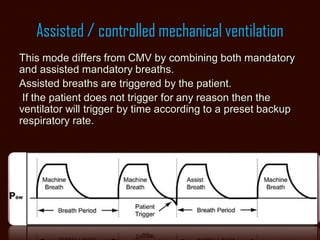
Assisted / controlled mechanical ventilation
This mode differs from CMV by combining both mandatory
and assisted mandatory breaths.
Assisted breaths are triggered by the patient.
If the patient does not trigger for any reason then the
ventilator will trigger by time according to a preset backup
respiratory rate.
AC ( Assist control ventilation) mode
Indications:
1. Myasthenia gravis.
2. GBS.
3. Post cardiac / resp arrest.
4. ARDS.
5. Pulmonary oedema.
Advantages:
Minimal work of breathing and patient controls RR which
helps normalize PaCO2.
Synchronized intermittent mandatory ventilation
This mode was invented aiming to give more
comfortability to patient by giving him chance to
breath spontaneously yet giving him a preset
number of mandatory breaths to guarantee minute
ventilation.
This mode can be used as a starting ventilatory
mode because it guarantee a fixed minute
ventilation and as a weaning mode by gradual
decrease in number of mandatory breaths.
Synchronized intermittent mandatory ventilation
This mode combines both spontaneous and mandatory
breaths .
In the past the mandatory breaths of this mode were not
synchronized with spontaneous breaths and the mode was
called intermittent mandatory ventilation.
This asynchronization created a problem called stacking
which means that mandatory tidal volume will buildup over
spontaneous tidal volume .
Stacking lead to patient discomfort and may lead in severe
cases to volutrauma and/or barotrauma.
Synchronized intermittent mandatory ventilation
This problem was solved by synchronizing the inspiration
of the mandatory breath with inspiration of the patient or
with an interval of absence of respiratory effort.
Note: synchronization is not triggering and the patient
does not trigger the mandatory breaths in this mode.
Synchronized intermittent mandatory ventilation
Pressure targeted modes
Here the constant parameter or variable is the pressure.
These include (PCMV, PA/CMV, P/SIMV, PS and CPAP).
Pressure targeted modes advantages
In addition to lung protection pressure targeted modes
have other advantages which are compensation for
limited leak and variable flow rate during inspiration
which offers better distribution of ventilation and more
patient comfortability.
PCV
Pressure controlled mechanical ventilation (PCMV):
This mode has the advantages of pressure targeted modes
but still needs deep sedation with or without muscle
relaxation.
P /SIMV
Pressure - synchronized intermittent mandatory ventilation
(P/SIMV):
Pressure are used to support patient`s effort during SIMV ,
this help to augment the tidal volume.
Pressure support (PS)
During pressure–supported ventilation (PSV), the ventilator
augments the inspiratory effort of the patient with positive
pressure support. Exhalation is passive. Since the level of
the pressure support is physician-preset – given a constant
strength of inspiratory effort on the part of the patient – the
tidal volumes can be made to rise or fall by varying the
level of the pressure support.
Airway pressure during an unassisted breath is
represented by the green line (A). Airway
pres sure during pressure supported breaths is
represented by the pink (B) and red (C) lines.
• Each inspiratory effort is augmented by ventilator at a
preset level of inspiratory pressure.
• Patient triggered, flow cycled and pressure controlled
mode.
• Applies pressure plateau to patient airway during
spontaneous breathing.
• Commonly applied to SIMV mode during spontaneous
ventilation to facilitate weaning PSV (Pressure Support
Ventilation) mode
Pressure support (PS)
Cycling primarily done by flow cycling.
This type of cycling is most comfortable for the patient
because it usually matches normal cycling.
If this cycling mechanism fail (due to leak for example)
then 2ndary mechanism works by time will cycle.
Pressure support (PS)
This is the best mode for patients who have mild to
moderate lung injury at the same time have good
respiratory efforts because it guarantees maximum patient-
ventilator synchrony and at the same time if the PS is set
right then it will provide good ventilation.
Disadvantage of PS
This mode does not guarantee fixed minute
ventilation because :
• It does not guarantee fixed VT because it depends on
patient efforts.
• It does not guarantee fixed RR because it depends on
patient rate.
(CPAP)
This is the same as PEEP but CPAP is more technically
accurate term because the pressure is keep positive during
the whole respiratory cycle not only at the end of expiration.
CPAP can be used both in intubated and nonintubated
patients. Nasal and oronasal CPAP masks enable the
adminis tration of positive end-expiratory pressure to the
patient’s lungs in a noninvasive manner. Since the aim of
the CPAP is solely to maintain a positive pressure in the
airways at the end of expiration
Advantages for CPAP or PEEP
1. Improve oxygenation:
 Opening collapsed alveoli during inspiration: so
increasing number of ventilated alveoli and
decreasing percentage of shunt. This is occurring
especially in basal areas and diseased areas.
Actually before the use of CPAP doctors used high
VTs (10-15 ml/kg Bwt) to open basal collapses. But
this turns to be harmful to lung and the use of high
VTs was abundant.
 Prevent collapse during expiration: by increase FRC
above closing capacity.
 Ventilate alveoli filled with edema fluid: by shifting
fluid out of them.
Advantages for CPAP or PEEP
2. Improve compliance of the lung by:
 Opening collapsed alveoli (recruitment)
 Shifting edema fluid out of alveoli and interstitial space.
3. Prevent lung injury.
Bilevel Positive Airway Pressure
o The patient is ventilated at two different levels of CPAP;
the switchover from one to the other level of CPAP is
synchro nized with the patient. Pressure–support can be
added at one or both the levels of the CPAP used.
o It also uses two pressure levels:
o Inspiratory Positive Airway Pressure (IPAP):
Delivered during inspiration.
o Expiratory Positive Airway Pressure (EPAP):
Maintained during expiration.
o The patient can trigger the ventilator to switch between
IPAP and EPAP.
Airway Pressure Release Ventilation (APRV)
APRV is available in Drager’s Evita 2 Dura and Evita 4, and
BiLevel-Puritan Bennet 840.
APRV involves the periodic release of pressure while
breathing in the CPAP mode.
 The distinction between APRV and biphasic intermittent
positive airway pressure (BIPAP) is not always clear-cut.
Compared with BIPAP, APRV is more frequently set on
extreme inverse ratios to improve refractory hypoxemia.
However, if the same inspiratory-expiratory ratio is
adopted, virtually no differences exist between APRV
and BIPAP.
basicmodesofventilation2022-220313203758.pdf

basicmodesofventilation2022-220313203758.pdf

  • 1.
    Assist. Prof. .RadhwanHazemAlkhashab Consultant anaesthesia & ICU 2024
  • 2.
    In this lecture 1.What are the ventilators variables. 2. What are the main modes. 3. Clinical application of these modes
  • 3.
    How to setthe ventilator right? Mechanical ventilation is an important tool in ICU for treatment of various ventilatory failure. To set the ventilator right you should know the ventilator language. In ventilator language we have variables and these form breaths.
  • 4.
    Variables are 5types 1. Control or target. 2. Trigger. 3. Limit. 4. Cycle. 5. Baseline.
  • 5.
    1st variable iscontrol or target  The definite thing or parameter you are aiming in ventilatory support to your patient.  It is either volume control {target} or pressure control {target}.
  • 6.
    Modes of Ventilation Fixed TV with each breath  Peak airway pressure can vary with each breath depending on:  Resistance to airflow during inspiration  Patient’s lung-chest wall compliance  Fixed peak airway pressure with each breath  TV can vary with each breath depending on:  Resistance to airflow during inspiration  Patient’s lung-chest wall compliance Volume Targeted Modes Pressure Targeted Modes
  • 7.
    2nd variable istrigger Triggering is the mechanism that the ventilator uses to cycle from expiration to inspiration.
  • 8.
  • 9.
    4th variable iscycle This is reverse of trigger that means it will tell the ventilator to end inspiration or in other words to switch from inspiration to expiration . Its either the ventilator senses a preset pressure , volume , flow or it will cycle by time usually in mandatory modes .
  • 10.
    5th variable isbase line This is the variable that is controlled at end exhalation. Most often, the baseline variable controlled is pressure. The end expiratory pressure may be set to zero (ZEEP), or a positive pressure may be created at end-expiration (PEEP) by the closure of the expiratory valve before the lung has quite emptied
  • 11.
    Definitions  Peak InspiratoryPressure (PIP):The peak pressure is the maximum pressure obtainable during active gas delivery. This pressure a function of the compliance of the lung and thorax and the airway resistance including the contribution made by the tracheal tube and the ventilator circuit. – Maintained at <45cm H2O to minimize barotrauma .  The plateau pressure : is defined as the end inspiratory pressure during a period of no gas flow. The plateau pressure reflects lung and chest wall compliance. However, the normal range for plateau pressure is 25–30 cmH2O. If the plateau pressure exceeds 30 cmH2O, it increases the risk of barotrauma and ventilator-induced lung injuries.
  • 12.
     Mean AirwayPressure-: is an average of the system pressure over the entire ventilatory period.  End Expiratory Pressure- End expiratory pressure is the airway pressure at the termination of the expiratory phase and is normally equal to atmospheric or the applied PEEP level.  Inspiratory Hold Once the inspiratory tidal volume has been delivered, the air may briefly be held within the patient’s lungs by using the inspiratory hold option. The inspiratory hold is used when the plateau airway pressure needs to be calculated
  • 13.
    Types of breath 1.Mandatory breath: this is triggered, limited and cycled by the ventilator and the patient has no role to do. We usually find this type in controlled modes where the breaths triggered and cycled by time. 2. Assisted mandatory: this is mandatory but with modification that it can be triggered by the patient or by ventilator {time trigger} otherwise it is like mandatory breathe limited and cycled by ventilator. 3. Spontaneous breath: this is normal natural breath triggered, limited and cycled by the patient. 4. Supported spontaneous breath: this is simply a spontaneous breath supported by pressure to make it more effective .It is still triggered, limited and cycled by patient.
  • 14.
    Mandatory breath This istriggered, limited and cycled by the ventilator and the patient has no role to do. We usually find this type in controlled modes where the breaths triggered and cycled by time.
  • 15.
    Assisted mandatory orassisted controlled breath This is mandatory but with modification that it can be triggered by the patient or by ventilator {time trigger} otherwise it is like mandatory breathe limited and cycled by ventilator.
  • 16.
    Spontaneous breath This isnormal natural breath triggered, limited and cycled by the patient.
  • 17.
    Supported spontaneous breaths Thisis simply a spontaneous breath supported by pressure to make it more effective .It is still triggered, limited and cycled by patient.
  • 18.
    Modes classified accordingto control 1. Volume targeted modes (CMV,A/CMV and SIMV,…) 2. Pressure targeted modes (PCMV,PA/CMV,SIMV,PS- PEEP and CPAP)
  • 19.
    Controlled mechanical ventilation{CMV} This is an old mode consists of mandatory breaths only leaving no role for the patient so it requires deep sedation with or without muscle relaxation. Hazards of this mode?
  • 20.
    Assisted / controlledmechanical ventilation This mode differs from CMV by combining both mandatory and assisted mandatory breaths. Assisted breaths are triggered by the patient. If the patient does not trigger for any reason then the ventilator will trigger by time according to a preset backup respiratory rate.
  • 21.
    AC ( Assistcontrol ventilation) mode Indications: 1. Myasthenia gravis. 2. GBS. 3. Post cardiac / resp arrest. 4. ARDS. 5. Pulmonary oedema. Advantages: Minimal work of breathing and patient controls RR which helps normalize PaCO2.
  • 22.
    Synchronized intermittent mandatoryventilation This mode was invented aiming to give more comfortability to patient by giving him chance to breath spontaneously yet giving him a preset number of mandatory breaths to guarantee minute ventilation. This mode can be used as a starting ventilatory mode because it guarantee a fixed minute ventilation and as a weaning mode by gradual decrease in number of mandatory breaths.
  • 23.
    Synchronized intermittent mandatoryventilation This mode combines both spontaneous and mandatory breaths . In the past the mandatory breaths of this mode were not synchronized with spontaneous breaths and the mode was called intermittent mandatory ventilation. This asynchronization created a problem called stacking which means that mandatory tidal volume will buildup over spontaneous tidal volume . Stacking lead to patient discomfort and may lead in severe cases to volutrauma and/or barotrauma.
  • 24.
    Synchronized intermittent mandatoryventilation This problem was solved by synchronizing the inspiration of the mandatory breath with inspiration of the patient or with an interval of absence of respiratory effort. Note: synchronization is not triggering and the patient does not trigger the mandatory breaths in this mode.
  • 25.
  • 26.
    Pressure targeted modes Herethe constant parameter or variable is the pressure. These include (PCMV, PA/CMV, P/SIMV, PS and CPAP).
  • 27.
    Pressure targeted modesadvantages In addition to lung protection pressure targeted modes have other advantages which are compensation for limited leak and variable flow rate during inspiration which offers better distribution of ventilation and more patient comfortability.
  • 28.
    PCV Pressure controlled mechanicalventilation (PCMV): This mode has the advantages of pressure targeted modes but still needs deep sedation with or without muscle relaxation.
  • 29.
    P /SIMV Pressure -synchronized intermittent mandatory ventilation (P/SIMV): Pressure are used to support patient`s effort during SIMV , this help to augment the tidal volume.
  • 30.
    Pressure support (PS) Duringpressure–supported ventilation (PSV), the ventilator augments the inspiratory effort of the patient with positive pressure support. Exhalation is passive. Since the level of the pressure support is physician-preset – given a constant strength of inspiratory effort on the part of the patient – the tidal volumes can be made to rise or fall by varying the level of the pressure support. Airway pressure during an unassisted breath is represented by the green line (A). Airway pres sure during pressure supported breaths is represented by the pink (B) and red (C) lines.
  • 31.
    • Each inspiratoryeffort is augmented by ventilator at a preset level of inspiratory pressure. • Patient triggered, flow cycled and pressure controlled mode. • Applies pressure plateau to patient airway during spontaneous breathing. • Commonly applied to SIMV mode during spontaneous ventilation to facilitate weaning PSV (Pressure Support Ventilation) mode
  • 32.
    Pressure support (PS) Cyclingprimarily done by flow cycling. This type of cycling is most comfortable for the patient because it usually matches normal cycling. If this cycling mechanism fail (due to leak for example) then 2ndary mechanism works by time will cycle.
  • 33.
    Pressure support (PS) Thisis the best mode for patients who have mild to moderate lung injury at the same time have good respiratory efforts because it guarantees maximum patient- ventilator synchrony and at the same time if the PS is set right then it will provide good ventilation.
  • 34.
    Disadvantage of PS Thismode does not guarantee fixed minute ventilation because : • It does not guarantee fixed VT because it depends on patient efforts. • It does not guarantee fixed RR because it depends on patient rate.
  • 35.
    (CPAP) This is thesame as PEEP but CPAP is more technically accurate term because the pressure is keep positive during the whole respiratory cycle not only at the end of expiration. CPAP can be used both in intubated and nonintubated patients. Nasal and oronasal CPAP masks enable the adminis tration of positive end-expiratory pressure to the patient’s lungs in a noninvasive manner. Since the aim of the CPAP is solely to maintain a positive pressure in the airways at the end of expiration
  • 36.
    Advantages for CPAPor PEEP 1. Improve oxygenation:  Opening collapsed alveoli during inspiration: so increasing number of ventilated alveoli and decreasing percentage of shunt. This is occurring especially in basal areas and diseased areas. Actually before the use of CPAP doctors used high VTs (10-15 ml/kg Bwt) to open basal collapses. But this turns to be harmful to lung and the use of high VTs was abundant.  Prevent collapse during expiration: by increase FRC above closing capacity.  Ventilate alveoli filled with edema fluid: by shifting fluid out of them.
  • 37.
    Advantages for CPAPor PEEP 2. Improve compliance of the lung by:  Opening collapsed alveoli (recruitment)  Shifting edema fluid out of alveoli and interstitial space. 3. Prevent lung injury.
  • 38.
    Bilevel Positive AirwayPressure o The patient is ventilated at two different levels of CPAP; the switchover from one to the other level of CPAP is synchro nized with the patient. Pressure–support can be added at one or both the levels of the CPAP used. o It also uses two pressure levels: o Inspiratory Positive Airway Pressure (IPAP): Delivered during inspiration. o Expiratory Positive Airway Pressure (EPAP): Maintained during expiration. o The patient can trigger the ventilator to switch between IPAP and EPAP.
  • 39.
    Airway Pressure ReleaseVentilation (APRV) APRV is available in Drager’s Evita 2 Dura and Evita 4, and BiLevel-Puritan Bennet 840. APRV involves the periodic release of pressure while breathing in the CPAP mode.
  • 40.
     The distinctionbetween APRV and biphasic intermittent positive airway pressure (BIPAP) is not always clear-cut. Compared with BIPAP, APRV is more frequently set on extreme inverse ratios to improve refractory hypoxemia. However, if the same inspiratory-expiratory ratio is adopted, virtually no differences exist between APRV and BIPAP.