RTS 474: Advanced Pulmonary
Function Testing
Lecture Four
Chapter 3: Diffusing Capacity Tests
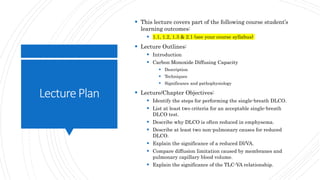
LecturePlan
 This lecture covers part of the following course student’s
learning outcomes:
 1.1, 1.2, 1.3 & 2.1 (see your course syllabus)
 Lecture Outlines:
 Introduction
 Carbon Monoxide Diffusing Capacity
 Description
 Techniques
 Significance and pathophysiology
 Lecture/Chapter Objectives:
 Identify the steps for performing the single-breath DLCO.
 List at least two criteria for an acceptable single-breath
DLCO test.
 Describe why DLCO is often reduced in emphysema.
 Describe at least two non-pulmonary causes for reduced
DLCO.
 Explain the significance of a reduced Dl/VA.
 Compare diffusion limitation caused by membranes and
pulmonary capillary blood volume.
 Explain the significance of the TLC-VA relationship.
Introduction
What is the purpose of the Diffusing
Capacity Testing?
Diffusing capacity is performed to
evaluate the alveolar capillary interface
where gas exchange occurs.
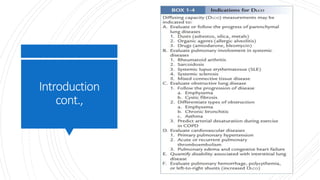
Introduction
cont.,
Diffusing capacity (also referred to as transfer
factor) is usually measured using small
concentrations of carbon monoxide (CO) and is
referred to as DLCO or DCO.
DLCO is used to assess the gas-exchange ability of
the lungs, specifically oxygenation of mixed venous
blood.
Various methods, all of which use CO, have been
described. The most commonly used method is the
single-breath, or breath-hold technique.
The single-breath method is also the most widely
standardized.
Introduction
cont.,
CARBON
MONOXIDE
DIFFUSING
CAPACITY
DESCRIPTION
 DLCO measures the transfer of a diffusion-limited gas
(CO) across the alveolocapillary membranes.
 DLCO is reported in milliliters of CO/minute/millimeter
of mercury at 0°C, 760 mm Hg, dry (i.e.,[STPD]).
DLCO
TECHNIQUES
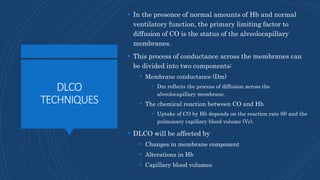
 In the presence of normal amounts of Hb and normal
ventilatory function, the primary limiting factor to
diffusion of CO is the status of the alveolocapillary
membranes.
 This process of conductance across the membranes can
be divided into two components:
 Membrane conductance (Dm)
 Dm reflects the process of diffusion across the
alveolocapillary membrane.
 The chemical reaction between CO and Hb
 Uptake of CO by Hb depends on the reaction rate (θ) and the
pulmonary capillary blood volume (Vc).
 DLCO will be affected by
 Changes in membrane component
 Alterations in Hb
 Capillary blood volumes
DLCOTECHNIQUES cont.,
 A small amount of CO in inspired gas produces measurable changes in the concentration
of inspired versus expired. Why?
 If the partial pressure of CO in the alveoli and the rate of uptake of the gas can be
measured, the DLCO of the lung can be determined.
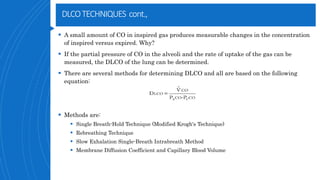
 There are several methods for determining DLCO and all are based on the following
equation:
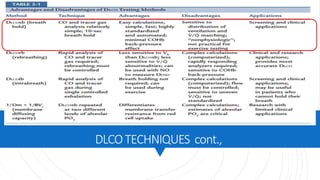
 Methods are:
 Single Breath-Hold Technique (Modified Krogh's Technique)
 Rebreathing Technique
 Slow Exhalation Single-Breath Intrabreath Method
 Membrane Diffusion Coefficient and Capillary Blood Volume
DLCOTECHNIQUES cont.,
TestGas for
DLCO
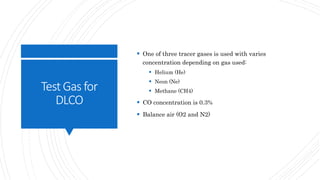
 One of three tracer gases is used with varies
concentration depending on gas used:
 Helium (He)
 Neon (Ne)
 Methane (CH4)
 CO concentration is 0.3%
 Balance air (O2 and N2)
Single Breath-Hold Technique
(Modified Krogh's Technique)
DLCOSb
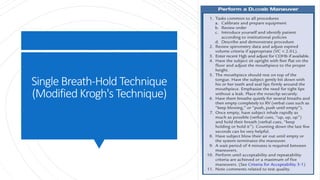
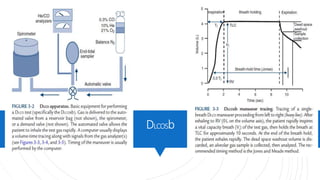
 Procedure
 Unforced exhalation to RV limited to 6 sec
 Rapid inhalation of a diffusion gas mixture to TLC from
spirometer/demand valve/reservoir
 0.3% CO
 10% He (tracer gas)
 21% O2
 Balance Nitrogen
 Breath hold at TLC for 10 +/- 2 sec
 Rapid exhalation should not exceed 4 sec
 Alveolar gas is collected after a washout volume (0.75-1.0 L)
has been discarded
 If VC is <2.0 L, washout volume may be reduced to 0.50L
 Sample gas volume should be 0.50 to I L
 If VC <1.0L, a sample of <0.50L can be analyzed if dead-space
volume has been cleared
 Average value = 25 mL CO/min/mmHg (STPD)
DLCOSb
DLCOSb
CRITERIAFOR
ACCEPTABILITY
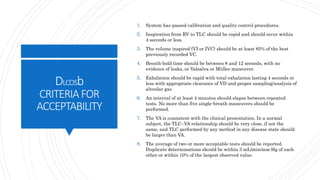
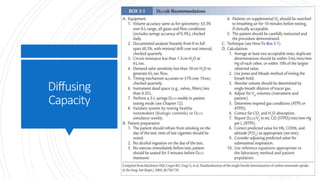
1. System has passed calibration and quality control procedures.
2. Inspiration from RV to TLC should be rapid and should occur within
4 seconds or less.
3. The volume inspired (VI or IVC) should be at least 85% of the best
previously recorded VC.
4. Breath-hold time should be between 8 and 12 seconds, with no
evidence of leaks, or Valsalva or Müller maneuver.
5. Exhalation should be rapid with total exhalation lasting 4 seconds or
less with appropriate clearance of VD and proper sampling/analysis of
alveolar gas
6. An interval of at least 4 minutes should elapse between repeated
tests. No more than five single-breath maneuvers should be
performed.
7. The VA is consistent with the clinical presentation. In a normal
subject, the TLC–VA relationship should be very close, if not the
same, and TLC performed by any method in any disease state should
be larger than VA.
8. The average of two or more acceptable tests should be reported.
Duplicate determinations should be within 3 mL/min/mm Hg of each
other or within 10% of the largest observed value.
Rebreathing
Technique
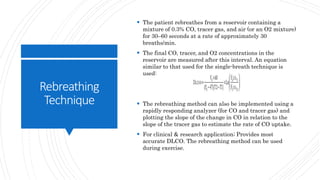
 The patient rebreathes from a reservoir containing a
mixture of 0.3% CO, tracer gas, and air (or an O2 mixture)
for 30–60 seconds at a rate of approximately 30
breaths/min.
 The final CO, tracer, and O2 concentrations in the
reservoir are measured after this interval. An equation
similar to that used for the single-breath technique is
used:
 The rebreathing method can also be implemented using a
rapidly responding analyzer (for CO and tracer gas) and
plotting the slope of the change in CO in relation to the
slope of the tracer gas to estimate the rate of CO uptake.
 For clinical & research application; Provides most
accurate DLCO. The rebreathing method can be used
during exercise.
SlowExhalation
Single Breath
Intrabreath
Method
 Patient Inspires a VC gas containing 0.3% CO, CH4
Methane and 21 % O2 the balance Nitrogen.
 Patient exhales slowly at approximately 0.5 l/sec from
TLC to RV.
 A rapidly responding infrared analyzer monitors CO
and CH4 gas concentrations
 Can be used during exercise
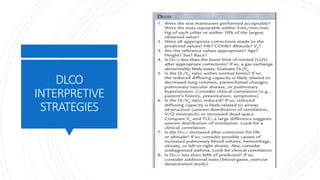
DLCO
INTERPRETIVE
STRATEGIES
Significanceand
Pathophysiology
Significanceand
Pathophysiology
 Decreases with
 Restrictive Lung diseases
 Asbestosis
 Silicosis
 Idiopathic pulmonary fibrosis
 Sarcoidosis
 Systemic lupus erythematosus
 Inhalation of toxic gases (alveolitis)
 Loss of lung tissue
 Space occupying lesions (tumors)
 Pulmonary edema
 Lung resection
 Radiation therapy (fibrotic changes)
 Chemotherapy
Significanceand
Pathophysiology
 Decreases in
 Emphysema
 Chronic Bronchitis , Asthma (may or may not be
decreased)
 DLco sometimes used to differentiate between
emphysema and chronic bronchitis
 In patients with COPD, DLco less than 50% of predicted
indicate O2 desaturation during exercise
 Low resting DLco (<50% - 60% of predicted) may indicate
the need for assessment of oxygenation during
exercise
DL/VA
 DLco is directly related to lung volume in healthy
individuals
 DL/VA is approximately 4-5 ml CO
transferred/minute/liter of lung volume
 DL/VA is useful in differentiating between restrictive
and obstructive disease
 Obstruction = Low DL/VA ratio
 Restriction = DL/VA Ratio is preserved
Physiologic
Factors
 Numerous physiologic factors can influence the
observed DLCO
 Hemoglobin and hematocrit (Hct):
 Decreased Hb or Hct reduces DLCO.
 Increased Hb and Hct elevate DLCO.
 DLCO may be corrected if the patient's Hb is known.
 CO uptake varies approximately 7% for each gram of Hb.
 The predicted DLCO may be corrected so that the value
reported is compared to a standardized Hb level of 14.6 g% for
men and 13.4 g% for women and children younger than 15
years.
Physiologic
Factors
 Carboxyhemoglobin (COHb)
 Increased COHb levels, often found in smokers, reduce
DLCO.
 Smokers may have COHb levels of 10% or greater,
causing significant CO back-pressure. (usually less than
2% COHb in non-smokers)
 Each 1% increase in COHb causes an approximate 1%
decrease in the measured DLCO CO back-pressure.
 Corrections for COHb should be applied
Physiologic
Factors
 Alveolar Pco2. Increased Pco2 elevates DLCO because the
alveolar Po2 is necessarily decreased. Significant
increases in alveolar Pco2 reduce the alveolar Po2.
 Body position. The supine position increases DLCO.
Changes in body position affect the distribution of
capillary blood flow.
 Altitude above sea level. DLCO varies inversely with
changes in alveolar oxygen pressure (PAO2). At altitudes
significantly greater than sea level, DLCO increases
unless corrections are made.
 Poor inspiratory effort during testing, if less than 85% of
VC will decrease DLCO.
 Asthma and obesity. Asthma and obesity have been
associated with an elevated DLCO.
 Increased pulmonary capillary blood volume may explain
these observations
Physiologic
Factors
 Pulmonary capillary blood volume. Increased blood
volume in the lungs (VC) causes increased DLCO.
 Increases in pulmonary capillary blood volume may
result from increased cardiac output as occurs during
exercise. Patients should be seated and resting for
several minutes before DLCO testing is performed.
 Pulmonary hemorrhage and left-to-right shunts may also
cause an increase in blood volume in the lungs.
 Excessive negative intrathoracic pressure during breath
holding can increase pulmonary capillary volume and
elevate the DLCO.
 Excessive positive intrathoracic pressure (Valsalva
maneuver) can reduce pulmonary blood flow and
decrease DLCO.
Diffusing
Capacity

Diffusing Capacity Tests

  • 1.
    RTS 474: AdvancedPulmonary Function Testing Lecture Four Chapter 3: Diffusing Capacity Tests
  • 2.
    LecturePlan  This lecturecovers part of the following course student’s learning outcomes:  1.1, 1.2, 1.3 & 2.1 (see your course syllabus)  Lecture Outlines:  Introduction  Carbon Monoxide Diffusing Capacity  Description  Techniques  Significance and pathophysiology  Lecture/Chapter Objectives:  Identify the steps for performing the single-breath DLCO.  List at least two criteria for an acceptable single-breath DLCO test.  Describe why DLCO is often reduced in emphysema.  Describe at least two non-pulmonary causes for reduced DLCO.  Explain the significance of a reduced Dl/VA.  Compare diffusion limitation caused by membranes and pulmonary capillary blood volume.  Explain the significance of the TLC-VA relationship.
  • 3.
    Introduction What is thepurpose of the Diffusing Capacity Testing? Diffusing capacity is performed to evaluate the alveolar capillary interface where gas exchange occurs.
  • 4.
    Introduction cont., Diffusing capacity (alsoreferred to as transfer factor) is usually measured using small concentrations of carbon monoxide (CO) and is referred to as DLCO or DCO. DLCO is used to assess the gas-exchange ability of the lungs, specifically oxygenation of mixed venous blood. Various methods, all of which use CO, have been described. The most commonly used method is the single-breath, or breath-hold technique. The single-breath method is also the most widely standardized.
  • 5.
  • 6.
    CARBON MONOXIDE DIFFUSING CAPACITY DESCRIPTION  DLCO measuresthe transfer of a diffusion-limited gas (CO) across the alveolocapillary membranes.  DLCO is reported in milliliters of CO/minute/millimeter of mercury at 0°C, 760 mm Hg, dry (i.e.,[STPD]).
  • 7.
    DLCO TECHNIQUES  In thepresence of normal amounts of Hb and normal ventilatory function, the primary limiting factor to diffusion of CO is the status of the alveolocapillary membranes.  This process of conductance across the membranes can be divided into two components:  Membrane conductance (Dm)  Dm reflects the process of diffusion across the alveolocapillary membrane.  The chemical reaction between CO and Hb  Uptake of CO by Hb depends on the reaction rate (θ) and the pulmonary capillary blood volume (Vc).  DLCO will be affected by  Changes in membrane component  Alterations in Hb  Capillary blood volumes
  • 8.
    DLCOTECHNIQUES cont.,  Asmall amount of CO in inspired gas produces measurable changes in the concentration of inspired versus expired. Why?  If the partial pressure of CO in the alveoli and the rate of uptake of the gas can be measured, the DLCO of the lung can be determined.  There are several methods for determining DLCO and all are based on the following equation:  Methods are:  Single Breath-Hold Technique (Modified Krogh's Technique)  Rebreathing Technique  Slow Exhalation Single-Breath Intrabreath Method  Membrane Diffusion Coefficient and Capillary Blood Volume
  • 9.
  • 10.
    TestGas for DLCO  Oneof three tracer gases is used with varies concentration depending on gas used:  Helium (He)  Neon (Ne)  Methane (CH4)  CO concentration is 0.3%  Balance air (O2 and N2)
  • 11.
  • 12.
    DLCOSb  Procedure  Unforcedexhalation to RV limited to 6 sec  Rapid inhalation of a diffusion gas mixture to TLC from spirometer/demand valve/reservoir  0.3% CO  10% He (tracer gas)  21% O2  Balance Nitrogen  Breath hold at TLC for 10 +/- 2 sec  Rapid exhalation should not exceed 4 sec  Alveolar gas is collected after a washout volume (0.75-1.0 L) has been discarded  If VC is <2.0 L, washout volume may be reduced to 0.50L  Sample gas volume should be 0.50 to I L  If VC <1.0L, a sample of <0.50L can be analyzed if dead-space volume has been cleared  Average value = 25 mL CO/min/mmHg (STPD)
  • 13.
  • 14.
    DLCOSb CRITERIAFOR ACCEPTABILITY 1. System haspassed calibration and quality control procedures. 2. Inspiration from RV to TLC should be rapid and should occur within 4 seconds or less. 3. The volume inspired (VI or IVC) should be at least 85% of the best previously recorded VC. 4. Breath-hold time should be between 8 and 12 seconds, with no evidence of leaks, or Valsalva or Müller maneuver. 5. Exhalation should be rapid with total exhalation lasting 4 seconds or less with appropriate clearance of VD and proper sampling/analysis of alveolar gas 6. An interval of at least 4 minutes should elapse between repeated tests. No more than five single-breath maneuvers should be performed. 7. The VA is consistent with the clinical presentation. In a normal subject, the TLC–VA relationship should be very close, if not the same, and TLC performed by any method in any disease state should be larger than VA. 8. The average of two or more acceptable tests should be reported. Duplicate determinations should be within 3 mL/min/mm Hg of each other or within 10% of the largest observed value.
  • 15.
    Rebreathing Technique  The patientrebreathes from a reservoir containing a mixture of 0.3% CO, tracer gas, and air (or an O2 mixture) for 30–60 seconds at a rate of approximately 30 breaths/min.  The final CO, tracer, and O2 concentrations in the reservoir are measured after this interval. An equation similar to that used for the single-breath technique is used:  The rebreathing method can also be implemented using a rapidly responding analyzer (for CO and tracer gas) and plotting the slope of the change in CO in relation to the slope of the tracer gas to estimate the rate of CO uptake.  For clinical & research application; Provides most accurate DLCO. The rebreathing method can be used during exercise.
  • 16.
    SlowExhalation Single Breath Intrabreath Method  PatientInspires a VC gas containing 0.3% CO, CH4 Methane and 21 % O2 the balance Nitrogen.  Patient exhales slowly at approximately 0.5 l/sec from TLC to RV.  A rapidly responding infrared analyzer monitors CO and CH4 gas concentrations  Can be used during exercise
  • 17.
  • 18.
  • 19.
    Significanceand Pathophysiology  Decreases with Restrictive Lung diseases  Asbestosis  Silicosis  Idiopathic pulmonary fibrosis  Sarcoidosis  Systemic lupus erythematosus  Inhalation of toxic gases (alveolitis)  Loss of lung tissue  Space occupying lesions (tumors)  Pulmonary edema  Lung resection  Radiation therapy (fibrotic changes)  Chemotherapy
  • 20.
    Significanceand Pathophysiology  Decreases in Emphysema  Chronic Bronchitis , Asthma (may or may not be decreased)  DLco sometimes used to differentiate between emphysema and chronic bronchitis  In patients with COPD, DLco less than 50% of predicted indicate O2 desaturation during exercise  Low resting DLco (<50% - 60% of predicted) may indicate the need for assessment of oxygenation during exercise
  • 21.
    DL/VA  DLco isdirectly related to lung volume in healthy individuals  DL/VA is approximately 4-5 ml CO transferred/minute/liter of lung volume  DL/VA is useful in differentiating between restrictive and obstructive disease  Obstruction = Low DL/VA ratio  Restriction = DL/VA Ratio is preserved
  • 22.
    Physiologic Factors  Numerous physiologicfactors can influence the observed DLCO  Hemoglobin and hematocrit (Hct):  Decreased Hb or Hct reduces DLCO.  Increased Hb and Hct elevate DLCO.  DLCO may be corrected if the patient's Hb is known.  CO uptake varies approximately 7% for each gram of Hb.  The predicted DLCO may be corrected so that the value reported is compared to a standardized Hb level of 14.6 g% for men and 13.4 g% for women and children younger than 15 years.
  • 23.
    Physiologic Factors  Carboxyhemoglobin (COHb) Increased COHb levels, often found in smokers, reduce DLCO.  Smokers may have COHb levels of 10% or greater, causing significant CO back-pressure. (usually less than 2% COHb in non-smokers)  Each 1% increase in COHb causes an approximate 1% decrease in the measured DLCO CO back-pressure.  Corrections for COHb should be applied
  • 24.
    Physiologic Factors  Alveolar Pco2.Increased Pco2 elevates DLCO because the alveolar Po2 is necessarily decreased. Significant increases in alveolar Pco2 reduce the alveolar Po2.  Body position. The supine position increases DLCO. Changes in body position affect the distribution of capillary blood flow.  Altitude above sea level. DLCO varies inversely with changes in alveolar oxygen pressure (PAO2). At altitudes significantly greater than sea level, DLCO increases unless corrections are made.  Poor inspiratory effort during testing, if less than 85% of VC will decrease DLCO.  Asthma and obesity. Asthma and obesity have been associated with an elevated DLCO.  Increased pulmonary capillary blood volume may explain these observations
  • 25.
    Physiologic Factors  Pulmonary capillaryblood volume. Increased blood volume in the lungs (VC) causes increased DLCO.  Increases in pulmonary capillary blood volume may result from increased cardiac output as occurs during exercise. Patients should be seated and resting for several minutes before DLCO testing is performed.  Pulmonary hemorrhage and left-to-right shunts may also cause an increase in blood volume in the lungs.  Excessive negative intrathoracic pressure during breath holding can increase pulmonary capillary volume and elevate the DLCO.  Excessive positive intrathoracic pressure (Valsalva maneuver) can reduce pulmonary blood flow and decrease DLCO.
  • 26.