Alpesh Jadhav
B.Sc. (Hons) Sports & Exercise
Sciences
DCS
DESCENDING
• The Total Pressure of The Respired Gas
during Diving increases in Direct
Proportion to “Diving Depth”.
• At each successive depth, The Gradient
increases for The Net Flow of Nitrogen
across the Alveolar Membrane into the
blood and eventually into All Tissue
Fluids for Equilibration.
HENRY’S LAW
• At a given TEMPRATURE,
• Greater The Partial Pressure of a Gas,
• Greater the amount of that gas that will
be dissolved in solution.
HENRY’S LAW
:Example:
• The Appearance of CO2 Bubbles, When
Removing The Cap from a Carbonated
Beverage Bottle.
• With the cap in place, the gas remains
dissolved under pressure. Removing the cap
suddenly reduces pressure above the fluid,
causing bubbles to form.
HENRY’S LAW
• With Rapid Ascent,
• The External Pressure against The Diver’s
Body decreases dramatically.
• Excess dissolved nitrogen in the body
tissues begins to separate from the
dissolved state
• Eventually forms bubbles in the tissues
ASCENDING
DECOMPRESSION SICKNESS
• Occurs When Dissolved Nitrogen
moves “Out of Solution” and Forms
Bubbles in Body Tissues and Fluids.
• Results from Ascending to The Surface
Too Rapidly following a Deep,
Prolonged Dive, often made possible
with Double and Triple air tanks.
Decompression Sickness
• Also Known as:
Caisson Disease
Dysbarism
Compressed Air Sickness
Bends
Divers Paralysis
TYPES
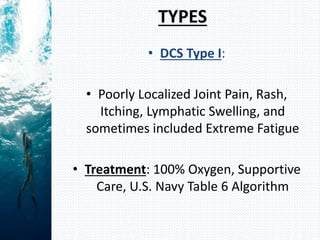
• DCS Type I:
• Poorly Localized Joint Pain, Rash,
Itching, Lymphatic Swelling, and
sometimes included Extreme Fatigue
• Treatment: 100% Oxygen, Supportive
Care, U.S. Navy Table 6 Algorithm
DCS TYPE II
• Numbness, Dizziness, Weakness, Gait-
Abnormality, Hypoesthesia,
Respiratory Symptoms, Hypovolemic
Shock, Cardiopulmonary Problems,
and Central or Peripheral Nervous
System Involvement.
• Treatment: 100% Oxygen, Supportive
Care, U.S. Navy Table 6 Algorithm
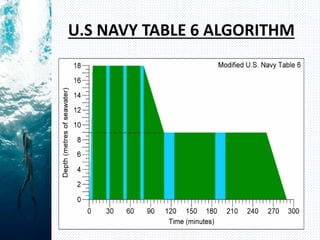
U.S NAVY TABLE 6 ALGORITHM
DCS TYPE III
• Includes Arterial Gas Embolism
• Also called Decompression Illness
(DCI)
DECOMPRESSION SICKNESS
• Nitrogen reaches Equilibrium slowly in
many tissues, particularly Fatty tissues,
so it leaves the body slowly.
• Hence, Women (with a greater average
percentage body fat than men) and
Obese men face greater risk for DCS.
Above Figure Compares Nitrogen Elimination after a
“Simulated Dive” by 2 Dogs that differed in fat content.
The relatively fat dog (yellow line) eliminated
considerably more nitrogen over the 4-hour
decompression than the leaner dog.
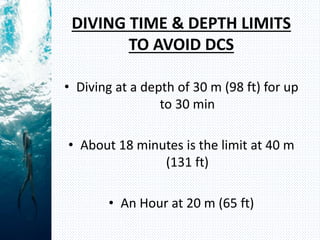
DIVING TIME & DEPTH LIMITS
TO AVOID DCS
• Diving at a depth of 30 m (98 ft) for up
to 30 min
• About 18 minutes is the limit at 40 m
(131 ft)
• An Hour at 20 m (65 ft)
ZERO DECOMPRESSION LIMITS
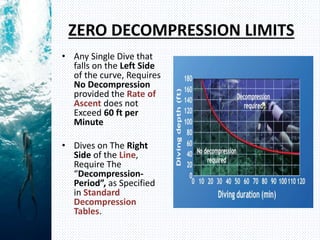
• Any Single Dive that
falls on the Left Side
of the curve, Requires
No Decompression
provided the Rate of
Ascent does not
Exceed 60 ft per
Minute
• Dives on The Right
Side of the Line,
Require The
“Decompression-
Period”, as Specified
in Standard
Decompression
Tables.
ZERO DECOMPRESSION LIMITS
• If a Diver exceeds The Depth Duration
Recommendations for “Compressed-Air
Diving”, Ascend should be at a
Prescribed, Relatively Slow Rate,
Designed “Not to Require Stops”.
• Enables All Excess Dissolved Nitrogen to
diffuse From the tissues into the blood
and Escape through the Lungs without
Forming Bubbles.
EXERCISE & DIVING
• Exercise before diving or during
Decompression, Does Not Increase The
Number of Bubbles or magnify the Risk
of “Decompression Sickness”.
• A Period of Mild Continuous Exercise
(30% VO2max), During a 3-minute
“Decompression Period” may reduce
Post-Dive Formation of Gas Bubbles.
STAGE DECOMPRESSION
• Requires The Diver to make One or
More Stops on Ascent to The Surface.
• The Time required for “The Slowest
Tissue Compartment” to lose Sufficient
Nitrogen to allow Ascent to The Next
Depth Determines The Duration of Such
Pauses.
• Termed “Stage-Decompression Stops”
Surface Stage Decompression
• Involves Transfer of The Diver from The
Water (after several in-water stops) to a
Decompression Chamber at The
Surface.
• The Judicious use of a Hyperoxic
Breathing Mixture facilitates
Recompression.
Consequences of Inadequate
Decompression
• The Primary Bubbles form in the
Venous and Arterial Vascular Bed.
• Other Bubbles Form in Central
Nervous Tissue, which causes Lesions
in The Brain and Spinal cord and
Damage Intervertebral Disks.
• Symptoms of Decompression Sickness
usually appear within 4 to 6 hours
Following a Dive.
• Severe Violation of Decompression
Procedures (e.g., diver runs out of air
and ascends too rapidly) initiates
Symptoms Immediately.
• These Symptoms Progress to Paralysis
within Minutes.
• Indications of Inadequate
Decompression include:
• Dizziness
• Itchy skin
• Aching Pain in The Legs and Arms,
particularly in Tight Tissues such as
Ligaments and Tendons
• The Degree of Injury depends on The Size
of The Bubbles and Where they form.
• Bubbles in the lungs cause choking and
Asphyxia;
• Bubbles in the brain and Coronary
Arteries block Blood Flow and Deprive
these Vital Tissues of Oxygen and
Nutrients, to produce Cellular Damage and
Death.
• CNS Bends occurs with some frequency;
Failure to provide Immediate Treatment
leads to Permanent Neural Damage.
Higher Prevalence with a Patent
Foramen Ovale
• Divers with Lesions Localized in The High Cervical
Spinal Cord and brain areas show a higher
prevalence of Patent Foramen Ovale (PFO) of the
Myocardium than Divers who experience
decompression sickness that localizes in The Lower
Spinal Cord.
Patent Foramen Ovale (PFO)
• Consists of an Interatrial Septum Channel that
forms a Functional Valve between The Right
and Left Atria.
• Can Cause Localized DCS, as Nitrogen bubbles
that the pulmonary vasculature normally
filters pass through the PFO into the arterial
circulation.
• The bubbles then migrate preferentially into
The Carotid and/or Vertebral Arteries.
PREVENTION
• Avoiding diving if you are Obese, Pregnant,
has Heart or Lung problems, or has had a
recent Joint or Limb Injury.
• Avoiding Excessive Alcohol Consumption for
24 hours before diving
• Avoiding Flying for 24 hours after Deep Sea
Diving
• Avoiding Repeated Dives within a 12-hour
period
TREATMENT
• Involves “Lengthy Recompression” in a
Hyperbaric Chamber.
• Elevates External Pressure to Force Nitrogen
Gas back into Solution.
• Gradual Decompression then follows to Provide
Time for The Expanding Gas to leave the body
as the diver returns to the Surface.
• Immediate Recompression offers the best
chance for success; any delay decreases the
prognosis for complete recovery.
A Collapsible, Lightweight, Transportable Chamber
Thanks

Decompression Sickness

  • 1.
    Alpesh Jadhav B.Sc. (Hons)Sports & Exercise Sciences DCS
  • 2.
    DESCENDING • The TotalPressure of The Respired Gas during Diving increases in Direct Proportion to “Diving Depth”. • At each successive depth, The Gradient increases for The Net Flow of Nitrogen across the Alveolar Membrane into the blood and eventually into All Tissue Fluids for Equilibration.
  • 3.
    HENRY’S LAW • Ata given TEMPRATURE, • Greater The Partial Pressure of a Gas, • Greater the amount of that gas that will be dissolved in solution.
  • 4.
    HENRY’S LAW :Example: • TheAppearance of CO2 Bubbles, When Removing The Cap from a Carbonated Beverage Bottle. • With the cap in place, the gas remains dissolved under pressure. Removing the cap suddenly reduces pressure above the fluid, causing bubbles to form.
  • 5.
  • 6.
    • With RapidAscent, • The External Pressure against The Diver’s Body decreases dramatically. • Excess dissolved nitrogen in the body tissues begins to separate from the dissolved state • Eventually forms bubbles in the tissues ASCENDING
  • 7.
    DECOMPRESSION SICKNESS • OccursWhen Dissolved Nitrogen moves “Out of Solution” and Forms Bubbles in Body Tissues and Fluids. • Results from Ascending to The Surface Too Rapidly following a Deep, Prolonged Dive, often made possible with Double and Triple air tanks.
  • 8.
    Decompression Sickness • AlsoKnown as: Caisson Disease Dysbarism Compressed Air Sickness Bends Divers Paralysis
  • 9.
    TYPES • DCS TypeI: • Poorly Localized Joint Pain, Rash, Itching, Lymphatic Swelling, and sometimes included Extreme Fatigue • Treatment: 100% Oxygen, Supportive Care, U.S. Navy Table 6 Algorithm
  • 10.
    DCS TYPE II •Numbness, Dizziness, Weakness, Gait- Abnormality, Hypoesthesia, Respiratory Symptoms, Hypovolemic Shock, Cardiopulmonary Problems, and Central or Peripheral Nervous System Involvement. • Treatment: 100% Oxygen, Supportive Care, U.S. Navy Table 6 Algorithm
  • 11.
    U.S NAVY TABLE6 ALGORITHM
  • 12.
    DCS TYPE III •Includes Arterial Gas Embolism • Also called Decompression Illness (DCI)
  • 13.
    DECOMPRESSION SICKNESS • Nitrogenreaches Equilibrium slowly in many tissues, particularly Fatty tissues, so it leaves the body slowly. • Hence, Women (with a greater average percentage body fat than men) and Obese men face greater risk for DCS.
  • 14.
    Above Figure ComparesNitrogen Elimination after a “Simulated Dive” by 2 Dogs that differed in fat content. The relatively fat dog (yellow line) eliminated considerably more nitrogen over the 4-hour decompression than the leaner dog.
  • 15.
    DIVING TIME &DEPTH LIMITS TO AVOID DCS • Diving at a depth of 30 m (98 ft) for up to 30 min • About 18 minutes is the limit at 40 m (131 ft) • An Hour at 20 m (65 ft)
  • 16.
    ZERO DECOMPRESSION LIMITS •Any Single Dive that falls on the Left Side of the curve, Requires No Decompression provided the Rate of Ascent does not Exceed 60 ft per Minute • Dives on The Right Side of the Line, Require The “Decompression- Period”, as Specified in Standard Decompression Tables.
  • 19.
    ZERO DECOMPRESSION LIMITS •If a Diver exceeds The Depth Duration Recommendations for “Compressed-Air Diving”, Ascend should be at a Prescribed, Relatively Slow Rate, Designed “Not to Require Stops”. • Enables All Excess Dissolved Nitrogen to diffuse From the tissues into the blood and Escape through the Lungs without Forming Bubbles.
  • 20.
    EXERCISE & DIVING •Exercise before diving or during Decompression, Does Not Increase The Number of Bubbles or magnify the Risk of “Decompression Sickness”. • A Period of Mild Continuous Exercise (30% VO2max), During a 3-minute “Decompression Period” may reduce Post-Dive Formation of Gas Bubbles.
  • 21.
    STAGE DECOMPRESSION • RequiresThe Diver to make One or More Stops on Ascent to The Surface. • The Time required for “The Slowest Tissue Compartment” to lose Sufficient Nitrogen to allow Ascent to The Next Depth Determines The Duration of Such Pauses. • Termed “Stage-Decompression Stops”
  • 22.
    Surface Stage Decompression •Involves Transfer of The Diver from The Water (after several in-water stops) to a Decompression Chamber at The Surface. • The Judicious use of a Hyperoxic Breathing Mixture facilitates Recompression.
  • 23.
    Consequences of Inadequate Decompression •The Primary Bubbles form in the Venous and Arterial Vascular Bed. • Other Bubbles Form in Central Nervous Tissue, which causes Lesions in The Brain and Spinal cord and Damage Intervertebral Disks.
  • 24.
    • Symptoms ofDecompression Sickness usually appear within 4 to 6 hours Following a Dive. • Severe Violation of Decompression Procedures (e.g., diver runs out of air and ascends too rapidly) initiates Symptoms Immediately. • These Symptoms Progress to Paralysis within Minutes.
  • 25.
    • Indications ofInadequate Decompression include: • Dizziness • Itchy skin • Aching Pain in The Legs and Arms, particularly in Tight Tissues such as Ligaments and Tendons
  • 26.
    • The Degreeof Injury depends on The Size of The Bubbles and Where they form. • Bubbles in the lungs cause choking and Asphyxia; • Bubbles in the brain and Coronary Arteries block Blood Flow and Deprive these Vital Tissues of Oxygen and Nutrients, to produce Cellular Damage and Death. • CNS Bends occurs with some frequency; Failure to provide Immediate Treatment leads to Permanent Neural Damage.
  • 27.
    Higher Prevalence witha Patent Foramen Ovale • Divers with Lesions Localized in The High Cervical Spinal Cord and brain areas show a higher prevalence of Patent Foramen Ovale (PFO) of the Myocardium than Divers who experience decompression sickness that localizes in The Lower Spinal Cord.
  • 28.
    Patent Foramen Ovale(PFO) • Consists of an Interatrial Septum Channel that forms a Functional Valve between The Right and Left Atria. • Can Cause Localized DCS, as Nitrogen bubbles that the pulmonary vasculature normally filters pass through the PFO into the arterial circulation. • The bubbles then migrate preferentially into The Carotid and/or Vertebral Arteries.
  • 29.
    PREVENTION • Avoiding divingif you are Obese, Pregnant, has Heart or Lung problems, or has had a recent Joint or Limb Injury. • Avoiding Excessive Alcohol Consumption for 24 hours before diving • Avoiding Flying for 24 hours after Deep Sea Diving • Avoiding Repeated Dives within a 12-hour period
  • 30.
    TREATMENT • Involves “LengthyRecompression” in a Hyperbaric Chamber. • Elevates External Pressure to Force Nitrogen Gas back into Solution. • Gradual Decompression then follows to Provide Time for The Expanding Gas to leave the body as the diver returns to the Surface. • Immediate Recompression offers the best chance for success; any delay decreases the prognosis for complete recovery.
  • 31.
    A Collapsible, Lightweight,Transportable Chamber
  • 33.

Editor's Notes

  • #11 Hypoesthesia: reduced sense of touch or sensation Hypovolemic Shock: liquid portion of the blood (plasma) is too low
  • #27 Asphyxia: o2 deprivation, suffocation, causing death