Decompression sicknessCaribbean Emergency Care Conference 2011J. van Leeuwen MD Surgeon
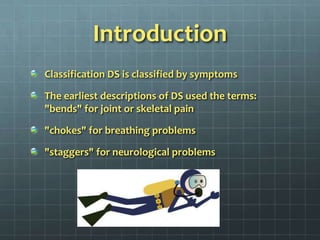
IntroductionClassification DS is classified by symptomsThe earliest descriptions of DS used the terms: "bends" for joint or skeletal pain"chokes" for breathing problems "staggers" for neurological problems
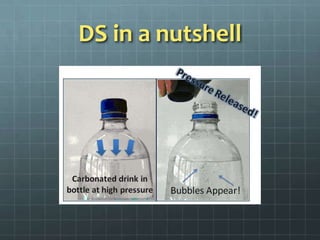
DS in a nutshell
IntroductionType I ('simple’)for symptoms involving only the skin, musculoskeletal system, or lymphatic syste Type II ('serious’)for symptoms where other organs (such as the central nervous system) are involved
IntroductionType II DCS is considered more serious and usually has worse outcomes
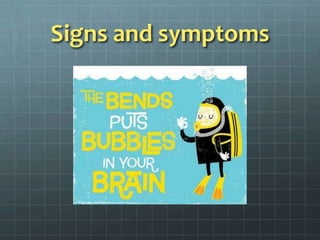
Signs and symptoms
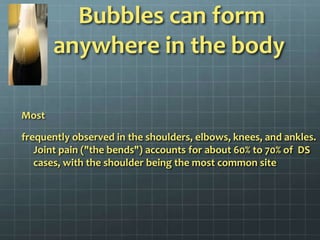
 Bubbles can form anywhere in the body Most frequently observed in the shoulders, elbows, knees, and ankles. Joint pain ("the bends") accounts for about 60% to 70% of  DS cases, with the shoulder being the most common site
 Musculoskeletal (mostly joints)Localized deep pain, ranging from mild to excruciatingRed rash in skinSometimes a dull ache, but rarely a sharp pain. Active and passive motion of the joint aggravates the pain
Itching, usually around the ears, face, neck, arms, and upper torsoSensation of tiny insects crawling over the skinMottled or marbled skin usually around the shoulders, upper chest and abdomen, with itchingSwelling of the skin, accompanied by tiny scar-like skin depressions (pitting edema)CutaneousType I DS
Neurologic (brain)Type II DSAltered sensation, tingling or numbness paresthesia, increased sensitivity hyperesthesiaConfusion or memory loss (amnesia)Visual abnormalitiesUnexplained mood or behaviour changesSeizures, unconsciousness
Neurologic (spinal cord)Ascending weakness or paralysis in the legsGirdling abdominal or chest painUrinary incontinence and fecal incontinence
Constitutional (whole body)HeadacheUnexplained fatigueGeneralised malaise, poorly localised aches
Audiovestibulair (inner ear)Loss of balanceDizziness, vertigo, nausea, vomitingHearing loss
Pulmonary Dry persistent coughBurning chest pain under the sternum, aggravated by breathingShortness of breath
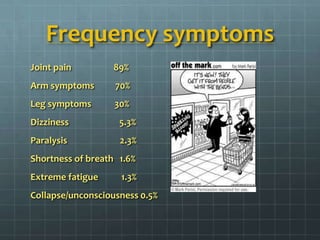
Frequency symptomsJoint pain                    89%Arm symptoms          70%Leg symptoms           30%Dizziness                        5.3%Paralysis                         2.3%Shortness of breath   1.6%Extreme fatigue           1.3%Collapse/unconsciousness 0.5%
Onset of DSwithin 1 hour	                  42%	within 3 hours	60%	within 8 hours	83%	within 24 hours	98%	within 48 hours	100%	Although onset of DS can occur rapidly after a dive, in extreme cases even before a dive has been completed, in more than half of all cases symptoms do not begin to present until over an hour following the dive
What causes DS      A reduction in ambient pressure that results in the formation of bubbles of inert gases within tissues of the body      It may happen when leaving a high-pressure environment, ascending from depth, or ascending to altitude
Predisposing factorsAlthough the occurrence of DS is not easily predictable, many predisposing factors are known environmental individual
Environmental (to increase risk)The magnitude of the pressure reduction ratio and duration Repetitive exposures – repetitive dives within a short period of time (a few hours)Repetitive ascents to altitudes above 5,500 metres The US Navy Dive Manual indicates that ascent rates greater than about 20 m/min (66 ft/min) when diving increase the chance of DS, while recreational dive tables require an ascent rate of 10 m/min (33 ft/min) with the last 6 m (20 ft) taking at least one minute
IndividualAge Previous injury – there is some indication that recent joint or limb injuries to developing decompression-related bubblesAmbient temperature –exposure to very cold ambient temperatures may increase the risk of altitude DSHigh body fat content is at greater risk of DS. This is due to nitrogen's five times greater solubility in fat than in water
Alcohol consumption and dehydration Maintaining proper hydration is recommended.Patent foramen ovale        Venous blood with microbubbles of inert gasbypass the lungs, where the bubbles would otherwise be filtered out by the lung capillary system, and return directly to arteries to the brain, spinal cord and heartIn the arterial system, bubbles (arterial gas embolism) are far more dangerous because they block circulation and cause infarction (tissue death, due to local loss of blood flow). In the brain, results in stroke, and in the spinal cordresults in paralysis
MechanismDepressurisation causes inert gases, which were dissolved under higher pressure, to come out of physical solution and form gas bubbles within the body. These bubbles produce the symptoms of decompression sicknessBubbles may form whenever the body experiences a reduction in pressure, but not all bubbles result in DS
On ascent from a dive, inert gas comes out of solution in a process called "outgassing" or "offgassing". Under normal conditions, most offgassing occurs by gas exchange in the lungs. If inert gas comes out of solution too quickly to allow outgassing in the lungs then bubbles may form in the bloodThe formation of bubbles in the skin or joints results in milder symptoms, while large numbers of bubbles in the venous blood can cause lung damage
DiagnosisDS should be suspected if any of the symptoms associated with the condition occurs following a drop in pressure, in particular, within 24 hours of divingIn 1995, 95% of all cases reported to Divers Alert Network had shown symptoms within 24 hoursThe diagnosis is confirmed if the symptoms are relieved by recompression
PreventionTo prevent ascend 10 metres (33 ft) per minute, and carry out a decompression schedule as necessary This schedule requires the diver to ascend to a particular depth, and remain at that depth until sufficient gas has been eliminated from the body to allow further ascentDives that contain no decompression stops are called "no-stop dives", but divers usually schedule a short "safety stop" at 3 metres (10 ft), 4.6 metres (15 ft), or 6 metres (20 ft), depending on the training agency
Treatment100% oxygen until hyperbaric oxygen therapy (100% oxygen delivered in a high-pressure chamber) can be provided Mild cases of the "bends" and some skin symptoms may disappear during descent from high altitudeNeurological symptoms, pulmonary symptoms, and mottled or marbled skin lesions should be treated with hyperbaric oxygen therapy if seen within 10 to 14 days of development
TreatmentOxygen first aid has been used as an emergency treatmentIf given within the first four hours of surfacing, it increases the success of recompression therapy as well as a decrease the number of recompression treatments required
TreatmentGive fluids, as this reduces dehydration In the past, both the Trendelenburg position and the left lateral decubitus position have been beneficial where air emboli are suspected
PrognosisImmediate treatment with 100% oxygen, followed by recompression in a hyperbaric chamber, will in most cases result in no long term effectsThree-month follow-ups on diving accidents reported to DAN in 1987 showed 14.3% of the 268 divers surveyed still had residual signs and symptoms from Type II DS and 7% from Type I DS
EpidemiologyThe incidence of decompression sickness is rare, estimated at 2.8 cases per 10,000 dives, with the risk 2.6 times greater for males than females DS affects approximately 1,000 U.S. scuba divers per year From 1998 to 2002, they recorded 50,150 dives, from which 28 recompressions were required  — 0.05%
Treatment principlesHBOT lies in its ability to drastically increase partial pressure of oxygen in the tissues of the body. The oxygen partial pressures achievable using HBOT are much higher than those achievable while breathing pure oxygen at normobaric conditionsUnder normal atmospheric pressure, oxygen transport is limited by the oxygen binding capacity of hemoglobin in red blood cells and very little oxygen is transported by blood plasma. Because the hemoglobin of the red blood cells is almost saturated with oxygen under atmospheric pressure, this transport cannot be used any further. Oxygen transport by plasma, however is significantly increased using HBOT
IndicationsAir or gas embolismCarbon monoxide poisoningClostridal myositis and myonecrosis (gas gangrene)Crush injury, compartment syndrome, and other acute traumatic ischemiasDecompression sickness
Hyperbaric Oxygen TherapyInvolves intermittently breathing pure oxygen at greater than ambient pressureThink of oxygen as a drug and the hyperbaric chamber as a dosing deviceElevating tissue oxygen tension is the primary effect
Hyperbaric Oxygen TherapyPrimary therapy for:Decompression sicknessAir embolismCarbon monoxide poisoningAdjunct therapy for:Surgical interventionAntibiotics
Accepted IndicationsAir or gas embolismCarbon monoxide poisoningClostridialmyositis and myonecrosisCrush injury, compartment syndrome, acute traumatic ischemiasDecompression sicknessEnhance healing of woundsNecrotizing fasciitisChronic osteomyelitisRadiation necrosis, brown recluse spider bitesThermal burns
Basic MechanismsBoyle’s Law – pressure and volume inversely proportional under constant temperatureBy increasing ambient pressure to 2 atm, decreases the volume by ½ Henry’s Law – at a given temperature, the amount of gas dissolved in solute is directly proportional to the partial pressure of the gas.By increasing ambient pressure, more oxygen can be dissolved in the plasma
Mechanism of actionAngiogenesis in ischemic tissuesBacteriostatic/bactericidal actionsCarboxyhemoglobin dissociation hastenedClostridium perfringens alpha toxin synthesis inhibitedVasoconstrictionTemporary inhibition of neutrophil Beta 2 integrin adhesion
Monoplace (1 person) or multiplace (2-14 patients) chamberPressures applied inside the chamber are usually 2-3 xatm pressure, plus may have an additional hydrostatic pressure equivalent of 1-2 atm.Treatments last from 2-8 hours
ComplicationsMiddle ear barotraumaMiddle ear barotrauma is the most common adverse effect of HBO treatmentHemorrhage or serous effusion developsPrevention:  teaching patient auto-insufflation technique or use of decongestantsIf auto-insufflation fails, tympanostomy tubes are placed.
ComplicationsPulmonary barotraumaRareSuspect if pulmonary or hemodynamic changes occur during or shortly after decompressionPlace chest tube if pneumothorax develops
ComplicationsOxygen ToxicityCan impair elasticity, vital capacity, and gas exchange. CNS toxicitySeizureRisk is higher in hypercapnic, acidotic, or septic patientsEyesProgressive myopia has been reported in patients undergoing repetitive daily therapy
CO PoisoningLeading cause of injury and death by poisoning in the worldAffinity of CO for hemoglobin (forming carboxyhemoglobin) is 200 times that of oxygen
ClostridialMyonecrosis(gas gangrene)Mortality rates of 11-52%Diffused oxygen which raises capillary p02 levels at the wound site, stimulates capillary budding and granulation of new, healthy tissue
Necrotizing Fasciitis andFournier’s gangreneAddition of HBO to surgical and antibiotic treatment reduced mortality versus surgery and antibiotics aloneMay suppress growth of anaerobic organismsMay increase leukocyte function and suppress bacterial growth
Crush injuryReduces infection and wound dehiscence and improves healingImproves oxygenation to hypoperfused tissueCauses arterial hyperoxia causing vasoconstriction and decreased edema formation.Also, intermittent pressure stimulates circulation and reduces edemaEarly use of HBO may reduce compartment pressures enough to avoid fasciotomy
PreventionDon’t push your limits and do all required decompression stopsKeep physically fit and within a healthy weight rangeDon't exercise within 12 hours of divingDon't ascend to altitude or fly immediately after divingMake sure you're adequately hydrated before every diveDon't drink alcohol before or after diving and never dive when hungoverGet checked out by a doctor to find out if you have a PFO
MASHA DANKI!

Decompression

  • 1.
    Decompression sicknessCaribbean EmergencyCare Conference 2011J. van Leeuwen MD Surgeon
  • 2.
    IntroductionClassification DS isclassified by symptomsThe earliest descriptions of DS used the terms: "bends" for joint or skeletal pain"chokes" for breathing problems "staggers" for neurological problems
  • 3.
    DS in anutshell
  • 4.
    IntroductionType I ('simple’)forsymptoms involving only the skin, musculoskeletal system, or lymphatic syste Type II ('serious’)for symptoms where other organs (such as the central nervous system) are involved
  • 5.
    IntroductionType II DCSis considered more serious and usually has worse outcomes
  • 6.
  • 7.
    Bubbles canform anywhere in the body Most frequently observed in the shoulders, elbows, knees, and ankles. Joint pain ("the bends") accounts for about 60% to 70% of DS cases, with the shoulder being the most common site

  • 8.
    Musculoskeletal (mostlyjoints)Localized deep pain, ranging from mild to excruciatingRed rash in skinSometimes a dull ache, but rarely a sharp pain. Active and passive motion of the joint aggravates the pain
  • 9.
    Itching, usually aroundthe ears, face, neck, arms, and upper torsoSensation of tiny insects crawling over the skinMottled or marbled skin usually around the shoulders, upper chest and abdomen, with itchingSwelling of the skin, accompanied by tiny scar-like skin depressions (pitting edema)CutaneousType I DS
  • 10.
    Neurologic (brain)Type IIDSAltered sensation, tingling or numbness paresthesia, increased sensitivity hyperesthesiaConfusion or memory loss (amnesia)Visual abnormalitiesUnexplained mood or behaviour changesSeizures, unconsciousness
  • 11.
    Neurologic (spinal cord)Ascendingweakness or paralysis in the legsGirdling abdominal or chest painUrinary incontinence and fecal incontinence
  • 12.
    Constitutional (whole body)HeadacheUnexplainedfatigueGeneralised malaise, poorly localised aches
  • 13.
    Audiovestibulair (inner ear)Lossof balanceDizziness, vertigo, nausea, vomitingHearing loss
  • 14.
    Pulmonary Dry persistentcoughBurning chest pain under the sternum, aggravated by breathingShortness of breath
  • 15.
    Frequency symptomsJoint pain 89%Arm symptoms 70%Leg symptoms 30%Dizziness 5.3%Paralysis 2.3%Shortness of breath 1.6%Extreme fatigue 1.3%Collapse/unconsciousness 0.5%
  • 16.
    Onset of DSwithin1 hour 42% within 3 hours 60% within 8 hours 83% within 24 hours 98% within 48 hours 100% Although onset of DS can occur rapidly after a dive, in extreme cases even before a dive has been completed, in more than half of all cases symptoms do not begin to present until over an hour following the dive
  • 17.
    What causes DS A reduction in ambient pressure that results in the formation of bubbles of inert gases within tissues of the body It may happen when leaving a high-pressure environment, ascending from depth, or ascending to altitude
  • 18.
    Predisposing factorsAlthough theoccurrence of DS is not easily predictable, many predisposing factors are known environmental individual
  • 19.
    Environmental (to increaserisk)The magnitude of the pressure reduction ratio and duration Repetitive exposures – repetitive dives within a short period of time (a few hours)Repetitive ascents to altitudes above 5,500 metres The US Navy Dive Manual indicates that ascent rates greater than about 20 m/min (66 ft/min) when diving increase the chance of DS, while recreational dive tables require an ascent rate of 10 m/min (33 ft/min) with the last 6 m (20 ft) taking at least one minute
  • 20.
    IndividualAge Previous injury – thereis some indication that recent joint or limb injuries to developing decompression-related bubblesAmbient temperature –exposure to very cold ambient temperatures may increase the risk of altitude DSHigh body fat content is at greater risk of DS. This is due to nitrogen's five times greater solubility in fat than in water
  • 21.
    Alcohol consumption anddehydration Maintaining proper hydration is recommended.Patent foramen ovale  Venous blood with microbubbles of inert gasbypass the lungs, where the bubbles would otherwise be filtered out by the lung capillary system, and return directly to arteries to the brain, spinal cord and heartIn the arterial system, bubbles (arterial gas embolism) are far more dangerous because they block circulation and cause infarction (tissue death, due to local loss of blood flow). In the brain, results in stroke, and in the spinal cordresults in paralysis
  • 22.
    MechanismDepressurisation causes inertgases, which were dissolved under higher pressure, to come out of physical solution and form gas bubbles within the body. These bubbles produce the symptoms of decompression sicknessBubbles may form whenever the body experiences a reduction in pressure, but not all bubbles result in DS
  • 23.
    On ascent froma dive, inert gas comes out of solution in a process called "outgassing" or "offgassing". Under normal conditions, most offgassing occurs by gas exchange in the lungs. If inert gas comes out of solution too quickly to allow outgassing in the lungs then bubbles may form in the bloodThe formation of bubbles in the skin or joints results in milder symptoms, while large numbers of bubbles in the venous blood can cause lung damage
  • 24.
    DiagnosisDS should besuspected if any of the symptoms associated with the condition occurs following a drop in pressure, in particular, within 24 hours of divingIn 1995, 95% of all cases reported to Divers Alert Network had shown symptoms within 24 hoursThe diagnosis is confirmed if the symptoms are relieved by recompression
  • 25.
    PreventionTo prevent ascend10 metres (33 ft) per minute, and carry out a decompression schedule as necessary This schedule requires the diver to ascend to a particular depth, and remain at that depth until sufficient gas has been eliminated from the body to allow further ascentDives that contain no decompression stops are called "no-stop dives", but divers usually schedule a short "safety stop" at 3 metres (10 ft), 4.6 metres (15 ft), or 6 metres (20 ft), depending on the training agency
  • 26.
    Treatment100% oxygen untilhyperbaric oxygen therapy (100% oxygen delivered in a high-pressure chamber) can be provided Mild cases of the "bends" and some skin symptoms may disappear during descent from high altitudeNeurological symptoms, pulmonary symptoms, and mottled or marbled skin lesions should be treated with hyperbaric oxygen therapy if seen within 10 to 14 days of development
  • 27.
    TreatmentOxygen first aidhas been used as an emergency treatmentIf given within the first four hours of surfacing, it increases the success of recompression therapy as well as a decrease the number of recompression treatments required
  • 28.
    TreatmentGive fluids, asthis reduces dehydration In the past, both the Trendelenburg position and the left lateral decubitus position have been beneficial where air emboli are suspected
  • 29.
    PrognosisImmediate treatment with100% oxygen, followed by recompression in a hyperbaric chamber, will in most cases result in no long term effectsThree-month follow-ups on diving accidents reported to DAN in 1987 showed 14.3% of the 268 divers surveyed still had residual signs and symptoms from Type II DS and 7% from Type I DS
  • 30.
    EpidemiologyThe incidence ofdecompression sickness is rare, estimated at 2.8 cases per 10,000 dives, with the risk 2.6 times greater for males than females DS affects approximately 1,000 U.S. scuba divers per year From 1998 to 2002, they recorded 50,150 dives, from which 28 recompressions were required — 0.05%
  • 31.
    Treatment principlesHBOT liesin its ability to drastically increase partial pressure of oxygen in the tissues of the body. The oxygen partial pressures achievable using HBOT are much higher than those achievable while breathing pure oxygen at normobaric conditionsUnder normal atmospheric pressure, oxygen transport is limited by the oxygen binding capacity of hemoglobin in red blood cells and very little oxygen is transported by blood plasma. Because the hemoglobin of the red blood cells is almost saturated with oxygen under atmospheric pressure, this transport cannot be used any further. Oxygen transport by plasma, however is significantly increased using HBOT
  • 32.
    IndicationsAir or gasembolismCarbon monoxide poisoningClostridal myositis and myonecrosis (gas gangrene)Crush injury, compartment syndrome, and other acute traumatic ischemiasDecompression sickness
  • 33.
    Hyperbaric Oxygen TherapyInvolvesintermittently breathing pure oxygen at greater than ambient pressureThink of oxygen as a drug and the hyperbaric chamber as a dosing deviceElevating tissue oxygen tension is the primary effect
  • 34.
    Hyperbaric Oxygen TherapyPrimarytherapy for:Decompression sicknessAir embolismCarbon monoxide poisoningAdjunct therapy for:Surgical interventionAntibiotics
  • 35.
    Accepted IndicationsAir orgas embolismCarbon monoxide poisoningClostridialmyositis and myonecrosisCrush injury, compartment syndrome, acute traumatic ischemiasDecompression sicknessEnhance healing of woundsNecrotizing fasciitisChronic osteomyelitisRadiation necrosis, brown recluse spider bitesThermal burns
  • 36.
    Basic MechanismsBoyle’s Law– pressure and volume inversely proportional under constant temperatureBy increasing ambient pressure to 2 atm, decreases the volume by ½ Henry’s Law – at a given temperature, the amount of gas dissolved in solute is directly proportional to the partial pressure of the gas.By increasing ambient pressure, more oxygen can be dissolved in the plasma
  • 37.
    Mechanism of actionAngiogenesisin ischemic tissuesBacteriostatic/bactericidal actionsCarboxyhemoglobin dissociation hastenedClostridium perfringens alpha toxin synthesis inhibitedVasoconstrictionTemporary inhibition of neutrophil Beta 2 integrin adhesion
  • 38.
    Monoplace (1 person)or multiplace (2-14 patients) chamberPressures applied inside the chamber are usually 2-3 xatm pressure, plus may have an additional hydrostatic pressure equivalent of 1-2 atm.Treatments last from 2-8 hours
  • 39.
    ComplicationsMiddle ear barotraumaMiddleear barotrauma is the most common adverse effect of HBO treatmentHemorrhage or serous effusion developsPrevention: teaching patient auto-insufflation technique or use of decongestantsIf auto-insufflation fails, tympanostomy tubes are placed.
  • 40.
    ComplicationsPulmonary barotraumaRareSuspect ifpulmonary or hemodynamic changes occur during or shortly after decompressionPlace chest tube if pneumothorax develops
  • 41.
    ComplicationsOxygen ToxicityCan impairelasticity, vital capacity, and gas exchange. CNS toxicitySeizureRisk is higher in hypercapnic, acidotic, or septic patientsEyesProgressive myopia has been reported in patients undergoing repetitive daily therapy
  • 42.
    CO PoisoningLeading causeof injury and death by poisoning in the worldAffinity of CO for hemoglobin (forming carboxyhemoglobin) is 200 times that of oxygen
  • 43.
    ClostridialMyonecrosis(gas gangrene)Mortality ratesof 11-52%Diffused oxygen which raises capillary p02 levels at the wound site, stimulates capillary budding and granulation of new, healthy tissue
  • 44.
    Necrotizing Fasciitis andFournier’sgangreneAddition of HBO to surgical and antibiotic treatment reduced mortality versus surgery and antibiotics aloneMay suppress growth of anaerobic organismsMay increase leukocyte function and suppress bacterial growth
  • 45.
    Crush injuryReduces infectionand wound dehiscence and improves healingImproves oxygenation to hypoperfused tissueCauses arterial hyperoxia causing vasoconstriction and decreased edema formation.Also, intermittent pressure stimulates circulation and reduces edemaEarly use of HBO may reduce compartment pressures enough to avoid fasciotomy
  • 46.
    PreventionDon’t push yourlimits and do all required decompression stopsKeep physically fit and within a healthy weight rangeDon't exercise within 12 hours of divingDon't ascend to altitude or fly immediately after divingMake sure you're adequately hydrated before every diveDon't drink alcohol before or after diving and never dive when hungoverGet checked out by a doctor to find out if you have a PFO
  • 47.