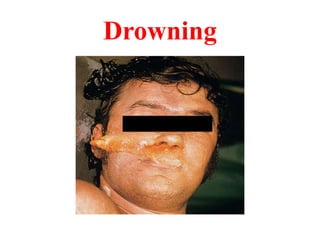
Drowning
Aim of this 2 parts class:1. To give you guys attendance.2. Theoretical, conceptual & practical know how3. To able you to understand the burden, mechanism, morphological, micro features4. To differentiate between freshwater and saltwater drowning5. To differentiate between AM and PM drowning6. To estimate the duration & Site of incidence.
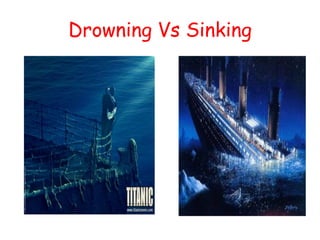
Drowning Vs Sinking
Home-work Difference b/w Drowning and Immersion?
Specific Gravity and DensitySpecific gravity is defined as the ratio of the density of a substance to the density of water.Water has a specific gravity of 1.0 Any object with a specific gravity less than1.0 will float in water and anything greater than 1.0 will sinkThe human body has a density slightly less than that of water and averages a specific gravity of 0.974. Therefore, we float. Lean body mass has a typical density near 1.1  Fat mass has a density of about 0.9.
Am I a stud?
SEQUENCE OF EVENTS IN DROWNING1. SENSE OF PANICExpressed by:	Violent struggleAutomatic swimming movementsUsually followed by:2. PERIOD OF VOLUNTARY APNOEADuration: 1-2 minutes.Hypoxemia, hypercapnia, R & M acidosis.
3. ATTEMPT AT TAKING A BREATHWATER:May be freely inhaledOr, may cause glottic spasm due to impingement.In 10-15 % victims:  glottic spasm severe asphyxia water may not enter the lungs unless subcouncious.Dry drowningIn 85-90 % victims: water is swallowed inducing vomiting, gasping & aspiration of water into lungs. 	When expiratory effort is made: fine froth, sometimes blood stained (due to overdistension of liquid coloumn)Wet drowning
4.  Cessation of constant struggling5. Stage of convulsive spasms, twitching, dilation of pupils6. Clinical death
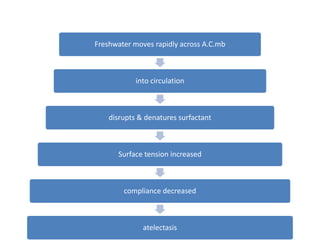
Freshwater DrowningThe Mechanism + RespPathophysiology
More liquid in the circulationHemodilution, decrease in Na+, Cl & Ca conc.Liquid/ water goes inside RBCsHemolysisRelease of K+Increase in K+ conc.
Marked Ventilation perfusion mismatchShift Acute hypervolemiaExperimental Vs RealityIncrease in K+ irritates myocardiumArrythmias (VF) occurs
Effect on CVSIncrease in circulatory volume but till plateau.Decrease in blood densityDec in Na, Cl
Salt water DrowningPulling out of water  Hemoconc. Inc. in Na, Cl and MgNo hemolysis, No VFDeath within 5-12 minutes (later than freshwater)
Hypertonic liquidPulmonary edema within minutesShift HypovolemiaDraws water out through mbInto pulmonary alveoliDamage to basement mb + Dilution & washing out of Surfactantcompliance decreased
Pulmonary edema X ray
Effect on CVSCVS effects are secondary to:1. Changes in arterial oxygen tension2. Changes in acid base balance.Acute hypoxemia Catecholamine release Transient tachycardia and hypertension.Followed by bradycardia and hypotension as hypoxemia intensifies.Hypoxemia may directly reduce myocardial contractilityHypoxia + Acidosis: increase the risk for arrythmias( VT, VF, Asystole)Note: VF as an immediate cause of death is uncommon in both forms of human drowning.
Effects on BrainHypoxia ischemic damage to brainWindow period of 4-6 minutes before irreversible neuronal damage.
Effects on other organsAcute renal and hepatic insufficiencyGI injuriesDIC
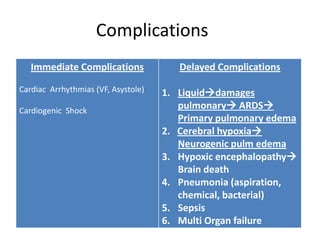
Complications
Types of drowning1. Wet drowning= primary drowning2. Dry drowning= 10-15%, laryngospasm, thick mucous foam plug, panoramic views of past life, pleasant dreams without distress.3. Secondary drowning= post immersion syndrome= near drowning; Secondary drowning is death due to chemical or biological changes in the lungs after a near drowning incident; resuscitated and survives for 24 hours, +/- conscious, hypoxemia brain damage, electrolyte disturbances, pulmonary edema, hemoglobinuria, chemical pneumonitis4. Immersion syndrome= hydrocution= submersion inhibition; cold water n. endings +/ strike epigastrium+/ entering ear drums, nasal passages. Horizontal entry (dive) pressure on abdomenAll these  Vagal inhibition Cardiac  arrest death
RESPIRATORY SYSTEMIn humans: As little as 1 to 3 ml/kg produces profound alteration in pulmonary gas exchange and decreases pulmonary compliance by 10 to 40%
Causes of death1. Asphyxia2. VF: disturbed Na/ K ratio (freshwater)3. Laryngeal spasm4. Vagal inhibition: cold water, emotions?, unexpected immersion.5. Exhaustion6. Injuries: # skull, cervical vertebrae.
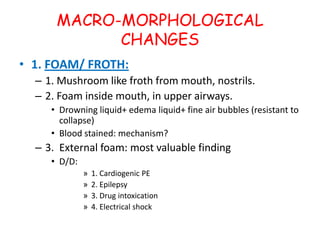
MACRO-MORPHOLOGICAL CHANGES1. FOAM/ FROTH: 1. Mushroom like froth from mouth, nostrils.2. Foam inside mouth, in upper airways.Drowning liquid+ edema liquid+ fine air bubbles (resistant to collapse)Blood stained: mechanism?3.  External foam: most valuable findingD/D: 	1. Cardiogenic PE2. Epilepsy3. Drug intoxication4. Electrical shock
Mechanism of foam formation
Clothing: wetSkin: wet, moist, pale ?Mud, silt, algae on bodyPM lividity: light pink in colorFace: +/- cyanoticConjunctivae: congestedPupils: dilated
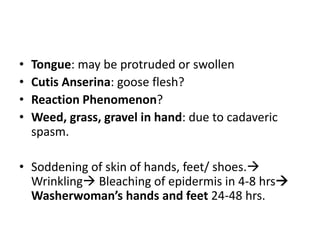
Tongue: may be protruded or swollenCutis Anserina: goose flesh?Reaction Phenomenon?Weed, grass, gravel in hand: due to cadaveric spasm.Soddening of skin of hands, feet/ shoes. Wrinkling Bleaching of epidermis in 4-8 hrs Washerwoman’s hands and feet 24-48 hrs.
Long standing Washer man/woman’s feet
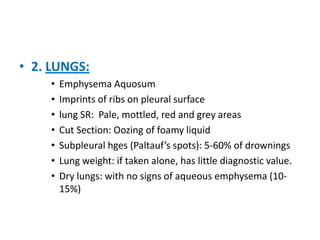
2. LUNGS:Emphysema AquosumImprints of ribs on pleural surfacelung SR:  Pale, mottled, red and grey areasCut Section: Oozing of foamy liquidSubpleuralhges (Paltauf’s spots): 5-60% of drowningsLung weight: if taken alone, has little diagnostic value.Dry lungs: with no signs of aqueous emphysema (10-15%)
Comparison of forensic pathology of lungs
Over distension and overlapping of anterior lung margin
Paltauf’s spots
3. PLEURA: PE: a relatively common findingDue to diffusion of liquid into thoracic cavity.4. TEMPORAL BONE:Gross hges in the petrous and mastoid region of temporal boneReasons:1. Barotrauma2. Penetration3. Increased capillary & venous pressure
5. SINUSES:Aqueous liquid inside sinuses.Sign of permanence, can occur PM too.6. SPLEEN:controversialCut off value 0.2% body weight.Decrease in weight due to (proposed):  symp. Stimulation V/c  Contraction of the spleen capsule and trabeculae
7. MUSCLES:Hges are seen, mostly in Resp & Aux resp ms > neck & back ms > ms of shoulder girdle > upper arm ms.Causes: Convulsions, hypercontraction, overexertion.8. GI:Laceration of GI mucosa: vague
When the body starts floating?
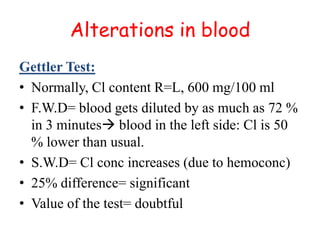
Alterations in bloodGettler Test:Normally, Cl content R=L, 600 mg/100 mlF.W.D= blood gets diluted by as much as 72 % in 3 minutes blood in the left side: Cl is 50 % lower than usual.S.W.D= Clconc increases (due to hemoconc)25% difference= significantValue of the test= doubtful
DiatomsMicroscopic, unicellular algaeSiliceous skeleton = frustuleResist heat and acid.Active circulation brings diatoms into intestine, liver, brain, bone marrow.Technique: HNo3 or enzymatic digestion Centrifuge deposit PC or DGI Microscopy
Thank you, for your patience 
Pressureis applied using the heel of one hand with the otherhand on top, to depress the sternum 1 in. to 11/4 in.with each stroke in adults, followed by release ofpressure, at the rate of about 60 per minute.The application of artfficial respiration andcardiac massage should be continued for at least15 minutesIf spontaneous respirationand restoration of the circulation do not occurwithin 15 minutes, further efforts are probablyfruitless. If there is discernible evidence of activecirculation, artificial respiration should be continueduntil spontaneous respiration is restored. Onthe other hand, marked body cooling or evidenceof early rigor mortis indicates the futility of continuedefforts in this direction. The presence offixed dilated pupils persisting for 15 minutes issuggestive of clinical death.
In fresh-waterdrowning, this consists of 1000 c.c. of 3% saline,which is repeated in three to six hours if the serumsodium level is below 110 mEq./l. The deficit inserum calcium may need to be corrected by aninfusion of calcium gluconate.Transfusion with whole blood, alternating with bleeding, may beneeded later.
In salt-water drowning, intravenoustherapy is carried out with 5% dextrose-neversaline, whole blood or plasma. Venesection may beneeded later.
anesthetic machineusing intermittent pressure and pure oxygen.If the cardiacstatus is unsatisfactory, injections of epinephrinehave been employed by some workers. If ventricularfibrillation has occurred, the use of externalstimuli such as a quick blow over the heart, theapplication of electrodes with one or more shocksusing 480 volts for .25 second,
In victims of fresh-water drowning the urinaryoutput must be carefully observed; the hemolysisof red cells may cause renal tubular nephrosis.
under circumstanceswhich induce emotions such as fear or surprise,the swimmer may be in such a state that anordinarily innocuous stimulus will cause vagal inhibitionand immediate cardiac arrest.

Drowning

  • 1.
  • 2.
    Aim of this2 parts class:1. To give you guys attendance.2. Theoretical, conceptual & practical know how3. To able you to understand the burden, mechanism, morphological, micro features4. To differentiate between freshwater and saltwater drowning5. To differentiate between AM and PM drowning6. To estimate the duration & Site of incidence.
  • 3.
  • 4.
    Home-work Difference b/wDrowning and Immersion?
  • 5.
    Specific Gravity andDensitySpecific gravity is defined as the ratio of the density of a substance to the density of water.Water has a specific gravity of 1.0 Any object with a specific gravity less than1.0 will float in water and anything greater than 1.0 will sinkThe human body has a density slightly less than that of water and averages a specific gravity of 0.974. Therefore, we float. Lean body mass has a typical density near 1.1 Fat mass has a density of about 0.9.
  • 6.
    Am I astud?
  • 7.
    SEQUENCE OF EVENTSIN DROWNING1. SENSE OF PANICExpressed by: Violent struggleAutomatic swimming movementsUsually followed by:2. PERIOD OF VOLUNTARY APNOEADuration: 1-2 minutes.Hypoxemia, hypercapnia, R & M acidosis.
  • 8.
    3. ATTEMPT ATTAKING A BREATHWATER:May be freely inhaledOr, may cause glottic spasm due to impingement.In 10-15 % victims: glottic spasm severe asphyxia water may not enter the lungs unless subcouncious.Dry drowningIn 85-90 % victims: water is swallowed inducing vomiting, gasping & aspiration of water into lungs. When expiratory effort is made: fine froth, sometimes blood stained (due to overdistension of liquid coloumn)Wet drowning
  • 9.
    4. Cessationof constant struggling5. Stage of convulsive spasms, twitching, dilation of pupils6. Clinical death
  • 10.
  • 12.
    More liquid inthe circulationHemodilution, decrease in Na+, Cl & Ca conc.Liquid/ water goes inside RBCsHemolysisRelease of K+Increase in K+ conc.
  • 13.
    Marked Ventilation perfusionmismatchShift Acute hypervolemiaExperimental Vs RealityIncrease in K+ irritates myocardiumArrythmias (VF) occurs
  • 14.
    Effect on CVSIncreasein circulatory volume but till plateau.Decrease in blood densityDec in Na, Cl
  • 15.
    Salt water DrowningPullingout of water  Hemoconc. Inc. in Na, Cl and MgNo hemolysis, No VFDeath within 5-12 minutes (later than freshwater)
  • 16.
    Hypertonic liquidPulmonary edemawithin minutesShift HypovolemiaDraws water out through mbInto pulmonary alveoliDamage to basement mb + Dilution & washing out of Surfactantcompliance decreased
  • 17.
  • 18.
    Effect on CVSCVSeffects are secondary to:1. Changes in arterial oxygen tension2. Changes in acid base balance.Acute hypoxemia Catecholamine release Transient tachycardia and hypertension.Followed by bradycardia and hypotension as hypoxemia intensifies.Hypoxemia may directly reduce myocardial contractilityHypoxia + Acidosis: increase the risk for arrythmias( VT, VF, Asystole)Note: VF as an immediate cause of death is uncommon in both forms of human drowning.
  • 19.
    Effects on BrainHypoxiaischemic damage to brainWindow period of 4-6 minutes before irreversible neuronal damage.
  • 20.
    Effects on otherorgansAcute renal and hepatic insufficiencyGI injuriesDIC
  • 21.
  • 22.
    Types of drowning1.Wet drowning= primary drowning2. Dry drowning= 10-15%, laryngospasm, thick mucous foam plug, panoramic views of past life, pleasant dreams without distress.3. Secondary drowning= post immersion syndrome= near drowning; Secondary drowning is death due to chemical or biological changes in the lungs after a near drowning incident; resuscitated and survives for 24 hours, +/- conscious, hypoxemia brain damage, electrolyte disturbances, pulmonary edema, hemoglobinuria, chemical pneumonitis4. Immersion syndrome= hydrocution= submersion inhibition; cold water n. endings +/ strike epigastrium+/ entering ear drums, nasal passages. Horizontal entry (dive) pressure on abdomenAll these  Vagal inhibition Cardiac arrest death
  • 23.
    RESPIRATORY SYSTEMIn humans:As little as 1 to 3 ml/kg produces profound alteration in pulmonary gas exchange and decreases pulmonary compliance by 10 to 40%
  • 24.
    Causes of death1.Asphyxia2. VF: disturbed Na/ K ratio (freshwater)3. Laryngeal spasm4. Vagal inhibition: cold water, emotions?, unexpected immersion.5. Exhaustion6. Injuries: # skull, cervical vertebrae.
  • 25.
    MACRO-MORPHOLOGICAL CHANGES1. FOAM/FROTH: 1. Mushroom like froth from mouth, nostrils.2. Foam inside mouth, in upper airways.Drowning liquid+ edema liquid+ fine air bubbles (resistant to collapse)Blood stained: mechanism?3. External foam: most valuable findingD/D: 1. Cardiogenic PE2. Epilepsy3. Drug intoxication4. Electrical shock
  • 26.
  • 27.
    Clothing: wetSkin: wet,moist, pale ?Mud, silt, algae on bodyPM lividity: light pink in colorFace: +/- cyanoticConjunctivae: congestedPupils: dilated
  • 28.
    Tongue: may beprotruded or swollenCutis Anserina: goose flesh?Reaction Phenomenon?Weed, grass, gravel in hand: due to cadaveric spasm.Soddening of skin of hands, feet/ shoes. Wrinkling Bleaching of epidermis in 4-8 hrs Washerwoman’s hands and feet 24-48 hrs.
  • 29.
    Long standing Washerman/woman’s feet
  • 30.
    2. LUNGS:Emphysema AquosumImprintsof ribs on pleural surfacelung SR: Pale, mottled, red and grey areasCut Section: Oozing of foamy liquidSubpleuralhges (Paltauf’s spots): 5-60% of drowningsLung weight: if taken alone, has little diagnostic value.Dry lungs: with no signs of aqueous emphysema (10-15%)
  • 31.
    Comparison of forensicpathology of lungs
  • 32.
    Over distension andoverlapping of anterior lung margin
  • 33.
  • 34.
    3. PLEURA: PE:a relatively common findingDue to diffusion of liquid into thoracic cavity.4. TEMPORAL BONE:Gross hges in the petrous and mastoid region of temporal boneReasons:1. Barotrauma2. Penetration3. Increased capillary & venous pressure
  • 36.
    5. SINUSES:Aqueous liquidinside sinuses.Sign of permanence, can occur PM too.6. SPLEEN:controversialCut off value 0.2% body weight.Decrease in weight due to (proposed): symp. Stimulation V/c  Contraction of the spleen capsule and trabeculae
  • 37.
    7. MUSCLES:Hges areseen, mostly in Resp & Aux resp ms > neck & back ms > ms of shoulder girdle > upper arm ms.Causes: Convulsions, hypercontraction, overexertion.8. GI:Laceration of GI mucosa: vague
  • 38.
    When the bodystarts floating?
  • 39.
    Alterations in bloodGettlerTest:Normally, Cl content R=L, 600 mg/100 mlF.W.D= blood gets diluted by as much as 72 % in 3 minutes blood in the left side: Cl is 50 % lower than usual.S.W.D= Clconc increases (due to hemoconc)25% difference= significantValue of the test= doubtful
  • 40.
    DiatomsMicroscopic, unicellular algaeSiliceousskeleton = frustuleResist heat and acid.Active circulation brings diatoms into intestine, liver, brain, bone marrow.Technique: HNo3 or enzymatic digestion Centrifuge deposit PC or DGI Microscopy
  • 42.
    Thank you, foryour patience 
  • 44.
    Pressureis applied usingthe heel of one hand with the otherhand on top, to depress the sternum 1 in. to 11/4 in.with each stroke in adults, followed by release ofpressure, at the rate of about 60 per minute.The application of artfficial respiration andcardiac massage should be continued for at least15 minutesIf spontaneous respirationand restoration of the circulation do not occurwithin 15 minutes, further efforts are probablyfruitless. If there is discernible evidence of activecirculation, artificial respiration should be continueduntil spontaneous respiration is restored. Onthe other hand, marked body cooling or evidenceof early rigor mortis indicates the futility of continuedefforts in this direction. The presence offixed dilated pupils persisting for 15 minutes issuggestive of clinical death.
  • 45.
    In fresh-waterdrowning, thisconsists of 1000 c.c. of 3% saline,which is repeated in three to six hours if the serumsodium level is below 110 mEq./l. The deficit inserum calcium may need to be corrected by aninfusion of calcium gluconate.Transfusion with whole blood, alternating with bleeding, may beneeded later.
  • 46.
    In salt-water drowning,intravenoustherapy is carried out with 5% dextrose-neversaline, whole blood or plasma. Venesection may beneeded later.
  • 47.
    anesthetic machineusing intermittentpressure and pure oxygen.If the cardiacstatus is unsatisfactory, injections of epinephrinehave been employed by some workers. If ventricularfibrillation has occurred, the use of externalstimuli such as a quick blow over the heart, theapplication of electrodes with one or more shocksusing 480 volts for .25 second,
  • 48.
    In victims offresh-water drowning the urinaryoutput must be carefully observed; the hemolysisof red cells may cause renal tubular nephrosis.
  • 49.
    under circumstanceswhich induceemotions such as fear or surprise,the swimmer may be in such a state that anordinarily innocuous stimulus will cause vagal inhibitionand immediate cardiac arrest.