ACUTE RESPIRATORY DISTRESS
SYNDROME (ARDS)
GUIDE - DR.SHIV.S.SHARMA
          - DR.Y. JAMRA
CANDIDATE-DR.SARATH MENON.R
Intensive care unit,Dept.Internal Medicine
MGM MEDICAL COLLEGE & M Y HOSPITAL,INDORE
OUTLINE

 Definition
 Clinical history

 Pathophysiology

 Diagnosis

 Management
CASE

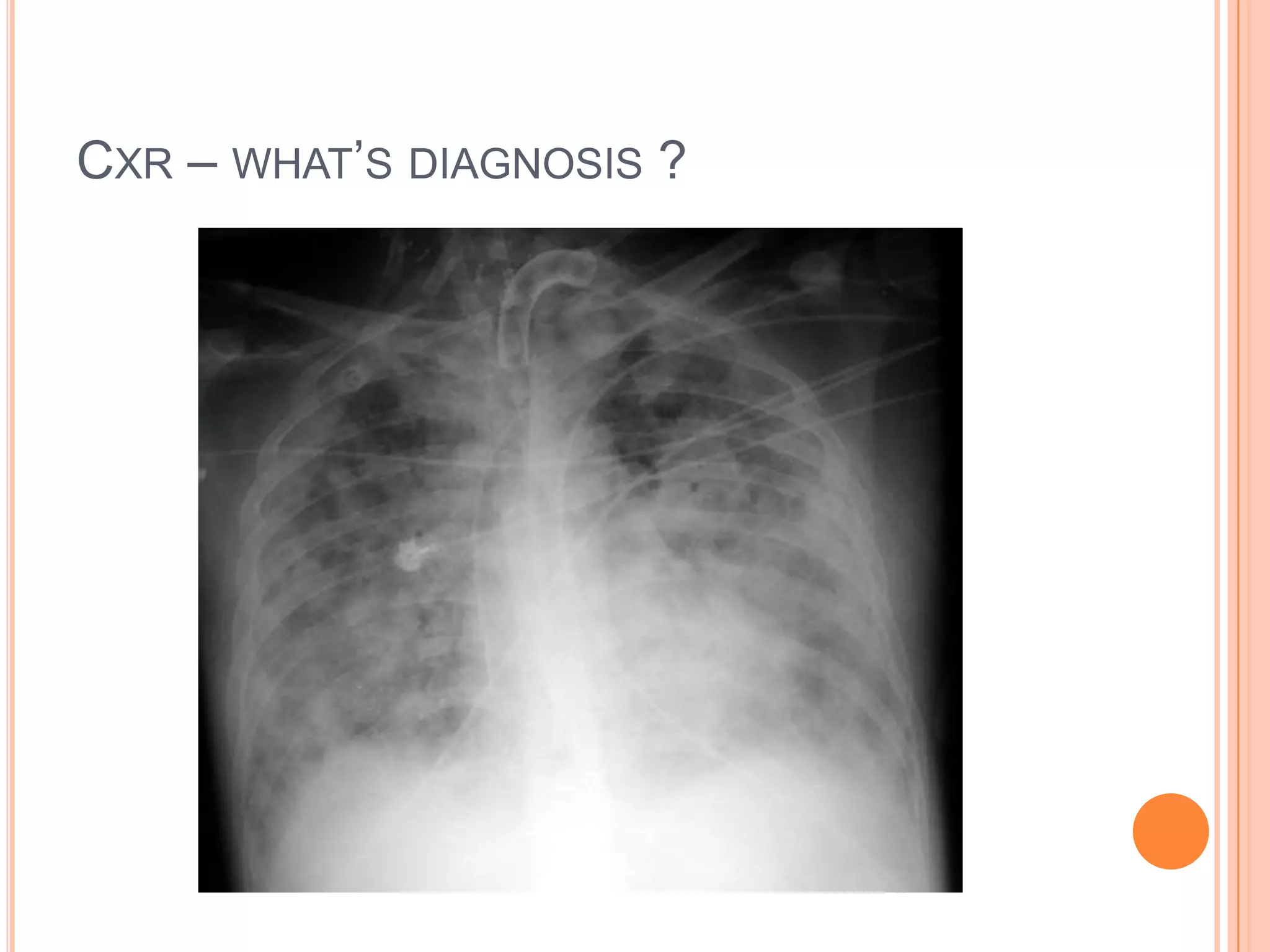
   35 yr old male met with an RTA was admitted in
    surgery icu developed severe tachpnoea,dyspnoea
     within 24hrs admission
     o/e-
         pulse- 110/mt,bp- 80/50mmHg
         pallor+ cyanosis + no jvp
         S1/S2- NL
         Chest b/l rales present in mid/lower area
         p/a- soft ,no HSM
    Abg analysis- O2 sat 50%,pao2-40%,pco2-45%
                     ph – 7.3
CXR – WHAT’S DIAGNOSIS ?
ARDS -DEFINITION
 ARDS is a clinical syndrome of dyspnea of rapid
  onset,hypoxemia and diffuse pulmonary infiltrates
  leading to respiratory failure.
 Inflammatory cells and proteinaceous fluid
  accumulate in the alveolar spaces leading to a
  decrease in diffusing capacity and hypoxemia.
ALI V/S ARDS

   ALI is the term used for patients with significant
    hypoxemia (PaO2/FiO2 ratio of ≤ 300)

   ARDS is the term used for a subset of ALI patients
    with severe hypoxemia (PaO2/FiO2 ratio of ≤ 200)
ARDS                           ALI

 Acute                         Acute
 PaO2/FiO2 < 200               < 300mmHg

 B/l interstitial /alveolar    Same
  infiltrates
 PCWP <18mmHg                    Same
ARDS DIAGNOSTIC CRITERIA

Acute Onset

Predisposing Condition

Bilateral Infiltrates

PaO2/FiO2 ≤ 200 mm Hg

Pulmonary capillary Wedge Pressure ≤ 18 mm Hg or
    no clinical evidence increase in LA pressure.
ARDS CAUSES
   Direct Lung Injury:
       a) Pneumonia
       b) pulmonary contusion
       c) near drowning
       d) inhalation injury
       f) aspiration of gastric contents
ARDS CAUSES
   Indirect lung injury
           a) sepsis
           b) severe trauma w/ shock,
              hypoperfusion
           c) acute pancreatitis
           d) transfusion of multp blood products
PATHOPHYSIOLOGY

 Diffuse alveolar damage
 Lung capillaries damage

 Inflammatory cells

 Alveolar edema

 Severe hypoxemia

 Decreased lung compliance & atelectasis

 Pulmonary hypertension
NATURAL HISTORY OF ARDS
   3 phases
               - exudative (0-7 d)

               - proliferative ( 7-21 d)

               - fibrotic ( > 21 days)
HISTOLOGIC FINDINGS
                                                          Hyaline Protein in air
                                                          spaces
                                                          Cellular Congestion

                                                          Typical histological
                                                           findings in ARDS
www.burnsurgery.com/.../pulmonary/part3/sec4.htm
                                                             alveolar inflammation,
                                                              thickened septal from protein
                                                              leak (pink), congestion and
                                                              decreased alveolar volume


                                                   ←Normal Lung Histology—large alveolar
                                                   volumes, septal spaces very thin, no
                                                   cellular congestion.
CLINICAL HISTORY
 Acute
 Critically ill

 Rapid –tachypnoea,dyspnoea,hypoxia

 Within in 12-48 hr of precipitating event

 Initial respiratory alkalosis

 Respiratory failure
LAB INVESTIGATIONS
 Routine blood counts
 RFT

 CXR

 ABG

 CT chest

 BNP

 2D Echo

 BAL

 PCWP
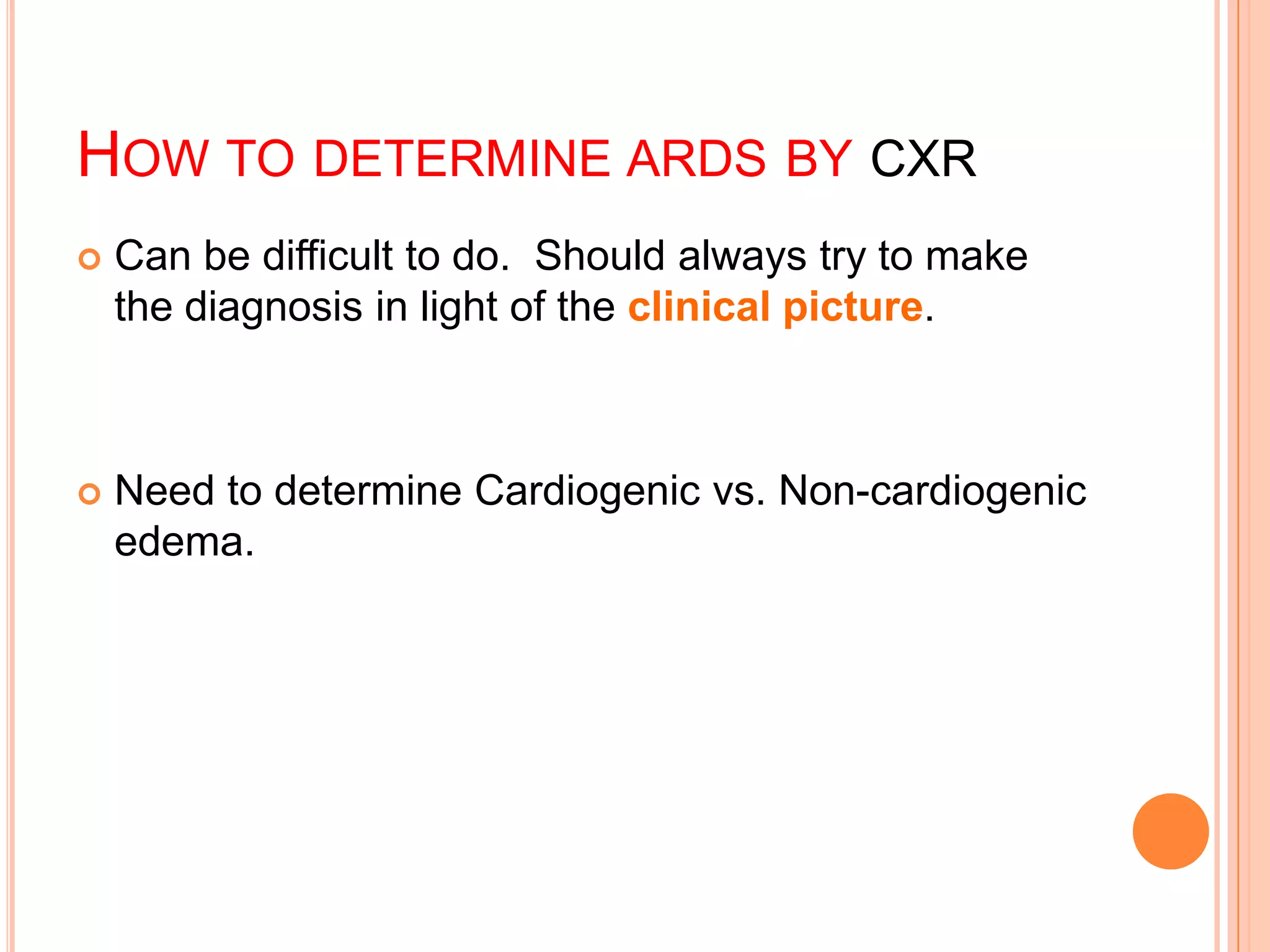
HOW TO DETERMINE ARDS BY CXR
   Can be difficult to do. Should always try to make
    the diagnosis in light of the clinical picture.


   Need to determine Cardiogenic vs. Non-cardiogenic
    edema.
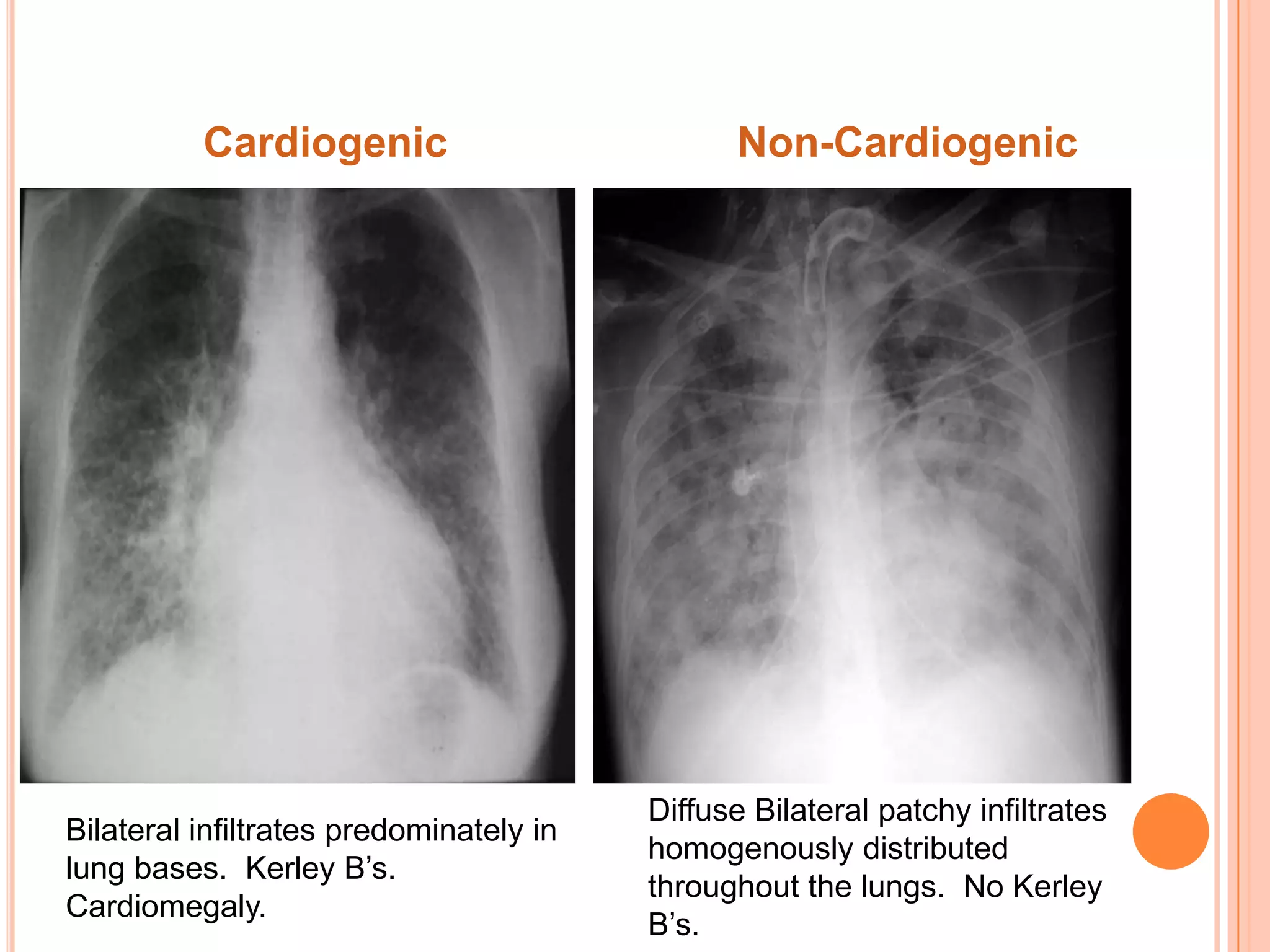
Cardiogenic                           Non-Cardiogenic


                                         Diffuse Bilateral patchy infiltrates
Bilateral infiltrates predominately in
                                         homogenously distributed
lung bases. Kerley B’s.
                                         throughout the lungs. No Kerley
Cardiomegaly.
                                         B’s.
CARDIOGENIC V/S NON CARDIOGENIC EDEMA

    cardiogenic                 Non-cardiogenic

 Patchy infiltrates in bases    Homogenous pluffy
 Effusions +                     shadows
 Kerley B lines +               Effusions –

 Cardiomegaly +                 Kerley B lines –

 Pulmonary vascular             Cardiomegaly –

  redistribuition                No pulm.vascular

 Excess fluid in alveoli         redistribuition
                                 Protein,inflammatory
                                  cells,fluid
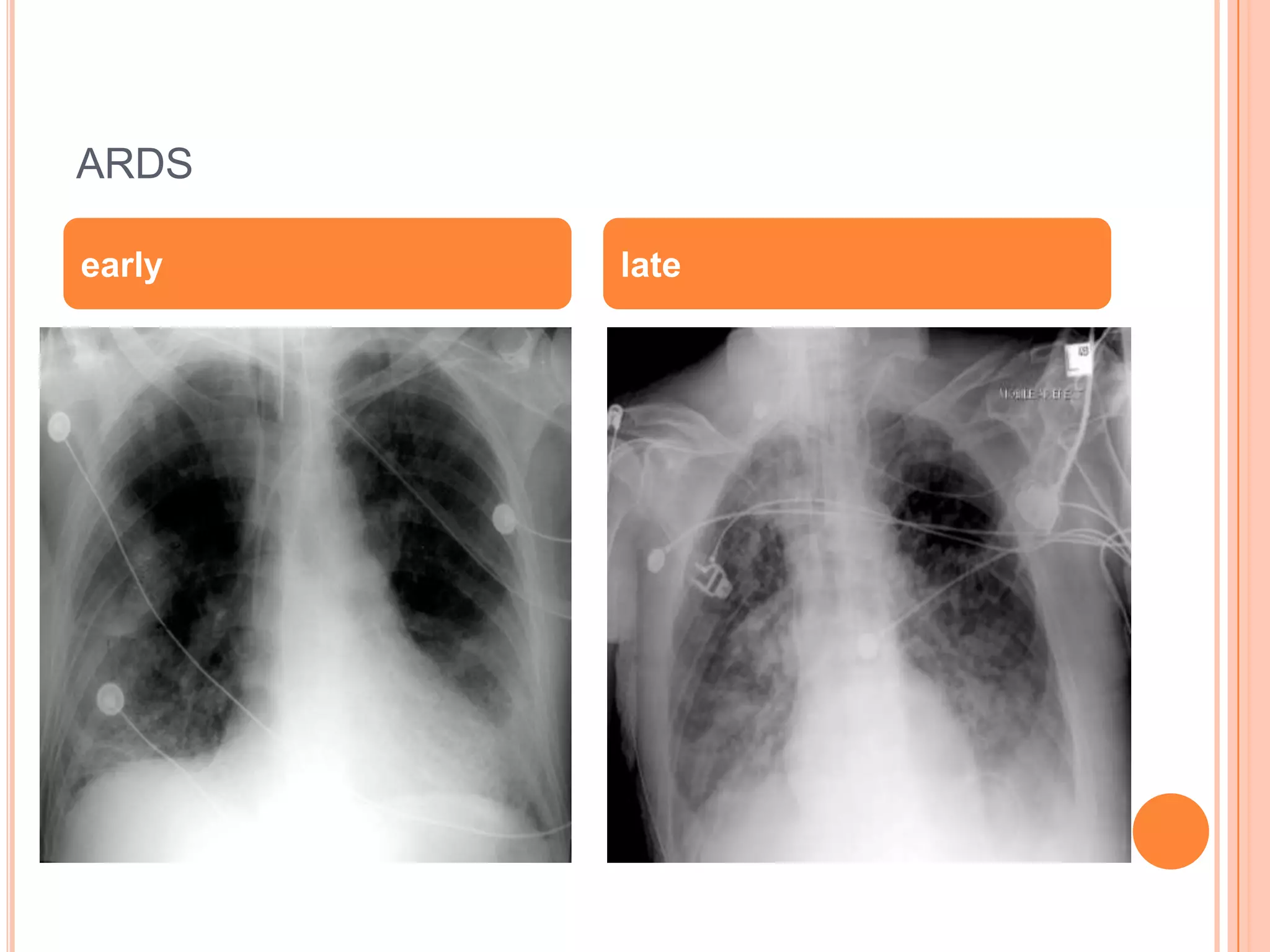
ARDS

early   late
Cardiogenic                         Non-Cardiogenic


                                    No septal thickening. Diffuse
Septal thickening. More severe in   alveolar infiltrates. Atelectasis
lung bases.                         of dependent lobes usually
                                    seen .
THERAPY- GOALS
 Treatment of underlying cause
 Cardio-pulmonary support

 Specific therapy targeted at lung injury

 Supportive therapy.
SPONTANEOUSLY BREATHING PATIENT
     In the early stages of ARDS the hypoxia may be
      corrected by 40 to 60% inspired oxygen .

     If the patient is well oxygenated on <= 60 % inspired
      oxygen and apparently stable without CO2 retention
      then ward monitoring may be feasible but close
      observation( 15 to 30 Min), continuous oximetry, and
      regular blood gases are required
INDICATION FOR MECHANICAL VENTILATION
   Inadequate oxygenation ( PaO2- < 60 with FiO2
    >=0.6)

   Rising or elevated PaCO2 ( > 50mmHg)

   Clinical signs of incipient respiratory failure
MECHANICAL VENTILATION


The Aims are to increase PaO2 while
minimizing the risk of further lung injury
(ventilator induced lung injury)
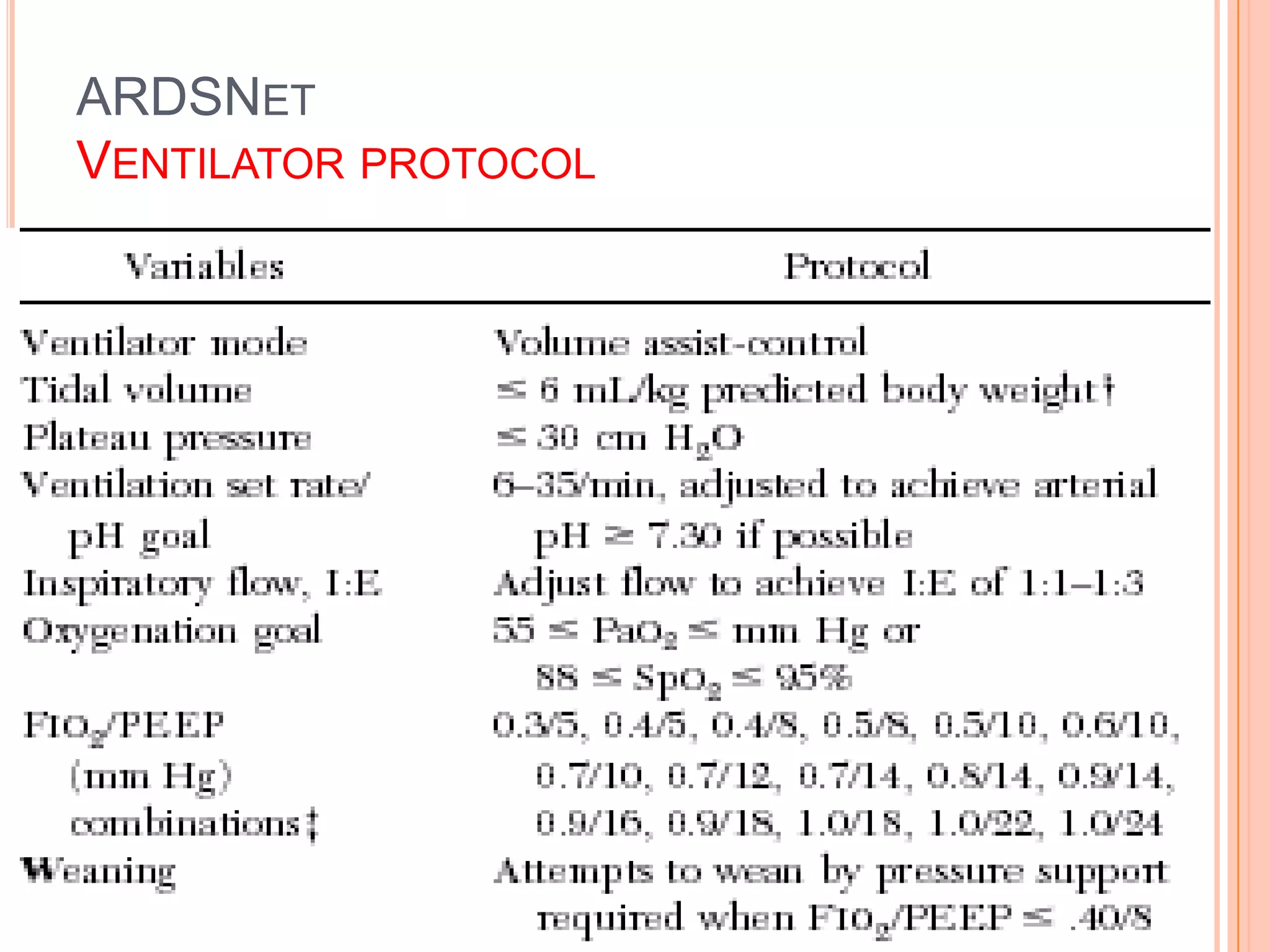
ARDSNET
VENTILATOR PROTOCOL
ARDS NET PROTOCOL -WEANING
 Spontaneous breathing trial daily
 PaO2/FiO2-<8/<.4 or <5/ <.5

 PaO2/FiO2 less than previous day

 Systolic BP > 90 without vasopressors

 No neuromuscular blockade

 2 hr trial- with T piece with 1-5cm water CPAP.

 ABG,RR,SPO2 monitoring

 If tolerated for 30 mt,consider extubation
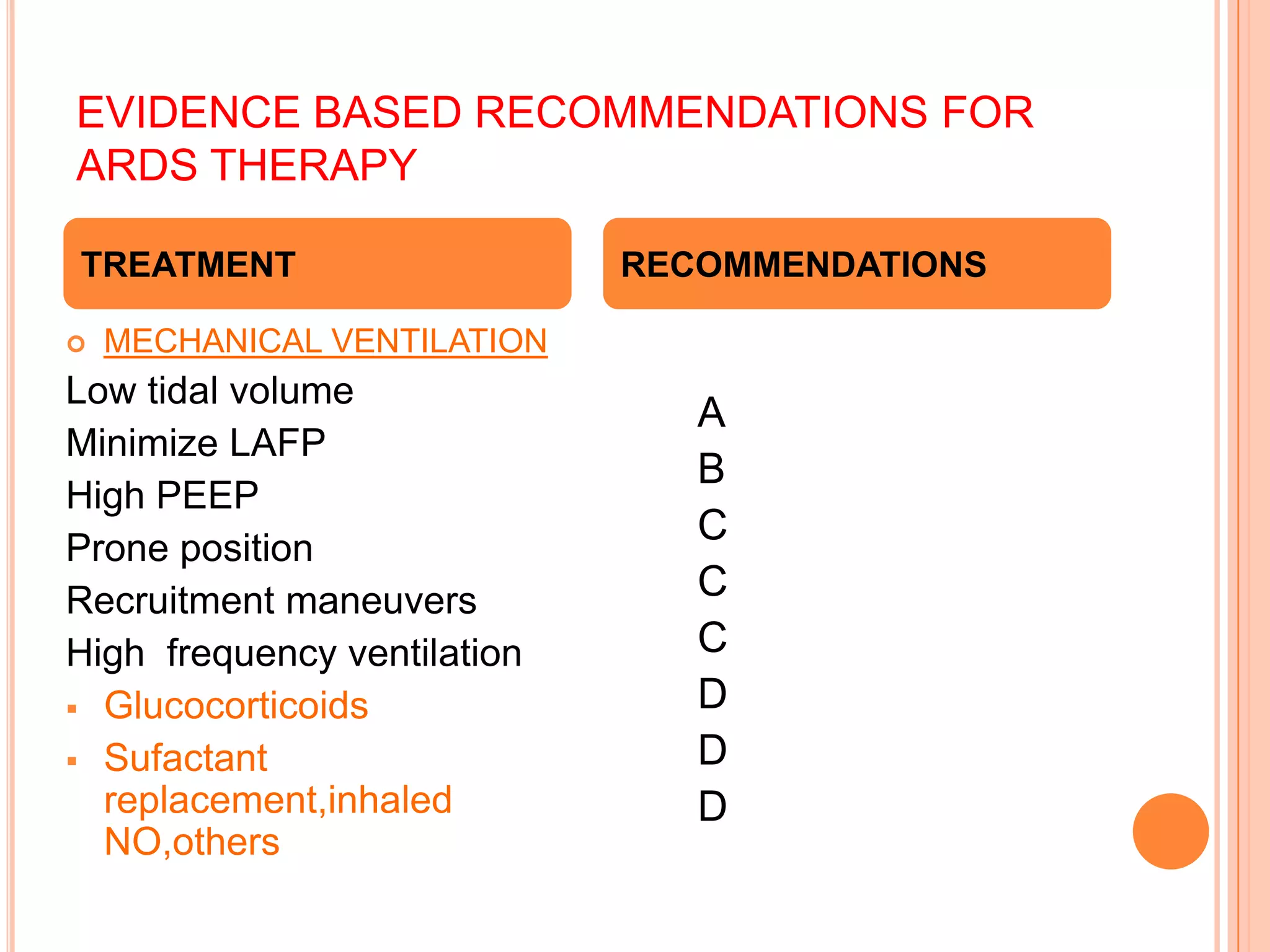
EVIDENCE BASED RECOMMENDATIONS FOR
ARDS THERAPY

TREATMENT                    RECOMMENDATIONS

   MECHANICAL VENTILATION
Low tidal volume
                                A
Minimize LAFP
                                B
High PEEP
                                C
Prone position
Recruitment maneuvers           C
High frequency ventilation      C
 Glucocorticoids               D
 Sufactant                     D
  replacement,inhaled           D
  NO,others
MANAGEMENT: REDUCING VENTILATOR-
INDUCED LUNG INJURY
 Low   tidal volume mechanical ventilation
    In ARDS there is a large amount of poorly compliant
     (i.e. non-ventilating) lung and a small amount of
     healthy, compliant lung tissue. Large tidal volume
     ventilation can lead to over-inflation of the healthy
     lung tissue resulting in ventilator-induced lung injury
     of that healthy tissue.
 PEEP
    Setting a PEEP prevents further lung injury due to
     shear forces by keeping airways patent during
     expiration
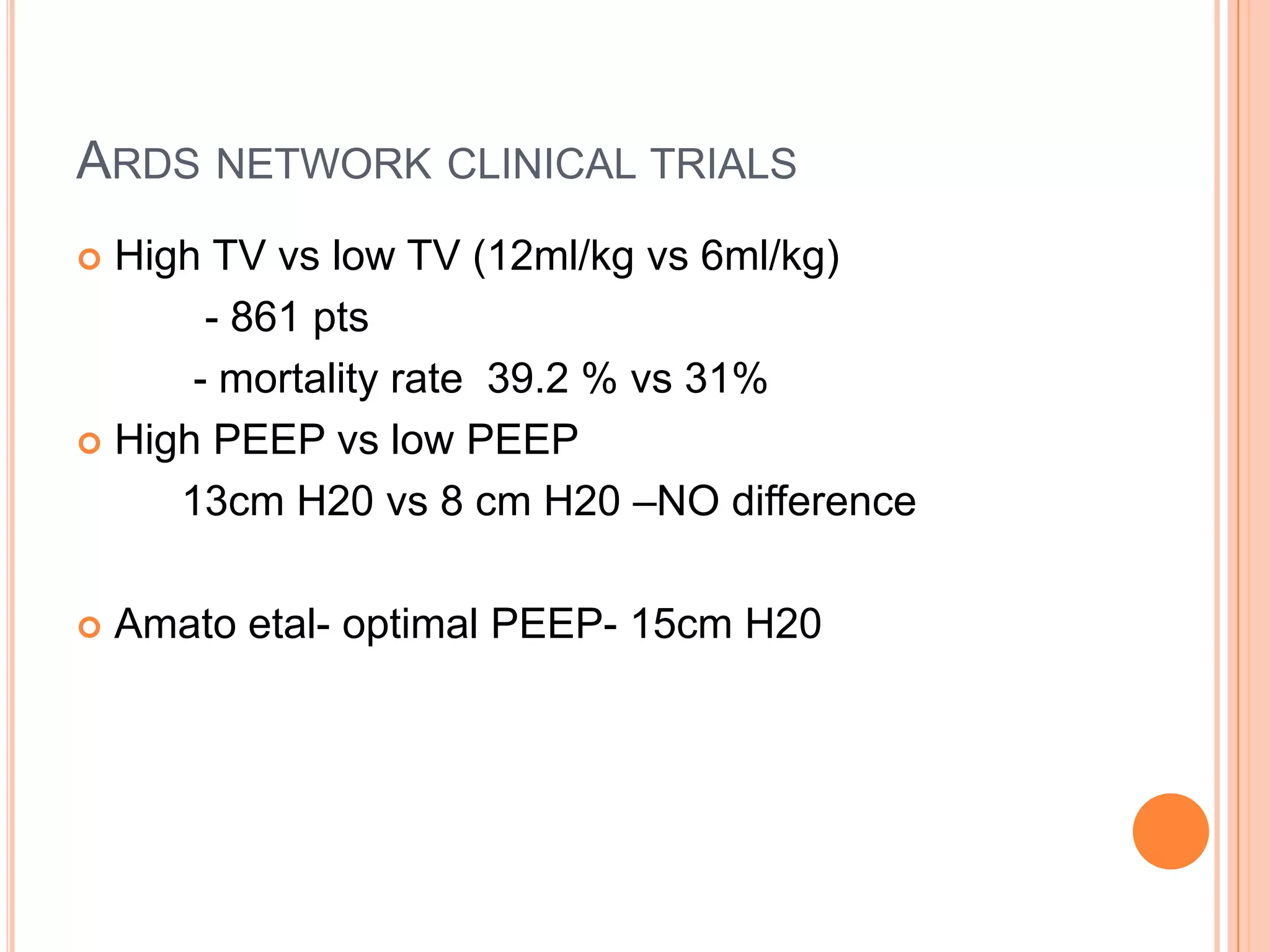
ARDS NETWORK CLINICAL TRIALS
 High TV vs low TV (12ml/kg vs 6ml/kg)
       - 861 pts
      - mortality rate 39.2 % vs 31%
 High PEEP vs low PEEP

     13cm H20 vs 8 cm H20 –NO difference

   Amato etal- optimal PEEP- 15cm H20
 Inverse ratio ventilation
              - reduce peak airway pressure
              - I: E – 1:1 & 4:1
              - severe hypoxemic resp.failure
 Permissive hypercapnea

              - controlled hypoventilation
              - PaCO2 upto 55mmhg
              - pH upto 7.25
 Proning
OTHER METHODS

 High flow ventilation
 ECMO

 Partial fluid ventilation (PLV)
EXTRA CORPOREAL MEMBRANE OXYGENATION
(ECMO)
MANAGEMENT

   Fluids –
               - conservative management
               - normal or low LAFP
               - reduce icu stay,duration of ventilation

   Steroids
               - Meduri et al study
               - methyprednisolone-2mg/kg
                 & taper to .5-1mg/kg in 1-2wk
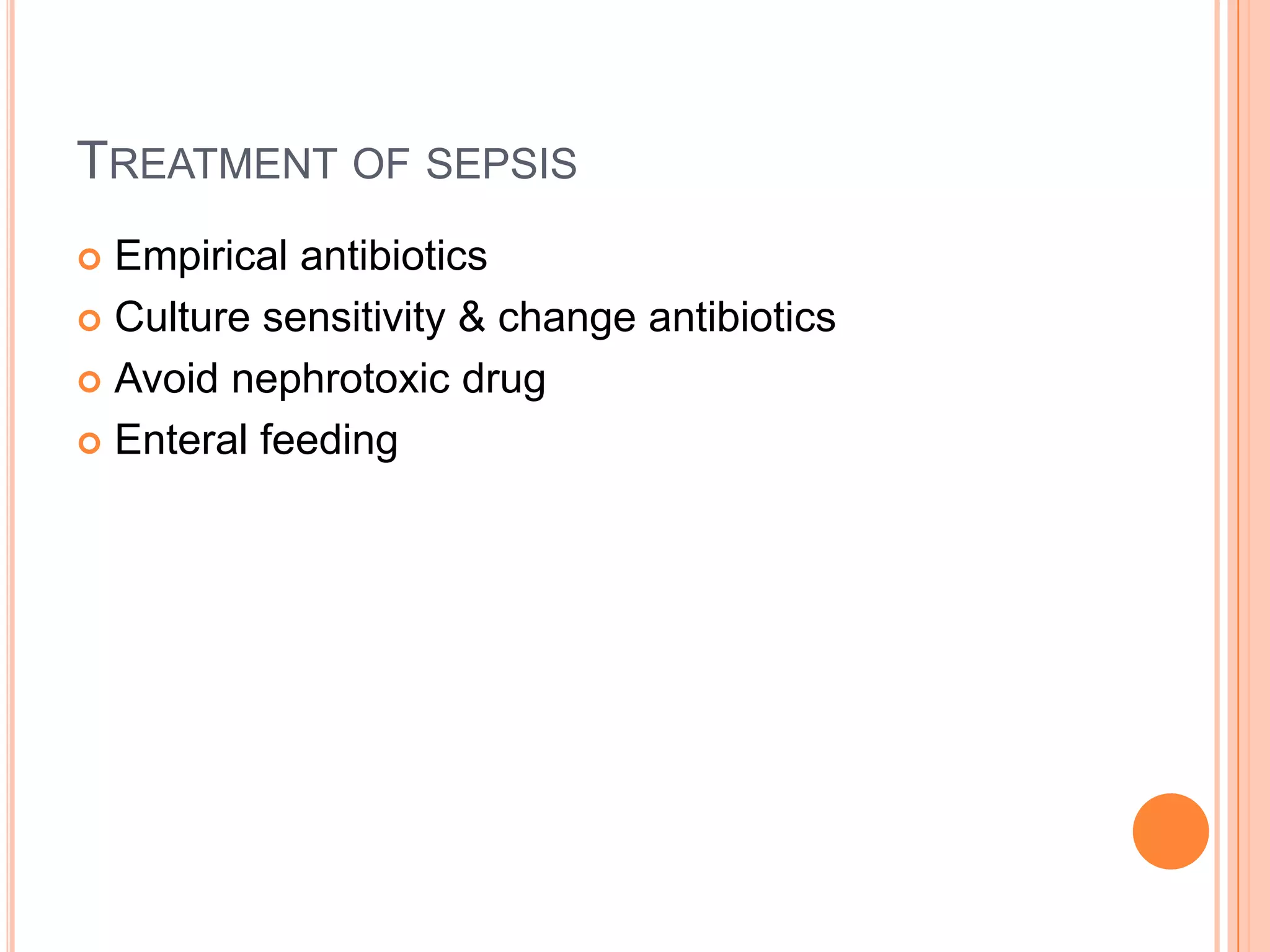
TREATMENT OF SEPSIS
 Empirical antibiotics
 Culture sensitivity & change antibiotics

 Avoid nephrotoxic drug

 Enteral feeding
OTHER TREATMENT MODALITIES
 NO
 Ketoconazole

 Albuterol

 Pentoxyphylline

 NSAIDS

 N-acetyl cysteine
PROGNOSIS

 Mortality ranges-26 %-44%
 Risk factors-

               - advanced age
               - CKD,CLD
               - Chronic immunosuppression
               - chronic alcohol abuse
 ARDS from direct lung injury has double mortality
REFERENCES

 Harrison’s text book of medicine-18th edition
 ARDS Network clinical trials

    - www.ardsnet.org
 ARDS Foundation

   - www.ardsusa.org
THANK U….

Acute respiratory distress syndrome (ards)

  • 1.
    ACUTE RESPIRATORY DISTRESS SYNDROME(ARDS) GUIDE - DR.SHIV.S.SHARMA - DR.Y. JAMRA CANDIDATE-DR.SARATH MENON.R Intensive care unit,Dept.Internal Medicine MGM MEDICAL COLLEGE & M Y HOSPITAL,INDORE
  • 2.
    OUTLINE  Definition  Clinicalhistory  Pathophysiology  Diagnosis  Management
  • 3.
    CASE  35 yr old male met with an RTA was admitted in surgery icu developed severe tachpnoea,dyspnoea within 24hrs admission o/e- pulse- 110/mt,bp- 80/50mmHg pallor+ cyanosis + no jvp S1/S2- NL Chest b/l rales present in mid/lower area p/a- soft ,no HSM Abg analysis- O2 sat 50%,pao2-40%,pco2-45% ph – 7.3
  • 4.
    CXR – WHAT’SDIAGNOSIS ?
  • 5.
    ARDS -DEFINITION  ARDSis a clinical syndrome of dyspnea of rapid onset,hypoxemia and diffuse pulmonary infiltrates leading to respiratory failure.  Inflammatory cells and proteinaceous fluid accumulate in the alveolar spaces leading to a decrease in diffusing capacity and hypoxemia.
  • 6.
    ALI V/S ARDS  ALI is the term used for patients with significant hypoxemia (PaO2/FiO2 ratio of ≤ 300)  ARDS is the term used for a subset of ALI patients with severe hypoxemia (PaO2/FiO2 ratio of ≤ 200)
  • 7.
    ARDS ALI  Acute  Acute  PaO2/FiO2 < 200  < 300mmHg  B/l interstitial /alveolar  Same infiltrates  PCWP <18mmHg  Same
  • 8.
    ARDS DIAGNOSTIC CRITERIA AcuteOnset Predisposing Condition Bilateral Infiltrates PaO2/FiO2 ≤ 200 mm Hg Pulmonary capillary Wedge Pressure ≤ 18 mm Hg or no clinical evidence increase in LA pressure.
  • 9.
    ARDS CAUSES  Direct Lung Injury: a) Pneumonia b) pulmonary contusion c) near drowning d) inhalation injury f) aspiration of gastric contents
  • 10.
    ARDS CAUSES  Indirect lung injury a) sepsis b) severe trauma w/ shock, hypoperfusion c) acute pancreatitis d) transfusion of multp blood products
  • 11.
    PATHOPHYSIOLOGY  Diffuse alveolardamage  Lung capillaries damage  Inflammatory cells  Alveolar edema  Severe hypoxemia  Decreased lung compliance & atelectasis  Pulmonary hypertension
  • 12.
    NATURAL HISTORY OFARDS  3 phases - exudative (0-7 d) - proliferative ( 7-21 d) - fibrotic ( > 21 days)
  • 15.
    HISTOLOGIC FINDINGS Hyaline Protein in air spaces Cellular Congestion  Typical histological findings in ARDS www.burnsurgery.com/.../pulmonary/part3/sec4.htm  alveolar inflammation, thickened septal from protein leak (pink), congestion and decreased alveolar volume ←Normal Lung Histology—large alveolar volumes, septal spaces very thin, no cellular congestion.
  • 16.
    CLINICAL HISTORY  Acute Critically ill  Rapid –tachypnoea,dyspnoea,hypoxia  Within in 12-48 hr of precipitating event  Initial respiratory alkalosis  Respiratory failure
  • 17.
    LAB INVESTIGATIONS  Routineblood counts  RFT  CXR  ABG  CT chest  BNP  2D Echo  BAL  PCWP
  • 18.
    HOW TO DETERMINEARDS BY CXR  Can be difficult to do. Should always try to make the diagnosis in light of the clinical picture.  Need to determine Cardiogenic vs. Non-cardiogenic edema.
  • 19.
    Cardiogenic Non-Cardiogenic Diffuse Bilateral patchy infiltrates Bilateral infiltrates predominately in homogenously distributed lung bases. Kerley B’s. throughout the lungs. No Kerley Cardiomegaly. B’s.
  • 20.
    CARDIOGENIC V/S NONCARDIOGENIC EDEMA cardiogenic Non-cardiogenic  Patchy infiltrates in bases  Homogenous pluffy  Effusions + shadows  Kerley B lines +  Effusions –  Cardiomegaly +  Kerley B lines –  Pulmonary vascular  Cardiomegaly – redistribuition  No pulm.vascular  Excess fluid in alveoli redistribuition  Protein,inflammatory cells,fluid
  • 21.
  • 22.
    Cardiogenic Non-Cardiogenic No septal thickening. Diffuse Septal thickening. More severe in alveolar infiltrates. Atelectasis lung bases. of dependent lobes usually seen .
  • 23.
    THERAPY- GOALS  Treatmentof underlying cause  Cardio-pulmonary support  Specific therapy targeted at lung injury  Supportive therapy.
  • 24.
    SPONTANEOUSLY BREATHING PATIENT  In the early stages of ARDS the hypoxia may be corrected by 40 to 60% inspired oxygen .  If the patient is well oxygenated on <= 60 % inspired oxygen and apparently stable without CO2 retention then ward monitoring may be feasible but close observation( 15 to 30 Min), continuous oximetry, and regular blood gases are required
  • 25.
    INDICATION FOR MECHANICALVENTILATION  Inadequate oxygenation ( PaO2- < 60 with FiO2 >=0.6)  Rising or elevated PaCO2 ( > 50mmHg)  Clinical signs of incipient respiratory failure
  • 26.
    MECHANICAL VENTILATION The Aimsare to increase PaO2 while minimizing the risk of further lung injury (ventilator induced lung injury)
  • 27.
  • 28.
    ARDS NET PROTOCOL-WEANING  Spontaneous breathing trial daily  PaO2/FiO2-<8/<.4 or <5/ <.5  PaO2/FiO2 less than previous day  Systolic BP > 90 without vasopressors  No neuromuscular blockade  2 hr trial- with T piece with 1-5cm water CPAP.  ABG,RR,SPO2 monitoring  If tolerated for 30 mt,consider extubation
  • 29.
    EVIDENCE BASED RECOMMENDATIONSFOR ARDS THERAPY TREATMENT RECOMMENDATIONS  MECHANICAL VENTILATION Low tidal volume A Minimize LAFP B High PEEP C Prone position Recruitment maneuvers C High frequency ventilation C  Glucocorticoids D  Sufactant D replacement,inhaled D NO,others
  • 30.
    MANAGEMENT: REDUCING VENTILATOR- INDUCEDLUNG INJURY  Low tidal volume mechanical ventilation  In ARDS there is a large amount of poorly compliant (i.e. non-ventilating) lung and a small amount of healthy, compliant lung tissue. Large tidal volume ventilation can lead to over-inflation of the healthy lung tissue resulting in ventilator-induced lung injury of that healthy tissue.  PEEP  Setting a PEEP prevents further lung injury due to shear forces by keeping airways patent during expiration
  • 31.
    ARDS NETWORK CLINICALTRIALS  High TV vs low TV (12ml/kg vs 6ml/kg) - 861 pts - mortality rate 39.2 % vs 31%  High PEEP vs low PEEP 13cm H20 vs 8 cm H20 –NO difference  Amato etal- optimal PEEP- 15cm H20
  • 32.
     Inverse ratioventilation - reduce peak airway pressure - I: E – 1:1 & 4:1 - severe hypoxemic resp.failure  Permissive hypercapnea - controlled hypoventilation - PaCO2 upto 55mmhg - pH upto 7.25  Proning
  • 33.
    OTHER METHODS  Highflow ventilation  ECMO  Partial fluid ventilation (PLV)
  • 34.
    EXTRA CORPOREAL MEMBRANEOXYGENATION (ECMO)
  • 35.
    MANAGEMENT  Fluids – - conservative management - normal or low LAFP - reduce icu stay,duration of ventilation  Steroids - Meduri et al study - methyprednisolone-2mg/kg & taper to .5-1mg/kg in 1-2wk
  • 36.
    TREATMENT OF SEPSIS Empirical antibiotics  Culture sensitivity & change antibiotics  Avoid nephrotoxic drug  Enteral feeding
  • 37.
    OTHER TREATMENT MODALITIES NO  Ketoconazole  Albuterol  Pentoxyphylline  NSAIDS  N-acetyl cysteine
  • 38.
    PROGNOSIS  Mortality ranges-26%-44%  Risk factors- - advanced age - CKD,CLD - Chronic immunosuppression - chronic alcohol abuse  ARDS from direct lung injury has double mortality
  • 39.
    REFERENCES  Harrison’s textbook of medicine-18th edition  ARDS Network clinical trials - www.ardsnet.org  ARDS Foundation - www.ardsusa.org
  • 40.