DISASTER
VULNERABILITY, RISK
AND CAPACITY
DEFINITION, CONCEPT & RELATIONSHIP
Md. Inzamul Haque Sazal
sazalgeo@outlook.com
WHAT IS VULNERABILITY ?
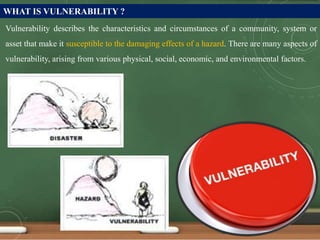
Vulnerability describes the characteristics and circumstances of a community, system or
asset that make it susceptible to the damaging effects of a hazard. There are many aspects of
vulnerability, arising from various physical, social, economic, and environmental factors.
WHAT IS VULNERABILITY ?
According to UNESCO/UNDRO (1982) Definitions of Hazard & Risk
Terminology-
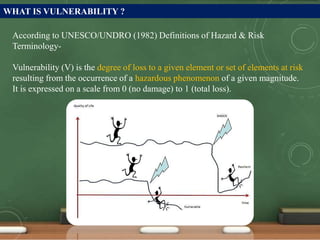
Vulnerability (V) is the degree of loss to a given element or set of elements at risk
resulting from the occurrence of a hazardous phenomenon of a given magnitude.
It is expressed on a scale from 0 (no damage) to 1 (total loss).
KEY CONCEPT OF VULNERABILITY ?
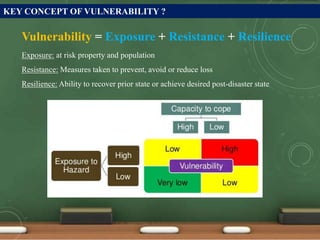
Vulnerability = Exposure + Resistance + Resilience
Exposure: at risk property and population
Resistance: Measures taken to prevent, avoid or reduce loss
Resilience: Ability to recover prior state or achieve desired post-disaster state
EXAMPLE OF VULNERABILITY ?
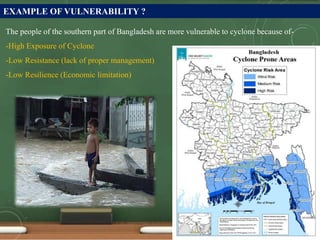
The people of the southern part of Bangladesh are more vulnerable to cyclone because of-
-High Exposure of Cyclone
-Low Resistance (lack of proper management)
-Low Resilience (Economic limitation)
TYPES OR SECTORS OF VULNERABILITY ?
There are four (4) main types of vulnerability:
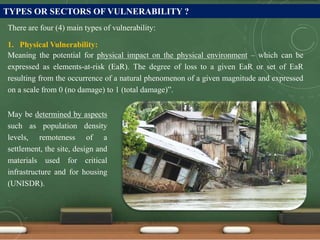
1. Physical Vulnerability:
Meaning the potential for physical impact on the physical environment – which can be
expressed as elements-at-risk (EaR). The degree of loss to a given EaR or set of EaR
resulting from the occurrence of a natural phenomenon of a given magnitude and expressed
on a scale from 0 (no damage) to 1 (total damage)”.
May be determined by aspects
such as population density
levels, remoteness of a
settlement, the site, design and
materials used for critical
infrastructure and for housing
(UNISDR).
TYPES OR SECTORS OF VULNERABILITY ?
2. Economic Vulnerability:
the potential impacts of hazards on economic assets and processes (i.e. business interruption,
secondary effects such as increased poverty and job loss) Vulnerability of different economic
sectors.
The poor are usually more vulnerable to disasters because they lack the resources to build sturdy
structures and put other engineering measures in place to protect themselves from being
negatively impacted by disasters.
3. Social Vulnerability:
refers to the inability of people, organizations and societies to withstand adverse impacts to
hazards due to characteristics inherent in social interactions, institutions and systems of cultural
values. It includes aspects related to levels of literacy and education, the existence of peace and
security, access to basic human rights, systems of good governance, social equity, positive
traditional values, customs and ideological beliefs and overall collective organizational systems
(UNISDR).
Example- When flooding occurs some citizens, such as children, elderly and differently-able,
may be unable to protect themselves or evacuate if necessary.
TYPES OR SECTORS OF VULNERABILITY ?
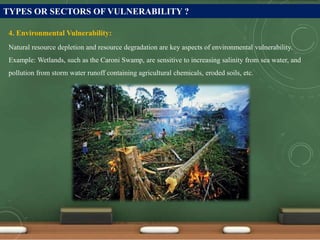
4. Environmental Vulnerability:
Natural resource depletion and resource degradation are key aspects of environmental vulnerability.
Example: Wetlands, such as the Caroni Swamp, are sensitive to increasing salinity from sea water, and
pollution from storm water runoff containing agricultural chemicals, eroded soils, etc.
WHAT IS RISK ?
The probability that a community’s structure or
geographic area is to be damaged or disrupted by the
impact of a particular hazard, on account of their
nature, construction, and proximity to a hazardous
area.
Risk is a function of threats exploiting
vulnerabilities to obtain, damage or destroy assets.
Thus, threats (actual, conceptual, or inherent) may
exist, but if there are no vulnerabilities then there is
little/no risk.
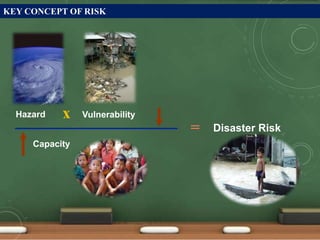
KEY CONCEPT OF RISK
Hazard Vulnerabilityx
Disaster Risk
Capacity
=
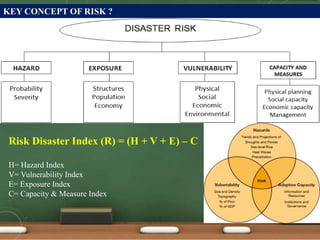
KEY CONCEPT OF RISK ?
Risk Disaster Index (R) = (H + V + E) – C
H= Hazard Index
V= Vulnerability Index
E= Exposure Index
C= Capacity & Measure Index
SMAUG MODEL- a basis for prioritizing hazard risks
The SMAUG model provides an effective means of prioritizing hazard risks based upon the
aforementioned criteria. SMAUG stands for Seriousness, Manageability, Acceptability, Urgency and
Growth are the criteria used for prioritization of hazard risks.
Seriousness can be defined as "The relative impact in terms of people and dollars." This includes the
potential for lives to be lost and potential for injury as well as the physical, social and as mentioned,
economic losses that may be incurred
Manageability can be defined as "the relative ability to mitigate or reduce the hazard (through
managing the hazard, or the community or both)".
Acceptability - The degree to which the risk of hazard is acceptable in terms of political,
environmental, social and economic impact
Urgency - This is related to the probability of risk of hazard and is defined in terms of how imperative
it is to address the hazard
Growth - This is the potential for the hazard or event to expand or increase in either probability or risk
to community or both. Should vulnerability increase, potential for growth may also increase.
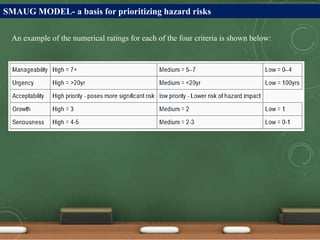
An example of the numerical ratings for each of the four criteria is shown below:
SMAUG MODEL- a basis for prioritizing hazard risks
WHAT IS Coping Capacity ?
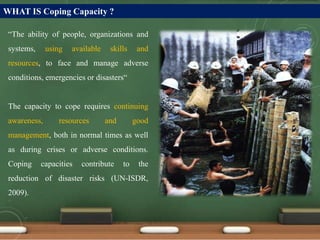
“The ability of people, organizations and
systems, using available skills and
resources, to face and manage adverse
conditions, emergencies or disasters“
The capacity to cope requires continuing
awareness, resources and good
management, both in normal times as well
as during crises or adverse conditions.
Coping capacities contribute to the
reduction of disaster risks (UN-ISDR,
2009).
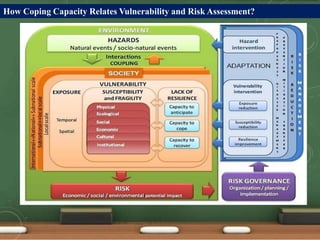
How Coping Capacity Relates Vulnerability and Risk Assessment?
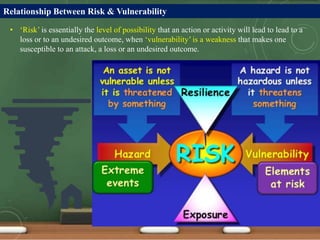
Relationship Between Risk & Vulnerability
• ‘Risk’ is essentially the level of possibility that an action or activity will lead to lead to a
loss or to an undesired outcome, when ‘vulnerability’ is a weakness that makes one
susceptible to an attack, a loss or an undesired outcome.
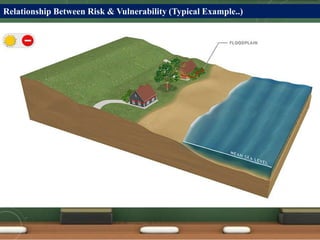
Relationship Between Risk & Vulnerability (Typical Example..)
Disaster vulnerability, risk and capacity

Disaster vulnerability, risk and capacity

  • 1.
    DISASTER VULNERABILITY, RISK AND CAPACITY DEFINITION,CONCEPT & RELATIONSHIP Md. Inzamul Haque Sazal sazalgeo@outlook.com
  • 2.
    WHAT IS VULNERABILITY? Vulnerability describes the characteristics and circumstances of a community, system or asset that make it susceptible to the damaging effects of a hazard. There are many aspects of vulnerability, arising from various physical, social, economic, and environmental factors.
  • 3.
    WHAT IS VULNERABILITY? According to UNESCO/UNDRO (1982) Definitions of Hazard & Risk Terminology- Vulnerability (V) is the degree of loss to a given element or set of elements at risk resulting from the occurrence of a hazardous phenomenon of a given magnitude. It is expressed on a scale from 0 (no damage) to 1 (total loss).
  • 4.
    KEY CONCEPT OFVULNERABILITY ? Vulnerability = Exposure + Resistance + Resilience Exposure: at risk property and population Resistance: Measures taken to prevent, avoid or reduce loss Resilience: Ability to recover prior state or achieve desired post-disaster state
  • 5.
    EXAMPLE OF VULNERABILITY? The people of the southern part of Bangladesh are more vulnerable to cyclone because of- -High Exposure of Cyclone -Low Resistance (lack of proper management) -Low Resilience (Economic limitation)
  • 6.
    TYPES OR SECTORSOF VULNERABILITY ? There are four (4) main types of vulnerability: 1. Physical Vulnerability: Meaning the potential for physical impact on the physical environment – which can be expressed as elements-at-risk (EaR). The degree of loss to a given EaR or set of EaR resulting from the occurrence of a natural phenomenon of a given magnitude and expressed on a scale from 0 (no damage) to 1 (total damage)”. May be determined by aspects such as population density levels, remoteness of a settlement, the site, design and materials used for critical infrastructure and for housing (UNISDR).
  • 7.
    TYPES OR SECTORSOF VULNERABILITY ? 2. Economic Vulnerability: the potential impacts of hazards on economic assets and processes (i.e. business interruption, secondary effects such as increased poverty and job loss) Vulnerability of different economic sectors. The poor are usually more vulnerable to disasters because they lack the resources to build sturdy structures and put other engineering measures in place to protect themselves from being negatively impacted by disasters. 3. Social Vulnerability: refers to the inability of people, organizations and societies to withstand adverse impacts to hazards due to characteristics inherent in social interactions, institutions and systems of cultural values. It includes aspects related to levels of literacy and education, the existence of peace and security, access to basic human rights, systems of good governance, social equity, positive traditional values, customs and ideological beliefs and overall collective organizational systems (UNISDR). Example- When flooding occurs some citizens, such as children, elderly and differently-able, may be unable to protect themselves or evacuate if necessary.
  • 8.
    TYPES OR SECTORSOF VULNERABILITY ? 4. Environmental Vulnerability: Natural resource depletion and resource degradation are key aspects of environmental vulnerability. Example: Wetlands, such as the Caroni Swamp, are sensitive to increasing salinity from sea water, and pollution from storm water runoff containing agricultural chemicals, eroded soils, etc.
  • 9.
    WHAT IS RISK? The probability that a community’s structure or geographic area is to be damaged or disrupted by the impact of a particular hazard, on account of their nature, construction, and proximity to a hazardous area. Risk is a function of threats exploiting vulnerabilities to obtain, damage or destroy assets. Thus, threats (actual, conceptual, or inherent) may exist, but if there are no vulnerabilities then there is little/no risk.
  • 10.
    KEY CONCEPT OFRISK Hazard Vulnerabilityx Disaster Risk Capacity =
  • 11.
    KEY CONCEPT OFRISK ? Risk Disaster Index (R) = (H + V + E) – C H= Hazard Index V= Vulnerability Index E= Exposure Index C= Capacity & Measure Index
  • 12.
    SMAUG MODEL- abasis for prioritizing hazard risks The SMAUG model provides an effective means of prioritizing hazard risks based upon the aforementioned criteria. SMAUG stands for Seriousness, Manageability, Acceptability, Urgency and Growth are the criteria used for prioritization of hazard risks. Seriousness can be defined as "The relative impact in terms of people and dollars." This includes the potential for lives to be lost and potential for injury as well as the physical, social and as mentioned, economic losses that may be incurred Manageability can be defined as "the relative ability to mitigate or reduce the hazard (through managing the hazard, or the community or both)". Acceptability - The degree to which the risk of hazard is acceptable in terms of political, environmental, social and economic impact Urgency - This is related to the probability of risk of hazard and is defined in terms of how imperative it is to address the hazard Growth - This is the potential for the hazard or event to expand or increase in either probability or risk to community or both. Should vulnerability increase, potential for growth may also increase.
  • 13.
    An example ofthe numerical ratings for each of the four criteria is shown below: SMAUG MODEL- a basis for prioritizing hazard risks
  • 14.
    WHAT IS CopingCapacity ? “The ability of people, organizations and systems, using available skills and resources, to face and manage adverse conditions, emergencies or disasters“ The capacity to cope requires continuing awareness, resources and good management, both in normal times as well as during crises or adverse conditions. Coping capacities contribute to the reduction of disaster risks (UN-ISDR, 2009).
  • 15.
    How Coping CapacityRelates Vulnerability and Risk Assessment?
  • 16.
    Relationship Between Risk& Vulnerability • ‘Risk’ is essentially the level of possibility that an action or activity will lead to lead to a loss or to an undesired outcome, when ‘vulnerability’ is a weakness that makes one susceptible to an attack, a loss or an undesired outcome.
  • 17.
    Relationship Between Risk& Vulnerability (Typical Example..)