Watershed
Concept, Delineation,
Management
Md. Inzamul Haque
mihaque.iu@gmail.com
Basic Concept of Watershed
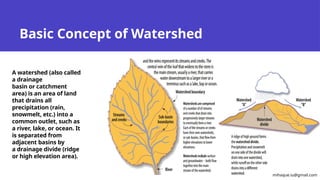
A watershed (also called
a drainage
basin or catchment
area) is an area of land
that drains all
precipitation (rain,
snowmelt, etc.) into a
common outlet, such as
a river, lake, or ocean. It
is separated from
adjacent basins by
a drainage divide (ridge
or high elevation area).
mihaque.iu@gmail.com
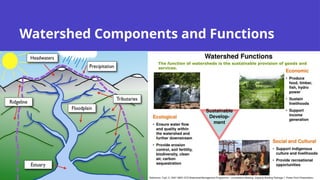
Watershed Components and Functions
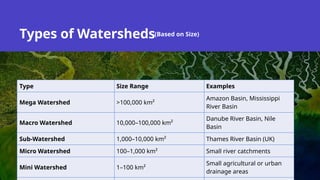
Types of Watersheds
Type Size Range Examples
Mega Watershed >100,000 km²
Amazon Basin, Mississippi
River Basin
Macro Watershed 10,000–100,000 km²
Danube River Basin, Nile
Basin
Sub-Watershed 1,000–10,000 km² Thames River Basin (UK)
Micro Watershed 100–1,000 km² Small river catchments
Mini Watershed 1–100 km²
Small agricultural or urban
drainage areas
(Based on Size)
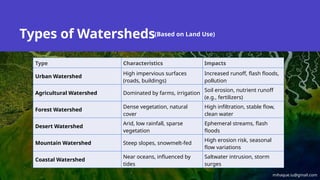
Types of Watersheds(Based on Land Use)
Type Characteristics Impacts
Urban Watershed
High impervious surfaces
(roads, buildings)
Increased runoff, flash floods,
pollution
Agricultural Watershed Dominated by farms, irrigation
Soil erosion, nutrient runoff
(e.g., fertilizers)
Forest Watershed
Dense vegetation, natural
cover
High infiltration, stable flow,
clean water
Desert Watershed
Arid, low rainfall, sparse
vegetation
Ephemeral streams, flash
floods
Mountain Watershed Steep slopes, snowmelt-fed
High erosion risk, seasonal
flow variations
Coastal Watershed
Near oceans, influenced by
tides
Saltwater intrusion, storm
surges
mihaque.iu@gmail.com
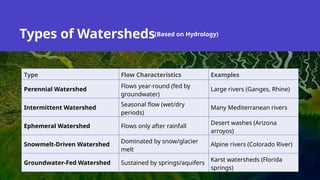
Types of Watersheds(Based on Hydrology)
Type Flow Characteristics Examples
Perennial Watershed
Flows year-round (fed by
groundwater)
Large rivers (Ganges, Rhine)
Intermittent Watershed
Seasonal flow (wet/dry
periods)
Many Mediterranean rivers
Ephemeral Watershed Flows only after rainfall
Desert washes (Arizona
arroyos)
Snowmelt-Driven Watershed
Dominated by snow/glacier
melt
Alpine rivers (Colorado River)
Groundwater-Fed Watershed Sustained by springs/aquifers
Karst watersheds (Florida
springs)
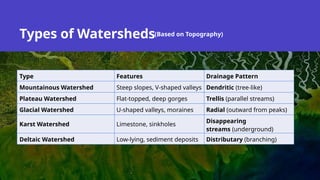
Types of Watersheds(Based on Topography)
Type Features Drainage Pattern
Mountainous Watershed Steep slopes, V-shaped valleys Dendritic (tree-like)
Plateau Watershed Flat-topped, deep gorges Trellis (parallel streams)
Glacial Watershed U-shaped valleys, moraines Radial (outward from peaks)
Karst Watershed Limestone, sinkholes
Disappearing
streams (underground)
Deltaic Watershed Low-lying, sediment deposits Distributary (branching)
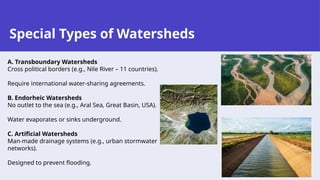
Special Types of Watersheds
A. Transboundary Watersheds
Cross political borders (e.g., Nile River – 11 countries).
Require international water-sharing agreements.
B. Endorheic Watersheds
No outlet to the sea (e.g., Aral Sea, Great Basin, USA).
Water evaporates or sinks underground.
C. Artificial Watersheds
Man-made drainage systems (e.g., urban stormwater
networks).
Designed to prevent flooding.
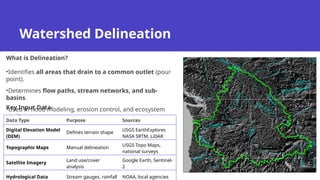
Watershed Delineation
What is Delineation?
•Identifies all areas that drain to a common outlet (pour
point).
•Determines flow paths, stream networks, and sub-
basins.
•Used in flood modeling, erosion control, and ecosystem
studies.
Data Type Purpose Sources
Digital Elevation Model
(DEM)
Defines terrain shape
USGS EarthExplorer,
NASA SRTM, LiDAR
Topographic Maps Manual delineation
USGS Topo Maps,
national surveys
Satellite Imagery
Land use/cover
analysis
Google Earth, Sentinel-
2
Hydrological Data Stream gauges, rainfall NOAA, local agencies
Key Input Data-
Watershed Delineation Techniques
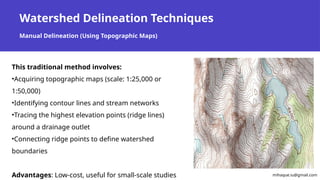
Manual Delineation (Using Topographic Maps)
This traditional method involves:
•Acquiring topographic maps (scale: 1:25,000 or
1:50,000)
•Identifying contour lines and stream networks
•Tracing the highest elevation points (ridge lines)
around a drainage outlet
•Connecting ridge points to define watershed
boundaries
Advantages: Low-cost, useful for small-scale studies mihaque.iu@gmail.com
Watershed Delineation Techniques
Digital Delineation (Using GIS & DEMs)
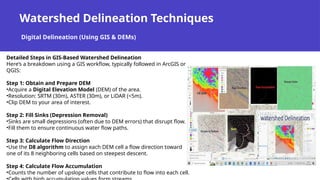
Detailed Steps in GIS-Based Watershed Delineation
Here’s a breakdown using a GIS workflow, typically followed in ArcGIS or
QGIS:
Step 1: Obtain and Prepare DEM
•Acquire a Digital Elevation Model (DEM) of the area.
•Resolution: SRTM (30m), ASTER (30m), or LiDAR (<5m).
•Clip DEM to your area of interest.
Step 2: Fill Sinks (Depression Removal)
•Sinks are small depressions (often due to DEM errors) that disrupt flow.
•Fill them to ensure continuous water flow paths.
Step 3: Calculate Flow Direction
•Use the D8 algorithm to assign each DEM cell a flow direction toward
one of its 8 neighboring cells based on steepest descent.
Step 4: Calculate Flow Accumulation
•Counts the number of upslope cells that contribute to flow into each cell.
Watershed Delineation Techniques
Digital Delineation (Using GIS & DEMs)
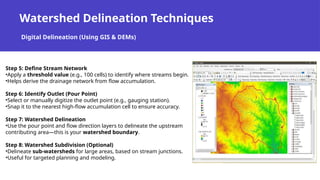
Step 5: Define Stream Network
•Apply a threshold value (e.g., 100 cells) to identify where streams begin.
•Helps derive the drainage network from flow accumulation.
Step 6: Identify Outlet (Pour Point)
•Select or manually digitize the outlet point (e.g., gauging station).
•Snap it to the nearest high-flow accumulation cell to ensure accuracy.
Step 7: Watershed Delineation
•Use the pour point and flow direction layers to delineate the upstream
contributing area—this is your watershed boundary.
Step 8: Watershed Subdivision (Optional)
•Delineate sub-watersheds for large areas, based on stream junctions.
•Useful for targeted planning and modeling.
Watershed Delineation Techniques
Advanced Methods
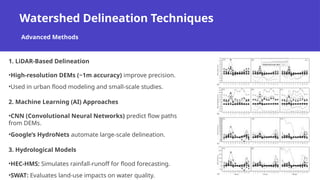
1. LiDAR-Based Delineation
•High-resolution DEMs (~1m accuracy) improve precision.
•Used in urban flood modeling and small-scale studies.
2. Machine Learning (AI) Approaches
•CNN (Convolutional Neural Networks) predict flow paths
from DEMs.
•Google’s HydroNets automate large-scale delineation.
3. Hydrological Models
•HEC-HMS: Simulates rainfall-runoff for flood forecasting.
•SWAT: Evaluates land-use impacts on water quality.
Watershed Delineation Techniques
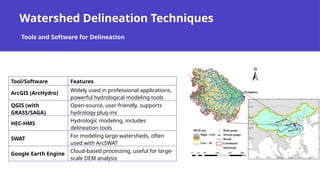
Tools and Software for Delineation
Tool/Software Features
ArcGIS (ArcHydro)
Widely used in professional applications,
powerful hydrological modeling tools
QGIS (with
GRASS/SAGA)
Open-source, user-friendly, supports
hydrology plug-ins
HEC-HMS
Hydrologic modeling, includes
delineation tools
SWAT
For modeling large watersheds, often
used with ArcSWAT
Google Earth Engine
Cloud-based processing, useful for large-
scale DEM analysis
What is
Watershed
Management?
Watershed management is the
process of managing land and water
resources within a watershed to
sustainably balance environmental,
economic, and social goals. A
watershed is an area of land where all
precipitation drains to a common
outlet like a river, lake, or ocean.
Proper management of this area
ensures water availability, reduces soil
erosion, enhances agricultural
productivity, and supports
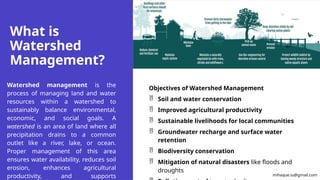
Objectives of Watershed Management
 Soil and water conservation
 Improved agricultural productivity
 Sustainable livelihoods for local communities
 Groundwater recharge and surface water
retention
 Biodiversity conservation
 Mitigation of natural disasters like floods and
droughts
mihaque.iu@gmail.com
What is
Watershed
Management?
Watershed management is the
process of managing land and water
resources within a watershed to
sustainably balance environmental,
economic, and social goals. A
watershed is an area of land where all
precipitation drains to a common
outlet like a river, lake, or ocean.
Proper management of this area
ensures water availability, reduces soil
erosion, enhances agricultural
productivity, and supports
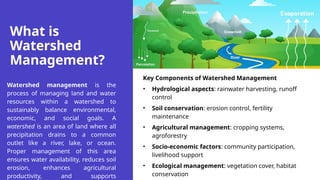
Key Components of Watershed Management
• Hydrological aspects: rainwater harvesting, runoff
control
• Soil conservation: erosion control, fertility
maintenance
• Agricultural management: cropping systems,
agroforestry
• Socio-economic factors: community participation,
livelihood support
• Ecological management: vegetation cover, habitat
conservation
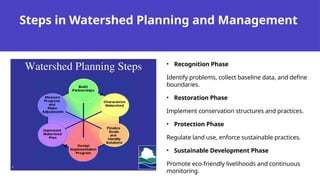
Steps in Watershed Planning and Management
• Recognition Phase
Identify problems, collect baseline data, and define
boundaries.
• Restoration Phase
Implement conservation structures and practices.
• Protection Phase
Regulate land use, enforce sustainable practices.
• Sustainable Development Phase
Promote eco-friendly livelihoods and continuous
monitoring.
Techniques of Watershed Management
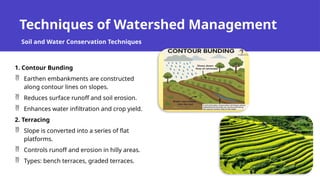
1. Contour Bunding
 Earthen embankments are constructed
along contour lines on slopes.
 Reduces surface runoff and soil erosion.
 Enhances water infiltration and crop yield.
2. Terracing
 Slope is converted into a series of flat
platforms.
 Controls runoff and erosion in hilly areas.
 Types: bench terraces, graded terraces.
Soil and Water Conservation Techniques
Techniques of Watershed Management
Soil and Water Conservation Techniques
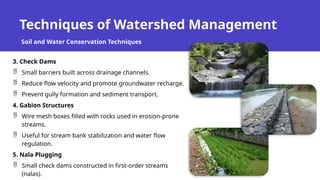
3. Check Dams
 Small barriers built across drainage channels.
 Reduce flow velocity and promote groundwater recharge.
 Prevent gully formation and sediment transport.
4. Gabion Structures
 Wire mesh boxes filled with rocks used in erosion-prone
streams.
 Useful for stream bank stabilization and water flow
regulation.
5. Nala Plugging
 Small check dams constructed in first-order streams
(nalas).
Techniques of Watershed Management
Water Harvesting and Recharge Techniques
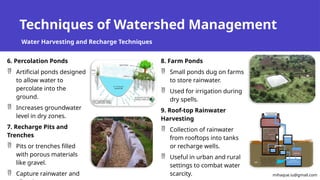
6. Percolation Ponds
 Artificial ponds designed
to allow water to
percolate into the
ground.
 Increases groundwater
level in dry zones.
7. Recharge Pits and
Trenches
 Pits or trenches filled
with porous materials
like gravel.
 Capture rainwater and
8. Farm Ponds
 Small ponds dug on farms
to store rainwater.
 Used for irrigation during
dry spells.
9. Roof-top Rainwater
Harvesting
 Collection of rainwater
from rooftops into tanks
or recharge wells.
 Useful in urban and rural
settings to combat water
scarcity. mihaque.iu@gmail.com
Techniques of Watershed Management
Vegetative Measures
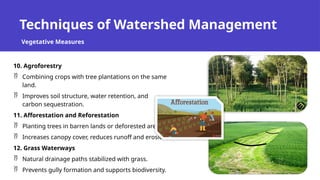
10. Agroforestry
 Combining crops with tree plantations on the same
land.
 Improves soil structure, water retention, and
carbon sequestration.
11. Afforestation and Reforestation
 Planting trees in barren lands or deforested areas.
 Increases canopy cover, reduces runoff and erosion.
12. Grass Waterways
 Natural drainage paths stabilized with grass.
 Prevents gully formation and supports biodiversity.
Techniques of Watershed Management
Agricultural Management Practices
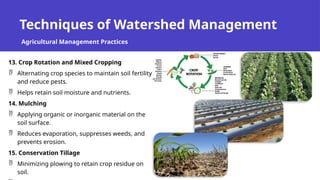
13. Crop Rotation and Mixed Cropping
 Alternating crop species to maintain soil fertility
and reduce pests.
 Helps retain soil moisture and nutrients.
14. Mulching
 Applying organic or inorganic material on the
soil surface.
 Reduces evaporation, suppresses weeds, and
prevents erosion.
15. Conservation Tillage
 Minimizing plowing to retain crop residue on
soil.
Techniques of Watershed Management
Livelihood and Community Involvement
Techniques
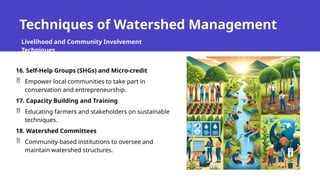
16. Self-Help Groups (SHGs) and Micro-credit
 Empower local communities to take part in
conservation and entrepreneurship.
17. Capacity Building and Training
 Educating farmers and stakeholders on sustainable
techniques.
18. Watershed Committees
 Community-based institutions to oversee and
maintain watershed structures.
Watershed
Management
Planning
Process
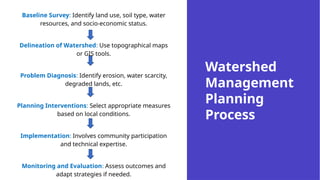
Baseline Survey: Identify land use, soil type, water
resources, and socio-economic status.
Delineation of Watershed: Use topographical maps
or GIS tools.
Problem Diagnosis: Identify erosion, water scarcity,
degraded lands, etc.
Planning Interventions: Select appropriate measures
based on local conditions.
Implementation: Involves community participation
and technical expertise.
Monitoring and Evaluation: Assess outcomes and
adapt strategies if needed.
Benefits of
Watershed
Management
1. Improved Water Quality
2. Flood Mitigation
3. Soil Conservation & Erosion Control
4. Enhanced Biodiversity & Ecosystem Health
5. Sustainable Water Supply
6. Climate Change Resilience
7. Economic Benefits
8. Community & Social Benefits
9. Sustainable Agriculture & Forestry.
Thank you
mihaque.iu@gmail.com

Watershed- conceps, delineation, management.pptx

  • 1.
  • 2.
    Basic Concept ofWatershed A watershed (also called a drainage basin or catchment area) is an area of land that drains all precipitation (rain, snowmelt, etc.) into a common outlet, such as a river, lake, or ocean. It is separated from adjacent basins by a drainage divide (ridge or high elevation area). mihaque.iu@gmail.com
  • 3.
  • 4.
    Types of Watersheds TypeSize Range Examples Mega Watershed >100,000 km² Amazon Basin, Mississippi River Basin Macro Watershed 10,000–100,000 km² Danube River Basin, Nile Basin Sub-Watershed 1,000–10,000 km² Thames River Basin (UK) Micro Watershed 100–1,000 km² Small river catchments Mini Watershed 1–100 km² Small agricultural or urban drainage areas (Based on Size)
  • 5.
    Types of Watersheds(Basedon Land Use) Type Characteristics Impacts Urban Watershed High impervious surfaces (roads, buildings) Increased runoff, flash floods, pollution Agricultural Watershed Dominated by farms, irrigation Soil erosion, nutrient runoff (e.g., fertilizers) Forest Watershed Dense vegetation, natural cover High infiltration, stable flow, clean water Desert Watershed Arid, low rainfall, sparse vegetation Ephemeral streams, flash floods Mountain Watershed Steep slopes, snowmelt-fed High erosion risk, seasonal flow variations Coastal Watershed Near oceans, influenced by tides Saltwater intrusion, storm surges mihaque.iu@gmail.com
  • 6.
    Types of Watersheds(Basedon Hydrology) Type Flow Characteristics Examples Perennial Watershed Flows year-round (fed by groundwater) Large rivers (Ganges, Rhine) Intermittent Watershed Seasonal flow (wet/dry periods) Many Mediterranean rivers Ephemeral Watershed Flows only after rainfall Desert washes (Arizona arroyos) Snowmelt-Driven Watershed Dominated by snow/glacier melt Alpine rivers (Colorado River) Groundwater-Fed Watershed Sustained by springs/aquifers Karst watersheds (Florida springs)
  • 7.
    Types of Watersheds(Basedon Topography) Type Features Drainage Pattern Mountainous Watershed Steep slopes, V-shaped valleys Dendritic (tree-like) Plateau Watershed Flat-topped, deep gorges Trellis (parallel streams) Glacial Watershed U-shaped valleys, moraines Radial (outward from peaks) Karst Watershed Limestone, sinkholes Disappearing streams (underground) Deltaic Watershed Low-lying, sediment deposits Distributary (branching)
  • 8.
    Special Types ofWatersheds A. Transboundary Watersheds Cross political borders (e.g., Nile River – 11 countries). Require international water-sharing agreements. B. Endorheic Watersheds No outlet to the sea (e.g., Aral Sea, Great Basin, USA). Water evaporates or sinks underground. C. Artificial Watersheds Man-made drainage systems (e.g., urban stormwater networks). Designed to prevent flooding.
  • 9.
    Watershed Delineation What isDelineation? •Identifies all areas that drain to a common outlet (pour point). •Determines flow paths, stream networks, and sub- basins. •Used in flood modeling, erosion control, and ecosystem studies. Data Type Purpose Sources Digital Elevation Model (DEM) Defines terrain shape USGS EarthExplorer, NASA SRTM, LiDAR Topographic Maps Manual delineation USGS Topo Maps, national surveys Satellite Imagery Land use/cover analysis Google Earth, Sentinel- 2 Hydrological Data Stream gauges, rainfall NOAA, local agencies Key Input Data-
  • 10.
    Watershed Delineation Techniques ManualDelineation (Using Topographic Maps) This traditional method involves: •Acquiring topographic maps (scale: 1:25,000 or 1:50,000) •Identifying contour lines and stream networks •Tracing the highest elevation points (ridge lines) around a drainage outlet •Connecting ridge points to define watershed boundaries Advantages: Low-cost, useful for small-scale studies mihaque.iu@gmail.com
  • 11.
    Watershed Delineation Techniques DigitalDelineation (Using GIS & DEMs) Detailed Steps in GIS-Based Watershed Delineation Here’s a breakdown using a GIS workflow, typically followed in ArcGIS or QGIS: Step 1: Obtain and Prepare DEM •Acquire a Digital Elevation Model (DEM) of the area. •Resolution: SRTM (30m), ASTER (30m), or LiDAR (<5m). •Clip DEM to your area of interest. Step 2: Fill Sinks (Depression Removal) •Sinks are small depressions (often due to DEM errors) that disrupt flow. •Fill them to ensure continuous water flow paths. Step 3: Calculate Flow Direction •Use the D8 algorithm to assign each DEM cell a flow direction toward one of its 8 neighboring cells based on steepest descent. Step 4: Calculate Flow Accumulation •Counts the number of upslope cells that contribute to flow into each cell.
  • 12.
    Watershed Delineation Techniques DigitalDelineation (Using GIS & DEMs) Step 5: Define Stream Network •Apply a threshold value (e.g., 100 cells) to identify where streams begin. •Helps derive the drainage network from flow accumulation. Step 6: Identify Outlet (Pour Point) •Select or manually digitize the outlet point (e.g., gauging station). •Snap it to the nearest high-flow accumulation cell to ensure accuracy. Step 7: Watershed Delineation •Use the pour point and flow direction layers to delineate the upstream contributing area—this is your watershed boundary. Step 8: Watershed Subdivision (Optional) •Delineate sub-watersheds for large areas, based on stream junctions. •Useful for targeted planning and modeling.
  • 13.
    Watershed Delineation Techniques AdvancedMethods 1. LiDAR-Based Delineation •High-resolution DEMs (~1m accuracy) improve precision. •Used in urban flood modeling and small-scale studies. 2. Machine Learning (AI) Approaches •CNN (Convolutional Neural Networks) predict flow paths from DEMs. •Google’s HydroNets automate large-scale delineation. 3. Hydrological Models •HEC-HMS: Simulates rainfall-runoff for flood forecasting. •SWAT: Evaluates land-use impacts on water quality.
  • 14.
    Watershed Delineation Techniques Toolsand Software for Delineation Tool/Software Features ArcGIS (ArcHydro) Widely used in professional applications, powerful hydrological modeling tools QGIS (with GRASS/SAGA) Open-source, user-friendly, supports hydrology plug-ins HEC-HMS Hydrologic modeling, includes delineation tools SWAT For modeling large watersheds, often used with ArcSWAT Google Earth Engine Cloud-based processing, useful for large- scale DEM analysis
  • 15.
    What is Watershed Management? Watershed managementis the process of managing land and water resources within a watershed to sustainably balance environmental, economic, and social goals. A watershed is an area of land where all precipitation drains to a common outlet like a river, lake, or ocean. Proper management of this area ensures water availability, reduces soil erosion, enhances agricultural productivity, and supports Objectives of Watershed Management  Soil and water conservation  Improved agricultural productivity  Sustainable livelihoods for local communities  Groundwater recharge and surface water retention  Biodiversity conservation  Mitigation of natural disasters like floods and droughts mihaque.iu@gmail.com
  • 16.
    What is Watershed Management? Watershed managementis the process of managing land and water resources within a watershed to sustainably balance environmental, economic, and social goals. A watershed is an area of land where all precipitation drains to a common outlet like a river, lake, or ocean. Proper management of this area ensures water availability, reduces soil erosion, enhances agricultural productivity, and supports Key Components of Watershed Management • Hydrological aspects: rainwater harvesting, runoff control • Soil conservation: erosion control, fertility maintenance • Agricultural management: cropping systems, agroforestry • Socio-economic factors: community participation, livelihood support • Ecological management: vegetation cover, habitat conservation
  • 17.
    Steps in WatershedPlanning and Management • Recognition Phase Identify problems, collect baseline data, and define boundaries. • Restoration Phase Implement conservation structures and practices. • Protection Phase Regulate land use, enforce sustainable practices. • Sustainable Development Phase Promote eco-friendly livelihoods and continuous monitoring.
  • 18.
    Techniques of WatershedManagement 1. Contour Bunding  Earthen embankments are constructed along contour lines on slopes.  Reduces surface runoff and soil erosion.  Enhances water infiltration and crop yield. 2. Terracing  Slope is converted into a series of flat platforms.  Controls runoff and erosion in hilly areas.  Types: bench terraces, graded terraces. Soil and Water Conservation Techniques
  • 19.
    Techniques of WatershedManagement Soil and Water Conservation Techniques 3. Check Dams  Small barriers built across drainage channels.  Reduce flow velocity and promote groundwater recharge.  Prevent gully formation and sediment transport. 4. Gabion Structures  Wire mesh boxes filled with rocks used in erosion-prone streams.  Useful for stream bank stabilization and water flow regulation. 5. Nala Plugging  Small check dams constructed in first-order streams (nalas).
  • 20.
    Techniques of WatershedManagement Water Harvesting and Recharge Techniques 6. Percolation Ponds  Artificial ponds designed to allow water to percolate into the ground.  Increases groundwater level in dry zones. 7. Recharge Pits and Trenches  Pits or trenches filled with porous materials like gravel.  Capture rainwater and 8. Farm Ponds  Small ponds dug on farms to store rainwater.  Used for irrigation during dry spells. 9. Roof-top Rainwater Harvesting  Collection of rainwater from rooftops into tanks or recharge wells.  Useful in urban and rural settings to combat water scarcity. mihaque.iu@gmail.com
  • 21.
    Techniques of WatershedManagement Vegetative Measures 10. Agroforestry  Combining crops with tree plantations on the same land.  Improves soil structure, water retention, and carbon sequestration. 11. Afforestation and Reforestation  Planting trees in barren lands or deforested areas.  Increases canopy cover, reduces runoff and erosion. 12. Grass Waterways  Natural drainage paths stabilized with grass.  Prevents gully formation and supports biodiversity.
  • 22.
    Techniques of WatershedManagement Agricultural Management Practices 13. Crop Rotation and Mixed Cropping  Alternating crop species to maintain soil fertility and reduce pests.  Helps retain soil moisture and nutrients. 14. Mulching  Applying organic or inorganic material on the soil surface.  Reduces evaporation, suppresses weeds, and prevents erosion. 15. Conservation Tillage  Minimizing plowing to retain crop residue on soil.
  • 23.
    Techniques of WatershedManagement Livelihood and Community Involvement Techniques 16. Self-Help Groups (SHGs) and Micro-credit  Empower local communities to take part in conservation and entrepreneurship. 17. Capacity Building and Training  Educating farmers and stakeholders on sustainable techniques. 18. Watershed Committees  Community-based institutions to oversee and maintain watershed structures.
  • 24.
    Watershed Management Planning Process Baseline Survey: Identifyland use, soil type, water resources, and socio-economic status. Delineation of Watershed: Use topographical maps or GIS tools. Problem Diagnosis: Identify erosion, water scarcity, degraded lands, etc. Planning Interventions: Select appropriate measures based on local conditions. Implementation: Involves community participation and technical expertise. Monitoring and Evaluation: Assess outcomes and adapt strategies if needed.
  • 25.
    Benefits of Watershed Management 1. ImprovedWater Quality 2. Flood Mitigation 3. Soil Conservation & Erosion Control 4. Enhanced Biodiversity & Ecosystem Health 5. Sustainable Water Supply 6. Climate Change Resilience 7. Economic Benefits 8. Community & Social Benefits 9. Sustainable Agriculture & Forestry.
  • 26.