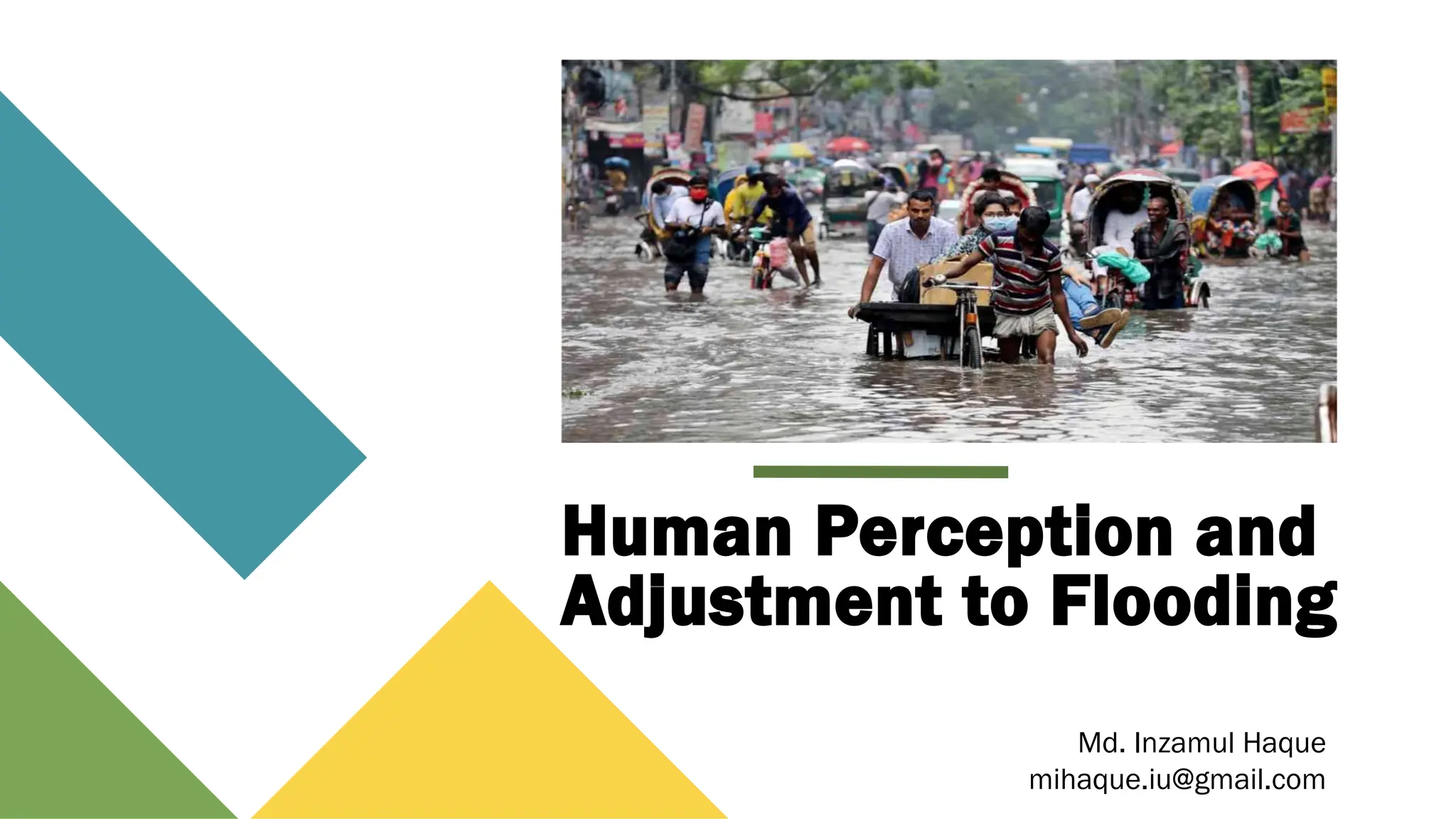
Human Perception and
Adjustment to Flooding
Md. Inzamul Haque
mihaque.iu@gmail.com
ToC
• Introduction
• Factors Influencing Flood Perception
• Psychological and Behavioural Responses to Flooding
• Adjustment and Adaptation Strategies
• Challenges in Flood Risk Management
• Human Perception and Adjustment to Flooding in
Bangladesh
Introduction
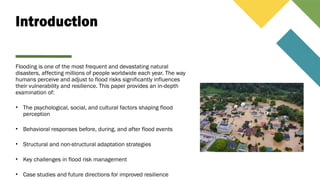
Flooding is one of the most frequent and devastating natural
disasters, affecting millions of people worldwide each year. The way
humans perceive and adjust to flood risks significantly influences
their vulnerability and resilience. This paper provides an in-depth
examination of:
• The psychological, social, and cultural factors shaping flood
perception
• Behavioral responses before, during, and after flood events
• Structural and non-structural adaptation strategies
• Key challenges in flood risk management
• Case studies and future directions for improved resilience
Factors Influencing Flood
Perception
Experience and Memory
Direct vs. Indirect Experience
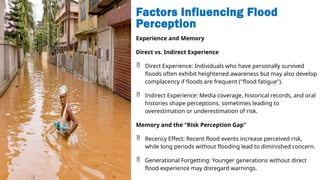
 Direct Experience: Individuals who have personally survived
floods often exhibit heightened awareness but may also develop
complacency if floods are frequent ("flood fatigue").
 Indirect Experience: Media coverage, historical records, and oral
histories shape perceptions, sometimes leading to
overestimation or underestimation of risk.
Memory and the "Risk Perception Gap"
 Recency Effect: Recent flood events increase perceived risk,
while long periods without flooding lead to diminished concern.
 Generational Forgetting: Younger generations without direct
flood experience may disregard warnings.
Factors Influencing Flood Perception
Socioeconomic and Cultural Influences
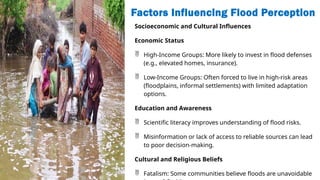
Economic Status
 High-Income Groups: More likely to invest in flood defenses
(e.g., elevated homes, insurance).
 Low-Income Groups: Often forced to live in high-risk areas
(floodplains, informal settlements) with limited adaptation
options.
Education and Awareness
 Scientific literacy improves understanding of flood risks.
 Misinformation or lack of access to reliable sources can lead
to poor decision-making.
Cultural and Religious Beliefs
 Fatalism: Some communities believe floods are unavoidable
Factors Influencing Flood Perception
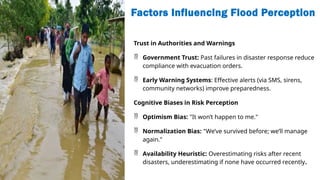
Trust in Authorities and Warnings
 Government Trust: Past failures in disaster response reduce
compliance with evacuation orders.
 Early Warning Systems: Effective alerts (via SMS, sirens,
community networks) improve preparedness.
Cognitive Biases in Risk Perception
 Optimism Bias: "It won’t happen to me."
 Normalization Bias: "We’ve survived before; we’ll manage
again."
 Availability Heuristic: Overestimating risks after recent
disasters, underestimating if none have occurred recently.
Psychological and Behavioral
Responses to Flooding
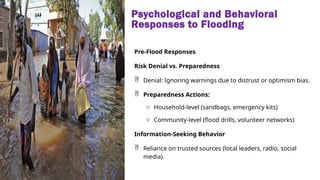
Pre-Flood Responses
Risk Denial vs. Preparedness
 Denial: Ignoring warnings due to distrust or optimism bias.
 Preparedness Actions:
o Household-level (sandbags, emergency kits)
o Community-level (flood drills, volunteer networks)
Information-Seeking Behavior
 Reliance on trusted sources (local leaders, radio, social
media).
Psychological and Behavioral
Responses to Flooding
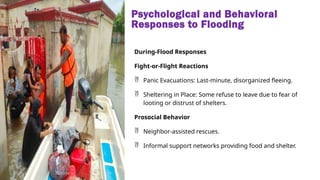
During-Flood Responses
Fight-or-Flight Reactions
 Panic Evacuations: Last-minute, disorganized fleeing.
 Sheltering in Place: Some refuse to leave due to fear of
looting or distrust of shelters.
Prosocial Behavior
 Neighbor-assisted rescues.
 Informal support networks providing food and shelter.
Psychological and Behavioral
Responses to Flooding
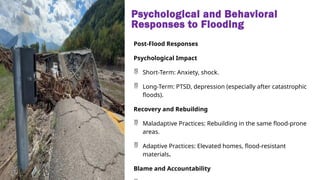
Post-Flood Responses
Psychological Impact
 Short-Term: Anxiety, shock.
 Long-Term: PTSD, depression (especially after catastrophic
floods).
Recovery and Rebuilding
 Maladaptive Practices: Rebuilding in the same flood-prone
areas.
 Adaptive Practices: Elevated homes, flood-resistant
materials.
Blame and Accountability
Adjustment and Adaptation
Strategies
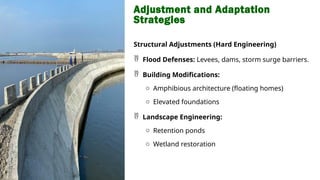
Structural Adjustments (Hard Engineering)
 Flood Defenses: Levees, dams, storm surge barriers.
 Building Modifications:
o Amphibious architecture (floating homes)
o Elevated foundations
 Landscape Engineering:
o Retention ponds
o Wetland restoration
Adjustment and Adaptation
Strategies
Non-Structural Adjustments (Policy & Behavior)
Policy Interventions
 Zoning Laws: Restricting construction in floodplains.
 Insurance Programs:
o National Flood Insurance Program (NFIP, U.S.)
o Community-based microinsurance
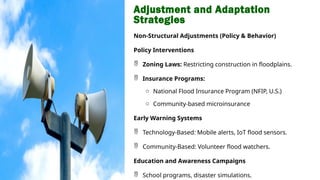
Early Warning Systems
 Technology-Based: Mobile alerts, IoT flood sensors.
 Community-Based: Volunteer flood watchers.
Education and Awareness Campaigns
 School programs, disaster simulations.
Adjustment and Adaptation
Strategies
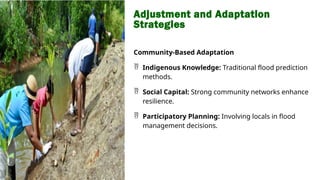
Community-Based Adaptation
 Indigenous Knowledge: Traditional flood prediction
methods.
 Social Capital: Strong community networks enhance
resilience.
 Participatory Planning: Involving locals in flood
management decisions.
Challenges in Flood Risk Management
Cognitive and Behavioral Barriers
 Underestimation of risk due to
lack of experience.
 Reluctance to relocate (emotional
attachment to land).
Economic and Political Constraints
 Short-term political cycles vs. long-
term flood investments.
 Unequal resource distribution
exacerbates vulnerability.
Climate Change and Urbanization
 Increased rainfall intensity and sea-level
rise.
 Urban sprawl reduces natural drainage
(impervious surfaces).
Conflicting Priorities
 Economic development vs. floodplain
preservation.
 Upstream deforestation worsens
downstream flooding.
Human Perception and Adjustment to Flooding in
Bangladesh
Bangladesh's Unique Flood Challenges
Bangladesh, a low-lying deltaic country, is exceptionally vulnerable to flooding due
to:
 Geographic location at the confluence of three major rivers (Ganges,
Brahmaputra, Meghna)
 Monsoon-dominated climate with heavy rainfall (80% of annual rain falls June-
September)
 Sea-level rise exacerbating coastal flooding
 High population density (1,300 people/km²) forcing settlement in flood-prone
areas
Factors Shaping Flood Perception
in Bangladesh
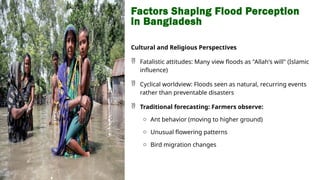
Cultural and Religious Perspectives
 Fatalistic attitudes: Many view floods as "Allah's will" (Islamic
influence)
 Cyclical worldview: Floods seen as natural, recurring events
rather than preventable disasters
 Traditional forecasting: Farmers observe:
o Ant behavior (moving to higher ground)
o Unusual flowering patterns
o Bird migration changes
Factors Shaping Flood Perception
in Bangladesh
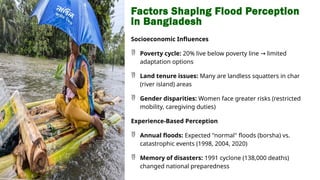
Socioeconomic Influences
 Poverty cycle: 20% live below poverty line limited
→
adaptation options
 Land tenure issues: Many are landless squatters in char
(river island) areas
 Gender disparities: Women face greater risks (restricted
mobility, caregiving duties)
Experience-Based Perception
 Annual floods: Expected "normal" floods (borsha) vs.
catastrophic events (1998, 2004, 2020)
 Memory of disasters: 1991 cyclone (138,000 deaths)
changed national preparedness
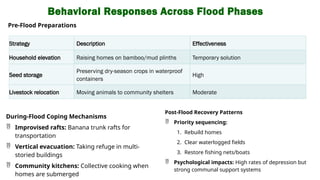
Behavioral Responses Across Flood Phases
Strategy Description Effectiveness
Household elevation Raising homes on bamboo/mud plinths Temporary solution
Seed storage
Preserving dry-season crops in waterproof
containers
High
Livestock relocation Moving animals to community shelters Moderate
Pre-Flood Preparations
During-Flood Coping Mechanisms
 Improvised rafts: Banana trunk rafts for
transportation
 Vertical evacuation: Taking refuge in multi-
storied buildings
 Community kitchens: Collective cooking when
homes are submerged
Post-Flood Recovery Patterns
 Priority sequencing:
1. Rebuild homes
2. Clear waterlogged fields
3. Restore fishing nets/boats
 Psychological impacts: High rates of depression but
strong communal support systems
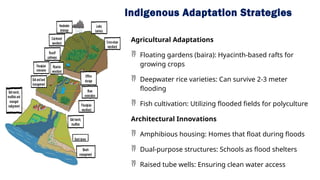
Indigenous Adaptation Strategies
Agricultural Adaptations
 Floating gardens (baira): Hyacinth-based rafts for
growing crops
 Deepwater rice varieties: Can survive 2-3 meter
flooding
 Fish cultivation: Utilizing flooded fields for polyculture
Architectural Innovations
 Amphibious housing: Homes that float during floods
 Dual-purpose structures: Schools as flood shelters
 Raised tube wells: Ensuring clean water access
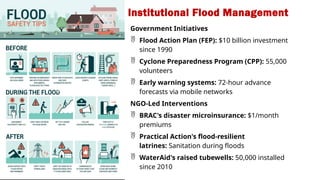
Institutional Flood Management
Government Initiatives
 Flood Action Plan (FEP): $10 billion investment
since 1990
 Cyclone Preparedness Program (CPP): 55,000
volunteers
 Early warning systems: 72-hour advance
forecasts via mobile networks
NGO-Led Interventions
 BRAC's disaster microinsurance: $1/month
premiums
 Practical Action's flood-resilient
latrines: Sanitation during floods
 WaterAid's raised tubewells: 50,000 installed
since 2010
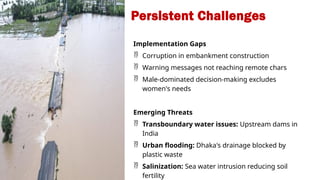
Persistent Challenges
Implementation Gaps
 Corruption in embankment construction
 Warning messages not reaching remote chars
 Male-dominated decision-making excludes
women's needs
Emerging Threats
 Transboundary water issues: Upstream dams in
India
 Urban flooding: Dhaka's drainage blocked by
plastic waste
 Salinization: Sea water intrusion reducing soil
fertility
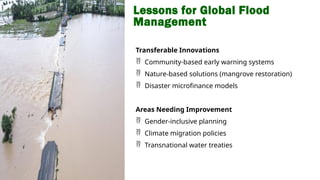
Lessons for Global Flood
Management
Transferable Innovations
 Community-based early warning systems
 Nature-based solutions (mangrove restoration)
 Disaster microfinance models
Areas Needing Improvement
 Gender-inclusive planning
 Climate migration policies
 Transnational water treaties
Thank you

Human Perception and Adjustment to Flooding.pptx

  • 1.
    Human Perception and Adjustmentto Flooding Md. Inzamul Haque mihaque.iu@gmail.com
  • 2.
    ToC • Introduction • FactorsInfluencing Flood Perception • Psychological and Behavioural Responses to Flooding • Adjustment and Adaptation Strategies • Challenges in Flood Risk Management • Human Perception and Adjustment to Flooding in Bangladesh
  • 3.
    Introduction Flooding is oneof the most frequent and devastating natural disasters, affecting millions of people worldwide each year. The way humans perceive and adjust to flood risks significantly influences their vulnerability and resilience. This paper provides an in-depth examination of: • The psychological, social, and cultural factors shaping flood perception • Behavioral responses before, during, and after flood events • Structural and non-structural adaptation strategies • Key challenges in flood risk management • Case studies and future directions for improved resilience
  • 4.
    Factors Influencing Flood Perception Experienceand Memory Direct vs. Indirect Experience  Direct Experience: Individuals who have personally survived floods often exhibit heightened awareness but may also develop complacency if floods are frequent ("flood fatigue").  Indirect Experience: Media coverage, historical records, and oral histories shape perceptions, sometimes leading to overestimation or underestimation of risk. Memory and the "Risk Perception Gap"  Recency Effect: Recent flood events increase perceived risk, while long periods without flooding lead to diminished concern.  Generational Forgetting: Younger generations without direct flood experience may disregard warnings.
  • 5.
    Factors Influencing FloodPerception Socioeconomic and Cultural Influences Economic Status  High-Income Groups: More likely to invest in flood defenses (e.g., elevated homes, insurance).  Low-Income Groups: Often forced to live in high-risk areas (floodplains, informal settlements) with limited adaptation options. Education and Awareness  Scientific literacy improves understanding of flood risks.  Misinformation or lack of access to reliable sources can lead to poor decision-making. Cultural and Religious Beliefs  Fatalism: Some communities believe floods are unavoidable
  • 6.
    Factors Influencing FloodPerception Trust in Authorities and Warnings  Government Trust: Past failures in disaster response reduce compliance with evacuation orders.  Early Warning Systems: Effective alerts (via SMS, sirens, community networks) improve preparedness. Cognitive Biases in Risk Perception  Optimism Bias: "It won’t happen to me."  Normalization Bias: "We’ve survived before; we’ll manage again."  Availability Heuristic: Overestimating risks after recent disasters, underestimating if none have occurred recently.
  • 7.
    Psychological and Behavioral Responsesto Flooding Pre-Flood Responses Risk Denial vs. Preparedness  Denial: Ignoring warnings due to distrust or optimism bias.  Preparedness Actions: o Household-level (sandbags, emergency kits) o Community-level (flood drills, volunteer networks) Information-Seeking Behavior  Reliance on trusted sources (local leaders, radio, social media).
  • 8.
    Psychological and Behavioral Responsesto Flooding During-Flood Responses Fight-or-Flight Reactions  Panic Evacuations: Last-minute, disorganized fleeing.  Sheltering in Place: Some refuse to leave due to fear of looting or distrust of shelters. Prosocial Behavior  Neighbor-assisted rescues.  Informal support networks providing food and shelter.
  • 9.
    Psychological and Behavioral Responsesto Flooding Post-Flood Responses Psychological Impact  Short-Term: Anxiety, shock.  Long-Term: PTSD, depression (especially after catastrophic floods). Recovery and Rebuilding  Maladaptive Practices: Rebuilding in the same flood-prone areas.  Adaptive Practices: Elevated homes, flood-resistant materials. Blame and Accountability
  • 10.
    Adjustment and Adaptation Strategies StructuralAdjustments (Hard Engineering)  Flood Defenses: Levees, dams, storm surge barriers.  Building Modifications: o Amphibious architecture (floating homes) o Elevated foundations  Landscape Engineering: o Retention ponds o Wetland restoration
  • 11.
    Adjustment and Adaptation Strategies Non-StructuralAdjustments (Policy & Behavior) Policy Interventions  Zoning Laws: Restricting construction in floodplains.  Insurance Programs: o National Flood Insurance Program (NFIP, U.S.) o Community-based microinsurance Early Warning Systems  Technology-Based: Mobile alerts, IoT flood sensors.  Community-Based: Volunteer flood watchers. Education and Awareness Campaigns  School programs, disaster simulations.
  • 12.
    Adjustment and Adaptation Strategies Community-BasedAdaptation  Indigenous Knowledge: Traditional flood prediction methods.  Social Capital: Strong community networks enhance resilience.  Participatory Planning: Involving locals in flood management decisions.
  • 13.
    Challenges in FloodRisk Management Cognitive and Behavioral Barriers  Underestimation of risk due to lack of experience.  Reluctance to relocate (emotional attachment to land). Economic and Political Constraints  Short-term political cycles vs. long- term flood investments.  Unequal resource distribution exacerbates vulnerability. Climate Change and Urbanization  Increased rainfall intensity and sea-level rise.  Urban sprawl reduces natural drainage (impervious surfaces). Conflicting Priorities  Economic development vs. floodplain preservation.  Upstream deforestation worsens downstream flooding.
  • 14.
    Human Perception andAdjustment to Flooding in Bangladesh Bangladesh's Unique Flood Challenges Bangladesh, a low-lying deltaic country, is exceptionally vulnerable to flooding due to:  Geographic location at the confluence of three major rivers (Ganges, Brahmaputra, Meghna)  Monsoon-dominated climate with heavy rainfall (80% of annual rain falls June- September)  Sea-level rise exacerbating coastal flooding  High population density (1,300 people/km²) forcing settlement in flood-prone areas
  • 15.
    Factors Shaping FloodPerception in Bangladesh Cultural and Religious Perspectives  Fatalistic attitudes: Many view floods as "Allah's will" (Islamic influence)  Cyclical worldview: Floods seen as natural, recurring events rather than preventable disasters  Traditional forecasting: Farmers observe: o Ant behavior (moving to higher ground) o Unusual flowering patterns o Bird migration changes
  • 16.
    Factors Shaping FloodPerception in Bangladesh Socioeconomic Influences  Poverty cycle: 20% live below poverty line limited → adaptation options  Land tenure issues: Many are landless squatters in char (river island) areas  Gender disparities: Women face greater risks (restricted mobility, caregiving duties) Experience-Based Perception  Annual floods: Expected "normal" floods (borsha) vs. catastrophic events (1998, 2004, 2020)  Memory of disasters: 1991 cyclone (138,000 deaths) changed national preparedness
  • 17.
    Behavioral Responses AcrossFlood Phases Strategy Description Effectiveness Household elevation Raising homes on bamboo/mud plinths Temporary solution Seed storage Preserving dry-season crops in waterproof containers High Livestock relocation Moving animals to community shelters Moderate Pre-Flood Preparations During-Flood Coping Mechanisms  Improvised rafts: Banana trunk rafts for transportation  Vertical evacuation: Taking refuge in multi- storied buildings  Community kitchens: Collective cooking when homes are submerged Post-Flood Recovery Patterns  Priority sequencing: 1. Rebuild homes 2. Clear waterlogged fields 3. Restore fishing nets/boats  Psychological impacts: High rates of depression but strong communal support systems
  • 18.
    Indigenous Adaptation Strategies AgriculturalAdaptations  Floating gardens (baira): Hyacinth-based rafts for growing crops  Deepwater rice varieties: Can survive 2-3 meter flooding  Fish cultivation: Utilizing flooded fields for polyculture Architectural Innovations  Amphibious housing: Homes that float during floods  Dual-purpose structures: Schools as flood shelters  Raised tube wells: Ensuring clean water access
  • 19.
    Institutional Flood Management GovernmentInitiatives  Flood Action Plan (FEP): $10 billion investment since 1990  Cyclone Preparedness Program (CPP): 55,000 volunteers  Early warning systems: 72-hour advance forecasts via mobile networks NGO-Led Interventions  BRAC's disaster microinsurance: $1/month premiums  Practical Action's flood-resilient latrines: Sanitation during floods  WaterAid's raised tubewells: 50,000 installed since 2010
  • 20.
    Persistent Challenges Implementation Gaps Corruption in embankment construction  Warning messages not reaching remote chars  Male-dominated decision-making excludes women's needs Emerging Threats  Transboundary water issues: Upstream dams in India  Urban flooding: Dhaka's drainage blocked by plastic waste  Salinization: Sea water intrusion reducing soil fertility
  • 21.
    Lessons for GlobalFlood Management Transferable Innovations  Community-based early warning systems  Nature-based solutions (mangrove restoration)  Disaster microfinance models Areas Needing Improvement  Gender-inclusive planning  Climate migration policies  Transnational water treaties
  • 22.