Prof. David Alexander University of Florence, Italy RISK assessment and reduction
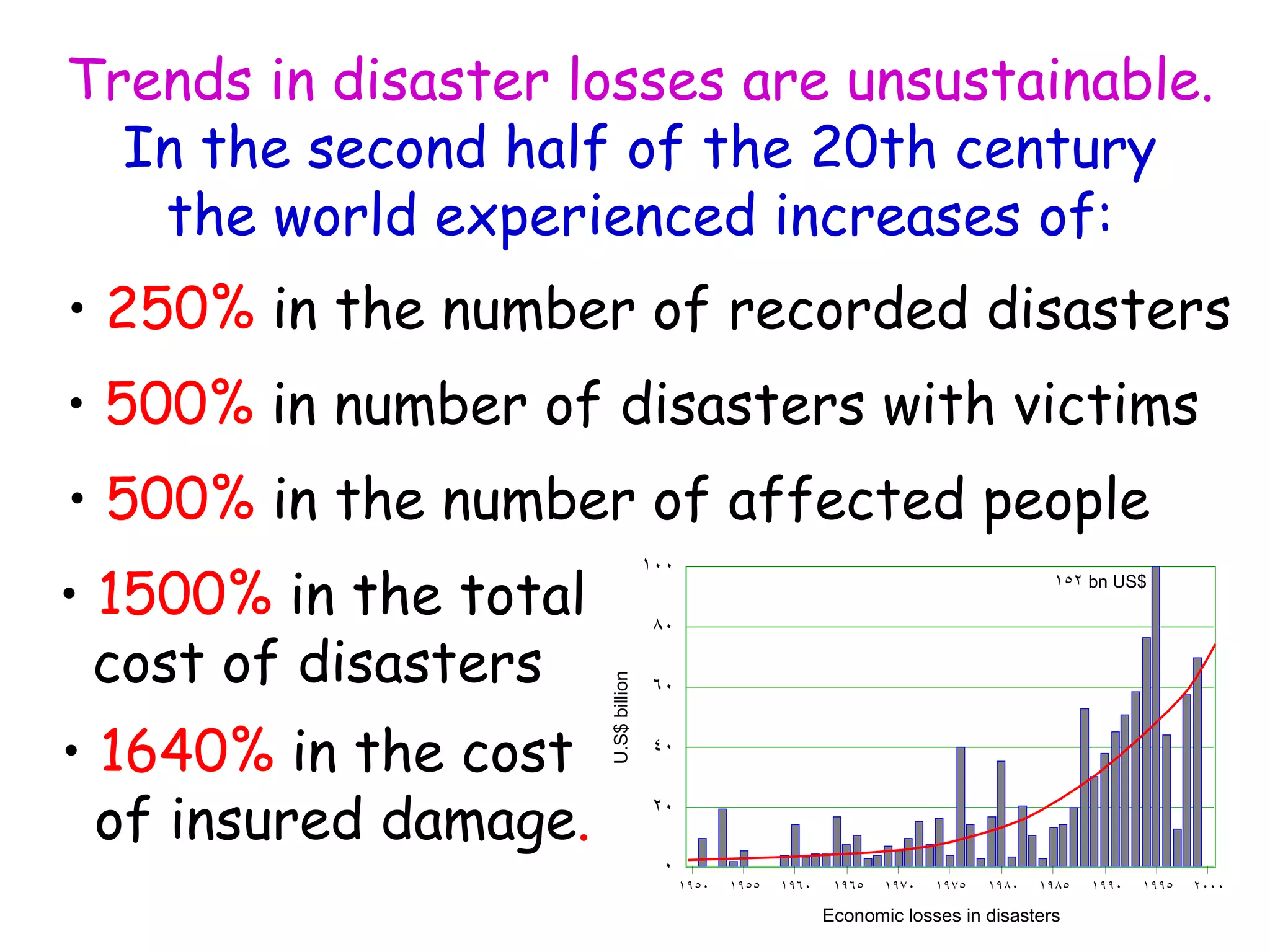
Trends in disaster losses are unsustainable. In the second half of the 20th century the world experienced increases of: 250%  in the number of recorded disasters 500%  in number of disasters with victims 500%  in the number of affected people 1640%  in the cost of insured damage . 1500%  in the total cost of disasters
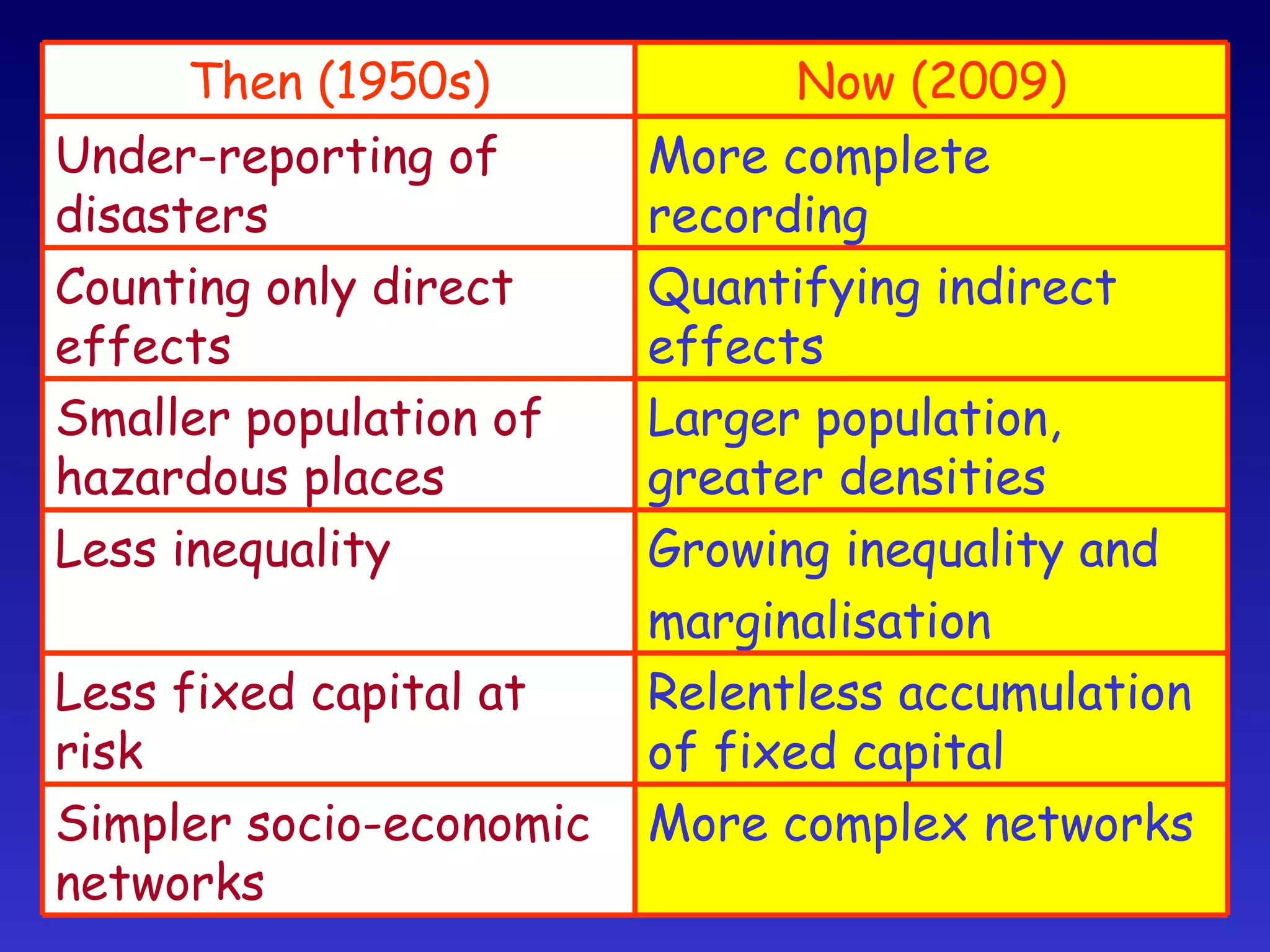
Then (1950s) Now (2009) Under-reporting of disasters More complete recording Counting only direct effects Quantifying indirect effects Smaller population of hazardous places Larger population, greater densities Less inequality Growing inequality and marginalisation Less fixed capital at risk Relentless accumulation of fixed capital Simpler socio-economic networks More complex networks
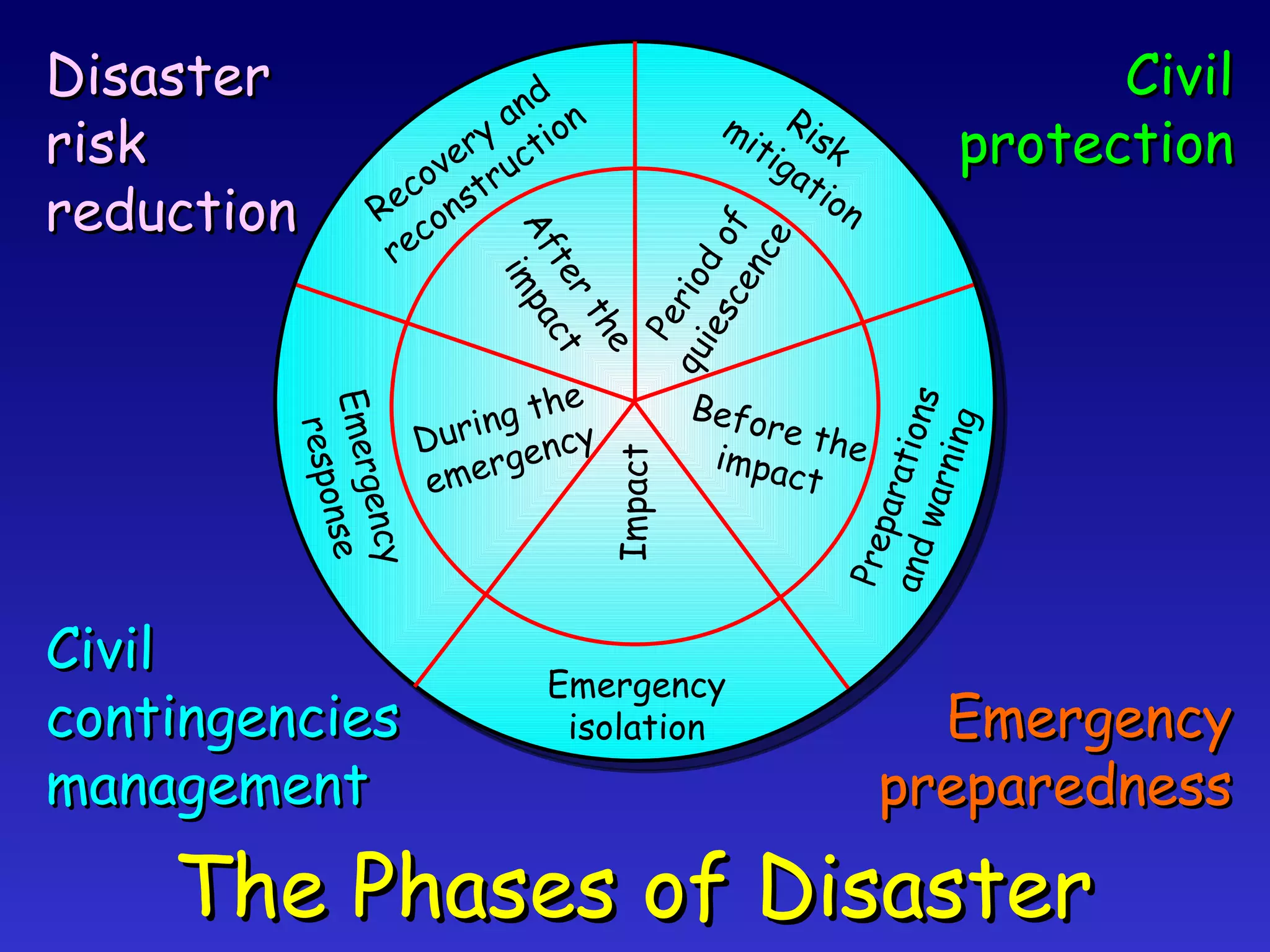
Impact Emergency isolation During the emergency Emergency response Before the impact Preparations and warning After the impact Period of quiescence Risk mitigation Recovery and reconstruction The Phases of Disaster Disaster risk reduction Civil contingencies management Civil protection Emergency preparedness
Risk assessment
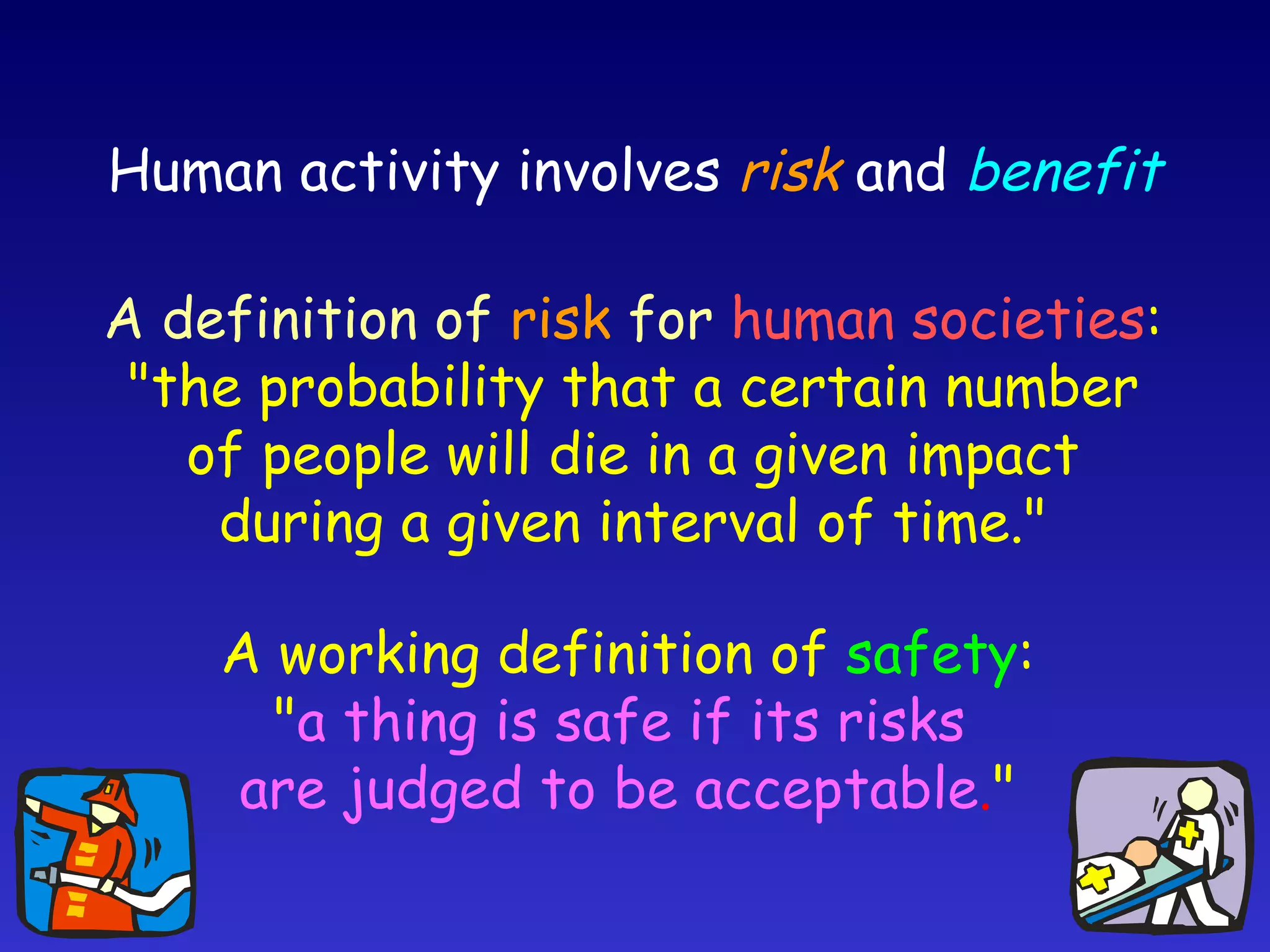
Human activity involves  risk   and   benefit A working definition of  safety : " a thing is safe if its risks  are judged to be acceptable . " A definition of  risk   for   human societies : "the probability that a certain number of people will die in a given impact during a given interval of time."
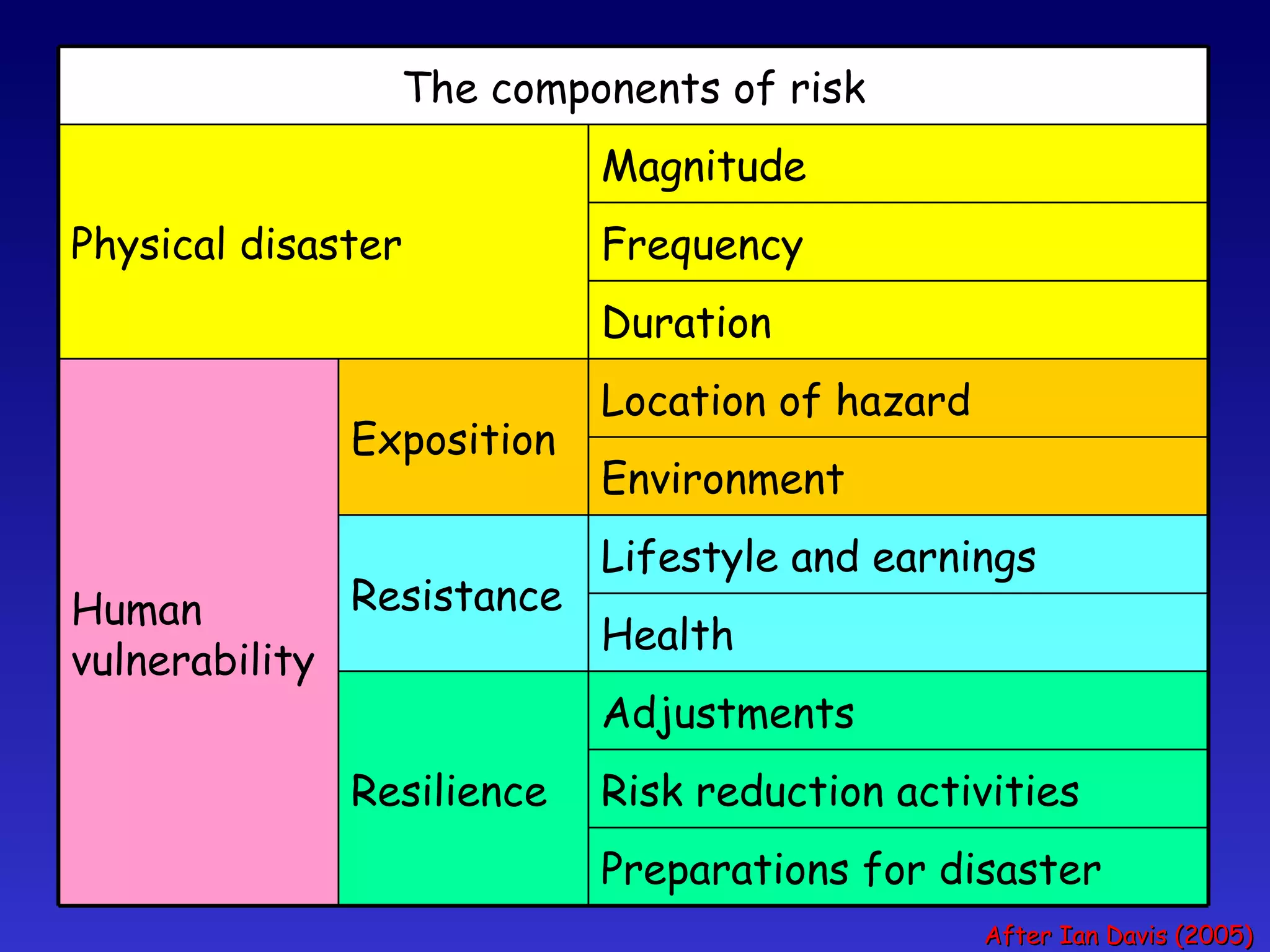
After Ian Davis (2005) The components of risk Physical disaster Magnitude Frequency Duration Human vulnerability Exposition Location of hazard Environment Resistance Lifestyle and earnings Health Resilience Adjustments Risk reduction activities Preparations for disaster
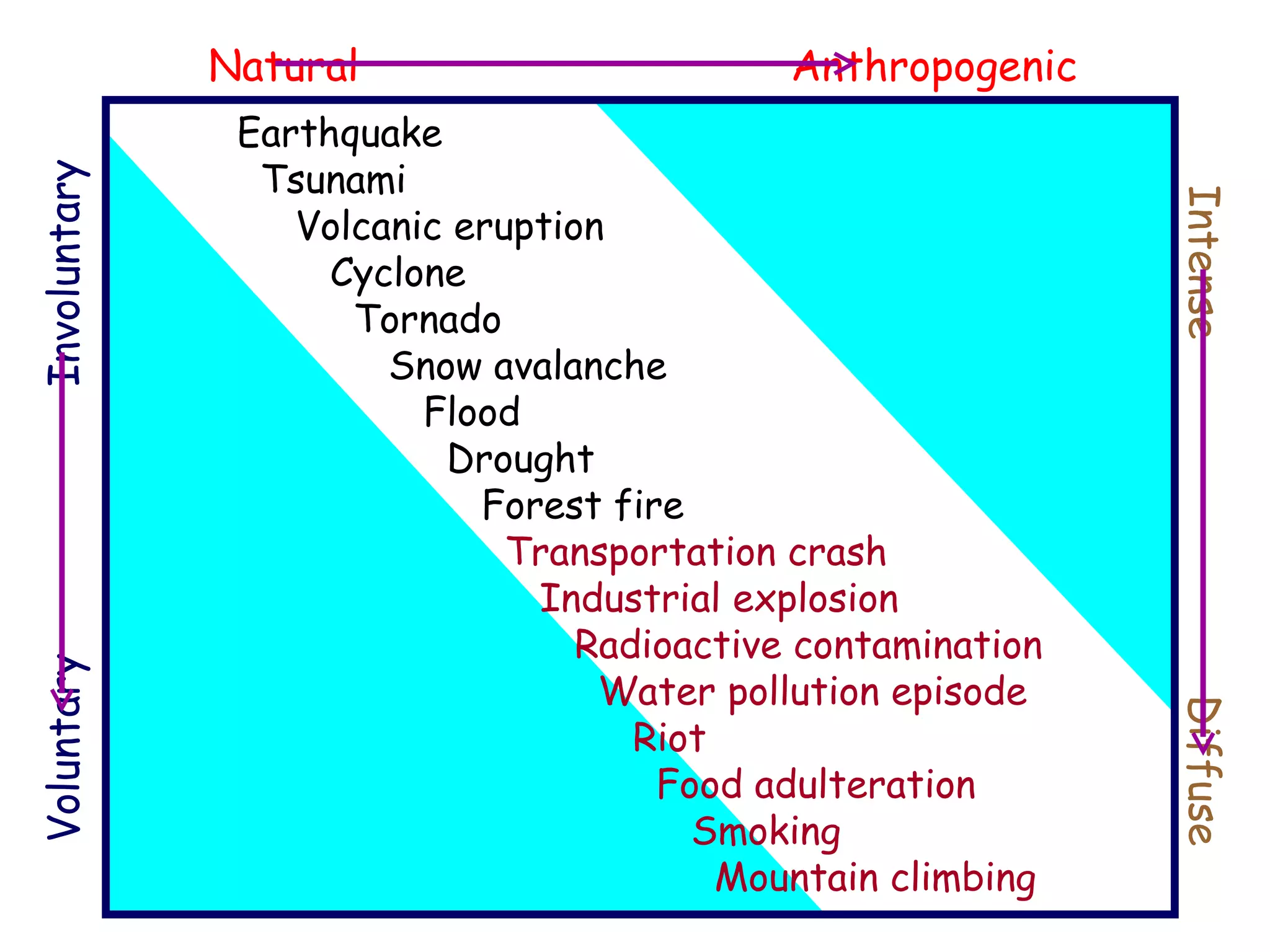
Earthquake Tsunami Volcanic eruption Cyclone Tornado Snow avalanche Flood Drought Forest fire Transportation crash Industrial explosion Radioactive contamination Water pollution episode Riot Food adulteration Smoking Mountain climbing Voluntary  Involuntary Intense  Diffuse Natural  Anthropogenic
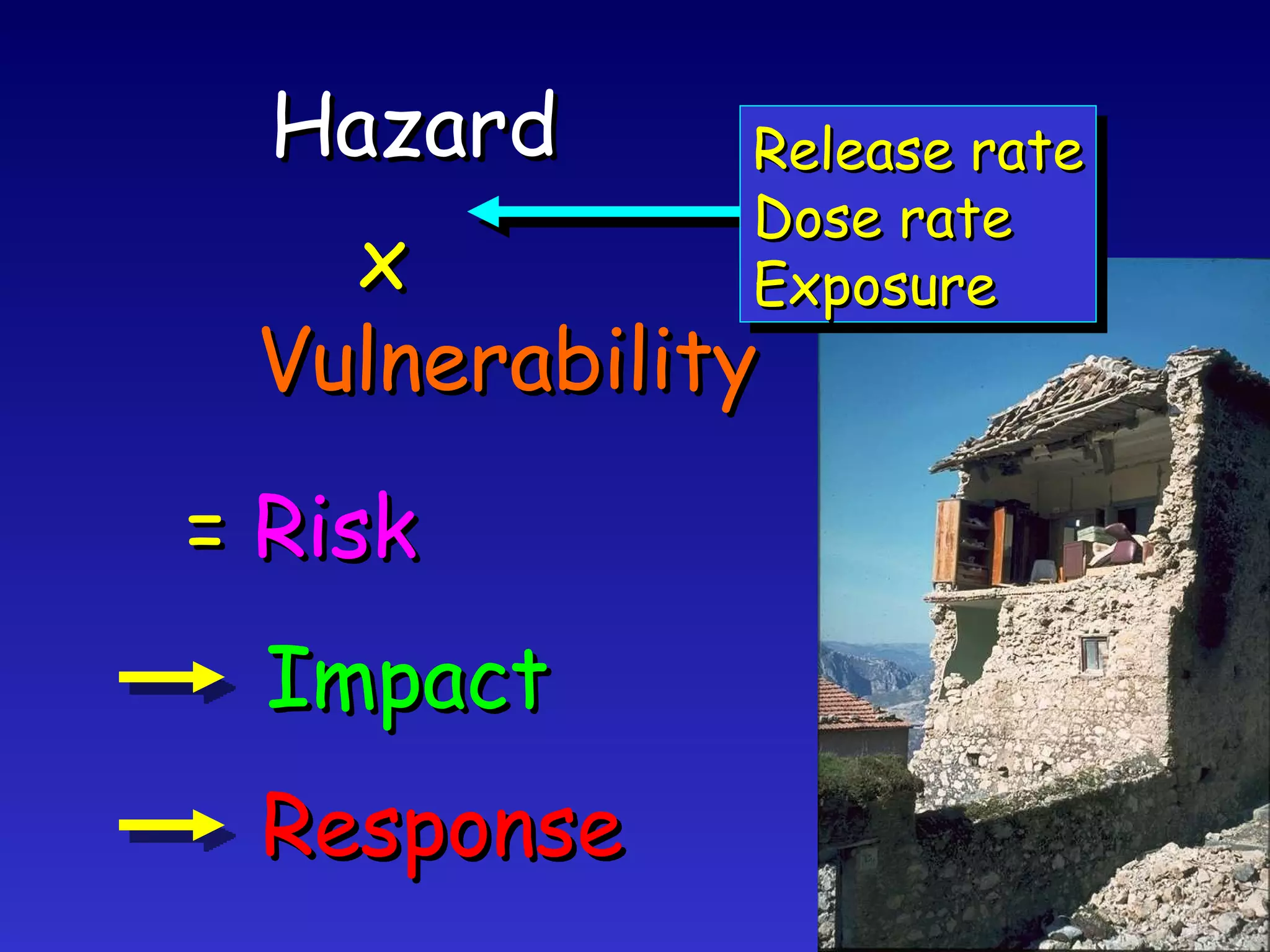
Hazard x  Vulnerability =  Risk Release rate Dose rate Exposure Impact Response
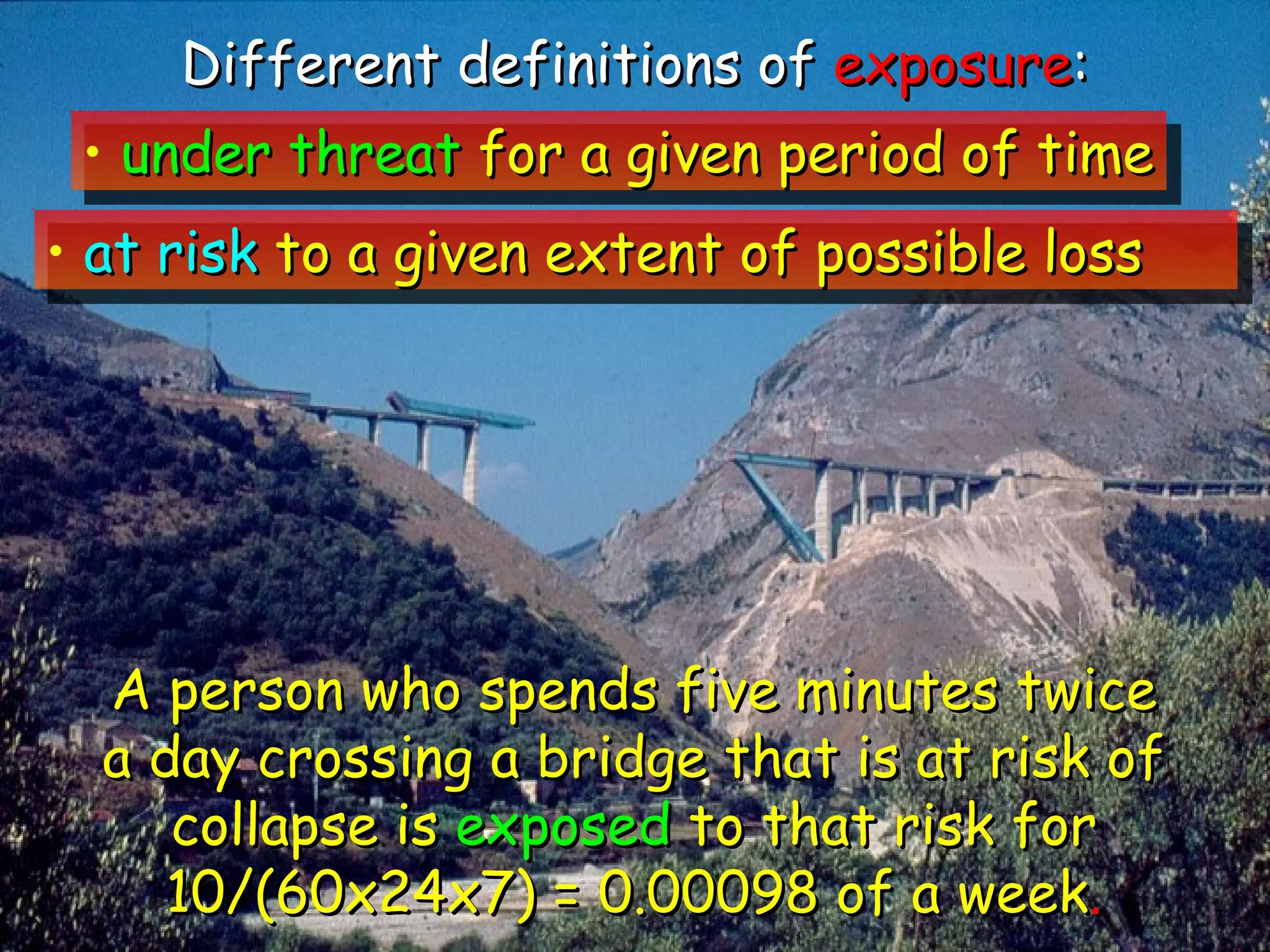
A person who spends five minutes twice a day crossing a bridge that is at risk of collapse is  exposed  to that risk for 10/(60x24x7) = 0.00098 of a week . under threat  for a given period of time at risk  to a given extent of possible loss Different definitions of  exposure :
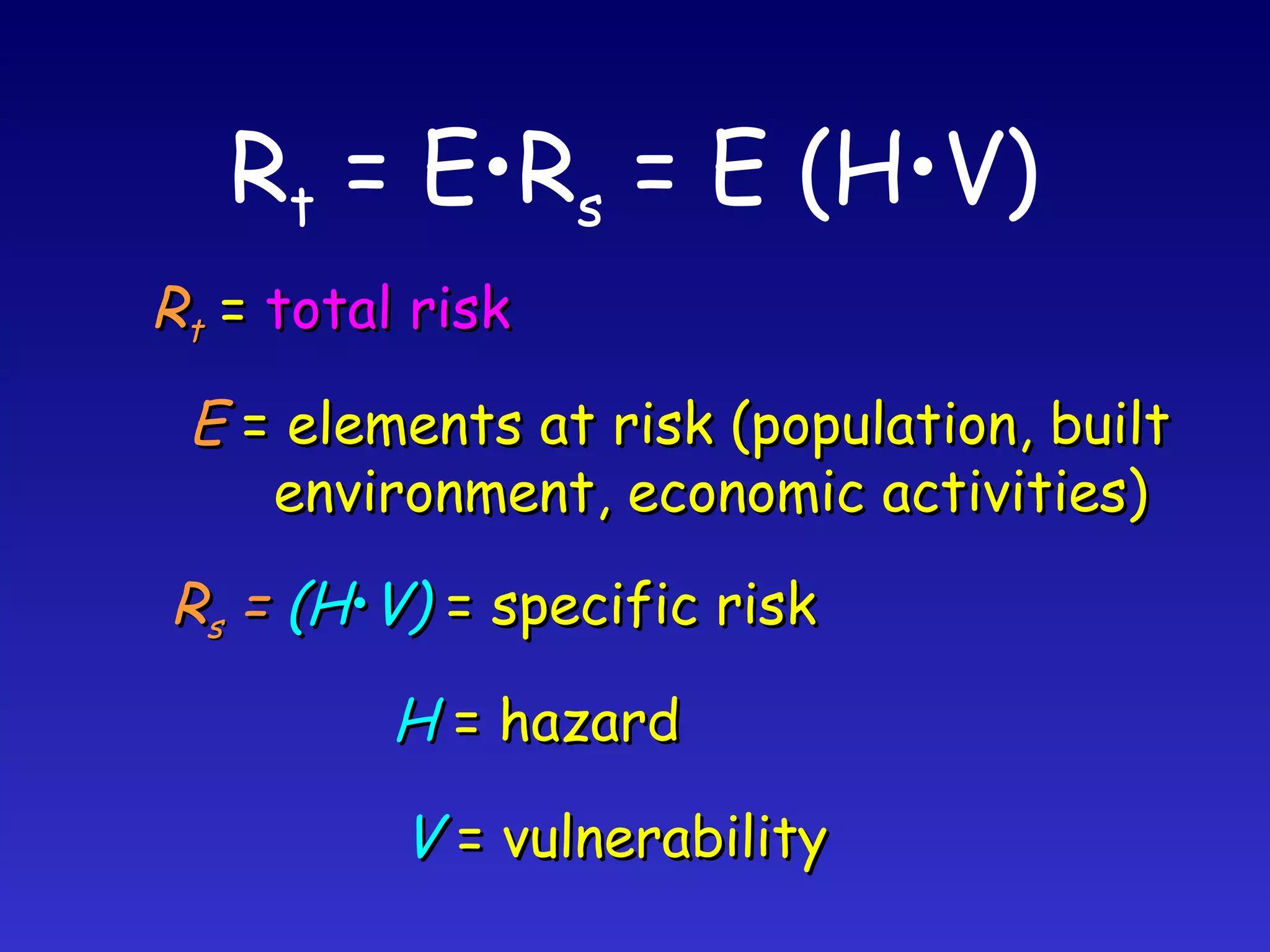
R t  = E•R s  = E (H•V) R t  =  total risk E  = elements at risk (population, built environment, economic activities) R s  =  (H • V)   = specific risk H  = hazard V  = vulnerability
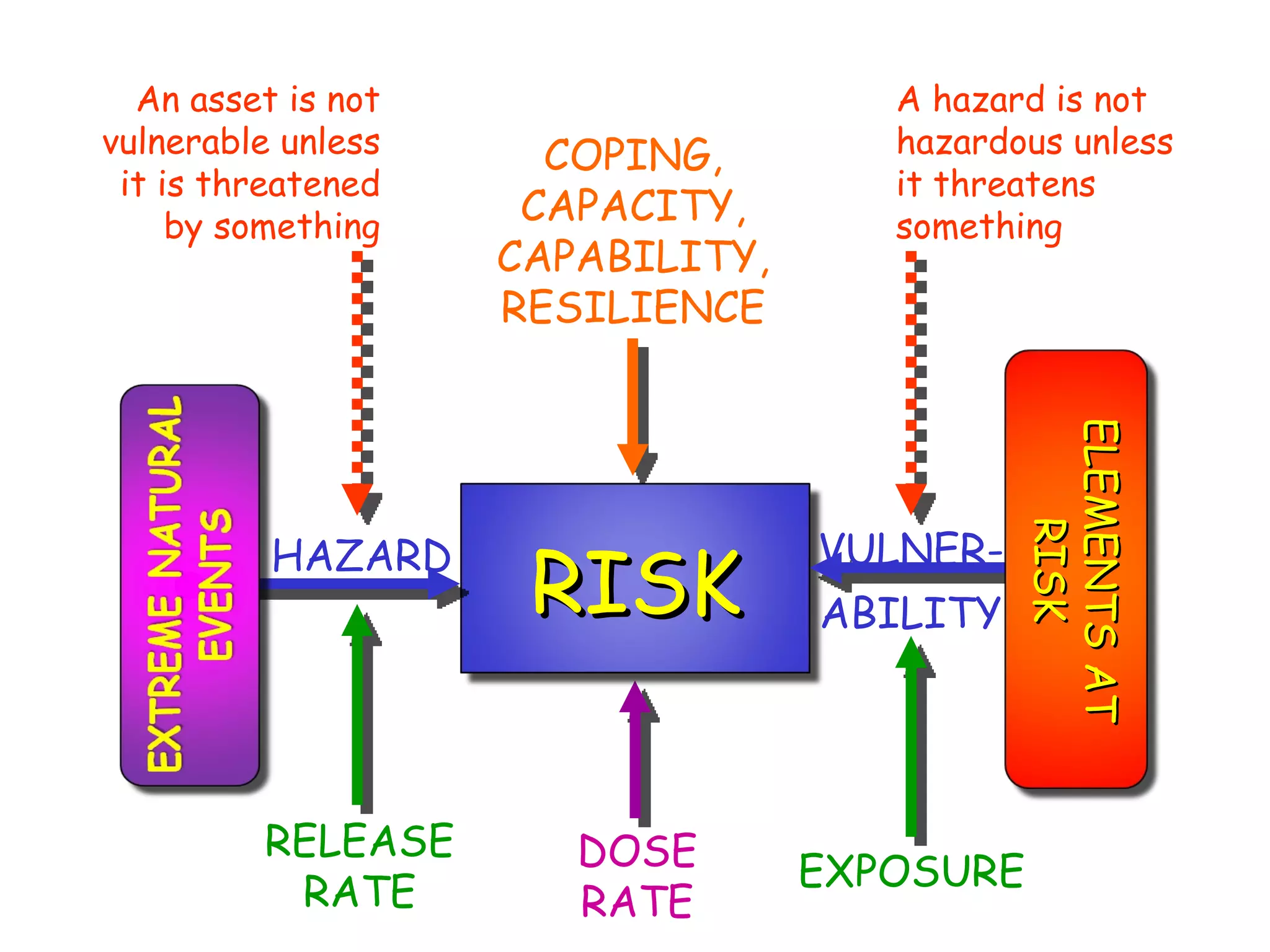
RELEASE RATE DOSE RATE EXPOSURE An asset is not vulnerable unless it is threatened by something A hazard is not hazardous unless it threatens something COPING, CAPACITY, CAPABILITY, RESILIENCE RISK HAZARD VULNER- ABILITY ELEMENTS AT RISK
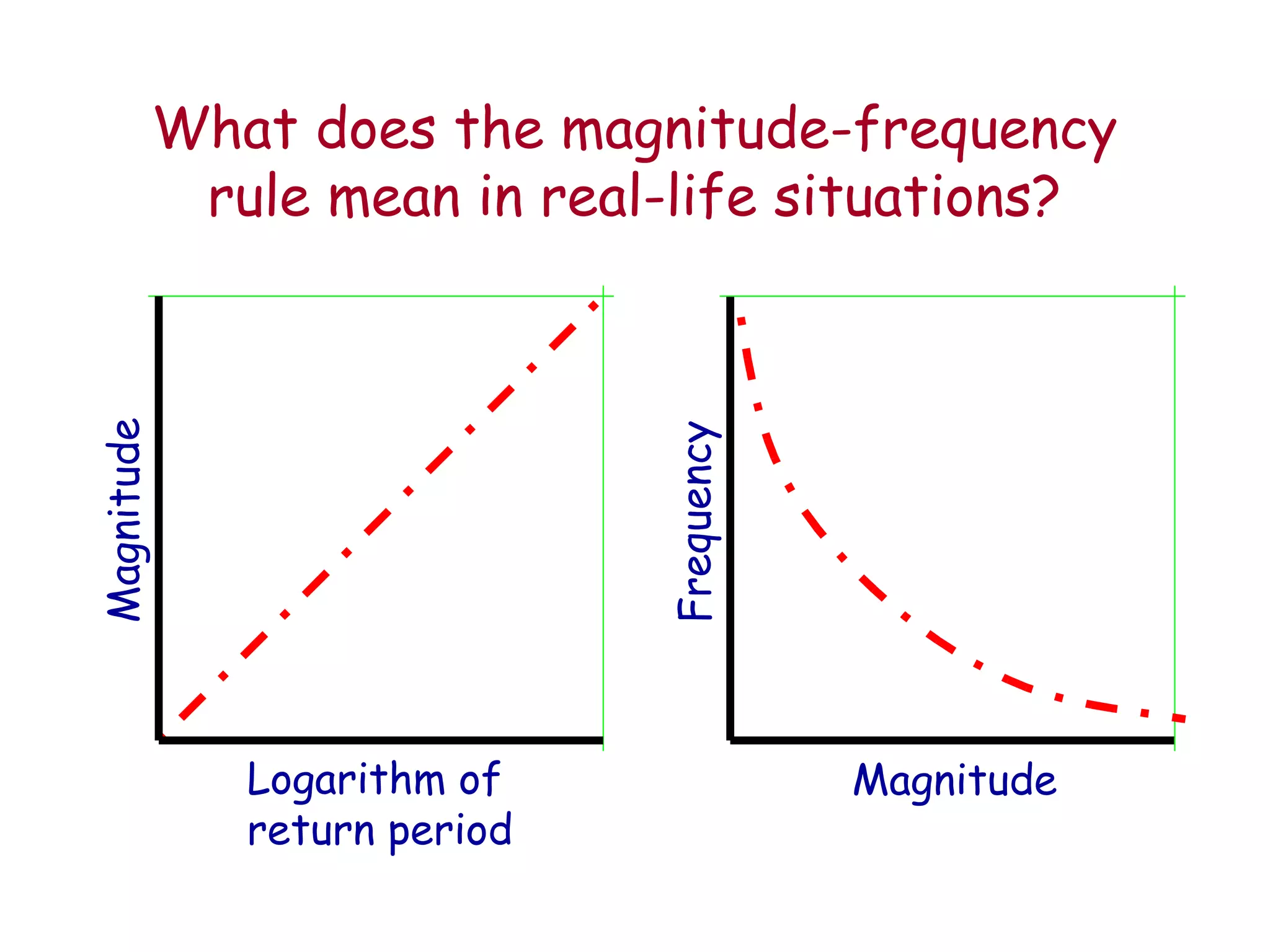
Magnitude Frequency Logarithm of return period Magnitude What does the magnitude-frequency rule mean in real-life situations?
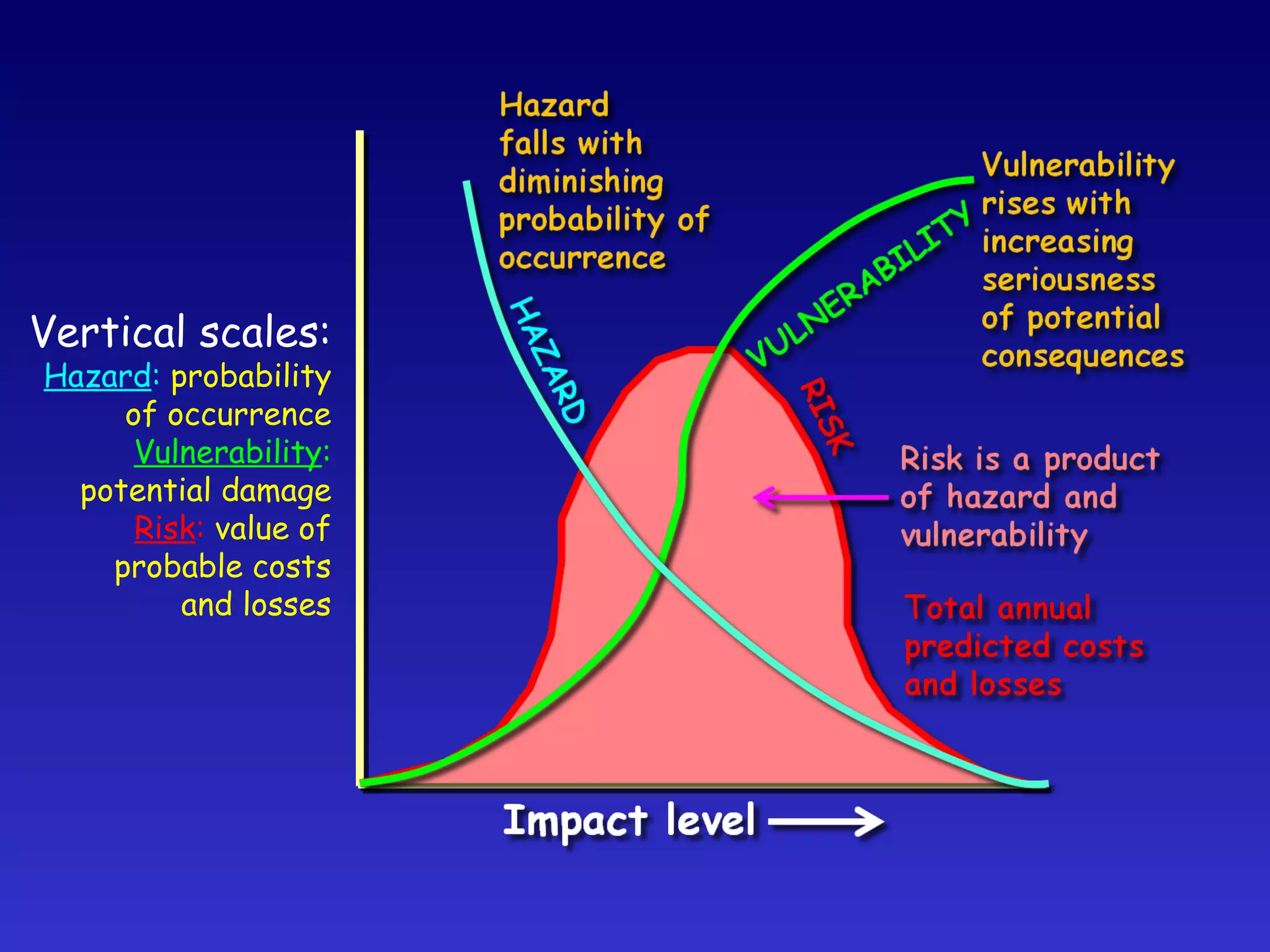
Vertical scales: Hazard :  probability of occurrence Vulnerability : potential damage Risk :   value of probable costs and losses
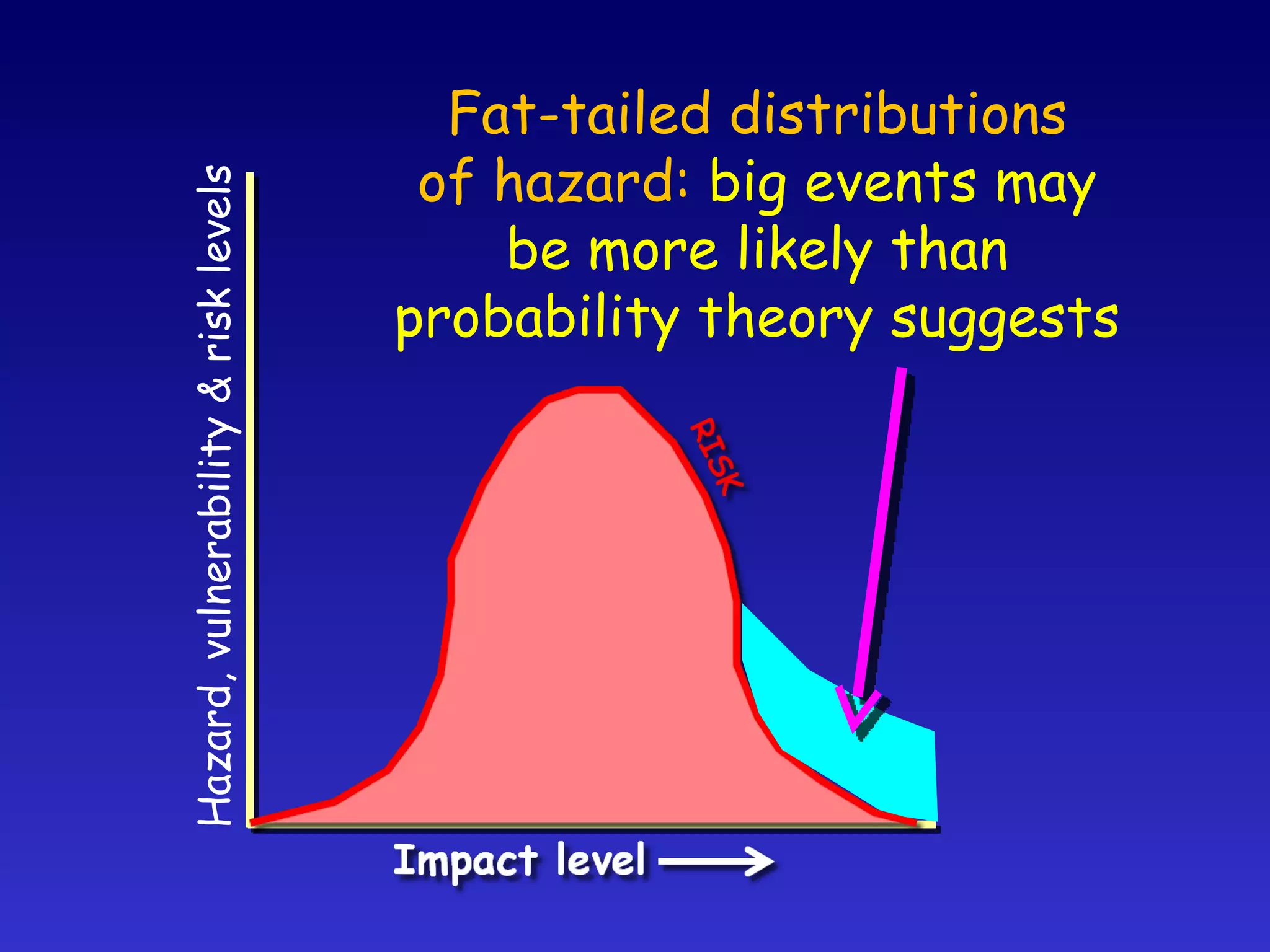
Fat-tailed distributions of hazard:  big events may be more likely than probability theory suggests Hazard, vulnerability & risk levels
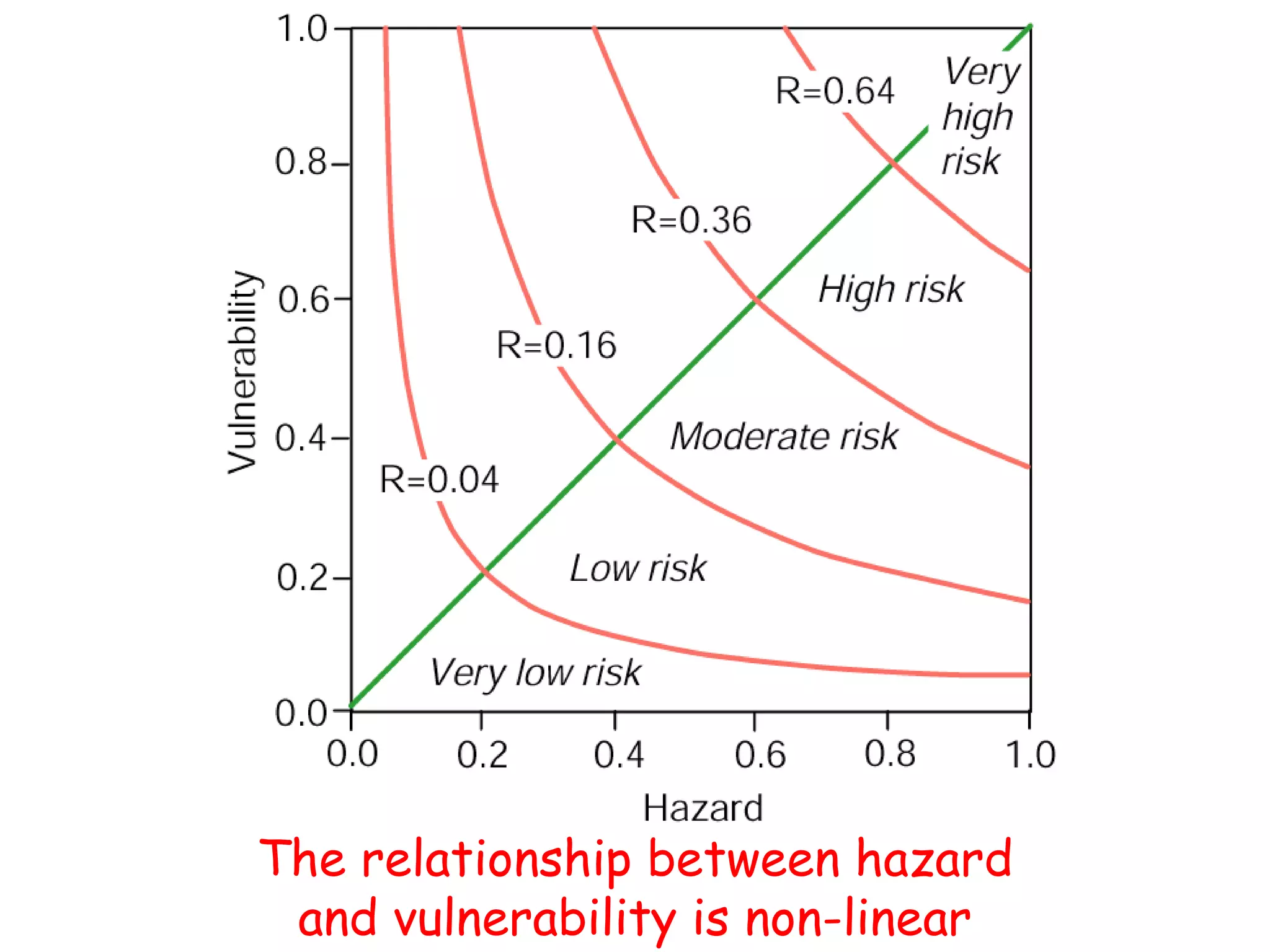
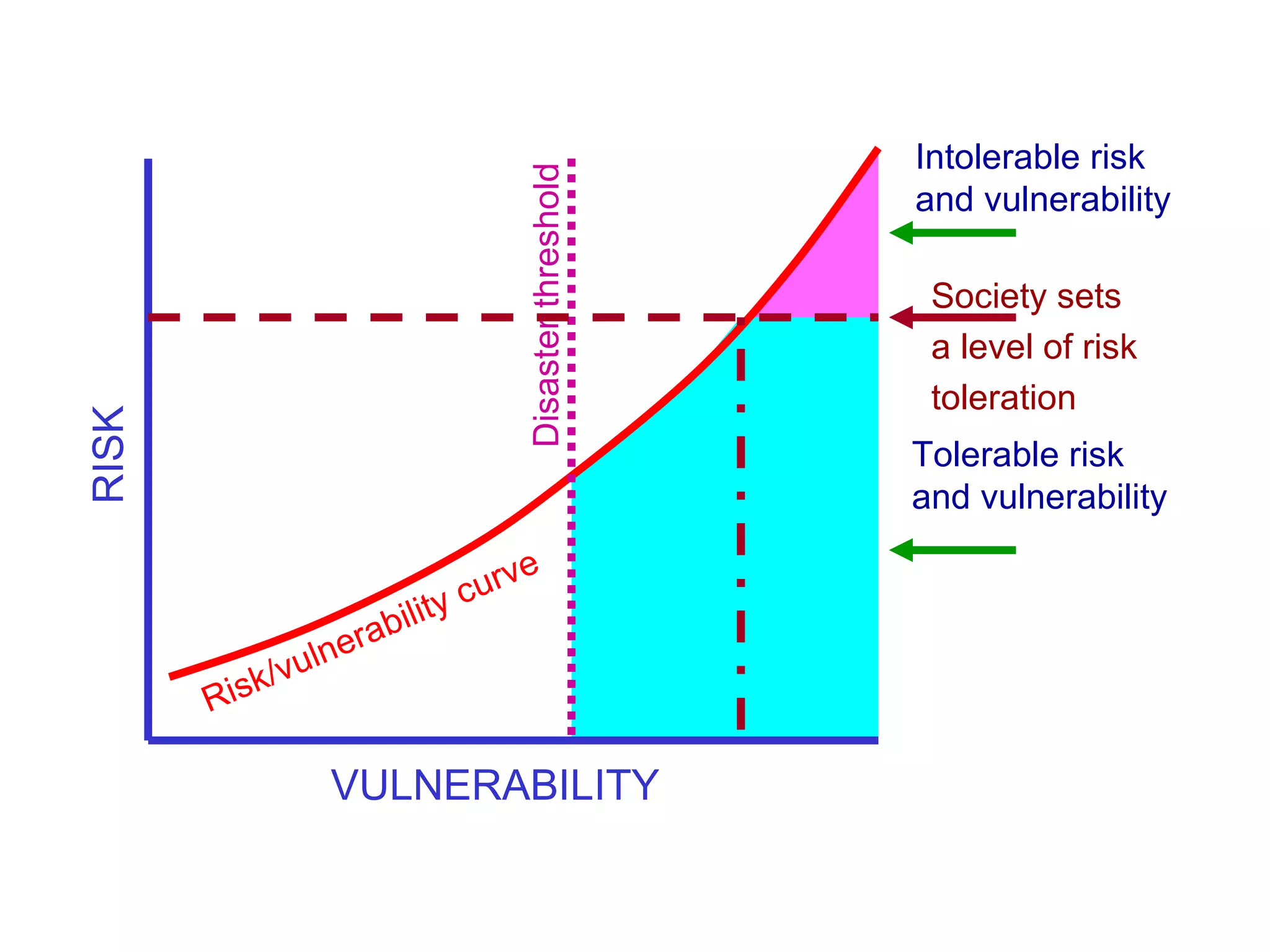
The relationship between hazard and vulnerability is non-linear
VULNERABILITY RISK Intolerable risk and vulnerability Tolerable risk and vulnerability Risk/vulnerability curve Disaster threshold Society sets a level of risk toleration
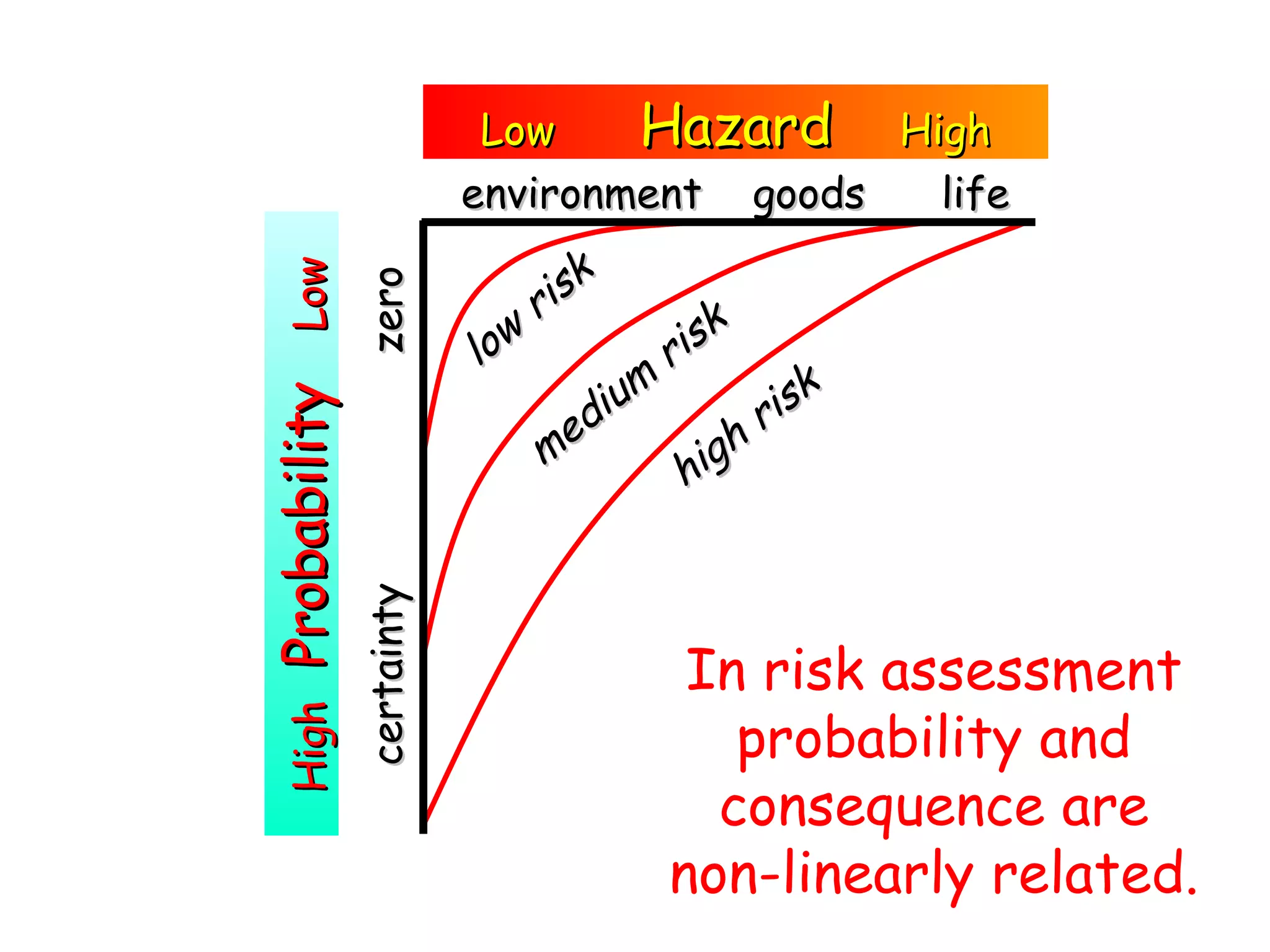
Low   Hazard  High environment  goods  life High   Probability  Low certainty  zero In risk assessment probability and consequence are non-linearly related. high risk medium risk low risk
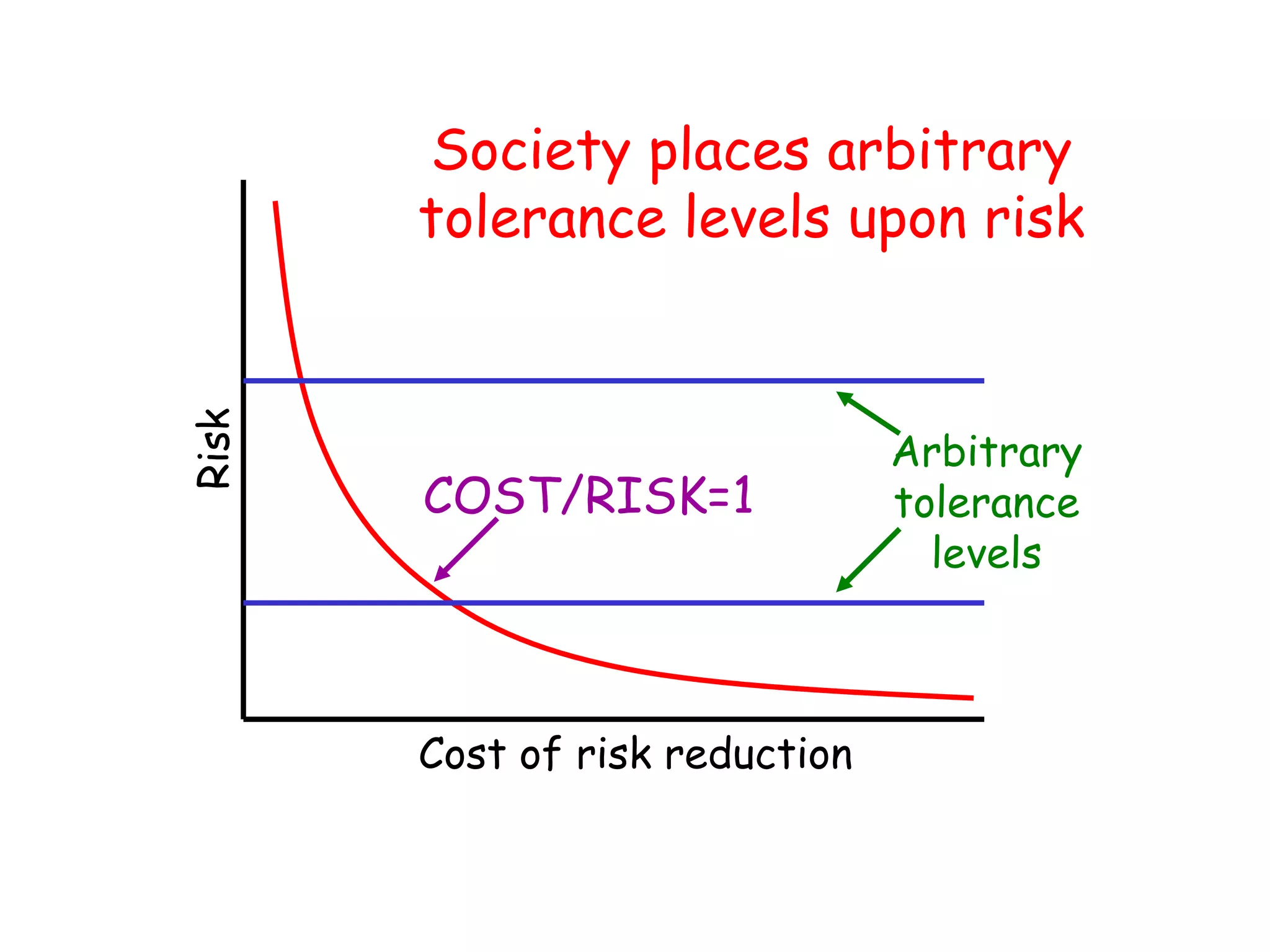
Society places arbitrary tolerance levels upon risk Cost of risk reduction Risk Arbitrary tolerance levels COST/RISK=1
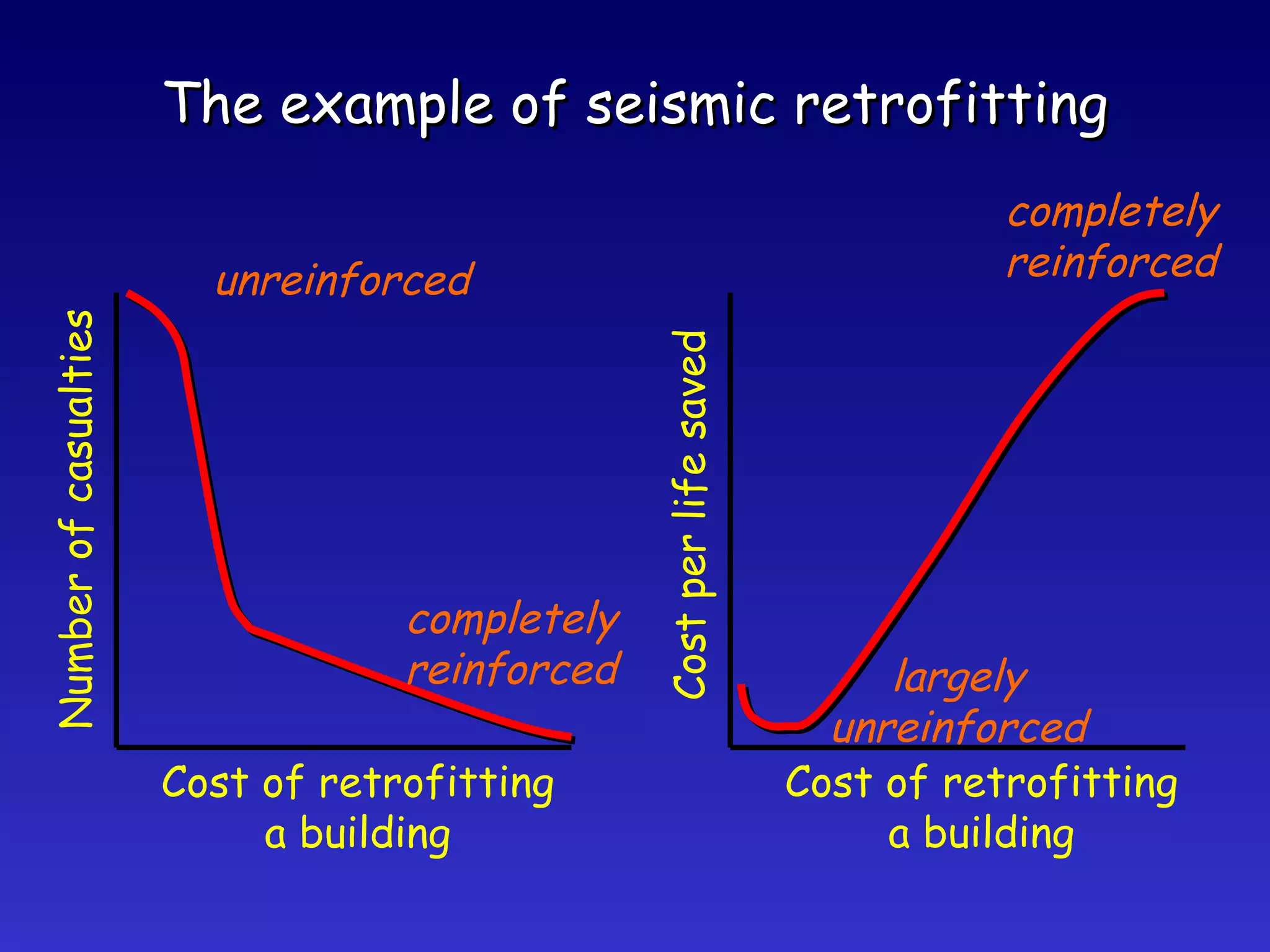
Number of casualties Cost of retrofitting a building The example of seismic retrofitting unreinforced completely reinforced completely reinforced largely unreinforced Cost of retrofitting a building Cost per life saved
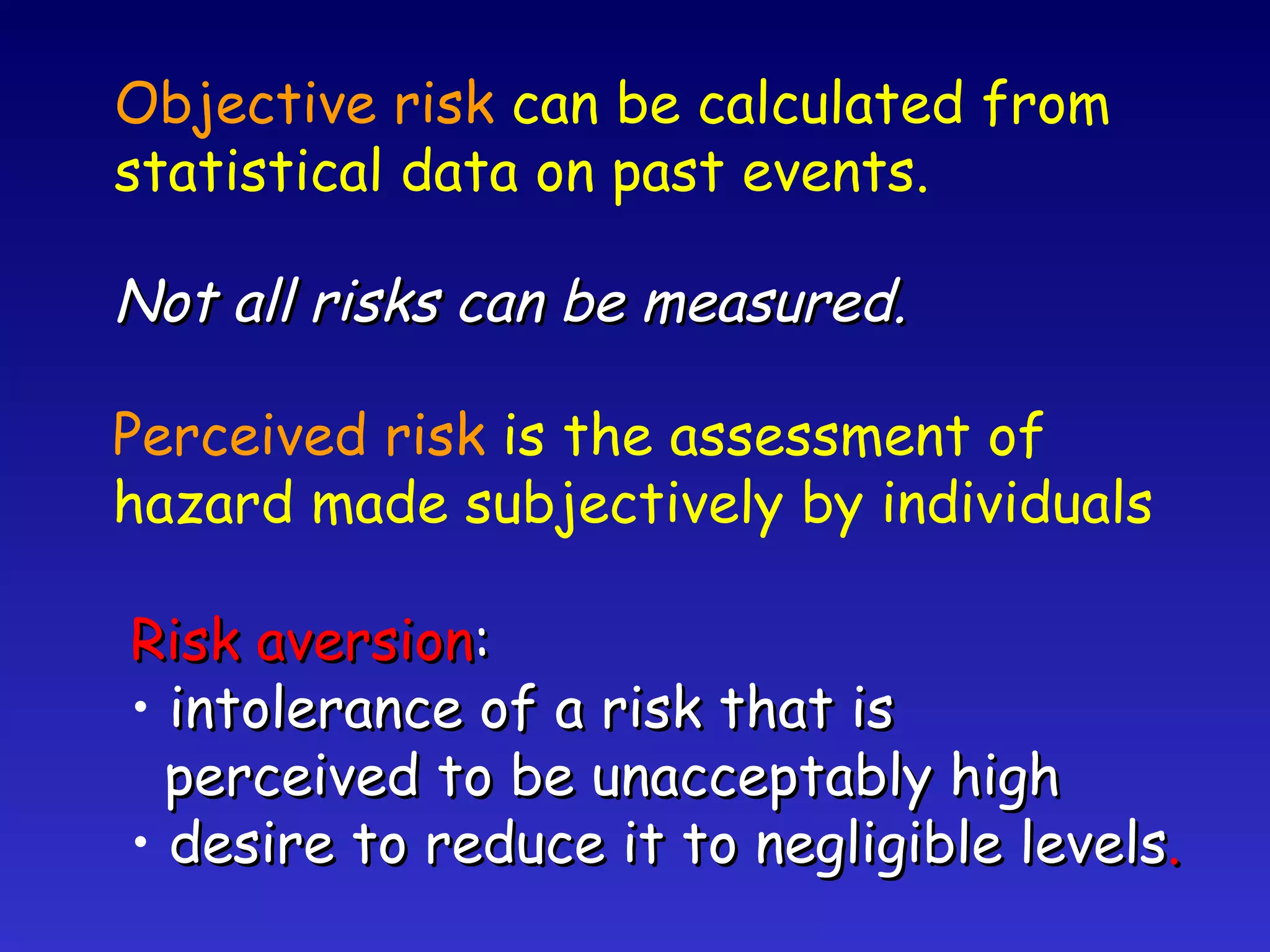
Perceived risk  is the assessment of hazard made subjectively by individuals Risk aversion : intolerance of a risk that is perceived to be unacceptably high desire to reduce it to negligible levels . Objective risk  can be calculated from  statistical data on past events. Not all risks can be measured.
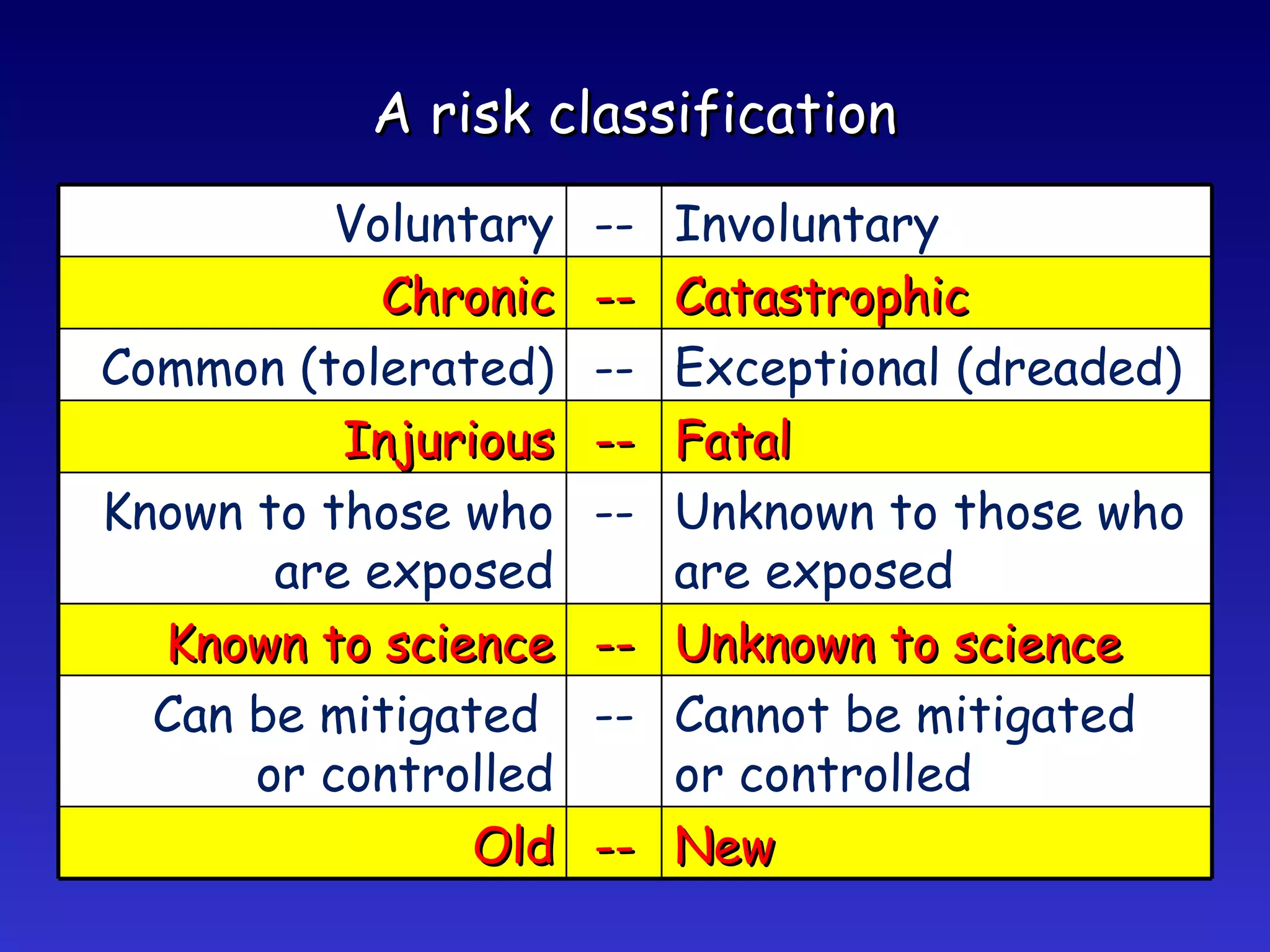
A risk classification Voluntary -- Involuntary Chronic -- Catastrophic Common (tolerated) -- Exceptional (dreaded) Injurious -- Fatal Known to those who are exposed -- Unknown to those who are exposed Known to science -- Unknown to science Can be mitigated  or controlled -- Cannot be mitigated or controlled Old -- New
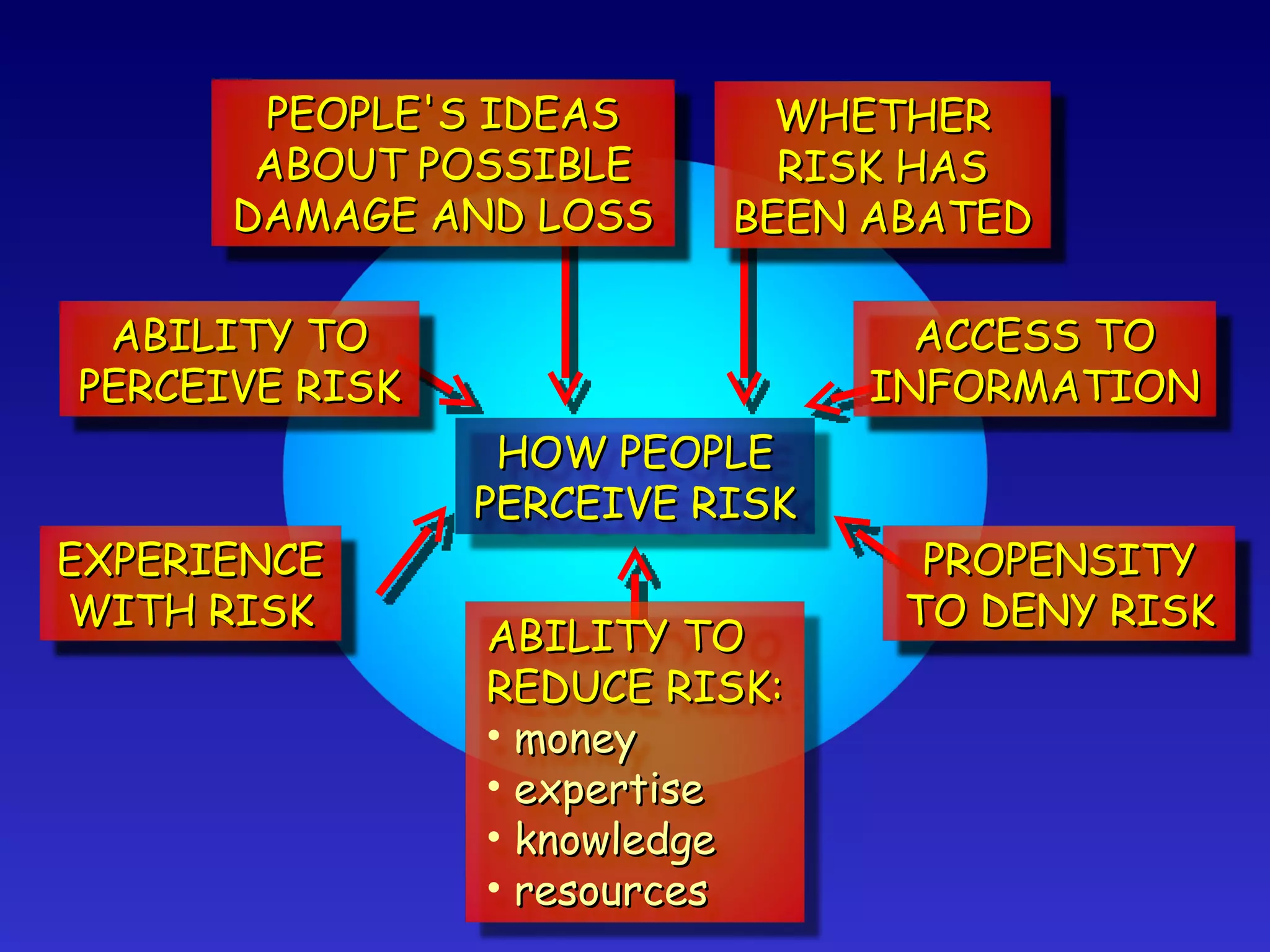
HOW PEOPLE PERCEIVE RISK ABILITY TO PERCEIVE RISK EXPERIENCE WITH RISK PROPENSITY TO DENY RISK ACCESS TO INFORMATION ABILITY TO REDUCE RISK: money  expertise  knowledge resources  WHETHER RISK HAS BEEN ABATED PEOPLE'S IDEAS ABOUT POSSIBLE DAMAGE AND LOSS
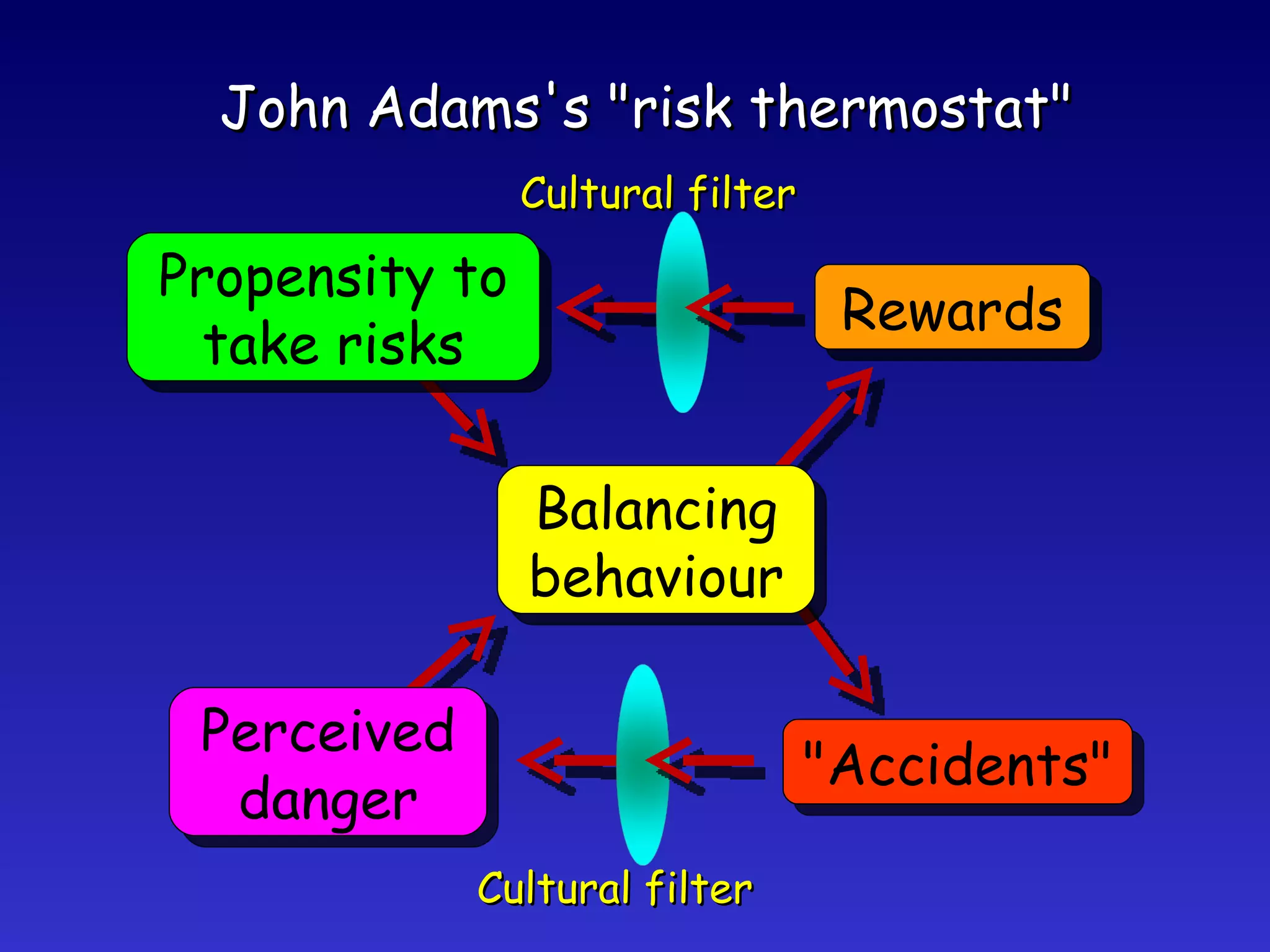
John Adams's "risk thermostat" Balancing behaviour "Accidents" Perceived danger Rewards Propensity to take risks Cultural filter Cultural filter
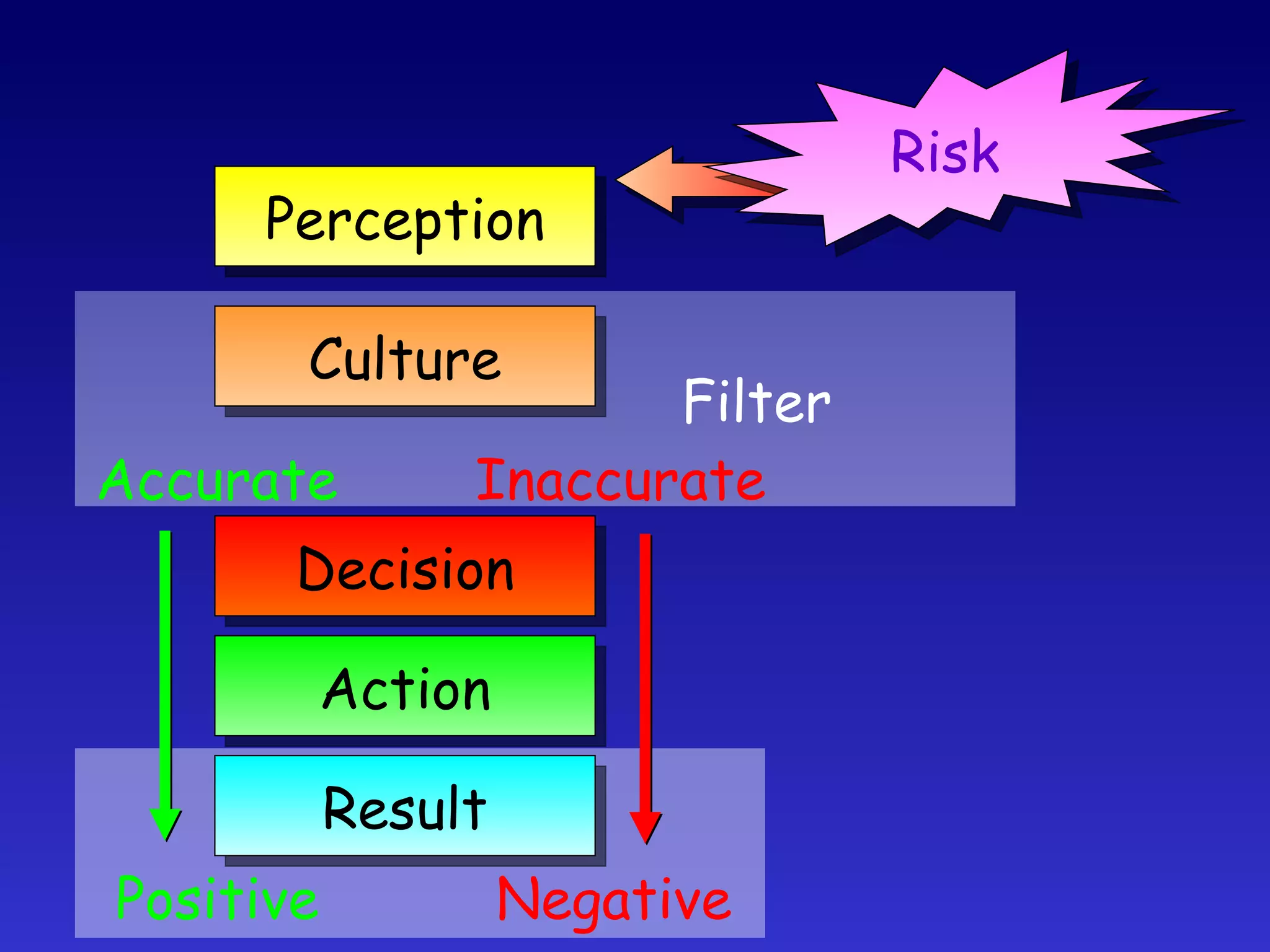
Filter Perception Culture Decision Action Result Positive Negative Risk Accurate Inaccurate
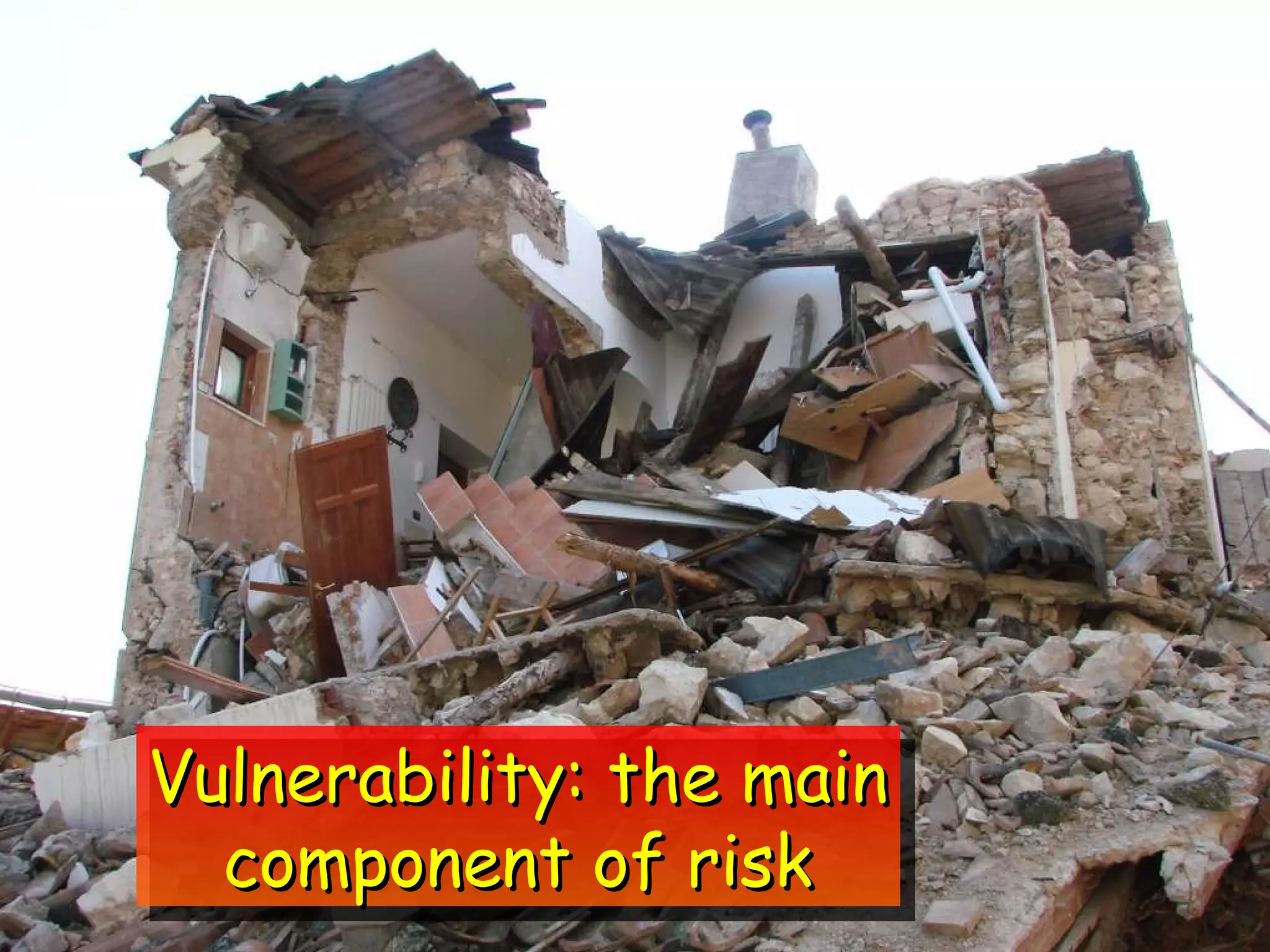
Vulnerability: the main component of risk
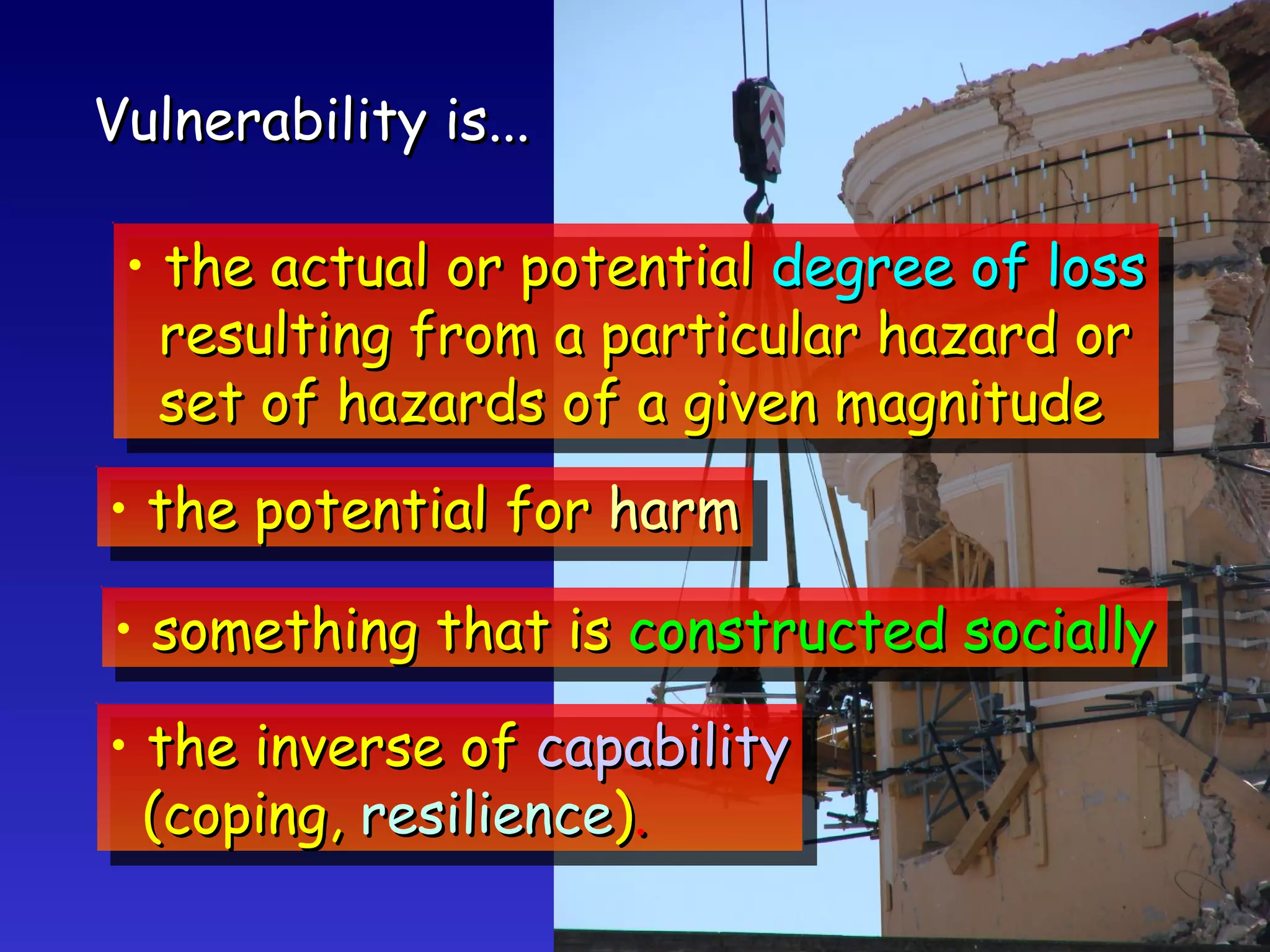
Vulnerability is... the actual or potential  degree of loss resulting from a particular hazard or set of hazards of a given magnitude the potential for  harm something that is  constructed socially the inverse of  capability (coping,  resilience ) .
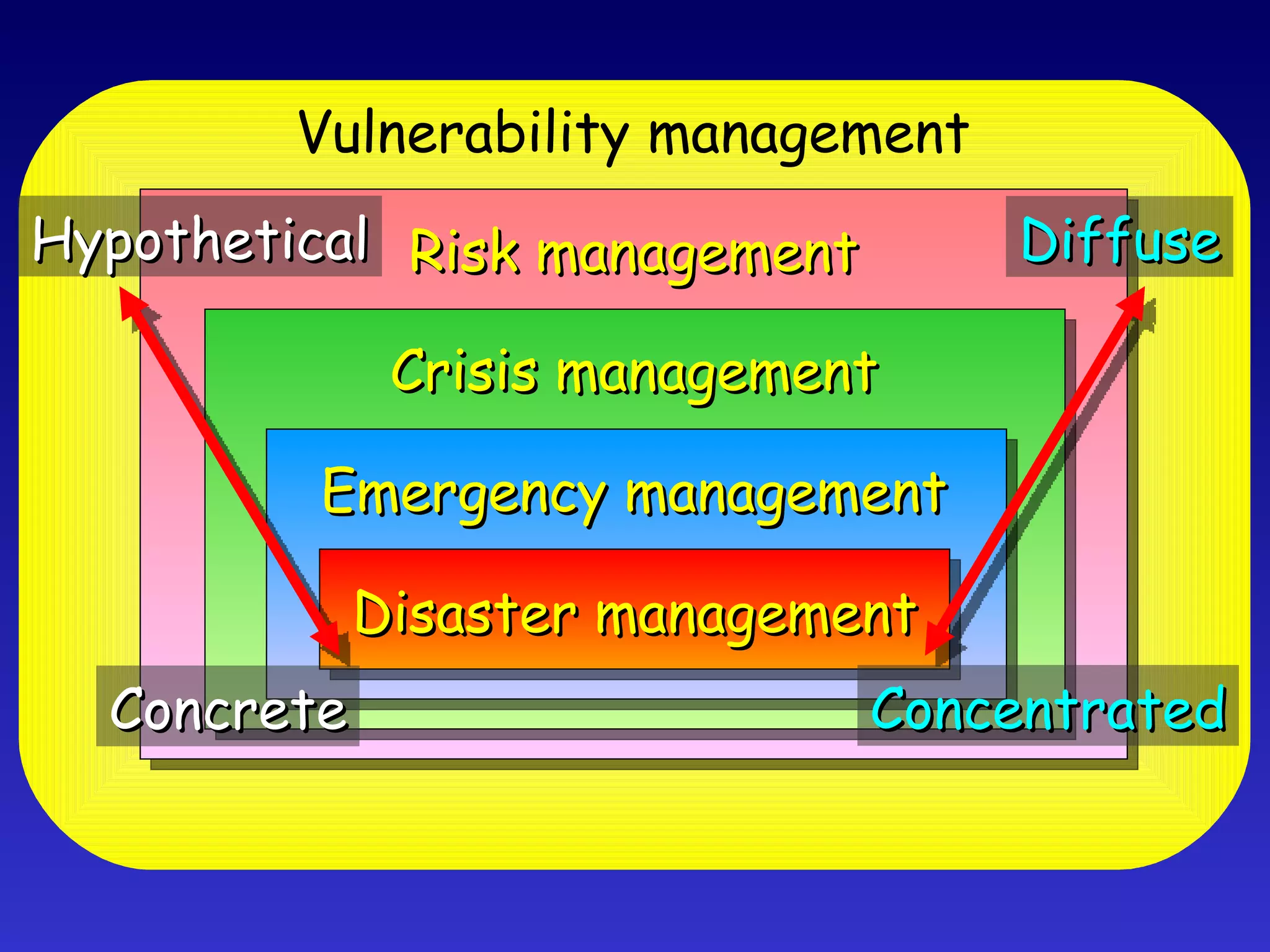
Disaster management Risk management Crisis management Emergency management Hypothetical Concrete Concentrated Diffuse Vulnerability management
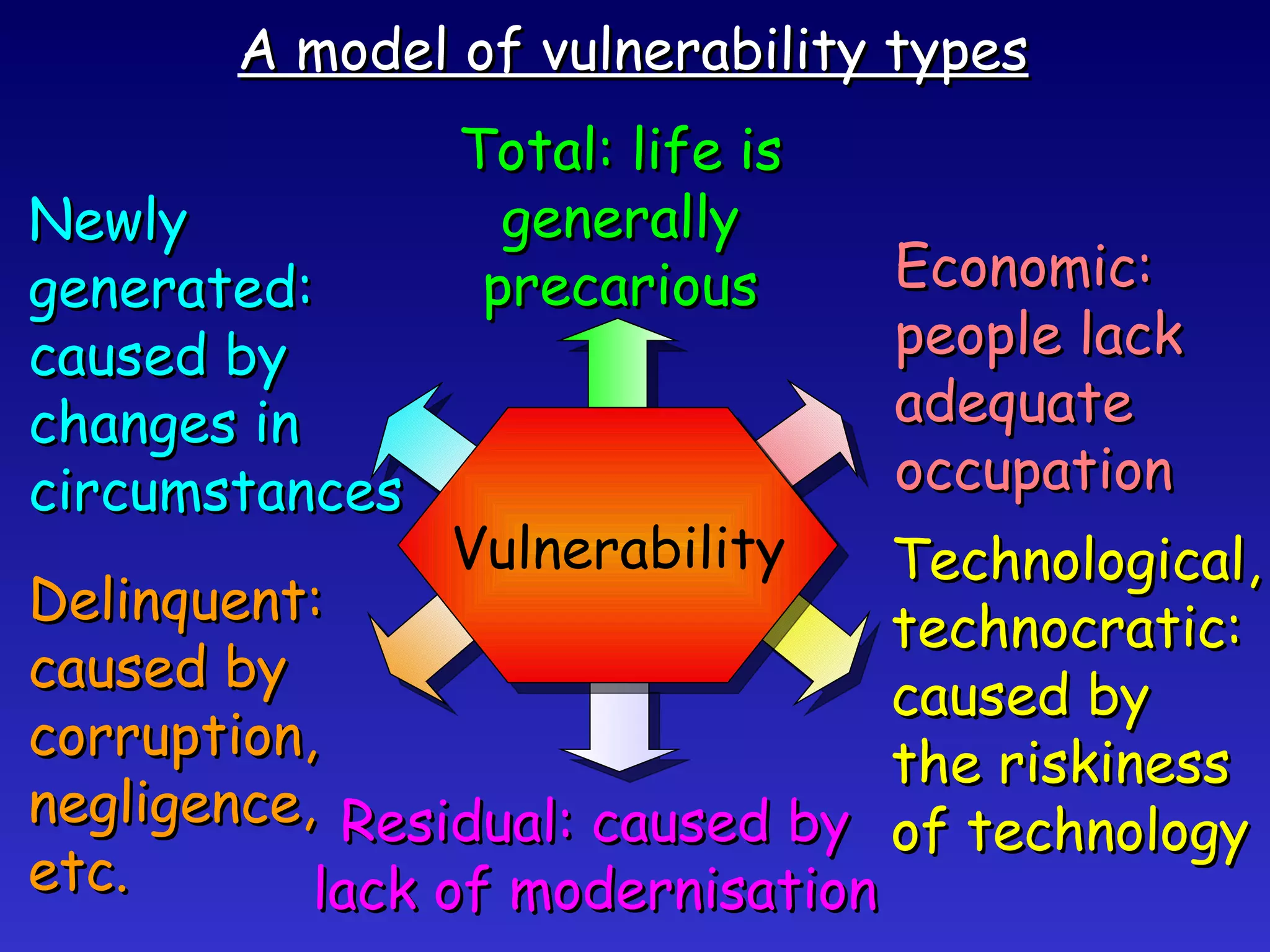
A model of vulnerability types Vulnerability Total: life is generally precarious Residual: caused by lack of modernisation Newly generated: caused by changes in circumstances Delinquent: caused by corruption, negligence, etc. Economic: people lack adequate occupation Technological, technocratic: caused by the riskiness of technology
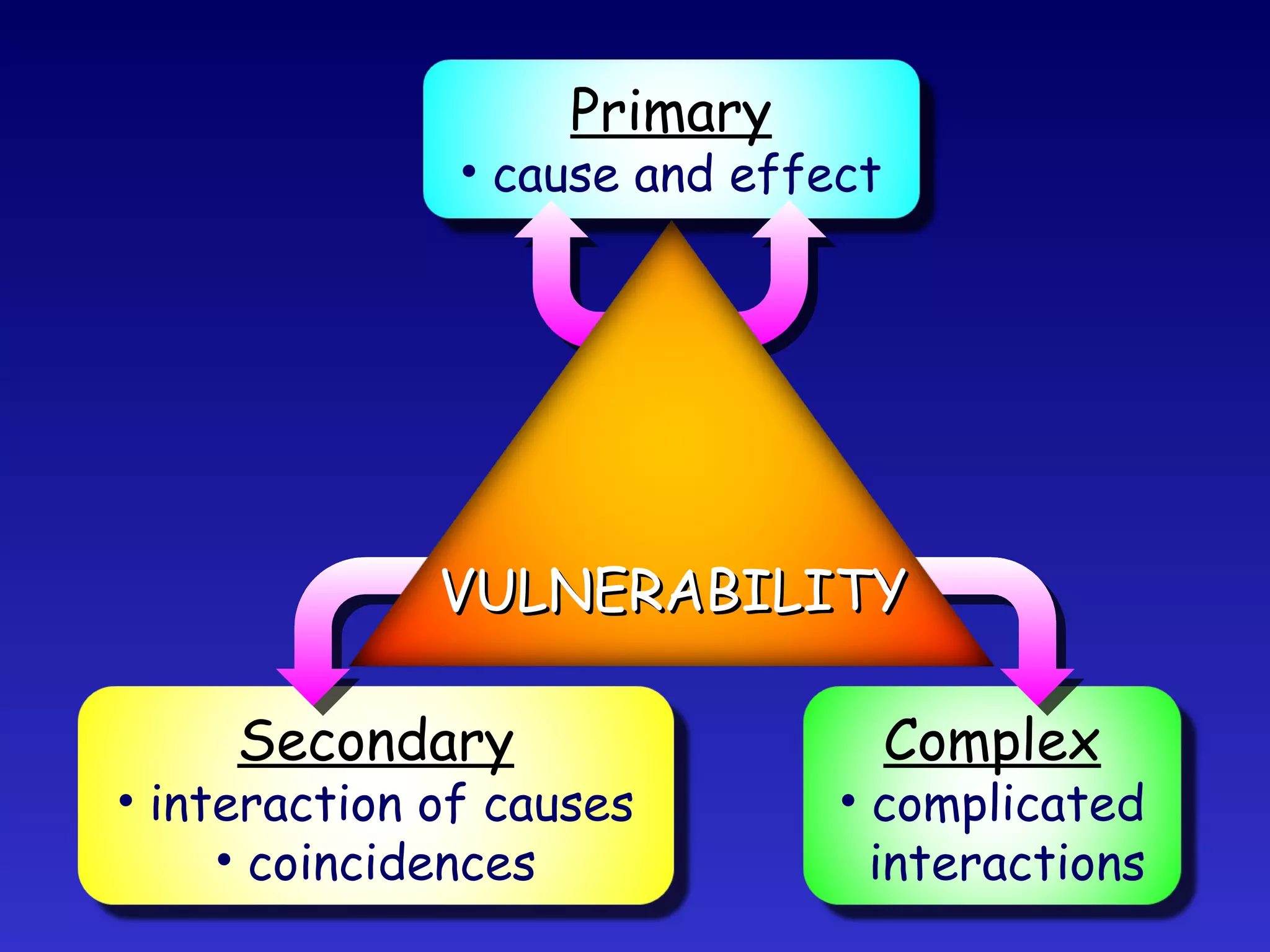
Primary cause and effect Secondary interaction of causes coincidences Complex complicated interactions VULNERABILITY
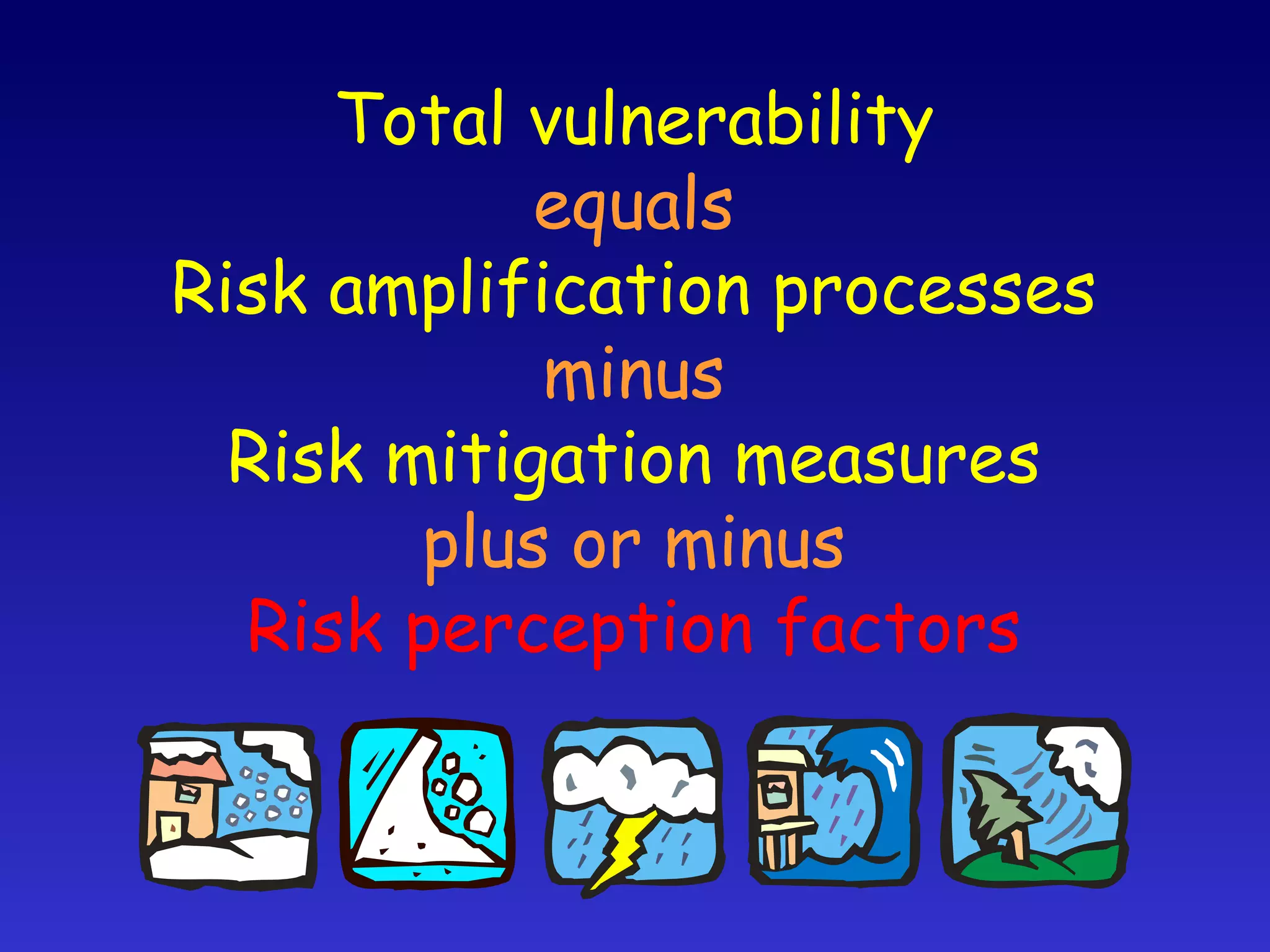
Total vulnerability equals Risk amplification processes minus Risk mitigation measures plus or minus Risk perception factors
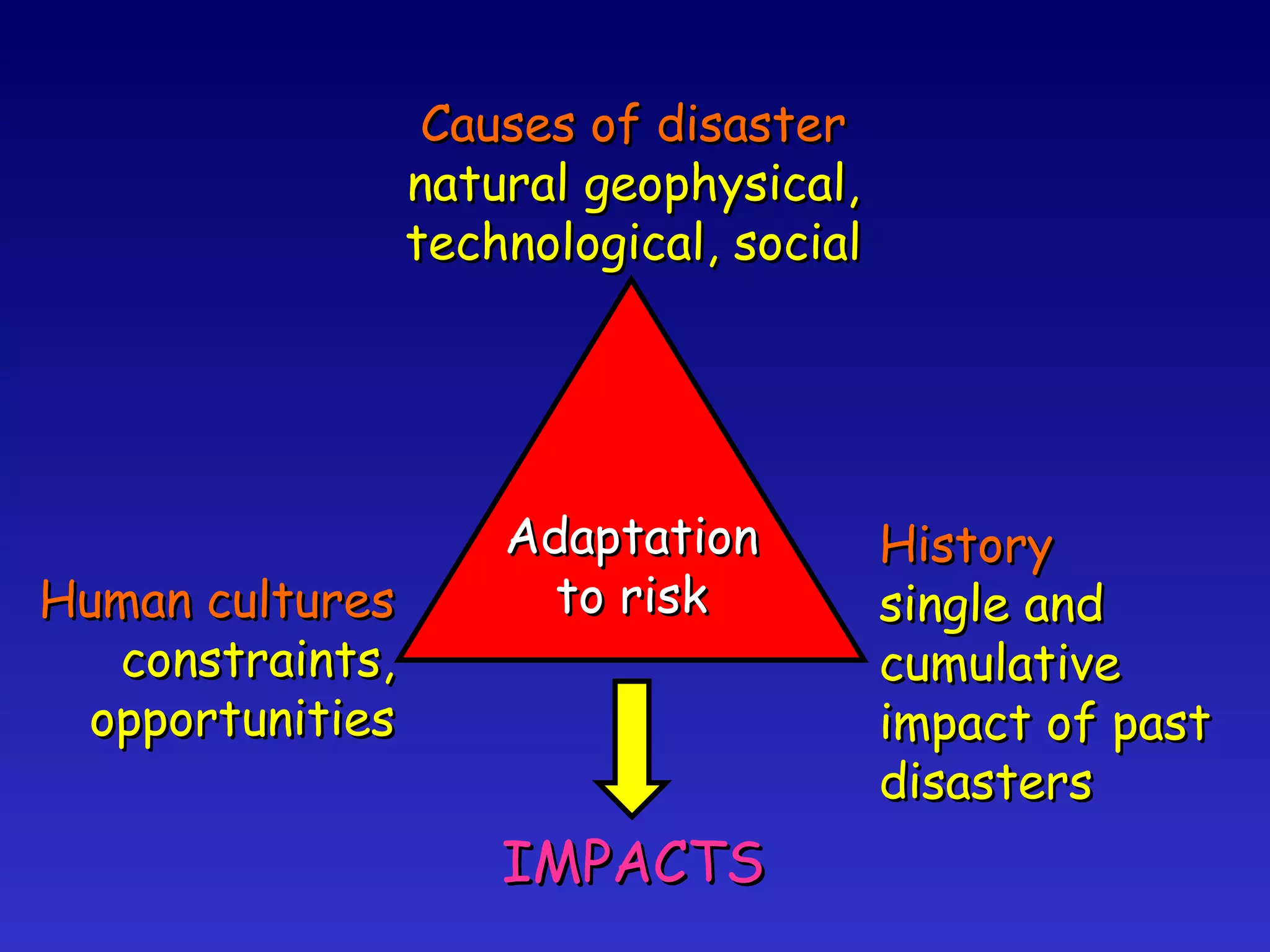
Human cultures constraints, opportunities History single and cumulative impact of past disasters Causes of disaster natural geophysical, technological, social Adaptation to risk IMPACTS
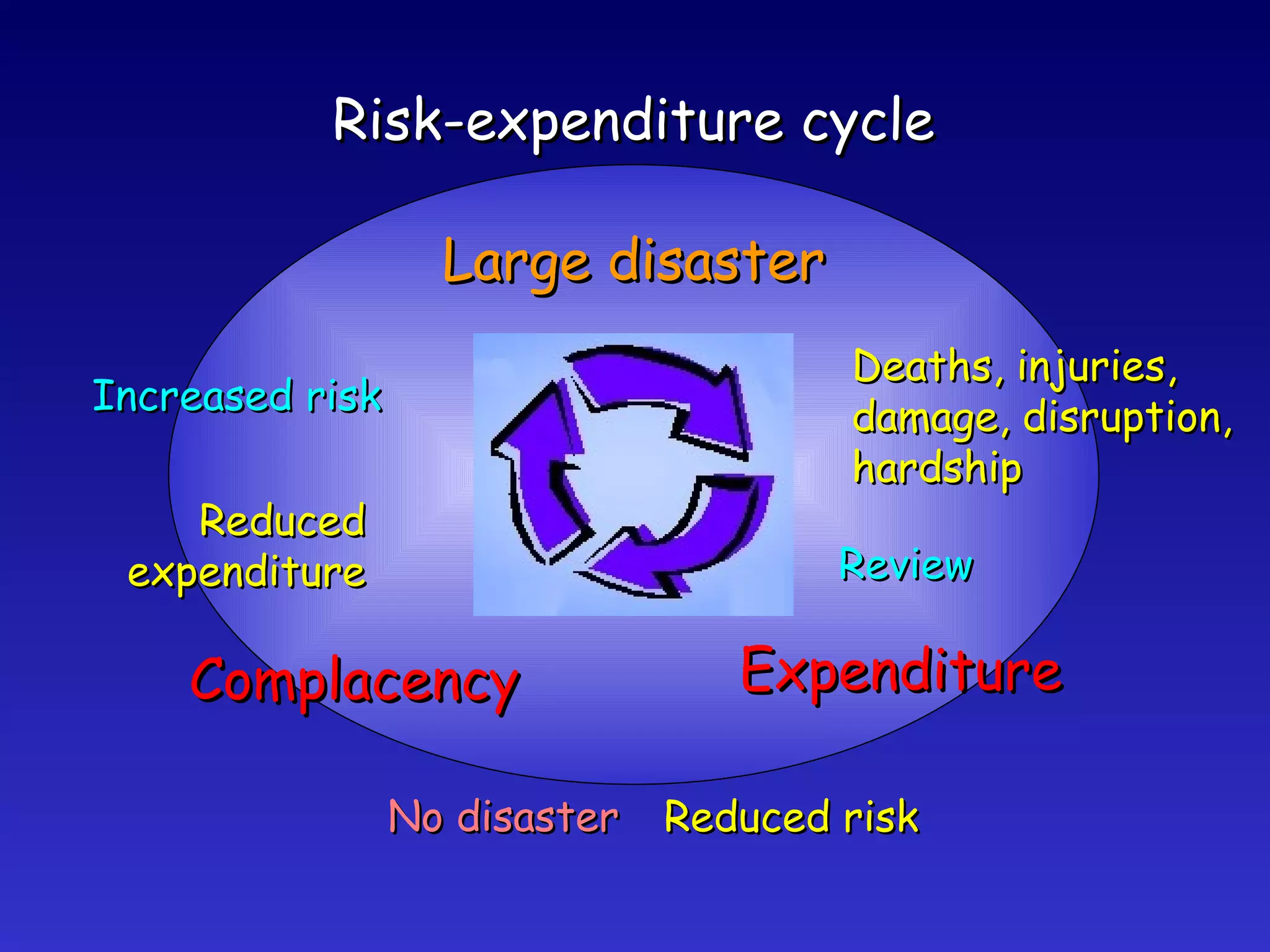
Large disaster Expenditure Complacency Risk-expenditure cycle Deaths, injuries, damage, disruption, hardship Review Reduced risk No disaster Reduced expenditure Increased risk
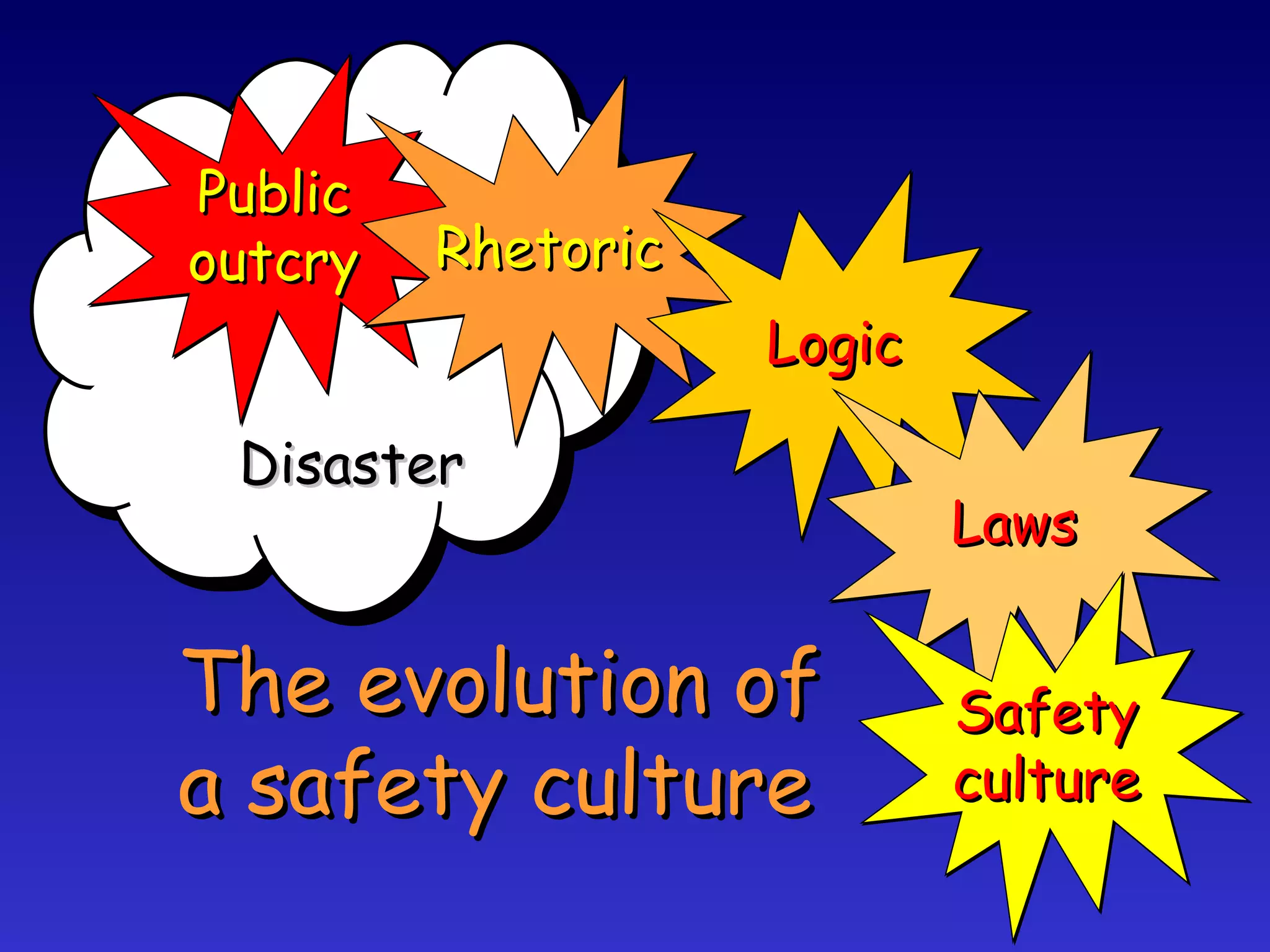
Public  outcry Rhetoric Logic Laws Safety  culture The evolution of a safety culture Disaster
 
 
What exactly is resilience?
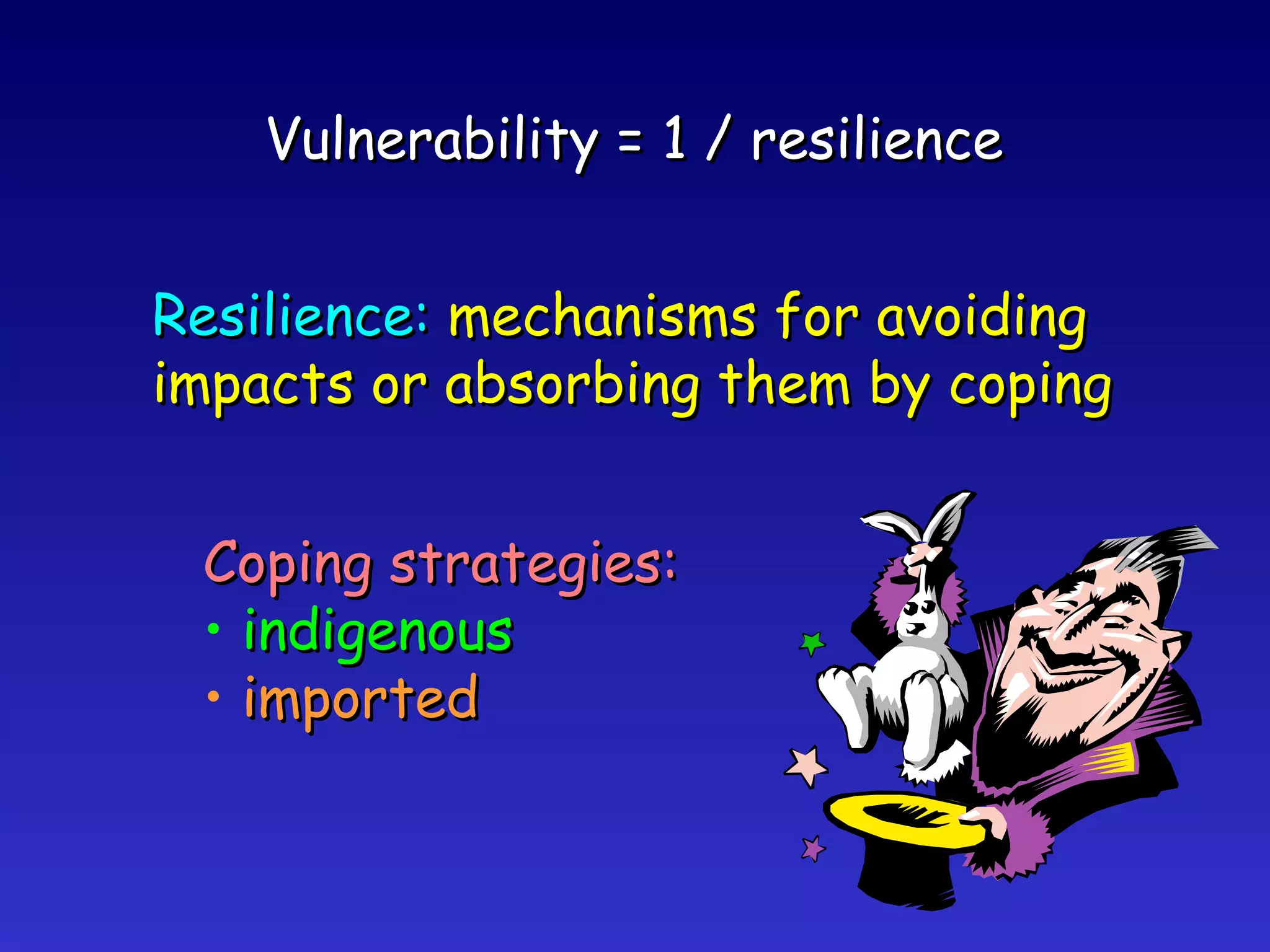
Vulnerability = 1 / resilience Resilience:  mechanisms for avoiding impacts or absorbing them by coping Coping strategies: indigenous imported
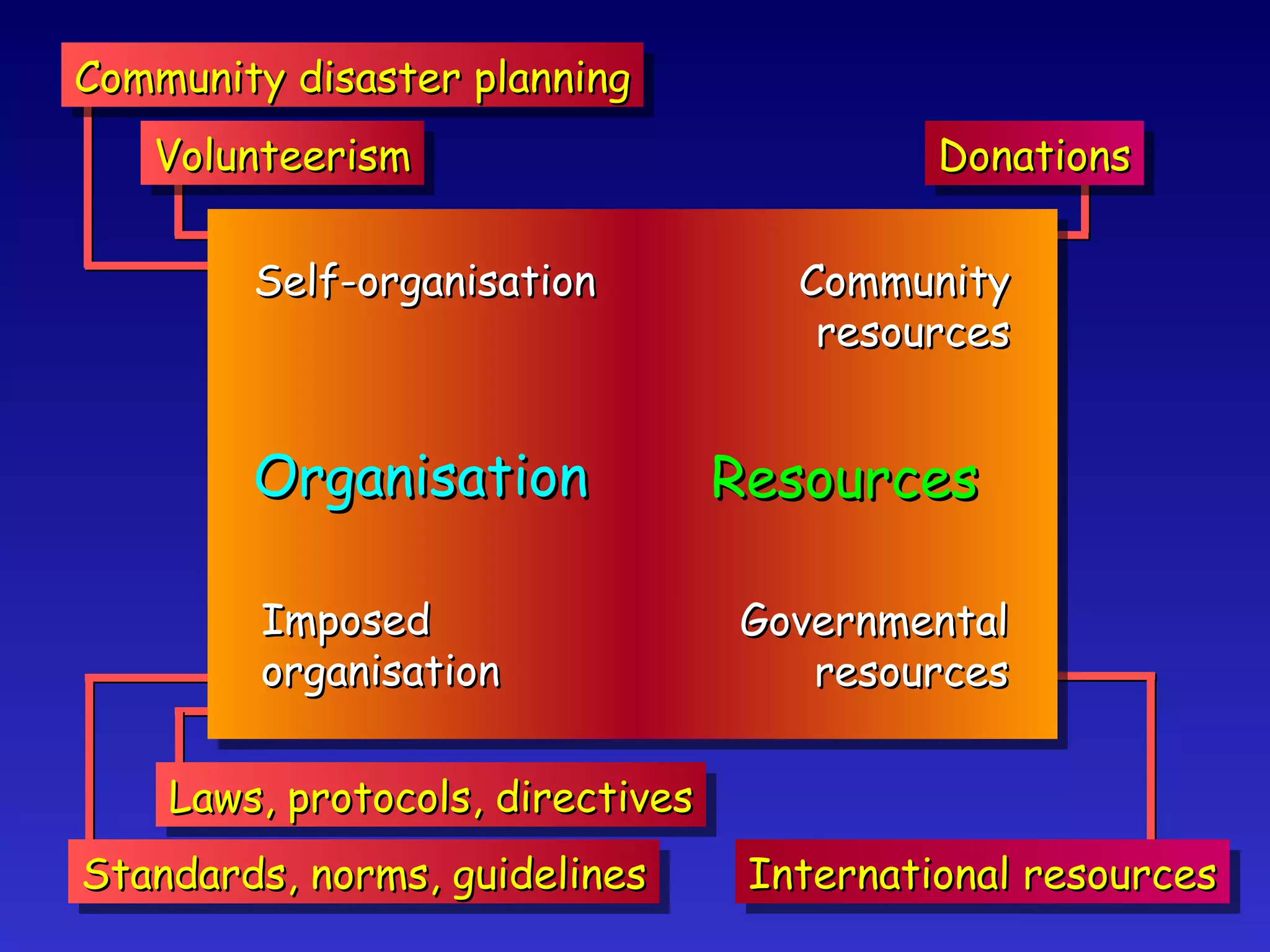
Organisation Resources Self-organisation Imposed organisation Volunteerism Community disaster planning Laws, protocols, directives Standards, norms, guidelines Community resources Governmental resources Donations International resources
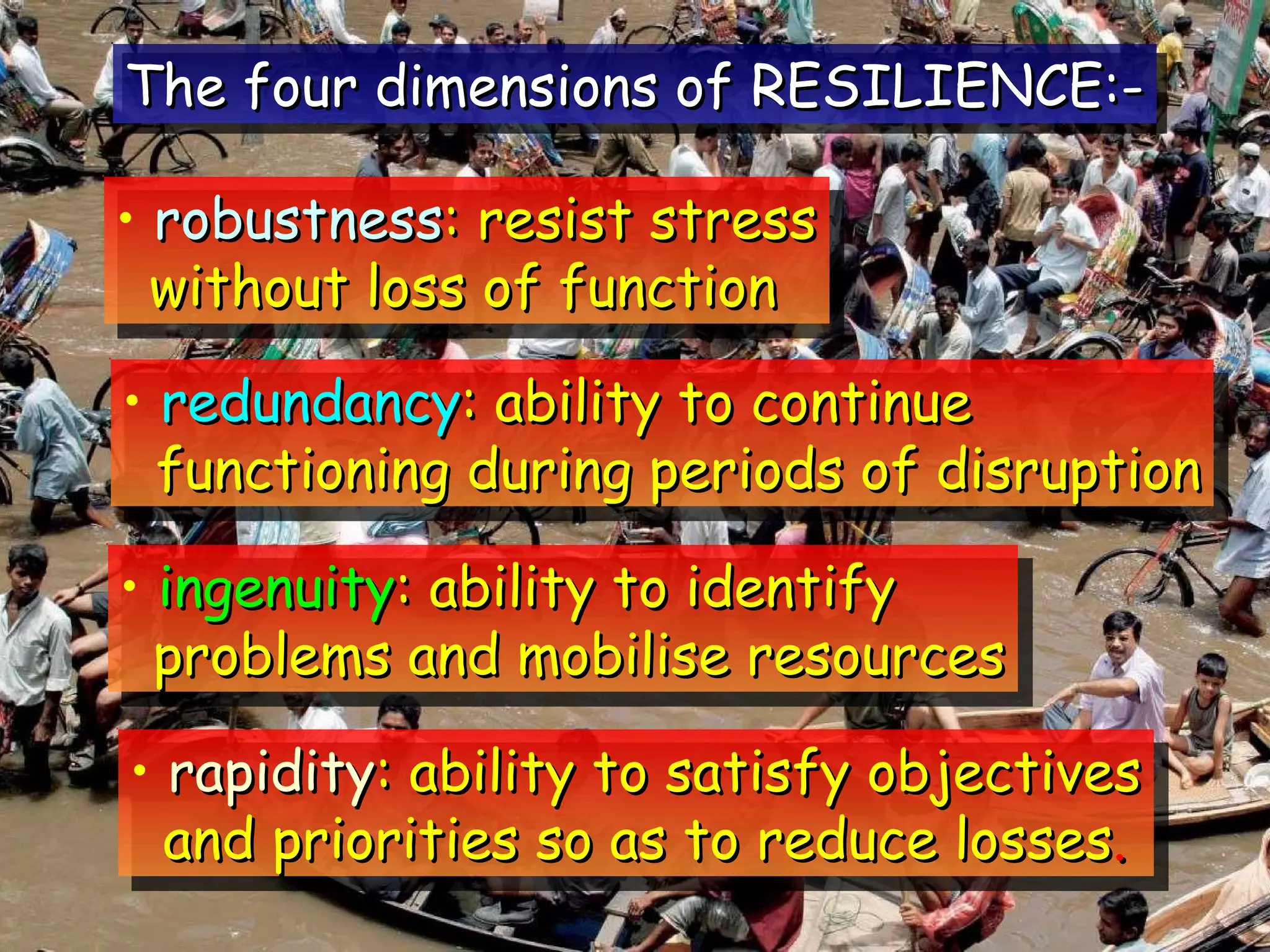
The four dimensions of RESILIENCE:- robustness : resist stress without loss of function redundancy : ability to continue functioning during periods of disruption ingenuity : ability to identify problems and mobilise resources rapidity : ability to satisfy objectives and priorities so as to reduce losses .
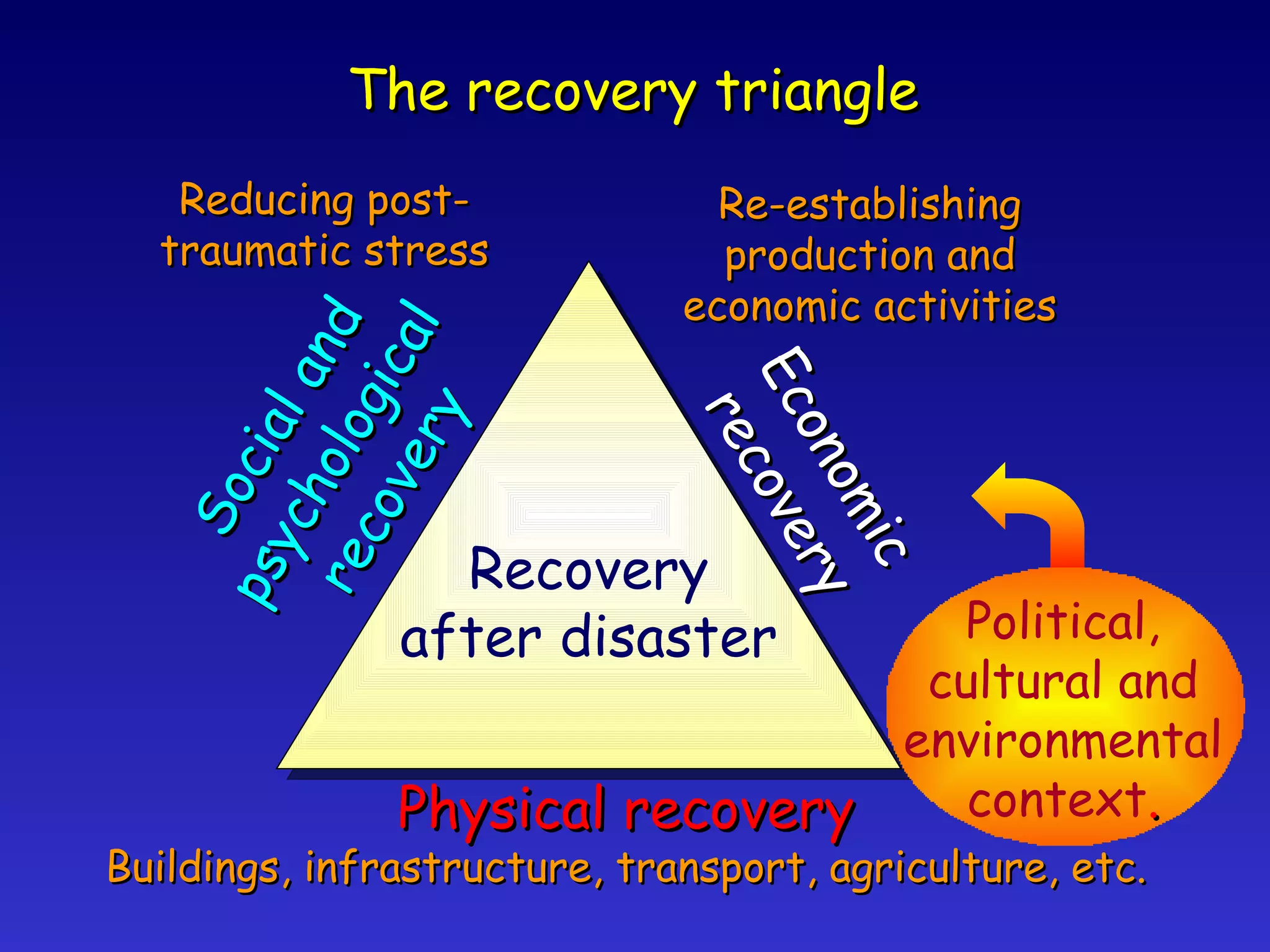
Recovery after disaster Physical recovery Buildings, infrastructure, transport, agriculture, etc. The recovery triangle Social and psychological recovery Reducing post- traumatic stress Economic recovery Re-establishing production and economic activities Political, cultural and environmental context .
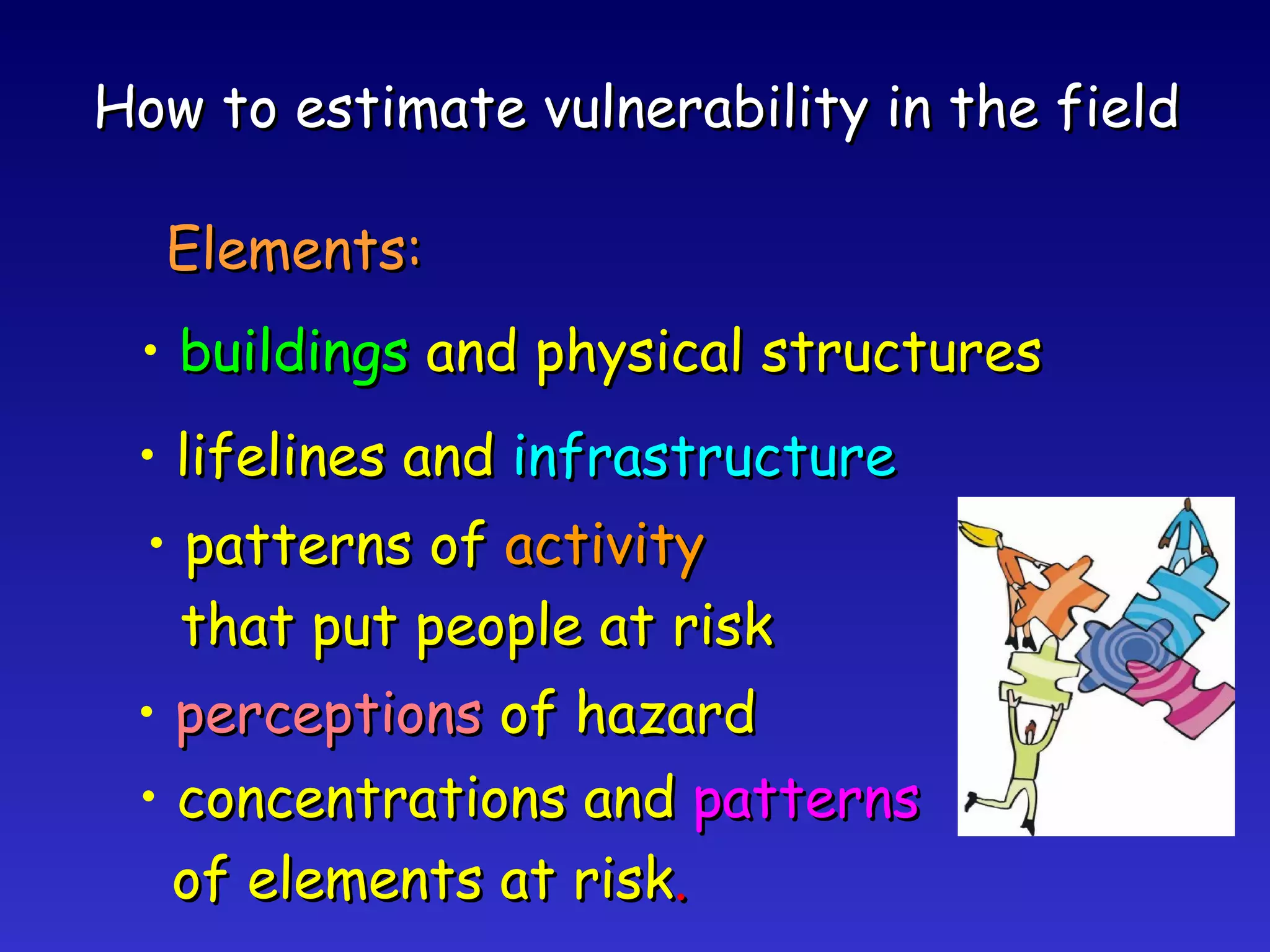
How to estimate vulnerability in the field Elements: buildings  and physical structures lifelines and  infrastructure patterns of  activity that put people at risk perceptions  of hazard concentrations and  patterns of elements at risk .
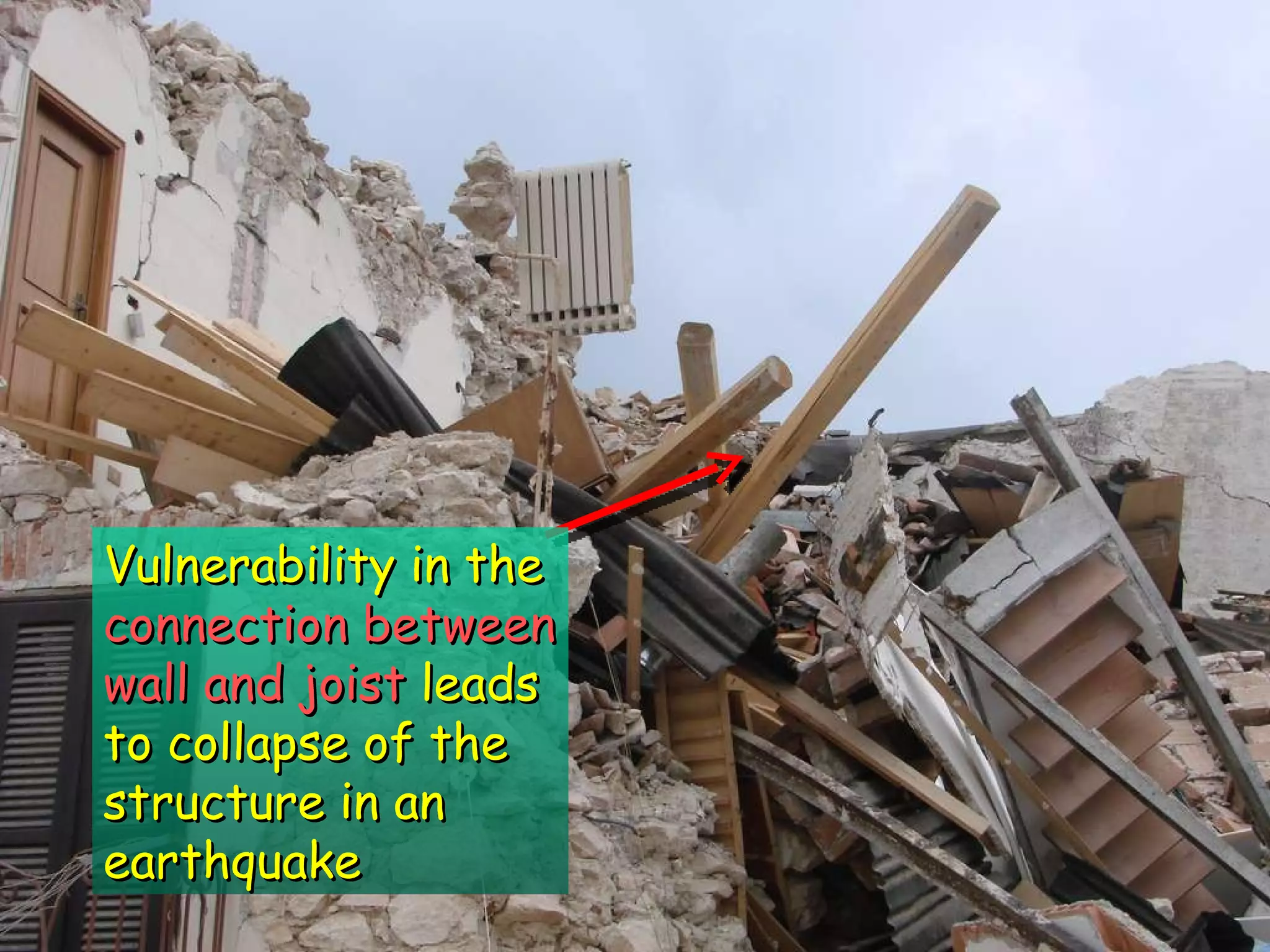
Vulnerability in the connection between wall and joist  leads to collapse of the  structure in an earthquake
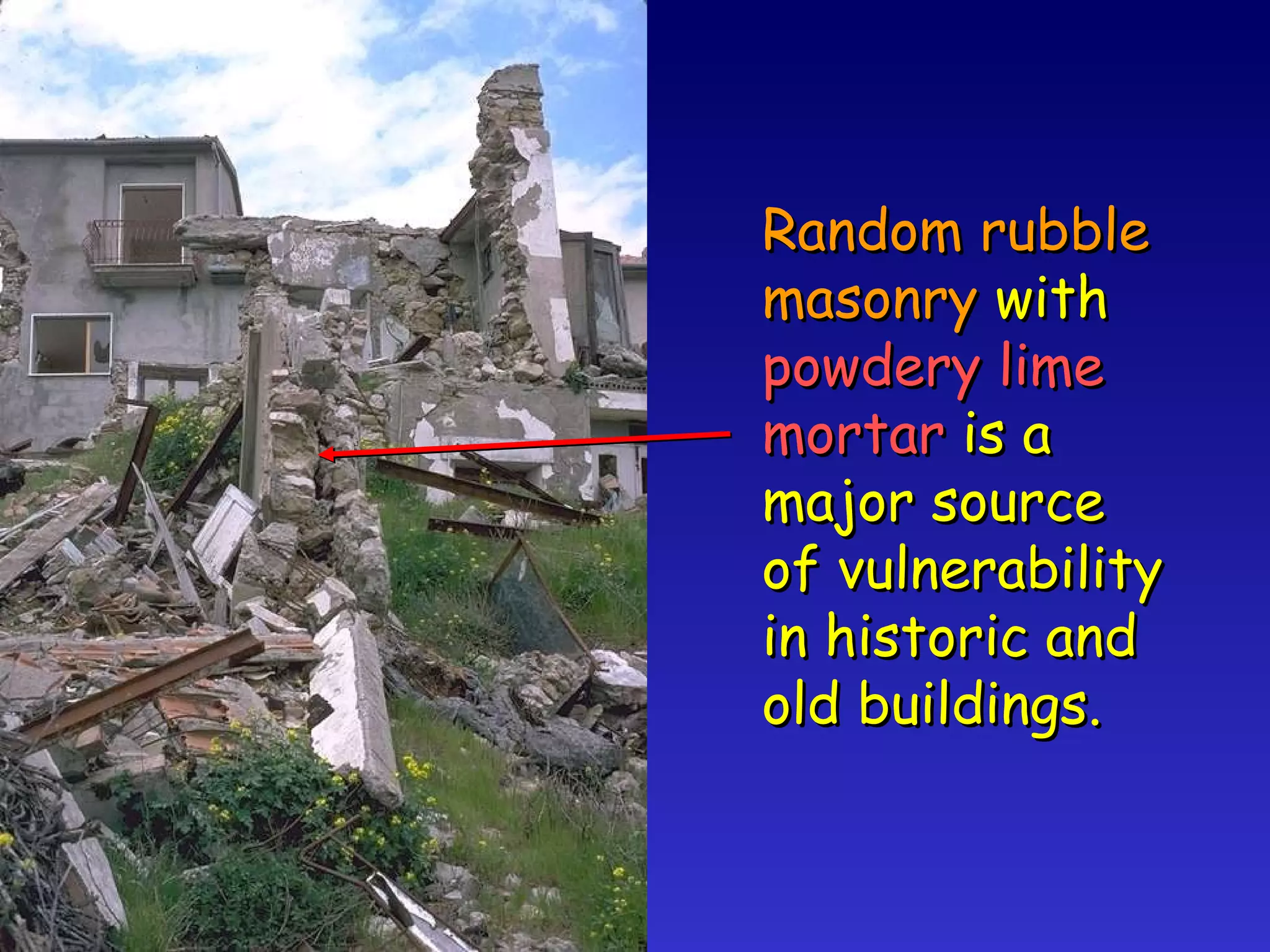
Random rubble masonry  with powdery lime mortar  is a major source of vulnerability in historic and old buildings.
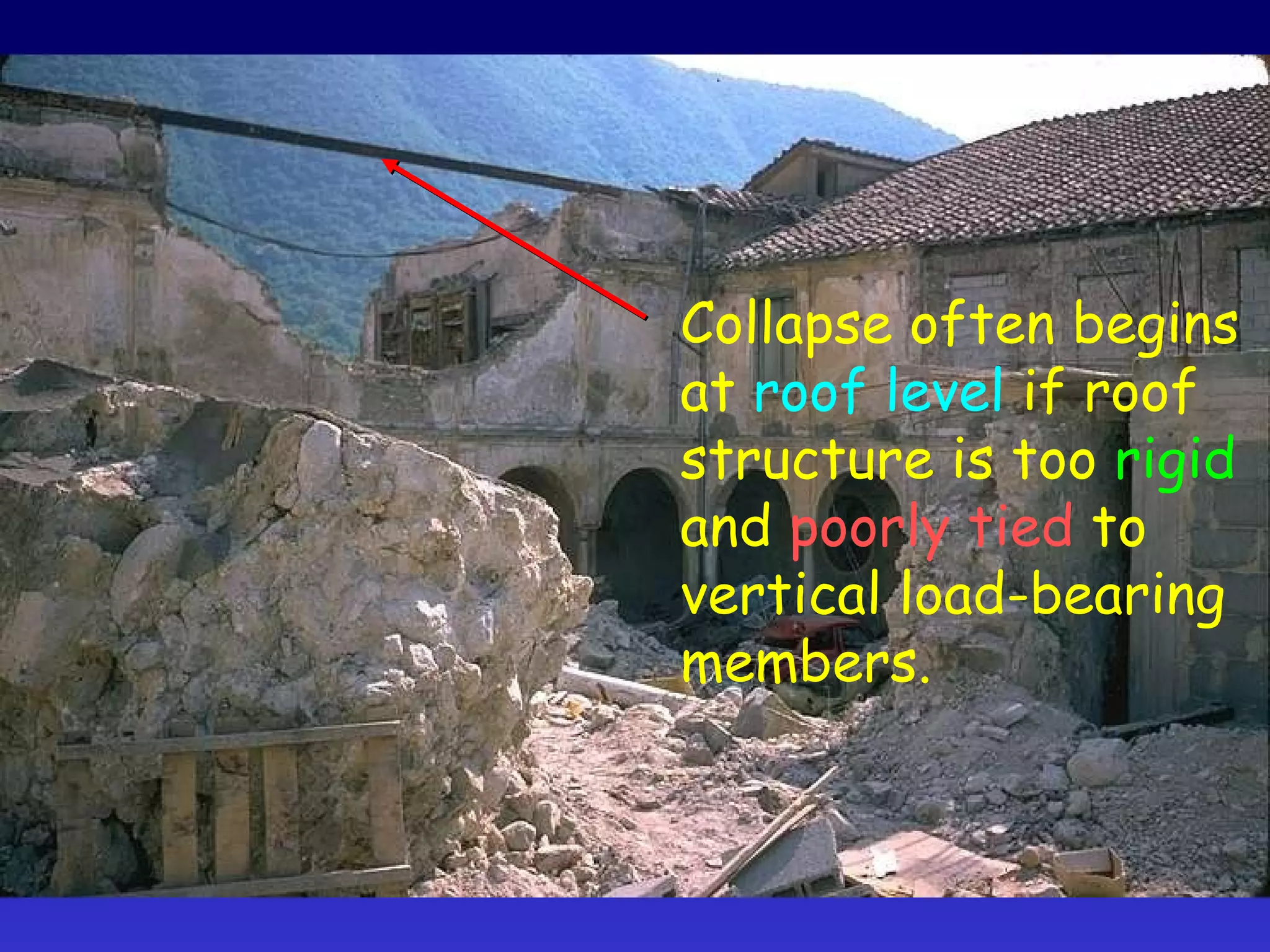
Collapse often begins at  roof level  if roof structure is too  rigid and  poorly tied  to vertical load-bearing members.
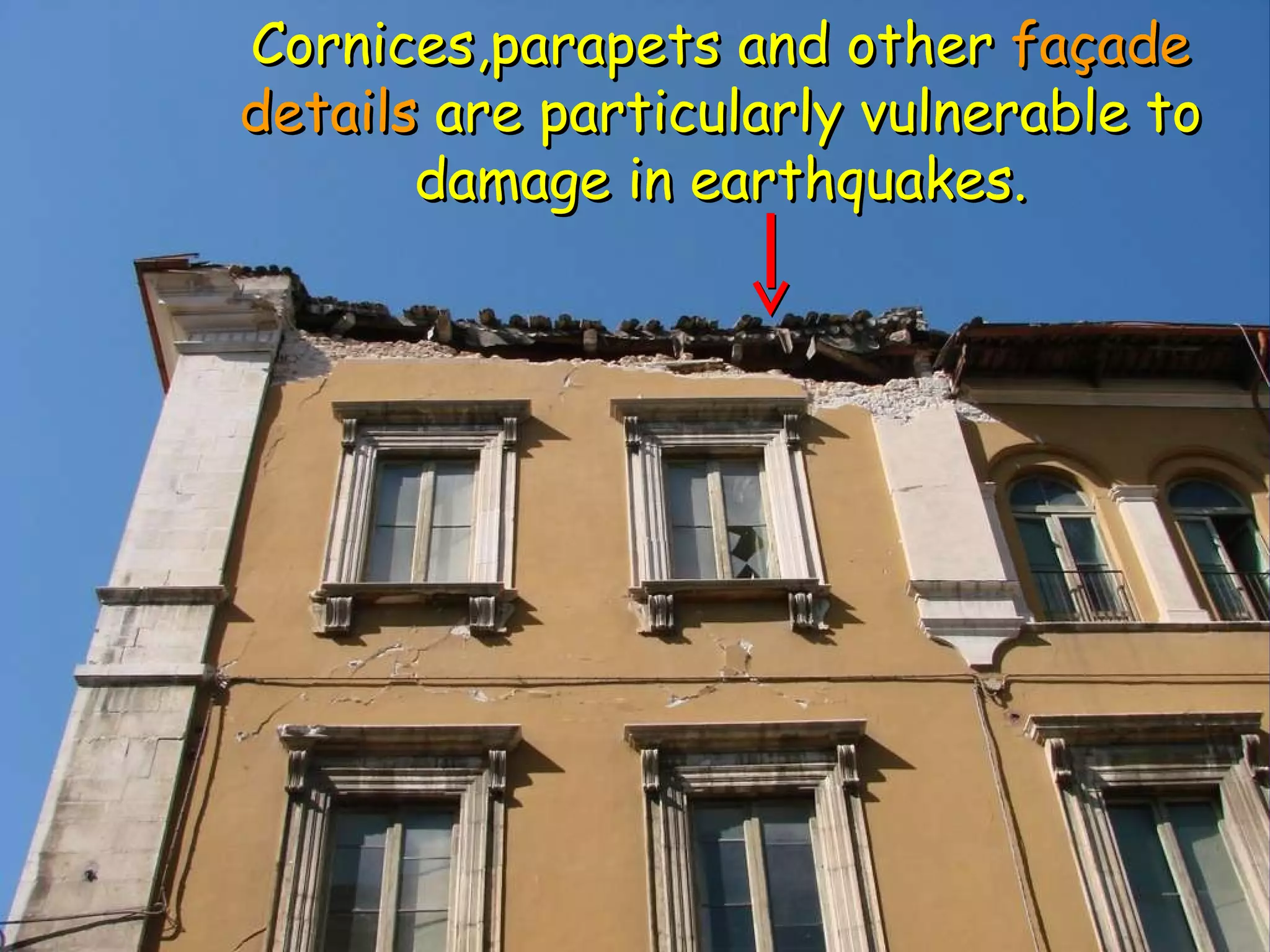
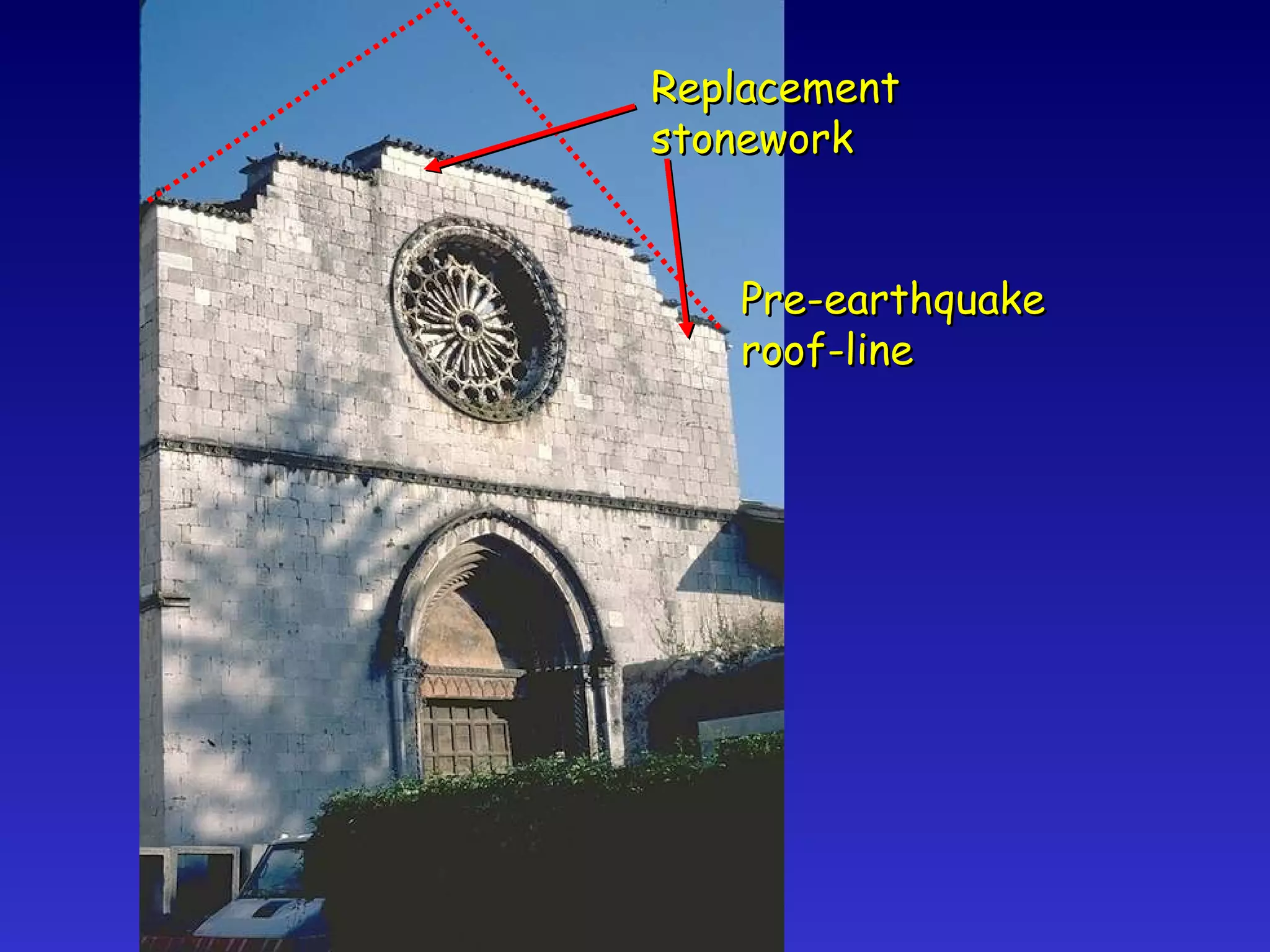
Cornices,parapets and other  façade details  are particularly vulnerable to damage in earthquakes.
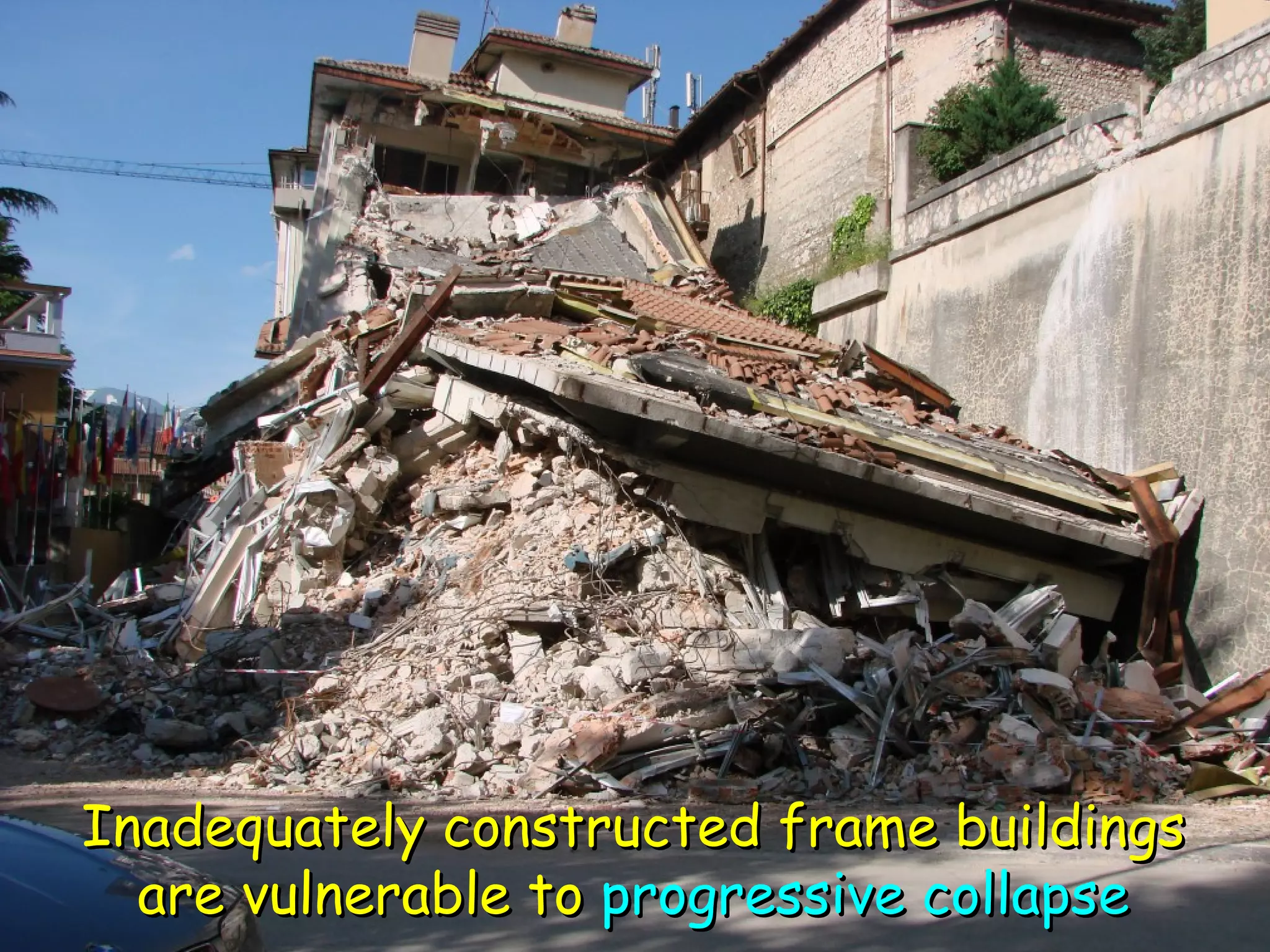
Inadequately constructed frame buildings are vulnerable to  progressive collapse
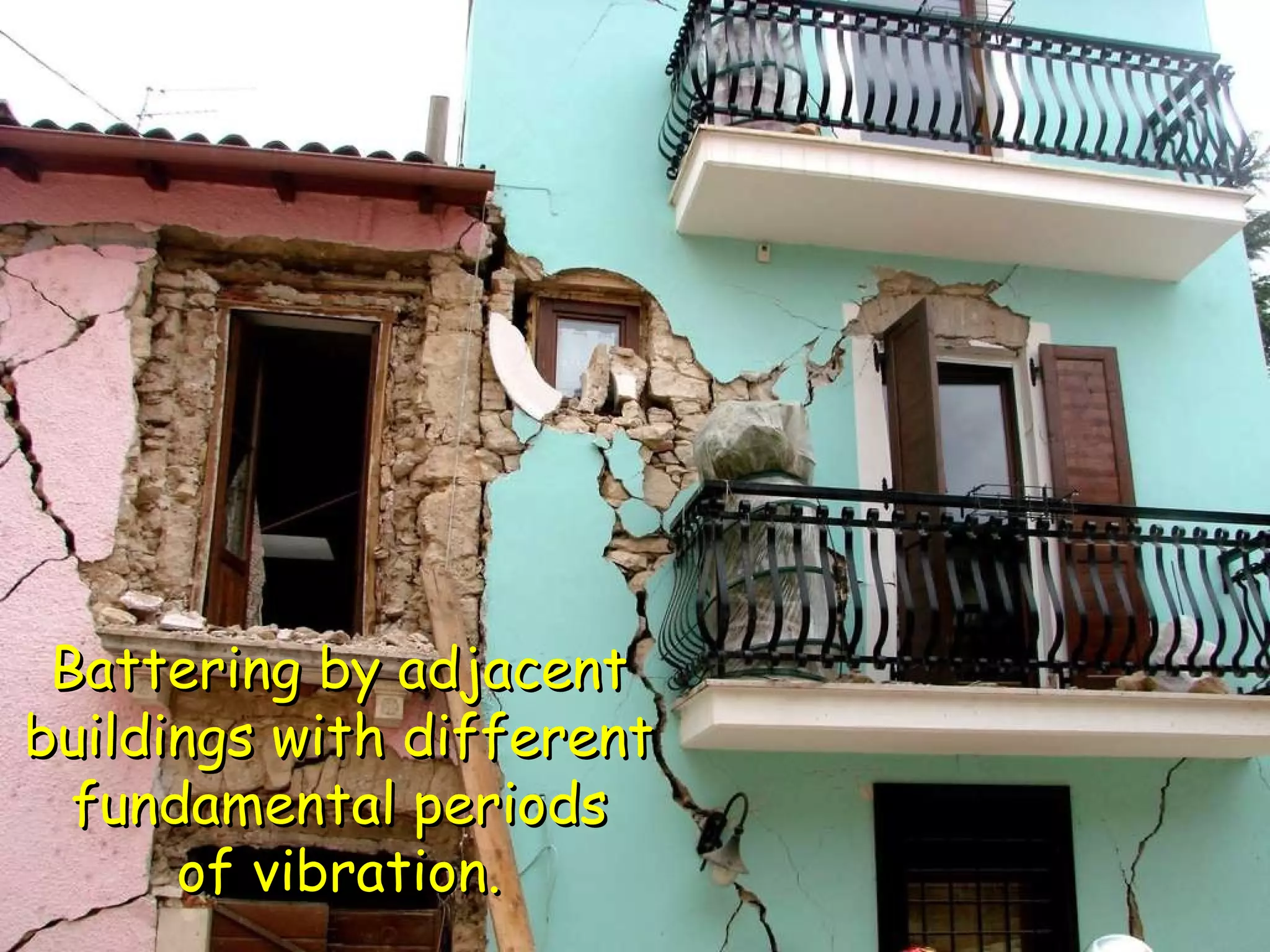
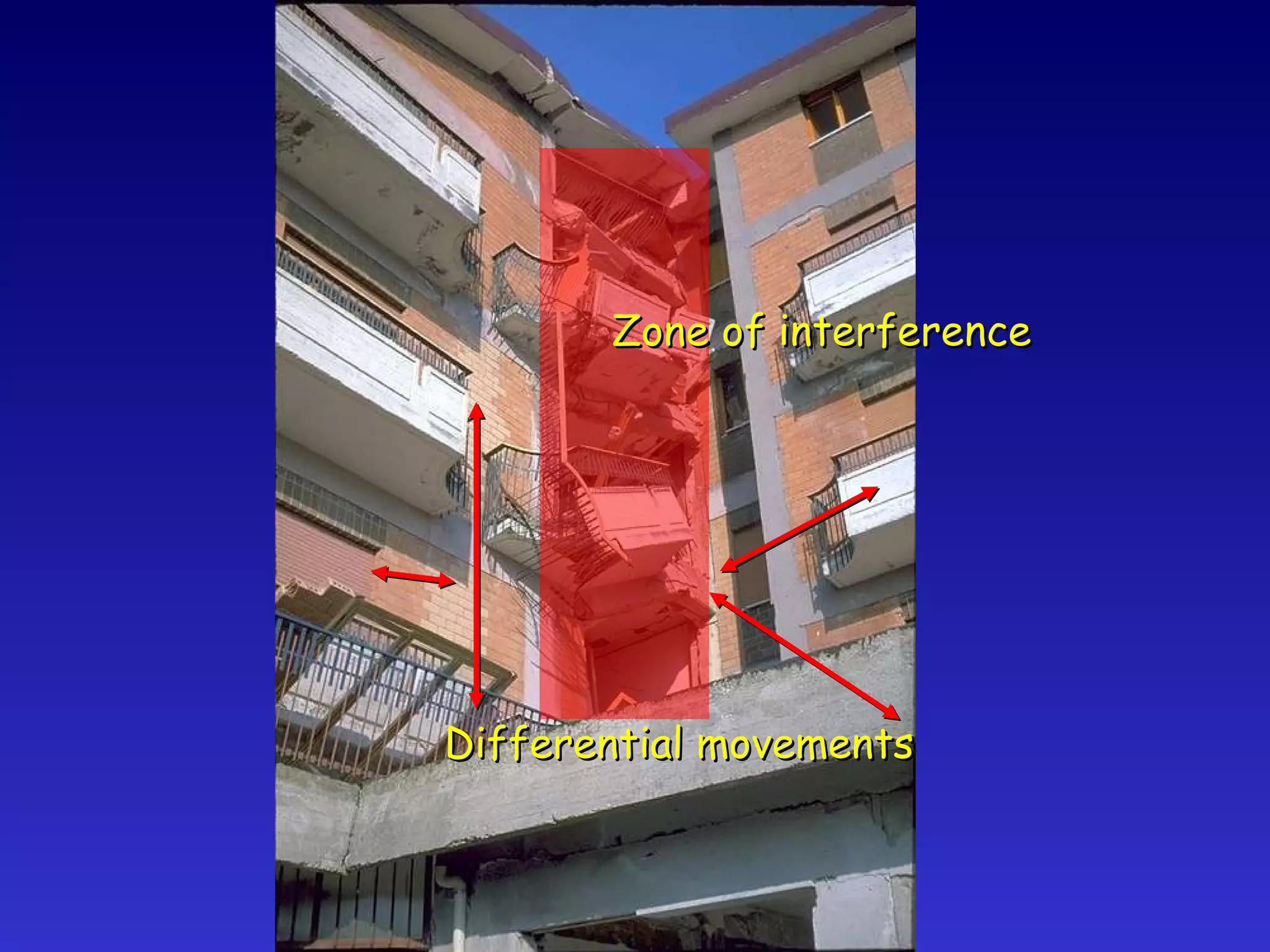
Battering by adjacent buildings with different fundamental periods of vibration.
Zone of interference Differential movements
Pre-earthquake roof-line Replacement stonework
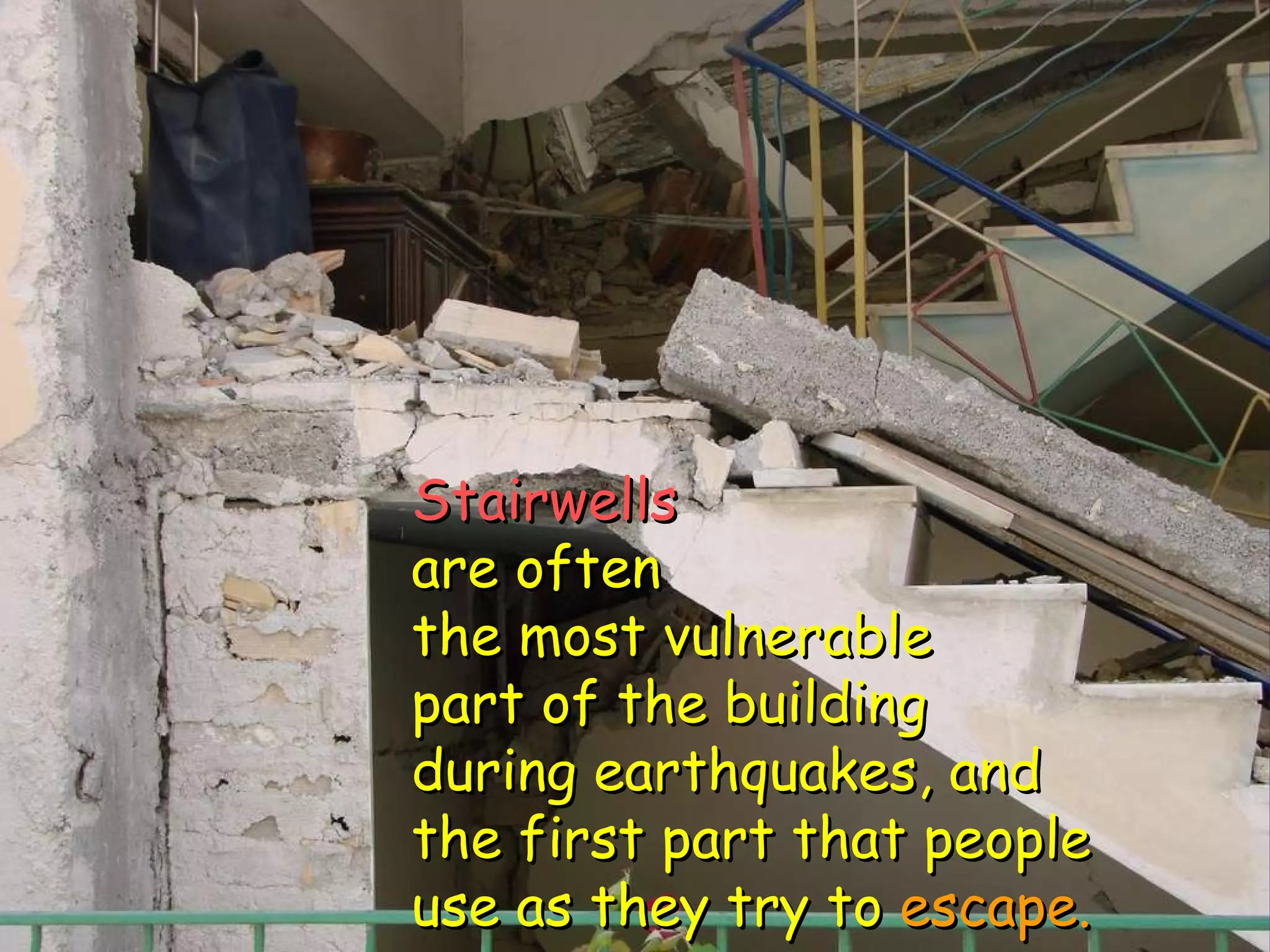
Stairwells are often the most vulnerable part of the building during earthquakes, and the first part that people use as they try to  escape.
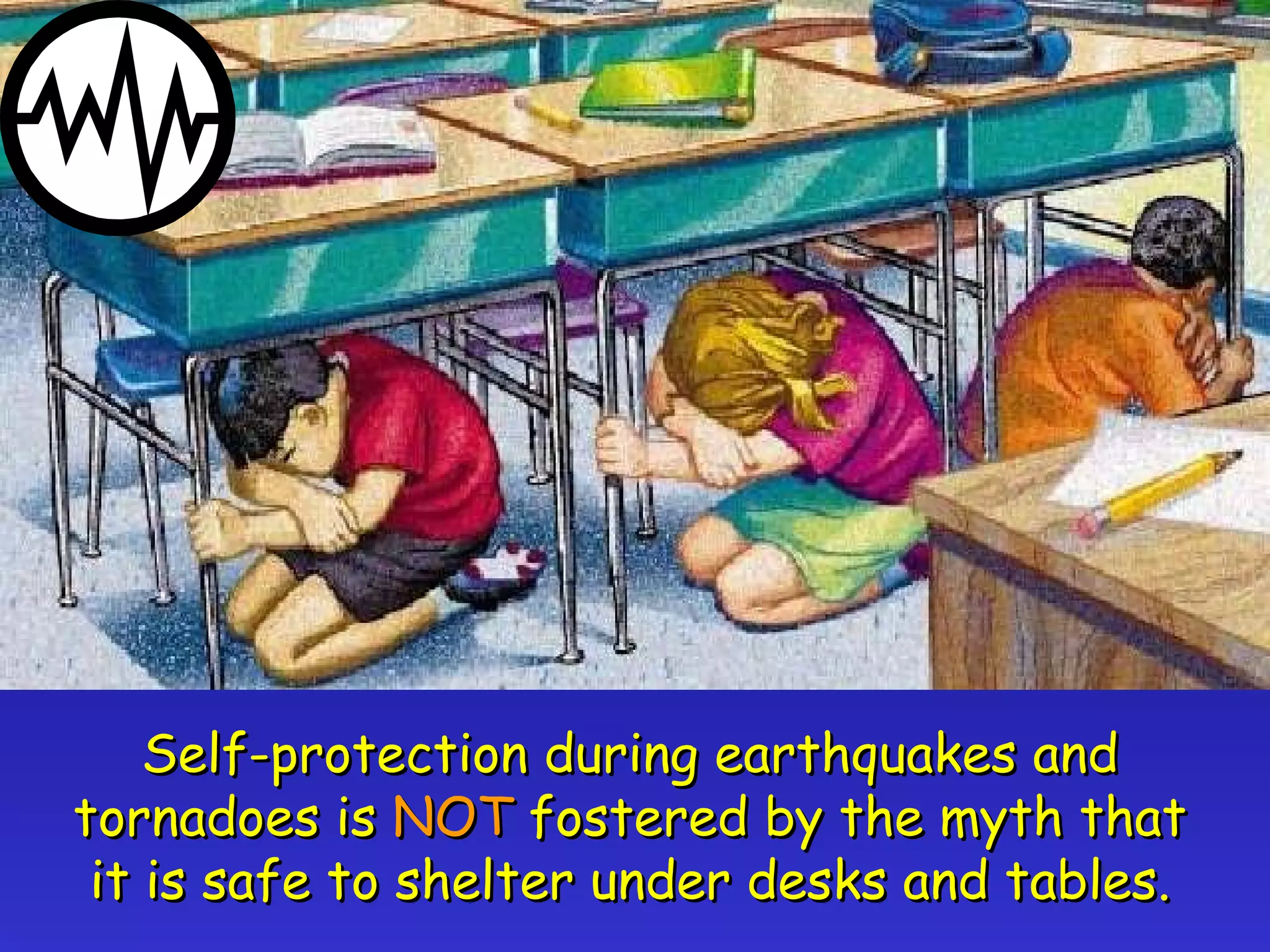
Self-protection during earthquakes and tornadoes is  NOT  fostered by the myth that it is safe to shelter under desks and tables.
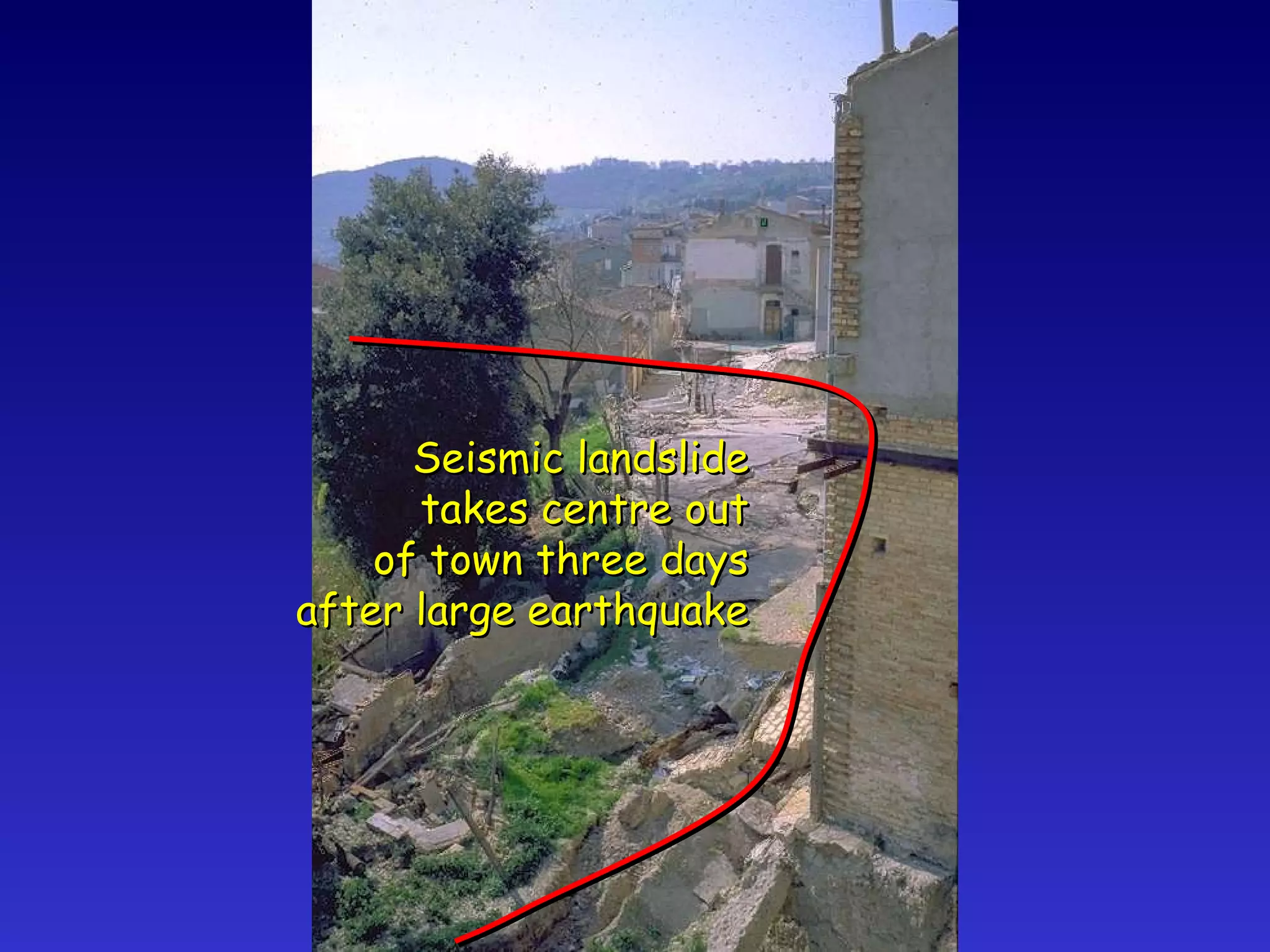
Seismic landslide takes centre out of town three days after large earthquake
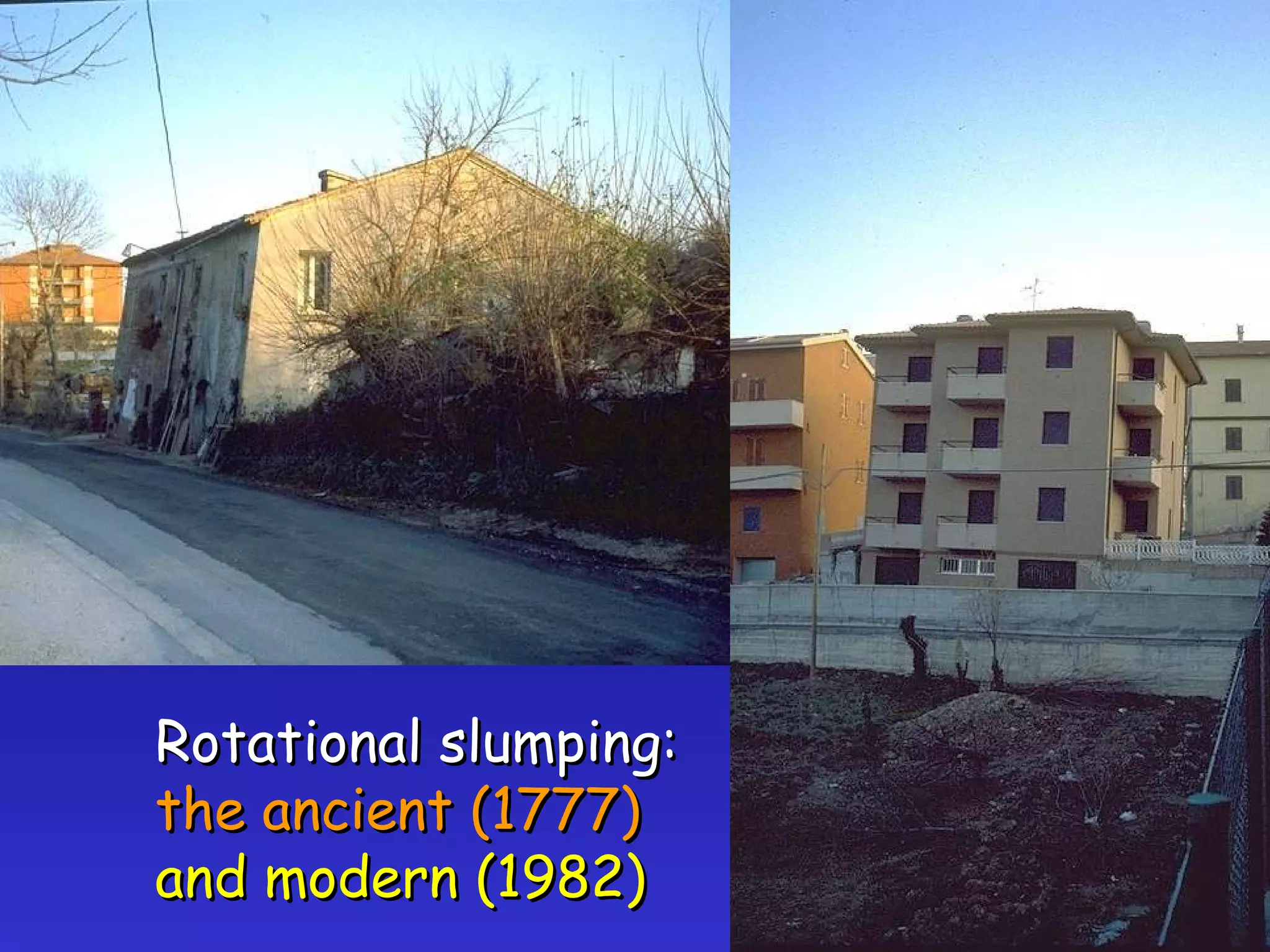
Rotational slumping: the ancient (1777) and modern (1982)
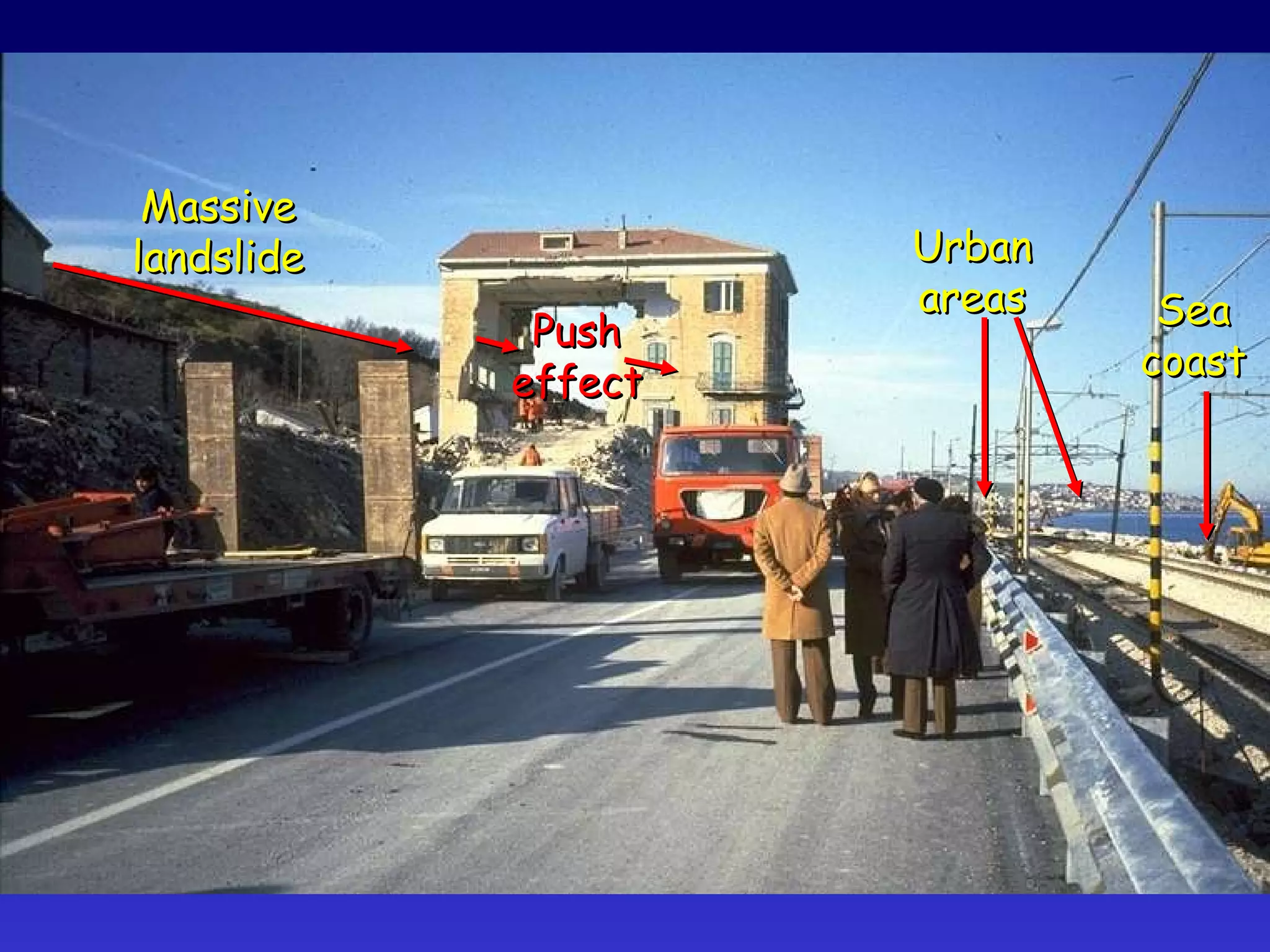
Sea coast Massive landslide Push effect Urban areas
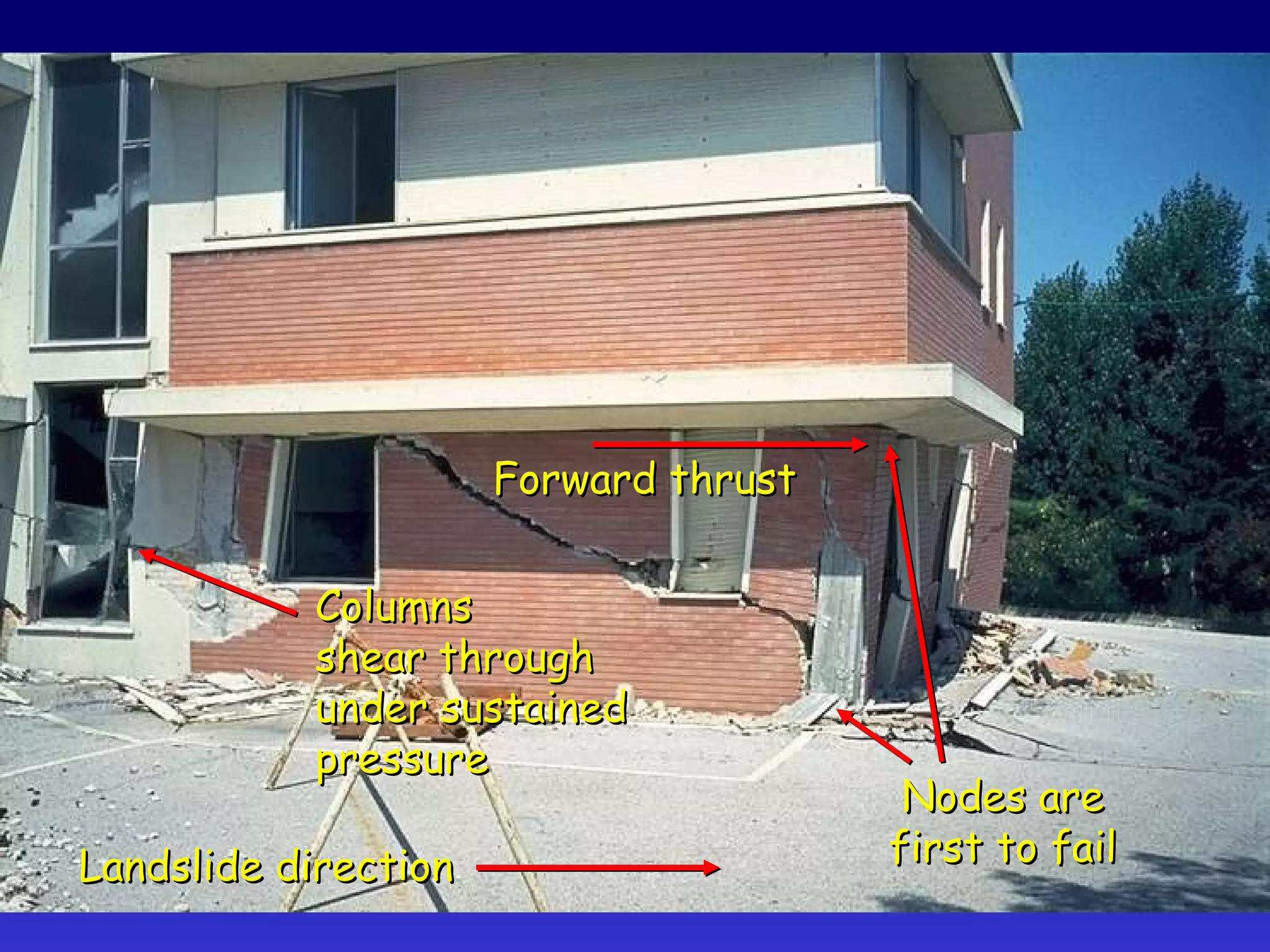
Forward thrust Nodes are first to fail Columns shear through under sustained pressure Landslide direction
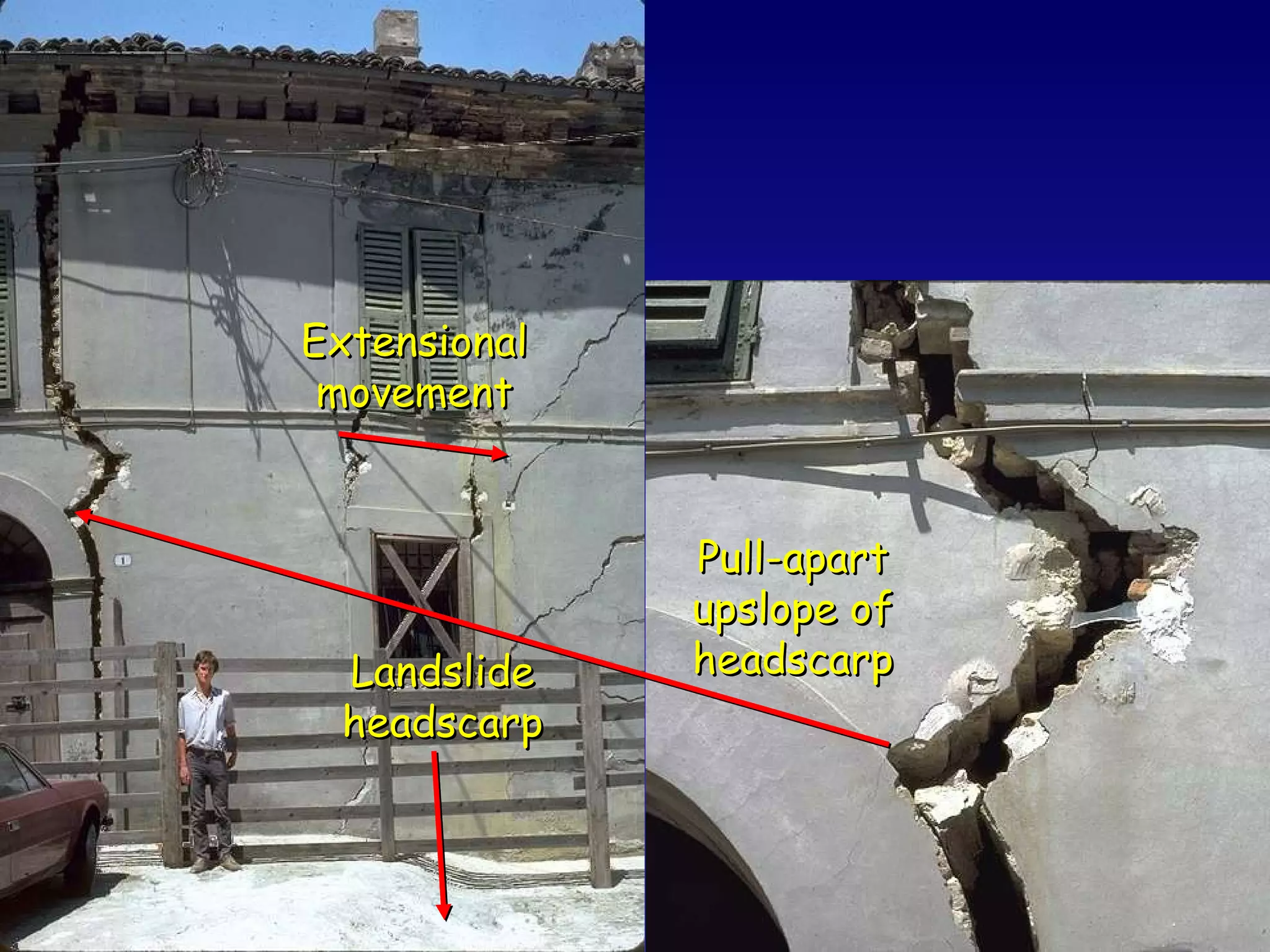
Landslide headscarp Extensional movement Pull-apart upslope of headscarp
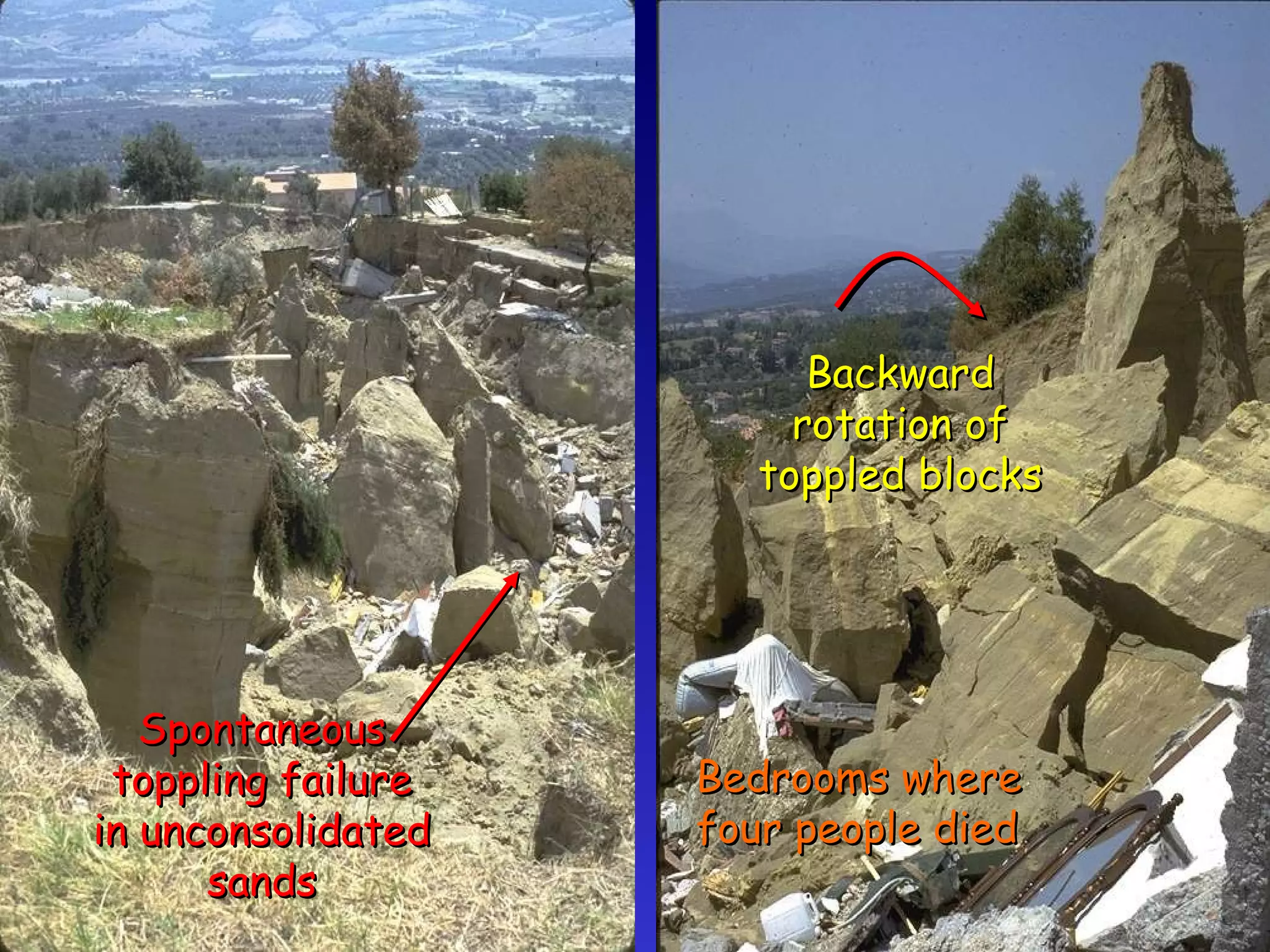
Bedrooms where four people died Spontaneous toppling failure in unconsolidated sands Backward rotation of toppled blocks
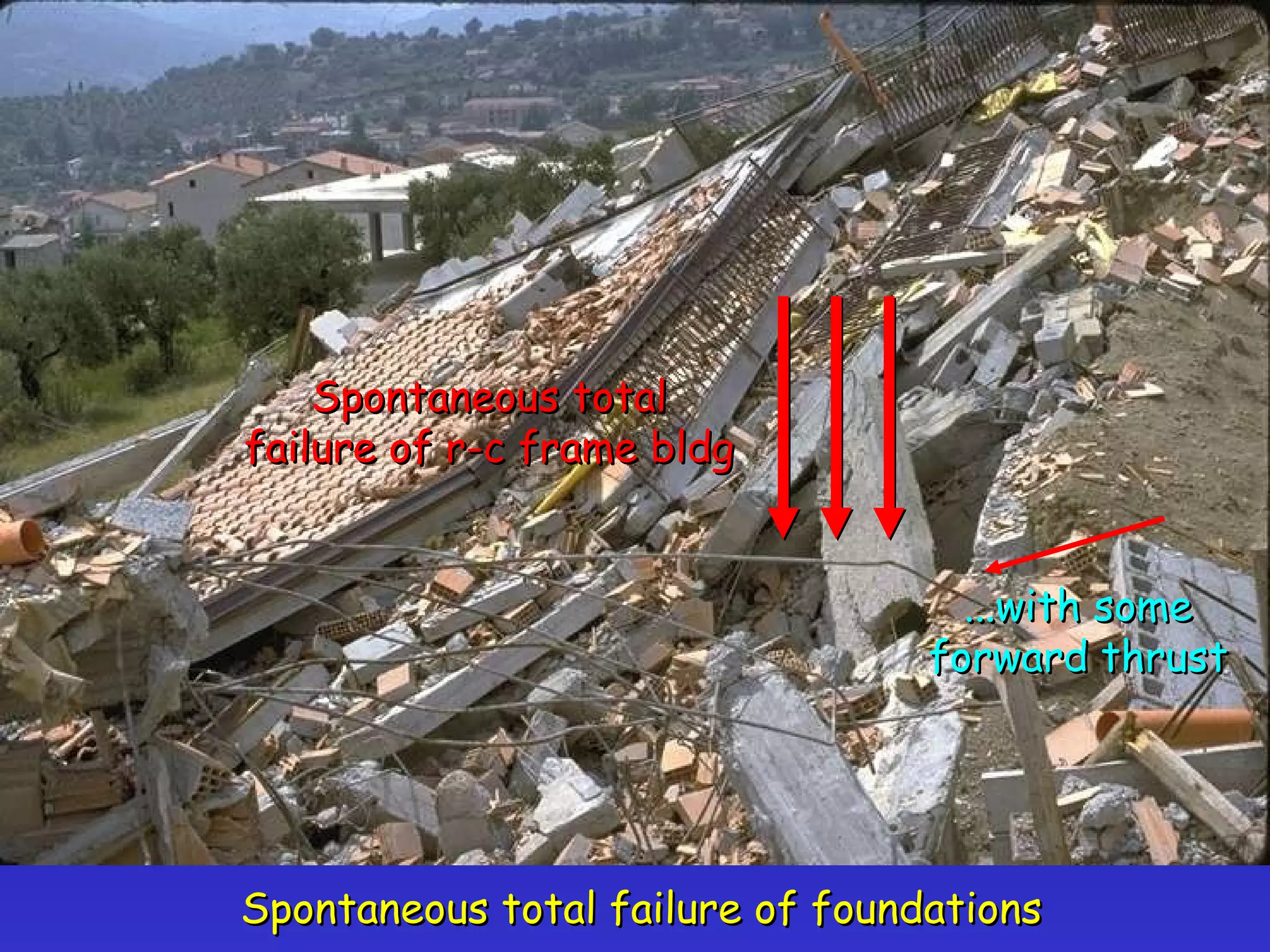
Spontaneous total failure of foundations Spontaneous total failure of r-c frame bldg ...with some forward thrust
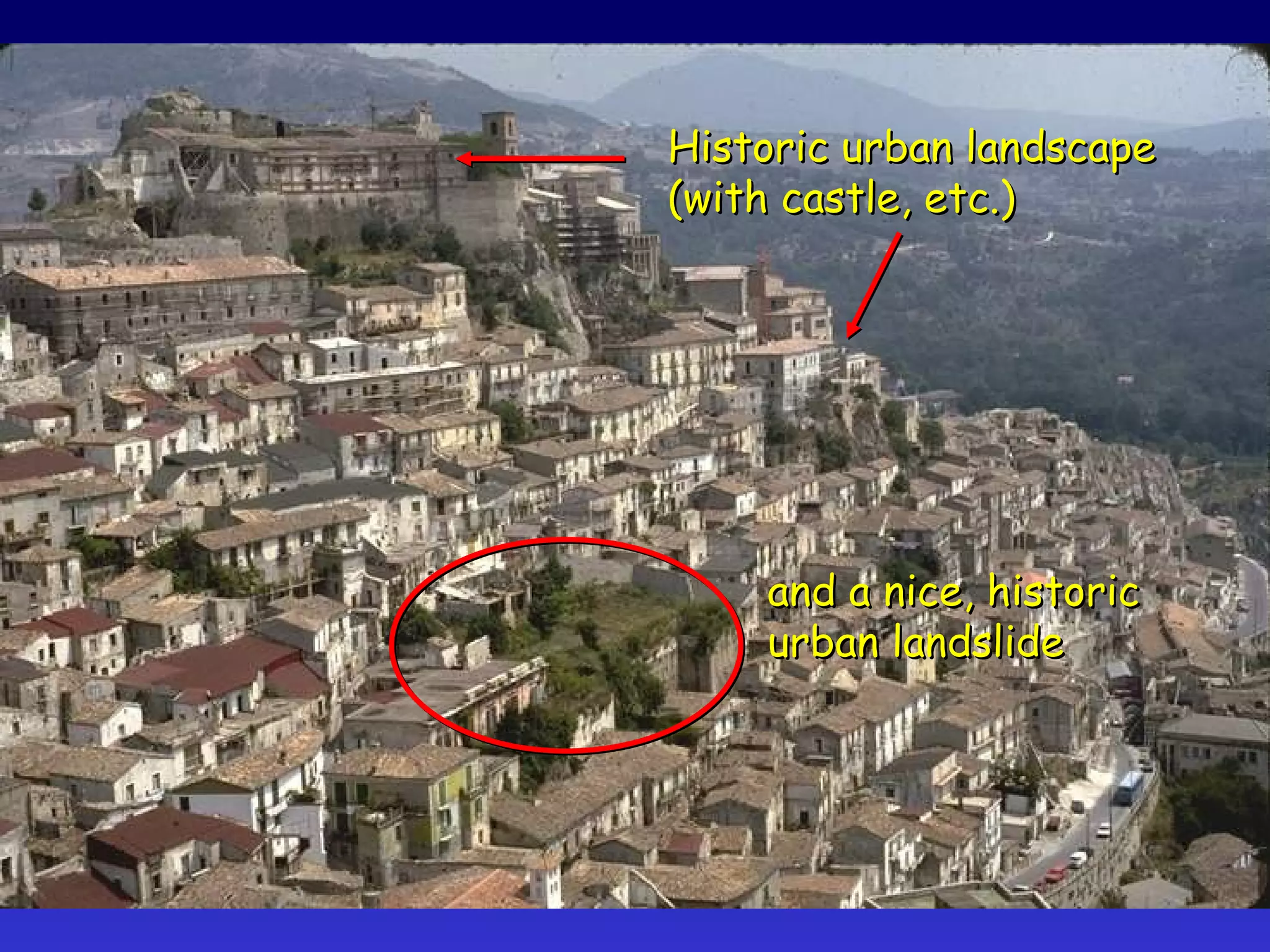
Historic urban landscape (with castle, etc.) and a nice, historic urban landslide
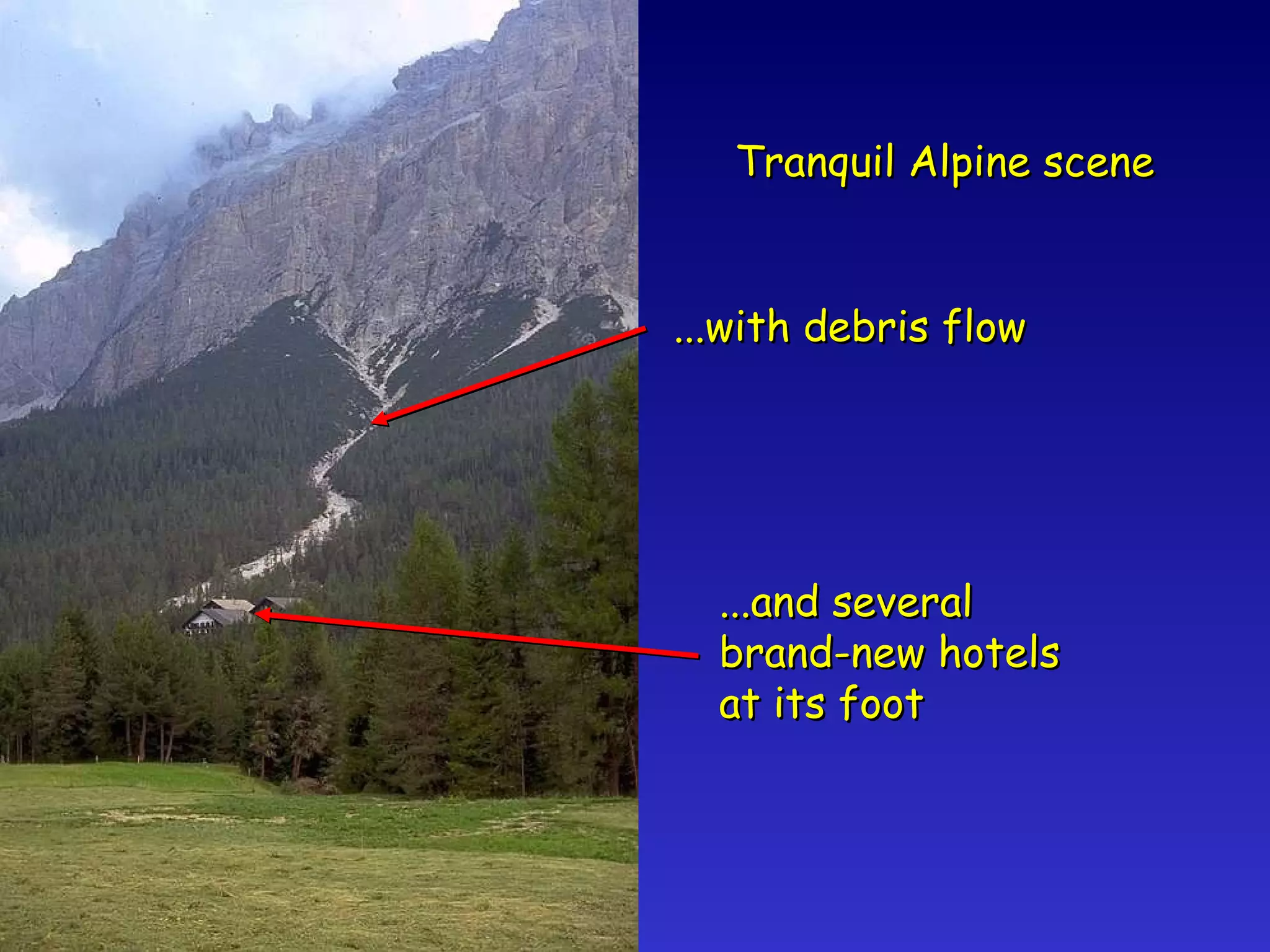
Tranquil Alpine scene ...with debris flow ...and several brand-new hotels at its foot
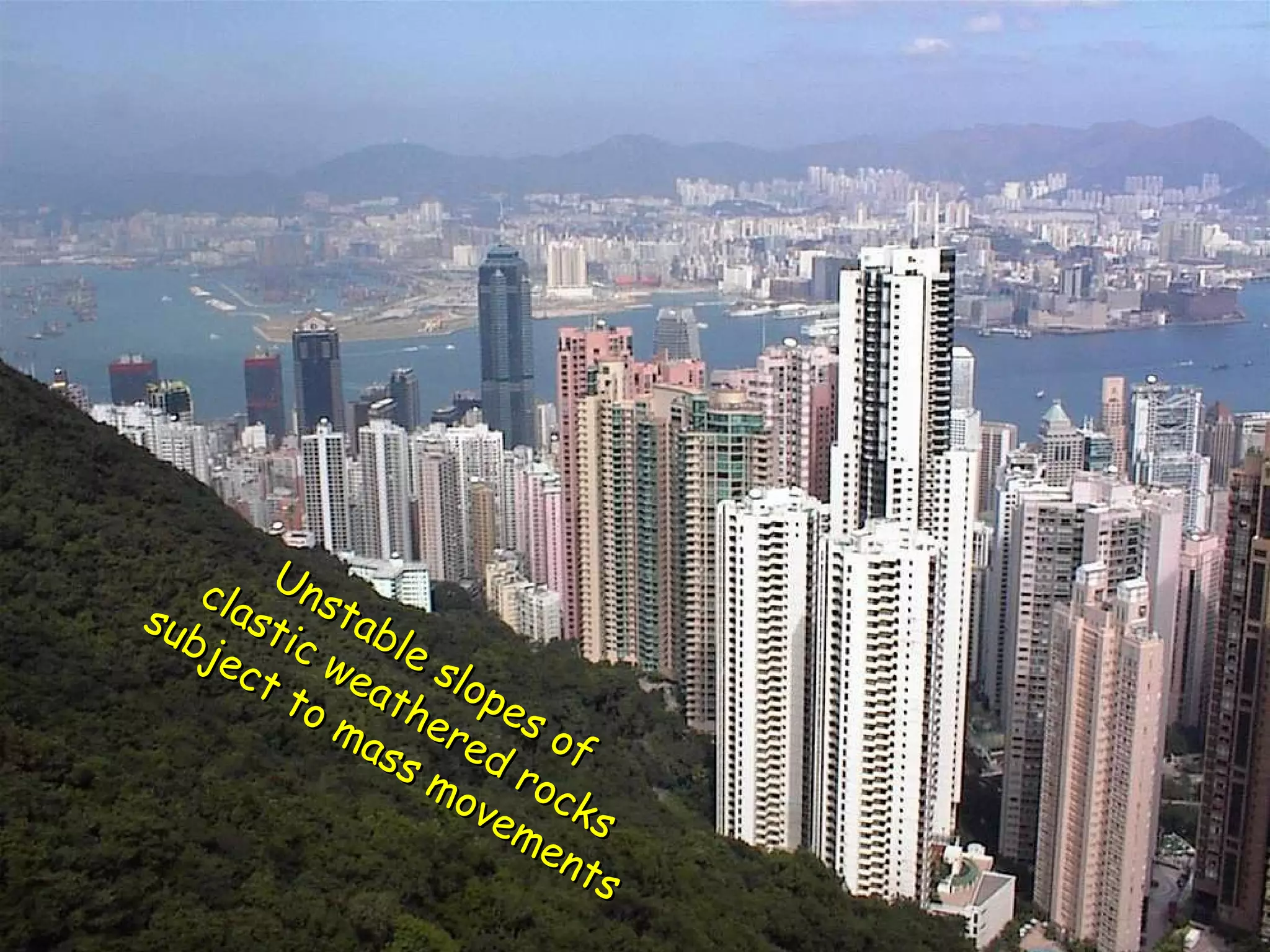
Unstable slopes of clastic weathered rocks subject to mass movements
 
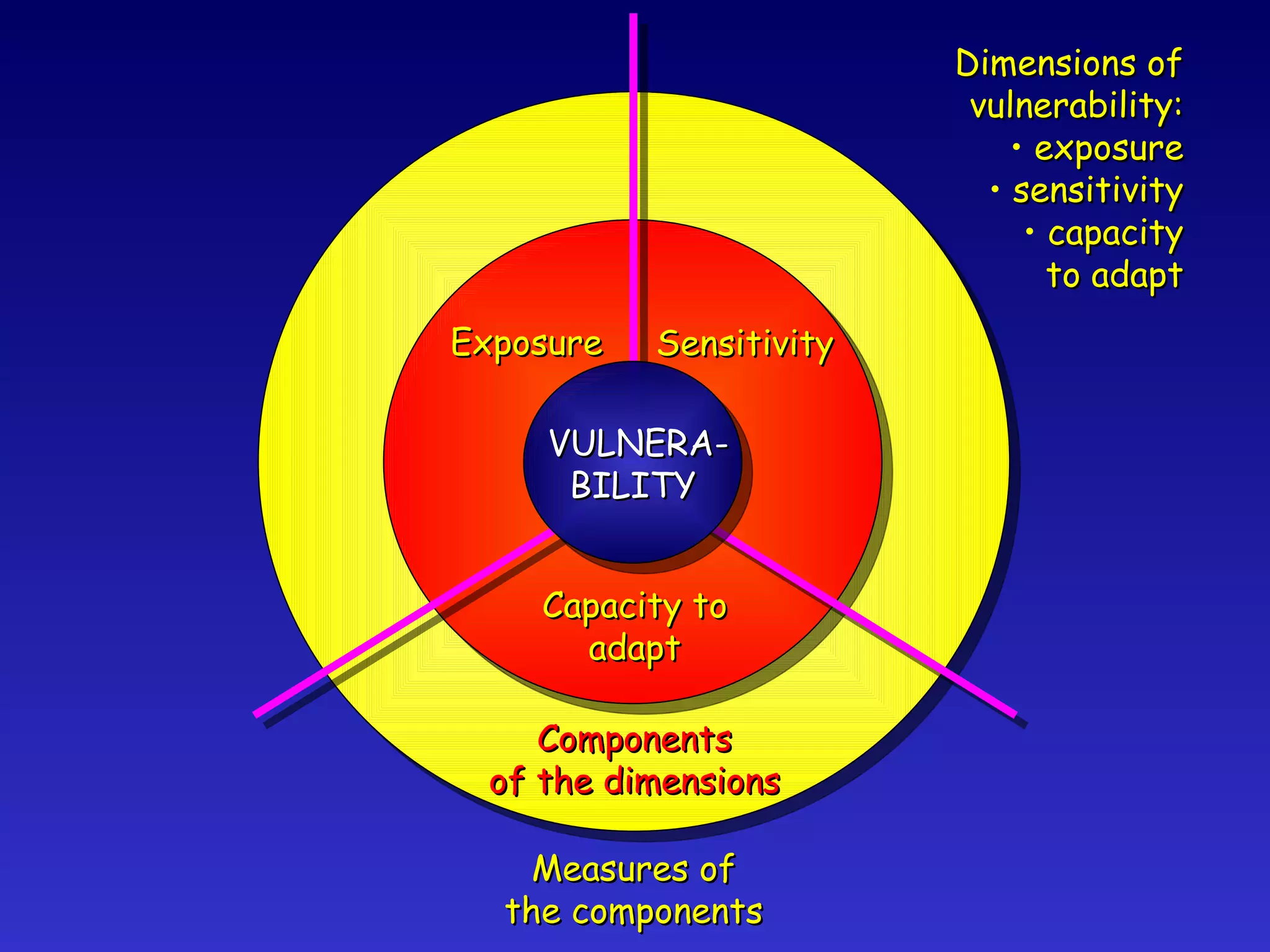
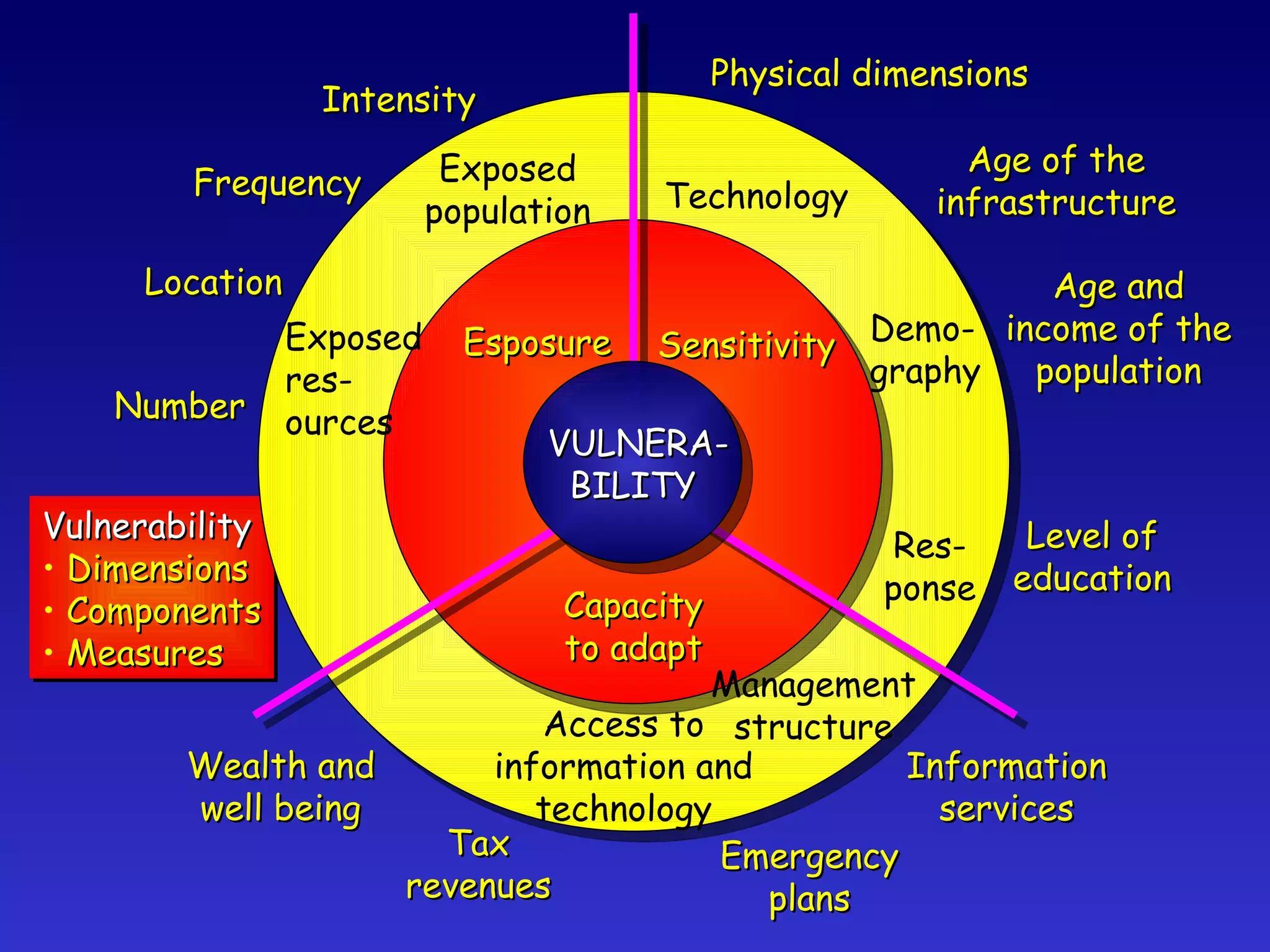
Exposure Sensitivity Capacity to adapt VULNERA- BILITY Dimensions of vulnerability: exposure sensitivity capacity to adapt Components of the dimensions Measures of the components
Vulnerability Dimensions Components Measures Esposure Sensitivity Capacity to adapt VULNERA- BILITY Physical dimensions Age of the infrastructure Age and income of the population Demo- graphy Technology Res- ponse Management structure Access to information and technology Exposed res- ources Exposed population Intensity Frequency Location Number Wealth and well being Tax revenues Emergency plans Level of education Information services
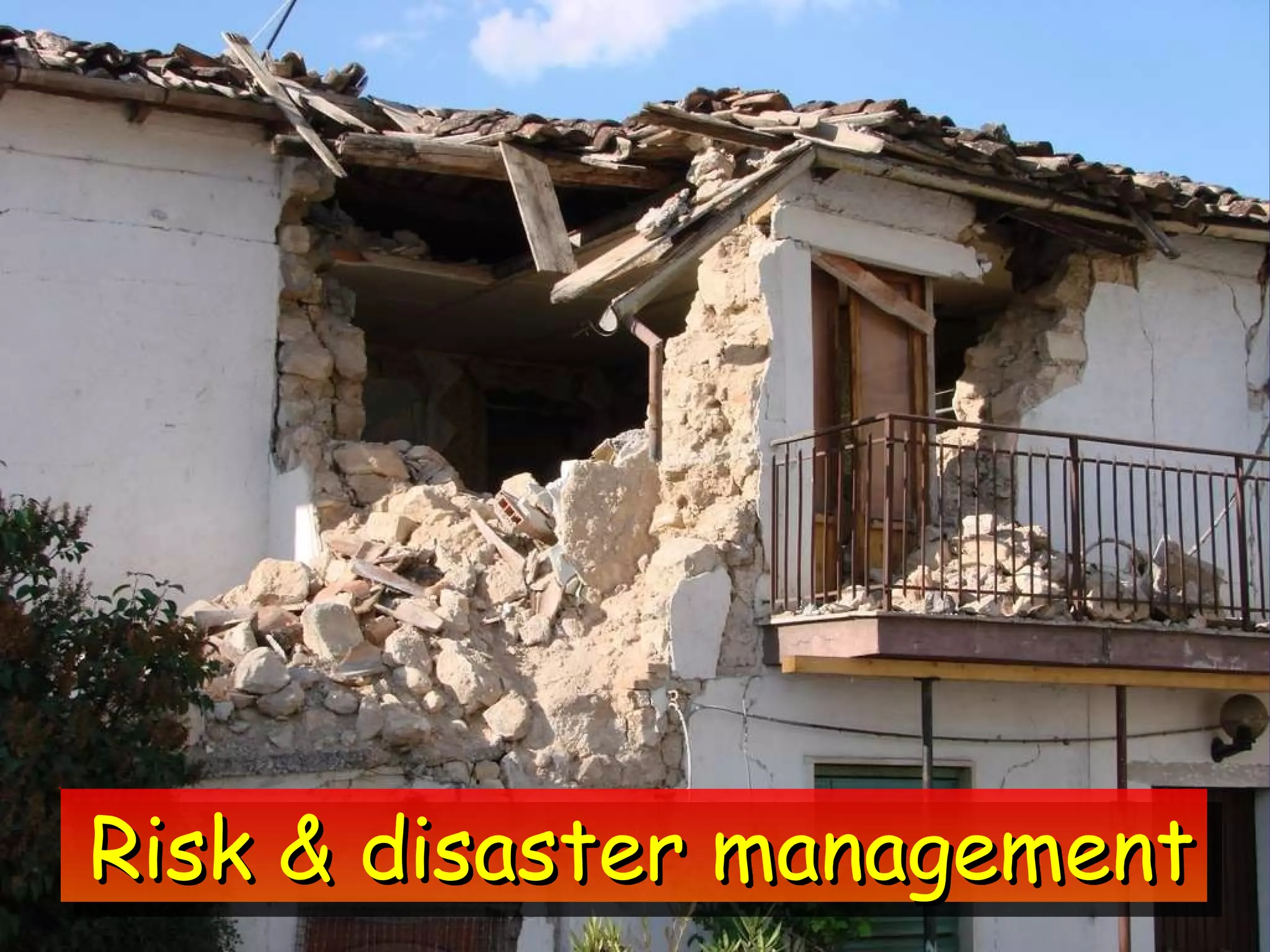
Risk & disaster management
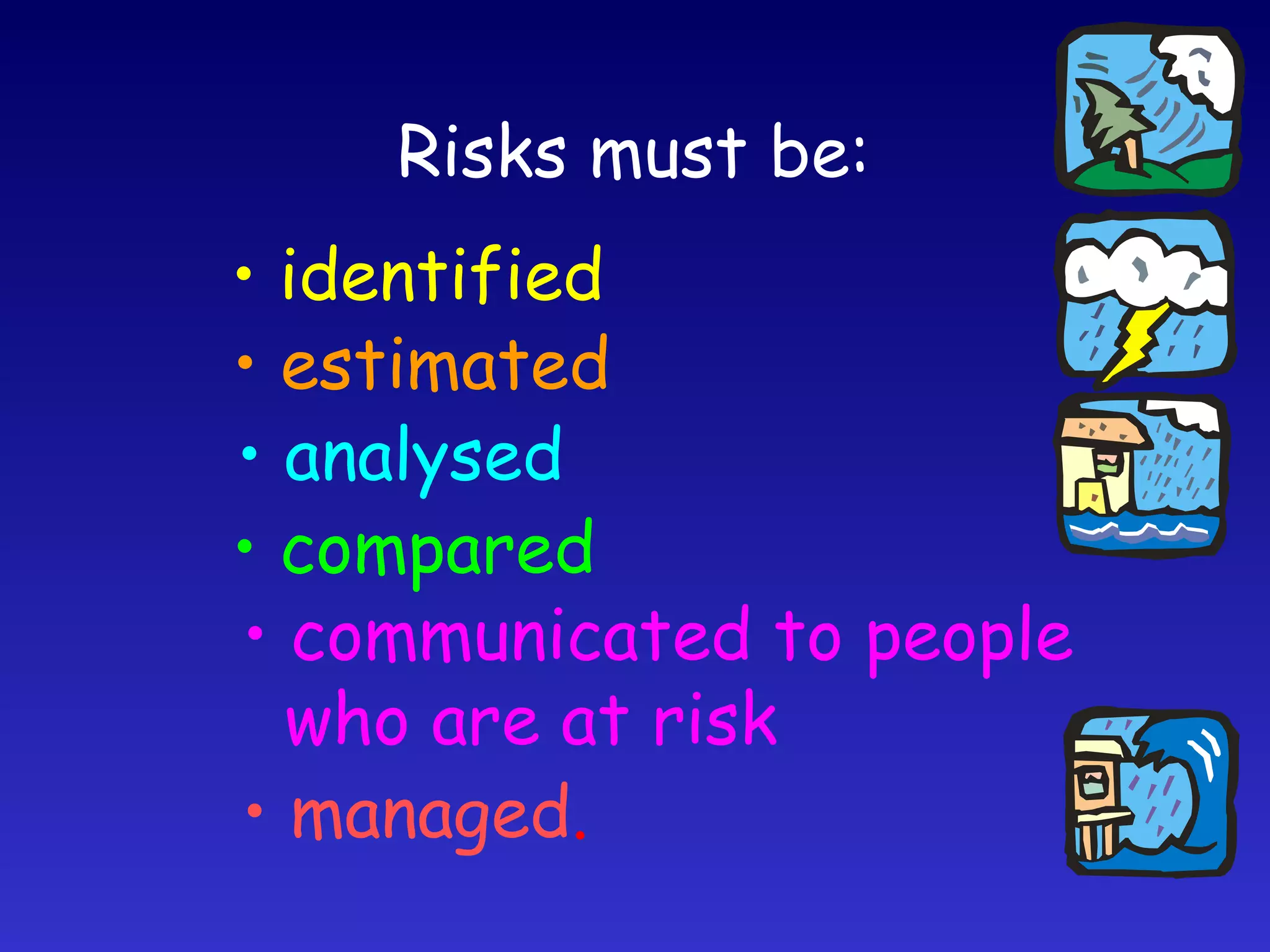
Risks must be: identified estimated analysed compared communicated to people who are at risk managed .
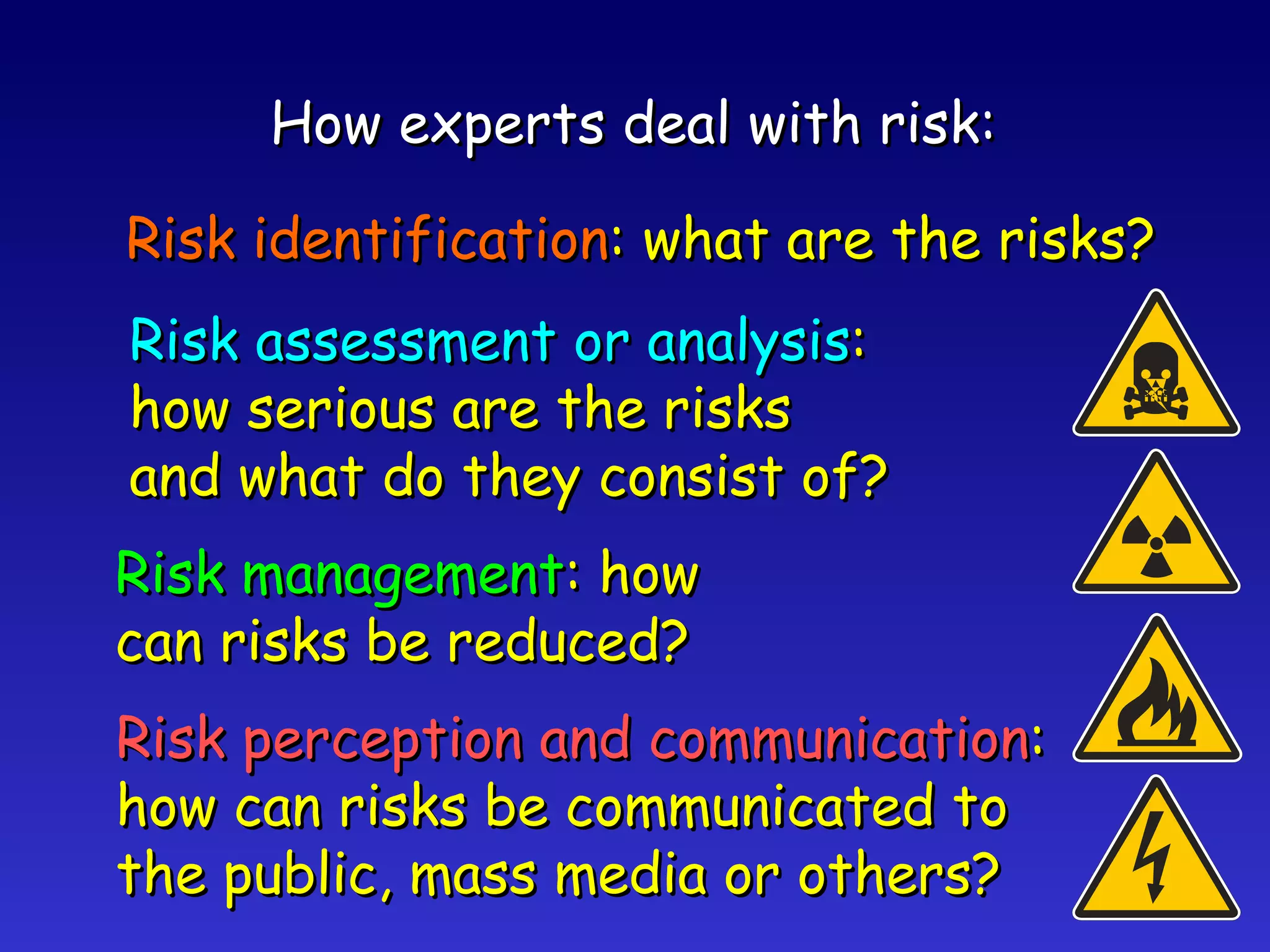
Risk identification : what are the risks? Risk assessment or analysis : how serious are the risks and what do they consist of? Risk management : how can risks be reduced? Risk perception and communication : how can risks be communicated to the public, mass media or others? How experts deal with risk:
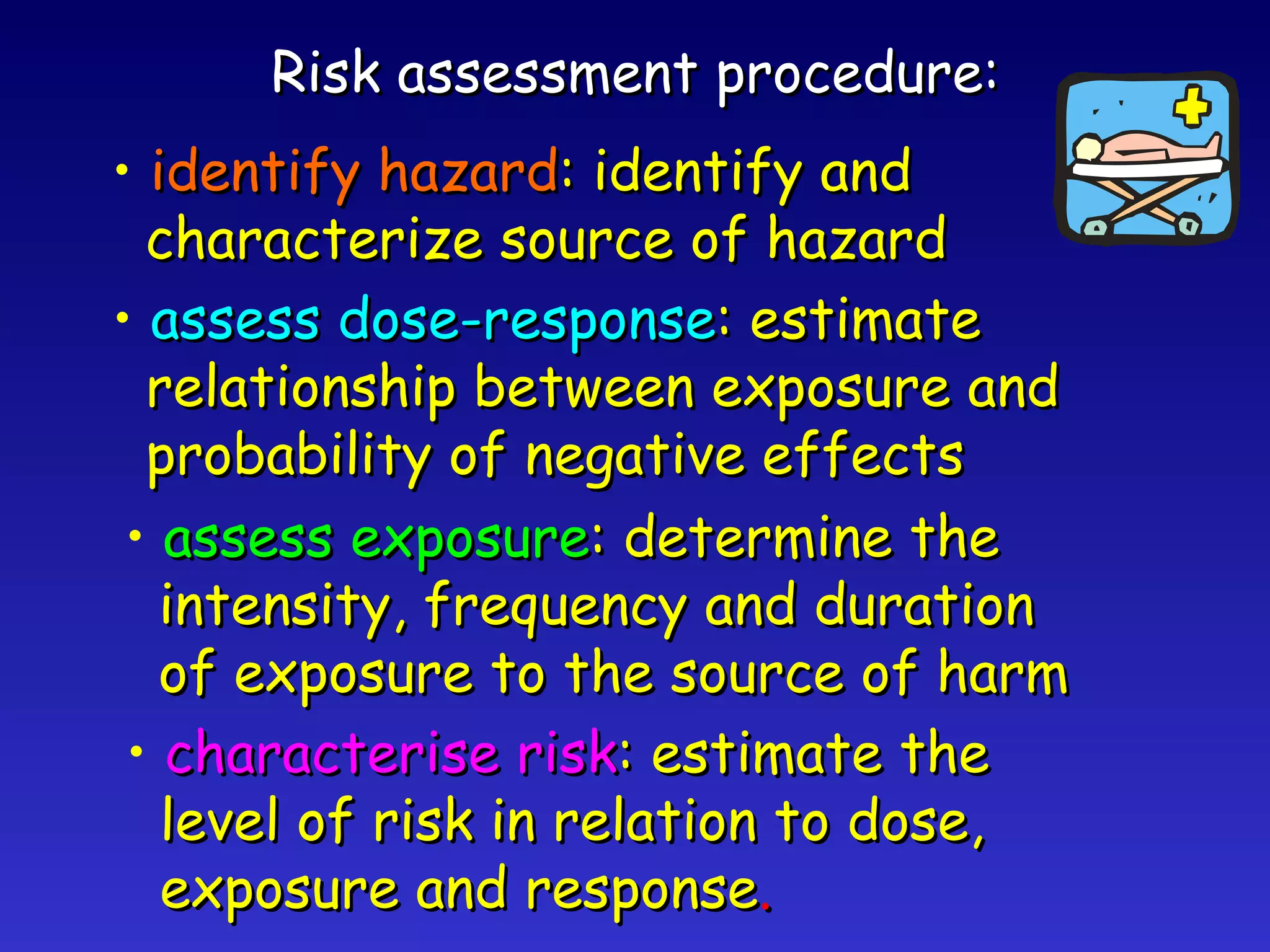
Risk assessment procedure: identify hazard : identify and characterize source of hazard assess dose-response : estimate relationship between exposure and probability of negative effects assess exposure : determine the intensity, frequency and duration of exposure to the source of harm characterise risk : estimate the level of risk in relation to dose, exposure and response .
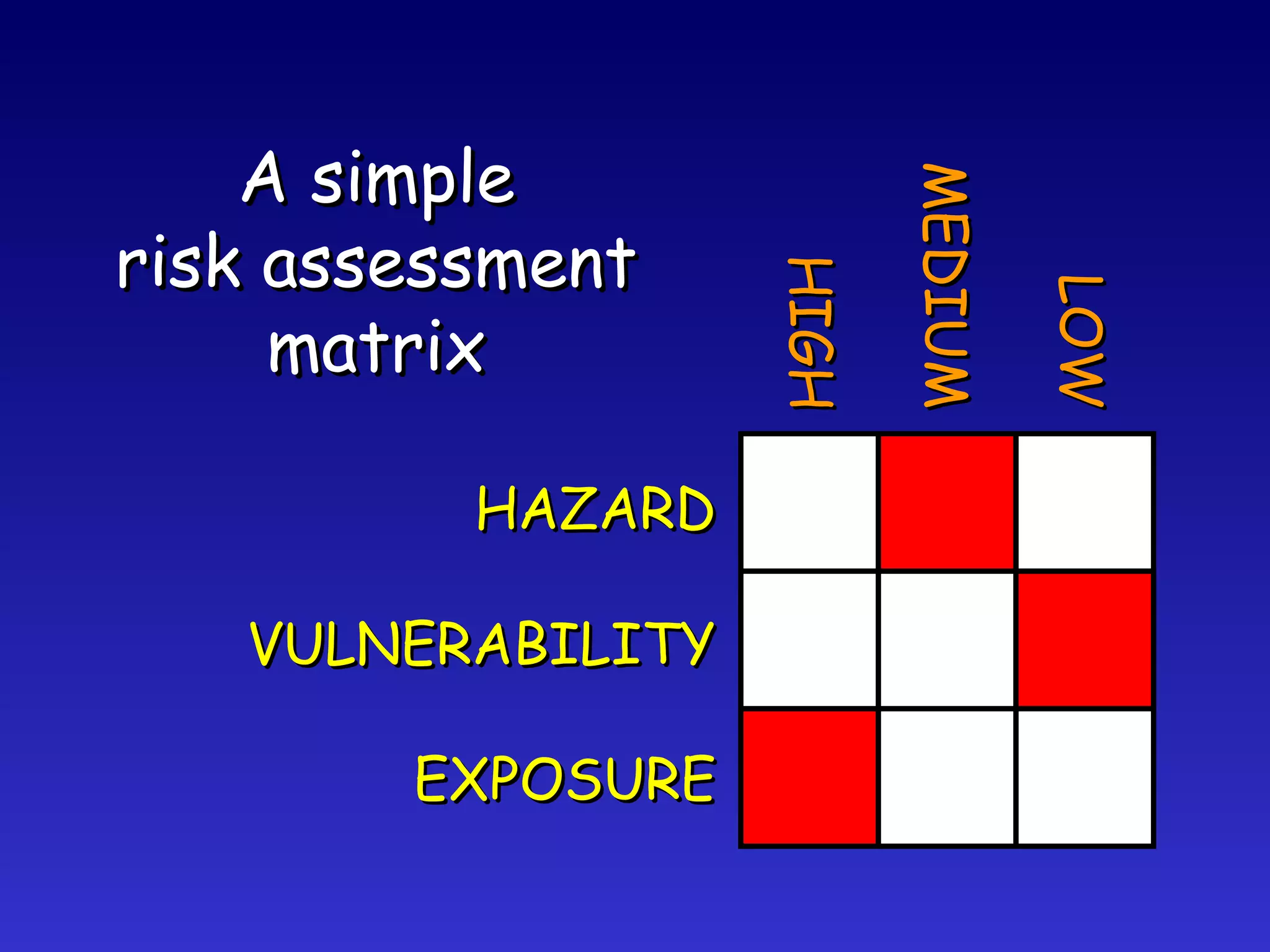
HAZARD VULNERABILITY EXPOSURE LOW MEDIUM HIGH A simple risk assessment matrix
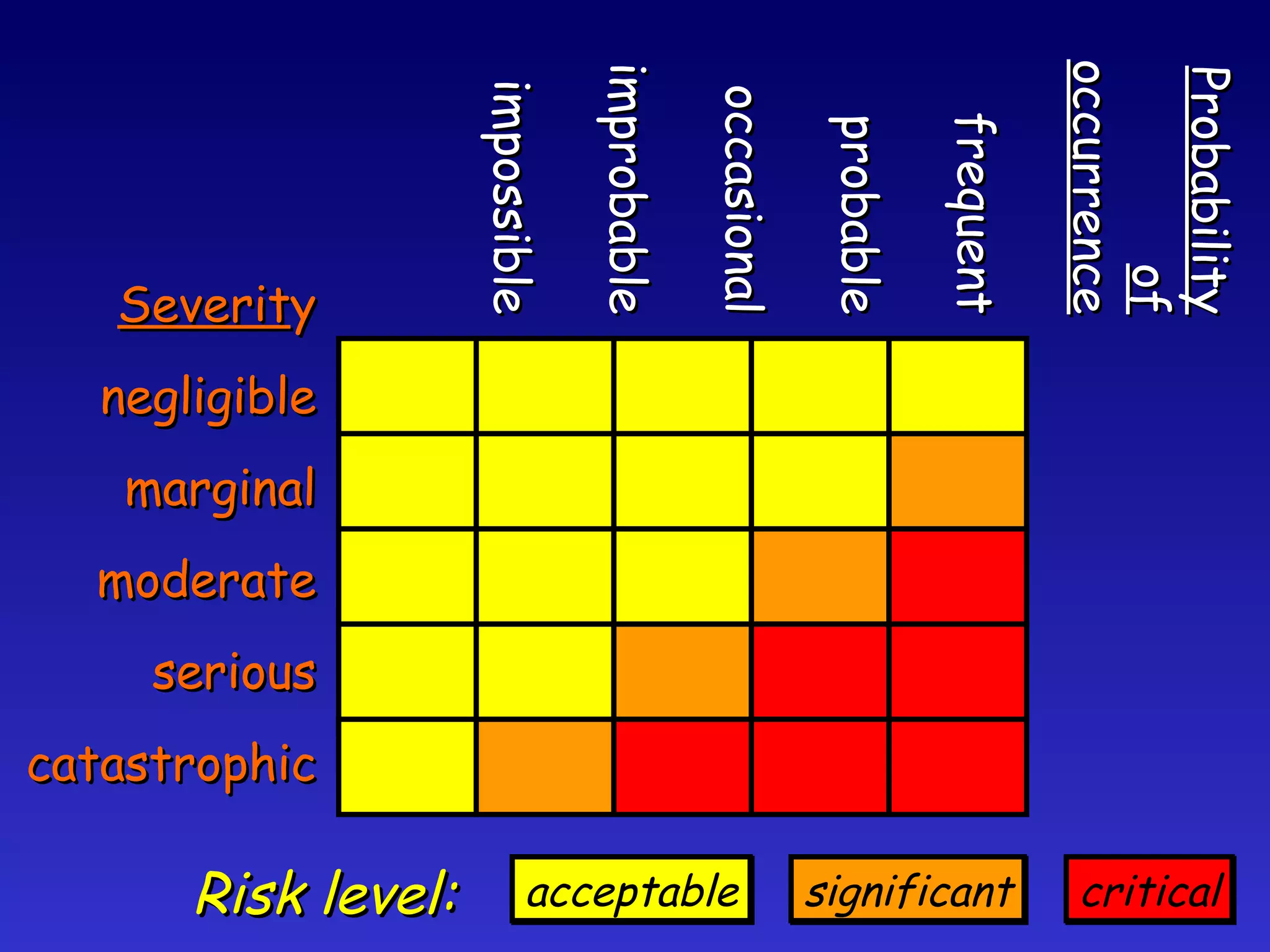
Severit y negligible marginal moderate serious catastrophic Probability of occurrence frequent probable occasional improbable impossible acceptable significant critical Risk level:
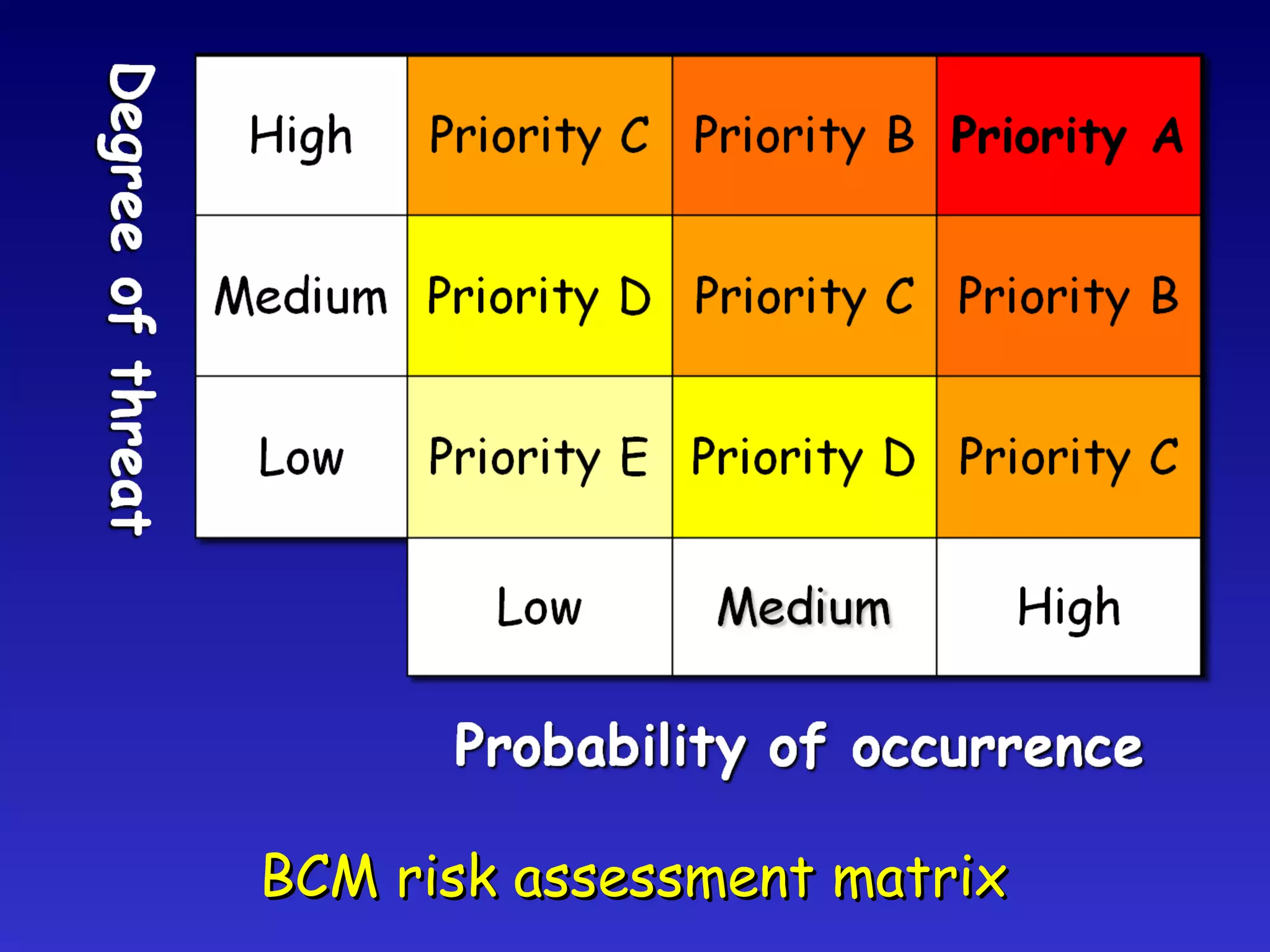
BCM risk assessment matrix
Constructing a  risk register all employees should be encouraged to contribute to the  identification , discussion   and  exploration   of risks institute a  "no fault, no blame" culture   for the identification of risks appoint and train a  risk manager in each department   of the organisation have frequent and open  discussions about how to manage the risks .
Company Board and CEO Business continuity management board BCM project team (and leader) direct project ensure appropriate resources ensure quality [Departmental] working group [Departmental] working group Risk register
Risk analysis  should express:- probability  of event of given size impact  magnitude  / population size basic  conditions  and  assumptions uncertainty  and  confidence  levels how predictions were  obtained .
single  or  multiple  risks considered? total  or  partial  risk? voluntary  or  involuntary  exposure? how analysis will affect management  of the risk . Risk analysis  should express:-
Factors that limit risk mitigation: environmental  hazard levels human  activities unclear  responsibilities poor understanding of organisational  networks inadequate  training  and education .
Risk communication messages   should:- come from an  official  source clearly  explain  risk and its likelihood say what sort of  impact  is expected describe probable  effect  of impact and where to get more  information . explain what  to do ...
Risk communication messages should:- present information  in sequence encourage people to  share  information with colleagues, family and friends repeat  message many times . explain  importance  of message and the need for action
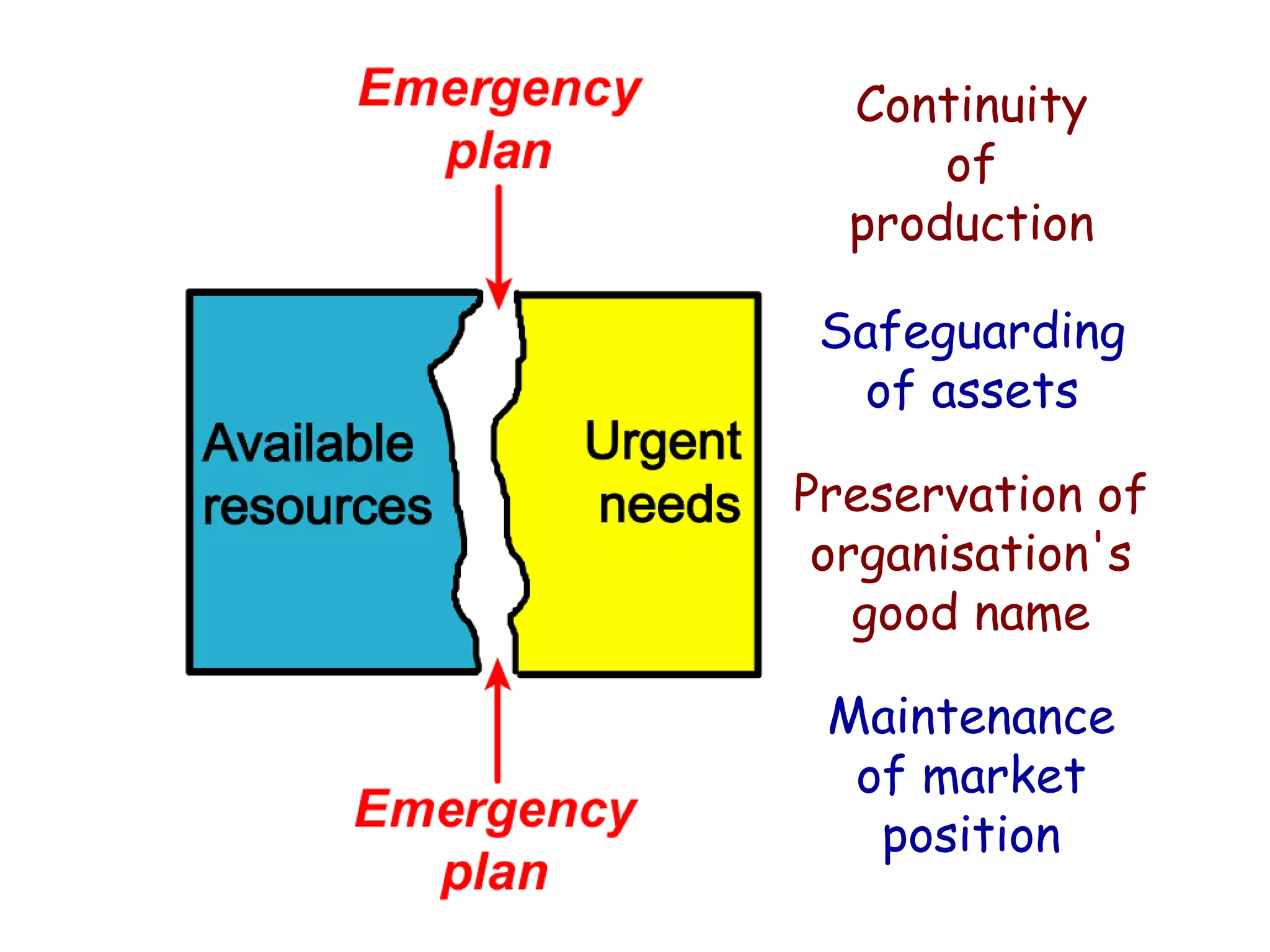
The essence of disaster management:- To tackle pressing needs with maximum efficiency and speed but with scarce resources and in the absence of necessary information BUT  emergency planning is still a young field: it lacks international consensus on standards,  procedures, and legal and institutional imperatives
Modern emergency plans are  generic ( "all hazards" ):- adaptable  to all emergencies focussed on the emergencies deemed most likely to occur  in the local area technical sophistication  must be balanced by  ease of use .
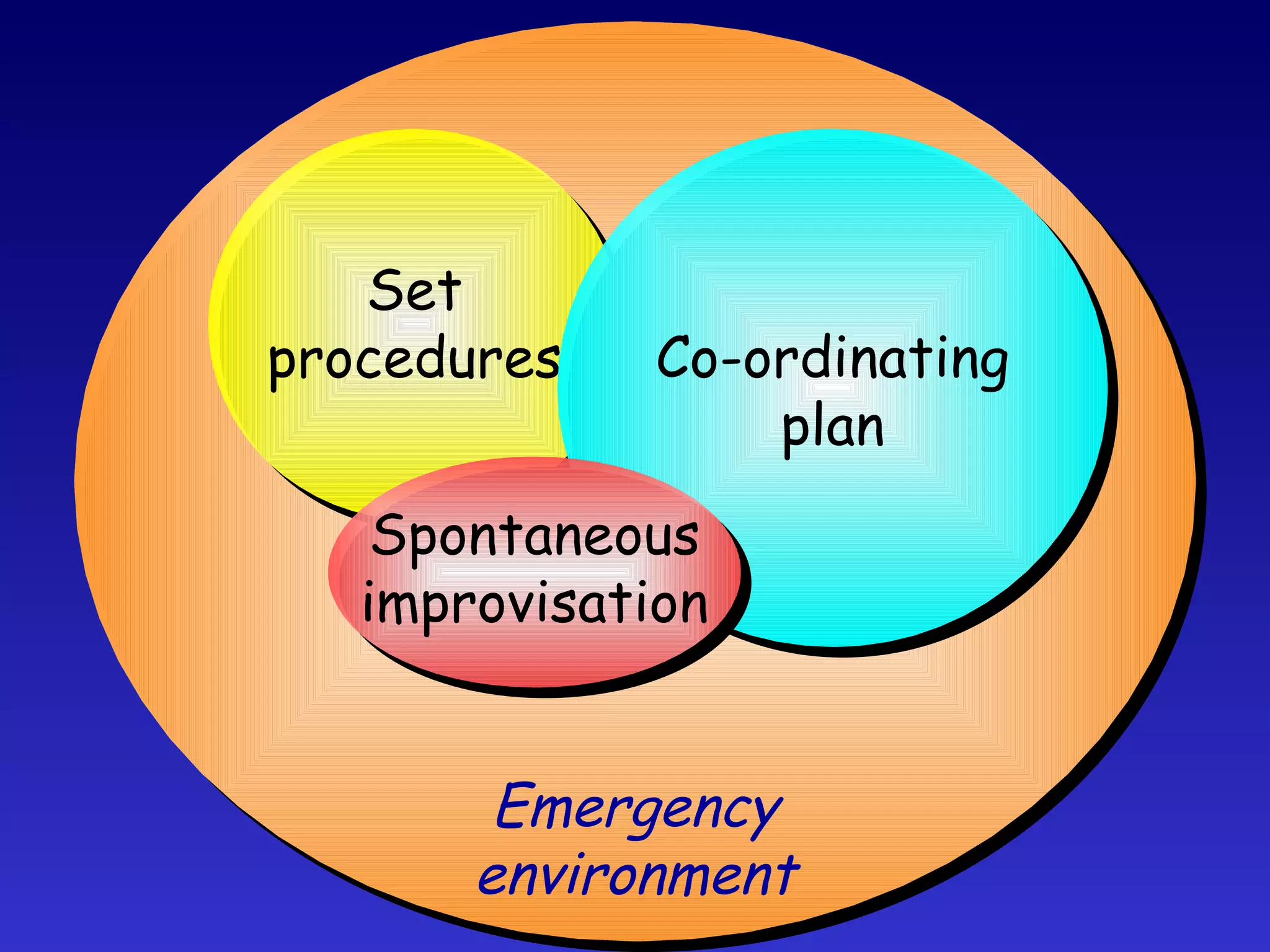
Set procedures Co-ordinating plan Spontaneous improvisation Set procedures Co-ordinating plan Spontaneous improvisation Emergency environment Emergency environment
Continuity of production Preservation of organisation's good name Safeguarding of assets Maintenance of market position
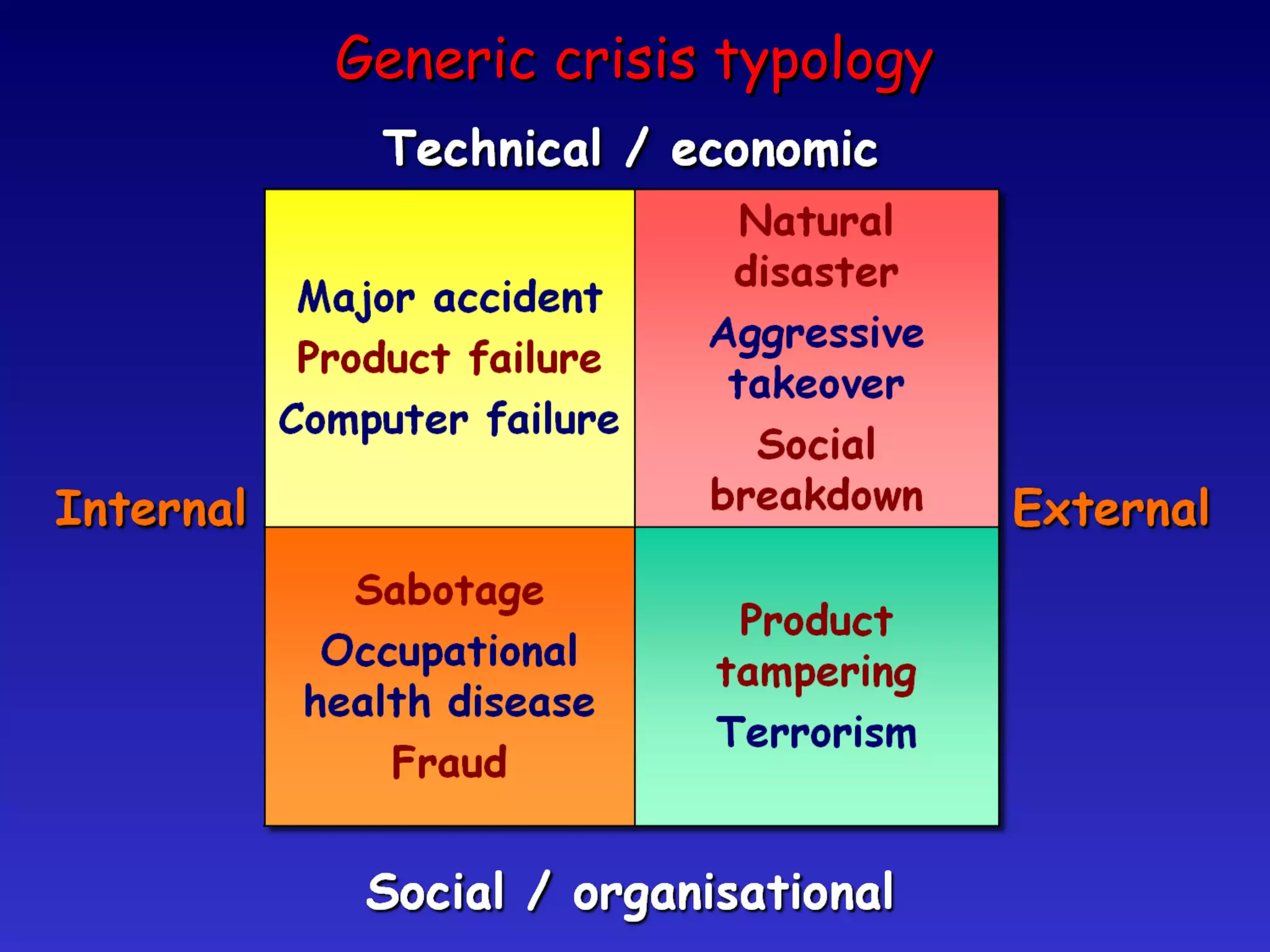
Generic crisis typology
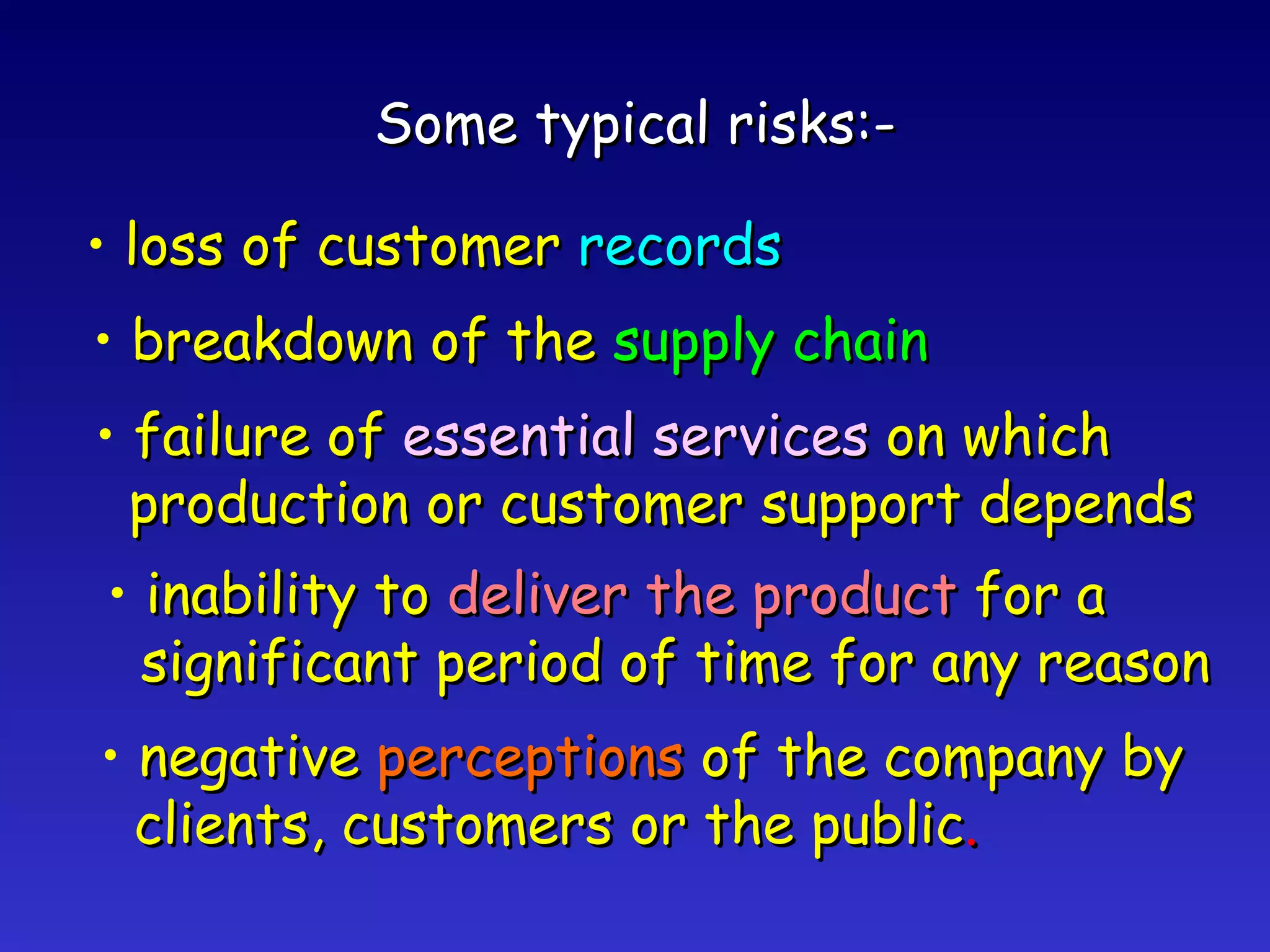
Some typical risks:- loss of customer  records breakdown of the  supply chain failure of  essential services  on which production or customer support depends inability to  deliver the product  for a significant period of time for any reason negative  perceptions  of the company by clients, customers or the public .
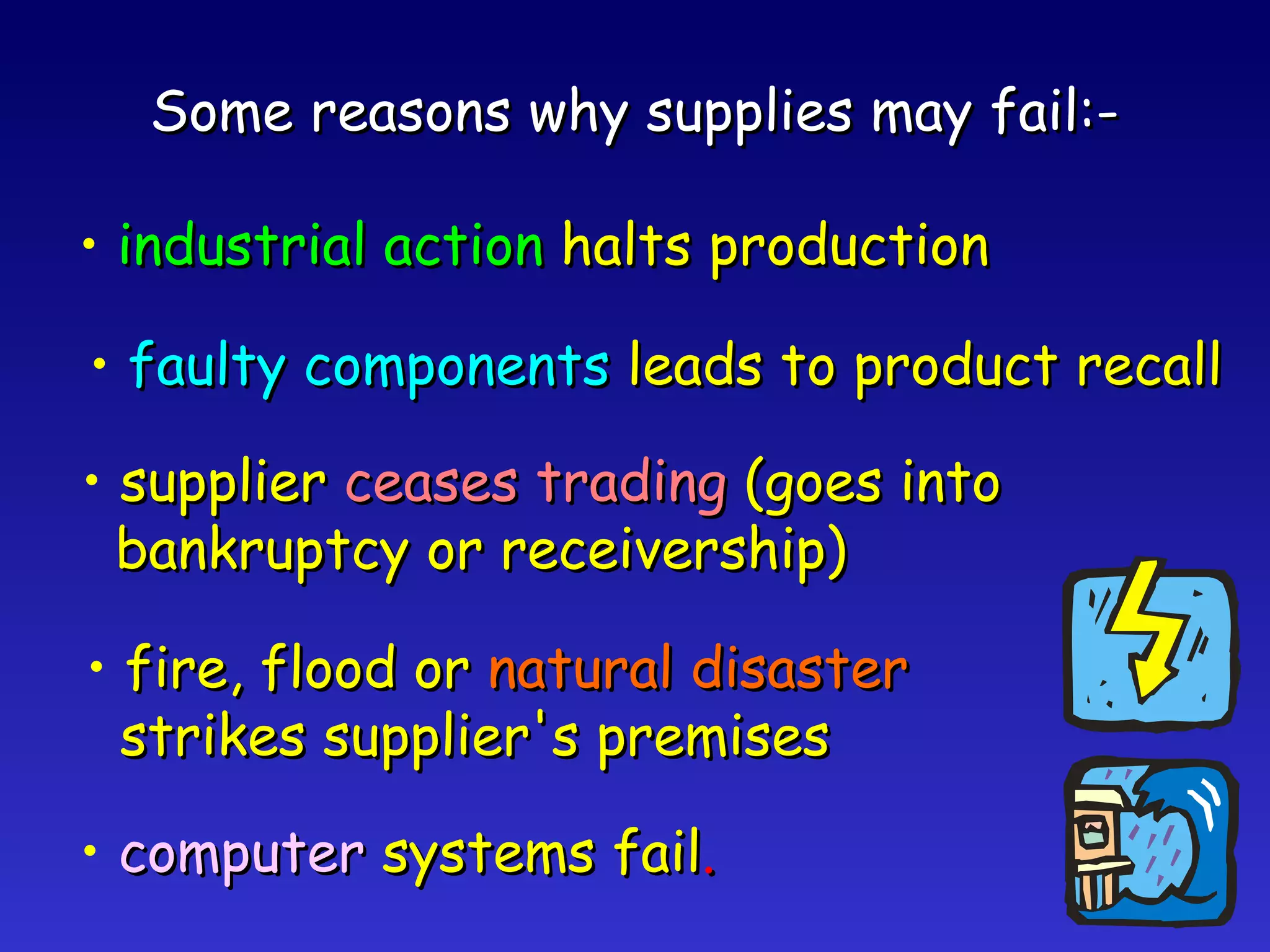
Some reasons why supplies may fail:- industrial action  halts production faulty components  leads to product recall supplier  ceases trading  (goes into bankruptcy or receivership) fire, flood or  natural disaster strikes supplier's premises computer  systems fail .
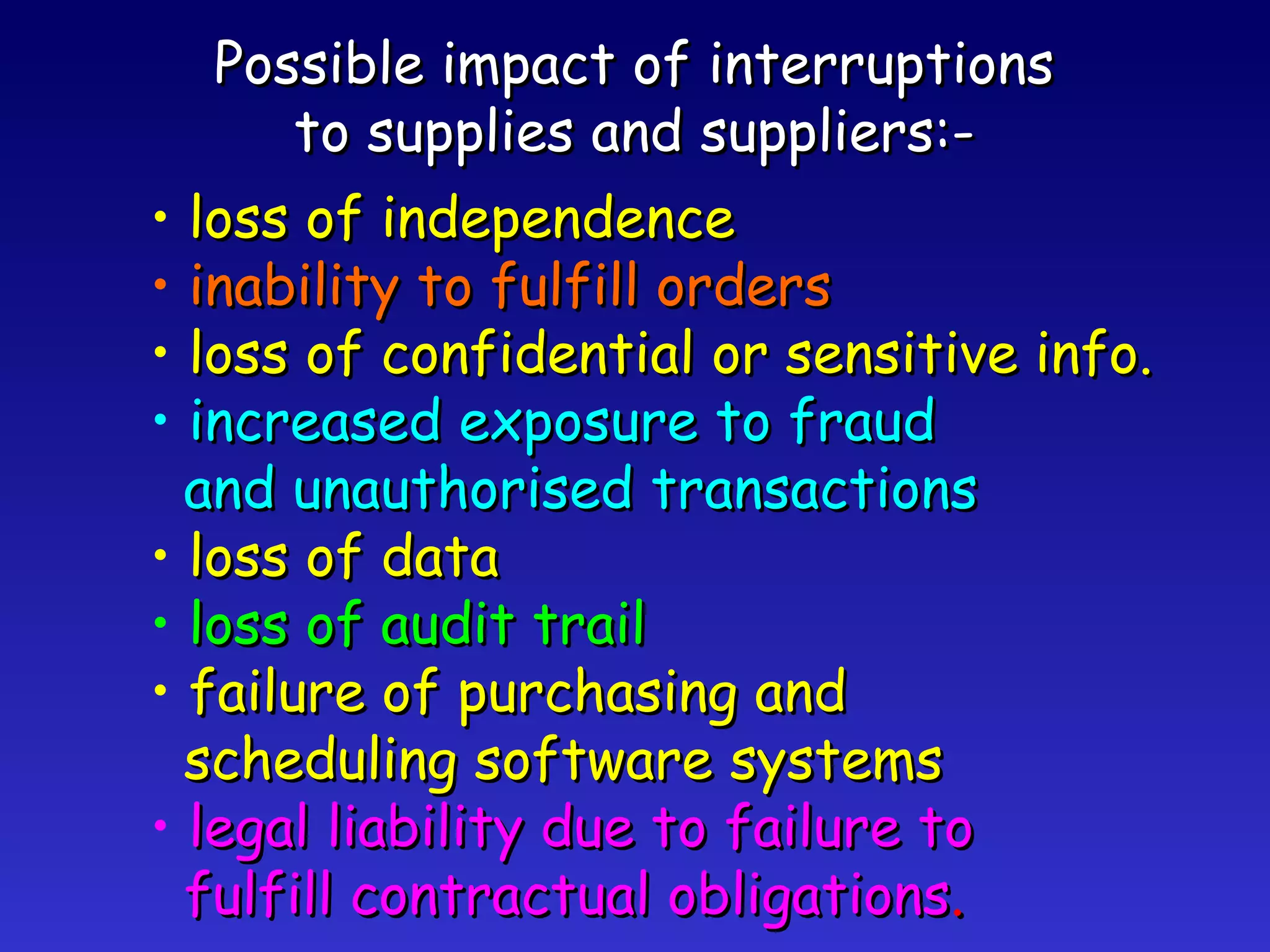
Possible impact of interruptions to supplies and suppliers:- loss of independence inability to fulfill orders loss of confidential or sensitive info. increased exposure to fraud and unauthorised transactions loss of data loss of audit trail failure of purchasing and scheduling software systems legal liability due to failure to fulfill contractual obligations .
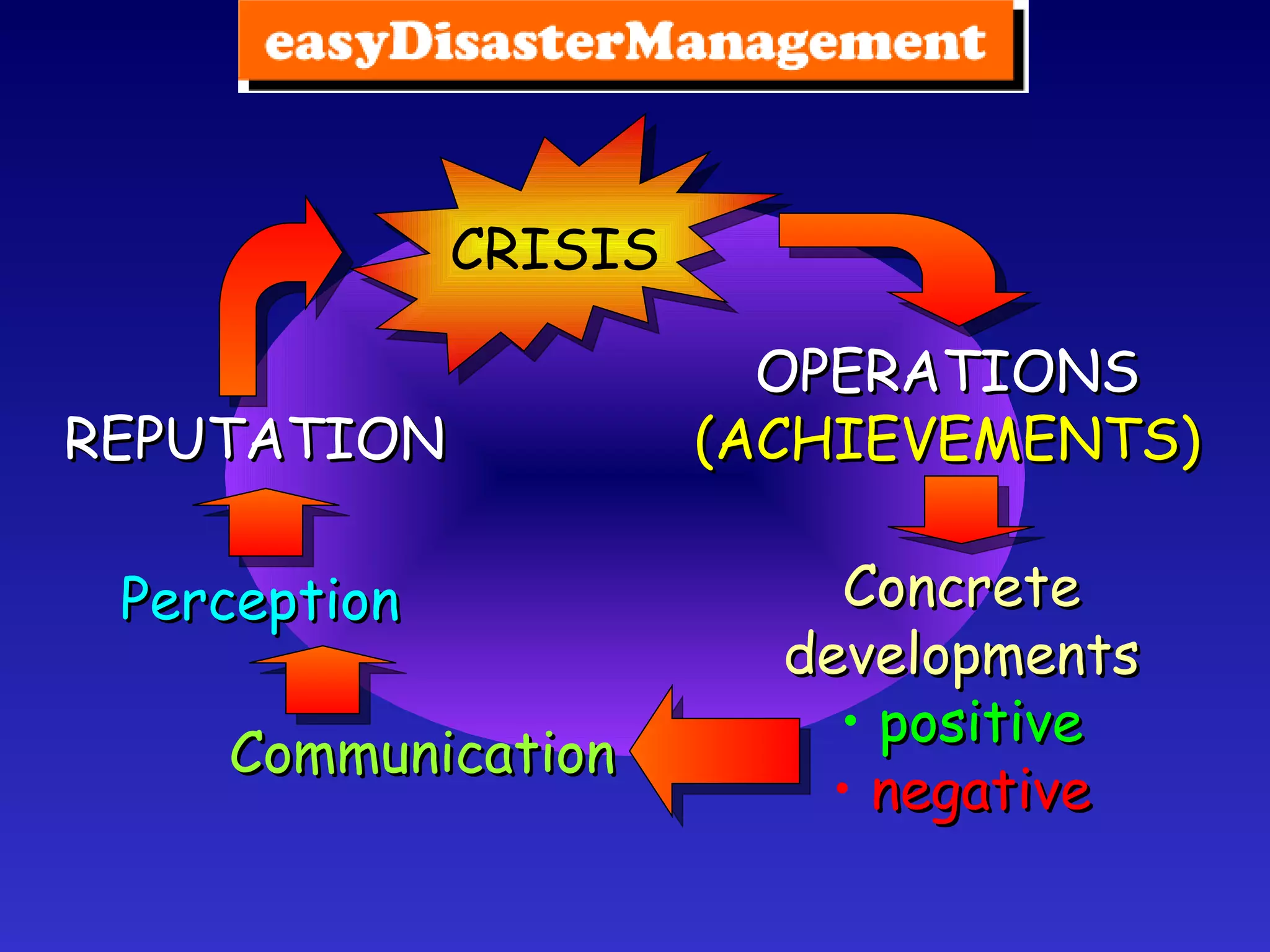
OPERATIONS (ACHIEVEMENTS) REPUTATION Perception Communication Concrete developments positive negative CRISIS
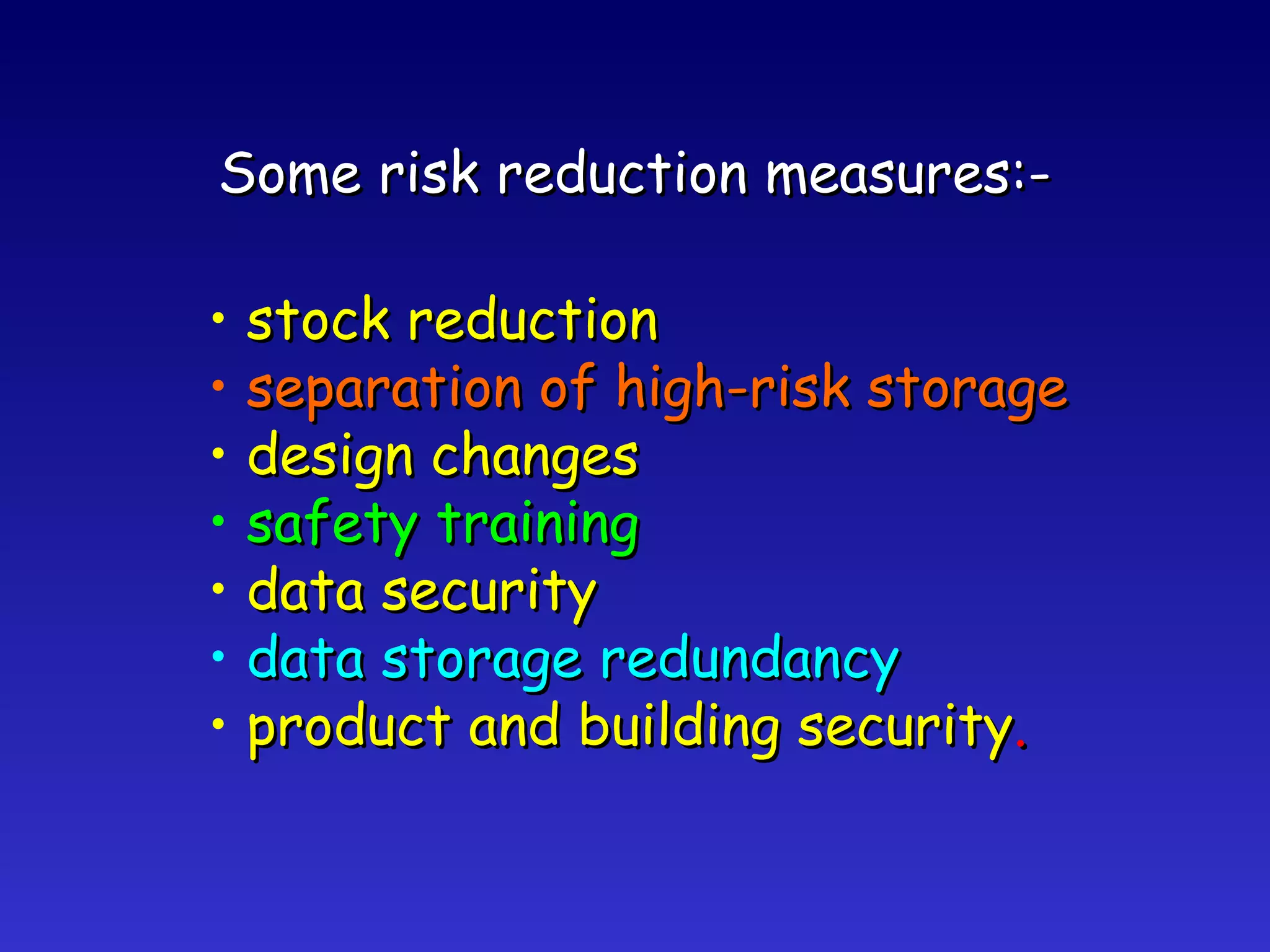
Some risk reduction measures:- stock reduction separation of high-risk storage design changes safety training data security data storage redundancy product and building security .
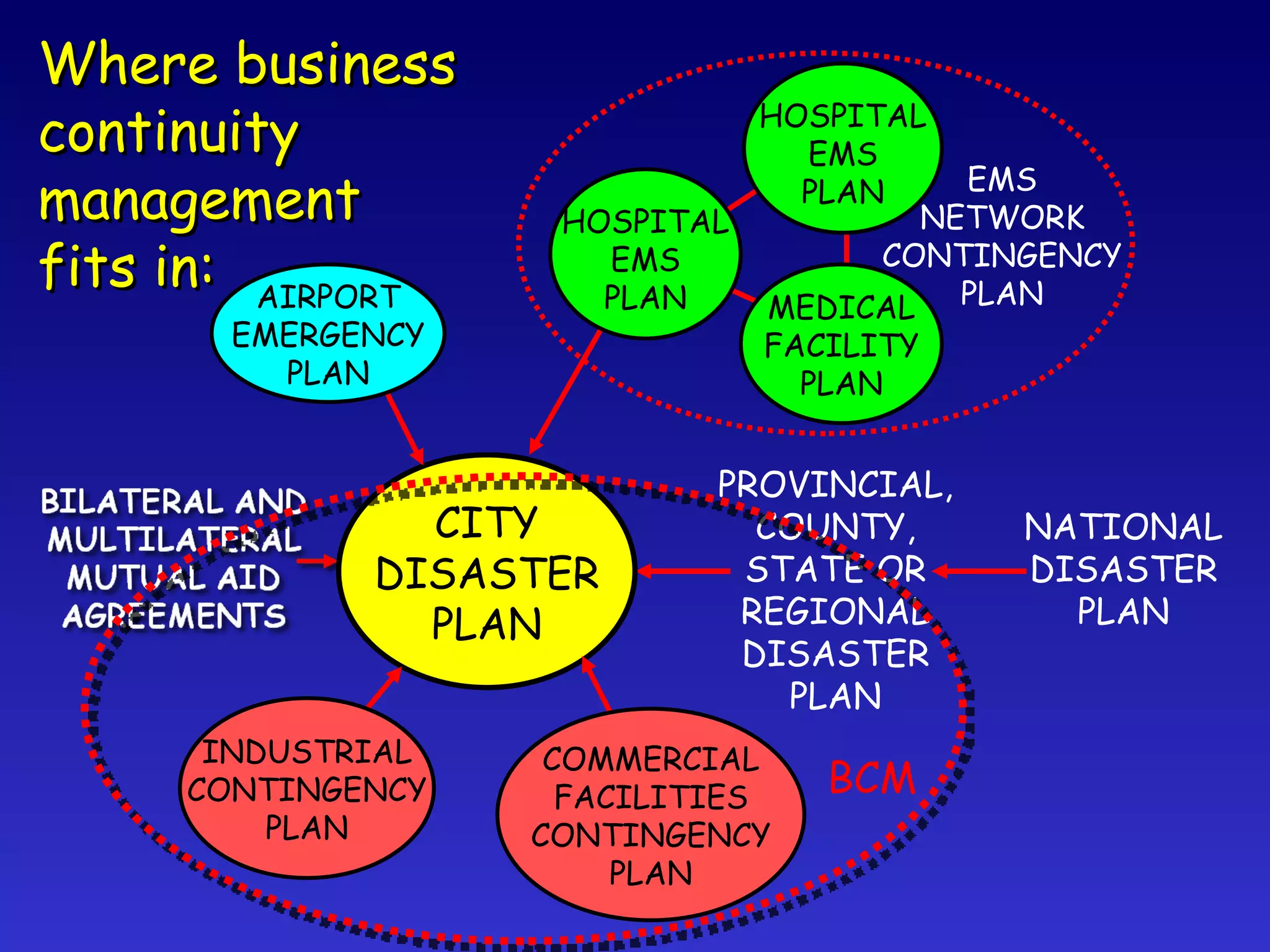
CITY DISASTER PLAN Where business continuity management fits in: PROVINCIAL, COUNTY, STATE OR REGIONAL DISASTER PLAN NATIONAL DISASTER PLAN AIRPORT EMERGENCY PLAN INDUSTRIAL CONTINGENCY PLAN COMMERCIAL FACILITIES CONTINGENCY PLAN EMS NETWORK CONTINGENCY PLAN HOSPITAL EMS PLAN HOSPITAL EMS PLAN MEDICAL FACILITY PLAN BCM
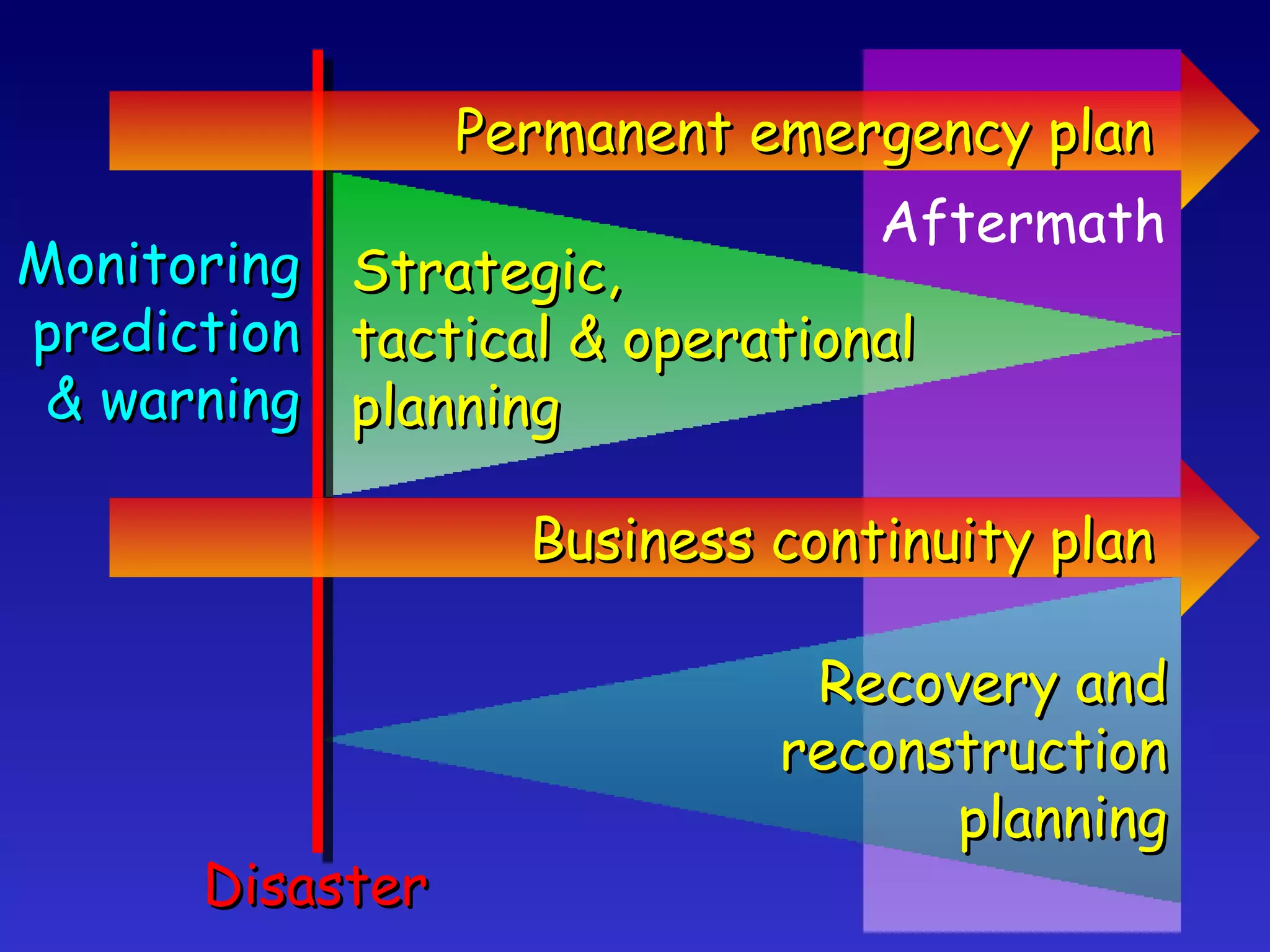
Strategic, tactical & operational planning Aftermath Disaster Monitoring prediction & warning Permanent emergency plan Business continuity plan Recovery and reconstruction planning
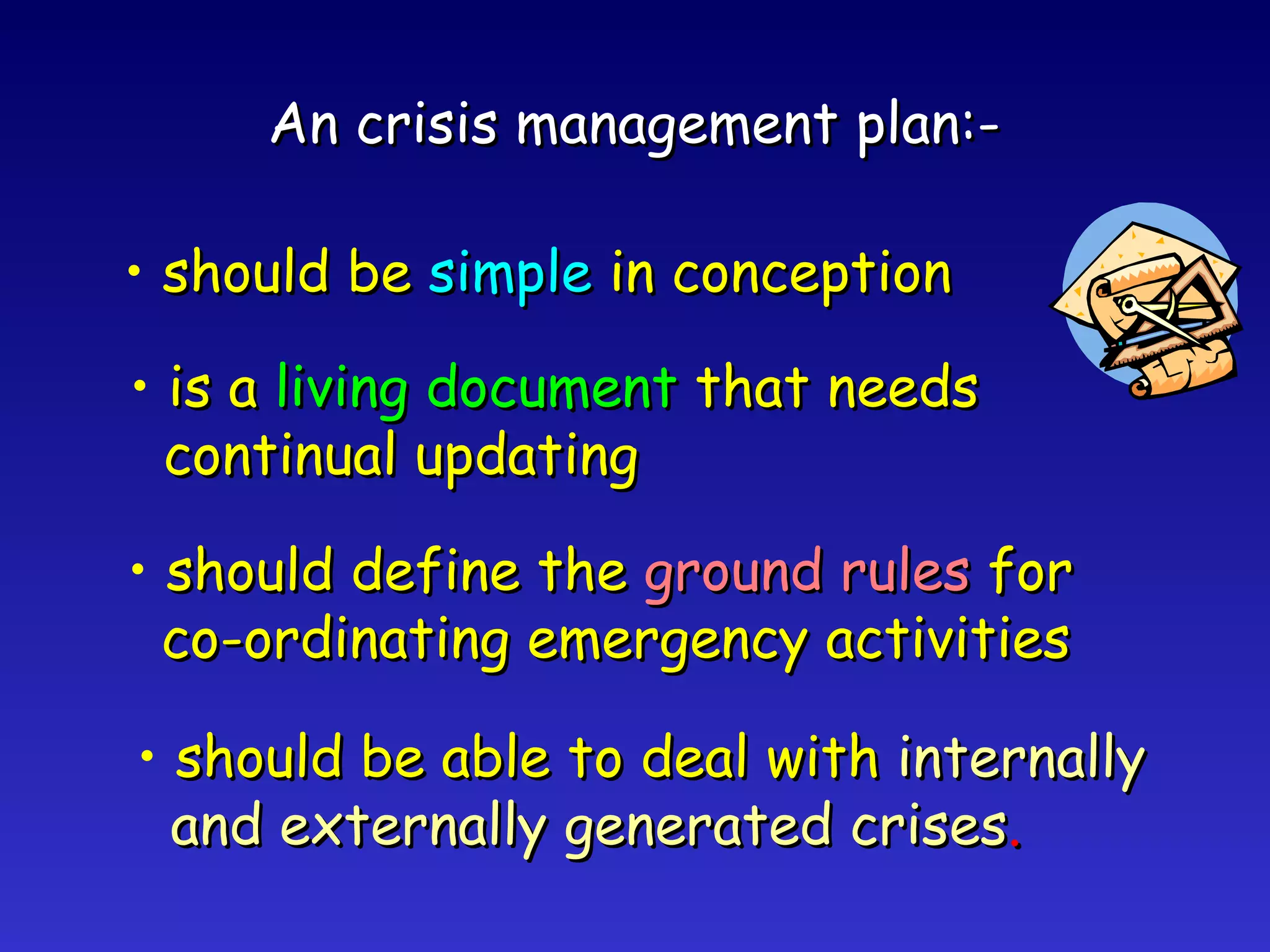
An crisis management plan:- should be  simple   in conception is a  living document  that needs continual updating should define the  ground rules  for co-ordinating emergency activities should be able to deal with  internally and externally generated crises .
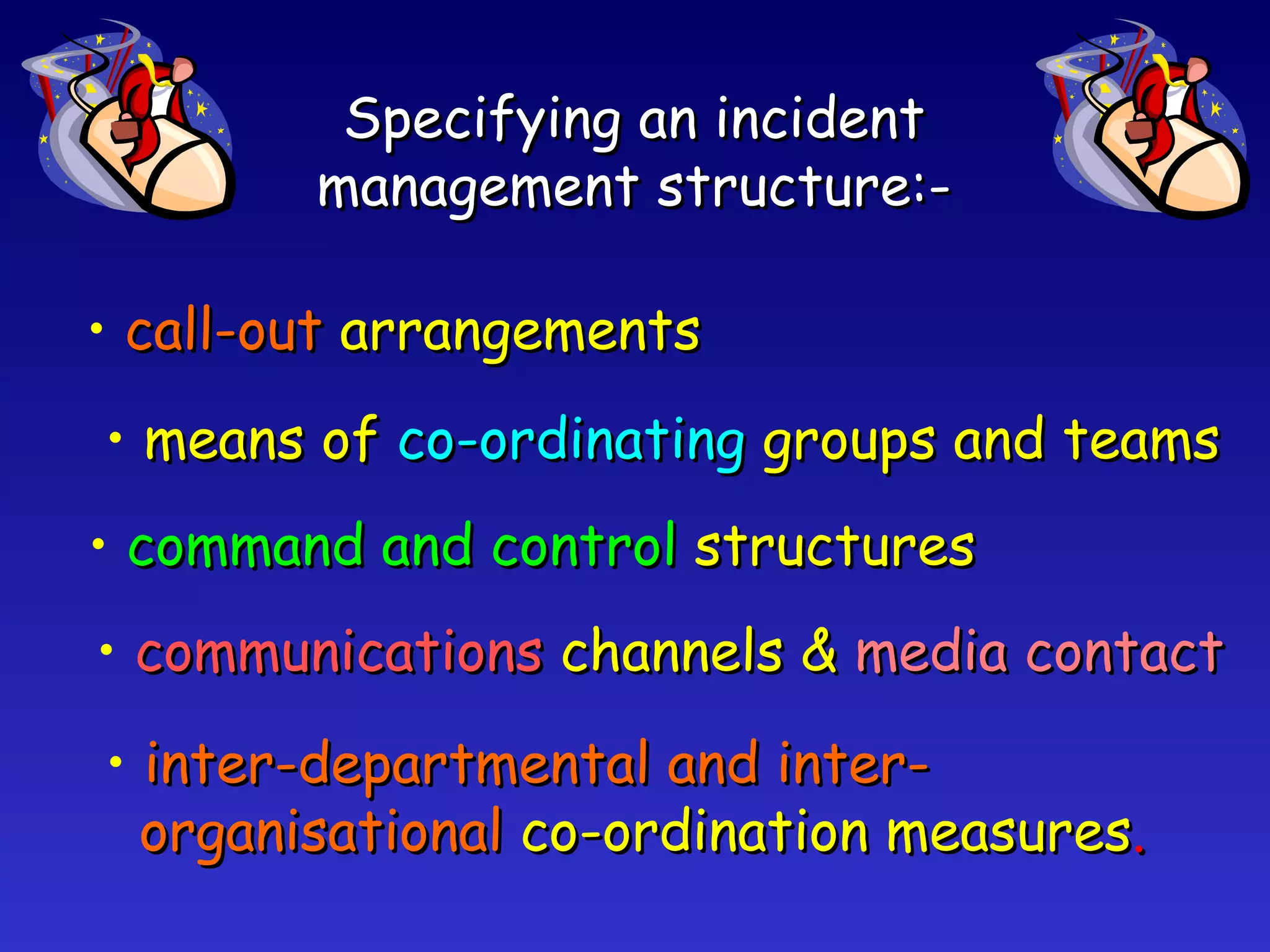
Specifying an incident management structure:- call-out   arrangements means of  co-ordinating   groups and teams command and control   structures communications   channels &  media contact inter-departmental and inter- organisational   co-ordination measures .
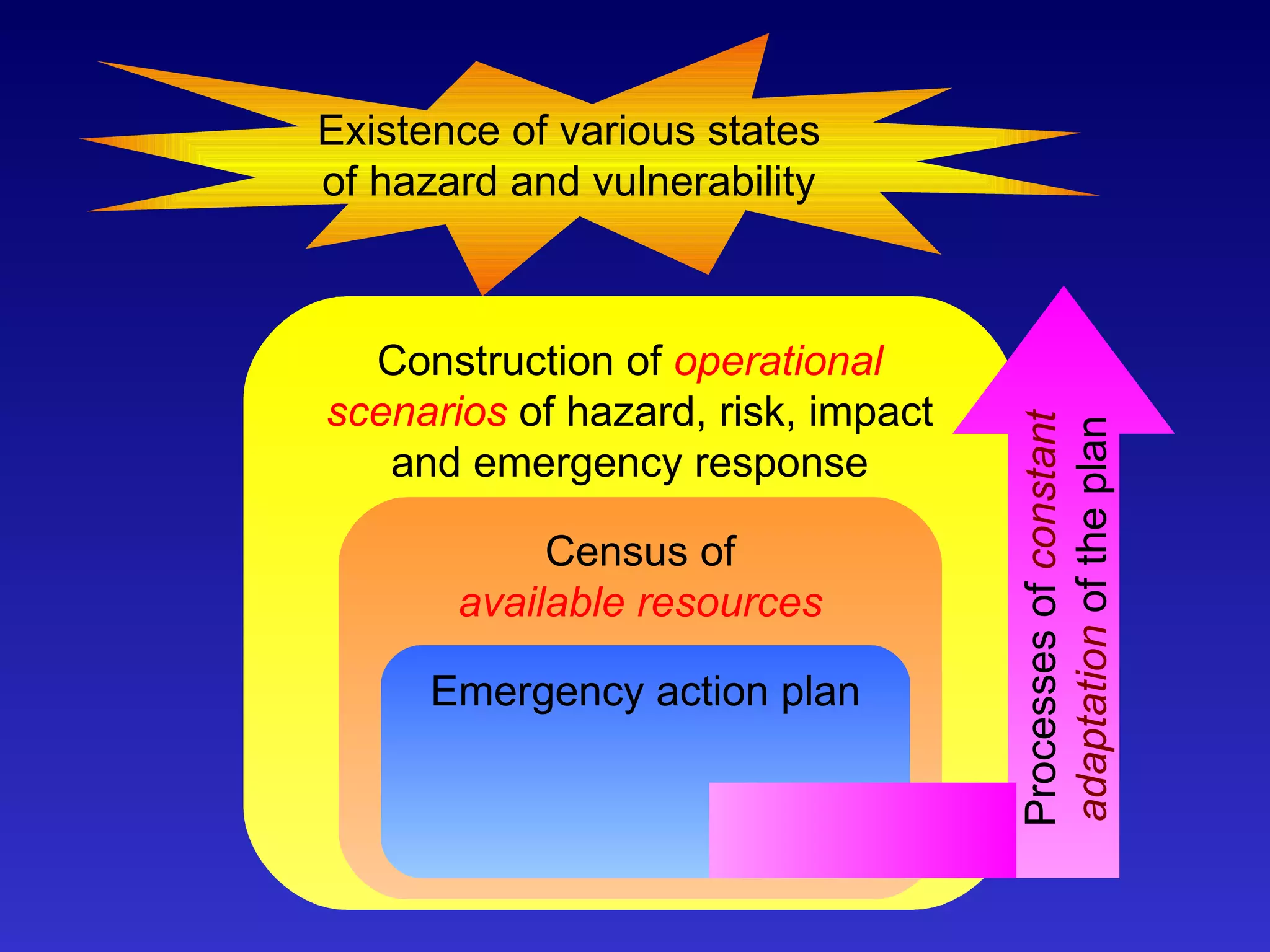
Construction of  operational scenarios  of hazard, risk, impact and emergency response Existence of various states of hazard and vulnerabilit y Census of available resources Emergency action plan Processes of  constant adaptation  of the plan
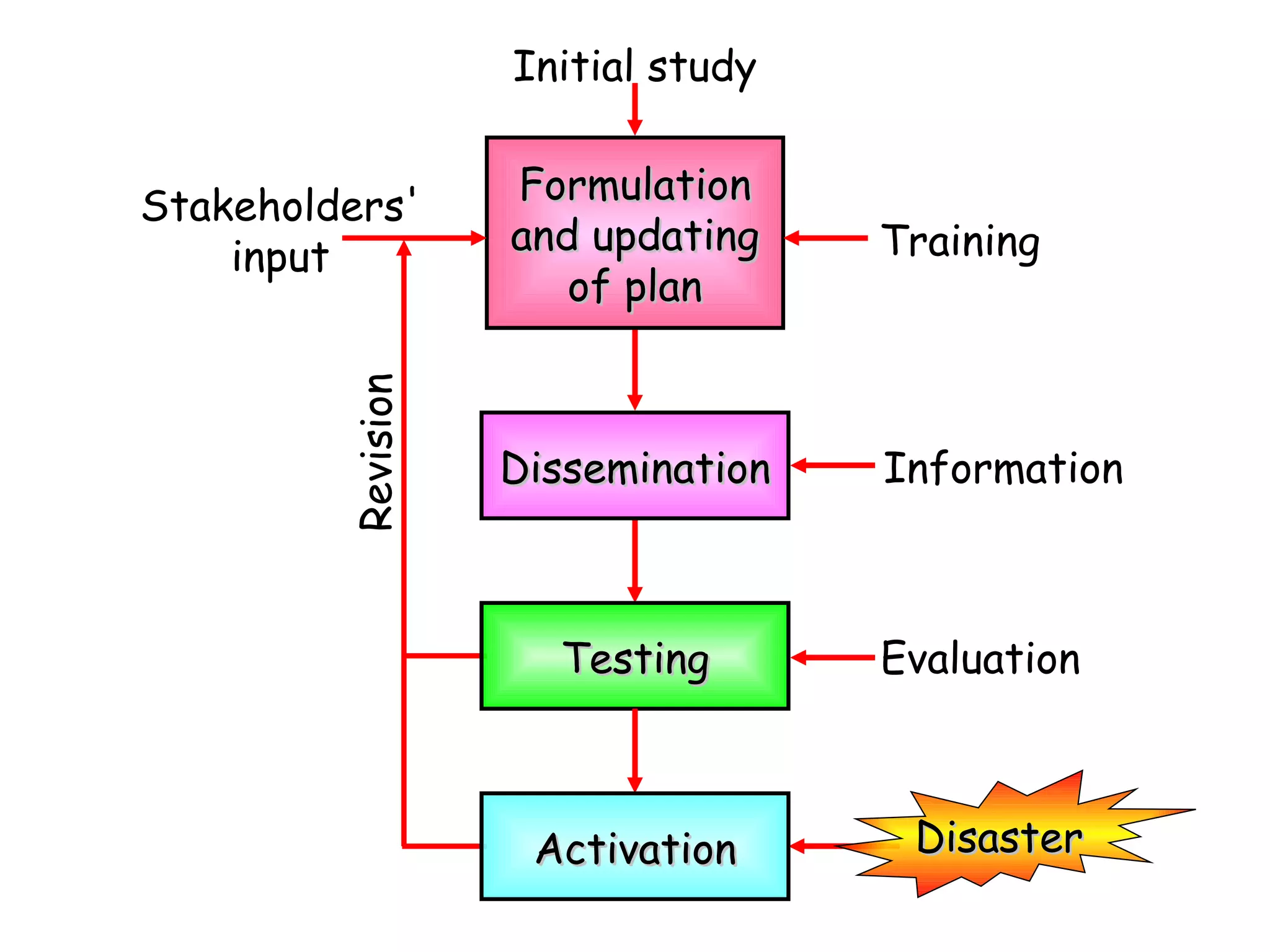
Initial study Revision Testing Evaluation Activation Disaster Dissemination Information Formulation and updating of plan Stakeholders' input Training
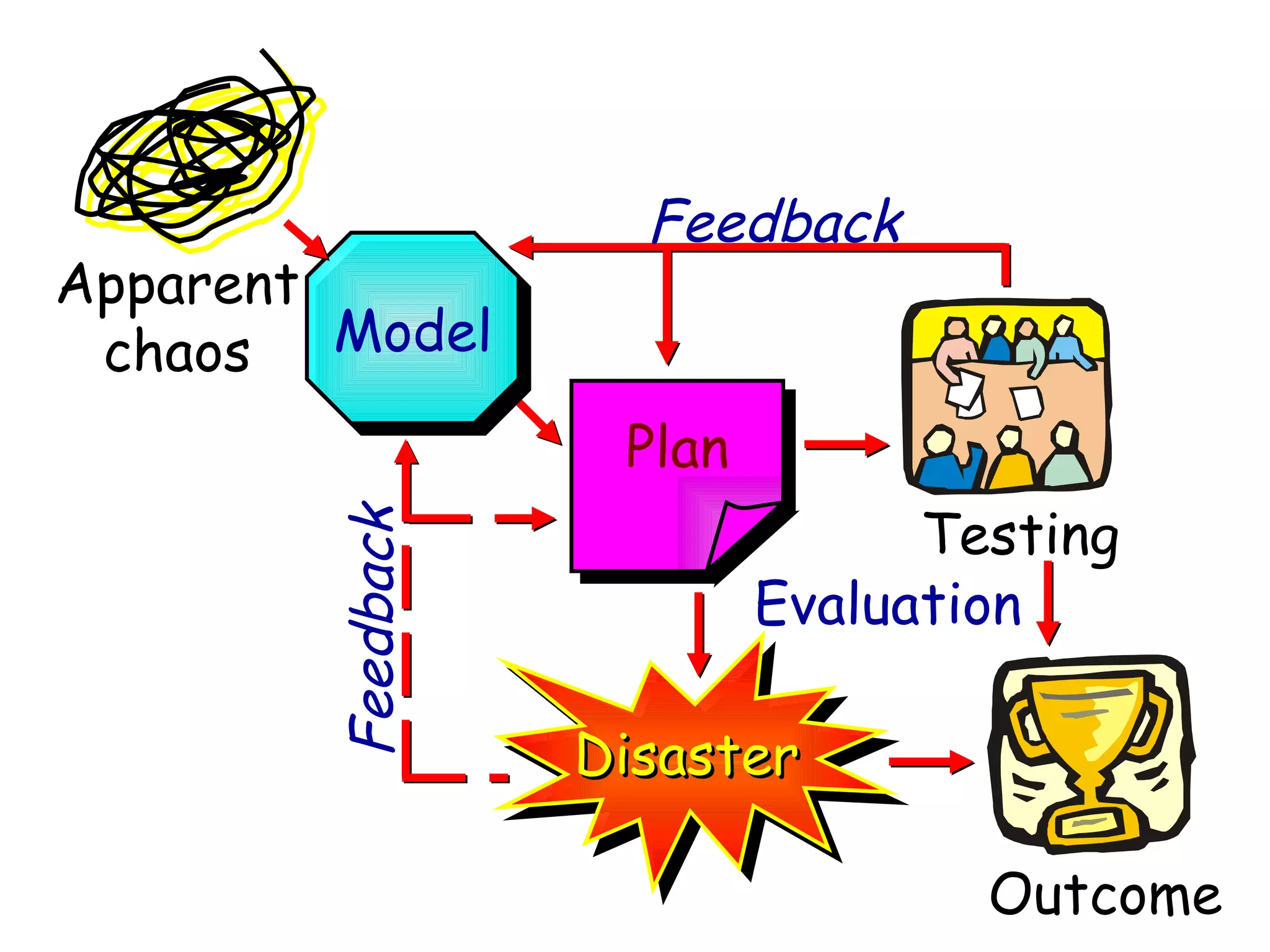
Evaluation Plan Apparent chaos Model Testing Disaster Outcome Feedback Feedback
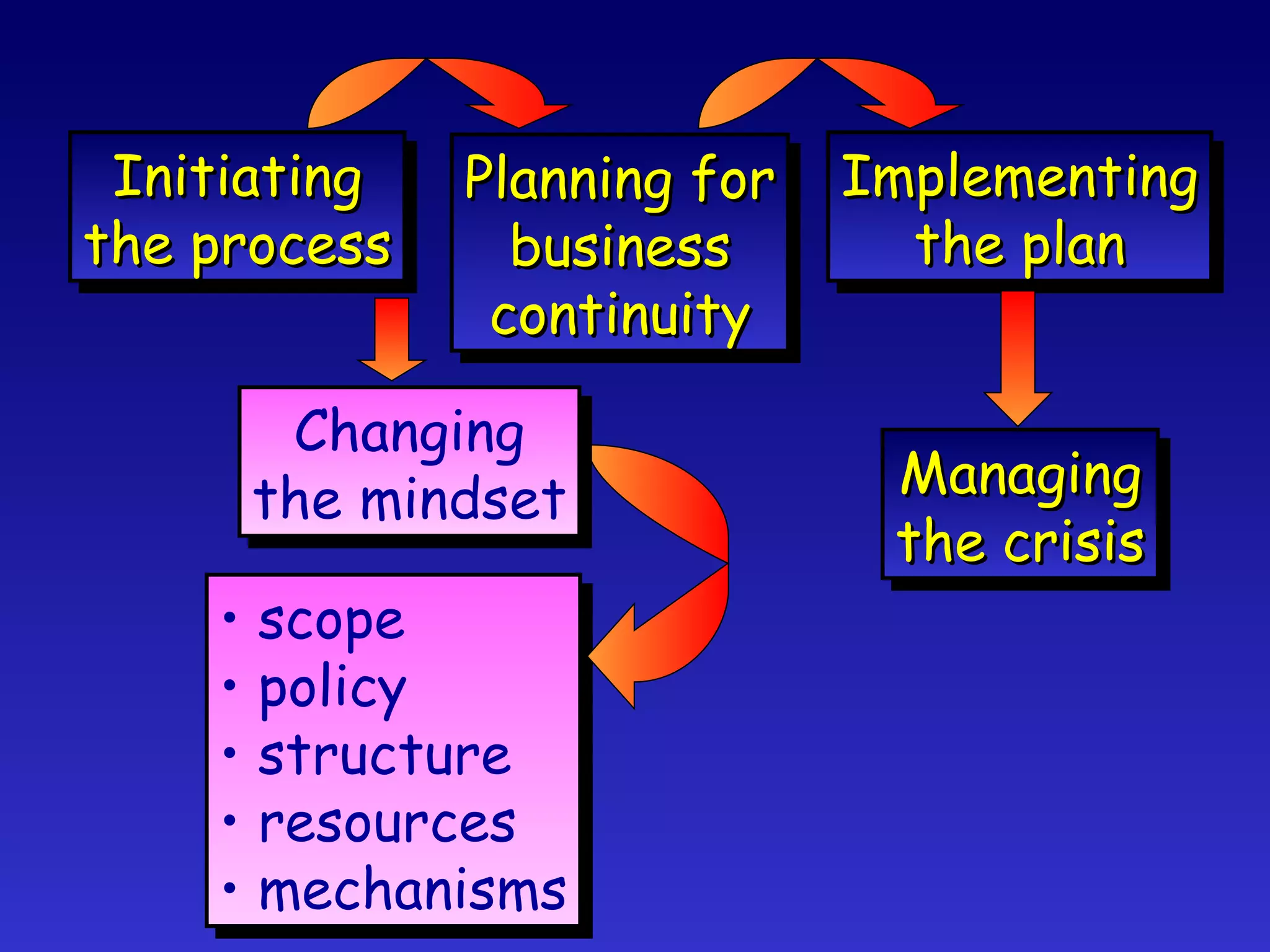
Initiating the process Planning for business continuity Implementing the plan Managing the crisis scope policy structure resources mechanisms Changing the mindset
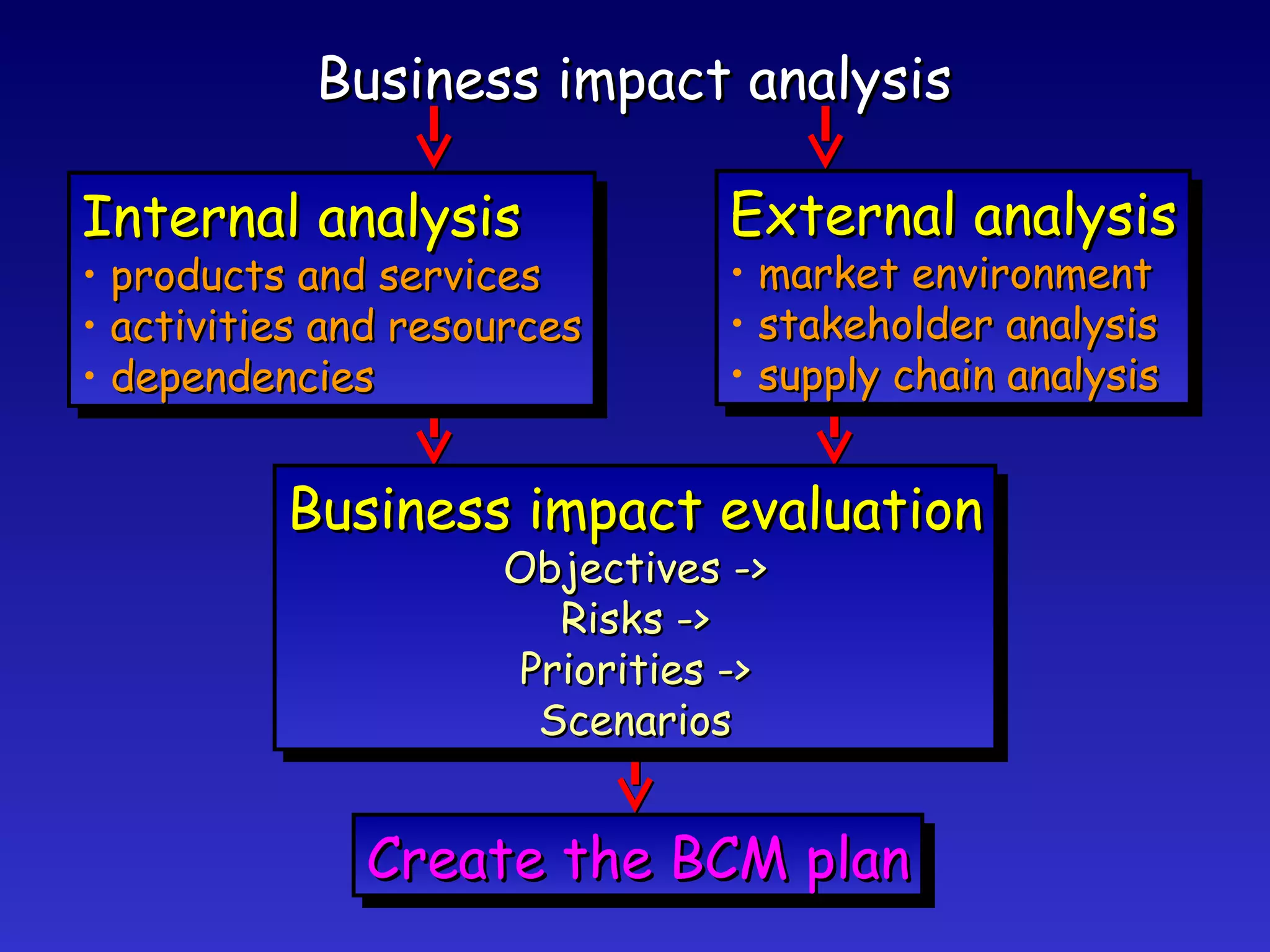
Business impact analysis Create the BCM plan Business impact evaluation Objectives -> Risks -> Priorities -> Scenarios Internal analysis products and services activities and resources dependencies External analysis market environment stakeholder analysis supply chain analysis
Conclusions
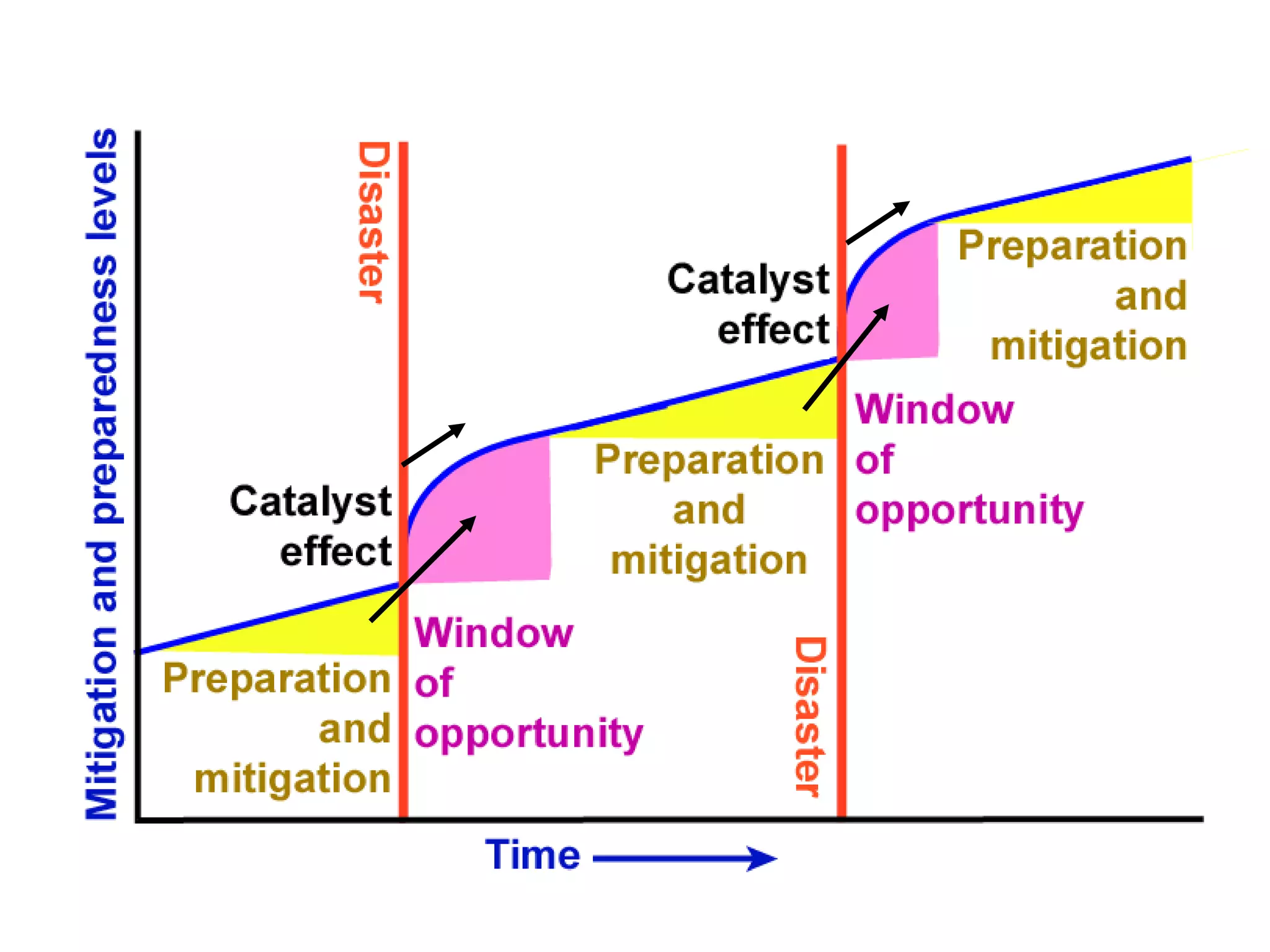
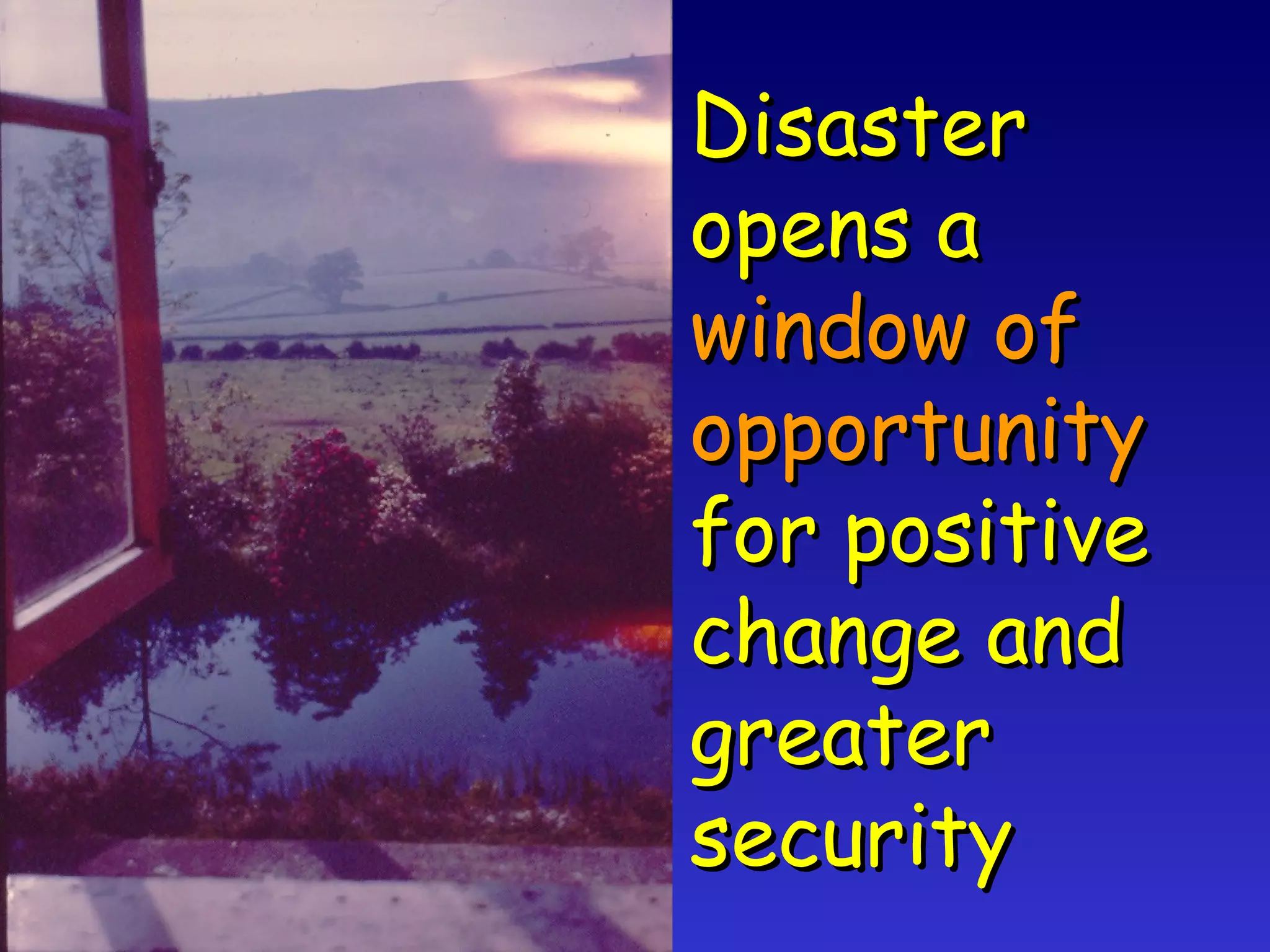
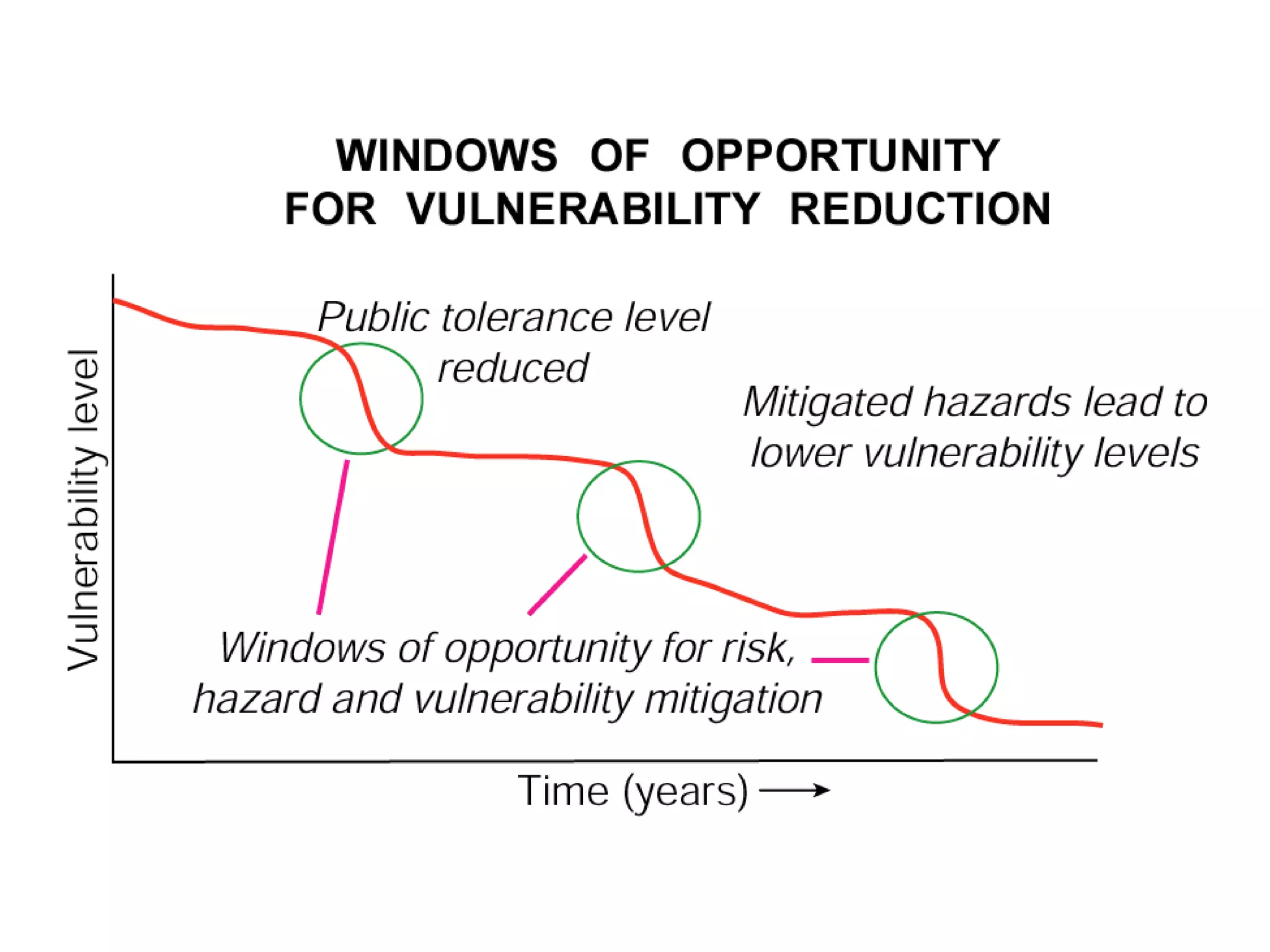
Disaster opens a window of opportunity for positive change and greater security
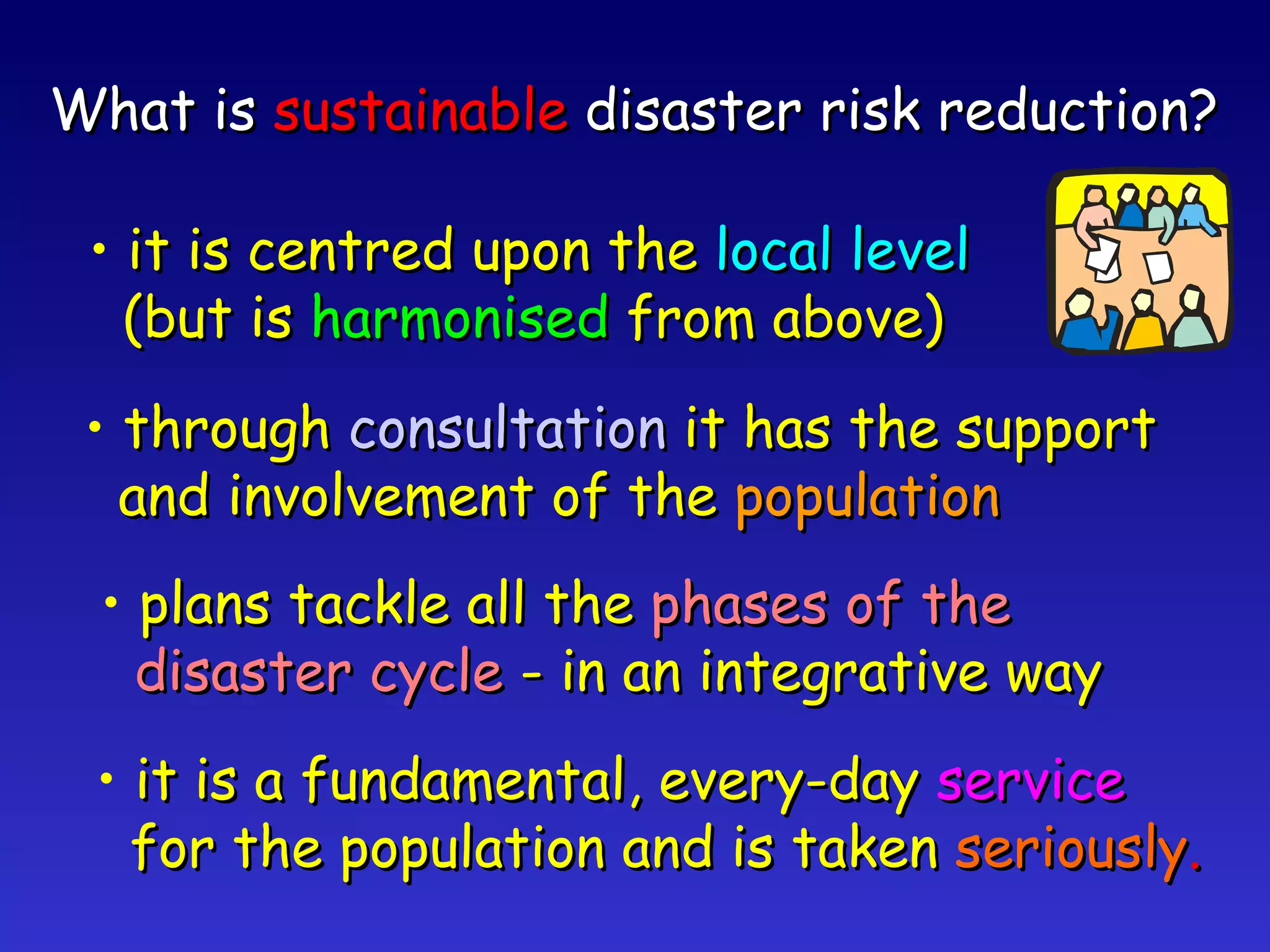
What is  sustainable  disaster risk reduction? it is centred upon the  local level (but is  harmonised  from above) through  consultation  it has the support and involvement of the  population plans tackle all the  phases of the disaster cycle  - in an integrative way it is a fundamental, every-day  service for the population and is taken  seriously .
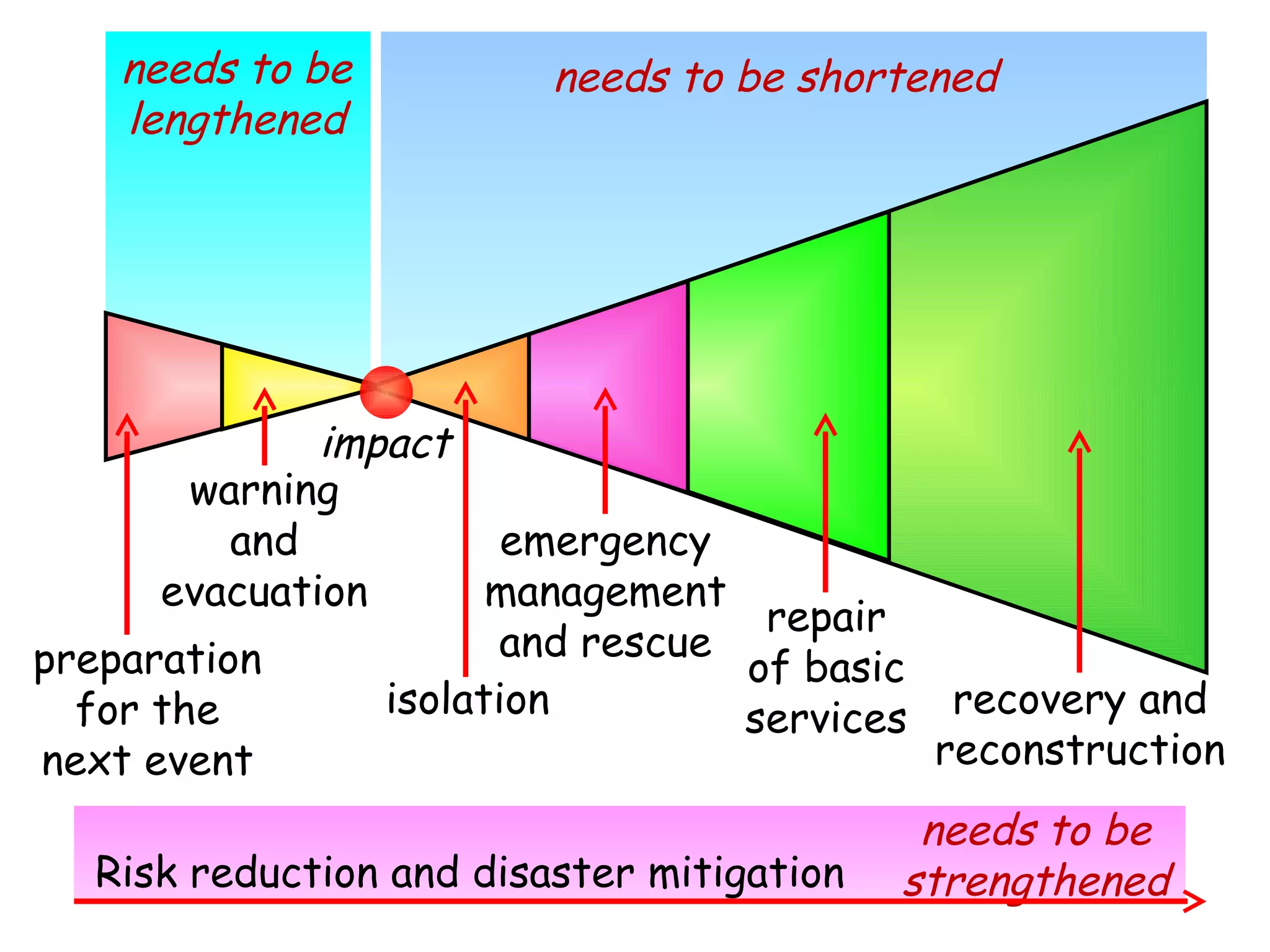
needs to be shortened needs to be lengthened preparation for the next event warning and evacuation recovery and reconstruction repair of basic services emergency management and rescue isolation impact needs to be strengthened Risk reduction and disaster mitigation
emergency-planning.blogspot.com [email_address] Thank you for your attention! www.terrapublishing.net

Risk Assessment and Reduction

  • 1.
    Prof. David AlexanderUniversity of Florence, Italy RISK assessment and reduction
  • 2.
    Trends in disasterlosses are unsustainable. In the second half of the 20th century the world experienced increases of: 250% in the number of recorded disasters 500% in number of disasters with victims 500% in the number of affected people 1640% in the cost of insured damage . 1500% in the total cost of disasters
  • 3.
    Then (1950s) Now(2009) Under-reporting of disasters More complete recording Counting only direct effects Quantifying indirect effects Smaller population of hazardous places Larger population, greater densities Less inequality Growing inequality and marginalisation Less fixed capital at risk Relentless accumulation of fixed capital Simpler socio-economic networks More complex networks
  • 4.
    Impact Emergency isolationDuring the emergency Emergency response Before the impact Preparations and warning After the impact Period of quiescence Risk mitigation Recovery and reconstruction The Phases of Disaster Disaster risk reduction Civil contingencies management Civil protection Emergency preparedness
  • 5.
  • 6.
    Human activity involves risk and benefit A working definition of safety : " a thing is safe if its risks are judged to be acceptable . " A definition of risk for human societies : "the probability that a certain number of people will die in a given impact during a given interval of time."
  • 7.
    After Ian Davis(2005) The components of risk Physical disaster Magnitude Frequency Duration Human vulnerability Exposition Location of hazard Environment Resistance Lifestyle and earnings Health Resilience Adjustments Risk reduction activities Preparations for disaster
  • 8.
    Earthquake Tsunami Volcaniceruption Cyclone Tornado Snow avalanche Flood Drought Forest fire Transportation crash Industrial explosion Radioactive contamination Water pollution episode Riot Food adulteration Smoking Mountain climbing Voluntary Involuntary Intense Diffuse Natural Anthropogenic
  • 9.
    Hazard x Vulnerability = Risk Release rate Dose rate Exposure Impact Response
  • 10.
    A person whospends five minutes twice a day crossing a bridge that is at risk of collapse is exposed to that risk for 10/(60x24x7) = 0.00098 of a week . under threat for a given period of time at risk to a given extent of possible loss Different definitions of exposure :
  • 11.
    R t = E•R s = E (H•V) R t = total risk E = elements at risk (population, built environment, economic activities) R s = (H • V) = specific risk H = hazard V = vulnerability
  • 12.
    RELEASE RATE DOSERATE EXPOSURE An asset is not vulnerable unless it is threatened by something A hazard is not hazardous unless it threatens something COPING, CAPACITY, CAPABILITY, RESILIENCE RISK HAZARD VULNER- ABILITY ELEMENTS AT RISK
  • 13.
    Magnitude Frequency Logarithmof return period Magnitude What does the magnitude-frequency rule mean in real-life situations?
  • 14.
    Vertical scales: Hazard: probability of occurrence Vulnerability : potential damage Risk : value of probable costs and losses
  • 15.
    Fat-tailed distributions ofhazard: big events may be more likely than probability theory suggests Hazard, vulnerability & risk levels
  • 16.
    The relationship betweenhazard and vulnerability is non-linear
  • 17.
    VULNERABILITY RISK Intolerablerisk and vulnerability Tolerable risk and vulnerability Risk/vulnerability curve Disaster threshold Society sets a level of risk toleration
  • 18.
    Low Hazard High environment goods life High Probability Low certainty zero In risk assessment probability and consequence are non-linearly related. high risk medium risk low risk
  • 19.
    Society places arbitrarytolerance levels upon risk Cost of risk reduction Risk Arbitrary tolerance levels COST/RISK=1
  • 20.
    Number of casualtiesCost of retrofitting a building The example of seismic retrofitting unreinforced completely reinforced completely reinforced largely unreinforced Cost of retrofitting a building Cost per life saved
  • 21.
    Perceived risk is the assessment of hazard made subjectively by individuals Risk aversion : intolerance of a risk that is perceived to be unacceptably high desire to reduce it to negligible levels . Objective risk can be calculated from statistical data on past events. Not all risks can be measured.
  • 22.
    A risk classificationVoluntary -- Involuntary Chronic -- Catastrophic Common (tolerated) -- Exceptional (dreaded) Injurious -- Fatal Known to those who are exposed -- Unknown to those who are exposed Known to science -- Unknown to science Can be mitigated or controlled -- Cannot be mitigated or controlled Old -- New
  • 23.
    HOW PEOPLE PERCEIVERISK ABILITY TO PERCEIVE RISK EXPERIENCE WITH RISK PROPENSITY TO DENY RISK ACCESS TO INFORMATION ABILITY TO REDUCE RISK: money expertise knowledge resources WHETHER RISK HAS BEEN ABATED PEOPLE'S IDEAS ABOUT POSSIBLE DAMAGE AND LOSS
  • 24.
    John Adams's "riskthermostat" Balancing behaviour "Accidents" Perceived danger Rewards Propensity to take risks Cultural filter Cultural filter
  • 25.
    Filter Perception CultureDecision Action Result Positive Negative Risk Accurate Inaccurate
  • 26.
    Vulnerability: the maincomponent of risk
  • 27.
    Vulnerability is... theactual or potential degree of loss resulting from a particular hazard or set of hazards of a given magnitude the potential for harm something that is constructed socially the inverse of capability (coping, resilience ) .
  • 28.
    Disaster management Riskmanagement Crisis management Emergency management Hypothetical Concrete Concentrated Diffuse Vulnerability management
  • 29.
    A model ofvulnerability types Vulnerability Total: life is generally precarious Residual: caused by lack of modernisation Newly generated: caused by changes in circumstances Delinquent: caused by corruption, negligence, etc. Economic: people lack adequate occupation Technological, technocratic: caused by the riskiness of technology
  • 30.
    Primary cause andeffect Secondary interaction of causes coincidences Complex complicated interactions VULNERABILITY
  • 31.
    Total vulnerability equalsRisk amplification processes minus Risk mitigation measures plus or minus Risk perception factors
  • 32.
    Human cultures constraints,opportunities History single and cumulative impact of past disasters Causes of disaster natural geophysical, technological, social Adaptation to risk IMPACTS
  • 33.
    Large disaster ExpenditureComplacency Risk-expenditure cycle Deaths, injuries, damage, disruption, hardship Review Reduced risk No disaster Reduced expenditure Increased risk
  • 34.
    Public outcryRhetoric Logic Laws Safety culture The evolution of a safety culture Disaster
  • 35.
  • 36.
  • 37.
    What exactly isresilience?
  • 38.
    Vulnerability = 1/ resilience Resilience: mechanisms for avoiding impacts or absorbing them by coping Coping strategies: indigenous imported
  • 39.
    Organisation Resources Self-organisationImposed organisation Volunteerism Community disaster planning Laws, protocols, directives Standards, norms, guidelines Community resources Governmental resources Donations International resources
  • 40.
    The four dimensionsof RESILIENCE:- robustness : resist stress without loss of function redundancy : ability to continue functioning during periods of disruption ingenuity : ability to identify problems and mobilise resources rapidity : ability to satisfy objectives and priorities so as to reduce losses .
  • 41.
    Recovery after disasterPhysical recovery Buildings, infrastructure, transport, agriculture, etc. The recovery triangle Social and psychological recovery Reducing post- traumatic stress Economic recovery Re-establishing production and economic activities Political, cultural and environmental context .
  • 42.
    How to estimatevulnerability in the field Elements: buildings and physical structures lifelines and infrastructure patterns of activity that put people at risk perceptions of hazard concentrations and patterns of elements at risk .
  • 43.
    Vulnerability in theconnection between wall and joist leads to collapse of the structure in an earthquake
  • 44.
    Random rubble masonry with powdery lime mortar is a major source of vulnerability in historic and old buildings.
  • 45.
    Collapse often beginsat roof level if roof structure is too rigid and poorly tied to vertical load-bearing members.
  • 46.
    Cornices,parapets and other façade details are particularly vulnerable to damage in earthquakes.
  • 47.
    Inadequately constructed framebuildings are vulnerable to progressive collapse
  • 48.
    Battering by adjacentbuildings with different fundamental periods of vibration.
  • 49.
    Zone of interferenceDifferential movements
  • 50.
  • 51.
    Stairwells are oftenthe most vulnerable part of the building during earthquakes, and the first part that people use as they try to escape.
  • 52.
    Self-protection during earthquakesand tornadoes is NOT fostered by the myth that it is safe to shelter under desks and tables.
  • 53.
    Seismic landslide takescentre out of town three days after large earthquake
  • 54.
    Rotational slumping: theancient (1777) and modern (1982)
  • 55.
    Sea coast Massivelandslide Push effect Urban areas
  • 56.
    Forward thrust Nodesare first to fail Columns shear through under sustained pressure Landslide direction
  • 57.
    Landslide headscarp Extensionalmovement Pull-apart upslope of headscarp
  • 58.
    Bedrooms where fourpeople died Spontaneous toppling failure in unconsolidated sands Backward rotation of toppled blocks
  • 59.
    Spontaneous total failureof foundations Spontaneous total failure of r-c frame bldg ...with some forward thrust
  • 60.
    Historic urban landscape(with castle, etc.) and a nice, historic urban landslide
  • 61.
    Tranquil Alpine scene...with debris flow ...and several brand-new hotels at its foot
  • 62.
    Unstable slopes ofclastic weathered rocks subject to mass movements
  • 63.
  • 64.
    Exposure Sensitivity Capacityto adapt VULNERA- BILITY Dimensions of vulnerability: exposure sensitivity capacity to adapt Components of the dimensions Measures of the components
  • 65.
    Vulnerability Dimensions ComponentsMeasures Esposure Sensitivity Capacity to adapt VULNERA- BILITY Physical dimensions Age of the infrastructure Age and income of the population Demo- graphy Technology Res- ponse Management structure Access to information and technology Exposed res- ources Exposed population Intensity Frequency Location Number Wealth and well being Tax revenues Emergency plans Level of education Information services
  • 66.
    Risk & disastermanagement
  • 67.
    Risks must be:identified estimated analysed compared communicated to people who are at risk managed .
  • 68.
    Risk identification :what are the risks? Risk assessment or analysis : how serious are the risks and what do they consist of? Risk management : how can risks be reduced? Risk perception and communication : how can risks be communicated to the public, mass media or others? How experts deal with risk:
  • 69.
    Risk assessment procedure:identify hazard : identify and characterize source of hazard assess dose-response : estimate relationship between exposure and probability of negative effects assess exposure : determine the intensity, frequency and duration of exposure to the source of harm characterise risk : estimate the level of risk in relation to dose, exposure and response .
  • 70.
    HAZARD VULNERABILITY EXPOSURELOW MEDIUM HIGH A simple risk assessment matrix
  • 71.
    Severit y negligiblemarginal moderate serious catastrophic Probability of occurrence frequent probable occasional improbable impossible acceptable significant critical Risk level:
  • 72.
  • 73.
    Constructing a risk register all employees should be encouraged to contribute to the identification , discussion and exploration of risks institute a "no fault, no blame" culture for the identification of risks appoint and train a risk manager in each department of the organisation have frequent and open discussions about how to manage the risks .
  • 74.
    Company Board andCEO Business continuity management board BCM project team (and leader) direct project ensure appropriate resources ensure quality [Departmental] working group [Departmental] working group Risk register
  • 75.
    Risk analysis should express:- probability of event of given size impact magnitude / population size basic conditions and assumptions uncertainty and confidence levels how predictions were obtained .
  • 76.
    single or multiple risks considered? total or partial risk? voluntary or involuntary exposure? how analysis will affect management of the risk . Risk analysis should express:-
  • 77.
    Factors that limitrisk mitigation: environmental hazard levels human activities unclear responsibilities poor understanding of organisational networks inadequate training and education .
  • 78.
    Risk communication messages should:- come from an official source clearly explain risk and its likelihood say what sort of impact is expected describe probable effect of impact and where to get more information . explain what to do ...
  • 79.
    Risk communication messagesshould:- present information in sequence encourage people to share information with colleagues, family and friends repeat message many times . explain importance of message and the need for action
  • 80.
    The essence ofdisaster management:- To tackle pressing needs with maximum efficiency and speed but with scarce resources and in the absence of necessary information BUT emergency planning is still a young field: it lacks international consensus on standards, procedures, and legal and institutional imperatives
  • 81.
    Modern emergency plansare generic ( "all hazards" ):- adaptable to all emergencies focussed on the emergencies deemed most likely to occur in the local area technical sophistication must be balanced by ease of use .
  • 82.
    Set procedures Co-ordinatingplan Spontaneous improvisation Set procedures Co-ordinating plan Spontaneous improvisation Emergency environment Emergency environment
  • 83.
    Continuity of productionPreservation of organisation's good name Safeguarding of assets Maintenance of market position
  • 84.
  • 85.
    Some typical risks:-loss of customer records breakdown of the supply chain failure of essential services on which production or customer support depends inability to deliver the product for a significant period of time for any reason negative perceptions of the company by clients, customers or the public .
  • 86.
    Some reasons whysupplies may fail:- industrial action halts production faulty components leads to product recall supplier ceases trading (goes into bankruptcy or receivership) fire, flood or natural disaster strikes supplier's premises computer systems fail .
  • 87.
    Possible impact ofinterruptions to supplies and suppliers:- loss of independence inability to fulfill orders loss of confidential or sensitive info. increased exposure to fraud and unauthorised transactions loss of data loss of audit trail failure of purchasing and scheduling software systems legal liability due to failure to fulfill contractual obligations .
  • 88.
    OPERATIONS (ACHIEVEMENTS) REPUTATIONPerception Communication Concrete developments positive negative CRISIS
  • 89.
    Some risk reductionmeasures:- stock reduction separation of high-risk storage design changes safety training data security data storage redundancy product and building security .
  • 90.
    CITY DISASTER PLANWhere business continuity management fits in: PROVINCIAL, COUNTY, STATE OR REGIONAL DISASTER PLAN NATIONAL DISASTER PLAN AIRPORT EMERGENCY PLAN INDUSTRIAL CONTINGENCY PLAN COMMERCIAL FACILITIES CONTINGENCY PLAN EMS NETWORK CONTINGENCY PLAN HOSPITAL EMS PLAN HOSPITAL EMS PLAN MEDICAL FACILITY PLAN BCM
  • 91.
    Strategic, tactical &operational planning Aftermath Disaster Monitoring prediction & warning Permanent emergency plan Business continuity plan Recovery and reconstruction planning
  • 92.
    An crisis managementplan:- should be simple in conception is a living document that needs continual updating should define the ground rules for co-ordinating emergency activities should be able to deal with internally and externally generated crises .
  • 93.
    Specifying an incidentmanagement structure:- call-out arrangements means of co-ordinating groups and teams command and control structures communications channels & media contact inter-departmental and inter- organisational co-ordination measures .
  • 94.
    Construction of operational scenarios of hazard, risk, impact and emergency response Existence of various states of hazard and vulnerabilit y Census of available resources Emergency action plan Processes of constant adaptation of the plan
  • 95.
    Initial study RevisionTesting Evaluation Activation Disaster Dissemination Information Formulation and updating of plan Stakeholders' input Training
  • 96.
    Evaluation Plan Apparentchaos Model Testing Disaster Outcome Feedback Feedback
  • 97.
    Initiating the processPlanning for business continuity Implementing the plan Managing the crisis scope policy structure resources mechanisms Changing the mindset
  • 98.
    Business impact analysisCreate the BCM plan Business impact evaluation Objectives -> Risks -> Priorities -> Scenarios Internal analysis products and services activities and resources dependencies External analysis market environment stakeholder analysis supply chain analysis
  • 99.
  • 100.
    Disaster opens awindow of opportunity for positive change and greater security
  • 101.
    What is sustainable disaster risk reduction? it is centred upon the local level (but is harmonised from above) through consultation it has the support and involvement of the population plans tackle all the phases of the disaster cycle - in an integrative way it is a fundamental, every-day service for the population and is taken seriously .
  • 102.
    needs to beshortened needs to be lengthened preparation for the next event warning and evacuation recovery and reconstruction repair of basic services emergency management and rescue isolation impact needs to be strengthened Risk reduction and disaster mitigation
  • 103.
    emergency-planning.blogspot.com [email_address] Thankyou for your attention! www.terrapublishing.net