Vulnerability: Concepts &
measurements
Prepared BY
Anup Kumar Mishra
Vulnerability
• Vulnerability describes the characteristics and
circumstances of a community, system or asset that
make it susceptible to the damaging effects of a
hazard. There are many aspects of vulnerability,
arising from various physical, social, economic, and
environmental factors. Examples may include:
• poor design and construction of buildings,
• inadequate protection of assets,
• lack of public information and awareness,
• limited official recognition of risks and preparedness
measures, and
• disregard for wise environmental management.
• Vulnerability varies significantly within a
community and over time.
• This definition identifies vulnerability as a
characteristic of the element of interest
(community, system or asset) which is
independent of its exposure.
• However, in common use the word is often
used more broadly to include the element’s
exposure.
Types of vulnerability
There are four (4) main types of vulnerability:
1. Physical Vulnerability may be determined by aspects such as population
density levels, remoteness of a settlement, the site, design and materials
used for critical infrastructure and for housing (UNISDR).
Example: Wooden homes are less likely to collapse in an earthquake, but
are more vulnerable to fire.
2. Social Vulnerability refers to the inability of people, organizations and
societies to withstand adverse impacts to hazards due to characteristics
inherent in social interactions, institutions and systems of cultural values.
It is linked to the level of well being of individuals, communities and
society. It includes aspects related to levels of literacy and education, the
existence of peace and security, access to basic human rights, systems of
good governance, social equity, positive traditional values, customs and
ideological beliefs and overall collective organizational systems (UNISDR).
Example: When flooding occurs some citizens, such as children, elderly
and differently-able, may be unable to protect themselves or evacuate if
necessary.
3. Economic Vulnerability. The level of vulnerability is highly
dependent upon the economic status of individuals, communities
and nations The poor are usually more vulnerable to disasters
because they lack the resources to build sturdy structures and put
other engineering measures in place to protect themselves from
being negatively impacted by disasters.
Example: Poorer families may live in squatter settlements because
they cannot afford to live in safer (more expensive) areas.
4. Environmental Vulnerability. Natural resource depletion and
resource degradation are key aspects of environmental
vulnerability.
Example: Wetlands, such as the Caroni Swamp, are sensitive to
increasing salinity from sea water, and pollution from stormwater
runoff containing agricultural chemicals, eroded soils, etc.
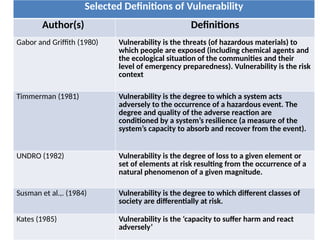
Selected Definitions of Vulnerability
Author(s) Definitions
Gabor and Griffith (1980) Vulnerability is the threats (of hazardous materials) to
which people are exposed (including chemical agents and
the ecological situation of the communities and their
level of emergency preparedness). Vulnerability is the risk
context
Timmerman (1981) Vulnerability is the degree to which a system acts
adversely to the occurrence of a hazardous event. The
degree and quality of the adverse reaction are
conditioned by a system’s resilience (a measure of the
system’s capacity to absorb and recover from the event).
UNDRO (1982) Vulnerability is the degree of loss to a given element or
set of elements at risk resulting from the occurrence of a
natural phenomenon of a given magnitude.
Susman et al.,. (1984) Vulnerability is the degree to which different classes of
society are differentially at risk.
Kates (1985) Vulnerability is the ‘capacity to suffer harm and react
adversely’
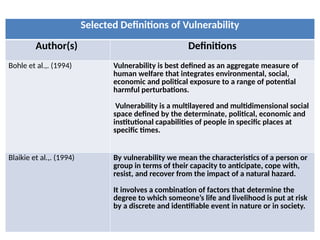
Selected Definitions of Vulnerability
Author(s) Definitions
Bohle et al.,. (1994) Vulnerability is best defined as an aggregate measure of
human welfare that integrates environmental, social,
economic and political exposure to a range of potential
harmful perturbations.
Vulnerability is a multilayered and multidimensional social
space defined by the determinate, political, economic and
institutional capabilities of people in specific places at
specific times.
Blaikie et al.,. (1994) By vulnerability we mean the characteristics of a person or
group in terms of their capacity to anticipate, cope with,
resist, and recover from the impact of a natural hazard.
It involves a combination of factors that determine the
degree to which someone’s life and livelihood is put at risk
by a discrete and identifiable event in nature or in society.
What is Risk
• Risk (or more specifically, disaster risk) is the potential disaster losses (in terms of
lives, health status, livelihoods, assets and services) which could occur to a
particular community or a society over some specified future time period.
(Reference UNISDR Terminology)
• It considers the probability of harmful consequences, or expected losses (deaths,
injuries, property, livelihoods, economic activity disrupted or environmentally
damaged) resulting from interactions between natural or human induced hazards
and vulnerable conditions.
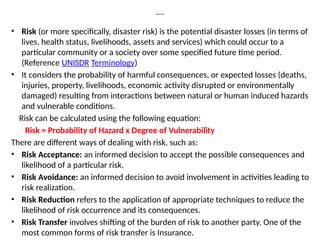
Risk can be calculated using the following equation:
Risk = Probability of Hazard x Degree of Vulnerability
There are different ways of dealing with risk, such as:
• Risk Acceptance: an informed decision to accept the possible consequences and
likelihood of a particular risk.
• Risk Avoidance: an informed decision to avoid involvement in activities leading to
risk realization.
• Risk Reduction refers to the application of appropriate techniques to reduce the
likelihood of risk occurrence and its consequences.
• Risk Transfer involves shifting of the burden of risk to another party. One of the
most common forms of risk transfer is Insurance.
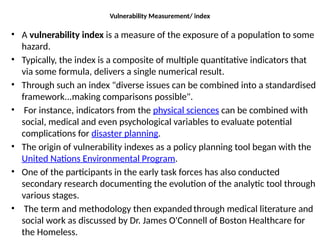
Vulnerability Measurement/ index
• A vulnerability index is a measure of the exposure of a population to some
hazard.
• Typically, the index is a composite of multiple quantitative indicators that
via some formula, delivers a single numerical result.
• Through such an index "diverse issues can be combined into a standardised
framework...making comparisons possible".
• For instance, indicators from the physical sciences can be combined with
social, medical and even psychological variables to evaluate potential
complications for disaster planning.
• The origin of vulnerability indexes as a policy planning tool began with the
United Nations Environmental Program.
• One of the participants in the early task forces has also conducted
secondary research documenting the evolution of the analytic tool through
various stages.
• The term and methodology then expandedthrough medical literature and
social work as discussed by Dr. James O'Connell of Boston Healthcare for
the Homeless.
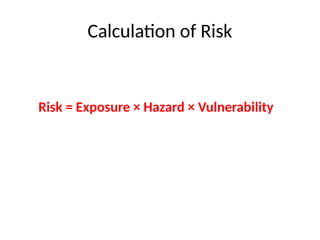
Calculation of Risk
Risk = Exposure × Hazard × Vulnerability
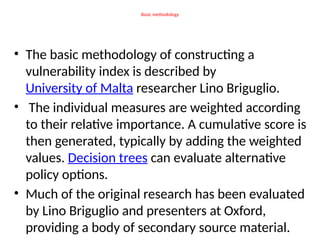
Basic methodology
• The basic methodology of constructing a
vulnerability index is described by
University of Malta researcher Lino Briguglio.
• The individual measures are weighted according
to their relative importance. A cumulative score is
then generated, typically by adding the weighted
values. Decision trees can evaluate alternative
policy options.
• Much of the original research has been evaluated
by Lino Briguglio and presenters at Oxford,
providing a body of secondary source material.
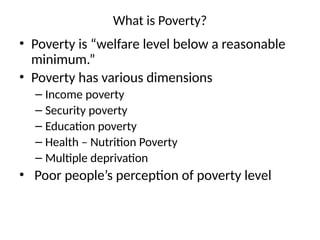
What is Poverty?
• Poverty is “welfare level below a reasonable
minimum.”
• Poverty has various dimensions
– Income poverty
– Security poverty
– Education poverty
– Health – Nutrition Poverty
– Multiple deprivation
• Poor people’s perception of poverty level
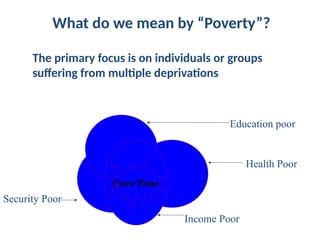
What do we mean by “Poverty”?
The primary focus is on individuals or groups
suffering from multiple deprivations
Core Poor
Core Poor
Education poor
Health Poor
Security Poor
Income Poor
Vulnerability and Poverty
• Vulnerability is a topic of interest on its own but it
has also important implications for economic
efficiency and long-run welfare of households.
• Those who are under a constant threat of poverty
are often observed to choose to make safer, but
less lucrative, investments than those who are free
from the fear of poverty.
• As pointed out by Eswaran and Kotwal (1990),
when the poor have less access to credit than the
rich, the former may engage in less risky and less
profitable behavior than the latter, even if everyone
has the same preference.
• Therefore, in the presence of credit constraints, bad
shocks can lead to a poverty trap (Morduch 1994).
• Vulnerability to poverty also affects the accumulation of
assets.
• On one hand, the lack of credit access can be mitigated by
accumulating assets over time because the poor can sell
assets at bad times and buy assets at good times to smooth
consumption over time (Carter and Zimmerman 2000).
• On the other hand, when poor people face a survival
constraint, they may respond to negative shocks by
adjusting consumption to defend or smooth their asset
value to ensure their survival (Zimmerman and Carter
2003).
• Therefore, it may be useful to look at the asset holdings to
assess the vulnerability of households.
Poverty Lines and Poverty Measurement
• Two Issues in Generating Poverty Estimates
– Fixing a poverty line: Identification
– Measuring poverty: Aggregation
Methods of Fixing Poverty Lines
• Cost-of-basic-needs method (Food-share method)
– Cost of basic food needs
– Cost of basic non-food needs
• Food-energy method
– Expenditure level that meets the food energy requirement
– Based on calorie-income relationships
– Fitting and tracing calorie-expenditure graph
Measures of Poverty
• Incidence of Poverty: poverty rate
– Use the headcount rate to calculate the poverty rate of the
% of population below the poverty line
• Depth of Poverty – how far a person is below the
poverty line
• Poverty Gap – aggregation of depth of poverty
• Poverty Severity – aggregation with weights
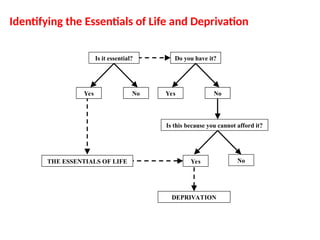
THE ESSENTIALS OF LIFE
DEPRIVATION
Yes
Is it essential?
No Yes
Do you have it?
No
Yes
Is this because you cannot afford it?
No
THE ESSENTIALS OF LIFE
DEPRIVATION
Yes
Is it essential?
No Yes
Do you have it?
No
Yes
Is this because you cannot afford it?
No
Identifying the Essentials of Life and Deprivation
Poverty Analysis
Income/Consumption Poverty Profile
• Correlates poverty with:
– Gender
– Age
– Residential location
– Ethnic characteristics
– Income source
– Employment sources
– Share of food/ non food consumption
– Education outcomes
– Malnutrition outcomes
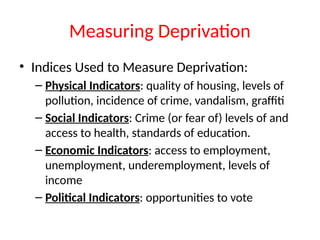
Measuring Deprivation
• Indices Used to Measure Deprivation:
– Physical Indicators: quality of housing, levels of
pollution, incidence of crime, vandalism, graffiti
– Social Indicators: Crime (or fear of) levels of and
access to health, standards of education.
– Economic Indicators: access to employment,
unemployment, underemployment, levels of
income
– Political Indicators: opportunities to vote
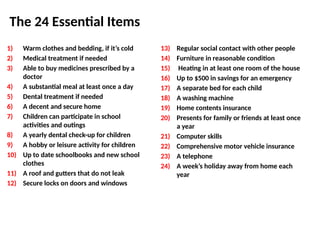
The 24 Essential Items
1) Warm clothes and bedding, if it’s cold
2) Medical treatment if needed
3) Able to buy medicines prescribed by a
doctor
4) A substantial meal at least once a day
5) Dental treatment if needed
6) A decent and secure home
7) Children can participate in school
activities and outings
8) A yearly dental check-up for children
9) A hobby or leisure activity for children
10) Up to date schoolbooks and new school
clothes
11) A roof and gutters that do not leak
12) Secure locks on doors and windows
13) Regular social contact with other people
14) Furniture in reasonable condition
15) Heating in at least one room of the house
16) Up to $500 in savings for an emergency
17) A separate bed for each child
18) A washing machine
19) Home contents insurance
20) Presents for family or friends at least once
a year
21) Computer skills
22) Comprehensive motor vehicle insurance
23) A telephone
24) A week’s holiday away from home each
year
Vulnerability to Climate Change
• There is now a wide agreement among scientists that the rapid increases in
the atmospheric concentration of greenhouse gases such as carbon dioxide
and methane since the industrial revolution are largely anthropogenic.
• The impacts of the increased concentration of greenhouse gases are already
apparent.
• The global surface temperature is estimated to have risen by more than 0.5
degrees Celsius over the last century and the global average sea level rose at
an average rate of 1.8 mm per year between 1961 and 2003 (Solomon et al.
2007).
• Even if stringent climate policies are implemented immediately, global mean
surface temperature is expected to rise in years to come.
• Climate change affects, among others, agriculture, forestry, water resources,
human health, and industry.
• The impact of climate change is complex because it varies across regions and
may be positive or negative.
• For example, in Asia, crop yields could increase up to 20% in East and
Southeast Asia whereas they could decrease up to 30% in Central and South
Asia by the mid 21-st century (Parry et al. 2007).
Pandemic and Vulnerability
• The current global pandemic has shown that households
can suffer acute drops in their well-being in multiple
dimensions when they are exposed to diverse shocks.
• Thus, due to the pandemic, many households have faced
well-being losses in terms of health of their members, but
also, in many cases, the imposed lockdowns have also
caused job losses, abrupt income declines, reduced school
attendance of children, and sometimes even the loss of
housing due to the inability to pay the monthly rent or bills.
• Therefore, the negative effects caused by the pandemic
have highlighted not only the households’ vulnerability to
monetary poverty (World Bank, 2020, Ferreira et al., 2021),
but also their vulnerability to multidimensional poverty (
UNDP and OPHI, 2021).
Measuring vulnerability in an indicative manner
• Index of Governance and Public Policies (iGOPP) that identifies
conditions of public policy and regulatory framework related to
disaster risk management.
• Disaster Deficit Index (DDI) that measures country risk from a
macro-economic and financial perspective when faced with
eventual catastrophic events.
• Local Disaster Index (LDI) that identifies the extent of spread and
damage resulting from small-scale disasters in all parts of a
country.
• Prevalent Vulnerability Index (PVI) that measures three tangible
social-related vulnerability aspects: hazard exposure and physical
susceptibility, socioeconomic fragility, and resilience.
• Risk Management Index (RMI) that measures institutional and
community performance on disaster risk management.

_2-Vulnurability Concept and Measurement.pptx

  • 1.
  • 2.
    Vulnerability • Vulnerability describesthe characteristics and circumstances of a community, system or asset that make it susceptible to the damaging effects of a hazard. There are many aspects of vulnerability, arising from various physical, social, economic, and environmental factors. Examples may include: • poor design and construction of buildings, • inadequate protection of assets, • lack of public information and awareness, • limited official recognition of risks and preparedness measures, and • disregard for wise environmental management.
  • 3.
    • Vulnerability variessignificantly within a community and over time. • This definition identifies vulnerability as a characteristic of the element of interest (community, system or asset) which is independent of its exposure. • However, in common use the word is often used more broadly to include the element’s exposure.
  • 4.
    Types of vulnerability Thereare four (4) main types of vulnerability: 1. Physical Vulnerability may be determined by aspects such as population density levels, remoteness of a settlement, the site, design and materials used for critical infrastructure and for housing (UNISDR). Example: Wooden homes are less likely to collapse in an earthquake, but are more vulnerable to fire. 2. Social Vulnerability refers to the inability of people, organizations and societies to withstand adverse impacts to hazards due to characteristics inherent in social interactions, institutions and systems of cultural values. It is linked to the level of well being of individuals, communities and society. It includes aspects related to levels of literacy and education, the existence of peace and security, access to basic human rights, systems of good governance, social equity, positive traditional values, customs and ideological beliefs and overall collective organizational systems (UNISDR). Example: When flooding occurs some citizens, such as children, elderly and differently-able, may be unable to protect themselves or evacuate if necessary.
  • 5.
    3. Economic Vulnerability.The level of vulnerability is highly dependent upon the economic status of individuals, communities and nations The poor are usually more vulnerable to disasters because they lack the resources to build sturdy structures and put other engineering measures in place to protect themselves from being negatively impacted by disasters. Example: Poorer families may live in squatter settlements because they cannot afford to live in safer (more expensive) areas. 4. Environmental Vulnerability. Natural resource depletion and resource degradation are key aspects of environmental vulnerability. Example: Wetlands, such as the Caroni Swamp, are sensitive to increasing salinity from sea water, and pollution from stormwater runoff containing agricultural chemicals, eroded soils, etc.
  • 6.
    Selected Definitions ofVulnerability Author(s) Definitions Gabor and Griffith (1980) Vulnerability is the threats (of hazardous materials) to which people are exposed (including chemical agents and the ecological situation of the communities and their level of emergency preparedness). Vulnerability is the risk context Timmerman (1981) Vulnerability is the degree to which a system acts adversely to the occurrence of a hazardous event. The degree and quality of the adverse reaction are conditioned by a system’s resilience (a measure of the system’s capacity to absorb and recover from the event). UNDRO (1982) Vulnerability is the degree of loss to a given element or set of elements at risk resulting from the occurrence of a natural phenomenon of a given magnitude. Susman et al.,. (1984) Vulnerability is the degree to which different classes of society are differentially at risk. Kates (1985) Vulnerability is the ‘capacity to suffer harm and react adversely’
  • 7.
    Selected Definitions ofVulnerability Author(s) Definitions Bohle et al.,. (1994) Vulnerability is best defined as an aggregate measure of human welfare that integrates environmental, social, economic and political exposure to a range of potential harmful perturbations. Vulnerability is a multilayered and multidimensional social space defined by the determinate, political, economic and institutional capabilities of people in specific places at specific times. Blaikie et al.,. (1994) By vulnerability we mean the characteristics of a person or group in terms of their capacity to anticipate, cope with, resist, and recover from the impact of a natural hazard. It involves a combination of factors that determine the degree to which someone’s life and livelihood is put at risk by a discrete and identifiable event in nature or in society.
  • 8.
    What is Risk •Risk (or more specifically, disaster risk) is the potential disaster losses (in terms of lives, health status, livelihoods, assets and services) which could occur to a particular community or a society over some specified future time period. (Reference UNISDR Terminology) • It considers the probability of harmful consequences, or expected losses (deaths, injuries, property, livelihoods, economic activity disrupted or environmentally damaged) resulting from interactions between natural or human induced hazards and vulnerable conditions. Risk can be calculated using the following equation: Risk = Probability of Hazard x Degree of Vulnerability There are different ways of dealing with risk, such as: • Risk Acceptance: an informed decision to accept the possible consequences and likelihood of a particular risk. • Risk Avoidance: an informed decision to avoid involvement in activities leading to risk realization. • Risk Reduction refers to the application of appropriate techniques to reduce the likelihood of risk occurrence and its consequences. • Risk Transfer involves shifting of the burden of risk to another party. One of the most common forms of risk transfer is Insurance.
  • 9.
    Vulnerability Measurement/ index •A vulnerability index is a measure of the exposure of a population to some hazard. • Typically, the index is a composite of multiple quantitative indicators that via some formula, delivers a single numerical result. • Through such an index "diverse issues can be combined into a standardised framework...making comparisons possible". • For instance, indicators from the physical sciences can be combined with social, medical and even psychological variables to evaluate potential complications for disaster planning. • The origin of vulnerability indexes as a policy planning tool began with the United Nations Environmental Program. • One of the participants in the early task forces has also conducted secondary research documenting the evolution of the analytic tool through various stages. • The term and methodology then expandedthrough medical literature and social work as discussed by Dr. James O'Connell of Boston Healthcare for the Homeless.
  • 10.
    Calculation of Risk Risk= Exposure × Hazard × Vulnerability
  • 11.
    Basic methodology • Thebasic methodology of constructing a vulnerability index is described by University of Malta researcher Lino Briguglio. • The individual measures are weighted according to their relative importance. A cumulative score is then generated, typically by adding the weighted values. Decision trees can evaluate alternative policy options. • Much of the original research has been evaluated by Lino Briguglio and presenters at Oxford, providing a body of secondary source material.
  • 12.
    What is Poverty? •Poverty is “welfare level below a reasonable minimum.” • Poverty has various dimensions – Income poverty – Security poverty – Education poverty – Health – Nutrition Poverty – Multiple deprivation • Poor people’s perception of poverty level
  • 13.
    What do wemean by “Poverty”? The primary focus is on individuals or groups suffering from multiple deprivations Core Poor Core Poor Education poor Health Poor Security Poor Income Poor
  • 14.
    Vulnerability and Poverty •Vulnerability is a topic of interest on its own but it has also important implications for economic efficiency and long-run welfare of households. • Those who are under a constant threat of poverty are often observed to choose to make safer, but less lucrative, investments than those who are free from the fear of poverty. • As pointed out by Eswaran and Kotwal (1990), when the poor have less access to credit than the rich, the former may engage in less risky and less profitable behavior than the latter, even if everyone has the same preference. • Therefore, in the presence of credit constraints, bad shocks can lead to a poverty trap (Morduch 1994).
  • 15.
    • Vulnerability topoverty also affects the accumulation of assets. • On one hand, the lack of credit access can be mitigated by accumulating assets over time because the poor can sell assets at bad times and buy assets at good times to smooth consumption over time (Carter and Zimmerman 2000). • On the other hand, when poor people face a survival constraint, they may respond to negative shocks by adjusting consumption to defend or smooth their asset value to ensure their survival (Zimmerman and Carter 2003). • Therefore, it may be useful to look at the asset holdings to assess the vulnerability of households.
  • 16.
    Poverty Lines andPoverty Measurement • Two Issues in Generating Poverty Estimates – Fixing a poverty line: Identification – Measuring poverty: Aggregation
  • 17.
    Methods of FixingPoverty Lines • Cost-of-basic-needs method (Food-share method) – Cost of basic food needs – Cost of basic non-food needs • Food-energy method – Expenditure level that meets the food energy requirement – Based on calorie-income relationships – Fitting and tracing calorie-expenditure graph
  • 18.
    Measures of Poverty •Incidence of Poverty: poverty rate – Use the headcount rate to calculate the poverty rate of the % of population below the poverty line • Depth of Poverty – how far a person is below the poverty line • Poverty Gap – aggregation of depth of poverty • Poverty Severity – aggregation with weights
  • 19.
    THE ESSENTIALS OFLIFE DEPRIVATION Yes Is it essential? No Yes Do you have it? No Yes Is this because you cannot afford it? No THE ESSENTIALS OF LIFE DEPRIVATION Yes Is it essential? No Yes Do you have it? No Yes Is this because you cannot afford it? No Identifying the Essentials of Life and Deprivation
  • 20.
    Poverty Analysis Income/Consumption PovertyProfile • Correlates poverty with: – Gender – Age – Residential location – Ethnic characteristics – Income source – Employment sources – Share of food/ non food consumption – Education outcomes – Malnutrition outcomes
  • 21.
    Measuring Deprivation • IndicesUsed to Measure Deprivation: – Physical Indicators: quality of housing, levels of pollution, incidence of crime, vandalism, graffiti – Social Indicators: Crime (or fear of) levels of and access to health, standards of education. – Economic Indicators: access to employment, unemployment, underemployment, levels of income – Political Indicators: opportunities to vote
  • 22.
    The 24 EssentialItems 1) Warm clothes and bedding, if it’s cold 2) Medical treatment if needed 3) Able to buy medicines prescribed by a doctor 4) A substantial meal at least once a day 5) Dental treatment if needed 6) A decent and secure home 7) Children can participate in school activities and outings 8) A yearly dental check-up for children 9) A hobby or leisure activity for children 10) Up to date schoolbooks and new school clothes 11) A roof and gutters that do not leak 12) Secure locks on doors and windows 13) Regular social contact with other people 14) Furniture in reasonable condition 15) Heating in at least one room of the house 16) Up to $500 in savings for an emergency 17) A separate bed for each child 18) A washing machine 19) Home contents insurance 20) Presents for family or friends at least once a year 21) Computer skills 22) Comprehensive motor vehicle insurance 23) A telephone 24) A week’s holiday away from home each year
  • 23.
    Vulnerability to ClimateChange • There is now a wide agreement among scientists that the rapid increases in the atmospheric concentration of greenhouse gases such as carbon dioxide and methane since the industrial revolution are largely anthropogenic. • The impacts of the increased concentration of greenhouse gases are already apparent. • The global surface temperature is estimated to have risen by more than 0.5 degrees Celsius over the last century and the global average sea level rose at an average rate of 1.8 mm per year between 1961 and 2003 (Solomon et al. 2007). • Even if stringent climate policies are implemented immediately, global mean surface temperature is expected to rise in years to come. • Climate change affects, among others, agriculture, forestry, water resources, human health, and industry. • The impact of climate change is complex because it varies across regions and may be positive or negative. • For example, in Asia, crop yields could increase up to 20% in East and Southeast Asia whereas they could decrease up to 30% in Central and South Asia by the mid 21-st century (Parry et al. 2007).
  • 24.
    Pandemic and Vulnerability •The current global pandemic has shown that households can suffer acute drops in their well-being in multiple dimensions when they are exposed to diverse shocks. • Thus, due to the pandemic, many households have faced well-being losses in terms of health of their members, but also, in many cases, the imposed lockdowns have also caused job losses, abrupt income declines, reduced school attendance of children, and sometimes even the loss of housing due to the inability to pay the monthly rent or bills. • Therefore, the negative effects caused by the pandemic have highlighted not only the households’ vulnerability to monetary poverty (World Bank, 2020, Ferreira et al., 2021), but also their vulnerability to multidimensional poverty ( UNDP and OPHI, 2021).
  • 25.
    Measuring vulnerability inan indicative manner • Index of Governance and Public Policies (iGOPP) that identifies conditions of public policy and regulatory framework related to disaster risk management. • Disaster Deficit Index (DDI) that measures country risk from a macro-economic and financial perspective when faced with eventual catastrophic events. • Local Disaster Index (LDI) that identifies the extent of spread and damage resulting from small-scale disasters in all parts of a country. • Prevalent Vulnerability Index (PVI) that measures three tangible social-related vulnerability aspects: hazard exposure and physical susceptibility, socioeconomic fragility, and resilience. • Risk Management Index (RMI) that measures institutional and community performance on disaster risk management.

Editor's Notes

  • #20 After reviewing slide speak about overhead Table 4, 5 figure, table 6, 7, 8