Dr Fayaz A. Malla
Assistant Professor, Environmental Sciences
GDC Tral
Higher Education Department, Govt. of J&K
Email: nami.fayaz@gmail.com
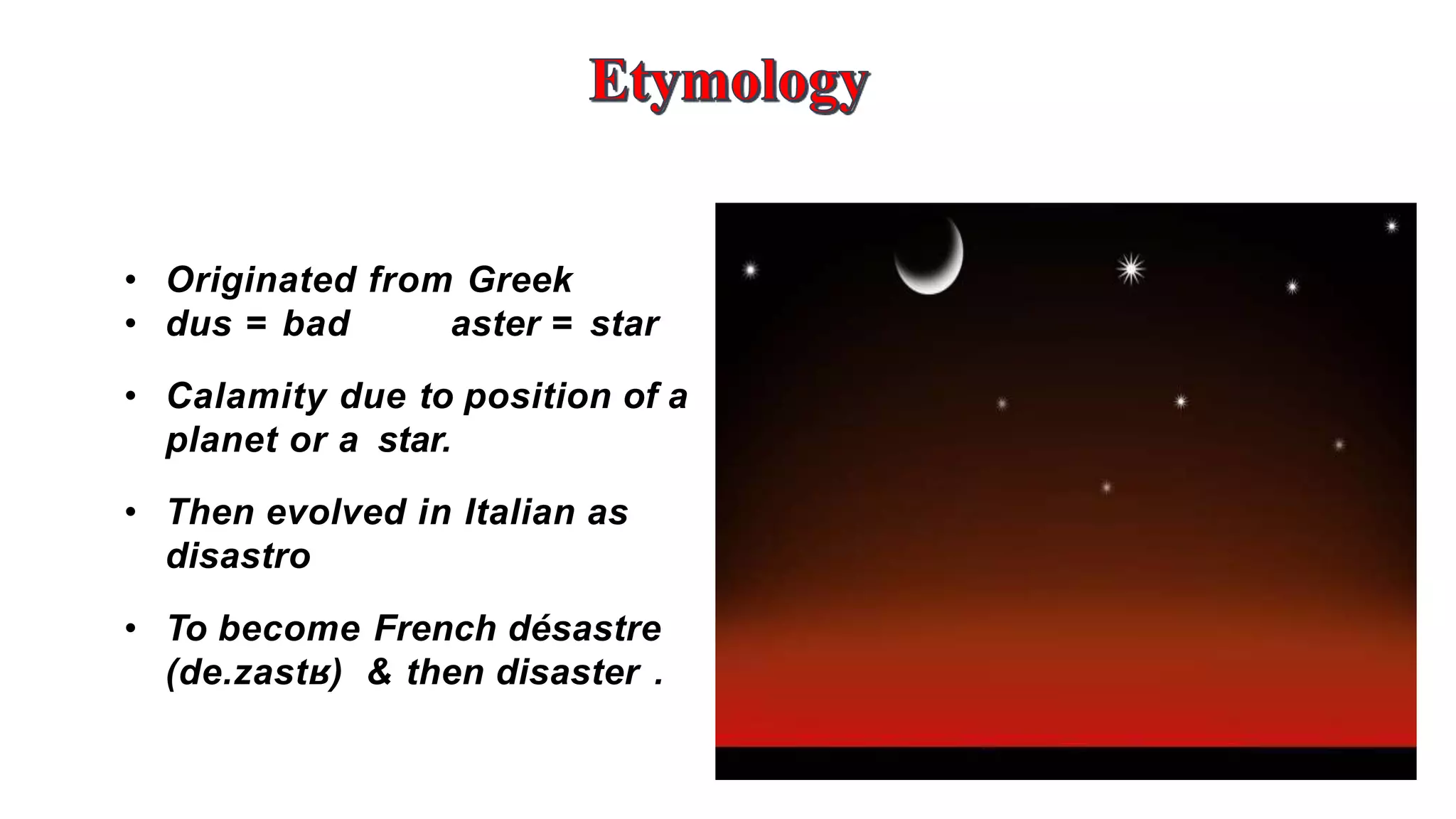
• Disastersare asold as Mankind.
• The first description of Disaster and its management comes from mythological “Noah”
and his ark.
• Similar Flood tales are widespread in- Greek Mythology, Puranas, Mesopotamian stories,
and many cultures.
4
• Originated from Greek
• dus = bad aster = star
• Calamity due to position of a
planet or a star.
• Then evolved in Italian as
disastro
• To become French désastre
(de.zastʁ) & then disaster .
Disaster
Any occurrence that causes damage, ecological disruption, loss of
human life, deterioration of health and health services on a scale,
sufficient to warrant an extraordinary response from outside the
affected community or area. (WHO)
A disaster can be defined as an occurrence either nature or man made
that causes human suffering and creates human needs that victim
cannot alleviate without assistance. (American Red Cross)
5
Hazard
• Any phenomenon that has the potential to cause disruption or damage
to people and their environment.
• A hazard is Natural or Anthropogenic event while the disaster is its
consequence.
• A hazard is perceived natural event which threatens both life and
property
• A disaster is a realization of hazard.
-John Whittow
• When hazard involves elements of risks, vulnerabilities and
capacities, they can turn into disasters.
• Hazards may be inevitable but disasters can be prevented.
WHAT IS
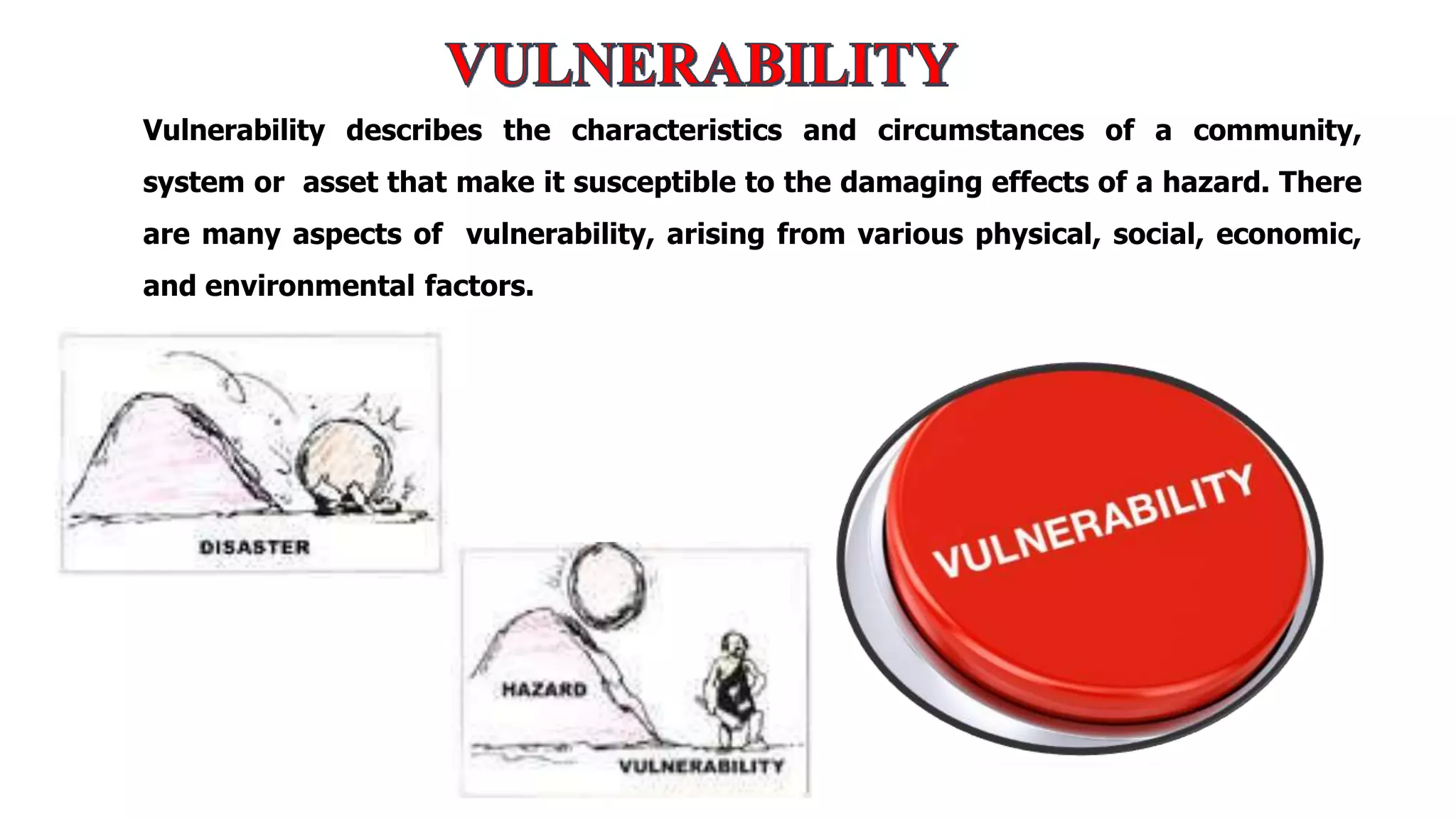
Vulnerability describes the characteristics and circumstances of a community,
system or asset that make it susceptible to the damaging effects of a hazard. There
are many aspects of vulnerability, arising from various physical, social, economic,
and environmental factors.
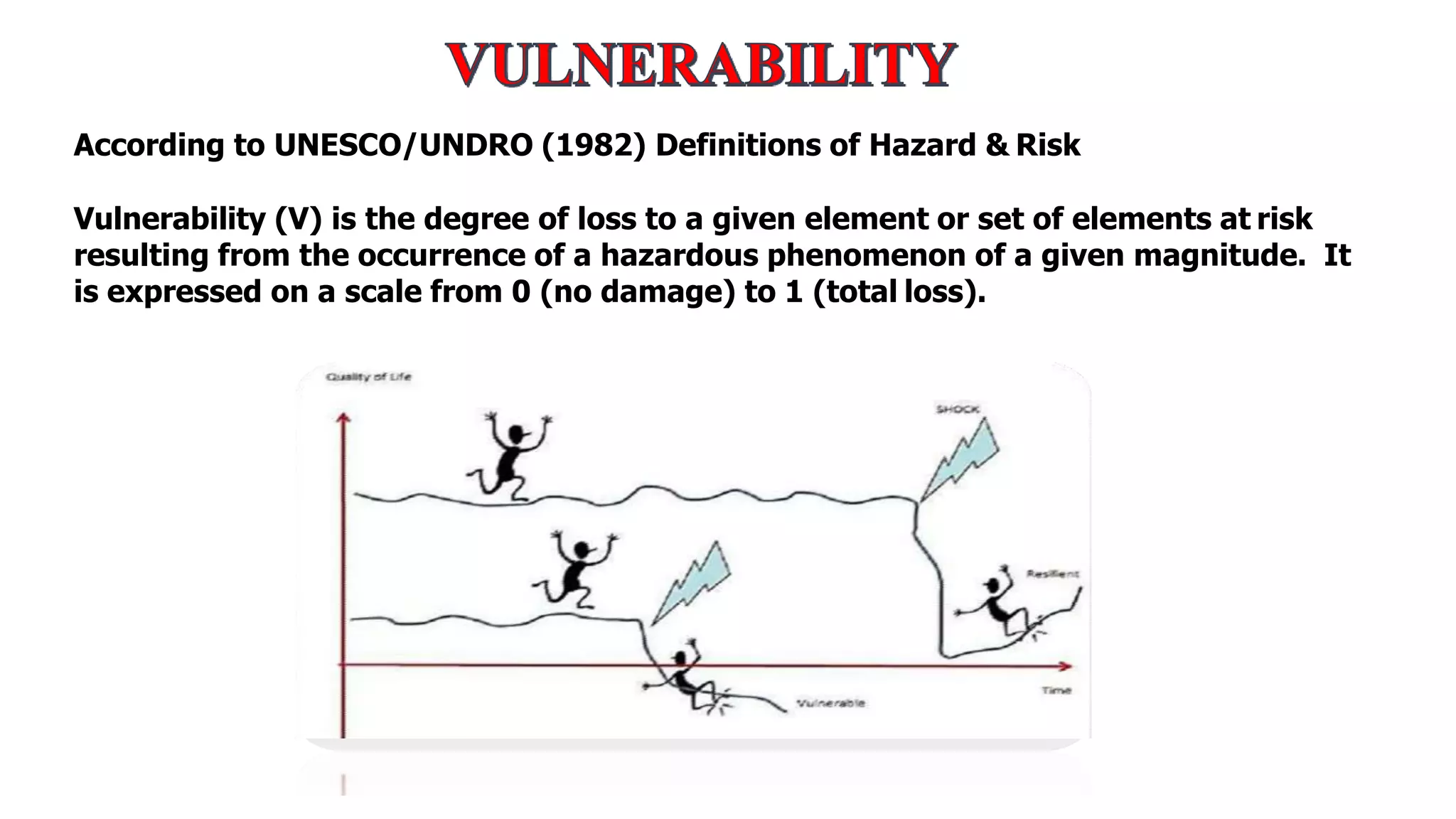
According to UNESCO/UNDRO (1982) Definitions of Hazard & Risk
Vulnerability (V) is the degree of loss to a given element or set of elements at risk
resulting from the occurrence of a hazardous phenomenon of a given magnitude. It
is expressed on a scale from 0 (no damage) to 1 (total loss).
WHAT IS
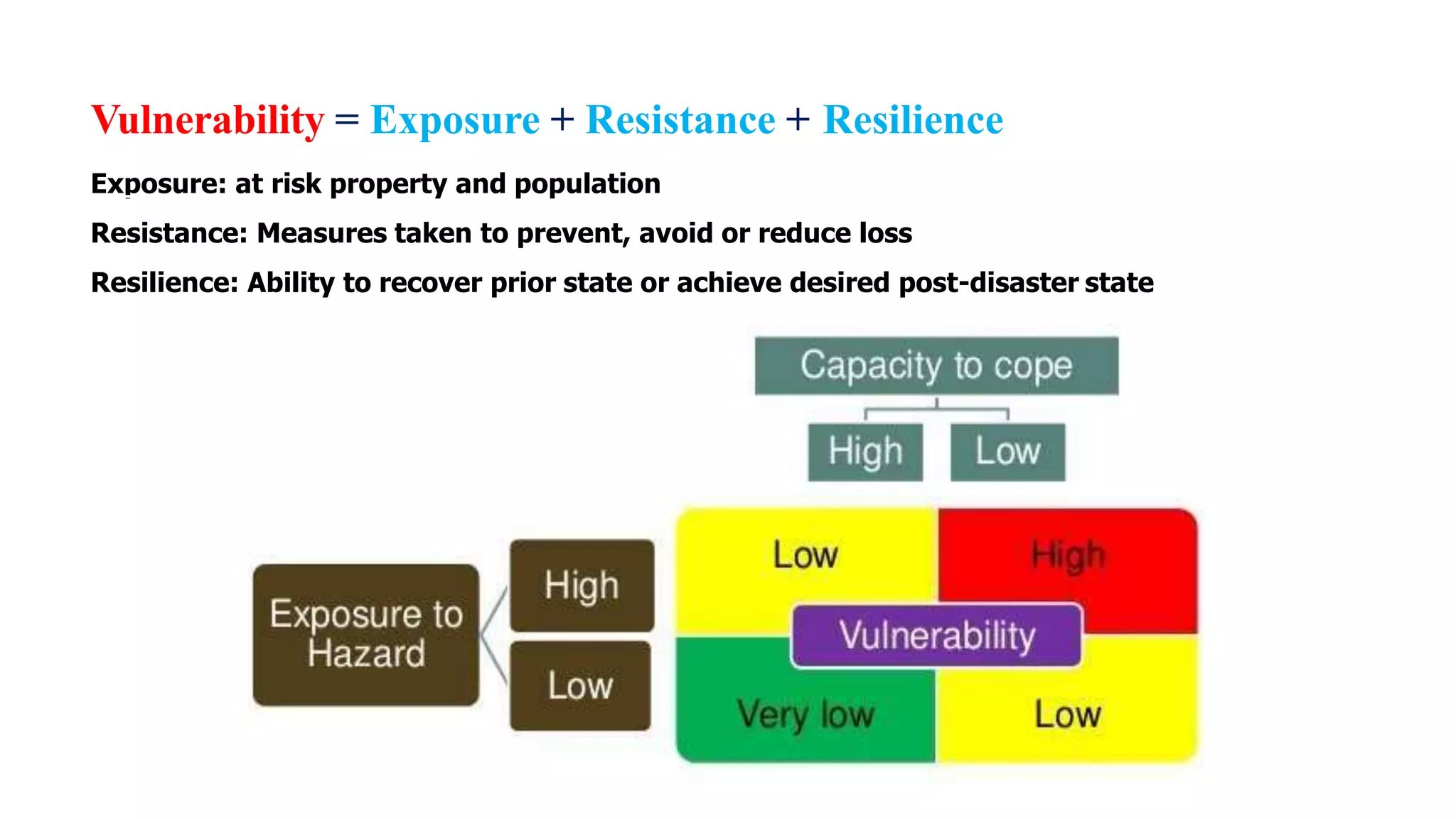
Vulnerability = Exposure + Resistance + Resilience
Exposure: at risk property and population
Resistance: Measures taken to prevent, avoid or reduce loss
Resilience: Ability to recover prior state or achieve desired post-disaster state
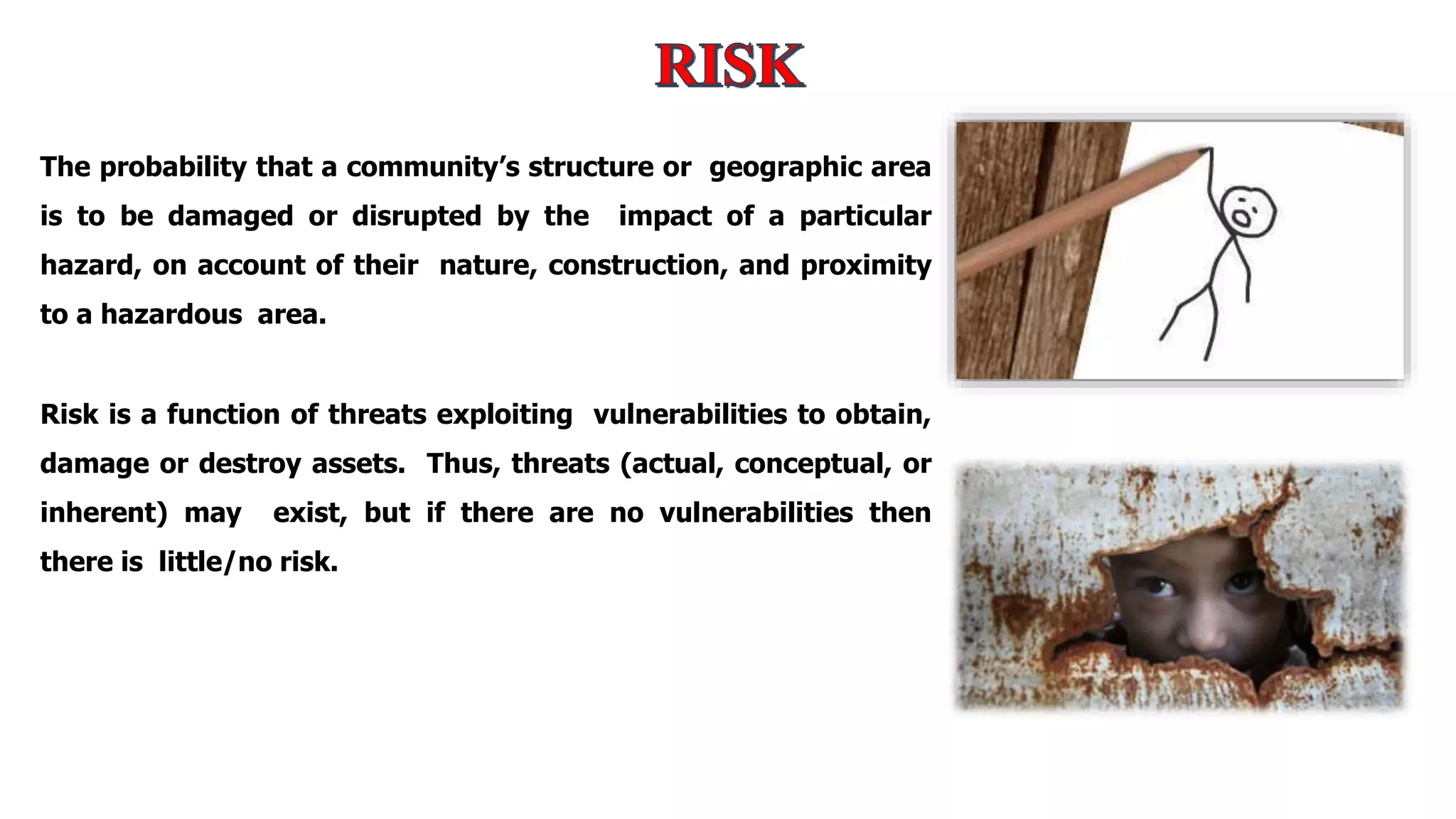
The probability that a community’s structure or geographic area
is to be damaged or disrupted by the impact of a particular
hazard, on account of their nature, construction, and proximity
to a hazardous area.
Risk is a function of threats exploiting vulnerabilities to obtain,
damage or destroy assets. Thus, threats (actual, conceptual, or
inherent) may exist, but if there are no vulnerabilities then
there is little/no risk.
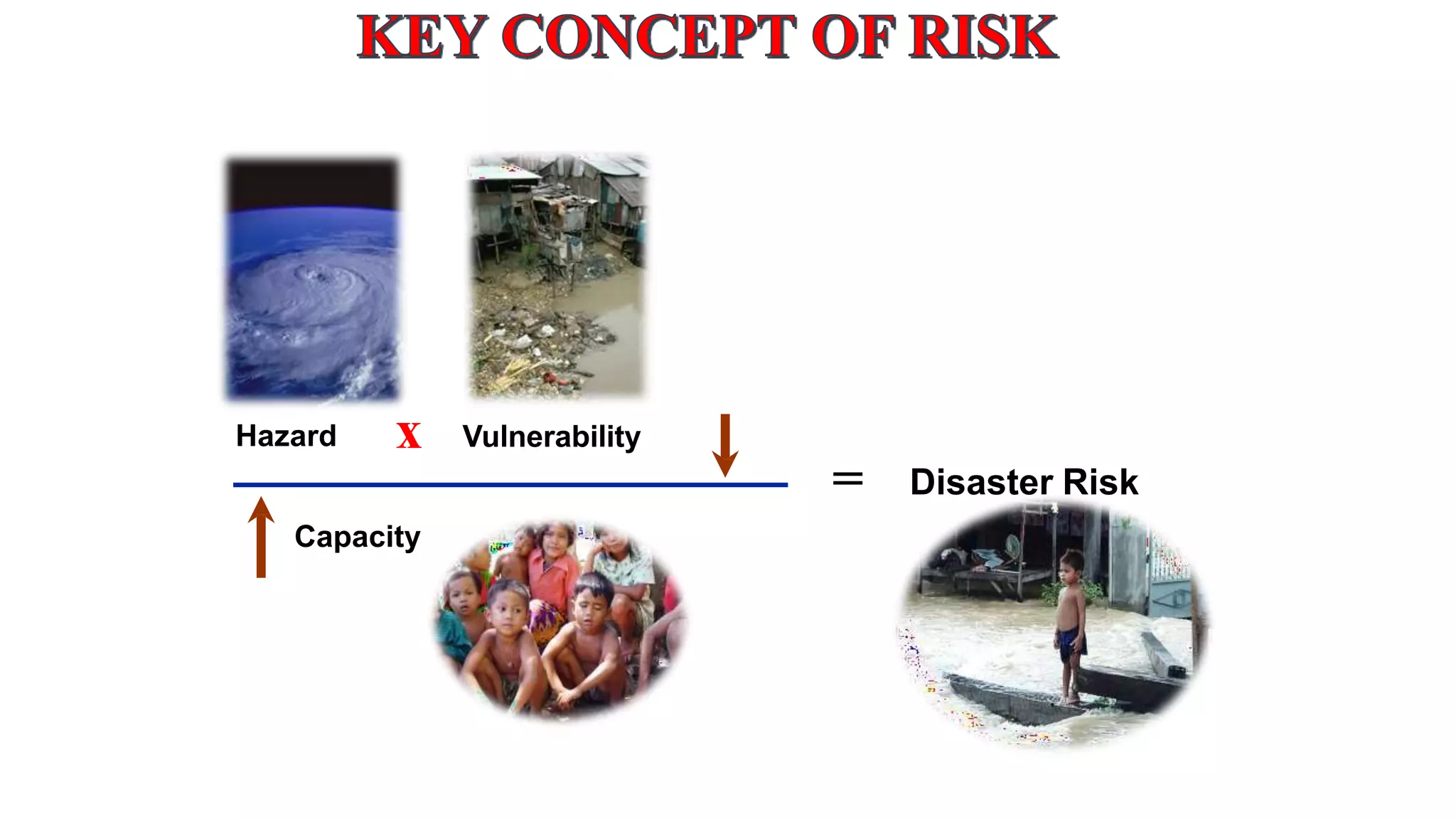
Hazard Vulnerability
x
Disaster Risk
Capacity
=
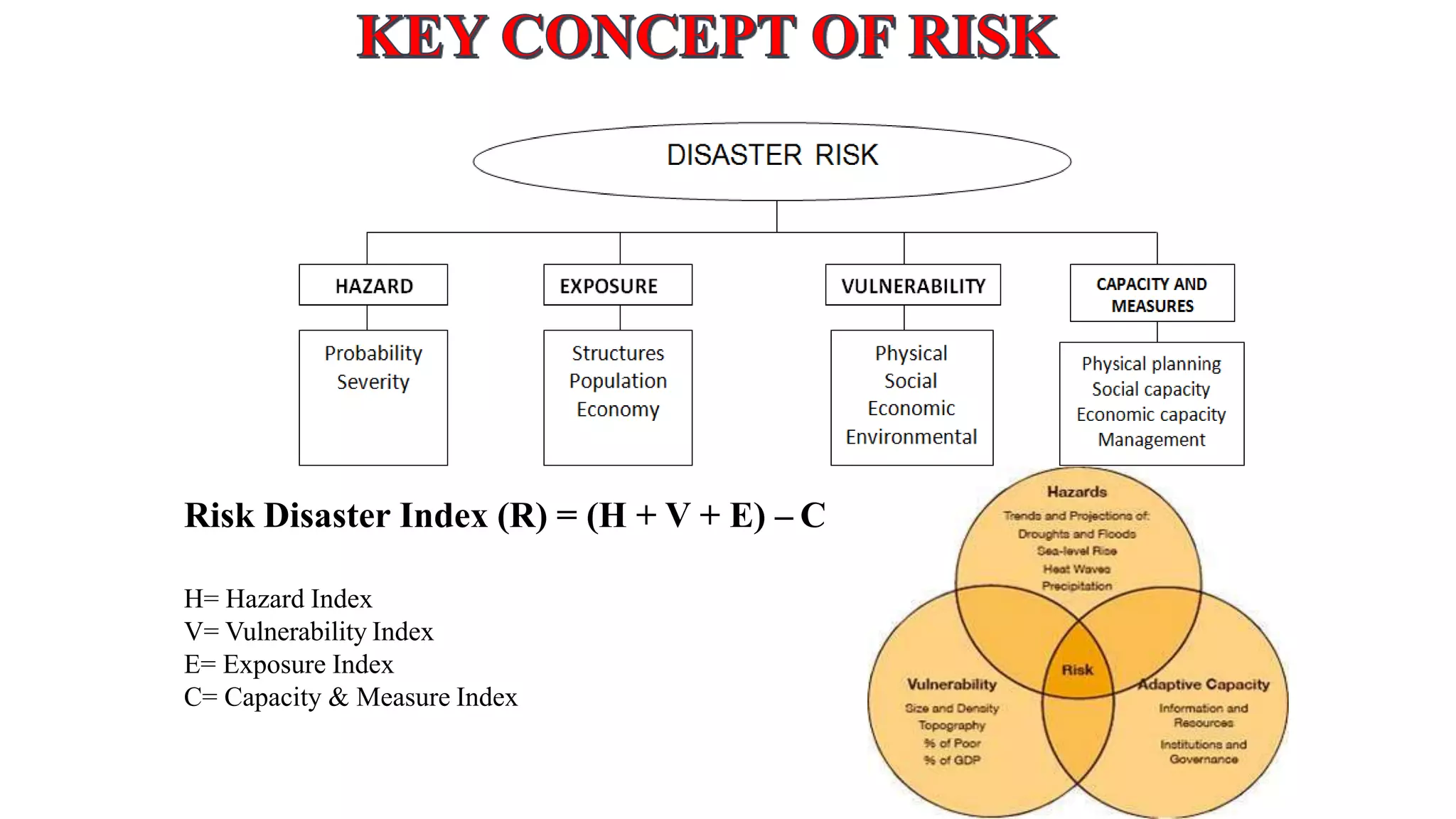
Risk Disaster Index (R) = (H + V + E) – C
H= Hazard Index
V= Vulnerability Index
E= Exposure Index
C= Capacity & Measure Index
Progression of vulnerability
Root causes Dynamic pressures Unsafe conditions
Limited
Access to -
• Power
• Structure
• Resources
Ideologies-
• Political -
system
• Economic
- system
Lack of –
•Local institutes
•Training
•Appropriate
skills
•Local investment
•Local market
•Media freedom
•Ethical standards
in public life
Macro forces-
•Rapid population
growth
•Rapid
urbanization
•Arms
expenditure
•Debt repayments
•Deforestation
•Decline in soil
productivity
Fragile physical
environment
•Dangerous
locations
•Unprotected
buildings &
infrastructure
Fragile local -
economy
•Livelihoods at risk
•Low income levels
Vulnerable society
•Special groupsat
risk
Public actions
•Lack of
preparedness
•Endemic disease
Earthquake
High winds
Hurricane
Cyclone
Typhoon
Flood
Volcanic-
eruptions
Landslides
Drought
Virus
Bacteria
Pests
Fire
Chemicals
Radiation
Armed-
conflicts
Hazards
NOT PREVENTED
9
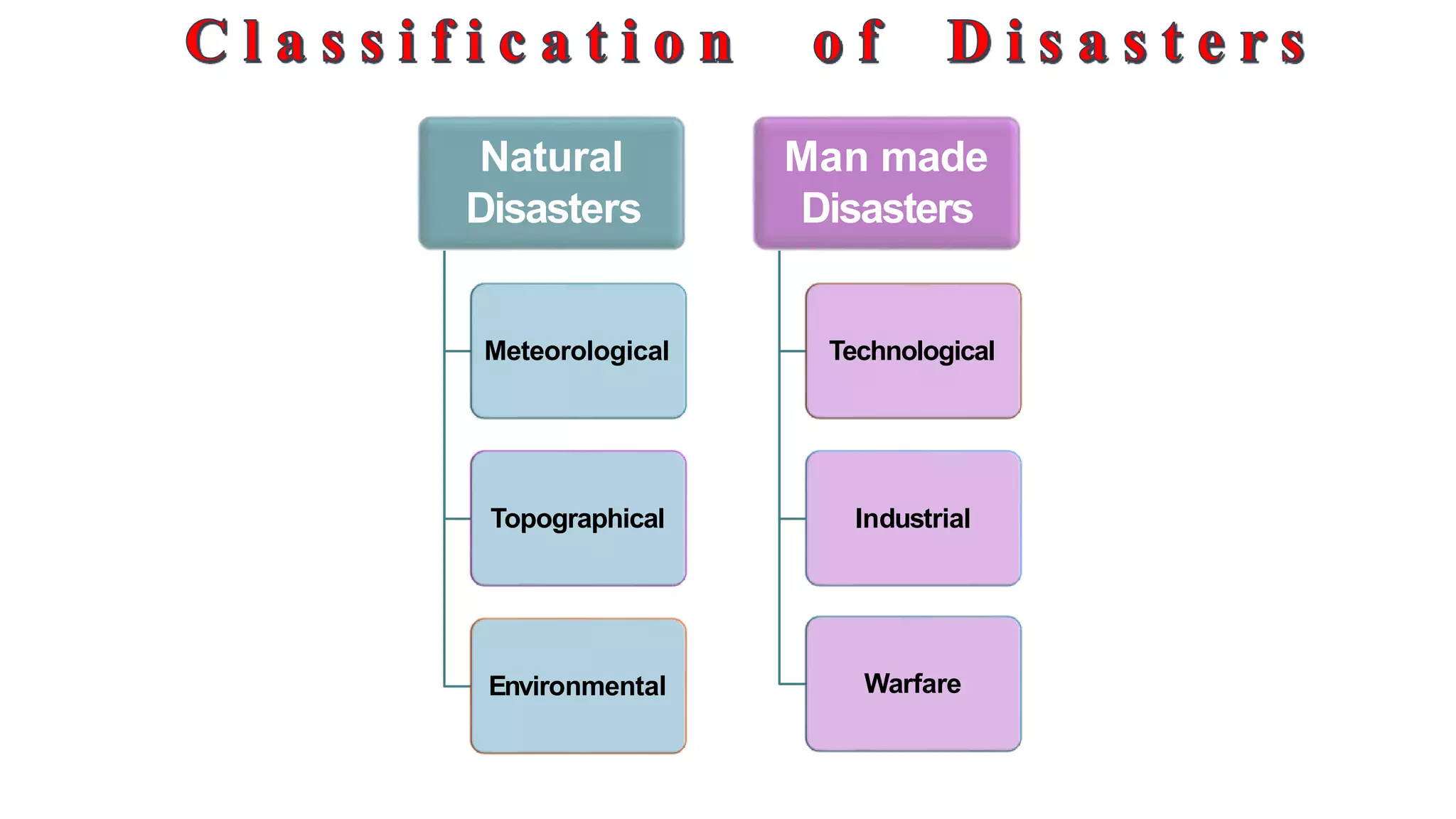
Natural
Disasters
Meteorological
Topographical
Environmental
Man made
Disasters
Technological
Industrial
Warfare
10
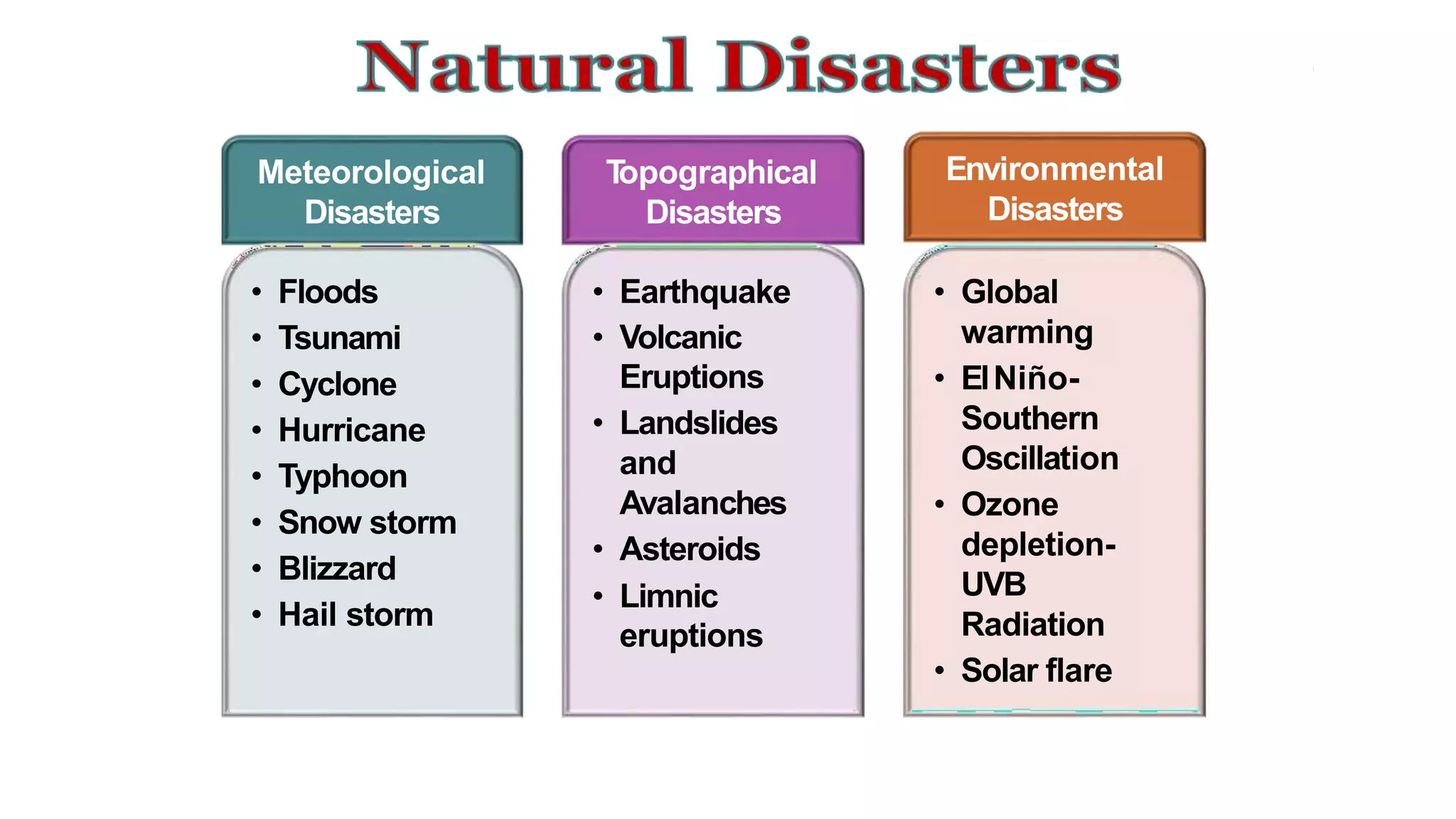
Meteorological
Disasters
• Floods
• Tsunami
• Cyclone
• Hurricane
• Typhoon
• Snow storm
• Blizzard
• Hail storm
T
opographical
Disasters
• Earthquake
• Volcanic
Eruptions
• Landslides
and
Avalanches
• Asteroids
• Limnic
eruptions
Environmental
Disasters
• Global
warming
• ElNiño-
Southern
Oscillation
• Ozone
depletion-
UVB
Radiation
• Solar flare
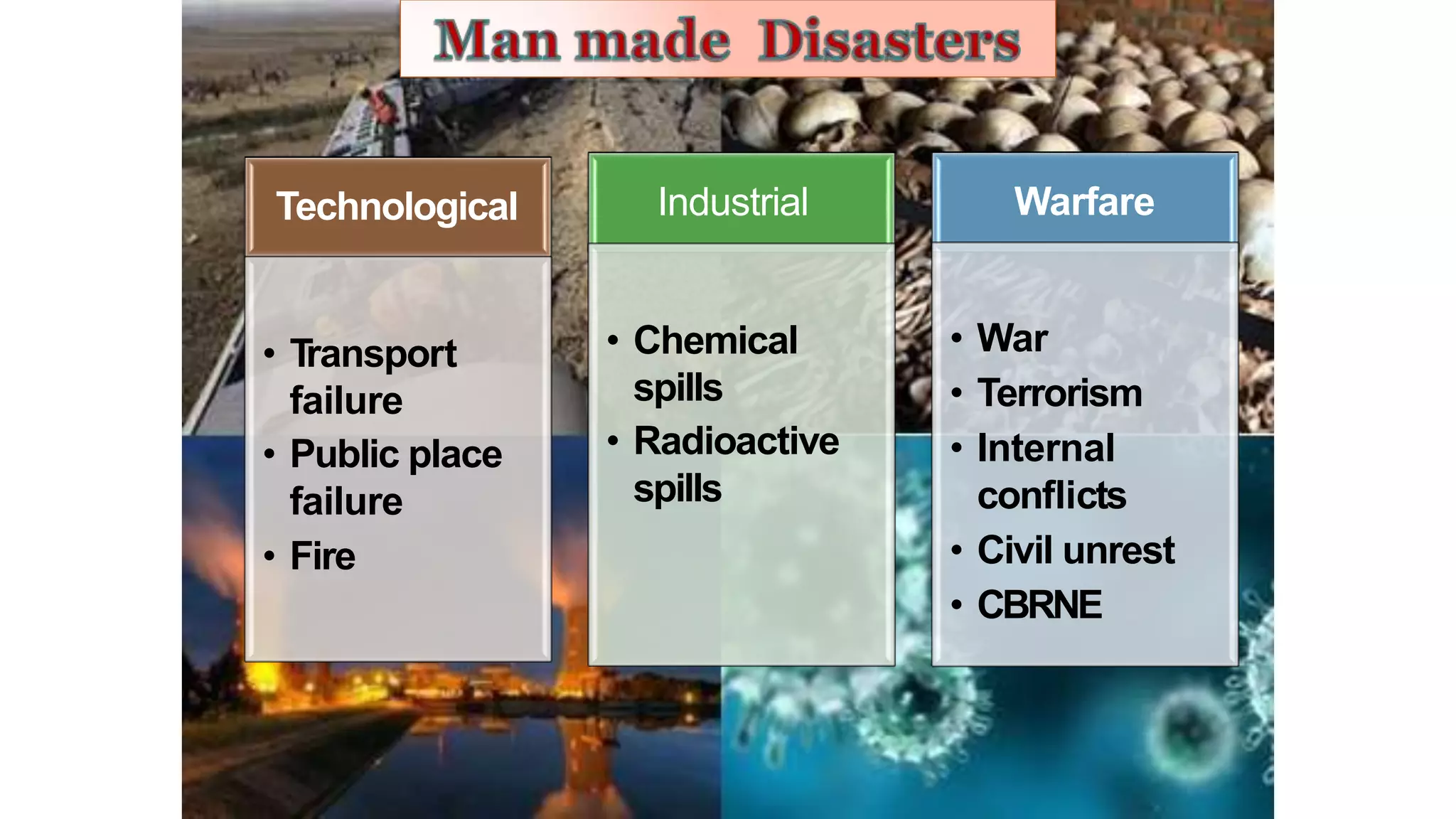
Technological
• Transport
failure
• Public place
failure
• Fire
Industrial
• Chemical
spills
• Radioactive
spills
Warfare
• War
• Terrorism
• Internal
conflicts
• Civil unrest
• CBRNE
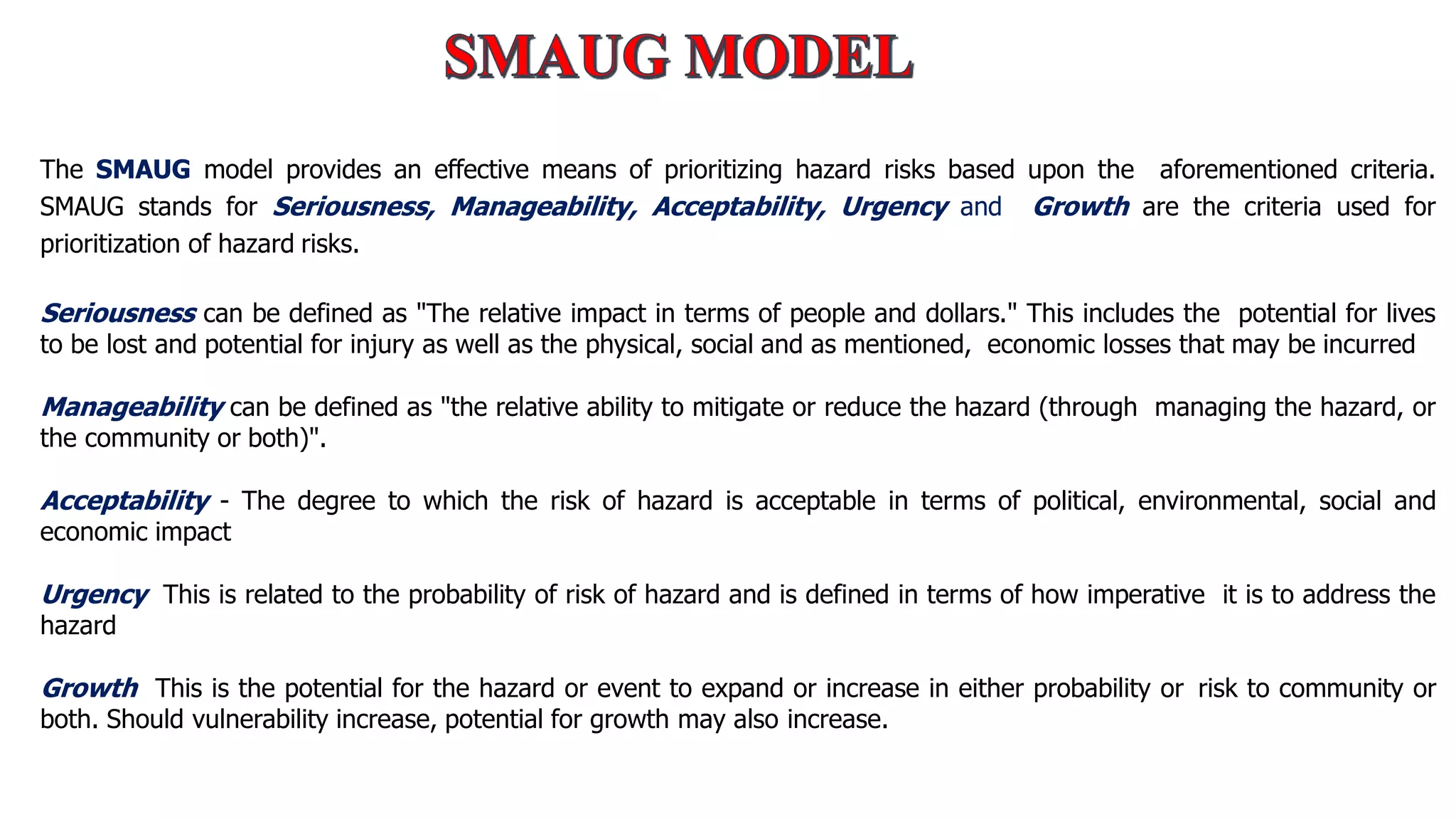
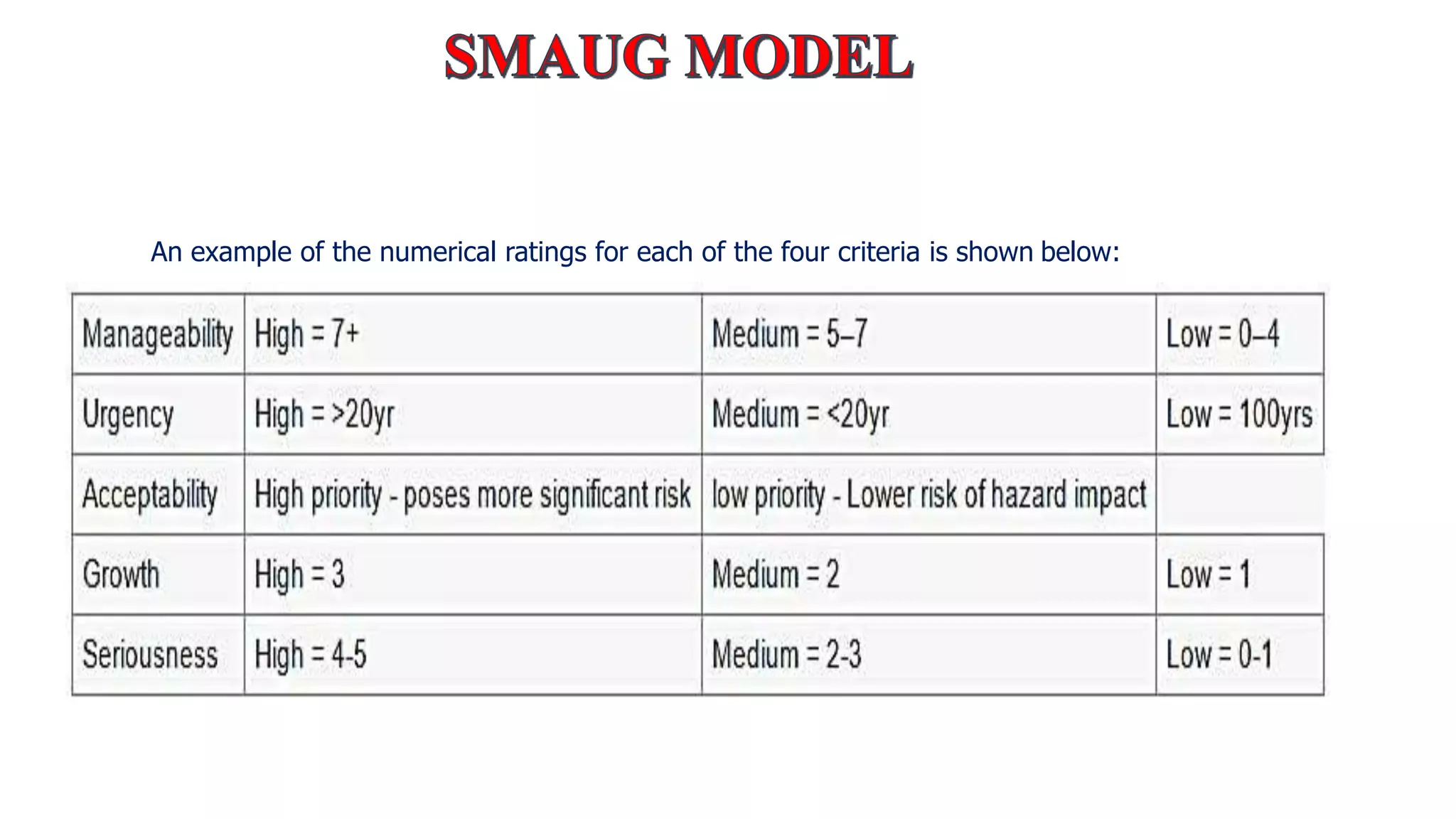
The SMAUG model provides an effective means of prioritizing hazard risks based upon the aforementioned criteria.
SMAUG stands for Seriousness, Manageability, Acceptability, Urgency and Growth are the criteria used for
prioritization of hazard risks.
Seriousness can be defined as "The relative impact in terms of people and dollars." This includes the potential for lives
to be lost and potential for injury as well as the physical, social and as mentioned, economic losses that may be incurred
Manageability can be defined as "the relative ability to mitigate or reduce the hazard (through managing the hazard, or
the community or both)".
Acceptability - The degree to which the risk of hazard is acceptable in terms of political, environmental, social and
economic impact
Urgency This is related to the probability of risk of hazard and is defined in terms of how imperative it is to address the
hazard
Growth This is the potential for the hazard or event to expand or increase in either probability or risk to community or
both. Should vulnerability increase, potential for growth may also increase.
An example of the numerical ratings for each of the four criteria is shown below:
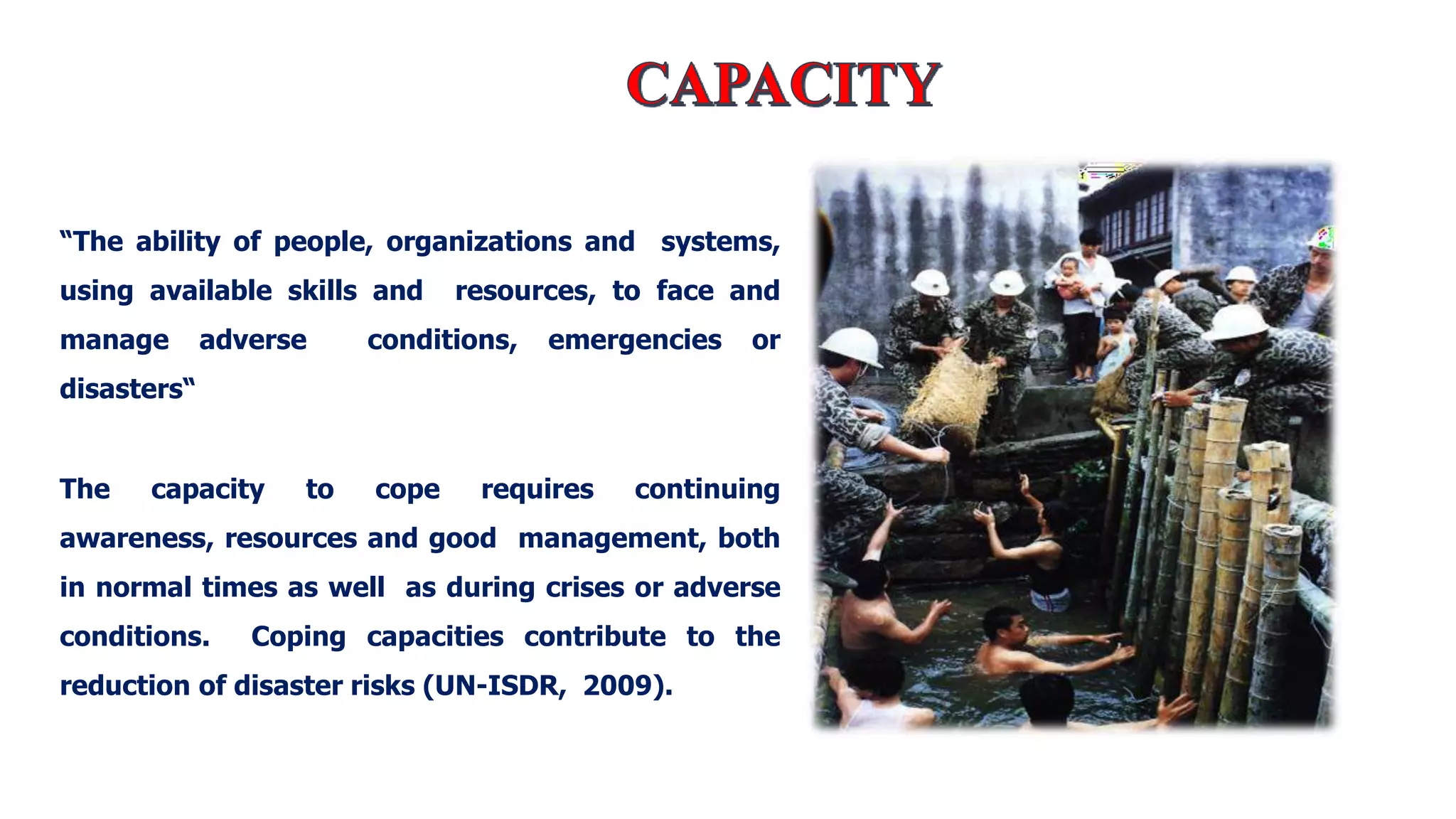
“The ability of people, organizations and systems,
using available skills and resources, to face and
manage adverse conditions, emergencies or
disasters“
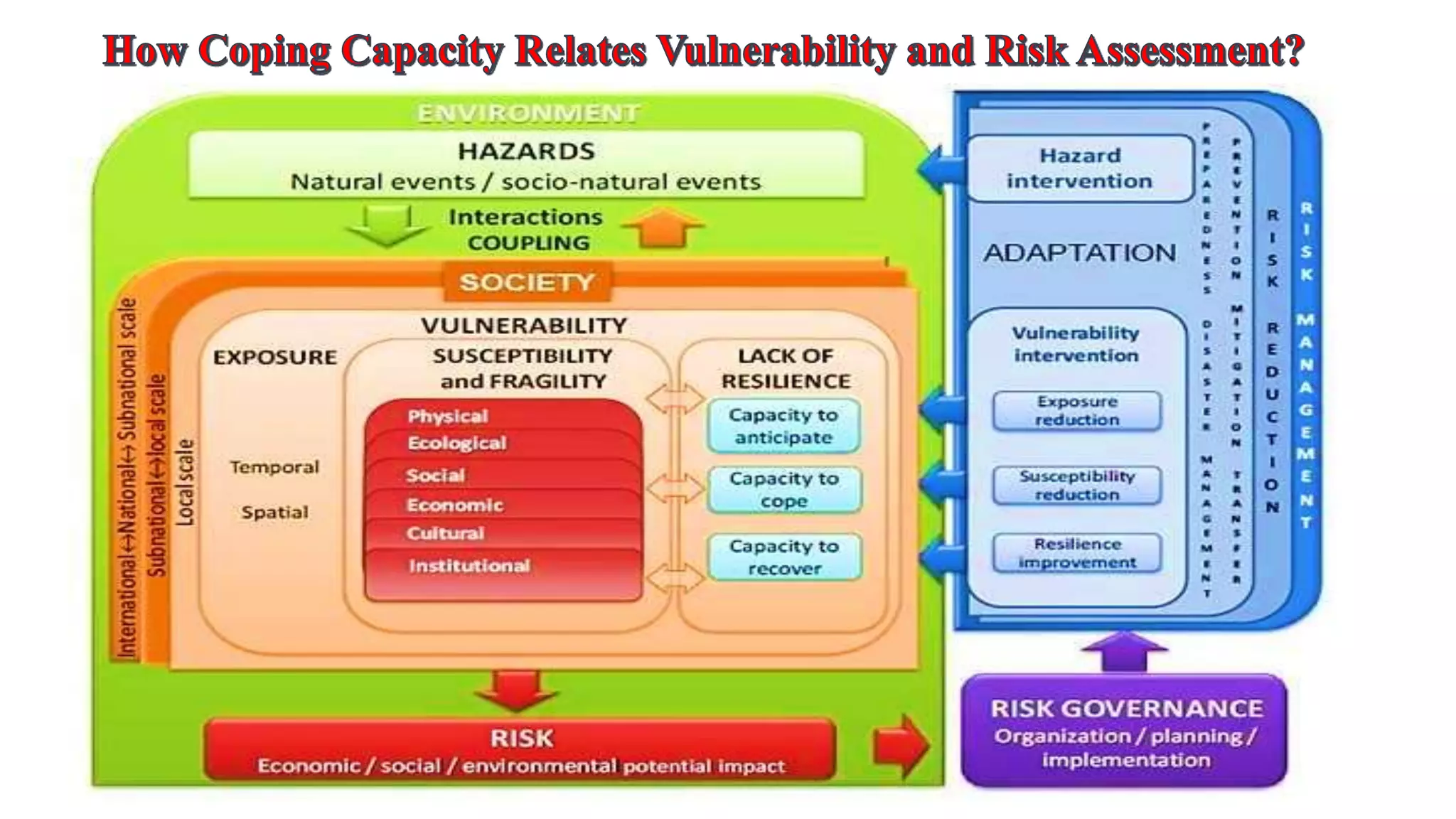
The capacity to cope requires continuing
awareness, resources and good management, both
in normal times as well as during crises or adverse
conditions. Coping capacities contribute to the
reduction of disaster risks (UN-ISDR, 2009).
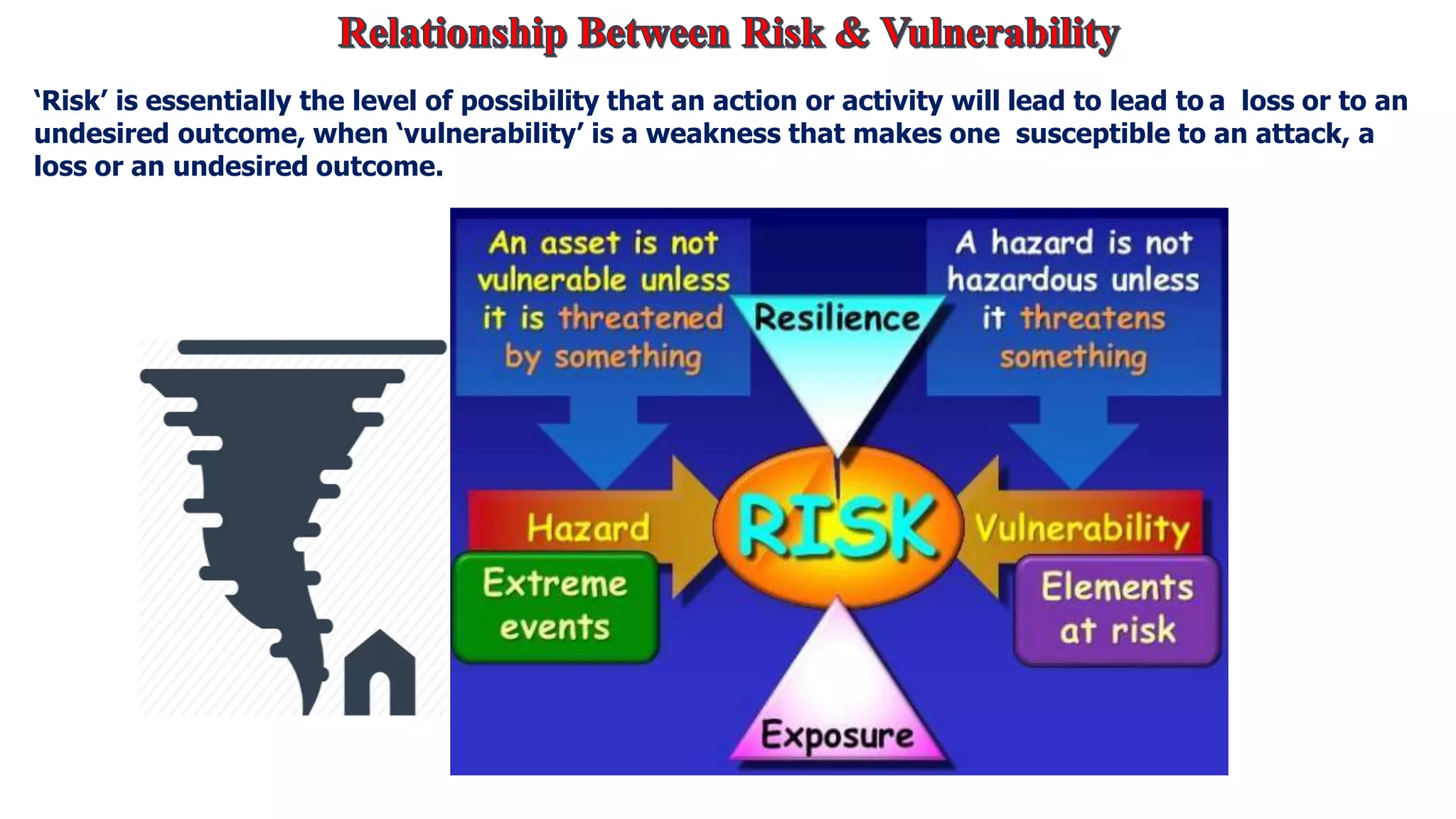
‘Risk’ is essentially the level of possibility that an action or activity will lead to lead to a loss or to an
undesired outcome, when ‘vulnerability’ is a weakness that makes one susceptible to an attack, a
loss or an undesired outcome.
Concept of disaster, hazard, vulnerability, exposure, capacity

Concept of disaster, hazard, vulnerability, exposure, capacity

  • 1.
    Dr Fayaz A.Malla Assistant Professor, Environmental Sciences GDC Tral Higher Education Department, Govt. of J&K Email: nami.fayaz@gmail.com
  • 2.
    • Disastersare asoldas Mankind. • The first description of Disaster and its management comes from mythological “Noah” and his ark. • Similar Flood tales are widespread in- Greek Mythology, Puranas, Mesopotamian stories, and many cultures.
  • 3.
    4 • Originated fromGreek • dus = bad aster = star • Calamity due to position of a planet or a star. • Then evolved in Italian as disastro • To become French désastre (de.zastʁ) & then disaster .
  • 4.
    Disaster Any occurrence thatcauses damage, ecological disruption, loss of human life, deterioration of health and health services on a scale, sufficient to warrant an extraordinary response from outside the affected community or area. (WHO) A disaster can be defined as an occurrence either nature or man made that causes human suffering and creates human needs that victim cannot alleviate without assistance. (American Red Cross) 5
  • 5.
    Hazard • Any phenomenonthat has the potential to cause disruption or damage to people and their environment. • A hazard is Natural or Anthropogenic event while the disaster is its consequence. • A hazard is perceived natural event which threatens both life and property • A disaster is a realization of hazard. -John Whittow • When hazard involves elements of risks, vulnerabilities and capacities, they can turn into disasters. • Hazards may be inevitable but disasters can be prevented.
  • 6.
    WHAT IS Vulnerability describesthe characteristics and circumstances of a community, system or asset that make it susceptible to the damaging effects of a hazard. There are many aspects of vulnerability, arising from various physical, social, economic, and environmental factors.
  • 7.
    According to UNESCO/UNDRO(1982) Definitions of Hazard & Risk Vulnerability (V) is the degree of loss to a given element or set of elements at risk resulting from the occurrence of a hazardous phenomenon of a given magnitude. It is expressed on a scale from 0 (no damage) to 1 (total loss). WHAT IS
  • 8.
    Vulnerability = Exposure+ Resistance + Resilience Exposure: at risk property and population Resistance: Measures taken to prevent, avoid or reduce loss Resilience: Ability to recover prior state or achieve desired post-disaster state
  • 10.
    The probability thata community’s structure or geographic area is to be damaged or disrupted by the impact of a particular hazard, on account of their nature, construction, and proximity to a hazardous area. Risk is a function of threats exploiting vulnerabilities to obtain, damage or destroy assets. Thus, threats (actual, conceptual, or inherent) may exist, but if there are no vulnerabilities then there is little/no risk.
  • 11.
  • 12.
    Risk Disaster Index(R) = (H + V + E) – C H= Hazard Index V= Vulnerability Index E= Exposure Index C= Capacity & Measure Index
  • 13.
    Progression of vulnerability Rootcauses Dynamic pressures Unsafe conditions Limited Access to - • Power • Structure • Resources Ideologies- • Political - system • Economic - system Lack of – •Local institutes •Training •Appropriate skills •Local investment •Local market •Media freedom •Ethical standards in public life Macro forces- •Rapid population growth •Rapid urbanization •Arms expenditure •Debt repayments •Deforestation •Decline in soil productivity Fragile physical environment •Dangerous locations •Unprotected buildings & infrastructure Fragile local - economy •Livelihoods at risk •Low income levels Vulnerable society •Special groupsat risk Public actions •Lack of preparedness •Endemic disease Earthquake High winds Hurricane Cyclone Typhoon Flood Volcanic- eruptions Landslides Drought Virus Bacteria Pests Fire Chemicals Radiation Armed- conflicts Hazards NOT PREVENTED
  • 14.
  • 15.
    10 Meteorological Disasters • Floods • Tsunami •Cyclone • Hurricane • Typhoon • Snow storm • Blizzard • Hail storm T opographical Disasters • Earthquake • Volcanic Eruptions • Landslides and Avalanches • Asteroids • Limnic eruptions Environmental Disasters • Global warming • ElNiño- Southern Oscillation • Ozone depletion- UVB Radiation • Solar flare
  • 16.
    Technological • Transport failure • Publicplace failure • Fire Industrial • Chemical spills • Radioactive spills Warfare • War • Terrorism • Internal conflicts • Civil unrest • CBRNE
  • 17.
    The SMAUG modelprovides an effective means of prioritizing hazard risks based upon the aforementioned criteria. SMAUG stands for Seriousness, Manageability, Acceptability, Urgency and Growth are the criteria used for prioritization of hazard risks. Seriousness can be defined as "The relative impact in terms of people and dollars." This includes the potential for lives to be lost and potential for injury as well as the physical, social and as mentioned, economic losses that may be incurred Manageability can be defined as "the relative ability to mitigate or reduce the hazard (through managing the hazard, or the community or both)". Acceptability - The degree to which the risk of hazard is acceptable in terms of political, environmental, social and economic impact Urgency This is related to the probability of risk of hazard and is defined in terms of how imperative it is to address the hazard Growth This is the potential for the hazard or event to expand or increase in either probability or risk to community or both. Should vulnerability increase, potential for growth may also increase.
  • 18.
    An example ofthe numerical ratings for each of the four criteria is shown below:
  • 19.
    “The ability ofpeople, organizations and systems, using available skills and resources, to face and manage adverse conditions, emergencies or disasters“ The capacity to cope requires continuing awareness, resources and good management, both in normal times as well as during crises or adverse conditions. Coping capacities contribute to the reduction of disaster risks (UN-ISDR, 2009).
  • 21.
    ‘Risk’ is essentiallythe level of possibility that an action or activity will lead to lead to a loss or to an undesired outcome, when ‘vulnerability’ is a weakness that makes one susceptible to an attack, a loss or an undesired outcome.