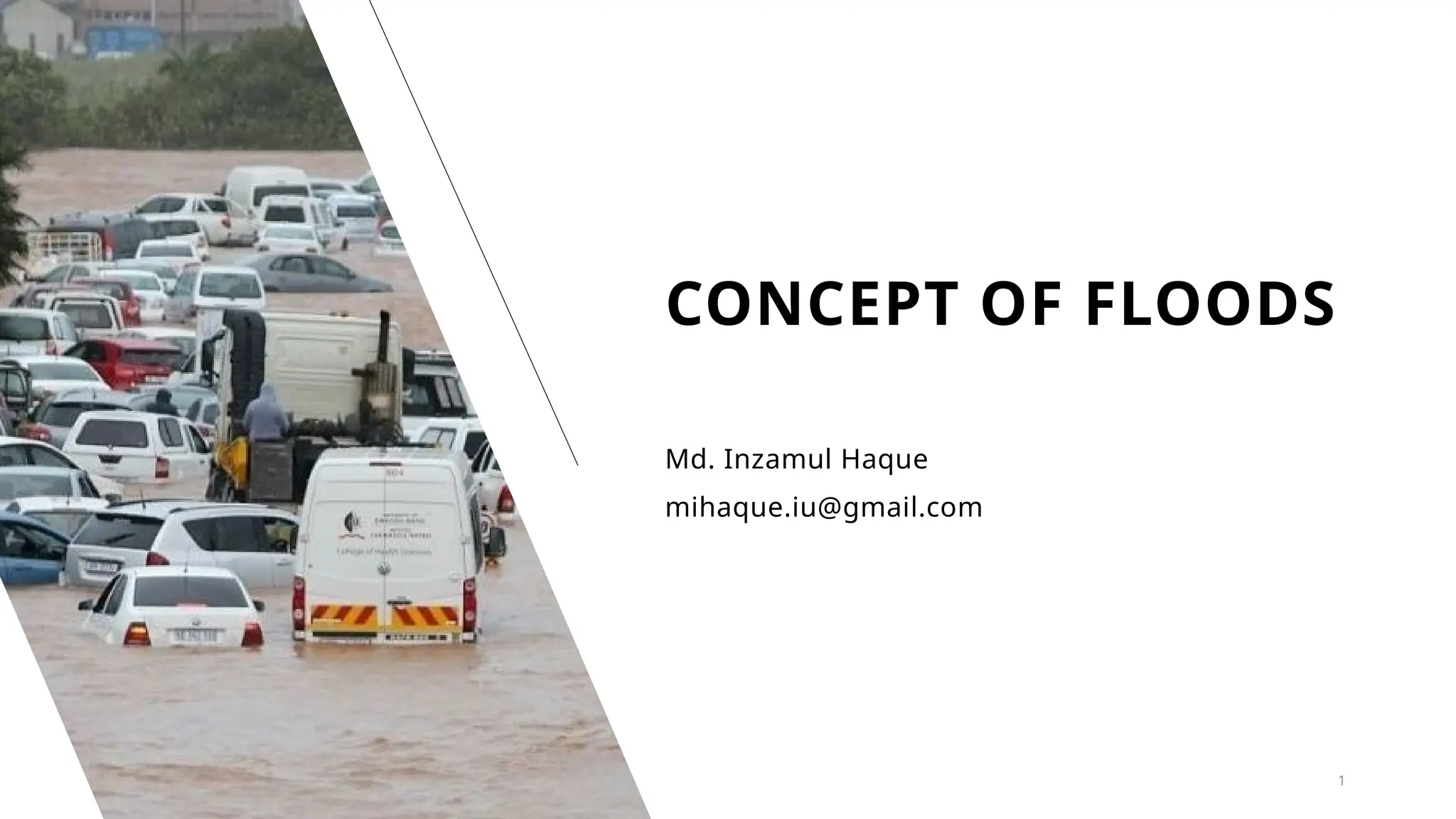
CONCEPT OF FLOODS
1
Md. Inzamul Haque
mihaque.iu@gmail.com
OUTLINE
2
Causes of Floods
Types of Floods
Consequences of Floods
Bangladesh: Flood Overview
CAUSES OF FLOODS
3
Natural Causes:
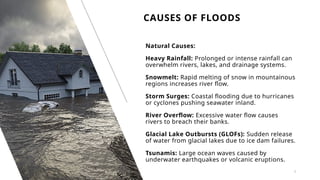
Heavy Rainfall: Prolonged or intense rainfall can
overwhelm rivers, lakes, and drainage systems.
Snowmelt: Rapid melting of snow in mountainous
regions increases river flow.
Storm Surges: Coastal flooding due to hurricanes
or cyclones pushing seawater inland.
River Overflow: Excessive water flow causes
rivers to breach their banks.
Glacial Lake Outbursts (GLOFs): Sudden release
of water from glacial lakes due to ice dam failures.
Tsunamis: Large ocean waves caused by
underwater earthquakes or volcanic eruptions.
CAUSES OF FLOODS
4
Human-Induced Causes:
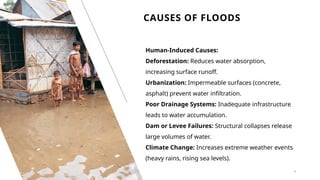
Deforestation: Reduces water absorption,
increasing surface runoff.
Urbanization: Impermeable surfaces (concrete,
asphalt) prevent water infiltration.
Poor Drainage Systems: Inadequate infrastructure
leads to water accumulation.
Dam or Levee Failures: Structural collapses release
large volumes of water.
Climate Change: Increases extreme weather events
(heavy rains, rising sea levels).
Types of Floods
Type of Flood Description
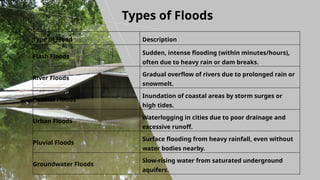
Flash Floods
Sudden, intense flooding (within minutes/hours),
often due to heavy rain or dam breaks.
River Floods
Gradual overflow of rivers due to prolonged rain or
snowmelt.
Coastal Floods
Inundation of coastal areas by storm surges or
high tides.
Urban Floods
Waterlogging in cities due to poor drainage and
excessive runoff.
Pluvial Floods
Surface flooding from heavy rainfall, even without
water bodies nearby.
Groundwater Floods
Slow-rising water from saturated underground
aquifers.
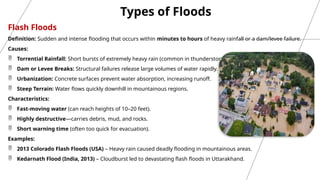
Flash Floods
Definition: Sudden and intense flooding that occurs within minutes to hours of heavy rainfall or a dam/levee failure.
Causes:
ď‚· Torrential Rainfall: Short bursts of extremely heavy rain (common in thunderstorms).
ď‚· Dam or Levee Breaks: Structural failures release large volumes of water rapidly.
ď‚· Urbanization: Concrete surfaces prevent water absorption, increasing runoff.
ď‚· Steep Terrain: Water flows quickly downhill in mountainous regions.
Characteristics:
 Fast-moving water (can reach heights of 10–20 feet).
 Highly destructive—carries debris, mud, and rocks.
ď‚· Short warning time (often too quick for evacuation).
Examples:
 2013 Colorado Flash Floods (USA) – Heavy rain caused deadly flooding in mountainous areas.
 Kedarnath Flood (India, 2013) – Cloudburst led to devastating flash floods in Uttarakhand.
Types of Floods
Types of Floods
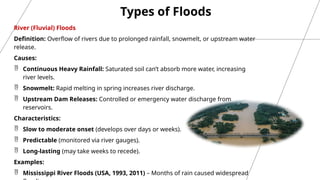
River (Fluvial) Floods
Definition: Overflow of rivers due to prolonged rainfall, snowmelt, or upstream water
release.
Causes:
 Continuous Heavy Rainfall: Saturated soil can’t absorb more water, increasing
river levels.
ď‚· Snowmelt: Rapid melting in spring increases river discharge.
ď‚· Upstream Dam Releases: Controlled or emergency water discharge from
reservoirs.
Characteristics:
ď‚· Slow to moderate onset (develops over days or weeks).
ď‚· Predictable (monitored via river gauges).
ď‚· Long-lasting (may take weeks to recede).
Examples:
 Mississippi River Floods (USA, 1993, 2011) – Months of rain caused widespread
Types of Floods
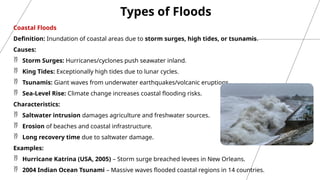
Coastal Floods
Definition: Inundation of coastal areas due to storm surges, high tides, or tsunamis.
Causes:
ď‚· Storm Surges: Hurricanes/cyclones push seawater inland.
ď‚· King Tides: Exceptionally high tides due to lunar cycles.
ď‚· Tsunamis: Giant waves from underwater earthquakes/volcanic eruptions.
ď‚· Sea-Level Rise: Climate change increases coastal flooding risks.
Characteristics:
ď‚· Saltwater intrusion damages agriculture and freshwater sources.
ď‚· Erosion of beaches and coastal infrastructure.
ď‚· Long recovery time due to saltwater damage.
Examples:
 Hurricane Katrina (USA, 2005) – Storm surge breached levees in New Orleans.
 2004 Indian Ocean Tsunami – Massive waves flooded coastal regions in 14 countries.
Types of Floods
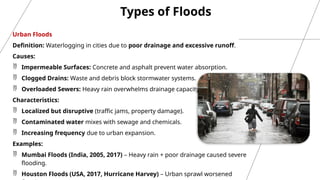
Urban Floods
Definition: Waterlogging in cities due to poor drainage and excessive runoff.
Causes:
ď‚· Impermeable Surfaces: Concrete and asphalt prevent water absorption.
ď‚· Clogged Drains: Waste and debris block stormwater systems.
ď‚· Overloaded Sewers: Heavy rain overwhelms drainage capacity.
Characteristics:
ď‚· Localized but disruptive (traffic jams, property damage).
ď‚· Contaminated water mixes with sewage and chemicals.
ď‚· Increasing frequency due to urban expansion.
Examples:
 Mumbai Floods (India, 2005, 2017) – Heavy rain + poor drainage caused severe
flooding.
 Houston Floods (USA, 2017, Hurricane Harvey) – Urban sprawl worsened
TYPES OF FLOODS
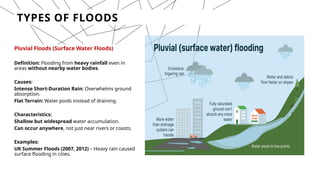
Pluvial Floods (Surface Water Floods)
Definition: Flooding from heavy rainfall even in
areas without nearby water bodies.
Causes:
Intense Short-Duration Rain: Overwhelms ground
absorption.
Flat Terrain: Water pools instead of draining.
Characteristics:
Shallow but widespread water accumulation.
Can occur anywhere, not just near rivers or coasts.
Examples:
UK Summer Floods (2007, 2012) – Heavy rain caused
surface flooding in cities.
TYPES OF FLOODS
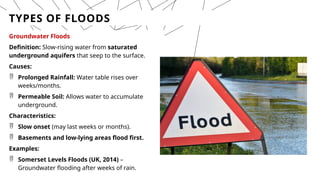
Groundwater Floods
Definition: Slow-rising water from saturated
underground aquifers that seep to the surface.
Causes:
ď‚· Prolonged Rainfall: Water table rises over
weeks/months.
ď‚· Permeable Soil: Allows water to accumulate
underground.
Characteristics:
ď‚· Slow onset (may last weeks or months).
ď‚· Basements and low-lying areas flood first.
Examples:
 Somerset Levels Floods (UK, 2014) –
Groundwater flooding after weeks of rain.
TYPES OF FLOODS
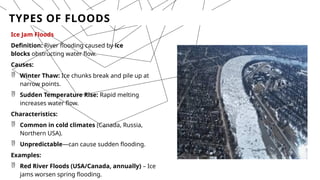
Ice Jam Floods
Definition: River flooding caused by ice
blocks obstructing water flow.
Causes:
ď‚· Winter Thaw: Ice chunks break and pile up at
narrow points.
ď‚· Sudden Temperature Rise: Rapid melting
increases water flow.
Characteristics:
ď‚· Common in cold climates (Canada, Russia,
Northern USA).
 Unpredictable—can cause sudden flooding.
Examples:
 Red River Floods (USA/Canada, annually) – Ice
jams worsen spring flooding.
CONSEQUENCE OF FLOODS
13
Environmental Impacts:
Soil Erosion & Land Degradation
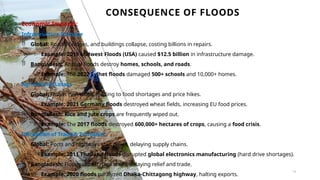
ď‚· Global: Floodwaters wash away fertile topsoil, reducing agricultural productivity.
o Example: The 2011 Thailand floods destroyed vast farmlands, leading to long-term soil infertility.
ď‚· Bangladesh: Riverbank erosion displaces thousands annually.
o Example: The Brahmaputra-Jamuna river system erodes 10,000+ hectares of land yearly, forcing
relocation.
Water Contamination
ď‚· Global: Floods mix sewage, chemicals, and waste into drinking water.
o Example: Hurricane Katrina (2005, USA) caused toxic water contamination in New Orleans.
ď‚· Bangladesh: Floods spread arsenic and bacterial pollutants in water sources.
o Example: After the 2020 monsoon floods, diarrhea outbreaks surged due to contaminated wells.
Ecosystem Destruction
ď‚· Global: Wetlands and forests are damaged, affecting biodiversity.
o Example: The 2022 Pakistan floods submerged 1/3 of the country, killing wildlife and damaging
CONSEQUENCE OF FLOODS
14
Economic Impacts:
Infrastructure Damage
ď‚· Global: Roads, bridges, and buildings collapse, costing billions in repairs.
o Example: 2019 Midwest Floods (USA) caused $12.5 billion in infrastructure damage.
ď‚· Bangladesh: Annual floods destroy homes, schools, and roads.
o Example: The 2022 Sylhet floods damaged 500+ schools and 10,000+ homes.
Agricultural Losses
ď‚· Global: Floods ruin crops, leading to food shortages and price hikes.
o Example: 2021 Germany floods destroyed wheat fields, increasing EU food prices.
ď‚· Bangladesh: Rice and jute crops are frequently wiped out.
o Example: The 2017 floods destroyed 600,000+ hectares of crops, causing a food crisis.
Disruption of Trade & Transport
ď‚· Global: Ports and highways shut down, delaying supply chains.
o Example: 2011 Thailand floods disrupted global electronics manufacturing (hard drive shortages).
ď‚· Bangladesh: Floods cut off rural areas, delaying relief and trade.
o Example: 2020 floods paralyzed Dhaka-Chittagong highway, halting exports.
CONSEQUENCE OF FLOODS
15
Health Impacts:
Waterborne Diseases
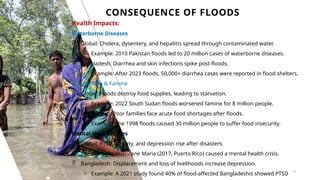
ď‚· Global: Cholera, dysentery, and hepatitis spread through contaminated water.
o Example: 2010 Pakistan floods led to 20 million cases of waterborne diseases.
ď‚· Bangladesh: Diarrhea and skin infections spike post-floods.
o Example: After 2023 floods, 50,000+ diarrhea cases were reported in flood shelters.
Malnutrition & Famine
ď‚· Global: Floods destroy food supplies, leading to starvation.
o Example: 2022 South Sudan floods worsened famine for 8 million people.
ď‚· Bangladesh: Poor families face acute food shortages after floods.
o Example: The 1998 floods caused 30 million people to suffer food insecurity.
Mental Health Issues
ď‚· Global: PTSD, anxiety, and depression rise after disasters.
o Example: Hurricane Maria (2017, Puerto Rico) caused a mental health crisis.
ď‚· Bangladesh: Displacement and loss of livelihoods increase depression.
o Example: A 2021 study found 40% of flood-affected Bangladeshis showed PTSD
CONSEQUENCE OF FLOODS
16
Social Impacts
Mass Displacement & Homelessness
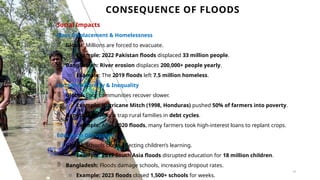
ď‚· Global: Millions are forced to evacuate.
o Example: 2022 Pakistan floods displaced 33 million people.
ď‚· Bangladesh: River erosion displaces 200,000+ people yearly.
o Example: The 2019 floods left 7.5 million homeless.
Increased Poverty & Inequality
ď‚· Global: Poor communities recover slower.
o Example: Hurricane Mitch (1998, Honduras) pushed 50% of farmers into poverty.
ď‚· Bangladesh: Floods trap rural families in debt cycles.
o Example: After 2020 floods, many farmers took high-interest loans to replant crops.
Education Disruptions
 Global: Schools close, affecting children’s learning.
o Example: 2017 South Asia floods disrupted education for 18 million children.
ď‚· Bangladesh: Floods damage schools, increasing dropout rates.
o Example: 2023 floods closed 1,500+ schools for weeks.
17
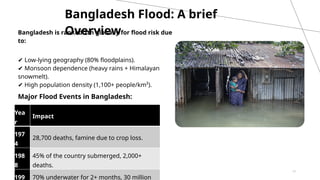
Bangladesh is ranked 7th globally for flood risk due
to:
âś” Low-lying geography (80% floodplains).
âś” Monsoon dependence (heavy rains + Himalayan
snowmelt).
✔ High population density (1,100+ people/km²).
Bangladesh Flood: A brief
Overview
Yea
r
Impact
197
4
28,700 deaths, famine due to crop loss.
198
8
45% of the country submerged, 2,000+
deaths.
199 70% underwater for 2+ months, 30 million
Major Flood Events in Bangladesh:
THANK YOU
18

Concept of Floods (Types, Causes & Consequences))

  • 1.
    CONCEPT OF FLOODS 1 Md.Inzamul Haque mihaque.iu@gmail.com
  • 2.
    OUTLINE 2 Causes of Floods Typesof Floods Consequences of Floods Bangladesh: Flood Overview
  • 3.
    CAUSES OF FLOODS 3 NaturalCauses: Heavy Rainfall: Prolonged or intense rainfall can overwhelm rivers, lakes, and drainage systems. Snowmelt: Rapid melting of snow in mountainous regions increases river flow. Storm Surges: Coastal flooding due to hurricanes or cyclones pushing seawater inland. River Overflow: Excessive water flow causes rivers to breach their banks. Glacial Lake Outbursts (GLOFs): Sudden release of water from glacial lakes due to ice dam failures. Tsunamis: Large ocean waves caused by underwater earthquakes or volcanic eruptions.
  • 4.
    CAUSES OF FLOODS 4 Human-InducedCauses: Deforestation: Reduces water absorption, increasing surface runoff. Urbanization: Impermeable surfaces (concrete, asphalt) prevent water infiltration. Poor Drainage Systems: Inadequate infrastructure leads to water accumulation. Dam or Levee Failures: Structural collapses release large volumes of water. Climate Change: Increases extreme weather events (heavy rains, rising sea levels).
  • 5.
    Types of Floods Typeof Flood Description Flash Floods Sudden, intense flooding (within minutes/hours), often due to heavy rain or dam breaks. River Floods Gradual overflow of rivers due to prolonged rain or snowmelt. Coastal Floods Inundation of coastal areas by storm surges or high tides. Urban Floods Waterlogging in cities due to poor drainage and excessive runoff. Pluvial Floods Surface flooding from heavy rainfall, even without water bodies nearby. Groundwater Floods Slow-rising water from saturated underground aquifers.
  • 6.
    Flash Floods Definition: Suddenand intense flooding that occurs within minutes to hours of heavy rainfall or a dam/levee failure. Causes:  Torrential Rainfall: Short bursts of extremely heavy rain (common in thunderstorms).  Dam or Levee Breaks: Structural failures release large volumes of water rapidly.  Urbanization: Concrete surfaces prevent water absorption, increasing runoff.  Steep Terrain: Water flows quickly downhill in mountainous regions. Characteristics:  Fast-moving water (can reach heights of 10–20 feet).  Highly destructive—carries debris, mud, and rocks.  Short warning time (often too quick for evacuation). Examples:  2013 Colorado Flash Floods (USA) – Heavy rain caused deadly flooding in mountainous areas.  Kedarnath Flood (India, 2013) – Cloudburst led to devastating flash floods in Uttarakhand. Types of Floods
  • 7.
    Types of Floods River(Fluvial) Floods Definition: Overflow of rivers due to prolonged rainfall, snowmelt, or upstream water release. Causes:  Continuous Heavy Rainfall: Saturated soil can’t absorb more water, increasing river levels.  Snowmelt: Rapid melting in spring increases river discharge.  Upstream Dam Releases: Controlled or emergency water discharge from reservoirs. Characteristics:  Slow to moderate onset (develops over days or weeks).  Predictable (monitored via river gauges).  Long-lasting (may take weeks to recede). Examples:  Mississippi River Floods (USA, 1993, 2011) – Months of rain caused widespread
  • 8.
    Types of Floods CoastalFloods Definition: Inundation of coastal areas due to storm surges, high tides, or tsunamis. Causes:  Storm Surges: Hurricanes/cyclones push seawater inland.  King Tides: Exceptionally high tides due to lunar cycles.  Tsunamis: Giant waves from underwater earthquakes/volcanic eruptions.  Sea-Level Rise: Climate change increases coastal flooding risks. Characteristics:  Saltwater intrusion damages agriculture and freshwater sources.  Erosion of beaches and coastal infrastructure.  Long recovery time due to saltwater damage. Examples:  Hurricane Katrina (USA, 2005) – Storm surge breached levees in New Orleans.  2004 Indian Ocean Tsunami – Massive waves flooded coastal regions in 14 countries.
  • 9.
    Types of Floods UrbanFloods Definition: Waterlogging in cities due to poor drainage and excessive runoff. Causes:  Impermeable Surfaces: Concrete and asphalt prevent water absorption.  Clogged Drains: Waste and debris block stormwater systems.  Overloaded Sewers: Heavy rain overwhelms drainage capacity. Characteristics:  Localized but disruptive (traffic jams, property damage).  Contaminated water mixes with sewage and chemicals.  Increasing frequency due to urban expansion. Examples:  Mumbai Floods (India, 2005, 2017) – Heavy rain + poor drainage caused severe flooding.  Houston Floods (USA, 2017, Hurricane Harvey) – Urban sprawl worsened
  • 10.
    TYPES OF FLOODS PluvialFloods (Surface Water Floods) Definition: Flooding from heavy rainfall even in areas without nearby water bodies. Causes: Intense Short-Duration Rain: Overwhelms ground absorption. Flat Terrain: Water pools instead of draining. Characteristics: Shallow but widespread water accumulation. Can occur anywhere, not just near rivers or coasts. Examples: UK Summer Floods (2007, 2012) – Heavy rain caused surface flooding in cities.
  • 11.
    TYPES OF FLOODS GroundwaterFloods Definition: Slow-rising water from saturated underground aquifers that seep to the surface. Causes:  Prolonged Rainfall: Water table rises over weeks/months.  Permeable Soil: Allows water to accumulate underground. Characteristics:  Slow onset (may last weeks or months).  Basements and low-lying areas flood first. Examples:  Somerset Levels Floods (UK, 2014) – Groundwater flooding after weeks of rain.
  • 12.
    TYPES OF FLOODS IceJam Floods Definition: River flooding caused by ice blocks obstructing water flow. Causes:  Winter Thaw: Ice chunks break and pile up at narrow points.  Sudden Temperature Rise: Rapid melting increases water flow. Characteristics:  Common in cold climates (Canada, Russia, Northern USA).  Unpredictable—can cause sudden flooding. Examples:  Red River Floods (USA/Canada, annually) – Ice jams worsen spring flooding.
  • 13.
    CONSEQUENCE OF FLOODS 13 EnvironmentalImpacts: Soil Erosion & Land Degradation ď‚· Global: Floodwaters wash away fertile topsoil, reducing agricultural productivity. o Example: The 2011 Thailand floods destroyed vast farmlands, leading to long-term soil infertility. ď‚· Bangladesh: Riverbank erosion displaces thousands annually. o Example: The Brahmaputra-Jamuna river system erodes 10,000+ hectares of land yearly, forcing relocation. Water Contamination ď‚· Global: Floods mix sewage, chemicals, and waste into drinking water. o Example: Hurricane Katrina (2005, USA) caused toxic water contamination in New Orleans. ď‚· Bangladesh: Floods spread arsenic and bacterial pollutants in water sources. o Example: After the 2020 monsoon floods, diarrhea outbreaks surged due to contaminated wells. Ecosystem Destruction ď‚· Global: Wetlands and forests are damaged, affecting biodiversity. o Example: The 2022 Pakistan floods submerged 1/3 of the country, killing wildlife and damaging
  • 14.
    CONSEQUENCE OF FLOODS 14 EconomicImpacts: Infrastructure Damage ď‚· Global: Roads, bridges, and buildings collapse, costing billions in repairs. o Example: 2019 Midwest Floods (USA) caused $12.5 billion in infrastructure damage. ď‚· Bangladesh: Annual floods destroy homes, schools, and roads. o Example: The 2022 Sylhet floods damaged 500+ schools and 10,000+ homes. Agricultural Losses ď‚· Global: Floods ruin crops, leading to food shortages and price hikes. o Example: 2021 Germany floods destroyed wheat fields, increasing EU food prices. ď‚· Bangladesh: Rice and jute crops are frequently wiped out. o Example: The 2017 floods destroyed 600,000+ hectares of crops, causing a food crisis. Disruption of Trade & Transport ď‚· Global: Ports and highways shut down, delaying supply chains. o Example: 2011 Thailand floods disrupted global electronics manufacturing (hard drive shortages). ď‚· Bangladesh: Floods cut off rural areas, delaying relief and trade. o Example: 2020 floods paralyzed Dhaka-Chittagong highway, halting exports.
  • 15.
    CONSEQUENCE OF FLOODS 15 HealthImpacts: Waterborne Diseases ď‚· Global: Cholera, dysentery, and hepatitis spread through contaminated water. o Example: 2010 Pakistan floods led to 20 million cases of waterborne diseases. ď‚· Bangladesh: Diarrhea and skin infections spike post-floods. o Example: After 2023 floods, 50,000+ diarrhea cases were reported in flood shelters. Malnutrition & Famine ď‚· Global: Floods destroy food supplies, leading to starvation. o Example: 2022 South Sudan floods worsened famine for 8 million people. ď‚· Bangladesh: Poor families face acute food shortages after floods. o Example: The 1998 floods caused 30 million people to suffer food insecurity. Mental Health Issues ď‚· Global: PTSD, anxiety, and depression rise after disasters. o Example: Hurricane Maria (2017, Puerto Rico) caused a mental health crisis. ď‚· Bangladesh: Displacement and loss of livelihoods increase depression. o Example: A 2021 study found 40% of flood-affected Bangladeshis showed PTSD
  • 16.
    CONSEQUENCE OF FLOODS 16 SocialImpacts Mass Displacement & Homelessness  Global: Millions are forced to evacuate. o Example: 2022 Pakistan floods displaced 33 million people.  Bangladesh: River erosion displaces 200,000+ people yearly. o Example: The 2019 floods left 7.5 million homeless. Increased Poverty & Inequality  Global: Poor communities recover slower. o Example: Hurricane Mitch (1998, Honduras) pushed 50% of farmers into poverty.  Bangladesh: Floods trap rural families in debt cycles. o Example: After 2020 floods, many farmers took high-interest loans to replant crops. Education Disruptions  Global: Schools close, affecting children’s learning. o Example: 2017 South Asia floods disrupted education for 18 million children.  Bangladesh: Floods damage schools, increasing dropout rates. o Example: 2023 floods closed 1,500+ schools for weeks.
  • 17.
    17 Bangladesh is ranked7th globally for flood risk due to: ✔ Low-lying geography (80% floodplains). ✔ Monsoon dependence (heavy rains + Himalayan snowmelt). ✔ High population density (1,100+ people/km²). Bangladesh Flood: A brief Overview Yea r Impact 197 4 28,700 deaths, famine due to crop loss. 198 8 45% of the country submerged, 2,000+ deaths. 199 70% underwater for 2+ months, 30 million Major Flood Events in Bangladesh:
  • 18.