Md. Inzamul Haque Sazal
sazalgeo@outlook.com
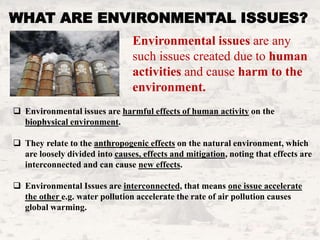
WHAT ARE ENVIRONMENTAL ISSUES?
Environmental issues are any
such issues created due to human
activities and cause harm to the
environment.
 Environmental issues are harmful effects of human activity on the
biophysical environment.
 They relate to the anthropogenic effects on the natural environment, which
are loosely divided into causes, effects and mitigation, noting that effects are
interconnected and can cause new effects.
 Environmental Issues are interconnected, that means one issue accelerate
the other e.g. water pollution accelerate the rate of air pollution causes
global warming.
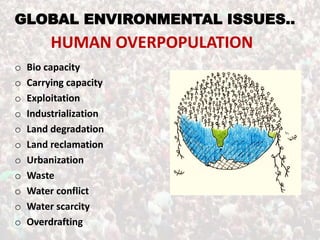
GLOBAL ENVIRONMENTAL ISSUES..
HUMAN OVERPOPULATION
o Bio capacity
o Carrying capacity
o Exploitation
o Industrialization
o Land degradation
o Land reclamation
o Urbanization
o Waste
o Water conflict
o Water scarcity
o Overdrafting
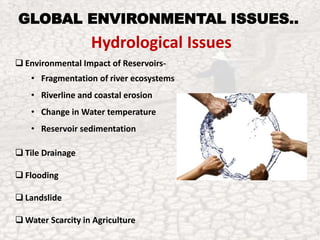
GLOBAL ENVIRONMENTAL ISSUES..
Hydrological Issues
 Environmental Impact of Reservoirs-
• Fragmentation of river ecosystems
• Riverline and coastal erosion
• Change in Water temperature
• Reservoir sedimentation
 Tile Drainage
 Flooding
 Landslide
 Water Scarcity in Agriculture
GLOBAL ENVIRONMENTAL ISSUES..
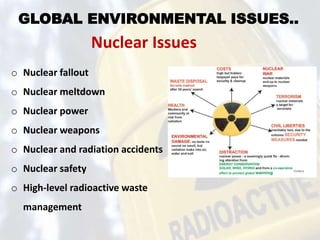
Nuclear Issues
o Nuclear fallout
o Nuclear meltdown
o Nuclear power
o Nuclear weapons
o Nuclear and radiation accidents
o Nuclear safety
o High-level radioactive waste
management
GLOBAL ENVIRONMENTAL ISSUES..
Land-Use Issues
Built environment
Desertification
Habitat fragmentation
Habitat destruction
Land degradation — Land pollution
Lawn-environmental concerns
Urban heat island
Urban sprawl
GLOBAL ENVIRONMENTAL ISSUES..
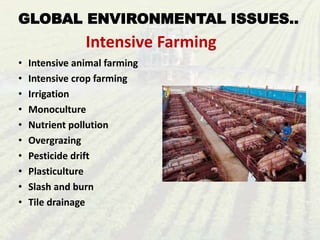
Intensive Farming
• Intensive animal farming
• Intensive crop farming
• Irrigation
• Monoculture
• Nutrient pollution
• Overgrazing
• Pesticide drift
• Plasticulture
• Slash and burn
• Tile drainage
GLOBAL ENVIRONMENTAL ISSUES..
Nanotechnology
Implication of Nanotechnology.
EFFECTS of GLOBAL ENVIRONMENTAL ISSUES..
 Global warming
 Global dimming
 Fossil fuels
 Sea level rise
 Greenhouse gas
 Ocean acidification
 Shutdown of thermohaline
circulation
 Environmental impact of the
coal industry
 Urban Heat Islands
 Flooding
Climate Change
EFFECTS of GLOBAL ENVIRONMENTAL ISSUES..
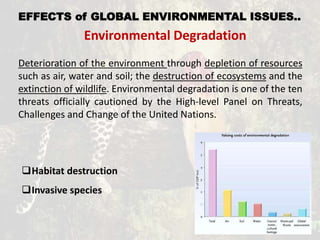
Environmental Degradation
Habitat destruction
Invasive species
Deterioration of the environment through depletion of resources
such as air, water and soil; the destruction of ecosystems and the
extinction of wildlife. Environmental degradation is one of the ten
threats officially cautioned by the High-level Panel on Threats,
Challenges and Change of the United Nations.
EFFECTS of GLOBAL ENVIRONMENTAL ISSUES..
Environmental Health
o Air quality
o Asthma
o Birth defect
o Developmental disability
o Endocrine disruptors
o Environmental impact of the coal industry
o Environmental impact of nanotechnology
o Electromagnetic radiation and health
o Lead poisoning
o Leukemia
o Nanotoxicology
o Nature deficit disorder
o One Health
o Sick Building Syndrome
o Environmental impact of hydraulic fracturing
EFFECTS of GLOBAL ENVIRONMENTAL ISSUES..
Pollution
• Air pollution
*Major Pollutants: Sulfur oxides (SOx), Nitrogen oxides (NOx), Carbon
monoxide (CO), Volatile organic compounds (VOC), Particulate Matter (PM), Toxic
metals such as Lead/Mercury, Chlorofluorocarbons (CFCs), Ammonia (NH3), Odours —
such as from garbage, sewage, and industrial processes, Radioactive pollutant, Ground
level ozone (O3) etc.
• Water Pollution
-Point Sources: Contaminants that enter a waterway from a single,
identifiable source, such as a pipe or ditch. Examples of sources in this category include
discharges from a sewage treatment plant, a factory, or a city storm drain.
-Non Point Sources: Refers to diffuse contamination that does not
originate from a single discrete source. A common example is the leaching out of
nitrogen compounds from fertilized agricultural lands. Nutrient runoff in storm water
from "sheet flow" over an agricultural field or a forest are also cited as examples of
NPS pollution.
• Soil pollution
Soil pollution can be caused by the following
*Accidental Spills *Acid rain (Which is caused by air pollution) *Intensive
farming *Deforestation*Genetically modified plants *Nuclear wastes
*Industrial Accidents *Landfill and illegal dumping *Land Erosion
*Agricultural practices, such as application of pesticides, herbicides and
fertilizers *Mining and other industries *Oil and fuel dumping *Buried
wastes *Disposal of coal ash *Disposal of ammunitions and agents of war
*Drainage of contaminated surface water into the soil *Electronic waste
• Noise pollution- Disturbing or excessive noise that may harm the activity
or balance of human or animal life.
• Light Pollution- Also known as photopollution or luminous pollution, is
excessive, misdirected, or obtrusive artificial light.
EFFECTS of GLOBAL ENVIRONMENTAL ISSUES..
Pollution
EFFECTS of GLOBAL ENVIRONMENTAL ISSUES..
Resource Depletion
Exploitation of natural resources, Overdrafting (groundwater),
Overexploitation
o Consumerism — Consumer capitalism • Planned obsolescence • Over-
consumption
o Fishing — Blast fishing • Bottom trawling • Cyanide fishing • Ghost nets •
Illegal, unreported and unregulated fishing • Overfishing • Shark finning •
Whaling
o Logging — Clearcutting • Deforestation • Illegal logging
o Mining — Acid mine drainage • Environmental impact of hydraulic fracturing
• Mountaintop removal mining • Slurry impoundments
o Water (depletion) — Anoxic waters • Aral Sea • California Water Wars • Dead
Sea • Lake Chad • Water scarcity
EFFECTS of GLOBAL ENVIRONMENTAL ISSUES..
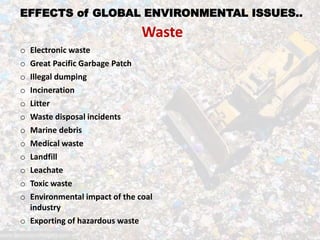
Waste
o Electronic waste
o Great Pacific Garbage Patch
o Illegal dumping
o Incineration
o Litter
o Waste disposal incidents
o Marine debris
o Medical waste
o Landfill
o Leachate
o Toxic waste
o Environmental impact of the coal
industry
o Exporting of hazardous waste
Measurement of Human impact on Environment
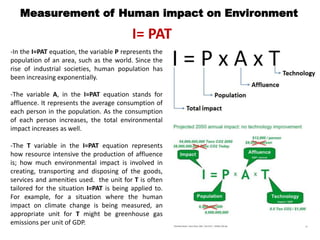
I= PAT
-In the I=PAT equation, the variable P represents the
population of an area, such as the world. Since the
rise of industrial societies, human population has
been increasing exponentially.
-The variable A, in the I=PAT equation stands for
affluence. It represents the average consumption of
each person in the population. As the consumption
of each person increases, the total environmental
impact increases as well.
-The T variable in the I=PAT equation represents
how resource intensive the production of affluence
is; how much environmental impact is involved in
creating, transporting and disposing of the goods,
services and amenities used. the unit for T is often
tailored for the situation I=PAT is being applied to.
For example, for a situation where the human
impact on climate change is being measured, an
appropriate unit for T might be greenhouse gas
emissions per unit of GDP.
GLOBAL ENVIRONMENTAL ISSUES
Mitigation
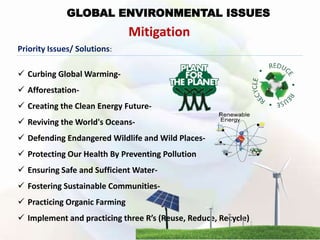
Priority Issues/ Solutions:
 Curbing Global Warming-
 Afforestation-
 Creating the Clean Energy Future-
 Reviving the World's Oceans-
 Defending Endangered Wildlife and Wild Places-
 Protecting Our Health By Preventing Pollution
 Ensuring Safe and Sufficient Water-
 Fostering Sustainable Communities-
 Practicing Organic Farming
 Implement and practicing three R’s (Reuse, Reduce, Recycle)
GLOBAL ENVIRONMENTAL ISSUES
Mitigation
WHO SHOULD COME FORWARD ?
Each and Everyone must come forward to mitigate with this burning issues
because our existence is now in our hand.
The implementation of the solutions in this document as well as those in the NEAP
Volume 1 is categorized by principal players thus:
a. Actions to be taken by people on their own;
b. Action to be taken by people with assistance from the Government or non
governmental agencies; and
c. Actions to taken by the Government alone.
GLOBAL ENVIRONMENTAL ISSUES
Mitigation Strategy
GLOBAL ENVIRONMENTAL ISSUES
Mitigation
Involvement of Media:
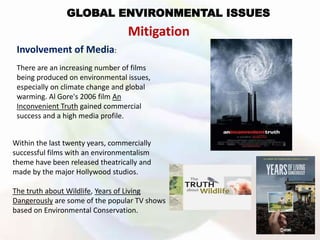
There are an increasing number of films
being produced on environmental issues,
especially on climate change and global
warming. Al Gore's 2006 film An
Inconvenient Truth gained commercial
success and a high media profile.
Within the last twenty years, commercially
successful films with an environmentalism
theme have been released theatrically and
made by the major Hollywood studios.
The truth about Wildlife, Years of Living
Dangerously are some of the popular TV shows
based on Environmental Conservation.
List of International Organization Working on
Environmental Issues:
• Earth System Governance Project (ESGP).
• Global Environment Facility (GEF).
• Intergovernmental Panel on Climate Change
(IPCC).
• International Union for Conservation of
Nature (IUCN).
• United Nations Environment Programme
(UNEP).
• World Nature Organization (WNO).
• Centre for Science and Environment (CSE).
etc.
GLOBAL ENVIRONMENTAL ISSUES
Mitigation
There are literally dozens of environmental organizations in the world, with most countries having at
least one government ministry or agency with a dedicated role to monitor and protect the environment.
In addition there are a large number of Private Organizations, sometimes known as Non-Government
Organizations (NGOs). A significant number of these have a worldwide coverage and although some of
them are relatively unknown outside a fairly specialized circle, several, such as Friends of the Earth and
Greenpeace have an international profile and reputation.
MAJOR ENVIRONMENTAL ISSUES OF BANGLADESH
 Climate Change- Increasing Temperature, Decreasing rainfall, Seasonal
instability.
 Biodiversity Loss- Extinction of many floral and faunal species. More and
more become endangered.
 Wetland Degradation- Degradation of rivers, lakes, ponds and many
important drainage.
 Air pollution- Increasing amount of harmful chemical compounds in the
atmosphere.
 Water pollution- Increasing amount of harmful chemicals, toxic wastes, non
degradable wastes changing the property of fresh water bodies.
 Soil Degradation- Increasing amount of Fertilizers & pesticides and excessive
agricultural practice damaging the soil stability.
 Noise pollution- Increasing amount of urbanized motor vehicle.
MAJOR ENVIRONMENTAL ISSUES OF BANGLADESH
Biodiversity Loss
Bangladesh has about 5000 species of flowering plants and 1500 species of fauna.
It was much more a century ago.
Flora:
-It is recorded 7095 (apx) species of different plant (MOef 2007).
-Total forest area less than 17%, day by day it is reduce due to increasing of population and
landlessness.
-According to latest account about 96 seed-bearing plant species are threatened.
-According to task force report 9 vascular plants are endangered and 27 are threatened
Fauna:
-According to IUCN Red Book 266 species of inland fishes, 442 species of marine fishes, 22
species of amphibians, 109 inland reptiles,17 marine reptiles, 388 resident birds, 240
migratory birds, 110 inland mammals and 3 species of marine mammals exist in Bangladesh.
-According to IUCN red list 54 species of sea fishes, 8 amphibians, 58 reptiles, 41 resident
birds and 40 mammals are threatened.
-Number of extinct fauna of Bangladesh is 17.
MAJOR ENVIRONMENTAL ISSUES OF BANGLADESH
Climate Change
Climate Change is the most fearing environmental issue in Bangladesh.
-Tropical monsoon climate (high temperature-high humidity, heavy rainfall). Mean
annual temperature of Bangladesh is 26oc. Average rainfall 1300 mm. to 4000 mm.
-Increasing trend of temperature.
-Decreasing trend of Monsoon.
-Recently, Seasons are not behaving regular.
-About 20 million people in the costal region of Bangladesh are affected by salinity
intrusion caused by sea level rise.
-40% of the productive land is projected to be loss in the southern region for 65cm sea
level rise within 2080.
-Desertification in the Northern Region.
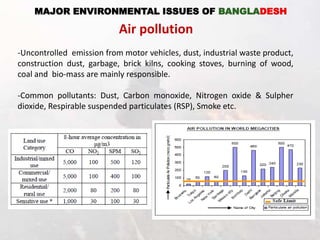
-Uncontrolled emission from motor vehicles, dust, industrial waste product,
construction dust, garbage, brick kilns, cooking stoves, burning of wood,
coal and bio-mass are mainly responsible.
-Common pollutants: Dust, Carbon monoxide, Nitrogen oxide & Sulpher
dioxide, Respirable suspended particulates (RSP), Smoke etc.
MAJOR ENVIRONMENTAL ISSUES OF BANGLADESH
Air pollution
-Bangladesh receives water: 74% from transboundary, 24% from rainfall & 2%
from groundwater.
-Source of pollution: Industrial effluent (textiles, tanneries, pulp and paper mill,
fertilizer), municipal waste, chemical fertilizer & pesticide, oil & lube spillage from
sea & river ports.
-Arsenic contamination in the groundwater (57 million people in Bangladesh
drink water containing arsenic). 9136 death per year due to arsenic related
diseases.
-Increasing salinity in the coastal regions during dry seasons.
-Water pollution by sector: Pulp & Paper Industry 47.4%, Pharmaceuticals 15.9%,
Metal Industry 14%, Food Industry 12.1%, Fertilizers & Pesticides 6.6%.
MAJOR ENVIRONMENTAL ISSUES OF BANGLADESH
Water and Soil pollution
-Water Pollution control Ordinance 1973 (promulgated in 1974).
-Bangladesh wild life (preservation) order 1973 (promulgated in 1974) & wild
life (preservation) Act 1973
-Environmental Protection Act (EPA) 1995.
-Environment Conservation Rules 1997.
-Environment Court Act 2000 (Amendment 2002)
-The Forest Act 1927 (amended in 1990, 2000)
-Bangladesh Bio-safety Rules 2010.
MAJOR ENVIRONMENTAL ISSUES OF BANGLADESH
Policy Adopted
THANK YOU

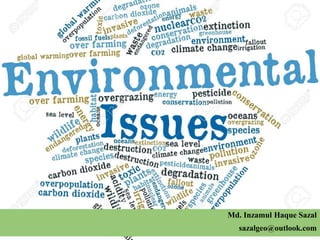
Global environmental issues

  • 1.
    Md. Inzamul HaqueSazal sazalgeo@outlook.com
  • 2.
    WHAT ARE ENVIRONMENTALISSUES? Environmental issues are any such issues created due to human activities and cause harm to the environment.  Environmental issues are harmful effects of human activity on the biophysical environment.  They relate to the anthropogenic effects on the natural environment, which are loosely divided into causes, effects and mitigation, noting that effects are interconnected and can cause new effects.  Environmental Issues are interconnected, that means one issue accelerate the other e.g. water pollution accelerate the rate of air pollution causes global warming.
  • 3.
    GLOBAL ENVIRONMENTAL ISSUES.. HUMANOVERPOPULATION o Bio capacity o Carrying capacity o Exploitation o Industrialization o Land degradation o Land reclamation o Urbanization o Waste o Water conflict o Water scarcity o Overdrafting
  • 4.
    GLOBAL ENVIRONMENTAL ISSUES.. HydrologicalIssues  Environmental Impact of Reservoirs- • Fragmentation of river ecosystems • Riverline and coastal erosion • Change in Water temperature • Reservoir sedimentation  Tile Drainage  Flooding  Landslide  Water Scarcity in Agriculture
  • 5.
    GLOBAL ENVIRONMENTAL ISSUES.. NuclearIssues o Nuclear fallout o Nuclear meltdown o Nuclear power o Nuclear weapons o Nuclear and radiation accidents o Nuclear safety o High-level radioactive waste management
  • 6.
    GLOBAL ENVIRONMENTAL ISSUES.. Land-UseIssues Built environment Desertification Habitat fragmentation Habitat destruction Land degradation — Land pollution Lawn-environmental concerns Urban heat island Urban sprawl
  • 7.
    GLOBAL ENVIRONMENTAL ISSUES.. IntensiveFarming • Intensive animal farming • Intensive crop farming • Irrigation • Monoculture • Nutrient pollution • Overgrazing • Pesticide drift • Plasticulture • Slash and burn • Tile drainage
  • 8.
  • 9.
    EFFECTS of GLOBALENVIRONMENTAL ISSUES..  Global warming  Global dimming  Fossil fuels  Sea level rise  Greenhouse gas  Ocean acidification  Shutdown of thermohaline circulation  Environmental impact of the coal industry  Urban Heat Islands  Flooding Climate Change
  • 10.
    EFFECTS of GLOBALENVIRONMENTAL ISSUES.. Environmental Degradation Habitat destruction Invasive species Deterioration of the environment through depletion of resources such as air, water and soil; the destruction of ecosystems and the extinction of wildlife. Environmental degradation is one of the ten threats officially cautioned by the High-level Panel on Threats, Challenges and Change of the United Nations.
  • 11.
    EFFECTS of GLOBALENVIRONMENTAL ISSUES.. Environmental Health o Air quality o Asthma o Birth defect o Developmental disability o Endocrine disruptors o Environmental impact of the coal industry o Environmental impact of nanotechnology o Electromagnetic radiation and health o Lead poisoning o Leukemia o Nanotoxicology o Nature deficit disorder o One Health o Sick Building Syndrome o Environmental impact of hydraulic fracturing
  • 12.
    EFFECTS of GLOBALENVIRONMENTAL ISSUES.. Pollution • Air pollution *Major Pollutants: Sulfur oxides (SOx), Nitrogen oxides (NOx), Carbon monoxide (CO), Volatile organic compounds (VOC), Particulate Matter (PM), Toxic metals such as Lead/Mercury, Chlorofluorocarbons (CFCs), Ammonia (NH3), Odours — such as from garbage, sewage, and industrial processes, Radioactive pollutant, Ground level ozone (O3) etc. • Water Pollution -Point Sources: Contaminants that enter a waterway from a single, identifiable source, such as a pipe or ditch. Examples of sources in this category include discharges from a sewage treatment plant, a factory, or a city storm drain. -Non Point Sources: Refers to diffuse contamination that does not originate from a single discrete source. A common example is the leaching out of nitrogen compounds from fertilized agricultural lands. Nutrient runoff in storm water from "sheet flow" over an agricultural field or a forest are also cited as examples of NPS pollution.
  • 13.
    • Soil pollution Soilpollution can be caused by the following *Accidental Spills *Acid rain (Which is caused by air pollution) *Intensive farming *Deforestation*Genetically modified plants *Nuclear wastes *Industrial Accidents *Landfill and illegal dumping *Land Erosion *Agricultural practices, such as application of pesticides, herbicides and fertilizers *Mining and other industries *Oil and fuel dumping *Buried wastes *Disposal of coal ash *Disposal of ammunitions and agents of war *Drainage of contaminated surface water into the soil *Electronic waste • Noise pollution- Disturbing or excessive noise that may harm the activity or balance of human or animal life. • Light Pollution- Also known as photopollution or luminous pollution, is excessive, misdirected, or obtrusive artificial light. EFFECTS of GLOBAL ENVIRONMENTAL ISSUES.. Pollution
  • 14.
    EFFECTS of GLOBALENVIRONMENTAL ISSUES.. Resource Depletion Exploitation of natural resources, Overdrafting (groundwater), Overexploitation o Consumerism — Consumer capitalism • Planned obsolescence • Over- consumption o Fishing — Blast fishing • Bottom trawling • Cyanide fishing • Ghost nets • Illegal, unreported and unregulated fishing • Overfishing • Shark finning • Whaling o Logging — Clearcutting • Deforestation • Illegal logging o Mining — Acid mine drainage • Environmental impact of hydraulic fracturing • Mountaintop removal mining • Slurry impoundments o Water (depletion) — Anoxic waters • Aral Sea • California Water Wars • Dead Sea • Lake Chad • Water scarcity
  • 15.
    EFFECTS of GLOBALENVIRONMENTAL ISSUES.. Waste o Electronic waste o Great Pacific Garbage Patch o Illegal dumping o Incineration o Litter o Waste disposal incidents o Marine debris o Medical waste o Landfill o Leachate o Toxic waste o Environmental impact of the coal industry o Exporting of hazardous waste
  • 16.
    Measurement of Humanimpact on Environment I= PAT -In the I=PAT equation, the variable P represents the population of an area, such as the world. Since the rise of industrial societies, human population has been increasing exponentially. -The variable A, in the I=PAT equation stands for affluence. It represents the average consumption of each person in the population. As the consumption of each person increases, the total environmental impact increases as well. -The T variable in the I=PAT equation represents how resource intensive the production of affluence is; how much environmental impact is involved in creating, transporting and disposing of the goods, services and amenities used. the unit for T is often tailored for the situation I=PAT is being applied to. For example, for a situation where the human impact on climate change is being measured, an appropriate unit for T might be greenhouse gas emissions per unit of GDP.
  • 17.
    GLOBAL ENVIRONMENTAL ISSUES Mitigation PriorityIssues/ Solutions:  Curbing Global Warming-  Afforestation-  Creating the Clean Energy Future-  Reviving the World's Oceans-  Defending Endangered Wildlife and Wild Places-  Protecting Our Health By Preventing Pollution  Ensuring Safe and Sufficient Water-  Fostering Sustainable Communities-  Practicing Organic Farming  Implement and practicing three R’s (Reuse, Reduce, Recycle)
  • 18.
    GLOBAL ENVIRONMENTAL ISSUES Mitigation WHOSHOULD COME FORWARD ? Each and Everyone must come forward to mitigate with this burning issues because our existence is now in our hand.
  • 19.
    The implementation ofthe solutions in this document as well as those in the NEAP Volume 1 is categorized by principal players thus: a. Actions to be taken by people on their own; b. Action to be taken by people with assistance from the Government or non governmental agencies; and c. Actions to taken by the Government alone. GLOBAL ENVIRONMENTAL ISSUES Mitigation Strategy
  • 20.
    GLOBAL ENVIRONMENTAL ISSUES Mitigation Involvementof Media: There are an increasing number of films being produced on environmental issues, especially on climate change and global warming. Al Gore's 2006 film An Inconvenient Truth gained commercial success and a high media profile. Within the last twenty years, commercially successful films with an environmentalism theme have been released theatrically and made by the major Hollywood studios. The truth about Wildlife, Years of Living Dangerously are some of the popular TV shows based on Environmental Conservation.
  • 21.
    List of InternationalOrganization Working on Environmental Issues: • Earth System Governance Project (ESGP). • Global Environment Facility (GEF). • Intergovernmental Panel on Climate Change (IPCC). • International Union for Conservation of Nature (IUCN). • United Nations Environment Programme (UNEP). • World Nature Organization (WNO). • Centre for Science and Environment (CSE). etc. GLOBAL ENVIRONMENTAL ISSUES Mitigation There are literally dozens of environmental organizations in the world, with most countries having at least one government ministry or agency with a dedicated role to monitor and protect the environment. In addition there are a large number of Private Organizations, sometimes known as Non-Government Organizations (NGOs). A significant number of these have a worldwide coverage and although some of them are relatively unknown outside a fairly specialized circle, several, such as Friends of the Earth and Greenpeace have an international profile and reputation.
  • 22.
    MAJOR ENVIRONMENTAL ISSUESOF BANGLADESH  Climate Change- Increasing Temperature, Decreasing rainfall, Seasonal instability.  Biodiversity Loss- Extinction of many floral and faunal species. More and more become endangered.  Wetland Degradation- Degradation of rivers, lakes, ponds and many important drainage.  Air pollution- Increasing amount of harmful chemical compounds in the atmosphere.  Water pollution- Increasing amount of harmful chemicals, toxic wastes, non degradable wastes changing the property of fresh water bodies.  Soil Degradation- Increasing amount of Fertilizers & pesticides and excessive agricultural practice damaging the soil stability.  Noise pollution- Increasing amount of urbanized motor vehicle.
  • 23.
    MAJOR ENVIRONMENTAL ISSUESOF BANGLADESH Biodiversity Loss Bangladesh has about 5000 species of flowering plants and 1500 species of fauna. It was much more a century ago. Flora: -It is recorded 7095 (apx) species of different plant (MOef 2007). -Total forest area less than 17%, day by day it is reduce due to increasing of population and landlessness. -According to latest account about 96 seed-bearing plant species are threatened. -According to task force report 9 vascular plants are endangered and 27 are threatened Fauna: -According to IUCN Red Book 266 species of inland fishes, 442 species of marine fishes, 22 species of amphibians, 109 inland reptiles,17 marine reptiles, 388 resident birds, 240 migratory birds, 110 inland mammals and 3 species of marine mammals exist in Bangladesh. -According to IUCN red list 54 species of sea fishes, 8 amphibians, 58 reptiles, 41 resident birds and 40 mammals are threatened. -Number of extinct fauna of Bangladesh is 17.
  • 24.
    MAJOR ENVIRONMENTAL ISSUESOF BANGLADESH Climate Change Climate Change is the most fearing environmental issue in Bangladesh. -Tropical monsoon climate (high temperature-high humidity, heavy rainfall). Mean annual temperature of Bangladesh is 26oc. Average rainfall 1300 mm. to 4000 mm. -Increasing trend of temperature. -Decreasing trend of Monsoon. -Recently, Seasons are not behaving regular. -About 20 million people in the costal region of Bangladesh are affected by salinity intrusion caused by sea level rise. -40% of the productive land is projected to be loss in the southern region for 65cm sea level rise within 2080. -Desertification in the Northern Region.
  • 25.
    -Uncontrolled emission frommotor vehicles, dust, industrial waste product, construction dust, garbage, brick kilns, cooking stoves, burning of wood, coal and bio-mass are mainly responsible. -Common pollutants: Dust, Carbon monoxide, Nitrogen oxide & Sulpher dioxide, Respirable suspended particulates (RSP), Smoke etc. MAJOR ENVIRONMENTAL ISSUES OF BANGLADESH Air pollution
  • 26.
    -Bangladesh receives water:74% from transboundary, 24% from rainfall & 2% from groundwater. -Source of pollution: Industrial effluent (textiles, tanneries, pulp and paper mill, fertilizer), municipal waste, chemical fertilizer & pesticide, oil & lube spillage from sea & river ports. -Arsenic contamination in the groundwater (57 million people in Bangladesh drink water containing arsenic). 9136 death per year due to arsenic related diseases. -Increasing salinity in the coastal regions during dry seasons. -Water pollution by sector: Pulp & Paper Industry 47.4%, Pharmaceuticals 15.9%, Metal Industry 14%, Food Industry 12.1%, Fertilizers & Pesticides 6.6%. MAJOR ENVIRONMENTAL ISSUES OF BANGLADESH Water and Soil pollution
  • 27.
    -Water Pollution controlOrdinance 1973 (promulgated in 1974). -Bangladesh wild life (preservation) order 1973 (promulgated in 1974) & wild life (preservation) Act 1973 -Environmental Protection Act (EPA) 1995. -Environment Conservation Rules 1997. -Environment Court Act 2000 (Amendment 2002) -The Forest Act 1927 (amended in 1990, 2000) -Bangladesh Bio-safety Rules 2010. MAJOR ENVIRONMENTAL ISSUES OF BANGLADESH Policy Adopted
  • 28.