STAYING Alive AND WELL

CHILD HEALTH AND DISASTER
RISK REDUCTION
Dr. Kathleen Skinner
Consultant SCF-UK
kathleenskinner@yahoo.com
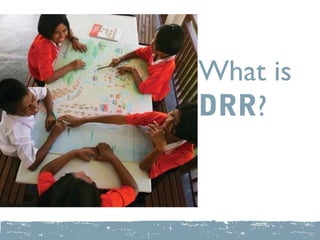
What is
DRR?
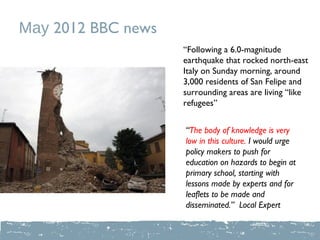
May 2012 BBC news
                    “Following a 6.0-magnitude
                    earthquake that rocked north-east
                    Italy on Sunday morning, around
                    3,000 residents of San Felipe and
                    surrounding areas are living “like
                    refugees”


                    “The body of knowledge is very
                    low in this culture. I would urge
                    policy makers to push for
                    education on hazards to begin at
                    primary school, starting with
                    lessons made by experts and for
                    leaflets to be made and
                    disseminated.” Local Expert
Disaster Risk Reduction

•   Is everyone’s responsibility across all sectors
•   Before, during and after disasters
•   Throughout the project cycle
•   Partnership working
•   Multisectoral coordination at all levels
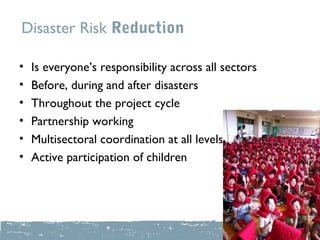
•   Active participation of children
Disaster Risk Reduction

• Saves Lives
• Minimises the impact of disasters
• Increases the resilience of the health system at all
  levels
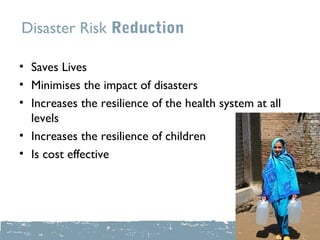
• Increases the resilience of children
• Is cost effective
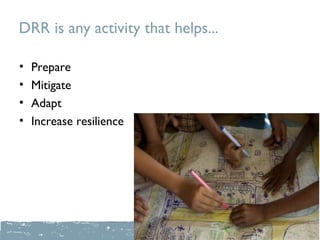
DRR is any activity that helps...

•   Prepare
•   Mitigate
•   Adapt
•   Increase resilience
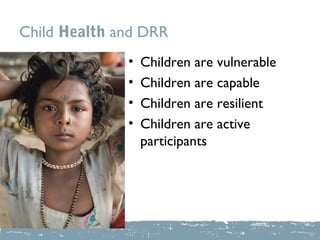
Child Health and DRR
              •   Children are vulnerable
              •   Children are capable
              •   Children are resilient
              •   Children are active
                  participants
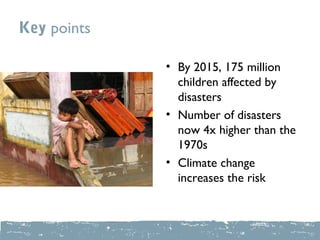
Key points

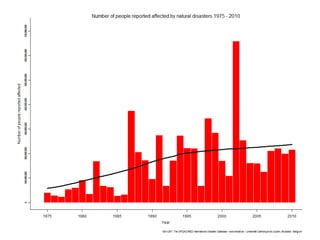
             • By 2015, 175 million
               children affected by
               disasters
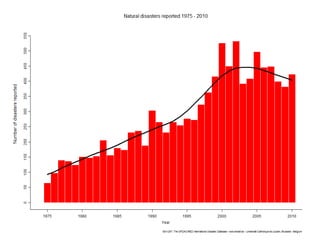
             • Number of disasters
               now 4x higher than the
               1970s
             • Climate change
               increases the risk
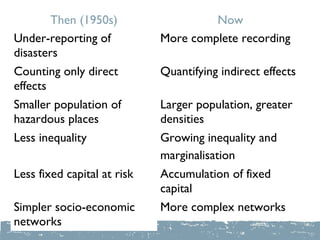
Then (1950s)                  Now
Under-reporting of           More complete recording
disasters
Counting only direct         Quantifying indirect effects
effects
Smaller population of        Larger population, greater
hazardous places             densities
Less inequality              Growing inequality and
                             marginalisation
Less fixed capital at risk   Accumulation of fixed
                             capital
Simpler socio-economic       More complex networks
networks
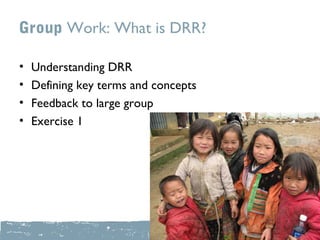
Group Work: What is DRR?

•   Understanding DRR
•   Defining key terms and concepts
•   Feedback to large group
•   Exercise 1
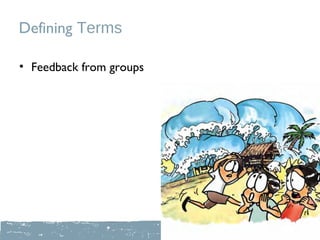
Defining Terms

• Feedback from groups
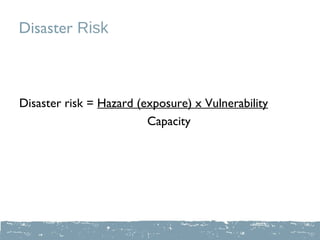
Disaster Risk


Disaster risk = Hazard (exposure) x Vulnerability
                         Capacity
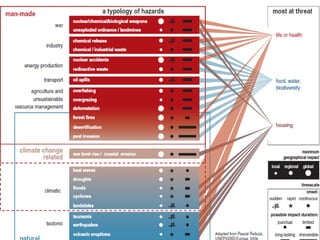
Types of Hazards

                                             terrorist
  Rapid
  onset

               earthquake                     attack
          volcano                   chemical      plane crash
                                      spill
                       flood

          cyclone              epidemic
                                               war
 onset
 Slow


             drought                         civil unrest
                                famine
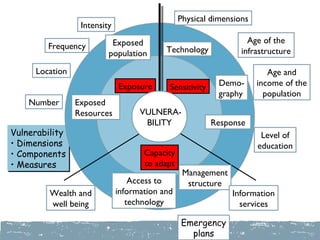
Vulnerability

...the potential to suffer harm or loss, related to the
    capacity to anticipate a hazard, cope with it, resist it
    and recover from its impact.
Physical dimensions
                 Intensity
                          Exposed                                 Age of the
        Frequency                         Technology
                         population                             infrastructure

     Location                                                           Age and
                             Exposure      Sensitivity    Demo-      income of the
                                                          graphy       population
    Number      Exposed
                Resources          VULNERA-
                                    BILITY               Response
Vulnerability
Vulnerability                                                         Level of
• Dimensions
• Dimensions                                                         education
• Components
• Components                        Capacity
• Measures
• Measures                          to adapt
                                                Management
                                 Access to       structure
         Wealth and          information and                  Information
         well being             technology                      services

                                               Emergency
                                                 plans
Capacity

the ability to anticipate, cope with, resist and recover
  from hazard impacts
the combination of all the strengths, attributes and
  resources that an individual, community or society
  has available
Resilience

Resilience is the capacity of a system, community or
  society potentially exposed to hazards to adapt, by
  resisting or changing in order to reach and maintain
  an acceptable level of functioning and structure.
  (ISDR, 2004).
Disaster

the occurrence of an extreme hazard event that
  impacts on vulnerable communities, causing
  substantial damage, disruption and possible
  casualties, and leaving the affected communities
  unable to function normally without outside
  assistance.
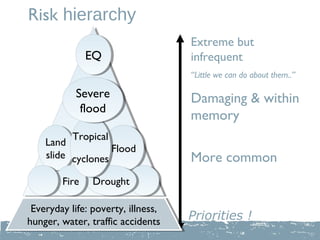
Risk hierarchy
                                    Extreme but
               EQ
               EQ                   infrequent
                                    “Little we can do about them..”

           Severe
           Severe                   Damaging & within
            flood
             flood
                                    memory
           Tropical
    Land Tropical
    Land
                    Flood
                     Flood
    slide cyclones
     slide cyclones                 More common
        Fire
        Fire   Drought
               Drought

 Everyday life: poverty, illness,
 Everyday life: poverty, illness,
hunger, water, traffic accidents
                                    Priorities !
Disasters: a development concern

                          DEVELOPMENT REALM

                   Development        Development
NEGATIVE REALM


                                                      POSITIVE REALM
                   can increase        can reduce
                   vulnerability      vulnerability

                                      Disasters can
                      Disasters
                                         provide
                    can set back
                                      development
                    development
                                      opportunities

                           DISASTER REALM
                                                      28
Risk Reduction - examples

•   Physical measures
•   Socio-economic measures
•   Environmental measures
•   Management and institutional
•   Post-disaster measures
Examples of DRR activities

•   Early Warning systems
•   Identifying potential hazards
•   Building regulations for schools and hospitals
•   Effective health systems
•   Legislation, policies, strategies and programmes…
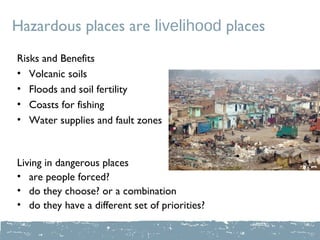
Hazardous places are livelihood places
Risks and Benefits
• Volcanic soils
• Floods and soil fertility
• Coasts for fishing
• Water supplies and fault zones


Living in dangerous places
• are people forced?
• do they choose? or a combination
• do they have a different set of priorities?
Disaster Risk


Disaster risk = Hazard (exposure) x Vulnerability
                         Capacity