Assignment on “Vulnerability Assessment”
Submitted by
Md. Asif Hasan
Roll: SH-037
Department of Geology
University of Dhaka
Vulnerability Assessment
Vulnerability: Vulnerability is a concept which describes factors or constraints of an economic, social,
physical or geographic nature, which reduce the ability to prepare for and cope with the impact of hazards. It
represents the degree to which a person, system or unit is likely to experience harm due to exposure to
perturbations or stresses.
Categories of Vulnerabilities-
• Hazard-specific: a characteristic which makes the element concerned susceptible to the force/s or
impact of a hazard. The geo-physical and locational attributes of the element/s concerned are
considered in this category. Based on the present-knowledge of the distribution and frequency of
hazards, a community or country may be threatened by specific hazards.
• Setting-specific: this is concerned with the prevailing socio-economic arrangement of the area
concerned as to whether it is predominantly rural or urban. There are inherent setting characteristics
that may be common to both as well as exclusive to each which contribute to the general susceptibility
of the area.
Characteristics of Vulnerabilities-
✓ Concentrations and Crowdedness - the three aspects are crowdedness and disease; crowdedness and
buildings; crowdedness and resource base.
✓ Numbers of Peoples and Activities - the two aspect of this condition are Technologies and the
Management System.
✓ Proximity to Man-made Hazards - the aspects considered are Technological hazards, Economic
hazards, and Social Hazards
Table: Types of Vulnerability with their characteristics
Types of Vulnerability Characteristics
Tangible/Material
(easy to see; value easily determined)
People – lives, health, security, living conditions
Property – services, physical property loss, loss of
use
Economy – loss of products and production,
income
Environment – water, soil, air, vegetation, wildlife
Intangible/Abstract
(difficult to see; value difficult to determine)
Social structures – family and community
relationships
Cultural practices – religious and agricultural
Cohesion – disruption of normal life
Motivation – will to recover; government response
Factors Contributing to Vulnerability-
➢ Interdependency of Lifelines – Major lifelines of the urban area are dependent on each other to
function effectively. This interdependency is a factor that may contribute to the area’s vulnerability.
➢ Social and Organizational Dimension– The existing arrangement of a society regarding relationships
of individuals, groups and institutions may create adverse situations that weakens these elements’
capabilities to face or withstand hazards and contribute instead to the intensifying of the effects.
➢ Attitudinal and Motivational Dimension– The prevalent worldview of the society or certain groups
within society may contribute to a passive or non-active stance regarding the disasters that beset the
area.
Concepts of Vulnerability:
Source: Kasperson, et al.
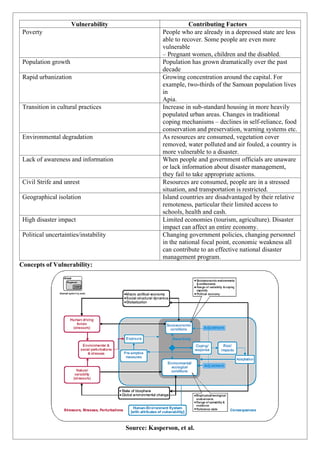
Vulnerability Contributing Factors
Poverty People who are already in a depressed state are less
able to recover. Some people are even more
vulnerable
– Pregnant women, children and the disabled.
Population growth Population has grown dramatically over the past
decade
Rapid urbanization Growing concentration around the capital. For
example, two-thirds of the Samoan population lives
in
Apia.
Transition in cultural practices Increase in sub-standard housing in more heavily
populated urban areas. Changes in traditional
coping mechanisms – declines in self-reliance, food
conservation and preservation, warning systems etc.
Environmental degradation As resources are consumed, vegetation cover
removed, water polluted and air fouled, a country is
more vulnerable to a disaster.
Lack of awareness and information When people and government officials are unaware
or lack information about disaster management,
they fail to take appropriate actions.
Civil Strife and unrest Resources are consumed, people are in a stressed
situation, and transportation is restricted.
Geographical isolation Island countries are disadvantaged by their relative
remoteness, particular their limited access to
schools, health and cash.
High disaster impact Limited economies (tourism, agriculture). Disaster
impact can affect an entire economy.
Political uncertainties/instability Changing government policies, changing personnel
in the national focal point, economic weakness all
can contribute to an effective national disaster
management program.
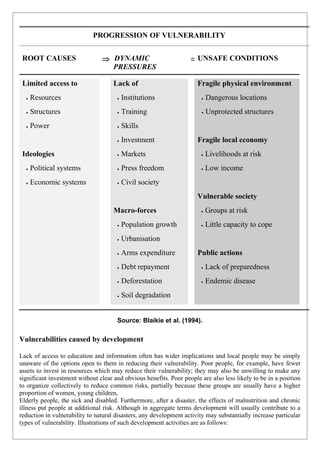
PROGRESSION OF VULNERABILITY
ROOT CAUSES  DYNAMIC
PRESSURES
UNSAFE CONDITIONS
Limited access to Lack of Fragile physical environment
• Resources • Institutions • Dangerous locations
• Structures • Training • Unprotected structures
• Power • Skills
• Investment Fragile local economy
Ideologies • Markets • Livelihoods at risk
• Political systems • Press freedom • Low income
• Economic systems • Civil society
Vulnerable society
Macro-forces • Groups at risk
• Population growth • Little capacity to cope
• Urbanisation
• Arms expenditure Public actions
• Debt repayment • Lack of preparedness
• Deforestation • Endemic disease
• Soil degradation
Source: Blaikie et al. (1994).
Vulnerabilities caused by development
Lack of access to education and information often has wider implications and local people may be simply
unaware of the options open to them in reducing their vulnerability. Poor people, for example, have fewer
assets to invest in resources which may reduce their vulnerability; they may also be unwilling to make any
significant investment without clear and obvious benefits. Poor people are also less likely to be in a position
to organize collectively to reduce common risks, partially because these groups are usually have a higher
proportion of women, young children,
Elderly people, the sick and disabled. Furthermore, after a disaster, the effects of malnutrition and chronic
illness put people at additional risk. Although in aggregate terms development will usually contribute to a
reduction in vulnerability to natural disasters, any development activity may substantially increase particular
types of vulnerability. Illustrations of such development activities are as follows:
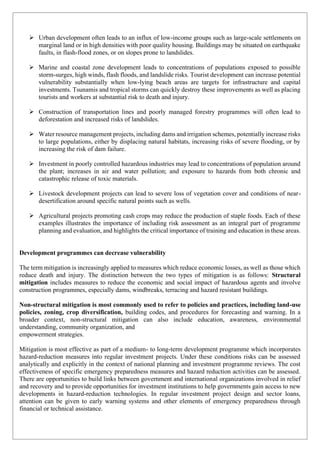
➢ Urban development often leads to an influx of low-income groups such as large-scale settlements on
marginal land or in high densities with poor quality housing. Buildings may be situated on earthquake
faults, in flash-flood zones, or on slopes prone to landslides.
➢ Marine and coastal zone development leads to concentrations of populations exposed to possible
storm-surges, high winds, flash floods, and landslide risks. Tourist development can increase potential
vulnerability substantially when low-lying beach areas are targets for infrastructure and capital
investments. Tsunamis and tropical storms can quickly destroy these improvements as well as placing
tourists and workers at substantial risk to death and injury.
➢ Construction of transportation lines and poorly managed forestry programmes will often lead to
deforestation and increased risks of landslides.
➢ Water resource management projects, including dams and irrigation schemes, potentially increase risks
to large populations, either by displacing natural habitats, increasing risks of severe flooding, or by
increasing the risk of dam failure.
➢ Investment in poorly controlled hazardous industries may lead to concentrations of population around
the plant; increases in air and water pollution; and exposure to hazards from both chronic and
catastrophic release of toxic materials.
➢ Livestock development projects can lead to severe loss of vegetation cover and conditions of near-
desertification around specific natural points such as wells.
➢ Agricultural projects promoting cash crops may reduce the production of staple foods. Each of these
examples illustrates the importance of including risk assessment as an integral part of programme
planning and evaluation, and highlights the critical importance of training and education in these areas.
Development programmes can decrease vulnerability
The term mitigation is increasingly applied to measures which reduce economic losses, as well as those which
reduce death and injury. The distinction between the two types of mitigation is as follows: Structural
mitigation includes measures to reduce the economic and social impact of hazardous agents and involve
construction programmes, especially dams, windbreaks, terracing and hazard resistant buildings.
Non-structural mitigation is most commonly used to refer to policies and practices, including land-use
policies, zoning, crop diversification, building codes, and procedures for forecasting and warning. In a
broader context, non-structural mitigation can also include education, awareness, environmental
understanding, community organization, and
empowerment strategies.
Mitigation is most effective as part of a medium- to long-term development programme which incorporates
hazard-reduction measures into regular investment projects. Under these conditions risks can be assessed
analytically and explicitly in the context of national planning and investment programme reviews. The cost
effectiveness of specific emergency preparedness measures and hazard reduction activities can be assessed.
There are opportunities to build links between government and international organizations involved in relief
and recovery and to provide opportunities for investment institutions to help governments gain access to new
developments in hazard-reduction technologies. In regular investment project design and sector loans,
attention can be given to early warning systems and other elements of emergency preparedness through
financial or technical assistance.
Using development programmes to decrease vulnerability should increasingly be incorporated into every level
of programme and project preparation and review within UNDP country programming as well as other
financial and technical assistance projects. Structured review procedures should require that the disaster
implications of new projects be explicitly taken into consideration.
There is a wide range of options for incorporating mitigation measures into regular development programmes.
Each of the following examples suggests ways of protecting populations and critical economic assets against
hazards and of reducing the overall impact of a disaster.
➢ Strengthening urban utility systems and industrial support infrastructures is a common aim of
development projects. This is achieved through a variety of external inputs including loans, technical
assistance, and support for institutional development. “Lifeline systems” – such as water, electric
power, transportation links and communications – can be made more effective as well as more
selectively resistant to particular hazards.
➢ Many other opportunities exist to incorporate hazard resistant building techniques in housing
and other construction programmes. These opportunities are usually specific to the type of
housing used in the region and the nature of local hazards. Such measures can substantially reduce
injuries and deaths from earthquakes and tropical storms. Additionally, these programmes can
protect high value economic resources, reducing the total costs of damage and improving the chances
of more rapid recovery. On a wider scale, the application of building codes, associated training
programmes, and more extensive use of zoning regulations in urban development reduce the risk for
the local population, and the likelihood of damage to industrial facilities. Improved drainage systems
and flood protection measures can further protect people and facilities in hazardous areas.
➢ Investments in improving administration and strengthening the resource-base of public
institutions will have a general positive impact on the effectiveness of preparedness
arrangements, emergency responses and the quality of longer-term recovery planning. Training
programmes in general, and especially those with a management or technical focus, can be expected
to improve the implementation of mitigation and response measures.
➢ Agricultural and forestry programmes provide a range of opportunities for mitigation.
Reforestation programmes reduce risks of erosion, landslides and flash flooding. Changes in
cropping patterns can also ameliorate erosion problems and losses due to floods and drought. The
introduction of pest-resistant crops can reduce the economic and other impacts of infestations.
Programmes for soil conservation, water harvesting and improving on-farm storage can mitigate the
effects of drought.
According to USAID:
✓ The operation must be directed at restoring assets or productivity in a long-term development
perspective - not relief.
✓ The prospective economic returns should be high.
✓ The effects of the emergency should be significant.
✓ The event triggering the emergency should have a low probability of happening again soon.
✓ The need for an urgent response should be evident. Emergency lending is limited to cases where
effective action can be felt in two to three years.
✓ There should be some prospect for future reduction in the hazard.

Vulnerability assessment

  • 1.
    Assignment on “VulnerabilityAssessment” Submitted by Md. Asif Hasan Roll: SH-037 Department of Geology University of Dhaka
  • 2.
    Vulnerability Assessment Vulnerability: Vulnerabilityis a concept which describes factors or constraints of an economic, social, physical or geographic nature, which reduce the ability to prepare for and cope with the impact of hazards. It represents the degree to which a person, system or unit is likely to experience harm due to exposure to perturbations or stresses. Categories of Vulnerabilities- • Hazard-specific: a characteristic which makes the element concerned susceptible to the force/s or impact of a hazard. The geo-physical and locational attributes of the element/s concerned are considered in this category. Based on the present-knowledge of the distribution and frequency of hazards, a community or country may be threatened by specific hazards. • Setting-specific: this is concerned with the prevailing socio-economic arrangement of the area concerned as to whether it is predominantly rural or urban. There are inherent setting characteristics that may be common to both as well as exclusive to each which contribute to the general susceptibility of the area. Characteristics of Vulnerabilities- ✓ Concentrations and Crowdedness - the three aspects are crowdedness and disease; crowdedness and buildings; crowdedness and resource base. ✓ Numbers of Peoples and Activities - the two aspect of this condition are Technologies and the Management System. ✓ Proximity to Man-made Hazards - the aspects considered are Technological hazards, Economic hazards, and Social Hazards Table: Types of Vulnerability with their characteristics Types of Vulnerability Characteristics Tangible/Material (easy to see; value easily determined) People – lives, health, security, living conditions Property – services, physical property loss, loss of use Economy – loss of products and production, income Environment – water, soil, air, vegetation, wildlife Intangible/Abstract (difficult to see; value difficult to determine) Social structures – family and community relationships Cultural practices – religious and agricultural Cohesion – disruption of normal life Motivation – will to recover; government response Factors Contributing to Vulnerability- ➢ Interdependency of Lifelines – Major lifelines of the urban area are dependent on each other to function effectively. This interdependency is a factor that may contribute to the area’s vulnerability. ➢ Social and Organizational Dimension– The existing arrangement of a society regarding relationships of individuals, groups and institutions may create adverse situations that weakens these elements’ capabilities to face or withstand hazards and contribute instead to the intensifying of the effects. ➢ Attitudinal and Motivational Dimension– The prevalent worldview of the society or certain groups within society may contribute to a passive or non-active stance regarding the disasters that beset the area.
  • 3.
    Concepts of Vulnerability: Source:Kasperson, et al. Vulnerability Contributing Factors Poverty People who are already in a depressed state are less able to recover. Some people are even more vulnerable – Pregnant women, children and the disabled. Population growth Population has grown dramatically over the past decade Rapid urbanization Growing concentration around the capital. For example, two-thirds of the Samoan population lives in Apia. Transition in cultural practices Increase in sub-standard housing in more heavily populated urban areas. Changes in traditional coping mechanisms – declines in self-reliance, food conservation and preservation, warning systems etc. Environmental degradation As resources are consumed, vegetation cover removed, water polluted and air fouled, a country is more vulnerable to a disaster. Lack of awareness and information When people and government officials are unaware or lack information about disaster management, they fail to take appropriate actions. Civil Strife and unrest Resources are consumed, people are in a stressed situation, and transportation is restricted. Geographical isolation Island countries are disadvantaged by their relative remoteness, particular their limited access to schools, health and cash. High disaster impact Limited economies (tourism, agriculture). Disaster impact can affect an entire economy. Political uncertainties/instability Changing government policies, changing personnel in the national focal point, economic weakness all can contribute to an effective national disaster management program.
  • 4.
    PROGRESSION OF VULNERABILITY ROOTCAUSES  DYNAMIC PRESSURES UNSAFE CONDITIONS Limited access to Lack of Fragile physical environment • Resources • Institutions • Dangerous locations • Structures • Training • Unprotected structures • Power • Skills • Investment Fragile local economy Ideologies • Markets • Livelihoods at risk • Political systems • Press freedom • Low income • Economic systems • Civil society Vulnerable society Macro-forces • Groups at risk • Population growth • Little capacity to cope • Urbanisation • Arms expenditure Public actions • Debt repayment • Lack of preparedness • Deforestation • Endemic disease • Soil degradation Source: Blaikie et al. (1994). Vulnerabilities caused by development Lack of access to education and information often has wider implications and local people may be simply unaware of the options open to them in reducing their vulnerability. Poor people, for example, have fewer assets to invest in resources which may reduce their vulnerability; they may also be unwilling to make any significant investment without clear and obvious benefits. Poor people are also less likely to be in a position to organize collectively to reduce common risks, partially because these groups are usually have a higher proportion of women, young children, Elderly people, the sick and disabled. Furthermore, after a disaster, the effects of malnutrition and chronic illness put people at additional risk. Although in aggregate terms development will usually contribute to a reduction in vulnerability to natural disasters, any development activity may substantially increase particular types of vulnerability. Illustrations of such development activities are as follows:
  • 5.
    ➢ Urban developmentoften leads to an influx of low-income groups such as large-scale settlements on marginal land or in high densities with poor quality housing. Buildings may be situated on earthquake faults, in flash-flood zones, or on slopes prone to landslides. ➢ Marine and coastal zone development leads to concentrations of populations exposed to possible storm-surges, high winds, flash floods, and landslide risks. Tourist development can increase potential vulnerability substantially when low-lying beach areas are targets for infrastructure and capital investments. Tsunamis and tropical storms can quickly destroy these improvements as well as placing tourists and workers at substantial risk to death and injury. ➢ Construction of transportation lines and poorly managed forestry programmes will often lead to deforestation and increased risks of landslides. ➢ Water resource management projects, including dams and irrigation schemes, potentially increase risks to large populations, either by displacing natural habitats, increasing risks of severe flooding, or by increasing the risk of dam failure. ➢ Investment in poorly controlled hazardous industries may lead to concentrations of population around the plant; increases in air and water pollution; and exposure to hazards from both chronic and catastrophic release of toxic materials. ➢ Livestock development projects can lead to severe loss of vegetation cover and conditions of near- desertification around specific natural points such as wells. ➢ Agricultural projects promoting cash crops may reduce the production of staple foods. Each of these examples illustrates the importance of including risk assessment as an integral part of programme planning and evaluation, and highlights the critical importance of training and education in these areas. Development programmes can decrease vulnerability The term mitigation is increasingly applied to measures which reduce economic losses, as well as those which reduce death and injury. The distinction between the two types of mitigation is as follows: Structural mitigation includes measures to reduce the economic and social impact of hazardous agents and involve construction programmes, especially dams, windbreaks, terracing and hazard resistant buildings. Non-structural mitigation is most commonly used to refer to policies and practices, including land-use policies, zoning, crop diversification, building codes, and procedures for forecasting and warning. In a broader context, non-structural mitigation can also include education, awareness, environmental understanding, community organization, and empowerment strategies. Mitigation is most effective as part of a medium- to long-term development programme which incorporates hazard-reduction measures into regular investment projects. Under these conditions risks can be assessed analytically and explicitly in the context of national planning and investment programme reviews. The cost effectiveness of specific emergency preparedness measures and hazard reduction activities can be assessed. There are opportunities to build links between government and international organizations involved in relief and recovery and to provide opportunities for investment institutions to help governments gain access to new developments in hazard-reduction technologies. In regular investment project design and sector loans, attention can be given to early warning systems and other elements of emergency preparedness through financial or technical assistance.
  • 6.
    Using development programmesto decrease vulnerability should increasingly be incorporated into every level of programme and project preparation and review within UNDP country programming as well as other financial and technical assistance projects. Structured review procedures should require that the disaster implications of new projects be explicitly taken into consideration. There is a wide range of options for incorporating mitigation measures into regular development programmes. Each of the following examples suggests ways of protecting populations and critical economic assets against hazards and of reducing the overall impact of a disaster. ➢ Strengthening urban utility systems and industrial support infrastructures is a common aim of development projects. This is achieved through a variety of external inputs including loans, technical assistance, and support for institutional development. “Lifeline systems” – such as water, electric power, transportation links and communications – can be made more effective as well as more selectively resistant to particular hazards. ➢ Many other opportunities exist to incorporate hazard resistant building techniques in housing and other construction programmes. These opportunities are usually specific to the type of housing used in the region and the nature of local hazards. Such measures can substantially reduce injuries and deaths from earthquakes and tropical storms. Additionally, these programmes can protect high value economic resources, reducing the total costs of damage and improving the chances of more rapid recovery. On a wider scale, the application of building codes, associated training programmes, and more extensive use of zoning regulations in urban development reduce the risk for the local population, and the likelihood of damage to industrial facilities. Improved drainage systems and flood protection measures can further protect people and facilities in hazardous areas. ➢ Investments in improving administration and strengthening the resource-base of public institutions will have a general positive impact on the effectiveness of preparedness arrangements, emergency responses and the quality of longer-term recovery planning. Training programmes in general, and especially those with a management or technical focus, can be expected to improve the implementation of mitigation and response measures. ➢ Agricultural and forestry programmes provide a range of opportunities for mitigation. Reforestation programmes reduce risks of erosion, landslides and flash flooding. Changes in cropping patterns can also ameliorate erosion problems and losses due to floods and drought. The introduction of pest-resistant crops can reduce the economic and other impacts of infestations. Programmes for soil conservation, water harvesting and improving on-farm storage can mitigate the effects of drought. According to USAID: ✓ The operation must be directed at restoring assets or productivity in a long-term development perspective - not relief. ✓ The prospective economic returns should be high. ✓ The effects of the emergency should be significant. ✓ The event triggering the emergency should have a low probability of happening again soon. ✓ The need for an urgent response should be evident. Emergency lending is limited to cases where effective action can be felt in two to three years. ✓ There should be some prospect for future reduction in the hazard.