Download to read offline

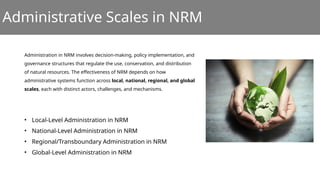
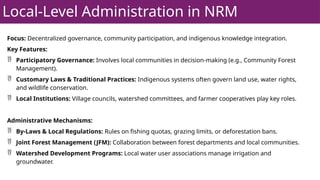
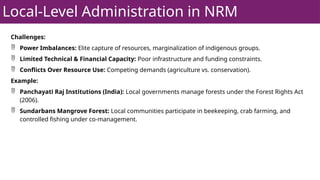
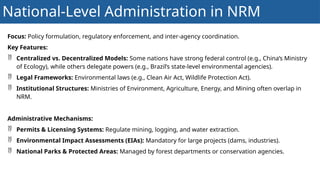
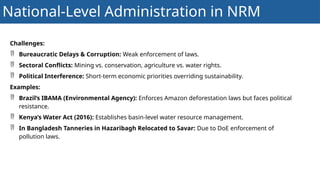
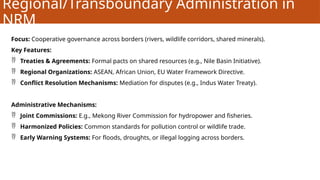
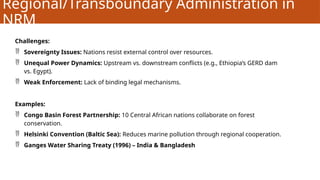
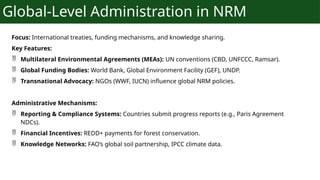
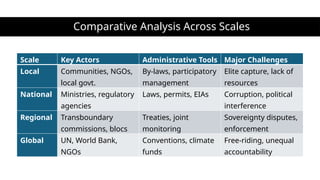
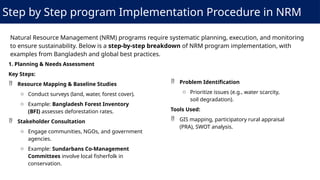
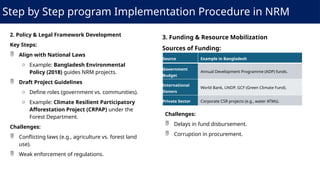
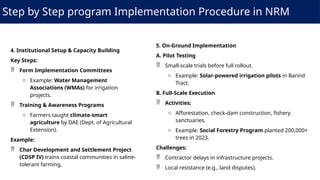
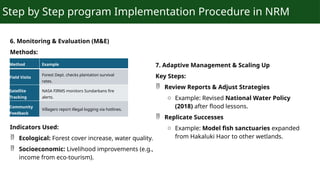
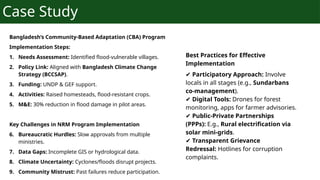


This presentation explores the administrative frameworks and implementation strategies for managing natural resources across different scales—local, national, regional, and global. Key Themes: Administrative Scales in NRM: Local: Community participation, customary laws, and decentralized governance (e.g., Joint Forest Management in India). National: Policy formulation, legal frameworks (e.g., Brazil’s IBAMA, Bangladesh’s Environmental Policy), and inter-agency coordination. Regional/Transboundary: Cooperative governance for shared resources (e.g., Mekong River Commission, Ganges Treaty). Global: International agreements (e.g., UNFCCC, REDD+) and funding mechanisms (e.g., World Bank, UNDP). Challenges: Power imbalances, bureaucratic delays, climate uncertainty, and conflicts over resource use (e.g., upstream-downstream disputes). Program Implementation Steps: Planning (stakeholder consultation, GIS mapping). Policy alignment (e.g., Bangladesh Climate Change Strategy). Funding, capacity building, on-ground execution (e.g., afforestation, check dams). Monitoring (ecological/socioeconomic indicators) and adaptive management. Case Studies & Best Practices: Bangladesh’s Community-Based Adaptation Program (flood resilience). Participatory approaches (Sundarbans co-management) and digital tools (drones, apps).


