Disaster Risk Management
What is Risk
?
The probability that a
community’s structure or
geographic area is to be
damaged or disrupted by
the impact of a particular
hazard/disaster.
RISKRISK
Centre for Disaster Preparedness and Management, University of Peshawar
RISK
Probability or likelihood of something happening in the future which has
a negative consequence
Risk= Probability (P) x Loss (L)
RISKS are the anticipated consequences (e.g. losses or damage) that can
be predicted to result from a particular hazard affecting a particular place at a
particular time
Disaster Risk
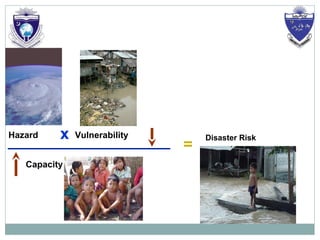
Disaster Risk is the likelihood of harmful consequences or losses (death,
injuries, destroyed property, disrupted economic activities or damaged
environment) resulting from interaction between a hazard and
vulnerable conditions.
Disaster Risk = Hazard x Vulnerability
Capacity
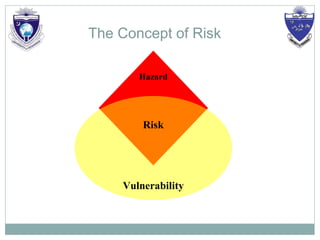
Hazard
The Concept of Risk
Risk
Vulnerability
Hazard Vulnerabilityx Disaster Risk
Capacity
=
Understanding of Disaster Risk
Management
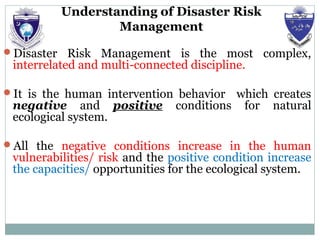
Disaster Risk Management is the most complex,
interrelated and multi-connected discipline.
It is the human intervention behavior which creates
negative and positive conditions for natural
ecological system.
All the negative conditions increase in the human
vulnerabilities/ risk and the positive condition increase
the capacities/ opportunities for the ecological system.
Centre for Disaster Preparedness and Management, University of Peshawar
Disaster Risk Management
DRM is about identifying & analysing risks, &
deciding what to do about them.
DRM is a problem-solving & decision-making
process, which will assist us in selecting the
most effective actions.
Centre for Disaster Preparedness and Management, University of Peshawar
Risk Management ...
 RISK MANAGEMENT is a comprehensive strategy for
reducing threats and consequences to public health and
safety by:
 preventing exposure to hazards (target = hazards)
 reducing vulnerabilities (target group = community)
 Developing capacities (target group = response agencies)
Centre for Disaster Preparedness and Management, University of Peshawar
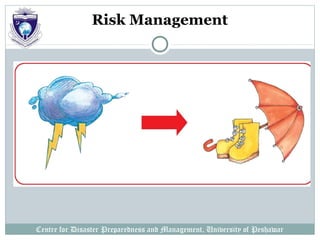
Risk Management
Centre for Disaster Preparedness and Management, University of Peshawar
Child at home alone
Why DRM?
 The world is facing a large scale of disasters.
 Nearly 25% of the world’s landmass and
most of its population is at risk.
 Disasters’ impacts are exacerbated by a
series of dynamic processes, including
population growth, increasing levels of
vulnerability, poor planning, climate change etc.
Centre for Disaster Preparedness and Management, University of Peshawar
One view of risk
 fatalities
 injuries
 disease (mental and physical)
 secondary hazards (fire, disease etc.)
 contamination of the environment
 displacement
 breakdown in security
 damage to infrastructure
 breakdown in essential services
 loss of property
 loss of income
Centre for Disaster Preparedness and Management, University of Peshawar
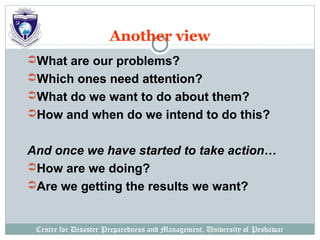
Another view
What are our problems?
Which ones need attention?
What do we want to do about them?
How and when do we intend to do this?
And once we have started to take action…
How are we doing?
Are we getting the results we want?
Centre for Disaster Preparedness and Management, University of Peshawar
A risk management process is to:
Identify risks
Analyse and prioritise risks
Identify risk management strategies
Implement strategies
Monitor, evaluate and adjust as necessary
Centre for Disaster Preparedness and Management, University of Peshawar
Diagrammatic Overview
of the Process
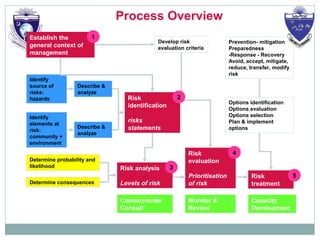
Establish the
general context of
management
Risk
identification
risks
statements
Risk analysis
Levels of risk
Risk
evaluation
Prioritisation
of risk
Risk
treatment
Identify
source of
risks:
hazards
Identify
elements at
risk:
community +
environment
Describe &
analyze
Describe &
analyze
Determine probability and
likelihood
Determine consequences
Develop risk
evaluation criteria
Prevention- mitigation
Preparedness
-Response - Recovery
Avoid, accept, mitigate,
reduce, transfer, modify
risk
Options identification
Options evaluation
Options selection
Plan & implement
options
Communicate
Consult
Monitor &
Review
Capacity
Development
1
2
3
4
5
Process Overview
Centre for Disaster Preparedness and Management, University of Peshawar
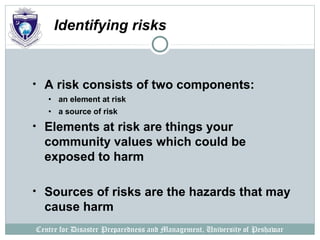
Identifying risks
• A risk consists of two components:
• an element at risk
• a source of risk
• Elements at risk are things your
community values which could be
exposed to harm
• Sources of risks are the hazards that may
cause harm
Centre for Disaster Preparedness and Management, University of Peshawar
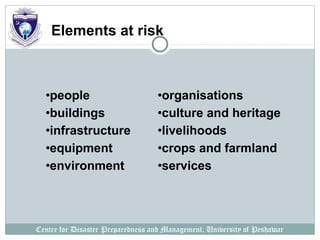
Elements at risk
•people
•buildings
•infrastructure
•equipment
•environment
•organisations
•culture and heritage
•livelihoods
•crops and farmland
•services
Activity
What are Elements at Risk in case of:
1.Floods
2.Earthquakes
3.Landsliding
4.Drought
Centre for Disaster Preparedness and Management, University of Peshawar
Risk Matrix
Sources of risk
Elements structural building land- earth- storm flood
at risk fire collapse slide quake
people      
crops      
buildings      
equipment      
Centre for Disaster Preparedness and Management, University of Peshawar
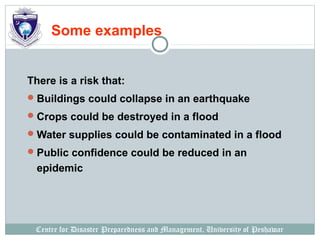
Some examples
There is a risk that:
Buildings could collapse in an earthquake
Crops could be destroyed in a flood
Water supplies could be contaminated in a flood
Public confidence could be reduced in an
epidemic
Centre for Disaster Preparedness and Management, University of Peshawar
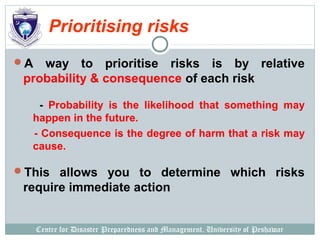
Prioritising risks
A way to prioritise risks is by relative
probability & consequence of each risk
- Probability is the likelihood that something may
happen in the future.
- Consequence is the degree of harm that a risk may
cause.
This allows you to determine which risks
require immediate action
Centre for Disaster Preparedness and Management, University of Peshawar
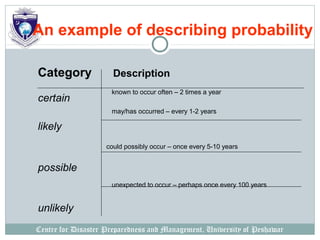
An example of describing probability
Category
certain
likely
possible
unlikely
Description
known to occur often – 2 times a year
may/has occurred – every 1-2 years
could possibly occur – once every 5-10 years
unexpected to occur – perhaps once every 100 years
Centre for Disaster Preparedness and Management, University of Peshawar
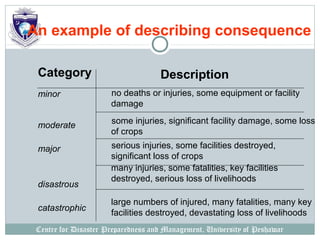
An example of describing consequence
Category
minor
moderate
major
disastrous
catastrophic
no deaths or injuries, some equipment or facility
damage
some injuries, significant facility damage, some loss
of crops
serious injuries, some facilities destroyed,
significant loss of crops
many injuries, some fatalities, key facilities
destroyed, serious loss of livelihoods
large numbers of injured, many fatalities, many key
facilities destroyed, devastating loss of livelihoods
Description
Centre for Disaster Preparedness and Management, University of Peshawar
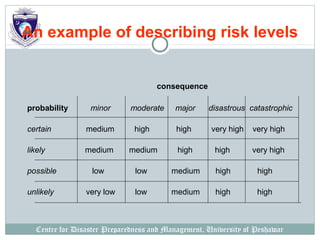
An example of describing risk levels
consequence
probability minor moderate major disastrous catastrophic
certain medium high high very high very high
likely medium medium high high very high
possible low low medium high high
unlikely very low low medium high high
Centre for Disaster Preparedness and Management, University of Peshawar
By using probability & consequence, it is
possible to compare & prioritise very different
risks
After prioritising the risks, you can then
prioritise actions to manage the risks
You can also justify the decisions taken
Centre for Disaster Preparedness and Management, University of Peshawar
Managing risks
• Some options for managing risks include:
• reducing probability
• reducing potential consequence
• removing the source of risk
• removing the element at risk
• Developing preparedness plans
• Preparing recovery plans

Disaster risk management

  • 2.
  • 3.
  • 4.
    The probability thata community’s structure or geographic area is to be damaged or disrupted by the impact of a particular hazard/disaster. RISKRISK
  • 5.
    Centre for DisasterPreparedness and Management, University of Peshawar RISK Probability or likelihood of something happening in the future which has a negative consequence Risk= Probability (P) x Loss (L) RISKS are the anticipated consequences (e.g. losses or damage) that can be predicted to result from a particular hazard affecting a particular place at a particular time Disaster Risk Disaster Risk is the likelihood of harmful consequences or losses (death, injuries, destroyed property, disrupted economic activities or damaged environment) resulting from interaction between a hazard and vulnerable conditions. Disaster Risk = Hazard x Vulnerability Capacity
  • 6.
    Hazard The Concept ofRisk Risk Vulnerability
  • 7.
  • 8.
    Understanding of DisasterRisk Management Disaster Risk Management is the most complex, interrelated and multi-connected discipline. It is the human intervention behavior which creates negative and positive conditions for natural ecological system. All the negative conditions increase in the human vulnerabilities/ risk and the positive condition increase the capacities/ opportunities for the ecological system.
  • 9.
    Centre for DisasterPreparedness and Management, University of Peshawar Disaster Risk Management DRM is about identifying & analysing risks, & deciding what to do about them. DRM is a problem-solving & decision-making process, which will assist us in selecting the most effective actions.
  • 10.
    Centre for DisasterPreparedness and Management, University of Peshawar Risk Management ...  RISK MANAGEMENT is a comprehensive strategy for reducing threats and consequences to public health and safety by:  preventing exposure to hazards (target = hazards)  reducing vulnerabilities (target group = community)  Developing capacities (target group = response agencies)
  • 11.
    Centre for DisasterPreparedness and Management, University of Peshawar Risk Management
  • 12.
    Centre for DisasterPreparedness and Management, University of Peshawar Child at home alone
  • 13.
    Why DRM?  Theworld is facing a large scale of disasters.  Nearly 25% of the world’s landmass and most of its population is at risk.  Disasters’ impacts are exacerbated by a series of dynamic processes, including population growth, increasing levels of vulnerability, poor planning, climate change etc.
  • 14.
    Centre for DisasterPreparedness and Management, University of Peshawar One view of risk  fatalities  injuries  disease (mental and physical)  secondary hazards (fire, disease etc.)  contamination of the environment  displacement  breakdown in security  damage to infrastructure  breakdown in essential services  loss of property  loss of income
  • 15.
    Centre for DisasterPreparedness and Management, University of Peshawar Another view What are our problems? Which ones need attention? What do we want to do about them? How and when do we intend to do this? And once we have started to take action… How are we doing? Are we getting the results we want?
  • 16.
    Centre for DisasterPreparedness and Management, University of Peshawar A risk management process is to: Identify risks Analyse and prioritise risks Identify risk management strategies Implement strategies Monitor, evaluate and adjust as necessary
  • 17.
    Centre for DisasterPreparedness and Management, University of Peshawar Diagrammatic Overview of the Process
  • 18.
    Establish the general contextof management Risk identification risks statements Risk analysis Levels of risk Risk evaluation Prioritisation of risk Risk treatment Identify source of risks: hazards Identify elements at risk: community + environment Describe & analyze Describe & analyze Determine probability and likelihood Determine consequences Develop risk evaluation criteria Prevention- mitigation Preparedness -Response - Recovery Avoid, accept, mitigate, reduce, transfer, modify risk Options identification Options evaluation Options selection Plan & implement options Communicate Consult Monitor & Review Capacity Development 1 2 3 4 5 Process Overview
  • 19.
    Centre for DisasterPreparedness and Management, University of Peshawar Identifying risks • A risk consists of two components: • an element at risk • a source of risk • Elements at risk are things your community values which could be exposed to harm • Sources of risks are the hazards that may cause harm
  • 20.
    Centre for DisasterPreparedness and Management, University of Peshawar Elements at risk •people •buildings •infrastructure •equipment •environment •organisations •culture and heritage •livelihoods •crops and farmland •services
  • 21.
    Activity What are Elementsat Risk in case of: 1.Floods 2.Earthquakes 3.Landsliding 4.Drought
  • 22.
    Centre for DisasterPreparedness and Management, University of Peshawar Risk Matrix Sources of risk Elements structural building land- earth- storm flood at risk fire collapse slide quake people       crops       buildings       equipment      
  • 23.
    Centre for DisasterPreparedness and Management, University of Peshawar Some examples There is a risk that: Buildings could collapse in an earthquake Crops could be destroyed in a flood Water supplies could be contaminated in a flood Public confidence could be reduced in an epidemic
  • 24.
    Centre for DisasterPreparedness and Management, University of Peshawar Prioritising risks A way to prioritise risks is by relative probability & consequence of each risk - Probability is the likelihood that something may happen in the future. - Consequence is the degree of harm that a risk may cause. This allows you to determine which risks require immediate action
  • 25.
    Centre for DisasterPreparedness and Management, University of Peshawar An example of describing probability Category certain likely possible unlikely Description known to occur often – 2 times a year may/has occurred – every 1-2 years could possibly occur – once every 5-10 years unexpected to occur – perhaps once every 100 years
  • 26.
    Centre for DisasterPreparedness and Management, University of Peshawar An example of describing consequence Category minor moderate major disastrous catastrophic no deaths or injuries, some equipment or facility damage some injuries, significant facility damage, some loss of crops serious injuries, some facilities destroyed, significant loss of crops many injuries, some fatalities, key facilities destroyed, serious loss of livelihoods large numbers of injured, many fatalities, many key facilities destroyed, devastating loss of livelihoods Description
  • 27.
    Centre for DisasterPreparedness and Management, University of Peshawar An example of describing risk levels consequence probability minor moderate major disastrous catastrophic certain medium high high very high very high likely medium medium high high very high possible low low medium high high unlikely very low low medium high high
  • 28.
    Centre for DisasterPreparedness and Management, University of Peshawar By using probability & consequence, it is possible to compare & prioritise very different risks After prioritising the risks, you can then prioritise actions to manage the risks You can also justify the decisions taken
  • 29.
    Centre for DisasterPreparedness and Management, University of Peshawar Managing risks • Some options for managing risks include: • reducing probability • reducing potential consequence • removing the source of risk • removing the element at risk • Developing preparedness plans • Preparing recovery plans

Editor's Notes

  • #17 For example, when deciding how risks can be controlled, you may discover further risks. These risks should be noted & dealt with as well.
  • #19 The CBDRM (community based risk management) conceptual framework is composed of a series of technically different programs (but related) Development programs, which target mainly the vulnerabilities of the people and the systems Prevention and mitigation programs, which target the specific characteristics of hazards Vulnerability reduction programs Emergency preparedness activities, which target agencies and their readiness The ultimate goal of CBDRM is to protect public safety and to promote safer communities through identification of threats to public safety, through the reduction of risks from the threats and vulnerabilities, and through the empowerment of the communities to respond to and recover from emergencies. Public health is a key element (including hospitals, EMS, etc.) Brief comment of the slide It is impossible to develop response plans unless we know why and what for we plan (this implies to know the risks, vulnerabilities, existing laws, context, etc.) Response plans are just one element of Risk Management The step 6 is important: importance of communicating and consulting throughout the process Step 7 tells us that it is an ongoing process and that the cycle has to be entered again and again Step 8 tells us that the final output is safer communities and increased sustainable development (capacity development)
  • #23 One way of recording which elements at risk may be affected by which sources of risk is to create a matrix such as this one. The matrix could also be useful for carrying out site assessments. This matrix is an example only & will need extension for different sites & activities.