HU-414
Hazard and Disaster Management
Engr. Muhammad Waqas Muneer
MS Transportation Engineering (NUST, Islamabad)
Department of Civil Engineering and Technology,
Institute of Southern Punjab (ISP), Multan.
Lecture # 3
Disaster Management,
Vulnerability, Risk, Capacity
Contents
Disaster Management
Vulnerability
Risk
Capacity
Other Terminologies
 The United Nations defines a disaster as a serious
disruption of the functioning of a community or a society.
 Disasters involve widespread human, material, economic or
environmental impacts, which exceed the ability of the
affected community or society to cope using its own
resources.
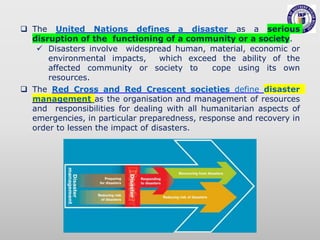
 The Red Cross and Red Crescent societies define disaster
management as the organisation and management of resources
and responsibilities for dealing with all humanitarian aspects of
emergencies, in particular preparedness, response and recovery in
order to lessen the impact of disasters.
 Any disaster can interrupt essential services, such as health care,
electricity, water, sewage/garbage removal, transportation and
communications. The interruption can seriously affect the health,
social and economic networks of local communities and countries.
 Disasters have a major and long-lasting impact on people long
after the immediate effect has been mitigated. Poorly planned
relief activities can have a significant negative impact not only on
the disaster victims but also on donors and relief agencies. So it
is important that physical therapists join established programmes
rather than attempting individual efforts.
 Local, regional, national and international organisations are all
involved in mounting a humanitarian response to disasters. Each
will have a prepared disaster management plan.
 These plans cover prevention, preparedness, relief and
recovery.
 Disaster Prevention
 These are activities designed to provide permanent protection from disasters.
 Not all disasters, particularly natural disasters, can be prevented, but the risk of
loss of life and injury can be mitigated with good evacuation plans,
environmental planning and design standards.
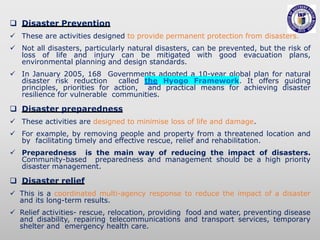
 In January 2005, 168 Governments adopted a 10-year global plan for natural
disaster risk reduction called the Hyogo Framework. It offers guiding
principles, priorities for action, and practical means for achieving disaster
resilience for vulnerable communities.
 Disaster preparedness
 These activities are designed to minimise loss of life and damage.
 For example, by removing people and property from a threatened location and
by facilitating timely and effective rescue, relief and rehabilitation.
 Preparedness is the main way of reducing the impact of disasters.
Community-based preparedness and management should be a high priority
disaster management.
 Disaster relief
 This is a coordinated multi-agency response to reduce the impact of a disaster
and its long-term results.
 Relief activities- rescue, relocation, providing food and water, preventing disease
and disability, repairing telecommunications and transport services, temporary
shelter and emergency health care.
 Disaster recovery
 Once emergency needs have been met and the initial crisis is
over, the people affected and the communities that support them
are still vulnerable.
 Recovery activities include rebuilding infrastructure, health care
and rehabilitation.
 These should blend with development activities, such as building
human resources for health and developing policies and practices
to avoid similar situations in future.
Disaster management is linked with sustainable
development, particularly in relation to vulnerable people
such as those with disabilities, elderly people, children and
other marginalized groups.
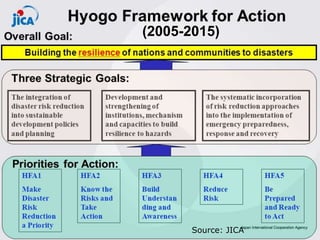
Source: JICA
(2005-2015)
Hyogo Framework for Action (HFA) - areas of focus:
• 10-year plan (2005-2015) to make the world safer from natural
disasters
1. Make disaster risk reduction a priority
 Ensure that disaster risk reduction is a national and a local
priority with a strong institutional basis for implementation.
2. Know the risks and take action
 Identify, assess, and monitor disaster risks – and enhance early
warning.
3. Build understanding and awareness
 Use knowledge, innovation, and education to build a culture of
safety and resilience at all levels.
4. Reduce the underlying risk factors (vulnerabilities and
exposure)
5. Strengthen disaster preparedness for effective response at
all levels
 by focusing on a population’s vulnerabilities and capacities.
Sendai Framework (2015-2030)
• Sendai Framework for Disaster Risk Reduction 2015-
2030
The present post-2015 framework for disaster risk reduction was adopted
at the Third World Conference on Disaster Risk Reduction, held from 14 to
18 March 2015 in Sendai, Miyagi, Japan, which represented a unique
opportunity for countries to:
(a) Adopt a concise, focused, forward-looking and action-oriented post-
2015 framework for disaster risk reduction;
(b) Complete the assessment and review of the implementation of the
Hyogo Framework for Action 2005-2015: Building Resilience of Nations
and Communities to Disasters;1
(c) Consider the experience gained through the regional and national
strategies/institutions and plans for disaster risk reduction and their
recommendations, as well as relevant regional agreements under the
implementation of the Hyogo Framework for Action;
(d) Identify modalities of cooperation based on commitments to
implement a post-2015 framework for disaster risk reduction;
(e) Determine modalities for the periodic review of the implementation of

a post-2015 framework for disaster risk reduction.
V
ulnerability
 Vulnerability describes the characteristics and
circumstances of a community, system or asset that
make it susceptible to the damaging effects of a hazard.
 There are many aspects of vulnerability, arising from
various
 physical,
 social,
 economic,
 and environmental factors.
 Vulnerability varies significantly within a community and
over time.
 This definition identifies vulnerability as a characteristic of
the element of interest (community, system or asset)
which is independent of its exposure.
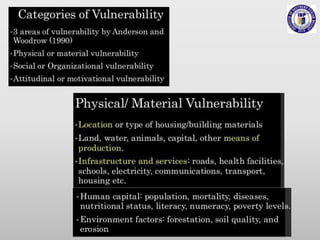
Types of Vulnerabilities
There are four (4) main types of vulnerability:
1. Physical Vulnerability The physical vulnerability of an
area depends on its geographic proximity to the source and
origin of the disasters.
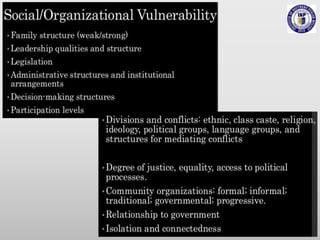
2. Social Vulnerability refers to the inability of people,
organizations and societies to withstand adverse impacts to
hazards due to characteristics inherent in social interactions,
institutions and systems of cultural values.
3. Economic Vulnerability The level of vulnerability is highly
dependent upon the economic status of individuals,
communities and nations
4. Environmental Vulnerability Natural resource depletion
and resource degradation are key aspects of environmental
vulnerability.
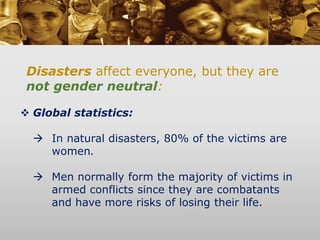
Disasters affect everyone, but they are
not gender neutral:
 Global statistics:
 In natural disasters, 80% of the victims are
women.
 Men normally form the majority of victims in
armed conflicts since they are combatants
and have more risks of losing their life.
Risk
 Risk (or more specifically, disaster risk) is the
potential disaster losses (in terms of lives, health
status, livelihoods, assets and services)
 Risk = probability of (deaths, injuries, property,
livelihoods, economic activity disrupted or
environmentally damaged) resulting from
interactions between natural or human induced
hazards and vulnerable conditions.
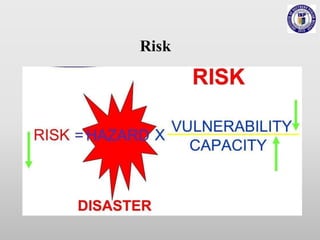
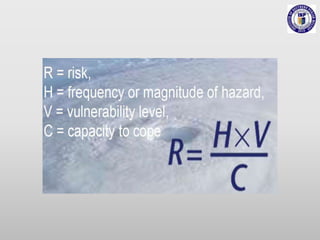
 Risk = Probability of Hazard x Degree of
Vulnerability.
There are different ways of dealing with risk, such as:
 Risk Acceptance: an informed decision to accept the possible consequences
and likelihood of a particular risk.
 Risk Avoidance: an informed decision to avoid involvement in activities
leading to risk realization.
 Risk Reduction refers to the application of appropriate techniques to reduce
the likelihood of risk occurrence and its consequences.
 Risk Transfer involves shifting of the burden of risk to another party. One of
the most common forms of risk transfer is Insurance.
Risk
 ANALYSES
 Before steps can be taken to reduce risk and vulnerability,
they must first be understood.
 Vulnerability assessments and risk analyses allow for the
identification of areas of critical concern and help to guide
mitigation efforts.
Risk
Risk
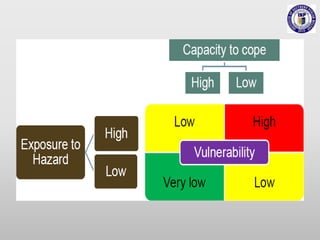
Capacity
Capacity: Ability to cope or decrease the
vulnerability.
Disaster Risk Reduction (DRR)
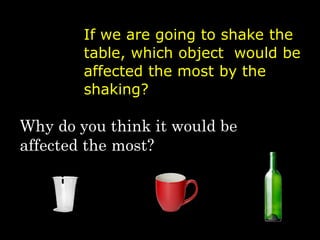
If we are going to shake the
table, which object would be
affected the most by the
shaking?
Why do you think it would be
affected the most?
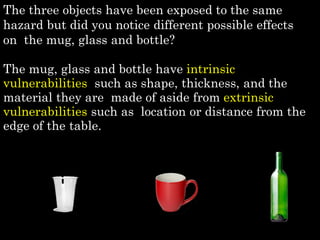
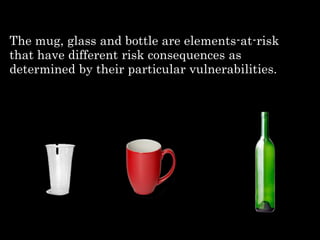
The three objects have been exposed to the same
hazard but did you notice different possible effects
on the mug, glass and bottle?
The mug, glass and bottle have intrinsic
vulnerabilities such as shape, thickness, and the
material they are made of aside from extrinsic
vulnerabilities such as location or distance from the
edge of the table.
The mug, glass and bottle are elements-at-risk
that have different risk consequences as
determined by their particular vulnerabilities.
OTHER TERMINOLOGIES
USED IN DISASTER
MANAGEMENT
Resilience: “the ability of resistance, absorption,
adaptation and recovery of a system from the effects
of hazard, including preserving and restoring the
basic structures and functions”.
This depends on the necessary resources and
organizing capability for the community before and
after a disruptive event. Building disaster resilience
can help community to be better prepared to the
disasters and recovery fast after the disasters (UN-
ISDR, 2009).
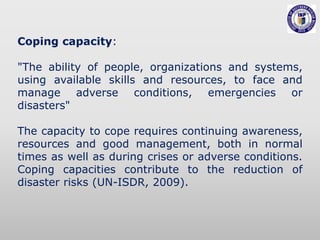
Coping capacity:
"The ability of people, organizations and systems,
using available skills and resources, to face and
manage adverse conditions, emergencies or
disasters"
The capacity to cope requires continuing awareness,
resources and good management, both in normal
times as well as during crises or adverse conditions.
Coping capacities contribute to the reduction of
disaster risks (UN-ISDR, 2009).
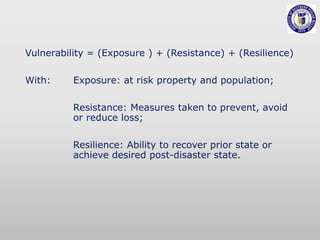
Vulnerability = (Exposure ) + (Resistance) + (Resilience)
With: Exposure: at risk property and population;
Resistance: Measures taken to prevent, avoid
or reduce loss;
Resilience: Ability to recover prior state or
achieve desired post-disaster state.
Thank you!

HDM-Lec-03.pptx

  • 1.
    HU-414 Hazard and DisasterManagement Engr. Muhammad Waqas Muneer MS Transportation Engineering (NUST, Islamabad) Department of Civil Engineering and Technology, Institute of Southern Punjab (ISP), Multan.
  • 2.
    Lecture # 3 DisasterManagement, Vulnerability, Risk, Capacity
  • 3.
  • 4.
     The UnitedNations defines a disaster as a serious disruption of the functioning of a community or a society.  Disasters involve widespread human, material, economic or environmental impacts, which exceed the ability of the affected community or society to cope using its own resources.  The Red Cross and Red Crescent societies define disaster management as the organisation and management of resources and responsibilities for dealing with all humanitarian aspects of emergencies, in particular preparedness, response and recovery in order to lessen the impact of disasters.
  • 5.
     Any disastercan interrupt essential services, such as health care, electricity, water, sewage/garbage removal, transportation and communications. The interruption can seriously affect the health, social and economic networks of local communities and countries.  Disasters have a major and long-lasting impact on people long after the immediate effect has been mitigated. Poorly planned relief activities can have a significant negative impact not only on the disaster victims but also on donors and relief agencies. So it is important that physical therapists join established programmes rather than attempting individual efforts.  Local, regional, national and international organisations are all involved in mounting a humanitarian response to disasters. Each will have a prepared disaster management plan.  These plans cover prevention, preparedness, relief and recovery.
  • 6.
     Disaster Prevention These are activities designed to provide permanent protection from disasters.  Not all disasters, particularly natural disasters, can be prevented, but the risk of loss of life and injury can be mitigated with good evacuation plans, environmental planning and design standards.  In January 2005, 168 Governments adopted a 10-year global plan for natural disaster risk reduction called the Hyogo Framework. It offers guiding principles, priorities for action, and practical means for achieving disaster resilience for vulnerable communities.  Disaster preparedness  These activities are designed to minimise loss of life and damage.  For example, by removing people and property from a threatened location and by facilitating timely and effective rescue, relief and rehabilitation.  Preparedness is the main way of reducing the impact of disasters. Community-based preparedness and management should be a high priority disaster management.  Disaster relief  This is a coordinated multi-agency response to reduce the impact of a disaster and its long-term results.  Relief activities- rescue, relocation, providing food and water, preventing disease and disability, repairing telecommunications and transport services, temporary shelter and emergency health care.
  • 7.
     Disaster recovery Once emergency needs have been met and the initial crisis is over, the people affected and the communities that support them are still vulnerable.  Recovery activities include rebuilding infrastructure, health care and rehabilitation.  These should blend with development activities, such as building human resources for health and developing policies and practices to avoid similar situations in future. Disaster management is linked with sustainable development, particularly in relation to vulnerable people such as those with disabilities, elderly people, children and other marginalized groups.
  • 8.
  • 9.
    Hyogo Framework forAction (HFA) - areas of focus: • 10-year plan (2005-2015) to make the world safer from natural disasters 1. Make disaster risk reduction a priority  Ensure that disaster risk reduction is a national and a local priority with a strong institutional basis for implementation. 2. Know the risks and take action  Identify, assess, and monitor disaster risks – and enhance early warning. 3. Build understanding and awareness  Use knowledge, innovation, and education to build a culture of safety and resilience at all levels. 4. Reduce the underlying risk factors (vulnerabilities and exposure) 5. Strengthen disaster preparedness for effective response at all levels  by focusing on a population’s vulnerabilities and capacities.
  • 10.
    Sendai Framework (2015-2030) •Sendai Framework for Disaster Risk Reduction 2015- 2030 The present post-2015 framework for disaster risk reduction was adopted at the Third World Conference on Disaster Risk Reduction, held from 14 to 18 March 2015 in Sendai, Miyagi, Japan, which represented a unique opportunity for countries to: (a) Adopt a concise, focused, forward-looking and action-oriented post- 2015 framework for disaster risk reduction; (b) Complete the assessment and review of the implementation of the Hyogo Framework for Action 2005-2015: Building Resilience of Nations and Communities to Disasters;1 (c) Consider the experience gained through the regional and national strategies/institutions and plans for disaster risk reduction and their recommendations, as well as relevant regional agreements under the implementation of the Hyogo Framework for Action; (d) Identify modalities of cooperation based on commitments to implement a post-2015 framework for disaster risk reduction; (e) Determine modalities for the periodic review of the implementation of a post-2015 framework for disaster risk reduction.
  • 11.
    V ulnerability  Vulnerability describesthe characteristics and circumstances of a community, system or asset that make it susceptible to the damaging effects of a hazard.  There are many aspects of vulnerability, arising from various  physical,  social,  economic,  and environmental factors.  Vulnerability varies significantly within a community and over time.  This definition identifies vulnerability as a characteristic of the element of interest (community, system or asset) which is independent of its exposure.
  • 12.
    Types of Vulnerabilities Thereare four (4) main types of vulnerability: 1. Physical Vulnerability The physical vulnerability of an area depends on its geographic proximity to the source and origin of the disasters. 2. Social Vulnerability refers to the inability of people, organizations and societies to withstand adverse impacts to hazards due to characteristics inherent in social interactions, institutions and systems of cultural values. 3. Economic Vulnerability The level of vulnerability is highly dependent upon the economic status of individuals, communities and nations 4. Environmental Vulnerability Natural resource depletion and resource degradation are key aspects of environmental vulnerability.
  • 13.
    Disasters affect everyone,but they are not gender neutral:  Global statistics:  In natural disasters, 80% of the victims are women.  Men normally form the majority of victims in armed conflicts since they are combatants and have more risks of losing their life.
  • 17.
    Risk  Risk (ormore specifically, disaster risk) is the potential disaster losses (in terms of lives, health status, livelihoods, assets and services)  Risk = probability of (deaths, injuries, property, livelihoods, economic activity disrupted or environmentally damaged) resulting from interactions between natural or human induced hazards and vulnerable conditions.  Risk = Probability of Hazard x Degree of Vulnerability.
  • 18.
    There are differentways of dealing with risk, such as:  Risk Acceptance: an informed decision to accept the possible consequences and likelihood of a particular risk.  Risk Avoidance: an informed decision to avoid involvement in activities leading to risk realization.  Risk Reduction refers to the application of appropriate techniques to reduce the likelihood of risk occurrence and its consequences.  Risk Transfer involves shifting of the burden of risk to another party. One of the most common forms of risk transfer is Insurance. Risk  ANALYSES  Before steps can be taken to reduce risk and vulnerability, they must first be understood.  Vulnerability assessments and risk analyses allow for the identification of areas of critical concern and help to guide mitigation efforts.
  • 19.
  • 20.
  • 21.
    Capacity Capacity: Ability tocope or decrease the vulnerability.
  • 22.
  • 24.
    If we aregoing to shake the table, which object would be affected the most by the shaking? Why do you think it would be affected the most?
  • 25.
    The three objectshave been exposed to the same hazard but did you notice different possible effects on the mug, glass and bottle? The mug, glass and bottle have intrinsic vulnerabilities such as shape, thickness, and the material they are made of aside from extrinsic vulnerabilities such as location or distance from the edge of the table.
  • 26.
    The mug, glassand bottle are elements-at-risk that have different risk consequences as determined by their particular vulnerabilities.
  • 27.
    OTHER TERMINOLOGIES USED INDISASTER MANAGEMENT
  • 31.
    Resilience: “the abilityof resistance, absorption, adaptation and recovery of a system from the effects of hazard, including preserving and restoring the basic structures and functions”. This depends on the necessary resources and organizing capability for the community before and after a disruptive event. Building disaster resilience can help community to be better prepared to the disasters and recovery fast after the disasters (UN- ISDR, 2009).
  • 34.
    Coping capacity: "The abilityof people, organizations and systems, using available skills and resources, to face and manage adverse conditions, emergencies or disasters" The capacity to cope requires continuing awareness, resources and good management, both in normal times as well as during crises or adverse conditions. Coping capacities contribute to the reduction of disaster risks (UN-ISDR, 2009).
  • 35.
    Vulnerability = (Exposure) + (Resistance) + (Resilience) With: Exposure: at risk property and population; Resistance: Measures taken to prevent, avoid or reduce loss; Resilience: Ability to recover prior state or achieve desired post-disaster state.
  • 38.

Editor's Notes

  • #8 Risk assessment = preparedness phase
  • #10 Afra tafri ka alam
  • #27 DRR – Hyogo Framework