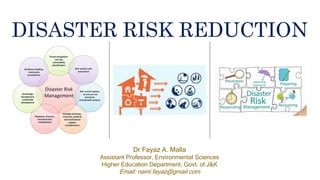
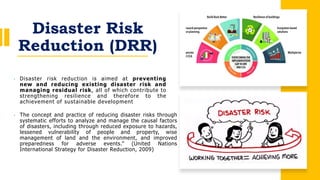
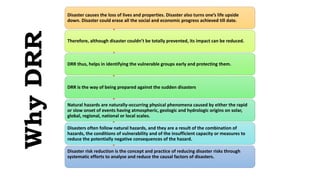
DISASTER RISK REDUCTION
Dr Fayaz A. Malla
Assistant Professor, Environmental Sciences
Higher Education Department, Govt. of J&K
Email: nami.fayaz@gmail.com
Disaster Risk
Reduction (DRR)
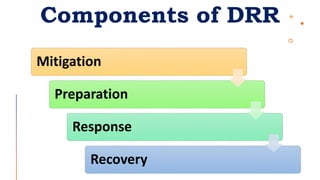
• Disaster risk reduction is aimed at preventing
new and reducing existing disaster risk and
managing residual risk, all of which contribute to
strengthening resilience and therefore to the
achievement of sustainable development
• The concept and practice of reducing disaster risks through
systematic efforts to analyze and manage the causal factors
of disasters, including through reduced exposure to hazards,
lessened vulnerability of people and property, wise
management of land and the environment, and improved
preparedness for adverse events.” (United Nations
International Strategy for Disaster Reduction, 2009)
Why
DRR
Disaster causes the loss of lives and properties. Disaster also turns one’s life upside
down. Disaster could erase all the social and economic progress achieved till date.
Therefore, although disaster couldn’t be totally prevented, its impact can be reduced.
DRR thus, helps in identifying the vulnerable groups early and protecting them.
DRR is the way of being prepared against the sudden disasters
Natural hazards are naturally-occurring physical phenomena caused by either the rapid
or slow onset of events having atmospheric, geologic and hydrologic origins on solar,
global, regional, national or local scales.
Disasters often follow natural hazards, and they are a result of the combination of
hazards, the conditions of vulnerability and of the insufficient capacity or measures to
reduce the potentially negative consequences of the hazard.
Disaster risk reduction is the concept and practice of reducing disaster risks through
systematic efforts to analyse and reduce the causal factors of disasters.
Components of DRR
Mitigation
Preparation
Response
Recovery
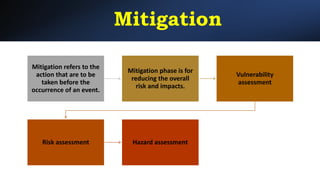
Mitigation
Mitigation refers to the
action that are to be
taken before the
occurrence of an event.
Mitigation phase is for
reducing the overall
risk and impacts.
Vulnerability
assessment
Risk assessment Hazard assessment
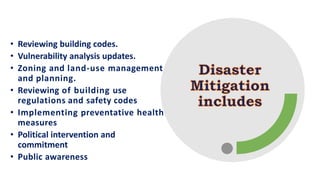
• Reviewing building codes.
• Vulnerability analysis updates.
• Zoning and land-use management
and planning.
• Reviewing of building use
regulations and safety codes
• Implementing preventative health
measures
• Political intervention and
commitment
• Public awareness
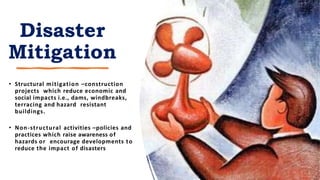
Disaster
Mitigation
• Structural mitigation –construction
projects which reduce economic and
social impacts i.e., dams, windbreaks,
terracing and hazard resistant
buildings.
• Non-structural activities –policies and
practices which raise awareness of
hazards or encourage developments to
reduce the impact of disasters
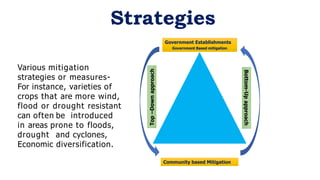
Various mitigation
strategies or measures-
For instance, varieties of
crops that are more wind,
flood or drought resistant
can often be introduced
in areas prone to floods,
drought and cyclones,
Economic diversification.
Strategies
Community based Mitigation
Government Establishments
Government Based mitigation
Top
–Down
approach
Bottom-Up
approach
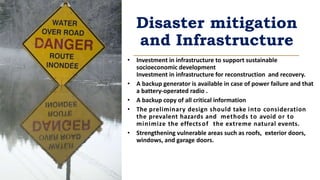
Disaster mitigation
and Infrastructure
• Investment in infrastructure to support sustainable
socioeconomic development
Investment in infrastructure for reconstruction and recovery.
• A backup generator is available in case of power failure and that
a battery-operated radio .
• A backup copy of all critical information
• The preliminary design should take into consideration
the prevalent hazards and methods to avoid or to
minimize the effectsof the extreme natural events.
• Strengthening vulnerable areas such as roofs, exterior doors,
windows, and garage doors.
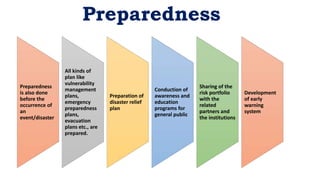
Preparedness
Preparedness
is also done
before the
occurrence of
an
event/disaster
All kinds of
plan like
vulnerability
management
plans,
emergency
preparedness
plans,
evacuation
plans etc., are
prepared.
Preparation of
disaster relief
plan
Conduction of
awareness and
education
programs for
general public
Sharing of the
risk portfolio
with the
related
partners and
the institutions
Development
of early
warning
system
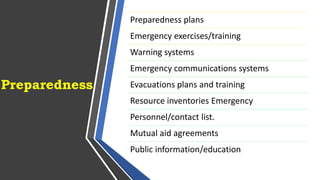
Preparedness
Preparedness plans
Emergency exercises/training
Warning systems
Emergency communications systems
Evacuations plans and training
Resource inventories Emergency
Personnel/contact list.
Mutual aid agreements
Public information/education
Response
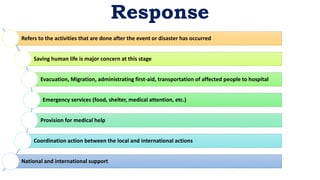
Refers to the activities that are done after the event or disaster has occurred
Saving human life is major concern at this stage
Evacuation, Migration, administrating first-aid, transportation of affected people to hospital
Emergency services (food, shelter, medical attention, etc.)
Provision for medical help
Coordination action between the local and international actions
National and international support
Response
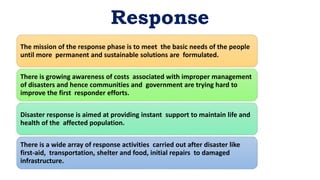
The mission of the response phase is to meet the basic needs of the people
until more permanent and sustainable solutions are formulated.
There is growing awareness of costs associated with improper management
of disasters and hence communities and government are trying hard to
improve the first responder efforts.
Disaster response is aimed at providing instant support to maintain life and
health of the affected population.
There is a wide array of response activities carried out after disaster like
first-aid, transportation, shelter and food, initial repairs to damaged
infrastructure.
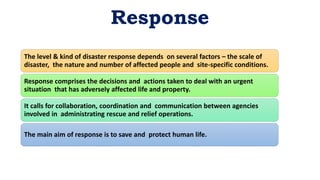
The level & kind of disaster response depends on several factors – the scale of
disaster, the nature and number of affected people and site-specific conditions.
Response comprises the decisions and actions taken to deal with an urgent
situation that has adversely affected life and property.
It calls for collaboration, coordination and communication between agencies
involved in administrating rescue and relief operations.
The main aim of response is to save and protect human life.
Response
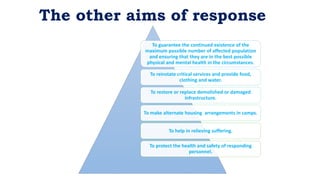
To guarantee the continued existence of the
maximum possible number of affected population
and ensuring that they are in the best possible
physical and mental health in the circumstances.
To reinstate critical services and provide food,
clothing and water.
To restore or replace demolished or damaged
infrastructure.
To make alternate housing arrangements in camps.
To help in relieving suffering.
To protect the health and safety of responding
personnel.
The other aims of response
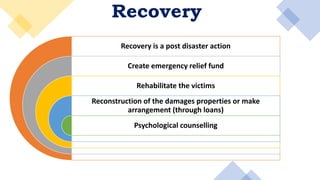
Recovery
Recovery is a post disaster action
Create emergency relief fund
Rehabilitate the victims
Reconstruction of the damages properties or make
arrangement (through loans)
Psychological counselling
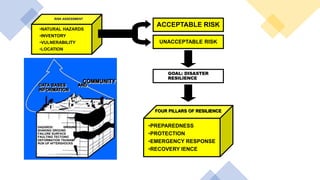
COMMUNITY
DATA BASES AND
INFORMATION
HAZARDS: GROUND
SHAKING GROUND
FAILURE SURFACE
FAULTING TECTONIC
DEFORMATION TSUNAMI
RUN UP AFTERSHOCKS
•NATURAL HAZARDS
•INVENTORY
•VULNERABILITY
•LOCATION
RISK ASSESSMENT
RISK
ACCEPTABLE RISK
UNACCEPTABLE RISK
GOAL: DISASTER
RESILIENCE
•PREPAREDNESS
•PROTECTION
•EMERGENCY RESPONSE
•RECOVERY IENCE
FOUR PILLARS OF RESILIENCE
Strategies
to
Strengthen
DRR
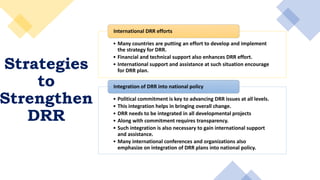
• Many countries are putting an effort to develop and implement
the strategy for DRR.
• Financial and technical support also enhances DRR effort.
• International support and assistance at such situation encourage
for DRR plan.
International DRR efforts
• Political commitment is key to advancing DRR issues at all levels.
• This integration helps in bringing overall change.
• DRR needs to be integrated in all developmental projects
• Along with commitment requires transparency.
• Such integration is also necessary to gain international support
and assistance.
• Many international conferences and organizations also
emphasize on integration of DRR plans into national policy.
Integration of DRR into national policy
Strategies
to
Strengthen
DRR
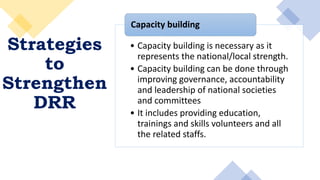
• Capacity building is necessary as it
represents the national/local strength.
• Capacity building can be done through
improving governance, accountability
and leadership of national societies
and committees
• It includes providing education,
trainings and skills volunteers and all
the related staffs.
Capacity building
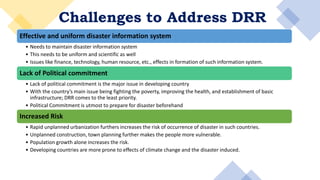
Challenges to Address DRR
Effective and uniform disaster information system
• Needs to maintain disaster information system
• This needs to be uniform and scientific as well
• Issues like finance, technology, human resource, etc., effects in formation of such information system.
Lack of Political commitment
• Lack of political commitment is the major issue in developing country
• With the country’s main issue being fighting the poverty, improving the health, and establishment of basic
infrastructure; DRR comes to the least priority.
• Political Commitment is utmost to prepare for disaster beforehand
Increased Risk
• Rapid unplanned urbanization furthers increases the risk of occurrence of disaster in such countries.
• Unplanned construction, town planning further makes the people more vulnerable.
• Population growth alone increases the risk.
• Developing countries are more prone to effects of climate change and the disaster induced.
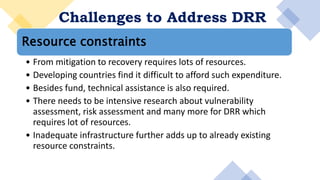
Challenges to Address DRR
Resource constraints
• From mitigation to recovery requires lots of resources.
• Developing countries find it difficult to afford such expenditure.
• Besides fund, technical assistance is also required.
• There needs to be intensive research about vulnerability
assessment, risk assessment and many more for DRR which
requires lot of resources.
• Inadequate infrastructure further adds up to already existing
resource constraints.
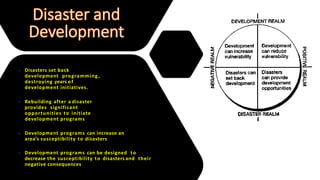
• Disasters set back
development programming,
destroying years of
development initiatives.
• Rebuilding after a disaster
provides significant
opportunities to initiate
development programs
• Development programs can increase an
area’s susceptibility to disasters
• Development programs can be designed to
decrease the susceptibility to disasters and their
negative consequences
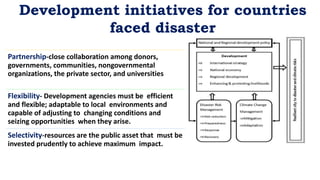
Development initiatives for countries
faced disaster
Partnership-close collaboration among donors,
governments, communities, nongovernmental
organizations, the private sector, and universities
Flexibility- Development agencies must be efficient
and flexible; adaptable to local environments and
capable of adjusting to changing conditions and
seizing opportunities when they arise.
Selectivity-resources are the public asset that must be
invested prudently to achieve maximum impact.
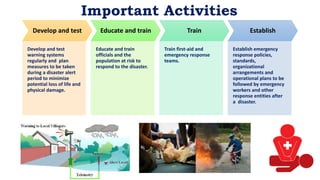
Important Activities
Develop and test
Develop and test
warning systems
regularly and plan
measures to be taken
during a disaster alert
period to minimize
potential loss of life and
physical damage.
Educate and train
Educate and train
officials and the
population at risk to
respond to the disaster.
Train
Train first-aid and
emergency response
teams.
Establish
Establish emergency
response policies,
standards,
organizational
arrangements and
operational plans to be
followed by emergency
workers and other
response entities after
a disaster.
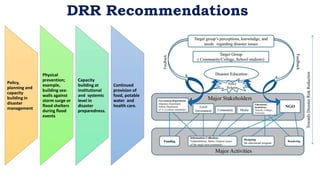
DRR Recommendations
Policy,
planning and
capacity
building in
disaster
management
Physical
prevention;
example,
building sea-
walls against
storm surge or
flood shelters
during flood
events
Capacity
building at
institutional
and systemic
level in
disaster
preparedness.
Continued
provision of
food, potable
water and
health care.
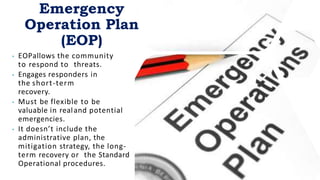
• EOPallows the community
to respond to threats.
• Engages responders in
the short-term
recovery.
• Must be flexible to be
valuable in realand potential
emergencies.
• It doesn’t include the
administrative plan, the
mitigation strategy, the long-
term recovery or the Standard
Operational procedures.
Emergency
Operation Plan
(EOP)
Policy Arena
There have been growing calls for greater clarity about the
components of DRR and about indicators of progress toward
resilience — a challenge that the international community took up at
the UN's World Conference on Disaster Reduction (WCDR) in Kobe,
Japan, in 2005, only days after the 2004 Indian Ocean earthquake.
The WCDR began the process of pushing international agencies and
national governments beyond the vague rhetoric of most policy
statements and toward setting clear targets and commitments for
DRR.
Hyogo Framework for Action
The first step in this process was the formal approval at the WCDR of the Hyogo
Framework for Action (2005–2015) (HFA).
This was the first internationally accepted framework for DRR. It set out an ordered
sequence of objectives (outcome – strategic goals – priorities), with five priorities
for action attempting to 'capture' the main areas of DRR intervention.
The UN's biennial Global Platform for Disaster Risk Reduction provided an
opportunity for the UN and its member states to review progress against the
Hyogo Framework.
It held its first session 5–7 June 2007 in Geneva, Switzerland, where UNISDR is
based.
The subsequent Global Platforms were held in June 2009, May 2011 and May 2013, all
in Geneva.
Sendai Framework for Disaster Risk Reduction
• The Sendai Framework for Disaster Risk Reduction (2015–2030) is an international document that was adopted by
the United Nations member states between 14 and 18 March 2015 at the World Conference on Disaster Risk
Reduction held in Sendai, Japan, and endorsed by the UN General Assembly in June 2015.
• It is the successor agreement to the Hyogo Framework for Action (2005–2015), which had been the most
encompassing international accord to date on disaster risk reduction.
• The Sendai document emerged from three years' of talks, assisted by the United Nations International Strategy for
Disaster Reduction, during which UN member states, NGOs, and other stakeholders made calls for an improved
version of the existing Hyogo Framework, with a set of common standards, a comprehensive framework with
achievable targets, and a legally-based instrument for disaster risk reduction.
• Member states also emphasized the need to tackle disaster risk reduction and climate change adaptation when
setting the Sustainable Development Goals, particularly considering an insufficient focus on risk reduction and
resilience in the original Millennium Development Goals.

Disaster Risk Reduction

  • 1.
    DISASTER RISK REDUCTION DrFayaz A. Malla Assistant Professor, Environmental Sciences Higher Education Department, Govt. of J&K Email: nami.fayaz@gmail.com
  • 2.
    Disaster Risk Reduction (DRR) •Disaster risk reduction is aimed at preventing new and reducing existing disaster risk and managing residual risk, all of which contribute to strengthening resilience and therefore to the achievement of sustainable development • The concept and practice of reducing disaster risks through systematic efforts to analyze and manage the causal factors of disasters, including through reduced exposure to hazards, lessened vulnerability of people and property, wise management of land and the environment, and improved preparedness for adverse events.” (United Nations International Strategy for Disaster Reduction, 2009)
  • 3.
    Why DRR Disaster causes theloss of lives and properties. Disaster also turns one’s life upside down. Disaster could erase all the social and economic progress achieved till date. Therefore, although disaster couldn’t be totally prevented, its impact can be reduced. DRR thus, helps in identifying the vulnerable groups early and protecting them. DRR is the way of being prepared against the sudden disasters Natural hazards are naturally-occurring physical phenomena caused by either the rapid or slow onset of events having atmospheric, geologic and hydrologic origins on solar, global, regional, national or local scales. Disasters often follow natural hazards, and they are a result of the combination of hazards, the conditions of vulnerability and of the insufficient capacity or measures to reduce the potentially negative consequences of the hazard. Disaster risk reduction is the concept and practice of reducing disaster risks through systematic efforts to analyse and reduce the causal factors of disasters.
  • 4.
  • 5.
    Mitigation Mitigation refers tothe action that are to be taken before the occurrence of an event. Mitigation phase is for reducing the overall risk and impacts. Vulnerability assessment Risk assessment Hazard assessment
  • 6.
    • Reviewing buildingcodes. • Vulnerability analysis updates. • Zoning and land-use management and planning. • Reviewing of building use regulations and safety codes • Implementing preventative health measures • Political intervention and commitment • Public awareness
  • 7.
    Disaster Mitigation • Structural mitigation–construction projects which reduce economic and social impacts i.e., dams, windbreaks, terracing and hazard resistant buildings. • Non-structural activities –policies and practices which raise awareness of hazards or encourage developments to reduce the impact of disasters
  • 9.
    Various mitigation strategies ormeasures- For instance, varieties of crops that are more wind, flood or drought resistant can often be introduced in areas prone to floods, drought and cyclones, Economic diversification. Strategies Community based Mitigation Government Establishments Government Based mitigation Top –Down approach Bottom-Up approach
  • 10.
    Disaster mitigation and Infrastructure •Investment in infrastructure to support sustainable socioeconomic development Investment in infrastructure for reconstruction and recovery. • A backup generator is available in case of power failure and that a battery-operated radio . • A backup copy of all critical information • The preliminary design should take into consideration the prevalent hazards and methods to avoid or to minimize the effectsof the extreme natural events. • Strengthening vulnerable areas such as roofs, exterior doors, windows, and garage doors.
  • 11.
    Preparedness Preparedness is also done beforethe occurrence of an event/disaster All kinds of plan like vulnerability management plans, emergency preparedness plans, evacuation plans etc., are prepared. Preparation of disaster relief plan Conduction of awareness and education programs for general public Sharing of the risk portfolio with the related partners and the institutions Development of early warning system
  • 12.
    Preparedness Preparedness plans Emergency exercises/training Warningsystems Emergency communications systems Evacuations plans and training Resource inventories Emergency Personnel/contact list. Mutual aid agreements Public information/education
  • 13.
    Response Refers to theactivities that are done after the event or disaster has occurred Saving human life is major concern at this stage Evacuation, Migration, administrating first-aid, transportation of affected people to hospital Emergency services (food, shelter, medical attention, etc.) Provision for medical help Coordination action between the local and international actions National and international support
  • 14.
    Response The mission ofthe response phase is to meet the basic needs of the people until more permanent and sustainable solutions are formulated. There is growing awareness of costs associated with improper management of disasters and hence communities and government are trying hard to improve the first responder efforts. Disaster response is aimed at providing instant support to maintain life and health of the affected population. There is a wide array of response activities carried out after disaster like first-aid, transportation, shelter and food, initial repairs to damaged infrastructure.
  • 15.
    The level &kind of disaster response depends on several factors – the scale of disaster, the nature and number of affected people and site-specific conditions. Response comprises the decisions and actions taken to deal with an urgent situation that has adversely affected life and property. It calls for collaboration, coordination and communication between agencies involved in administrating rescue and relief operations. The main aim of response is to save and protect human life. Response
  • 16.
    To guarantee thecontinued existence of the maximum possible number of affected population and ensuring that they are in the best possible physical and mental health in the circumstances. To reinstate critical services and provide food, clothing and water. To restore or replace demolished or damaged infrastructure. To make alternate housing arrangements in camps. To help in relieving suffering. To protect the health and safety of responding personnel. The other aims of response
  • 17.
    Recovery Recovery is apost disaster action Create emergency relief fund Rehabilitate the victims Reconstruction of the damages properties or make arrangement (through loans) Psychological counselling
  • 18.
    COMMUNITY DATA BASES AND INFORMATION HAZARDS:GROUND SHAKING GROUND FAILURE SURFACE FAULTING TECTONIC DEFORMATION TSUNAMI RUN UP AFTERSHOCKS •NATURAL HAZARDS •INVENTORY •VULNERABILITY •LOCATION RISK ASSESSMENT RISK ACCEPTABLE RISK UNACCEPTABLE RISK GOAL: DISASTER RESILIENCE •PREPAREDNESS •PROTECTION •EMERGENCY RESPONSE •RECOVERY IENCE FOUR PILLARS OF RESILIENCE
  • 19.
    Strategies to Strengthen DRR • Many countriesare putting an effort to develop and implement the strategy for DRR. • Financial and technical support also enhances DRR effort. • International support and assistance at such situation encourage for DRR plan. International DRR efforts • Political commitment is key to advancing DRR issues at all levels. • This integration helps in bringing overall change. • DRR needs to be integrated in all developmental projects • Along with commitment requires transparency. • Such integration is also necessary to gain international support and assistance. • Many international conferences and organizations also emphasize on integration of DRR plans into national policy. Integration of DRR into national policy
  • 20.
    Strategies to Strengthen DRR • Capacity buildingis necessary as it represents the national/local strength. • Capacity building can be done through improving governance, accountability and leadership of national societies and committees • It includes providing education, trainings and skills volunteers and all the related staffs. Capacity building
  • 21.
    Challenges to AddressDRR Effective and uniform disaster information system • Needs to maintain disaster information system • This needs to be uniform and scientific as well • Issues like finance, technology, human resource, etc., effects in formation of such information system. Lack of Political commitment • Lack of political commitment is the major issue in developing country • With the country’s main issue being fighting the poverty, improving the health, and establishment of basic infrastructure; DRR comes to the least priority. • Political Commitment is utmost to prepare for disaster beforehand Increased Risk • Rapid unplanned urbanization furthers increases the risk of occurrence of disaster in such countries. • Unplanned construction, town planning further makes the people more vulnerable. • Population growth alone increases the risk. • Developing countries are more prone to effects of climate change and the disaster induced.
  • 22.
    Challenges to AddressDRR Resource constraints • From mitigation to recovery requires lots of resources. • Developing countries find it difficult to afford such expenditure. • Besides fund, technical assistance is also required. • There needs to be intensive research about vulnerability assessment, risk assessment and many more for DRR which requires lot of resources. • Inadequate infrastructure further adds up to already existing resource constraints.
  • 23.
    • Disasters setback development programming, destroying years of development initiatives. • Rebuilding after a disaster provides significant opportunities to initiate development programs • Development programs can increase an area’s susceptibility to disasters • Development programs can be designed to decrease the susceptibility to disasters and their negative consequences
  • 24.
    Development initiatives forcountries faced disaster Partnership-close collaboration among donors, governments, communities, nongovernmental organizations, the private sector, and universities Flexibility- Development agencies must be efficient and flexible; adaptable to local environments and capable of adjusting to changing conditions and seizing opportunities when they arise. Selectivity-resources are the public asset that must be invested prudently to achieve maximum impact.
  • 25.
    Important Activities Develop andtest Develop and test warning systems regularly and plan measures to be taken during a disaster alert period to minimize potential loss of life and physical damage. Educate and train Educate and train officials and the population at risk to respond to the disaster. Train Train first-aid and emergency response teams. Establish Establish emergency response policies, standards, organizational arrangements and operational plans to be followed by emergency workers and other response entities after a disaster.
  • 26.
    DRR Recommendations Policy, planning and capacity buildingin disaster management Physical prevention; example, building sea- walls against storm surge or flood shelters during flood events Capacity building at institutional and systemic level in disaster preparedness. Continued provision of food, potable water and health care.
  • 27.
    • EOPallows thecommunity to respond to threats. • Engages responders in the short-term recovery. • Must be flexible to be valuable in realand potential emergencies. • It doesn’t include the administrative plan, the mitigation strategy, the long- term recovery or the Standard Operational procedures. Emergency Operation Plan (EOP)
  • 28.
    Policy Arena There havebeen growing calls for greater clarity about the components of DRR and about indicators of progress toward resilience — a challenge that the international community took up at the UN's World Conference on Disaster Reduction (WCDR) in Kobe, Japan, in 2005, only days after the 2004 Indian Ocean earthquake. The WCDR began the process of pushing international agencies and national governments beyond the vague rhetoric of most policy statements and toward setting clear targets and commitments for DRR.
  • 29.
    Hyogo Framework forAction The first step in this process was the formal approval at the WCDR of the Hyogo Framework for Action (2005–2015) (HFA). This was the first internationally accepted framework for DRR. It set out an ordered sequence of objectives (outcome – strategic goals – priorities), with five priorities for action attempting to 'capture' the main areas of DRR intervention. The UN's biennial Global Platform for Disaster Risk Reduction provided an opportunity for the UN and its member states to review progress against the Hyogo Framework. It held its first session 5–7 June 2007 in Geneva, Switzerland, where UNISDR is based. The subsequent Global Platforms were held in June 2009, May 2011 and May 2013, all in Geneva.
  • 30.
    Sendai Framework forDisaster Risk Reduction • The Sendai Framework for Disaster Risk Reduction (2015–2030) is an international document that was adopted by the United Nations member states between 14 and 18 March 2015 at the World Conference on Disaster Risk Reduction held in Sendai, Japan, and endorsed by the UN General Assembly in June 2015. • It is the successor agreement to the Hyogo Framework for Action (2005–2015), which had been the most encompassing international accord to date on disaster risk reduction. • The Sendai document emerged from three years' of talks, assisted by the United Nations International Strategy for Disaster Reduction, during which UN member states, NGOs, and other stakeholders made calls for an improved version of the existing Hyogo Framework, with a set of common standards, a comprehensive framework with achievable targets, and a legally-based instrument for disaster risk reduction. • Member states also emphasized the need to tackle disaster risk reduction and climate change adaptation when setting the Sustainable Development Goals, particularly considering an insufficient focus on risk reduction and resilience in the original Millennium Development Goals.