Approaches in Resource
Management
Md. Inzamul Haque
mihaque.iu@gmail.com
agenda
INTRODUCTION
Ecological Approaches
Economic Approach
Ethnological Approach
Comparison
Integrated Resource Management Strategies:
Balancing Ecology, Economics & Culture
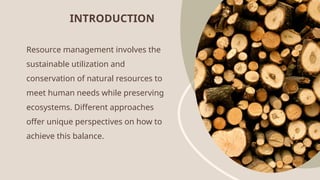
Resource management involves the
sustainable utilization and
conservation of natural resources to
meet human needs while preserving
ecosystems. Different approaches
offer unique perspectives on how to
achieve this balance.
INTRODUCTION
4
Ecological Approaches
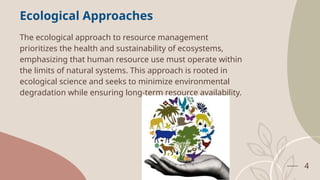
The ecological approach to resource management
prioritizes the health and sustainability of ecosystems,
emphasizing that human resource use must operate within
the limits of natural systems. This approach is rooted in
ecological science and seeks to minimize environmental
degradation while ensuring long-term resource availability.
Ecological Approaches: Key Principles
1. Sustainability & Carrying Capacity
o Resources should be used at a rate that allows natural regeneration.
o The concept of carrying capacity (maximum population an ecosystem can support without
degradation) is central.
2. Biodiversity Conservation
o Protecting species diversity ensures ecosystem resilience.
o Keystone species (e.g., wolves, bees) are prioritized due to their critical role in ecosystems.
3. Ecosystem-Based Management (EBM)
o Focuses on entire ecosystems rather than single species or resources.
o Recognizes interconnectedness (e.g., forests influence water cycles, which affect fisheries).
4. Precautionary Principle
o If an action risks severe harm to the environment, it should be avoided even if scientific certainty is
lacking.
5. Ecological Thresholds & Tipping Points
o Avoids pushing ecosystems beyond irreversible damage (e.g., coral reef bleaching, deforestation
6
Methods & Strategies in Ecological Resource
Management
1. Protected Areas & Conservation Reserves
 National Parks, Wildlife Sanctuaries: Strict protection of habitats.
 Biosphere Reserves: Combines conservation with sustainable use in buffer zones.
 Marine Protected Areas (MPAs): Safeguard marine biodiversity (e.g., Great Barrier Reef).
2. Habitat Restoration & Rewilding
 Reforestation: Replanting trees to combat deforestation (e.g., Amazon restoration).
 Wetland Rehabilitation: Restoring marshes to improve water filtration and flood control.
 Rewilding: Reintroducing apex predators (e.g., wolves in Yellowstone) to restore balance.
7
Methods & Strategies in Ecological Resource
Management
3. Sustainable Harvesting Practices
 Maximum Sustainable Yield (MSY): Harvesting at a level that doesn’t deplete the resource
(e.g., regulated fishing quotas).
 Selective Logging: Cutting only mature trees while preserving young ones.
4. Pollution & Waste Management
 Circular Economy: Minimizing waste by reusing/recycling materials.
 Bioremediation: Using microorganisms to clean oil spills or contaminated soil.
5. Climate & Ecosystem Monitoring
 Remote Sensing & GIS: Tracking deforestation, wildlife migration, and climate change
impacts.
 Citizen Science: Involving the public in data collection (e.g., bird counts, water quality
testing).
8
Advantages of the Ecological Approach
✅ Long-term sustainability – Prevents resource depletion.
✅ Biodiversity protection – Maintains ecosystem services (pollination, clean water).
✅ Resilience to climate change – Healthy ecosystems adapt better.
✅ Scientific foundation – Uses data-driven policies rather than short-term economic gains.
Criticisms & Challenges
❌ Economic trade-offs – Strict conservation may limit industries (logging, mining).
❌ Conflict with local communities – Protected areas may displace indigenous people.
❌ Implementation difficulties – Requires strong governance and enforcement.
❌ Uncertainty in ecological predictions – Ecosystems are complex and dynamic.
Ecological Approaches: Advantages and Criticisms
9
Ecological Approaches: Case Studies
1. Yellowstone Wolf Reintroduction (USA, 1995)
o Wolves were reintroduced to control elk populations, leading to
forest regeneration and improved riverbank stability.
2. Costa Rica’s Payment for Ecosystem Services (PES)
o Farmers are paid to conserve forests, increasing biodiversity
while supporting livelihoods.
3. Great Green Wall (Africa)
o A reforestation project to combat desertification in the Sahel
region.
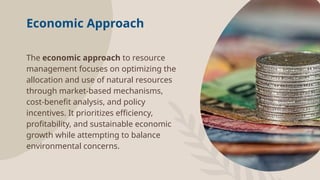
Economic Approach
The economic approach to resource
management focuses on optimizing the
allocation and use of natural resources
through market-based mechanisms,
cost-benefit analysis, and policy
incentives. It prioritizes efficiency,
profitability, and sustainable economic
growth while attempting to balance
environmental concerns.
11
1. Resource Scarcity & Opportunity Cost
o Resources are limited, so their use must be optimized for maximum societal
benefit.
o Every resource allocation has an opportunity cost (what is sacrificed when
choosing one use over another).
2. Market-Based Allocation
o Prices reflect scarcity—when a resource becomes rare, its price rises,
encouraging conservation or substitution.
o Example: Rising oil prices lead to investment in renewable energy.
3. Cost-Benefit Analysis (CBA)
o Decisions are based on comparing economic benefits (e.g., revenue from
logging) with costs (e.g., loss of biodiversity).
Key Principles of the Economic
Approach
12
Key Principles of the Economic
Approach
4. Externalities & Market Failures
4. Negative externalities (e.g., pollution) occur when market prices don’t account for
environmental damage.
5. Solutions include Pigovian taxes (carbon tax) or cap-and-trade systems.
5. Property Rights & the Tragedy of the Commons
4. Open-access resources (e.g., oceans, air) are prone to overuse (Hardin’s Tragedy of the
Commons).
5. Solutions: Privatization, quotas, or community-based management.
6. Valuation of Ecosystem Services
4. Assigning economic value to nature (e.g., wetlands filter water, forests sequester carbon)
helps justify conservation.
13
Methods & Strategies in Economic Resource
Management
1. Market-Based Instruments
 Cap-and-Trade (Emissions Trading)
o Governments set a pollution limit (cap) and allow companies to trade permits (e.g., EU
Carbon Market).
 Green Taxes
o Taxes on pollution (carbon tax) or resource extraction (timber taxes) to discourage overuse.
 Subsidies for Sustainable Practices
o Incentives for renewable energy (solar/wind tax credits) or organic farming.
2. Privatization & Property Rights
 Assigning ownership (e.g., individual fishing quotas) can prevent overexploitation.
 Example: New Zealand’s ITQ System (Individual Transferable Quotas) for fisheries.
3. Payment for Ecosystem Services (PES)
 Paying landowners to conserve forests, wetlands, or wildlife habitats.
 Example: Costa Rica’s PES program pays farmers to protect watersheds.
14
Methods & Strategies in Economic Resource
Management
4. Sustainable Resource Pricing
 Removing subsidies that encourage waste (e.g., fossil fuel subsidies).
 Implementing full-cost pricing (including environmental damage in prices).
5. Technological Innovation & Efficiency
 Precision agriculture reduces water/fertilizer use.
 Circular economy promotes recycling and waste reduction.
15
Economic Approaches: Advantages and Criticisms
Advantages of the Economic Approach
✅ Efficiency – Markets allocate resources where they are most valued.
✅ Innovation incentives – Higher prices drive technological solutions (e.g., renewable energy).
✅ Flexibility – Tradable permits and taxes adapt better than rigid regulations.
✅ Revenue generation – Taxes and permits fund environmental programs.
Criticisms & Challenges
❌ Short-term focus – Profit motives may override long-term sustainability.
❌ Difficulty in valuing nature – Some ecosystem services (e.g., biodiversity) are hard to price.
❌ Inequity – Poor communities may bear the cost (e.g., higher energy prices from carbon taxes).
❌ Market failures – Without regulation, companies may exploit loopholes.
16
Economic Approaches: Case Studies
1. Norway’s Carbon Tax (1991)
 One of the first countries to implement a carbon tax, reducing emissions while
maintaining economic growth.
2. Individual Fishing Quotas (Iceland, New Zealand)
 Prevented overfishing by assigning tradable quotas, stabilizing fish stocks.
3. California’s Cap-and-Trade Program (2013)
 Reduced greenhouse gas emissions while generating billions for clean energy
projects.
4. Germany’s Renewable Energy Transition (Energiewende)
 Subsidies and feed-in tariffs boosted wind/solar power, reducing fossil fuel
dependence.
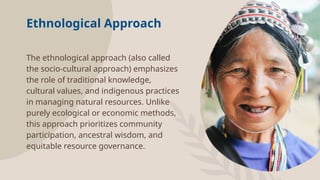
Ethnological Approach
The ethnological approach (also called
the socio-cultural approach) emphasizes
the role of traditional knowledge,
cultural values, and indigenous practices
in managing natural resources. Unlike
purely ecological or economic methods,
this approach prioritizes community
participation, ancestral wisdom, and
equitable resource governance.
18
Key Principles of the Ethnological Approach
1. Indigenous & Local Knowledge (ILK)
o Recognizes that indigenous peoples and local communities have centuries of adaptive
knowledge about their ecosystems.
o Examples:
 Rotational farming (shifting cultivation) in Amazonia and Southeast Asia.
 Sacred groves in India and Africa, where forests are protected for cultural reasons.
2. Community-Based Resource Management (CBRM)
o Decision-making is decentralized, with local communities (not just governments or corporations)
controlling resources.
o Example: Community forests in Nepal, where villagers manage woodlands sustainably.
3. Cultural & Spiritual Values of Nature
o Many cultures view nature as sacred, not just as an economic resource.
o Example: Maori guardianship (kaitiakitanga) in New Zealand, where land is seen as an ancestor.
19
Key Principles of the Ethnographic Approach
4. Participatory Governance & Co-Management
4. Governments and indigenous groups share responsibility for managing
resources.
5. Example: Joint Inuit-government wildlife management in Canada.
5. Social Equity & Justice
4. Ensures marginalized groups (indigenous peoples, small-scale fishers) have fair
access to resources.
5. Example: Land rights movements in Brazil protecting Amazon tribes from illegal
logging.
20
Methods & Strategies in Ethnological Resource
Management
1. Traditional Ecological Knowledge (TEK)
 Indigenous fire management (Australia’s Aboriginal "cool burns" prevent wildfires).
 Water harvesting systems (ancient stepwells in India, qanats in Iran).
2. Community Conservancies & Indigenous Reserves
 Namibia’s communal conservancies – Locals manage wildlife tourism and anti-poaching.
 Sámi reindeer herding cooperatives in Scandinavia.
3. Legal Recognition of Indigenous Rights
 UN Declaration on the Rights of Indigenous Peoples (UNDRIP, 2007).
 Land titling programs (e.g., Bolivia’s TCOs – Original Community Lands).
4. Ethnobiology & Biocultural Conservation
 Studying how cultures classify and use biodiversity (e.g., medicinal plants in Ayurveda).
 Protecting heirloom crop varieties maintained by indigenous farmers.
5. Conflict Resolution & Mediation
 Resolving disputes between governments, corporations, and indigenous groups.
 Example: Ecuador’s court cases on oil drilling in indigenous territories.
21
Ethnological Approaches: Advantages and Criticisms
✅ Sustainable practices – Many indigenous systems have maintained ecosystems for millennia.
✅ Social inclusion – Empowers marginalized groups in decision-making.
✅ Cost-effective – Often cheaper than high-tech conservation methods.
✅ Cultural preservation – Protects languages, traditions, and heritage linked to nature.
Criticisms & Challenges
❌ Marginalization by governments – Indigenous knowledge is often ignored in policy.
❌ Scaling difficulties – Hard to apply traditional methods in large industrial economies.
❌ Modernization pressures – Younger generations may abandon traditional practices.
❌ Legal conflicts – Governments may resist granting land rights to indigenous groups.
22
Ethnological Approaches: Case Studies
1. The Guna Yala (Panama) – Autonomous Indigenous Governance
 The Guna people manage their coastal and forest resources autonomously, protecting
coral reefs and mangroves.
2. Māori Fisheries (New Zealand) – Treaty-Based Co-Management
 The Treaty of Waitangi ensures Māori participation in fishing quota systems.
3. Satoyama (Japan) – Traditional Agroforestry
 A mix of rice paddies, woodlands, and grasslands maintained for centuries.
4. Kayapó Amazon Warriors (Brazil) – Indigenous-Led Conservation
 The Kayapó use drones and GPS to monitor illegal logging in their territory.
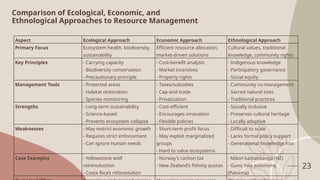
Comparison of Ecological, Economic, and
Ethnological Approaches to Resource Management
23
Aspect Ecological Approach Economic Approach Ethnological Approach
Primary Focus Ecosystem health, biodiversity,
sustainability
Efficient resource allocation,
market-driven solutions
Cultural values, traditional
knowledge, community rights
Key Principles - Carrying capacity
- Biodiversity conservation
- Precautionary principle
- Cost-benefit analysis
- Market incentives
- Property rights
- Indigenous knowledge
- Participatory governance
- Social equity
Management Tools - Protected areas
- Habitat restoration
- Species monitoring
- Taxes/subsidies
- Cap-and-trade
- Privatization
- Community co-management
- Sacred natural sites
- Traditional practices
Strengths - Long-term sustainability
- Science-based
- Prevents ecosystem collapse
- Cost-efficient
- Encourages innovation
- Flexible policies
- Socially inclusive
- Preserves cultural heritage
- Locally adaptive
Weaknesses - May restrict economic growth
- Requires strict enforcement
- Can ignore human needs
- Short-term profit focus
- May exploit marginalized
groups
- Hard to value ecosystems
- Difficult to scale
- Lacks formal policy support
- Generational knowledge loss
Case Examples - Yellowstone wolf
reintroduction
- Costa Rica’s reforestation
- Norway’s carbon tax
- New Zealand’s fishing quotas
- Māori kaitiakitanga (NZ)
- Guna Yala autonomy
(Panama)
24
Integrated Resource Management
Strategies: Balancing Ecology, Economics
& Culture
Effective resource management requires blending ecological sustainability, economic viability, and cultural
equity. Below are key strategies to integrate these approaches, with real-world examples.
1. Policy & Governance Integration
Strategy: Combine legal frameworks from all three approaches.
Examples:
 Brazil’s Socio-Environmental Zoning (ZSEE):
o Ecological: Protects critical biodiversity corridors.
o Economic: Designates sustainable-use zones (e.g., agroforestry).
o Ethnological: Recognizes indigenous territories (e.g., Xingu Indigenous Park).
 EU’s Deforestation Regulation (2023):
o Bans imports linked to deforestation, forcing economic compliance with ecological/ethnological standards.
Tool: Triple-Bottom-Line (TBL) Reporting – Companies must disclose environmental, social, and financial impacts.
25
Integrated Resource Management
Strategies: Balancing Ecology, Economics
& Culture
2. Market-Based Conservation
Strategy: Use economic incentives to fund ecological/ethnological goals.
Examples:
 Ecuador’s Yasuní-ITT Initiative (Failed but instructive):
o Proposed leaving oil underground (ecological) in exchange for international payments
(economic), with indigenous consent (ethnological).
 Kenya’s Wildlife Conservancies:
o Tourism revenue (economic) funds conservation (ecological) and Maasai land leases
(ethnological).
Tool: Biodiversity Credits – Like carbon credits, but for habitat protection.
26
Integrated Resource Management
Strategies: Balancing Ecology, Economics
& Culture
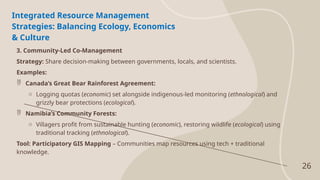
3. Community-Led Co-Management
Strategy: Share decision-making between governments, locals, and scientists.
Examples:
 Canada’s Great Bear Rainforest Agreement:
o Logging quotas (economic) set alongside indigenous-led monitoring (ethnological) and
grizzly bear protections (ecological).
 Namibia’s Community Forests:
o Villagers profit from sustainable hunting (economic), restoring wildlife (ecological) using
traditional tracking (ethnological).
Tool: Participatory GIS Mapping – Communities map resources using tech + traditional
knowledge.
27
Integrated Resource Management
Strategies: Balancing Ecology, Economics
& Culture
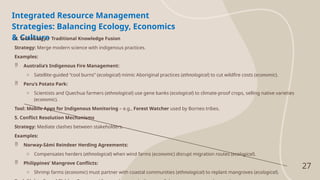
4. Technology + Traditional Knowledge Fusion
Strategy: Merge modern science with indigenous practices.
Examples:
 Australia’s Indigenous Fire Management:
o Satellite-guided “cool burns” (ecological) mimic Aboriginal practices (ethnological) to cut wildfire costs (economic).
 Peru’s Potato Park:
o Scientists and Quechua farmers (ethnological) use gene banks (ecological) to climate-proof crops, selling native varieties
(economic).
Tool: Mobile Apps for Indigenous Monitoring – e.g., Forest Watcher used by Borneo tribes.
5. Conflict Resolution Mechanisms
Strategy: Mediate clashes between stakeholders.
Examples:
 Norway-Sámi Reindeer Herding Agreements:
o Compensates herders (ethnological) when wind farms (economic) disrupt migration routes (ecological).
 Philippines’ Mangrove Conflicts:
o Shrimp farms (economic) must partner with coastal communities (ethnological) to replant mangroves (ecological).
28
Integrated Resource Management
Strategies: Balancing Ecology, Economics
& Culture
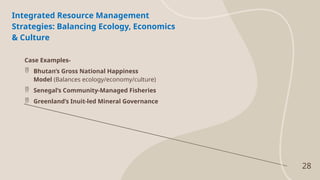
Case Examples-
 Bhutan’s Gross National Happiness
Model (Balances ecology/economy/culture)
 Senegal’s Community-Managed Fisheries
 Greenland’s Inuit-led Mineral Governance
29
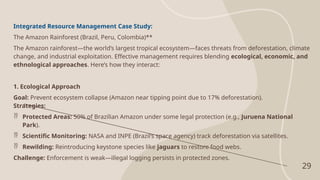
Integrated Resource Management Case Study:
The Amazon Rainforest (Brazil, Peru, Colombia)**
The Amazon rainforest—the world’s largest tropical ecosystem—faces threats from deforestation, climate
change, and industrial exploitation. Effective management requires blending ecological, economic, and
ethnological approaches. Here’s how they interact:
1. Ecological Approach
Goal: Prevent ecosystem collapse (Amazon near tipping point due to 17% deforestation).
Strategies:
 Protected Areas: 50% of Brazilian Amazon under some legal protection (e.g., Juruena National
Park).
 Scientific Monitoring: NASA and INPE (Brazil’s space agency) track deforestation via satellites.
 Rewilding: Reintroducing keystone species like jaguars to restore food webs.
Challenge: Enforcement is weak—illegal logging persists in protected zones.
30
Integrated Resource Management Case Study:
The Amazon Rainforest (Brazil, Peru, Colombia)**
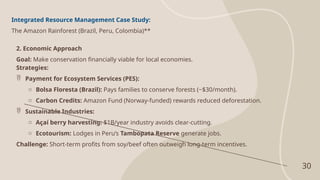
2. Economic Approach
Goal: Make conservation financially viable for local economies.
Strategies:
 Payment for Ecosystem Services (PES):
o Bolsa Floresta (Brazil): Pays families to conserve forests (~$30/month).
o Carbon Credits: Amazon Fund (Norway-funded) rewards reduced deforestation.
 Sustainable Industries:
o Açaí berry harvesting: $1B/year industry avoids clear-cutting.
o Ecotourism: Lodges in Peru’s Tambopata Reserve generate jobs.
Challenge: Short-term profits from soy/beef often outweigh long-term incentives.
31
Integrated Resource Management Case Study:
The Amazon Rainforest (Brazil, Peru, Colombia)**
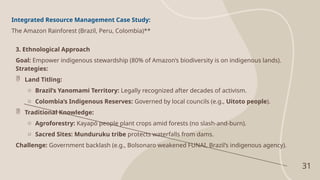
3. Ethnological Approach
Goal: Empower indigenous stewardship (80% of Amazon’s biodiversity is on indigenous lands).
Strategies:
 Land Titling:
o Brazil’s Yanomami Territory: Legally recognized after decades of activism.
o Colombia’s Indigenous Reserves: Governed by local councils (e.g., Uitoto people).
 Traditional Knowledge:
o Agroforestry: Kayapó people plant crops amid forests (no slash-and-burn).
o Sacred Sites: Munduruku tribe protects waterfalls from dams.
Challenge: Government backlash (e.g., Bolsonaro weakened FUNAI, Brazil’s indigenous agency).
32
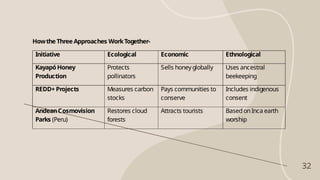
Howthe Three Approaches WorkTogether-
Initiative Ecological Economic Ethnological
Kayapó Honey
Production
Protects
pollinators
Sells honeyglobally Uses ancestral
beekeeping
REDD+ Projects Measures carbon
stocks
Pays communities to
conserve
Includes indigenous
consent
AndeanCosmovision
Parks (Peru)
Restores cloud
forests
Attracts tourists BasedonInca earth
worship
Thank You

Approaches in Natural Resource Management

  • 1.
    Approaches in Resource Management Md.Inzamul Haque mihaque.iu@gmail.com
  • 2.
    agenda INTRODUCTION Ecological Approaches Economic Approach EthnologicalApproach Comparison Integrated Resource Management Strategies: Balancing Ecology, Economics & Culture
  • 3.
    Resource management involvesthe sustainable utilization and conservation of natural resources to meet human needs while preserving ecosystems. Different approaches offer unique perspectives on how to achieve this balance. INTRODUCTION
  • 4.
    4 Ecological Approaches The ecologicalapproach to resource management prioritizes the health and sustainability of ecosystems, emphasizing that human resource use must operate within the limits of natural systems. This approach is rooted in ecological science and seeks to minimize environmental degradation while ensuring long-term resource availability.
  • 5.
    Ecological Approaches: KeyPrinciples 1. Sustainability & Carrying Capacity o Resources should be used at a rate that allows natural regeneration. o The concept of carrying capacity (maximum population an ecosystem can support without degradation) is central. 2. Biodiversity Conservation o Protecting species diversity ensures ecosystem resilience. o Keystone species (e.g., wolves, bees) are prioritized due to their critical role in ecosystems. 3. Ecosystem-Based Management (EBM) o Focuses on entire ecosystems rather than single species or resources. o Recognizes interconnectedness (e.g., forests influence water cycles, which affect fisheries). 4. Precautionary Principle o If an action risks severe harm to the environment, it should be avoided even if scientific certainty is lacking. 5. Ecological Thresholds & Tipping Points o Avoids pushing ecosystems beyond irreversible damage (e.g., coral reef bleaching, deforestation
  • 6.
    6 Methods & Strategiesin Ecological Resource Management 1. Protected Areas & Conservation Reserves  National Parks, Wildlife Sanctuaries: Strict protection of habitats.  Biosphere Reserves: Combines conservation with sustainable use in buffer zones.  Marine Protected Areas (MPAs): Safeguard marine biodiversity (e.g., Great Barrier Reef). 2. Habitat Restoration & Rewilding  Reforestation: Replanting trees to combat deforestation (e.g., Amazon restoration).  Wetland Rehabilitation: Restoring marshes to improve water filtration and flood control.  Rewilding: Reintroducing apex predators (e.g., wolves in Yellowstone) to restore balance.
  • 7.
    7 Methods & Strategiesin Ecological Resource Management 3. Sustainable Harvesting Practices  Maximum Sustainable Yield (MSY): Harvesting at a level that doesn’t deplete the resource (e.g., regulated fishing quotas).  Selective Logging: Cutting only mature trees while preserving young ones. 4. Pollution & Waste Management  Circular Economy: Minimizing waste by reusing/recycling materials.  Bioremediation: Using microorganisms to clean oil spills or contaminated soil. 5. Climate & Ecosystem Monitoring  Remote Sensing & GIS: Tracking deforestation, wildlife migration, and climate change impacts.  Citizen Science: Involving the public in data collection (e.g., bird counts, water quality testing).
  • 8.
    8 Advantages of theEcological Approach ✅ Long-term sustainability – Prevents resource depletion. ✅ Biodiversity protection – Maintains ecosystem services (pollination, clean water). ✅ Resilience to climate change – Healthy ecosystems adapt better. ✅ Scientific foundation – Uses data-driven policies rather than short-term economic gains. Criticisms & Challenges ❌ Economic trade-offs – Strict conservation may limit industries (logging, mining). ❌ Conflict with local communities – Protected areas may displace indigenous people. ❌ Implementation difficulties – Requires strong governance and enforcement. ❌ Uncertainty in ecological predictions – Ecosystems are complex and dynamic. Ecological Approaches: Advantages and Criticisms
  • 9.
    9 Ecological Approaches: CaseStudies 1. Yellowstone Wolf Reintroduction (USA, 1995) o Wolves were reintroduced to control elk populations, leading to forest regeneration and improved riverbank stability. 2. Costa Rica’s Payment for Ecosystem Services (PES) o Farmers are paid to conserve forests, increasing biodiversity while supporting livelihoods. 3. Great Green Wall (Africa) o A reforestation project to combat desertification in the Sahel region.
  • 10.
    Economic Approach The economicapproach to resource management focuses on optimizing the allocation and use of natural resources through market-based mechanisms, cost-benefit analysis, and policy incentives. It prioritizes efficiency, profitability, and sustainable economic growth while attempting to balance environmental concerns.
  • 11.
    11 1. Resource Scarcity& Opportunity Cost o Resources are limited, so their use must be optimized for maximum societal benefit. o Every resource allocation has an opportunity cost (what is sacrificed when choosing one use over another). 2. Market-Based Allocation o Prices reflect scarcity—when a resource becomes rare, its price rises, encouraging conservation or substitution. o Example: Rising oil prices lead to investment in renewable energy. 3. Cost-Benefit Analysis (CBA) o Decisions are based on comparing economic benefits (e.g., revenue from logging) with costs (e.g., loss of biodiversity). Key Principles of the Economic Approach
  • 12.
    12 Key Principles ofthe Economic Approach 4. Externalities & Market Failures 4. Negative externalities (e.g., pollution) occur when market prices don’t account for environmental damage. 5. Solutions include Pigovian taxes (carbon tax) or cap-and-trade systems. 5. Property Rights & the Tragedy of the Commons 4. Open-access resources (e.g., oceans, air) are prone to overuse (Hardin’s Tragedy of the Commons). 5. Solutions: Privatization, quotas, or community-based management. 6. Valuation of Ecosystem Services 4. Assigning economic value to nature (e.g., wetlands filter water, forests sequester carbon) helps justify conservation.
  • 13.
    13 Methods & Strategiesin Economic Resource Management 1. Market-Based Instruments  Cap-and-Trade (Emissions Trading) o Governments set a pollution limit (cap) and allow companies to trade permits (e.g., EU Carbon Market).  Green Taxes o Taxes on pollution (carbon tax) or resource extraction (timber taxes) to discourage overuse.  Subsidies for Sustainable Practices o Incentives for renewable energy (solar/wind tax credits) or organic farming. 2. Privatization & Property Rights  Assigning ownership (e.g., individual fishing quotas) can prevent overexploitation.  Example: New Zealand’s ITQ System (Individual Transferable Quotas) for fisheries. 3. Payment for Ecosystem Services (PES)  Paying landowners to conserve forests, wetlands, or wildlife habitats.  Example: Costa Rica’s PES program pays farmers to protect watersheds.
  • 14.
    14 Methods & Strategiesin Economic Resource Management 4. Sustainable Resource Pricing  Removing subsidies that encourage waste (e.g., fossil fuel subsidies).  Implementing full-cost pricing (including environmental damage in prices). 5. Technological Innovation & Efficiency  Precision agriculture reduces water/fertilizer use.  Circular economy promotes recycling and waste reduction.
  • 15.
    15 Economic Approaches: Advantagesand Criticisms Advantages of the Economic Approach ✅ Efficiency – Markets allocate resources where they are most valued. ✅ Innovation incentives – Higher prices drive technological solutions (e.g., renewable energy). ✅ Flexibility – Tradable permits and taxes adapt better than rigid regulations. ✅ Revenue generation – Taxes and permits fund environmental programs. Criticisms & Challenges ❌ Short-term focus – Profit motives may override long-term sustainability. ❌ Difficulty in valuing nature – Some ecosystem services (e.g., biodiversity) are hard to price. ❌ Inequity – Poor communities may bear the cost (e.g., higher energy prices from carbon taxes). ❌ Market failures – Without regulation, companies may exploit loopholes.
  • 16.
    16 Economic Approaches: CaseStudies 1. Norway’s Carbon Tax (1991)  One of the first countries to implement a carbon tax, reducing emissions while maintaining economic growth. 2. Individual Fishing Quotas (Iceland, New Zealand)  Prevented overfishing by assigning tradable quotas, stabilizing fish stocks. 3. California’s Cap-and-Trade Program (2013)  Reduced greenhouse gas emissions while generating billions for clean energy projects. 4. Germany’s Renewable Energy Transition (Energiewende)  Subsidies and feed-in tariffs boosted wind/solar power, reducing fossil fuel dependence.
  • 17.
    Ethnological Approach The ethnologicalapproach (also called the socio-cultural approach) emphasizes the role of traditional knowledge, cultural values, and indigenous practices in managing natural resources. Unlike purely ecological or economic methods, this approach prioritizes community participation, ancestral wisdom, and equitable resource governance.
  • 18.
    18 Key Principles ofthe Ethnological Approach 1. Indigenous & Local Knowledge (ILK) o Recognizes that indigenous peoples and local communities have centuries of adaptive knowledge about their ecosystems. o Examples:  Rotational farming (shifting cultivation) in Amazonia and Southeast Asia.  Sacred groves in India and Africa, where forests are protected for cultural reasons. 2. Community-Based Resource Management (CBRM) o Decision-making is decentralized, with local communities (not just governments or corporations) controlling resources. o Example: Community forests in Nepal, where villagers manage woodlands sustainably. 3. Cultural & Spiritual Values of Nature o Many cultures view nature as sacred, not just as an economic resource. o Example: Maori guardianship (kaitiakitanga) in New Zealand, where land is seen as an ancestor.
  • 19.
    19 Key Principles ofthe Ethnographic Approach 4. Participatory Governance & Co-Management 4. Governments and indigenous groups share responsibility for managing resources. 5. Example: Joint Inuit-government wildlife management in Canada. 5. Social Equity & Justice 4. Ensures marginalized groups (indigenous peoples, small-scale fishers) have fair access to resources. 5. Example: Land rights movements in Brazil protecting Amazon tribes from illegal logging.
  • 20.
    20 Methods & Strategiesin Ethnological Resource Management 1. Traditional Ecological Knowledge (TEK)  Indigenous fire management (Australia’s Aboriginal "cool burns" prevent wildfires).  Water harvesting systems (ancient stepwells in India, qanats in Iran). 2. Community Conservancies & Indigenous Reserves  Namibia’s communal conservancies – Locals manage wildlife tourism and anti-poaching.  Sámi reindeer herding cooperatives in Scandinavia. 3. Legal Recognition of Indigenous Rights  UN Declaration on the Rights of Indigenous Peoples (UNDRIP, 2007).  Land titling programs (e.g., Bolivia’s TCOs – Original Community Lands). 4. Ethnobiology & Biocultural Conservation  Studying how cultures classify and use biodiversity (e.g., medicinal plants in Ayurveda).  Protecting heirloom crop varieties maintained by indigenous farmers. 5. Conflict Resolution & Mediation  Resolving disputes between governments, corporations, and indigenous groups.  Example: Ecuador’s court cases on oil drilling in indigenous territories.
  • 21.
    21 Ethnological Approaches: Advantagesand Criticisms ✅ Sustainable practices – Many indigenous systems have maintained ecosystems for millennia. ✅ Social inclusion – Empowers marginalized groups in decision-making. ✅ Cost-effective – Often cheaper than high-tech conservation methods. ✅ Cultural preservation – Protects languages, traditions, and heritage linked to nature. Criticisms & Challenges ❌ Marginalization by governments – Indigenous knowledge is often ignored in policy. ❌ Scaling difficulties – Hard to apply traditional methods in large industrial economies. ❌ Modernization pressures – Younger generations may abandon traditional practices. ❌ Legal conflicts – Governments may resist granting land rights to indigenous groups.
  • 22.
    22 Ethnological Approaches: CaseStudies 1. The Guna Yala (Panama) – Autonomous Indigenous Governance  The Guna people manage their coastal and forest resources autonomously, protecting coral reefs and mangroves. 2. Māori Fisheries (New Zealand) – Treaty-Based Co-Management  The Treaty of Waitangi ensures Māori participation in fishing quota systems. 3. Satoyama (Japan) – Traditional Agroforestry  A mix of rice paddies, woodlands, and grasslands maintained for centuries. 4. Kayapó Amazon Warriors (Brazil) – Indigenous-Led Conservation  The Kayapó use drones and GPS to monitor illegal logging in their territory.
  • 23.
    Comparison of Ecological,Economic, and Ethnological Approaches to Resource Management 23 Aspect Ecological Approach Economic Approach Ethnological Approach Primary Focus Ecosystem health, biodiversity, sustainability Efficient resource allocation, market-driven solutions Cultural values, traditional knowledge, community rights Key Principles - Carrying capacity - Biodiversity conservation - Precautionary principle - Cost-benefit analysis - Market incentives - Property rights - Indigenous knowledge - Participatory governance - Social equity Management Tools - Protected areas - Habitat restoration - Species monitoring - Taxes/subsidies - Cap-and-trade - Privatization - Community co-management - Sacred natural sites - Traditional practices Strengths - Long-term sustainability - Science-based - Prevents ecosystem collapse - Cost-efficient - Encourages innovation - Flexible policies - Socially inclusive - Preserves cultural heritage - Locally adaptive Weaknesses - May restrict economic growth - Requires strict enforcement - Can ignore human needs - Short-term profit focus - May exploit marginalized groups - Hard to value ecosystems - Difficult to scale - Lacks formal policy support - Generational knowledge loss Case Examples - Yellowstone wolf reintroduction - Costa Rica’s reforestation - Norway’s carbon tax - New Zealand’s fishing quotas - Māori kaitiakitanga (NZ) - Guna Yala autonomy (Panama)
  • 24.
    24 Integrated Resource Management Strategies:Balancing Ecology, Economics & Culture Effective resource management requires blending ecological sustainability, economic viability, and cultural equity. Below are key strategies to integrate these approaches, with real-world examples. 1. Policy & Governance Integration Strategy: Combine legal frameworks from all three approaches. Examples:  Brazil’s Socio-Environmental Zoning (ZSEE): o Ecological: Protects critical biodiversity corridors. o Economic: Designates sustainable-use zones (e.g., agroforestry). o Ethnological: Recognizes indigenous territories (e.g., Xingu Indigenous Park).  EU’s Deforestation Regulation (2023): o Bans imports linked to deforestation, forcing economic compliance with ecological/ethnological standards. Tool: Triple-Bottom-Line (TBL) Reporting – Companies must disclose environmental, social, and financial impacts.
  • 25.
    25 Integrated Resource Management Strategies:Balancing Ecology, Economics & Culture 2. Market-Based Conservation Strategy: Use economic incentives to fund ecological/ethnological goals. Examples:  Ecuador’s Yasuní-ITT Initiative (Failed but instructive): o Proposed leaving oil underground (ecological) in exchange for international payments (economic), with indigenous consent (ethnological).  Kenya’s Wildlife Conservancies: o Tourism revenue (economic) funds conservation (ecological) and Maasai land leases (ethnological). Tool: Biodiversity Credits – Like carbon credits, but for habitat protection.
  • 26.
    26 Integrated Resource Management Strategies:Balancing Ecology, Economics & Culture 3. Community-Led Co-Management Strategy: Share decision-making between governments, locals, and scientists. Examples:  Canada’s Great Bear Rainforest Agreement: o Logging quotas (economic) set alongside indigenous-led monitoring (ethnological) and grizzly bear protections (ecological).  Namibia’s Community Forests: o Villagers profit from sustainable hunting (economic), restoring wildlife (ecological) using traditional tracking (ethnological). Tool: Participatory GIS Mapping – Communities map resources using tech + traditional knowledge.
  • 27.
    27 Integrated Resource Management Strategies:Balancing Ecology, Economics & Culture 4. Technology + Traditional Knowledge Fusion Strategy: Merge modern science with indigenous practices. Examples:  Australia’s Indigenous Fire Management: o Satellite-guided “cool burns” (ecological) mimic Aboriginal practices (ethnological) to cut wildfire costs (economic).  Peru’s Potato Park: o Scientists and Quechua farmers (ethnological) use gene banks (ecological) to climate-proof crops, selling native varieties (economic). Tool: Mobile Apps for Indigenous Monitoring – e.g., Forest Watcher used by Borneo tribes. 5. Conflict Resolution Mechanisms Strategy: Mediate clashes between stakeholders. Examples:  Norway-Sámi Reindeer Herding Agreements: o Compensates herders (ethnological) when wind farms (economic) disrupt migration routes (ecological).  Philippines’ Mangrove Conflicts: o Shrimp farms (economic) must partner with coastal communities (ethnological) to replant mangroves (ecological).
  • 28.
    28 Integrated Resource Management Strategies:Balancing Ecology, Economics & Culture Case Examples-  Bhutan’s Gross National Happiness Model (Balances ecology/economy/culture)  Senegal’s Community-Managed Fisheries  Greenland’s Inuit-led Mineral Governance
  • 29.
    29 Integrated Resource ManagementCase Study: The Amazon Rainforest (Brazil, Peru, Colombia)** The Amazon rainforest—the world’s largest tropical ecosystem—faces threats from deforestation, climate change, and industrial exploitation. Effective management requires blending ecological, economic, and ethnological approaches. Here’s how they interact: 1. Ecological Approach Goal: Prevent ecosystem collapse (Amazon near tipping point due to 17% deforestation). Strategies:  Protected Areas: 50% of Brazilian Amazon under some legal protection (e.g., Juruena National Park).  Scientific Monitoring: NASA and INPE (Brazil’s space agency) track deforestation via satellites.  Rewilding: Reintroducing keystone species like jaguars to restore food webs. Challenge: Enforcement is weak—illegal logging persists in protected zones.
  • 30.
    30 Integrated Resource ManagementCase Study: The Amazon Rainforest (Brazil, Peru, Colombia)** 2. Economic Approach Goal: Make conservation financially viable for local economies. Strategies:  Payment for Ecosystem Services (PES): o Bolsa Floresta (Brazil): Pays families to conserve forests (~$30/month). o Carbon Credits: Amazon Fund (Norway-funded) rewards reduced deforestation.  Sustainable Industries: o Açaí berry harvesting: $1B/year industry avoids clear-cutting. o Ecotourism: Lodges in Peru’s Tambopata Reserve generate jobs. Challenge: Short-term profits from soy/beef often outweigh long-term incentives.
  • 31.
    31 Integrated Resource ManagementCase Study: The Amazon Rainforest (Brazil, Peru, Colombia)** 3. Ethnological Approach Goal: Empower indigenous stewardship (80% of Amazon’s biodiversity is on indigenous lands). Strategies:  Land Titling: o Brazil’s Yanomami Territory: Legally recognized after decades of activism. o Colombia’s Indigenous Reserves: Governed by local councils (e.g., Uitoto people).  Traditional Knowledge: o Agroforestry: Kayapó people plant crops amid forests (no slash-and-burn). o Sacred Sites: Munduruku tribe protects waterfalls from dams. Challenge: Government backlash (e.g., Bolsonaro weakened FUNAI, Brazil’s indigenous agency).
  • 32.
    32 Howthe Three ApproachesWorkTogether- Initiative Ecological Economic Ethnological Kayapó Honey Production Protects pollinators Sells honeyglobally Uses ancestral beekeeping REDD+ Projects Measures carbon stocks Pays communities to conserve Includes indigenous consent AndeanCosmovision Parks (Peru) Restores cloud forests Attracts tourists BasedonInca earth worship
  • 33.