Risks Threats and Vulnerabilities
The Fundamentals of R-T-A
Agenda
• Analysis vs. Assessment
• Risks
• Threats
• Vulnerability
• The Flow of R-T-A
Analysis vs. Assessment
• An assessment is more of a general
comparison of something to a standard,
or between two something; which is
better, more correct, which is closer to
the color teal.
• An analysis requires deep scrutiny and
calculated measuring and recording of
criteria.
• An assessment is not exact, an analysis
is more precise and less general than an
assessment.
HAZARDS
• Existing condition or possible (under
current conditions) situation that has the
potential to generate a disaster
• Natural hazards – naturally occurring
phenomena – weather, topographic,
geological, hydrological, etc.
• Human systems developed – caused by
human activity, infrastructure,
transportation, etc.
• Conflict based – civil war, terrorism,
nuclear war, etc.
HAZARDS - Examples
• Hurricanes and tornadoes during
their seasons
• Earthquakes
• High hazard, poorly maintained
dams
• Airlines with abysmal safety
records
• Power production systems with
either dangerous technologies or
poorly maintained transmission
systems
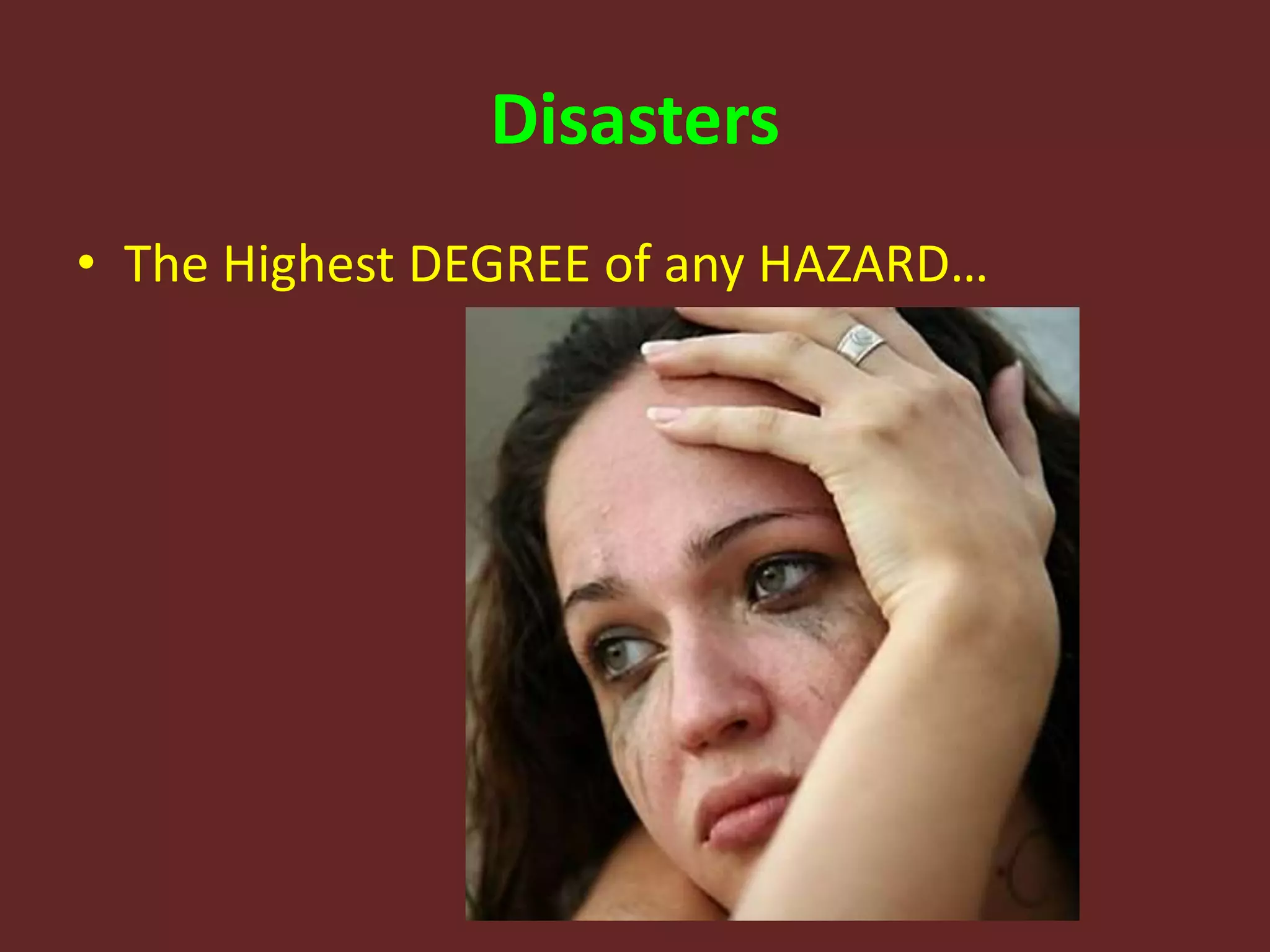
Disasters
• The Highest DEGREE of any HAZARD…
Risk
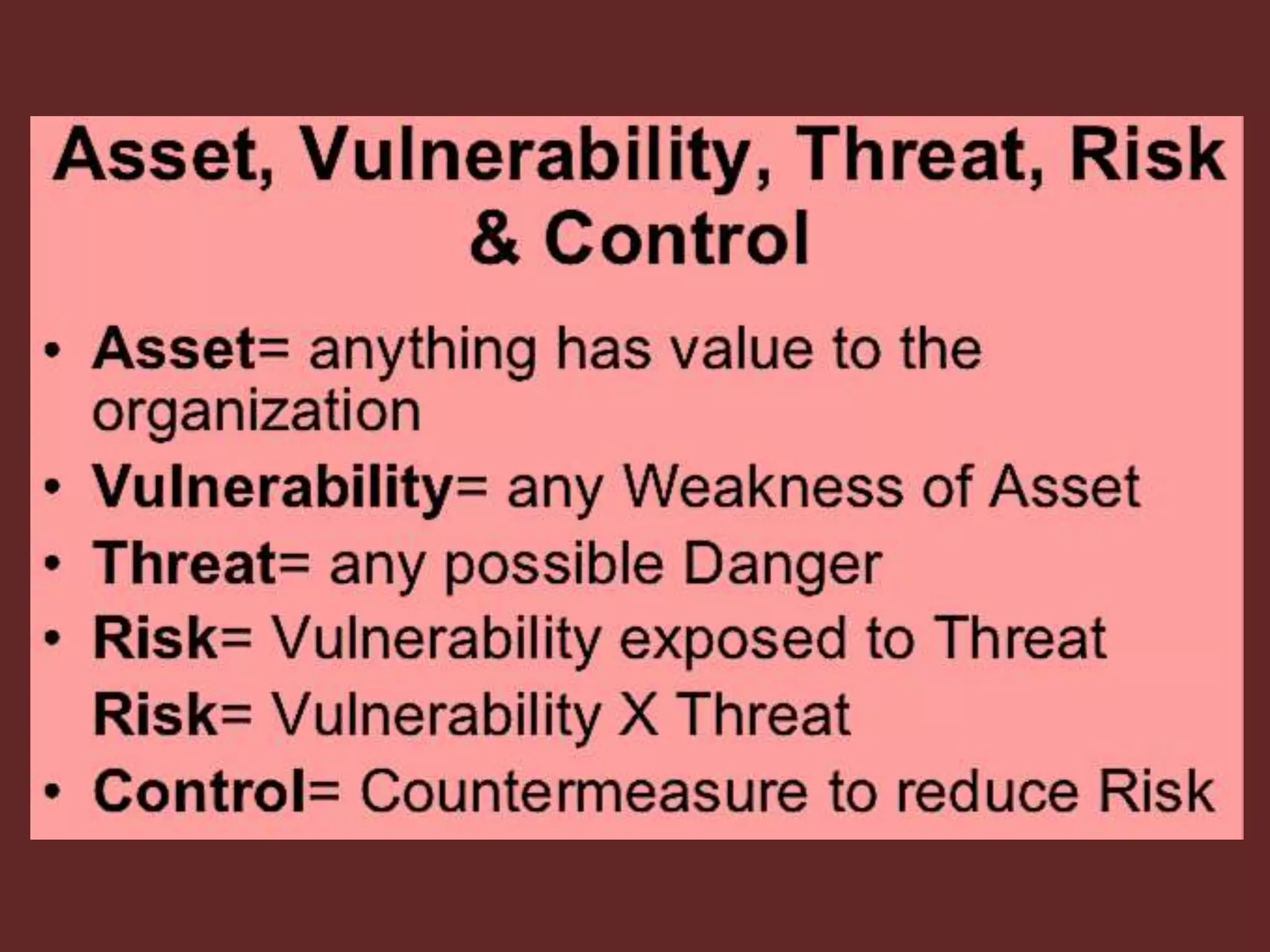
• The probability that a particular threat will
exploit a particular vulnerability
• Need to systematically understand risks to a
system and decide how to control them.
• Risk = Probability x Impact
Examples of Risk
• Overreliance on security monitoring software
• Inadequate system logging
• Technology innovations that outpace security
• Outdated operating systems
• Lack of encryption
• Data on user-owned mobile devices
• IT “diplomatic immunity” within your organization
• Lack of management support
• Challenges recruiting and retaining qualified IT staff
• Segregation of duties
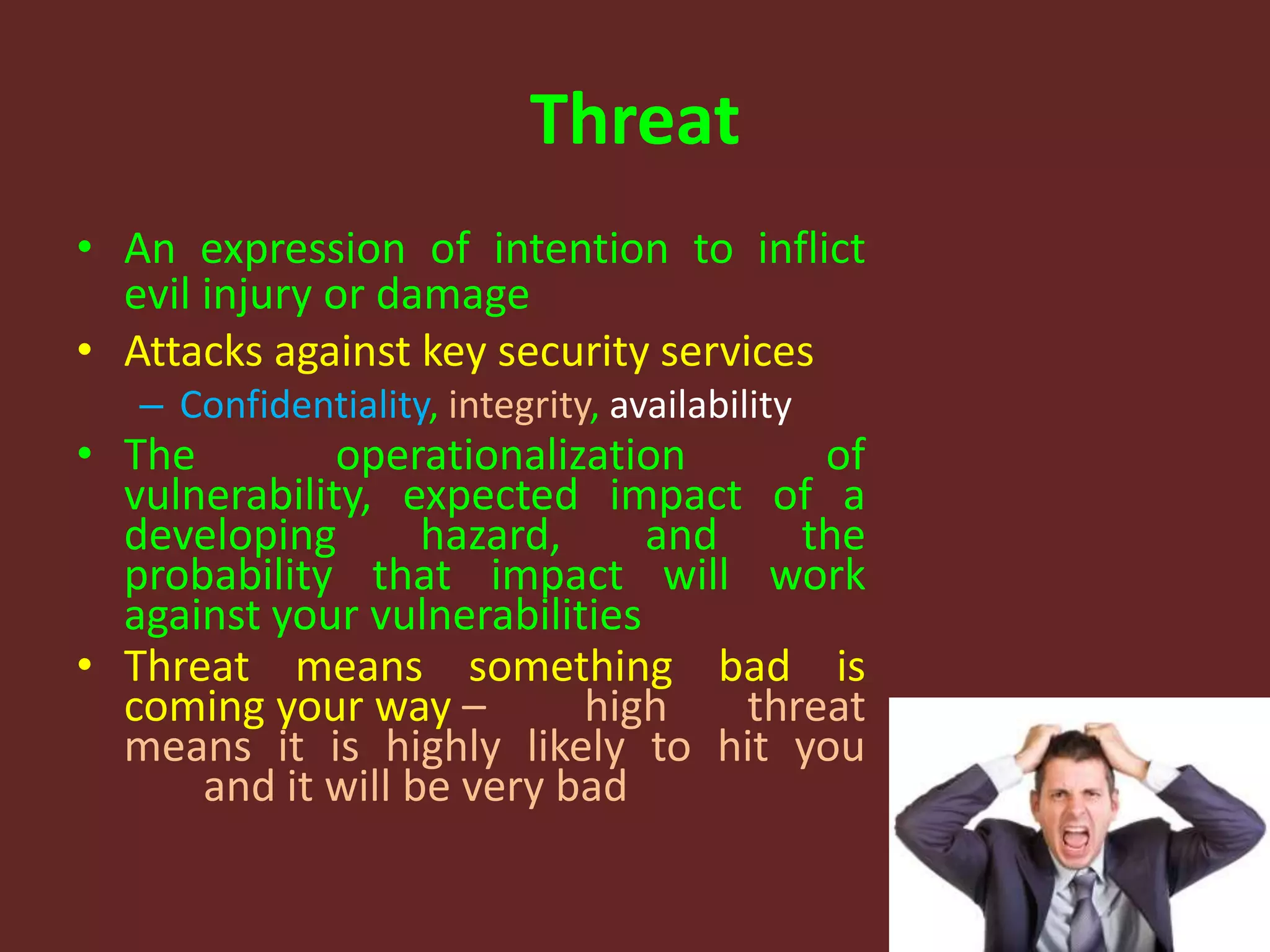
Threat
• An expression of intention to inflict
evil injury or damage
• Attacks against key security services
– Confidentiality, integrity, availability
• The operationalization of
vulnerability, expected impact of a
developing hazard, and the
probability that impact will work
against your vulnerabilities
• Threat means something bad is
coming your way – high threat
means it is highly likely to hit you
and it will be very bad
Slide #10
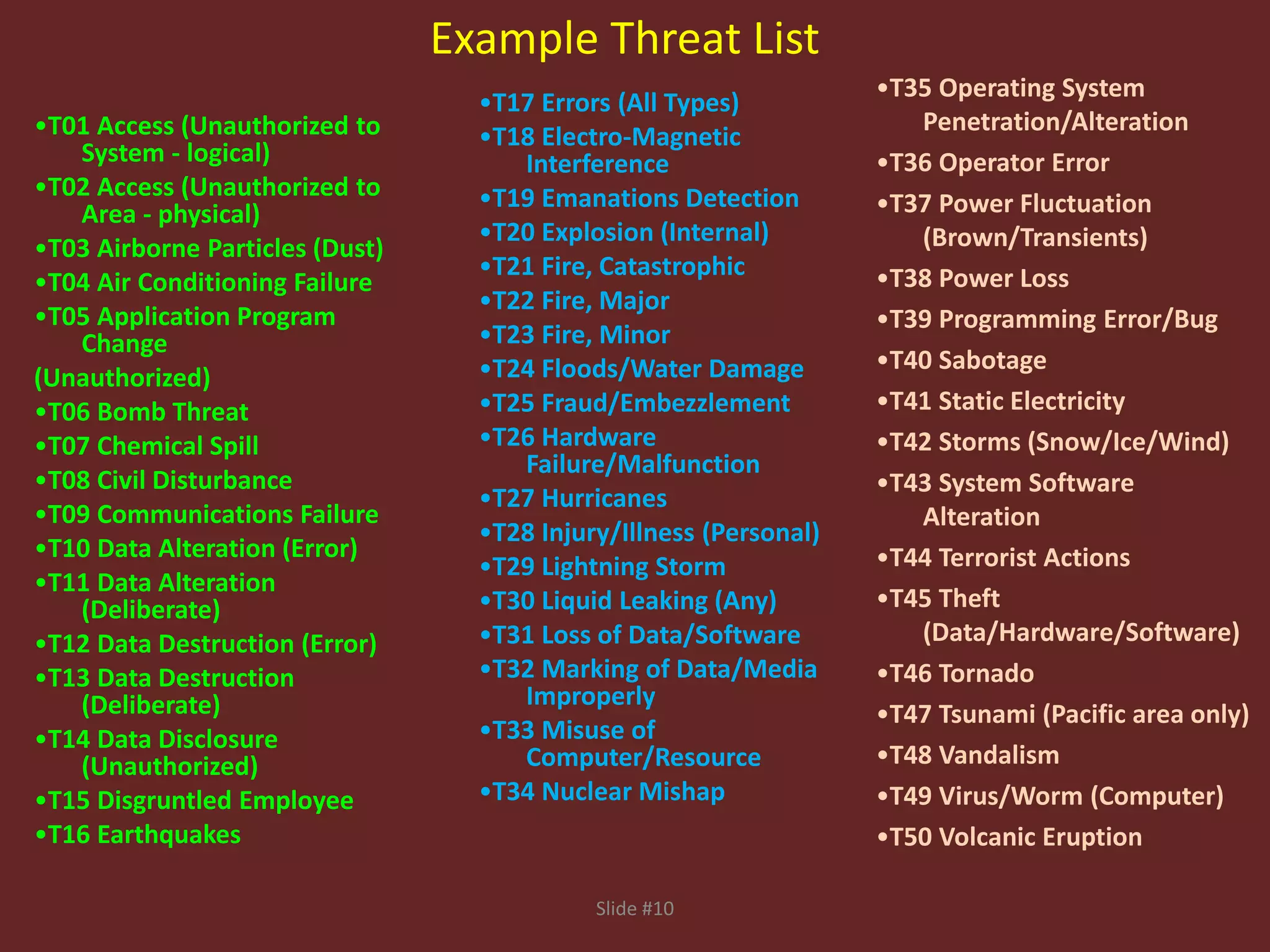
Example Threat List
•T01 Access (Unauthorized to
System - logical)
•T02 Access (Unauthorized to
Area - physical)
•T03 Airborne Particles (Dust)
•T04 Air Conditioning Failure
•T05 Application Program
Change
(Unauthorized)
•T06 Bomb Threat
•T07 Chemical Spill
•T08 Civil Disturbance
•T09 Communications Failure
•T10 Data Alteration (Error)
•T11 Data Alteration
(Deliberate)
•T12 Data Destruction (Error)
•T13 Data Destruction
(Deliberate)
•T14 Data Disclosure
(Unauthorized)
•T15 Disgruntled Employee
•T16 Earthquakes
•T17 Errors (All Types)
•T18 Electro-Magnetic
Interference
•T19 Emanations Detection
•T20 Explosion (Internal)
•T21 Fire, Catastrophic
•T22 Fire, Major
•T23 Fire, Minor
•T24 Floods/Water Damage
•T25 Fraud/Embezzlement
•T26 Hardware
Failure/Malfunction
•T27 Hurricanes
•T28 Injury/Illness (Personal)
•T29 Lightning Storm
•T30 Liquid Leaking (Any)
•T31 Loss of Data/Software
•T32 Marking of Data/Media
Improperly
•T33 Misuse of
Computer/Resource
•T34 Nuclear Mishap
•T35 Operating System
Penetration/Alteration
•T36 Operator Error
•T37 Power Fluctuation
(Brown/Transients)
•T38 Power Loss
•T39 Programming Error/Bug
•T40 Sabotage
•T41 Static Electricity
•T42 Storms (Snow/Ice/Wind)
•T43 System Software
Alteration
•T44 Terrorist Actions
•T45 Theft
(Data/Hardware/Software)
•T46 Tornado
•T47 Tsunami (Pacific area only)
•T48 Vandalism
•T49 Virus/Worm (Computer)
•T50 Volcanic Eruption
Slide #11
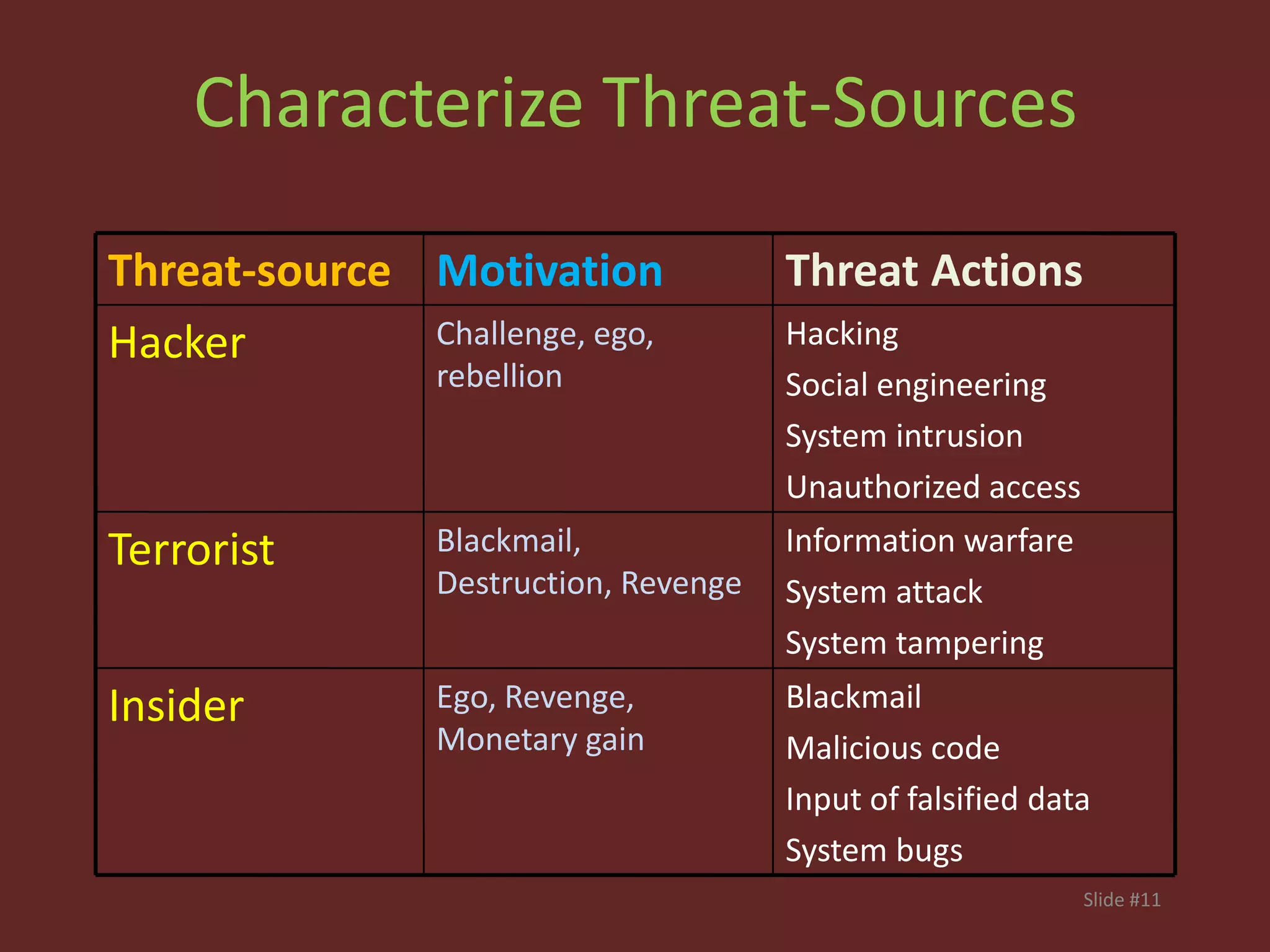
Characterize Threat-Sources
Blackmail
Malicious code
Input of falsified data
System bugs
Ego, Revenge,
Monetary gain
Insider
Information warfare
System attack
System tampering
Blackmail,
Destruction, Revenge
Terrorist
Hacking
Social engineering
System intrusion
Unauthorized access
Challenge, ego,
rebellion
Hacker
Threat ActionsMotivationThreat-source
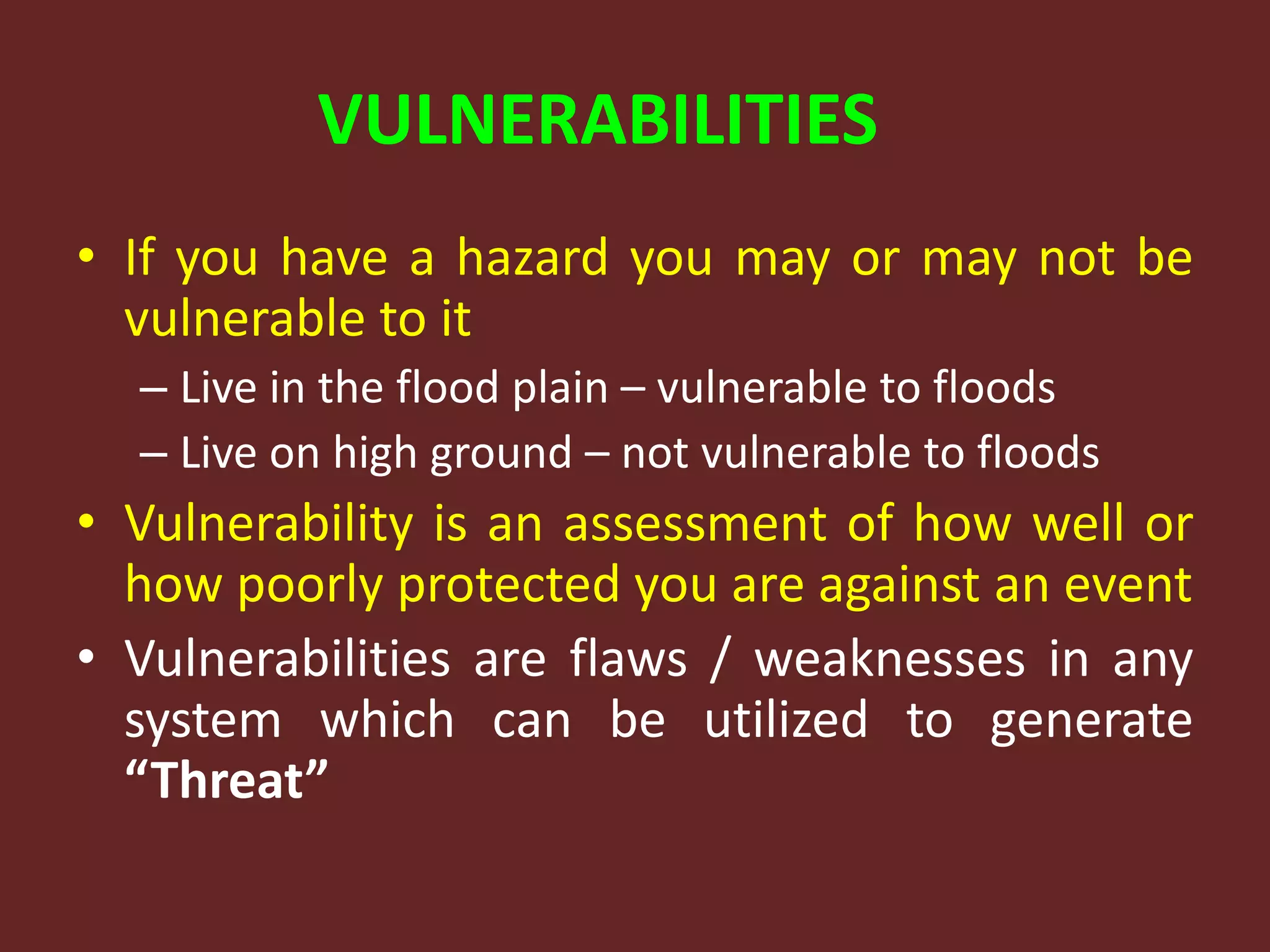
VULNERABILITIES
• If you have a hazard you may or may not be
vulnerable to it
– Live in the flood plain – vulnerable to floods
– Live on high ground – not vulnerable to floods
• Vulnerability is an assessment of how well or
how poorly protected you are against an event
• Vulnerabilities are flaws / weaknesses in any
system which can be utilized to generate
“Threat”
Slide #13
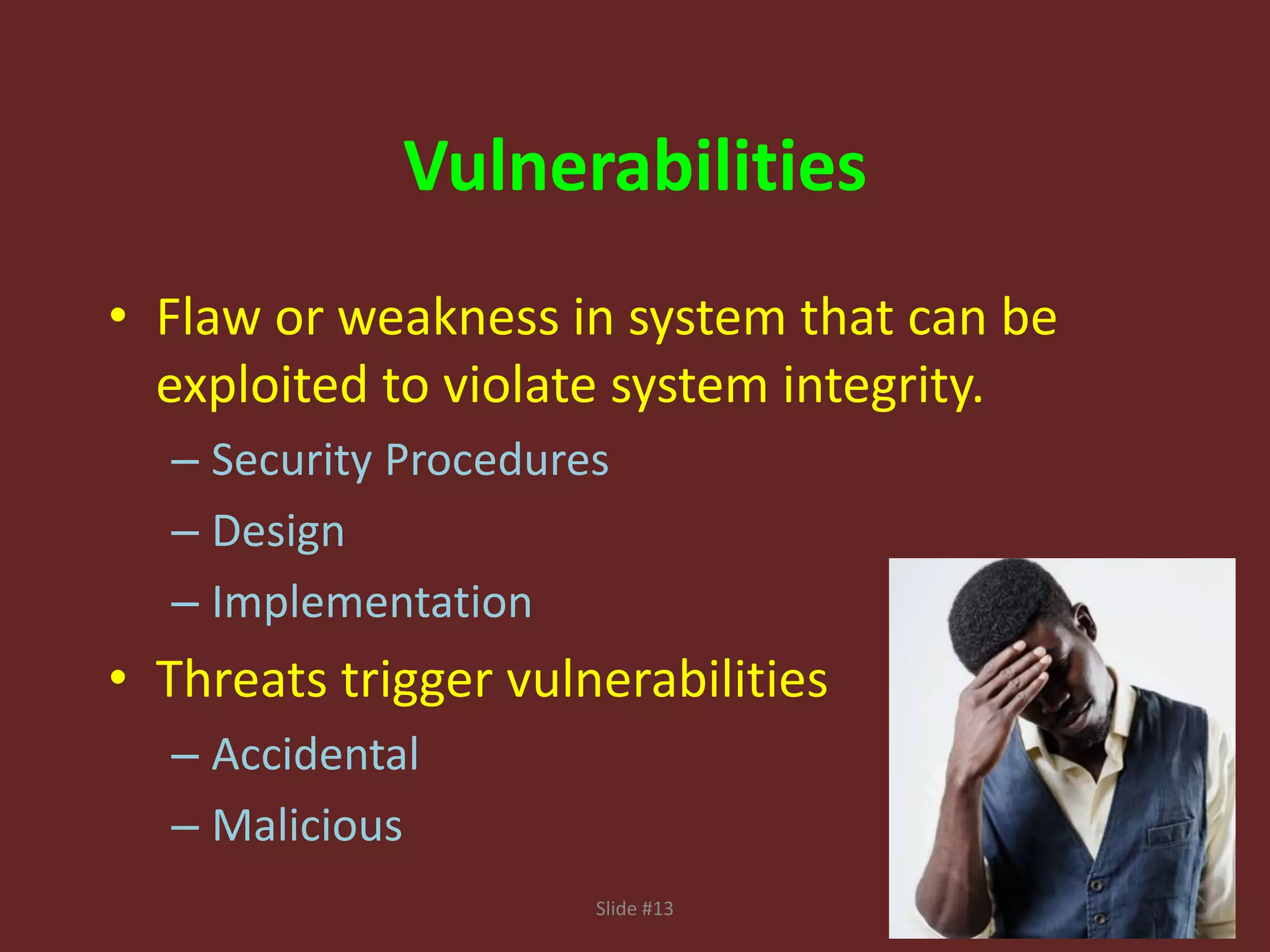
Vulnerabilities
• Flaw or weakness in system that can be
exploited to violate system integrity.
– Security Procedures
– Design
– Implementation
• Threats trigger vulnerabilities
– Accidental
– Malicious
VULNERABILITIES
• Vulnerabilities may be reduced by mitigation
measures (building construction, land use
control, maintenance, etc.)
• Or by the level of preparedness you have
achieved (well trained and equipped
emergency teams, plans, exercises, etc.)
Factors influencing VULNERABILITY
• Three factors may influence the determination
of vulnerability
– Criticality – how important is the asset or function
that is subject to impact
– Exposure – to how much of the force of the event
is the resource exposed
– Time – does vulnerability fluctuate over time of
day, month, season?
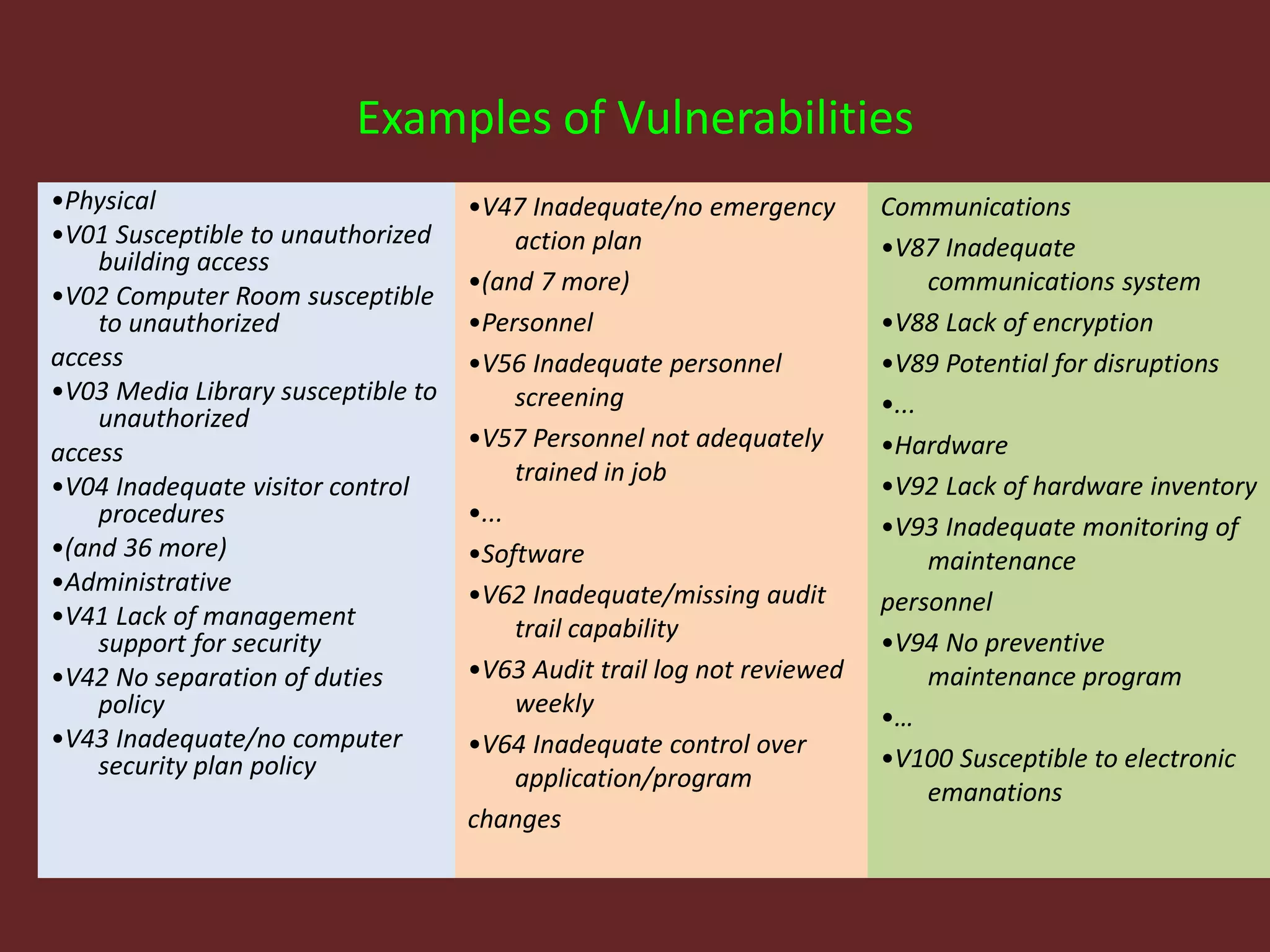
Examples of Vulnerabilities
•Physical
•V01 Susceptible to unauthorized
building access
•V02 Computer Room susceptible
to unauthorized
access
•V03 Media Library susceptible to
unauthorized
access
•V04 Inadequate visitor control
procedures
•(and 36 more)
•Administrative
•V41 Lack of management
support for security
•V42 No separation of duties
policy
•V43 Inadequate/no computer
security plan policy
•V47 Inadequate/no emergency
action plan
•(and 7 more)
•Personnel
•V56 Inadequate personnel
screening
•V57 Personnel not adequately
trained in job
•...
•Software
•V62 Inadequate/missing audit
trail capability
•V63 Audit trail log not reviewed
weekly
•V64 Inadequate control over
application/program
changes
Communications
•V87 Inadequate
communications system
•V88 Lack of encryption
•V89 Potential for disruptions
•...
•Hardware
•V92 Lack of hardware inventory
•V93 Inadequate monitoring of
maintenance
personnel
•V94 No preventive
maintenance program
•…
•V100 Susceptible to electronic
emanations
IMPACT
• Assessment of interaction of
hazard effects with your
vulnerabilities
• Scalar based on the two key
variables – hazard strength and
vulnerability level
• Will be hazard specific in
aggregate (hurricane impacts),
but may be functionally common
to a variety of hazards in the
specific (power loss)
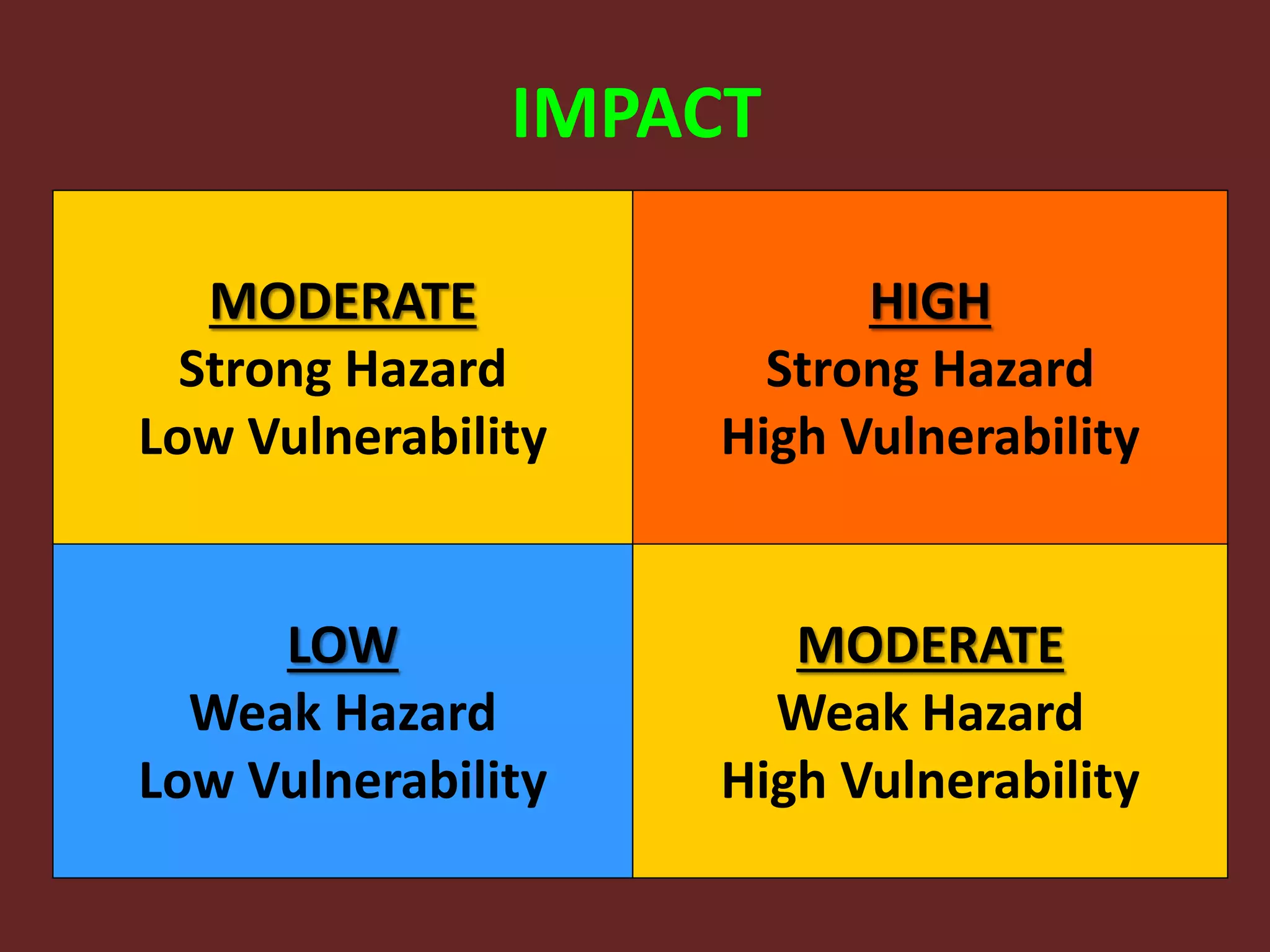
IMPACT
HIGH
Strong Hazard
High Vulnerability
MODERATE
Strong Hazard
Low Vulnerability
MODERATE
Weak Hazard
High Vulnerability
LOW
Weak Hazard
Low Vulnerability
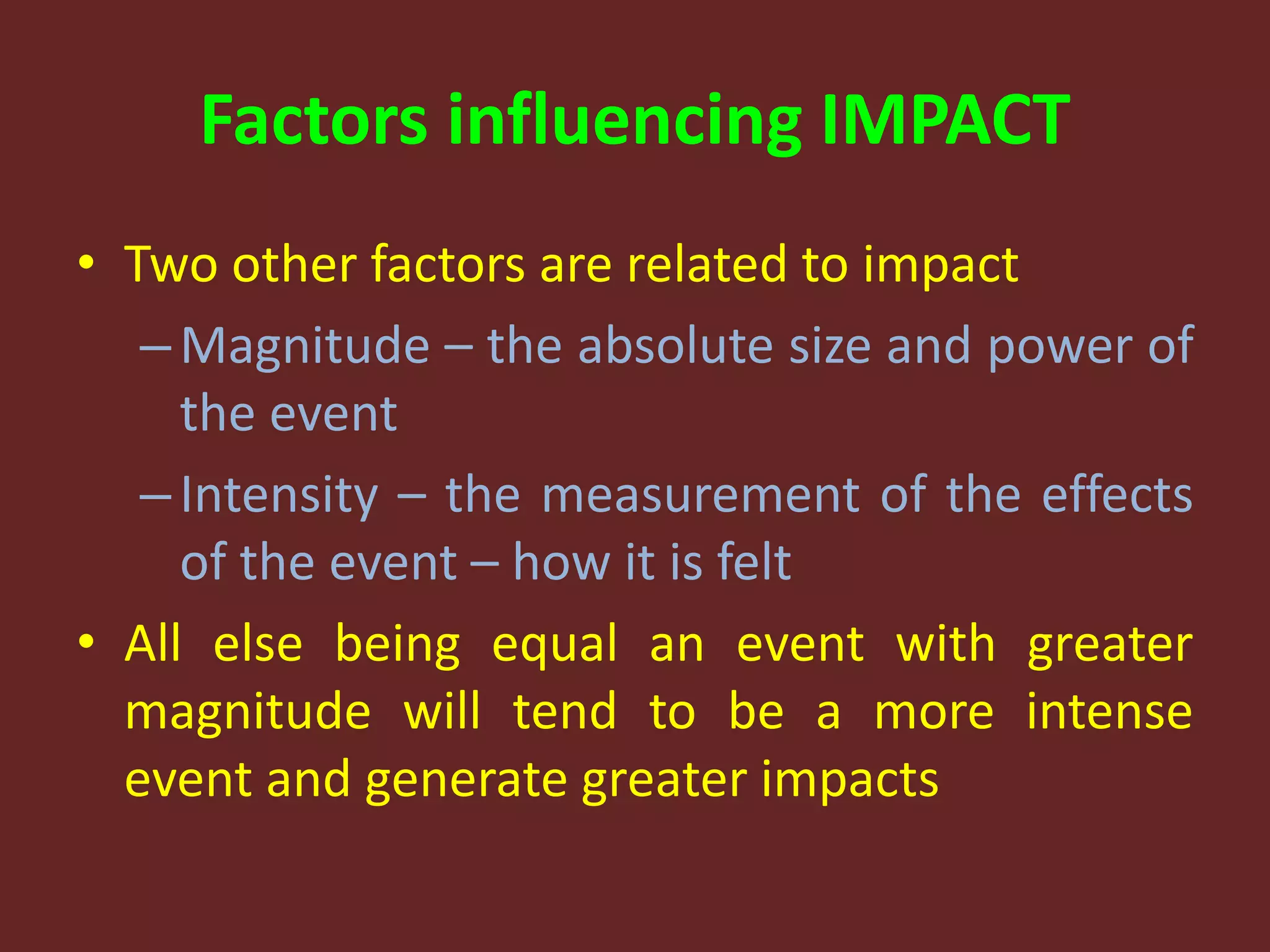
Factors influencing IMPACT
• Two other factors are related to impact
–Magnitude – the absolute size and power of
the event
–Intensity – the measurement of the effects
of the event – how it is felt
• All else being equal an event with greater
magnitude will tend to be a more intense
event and generate greater impacts
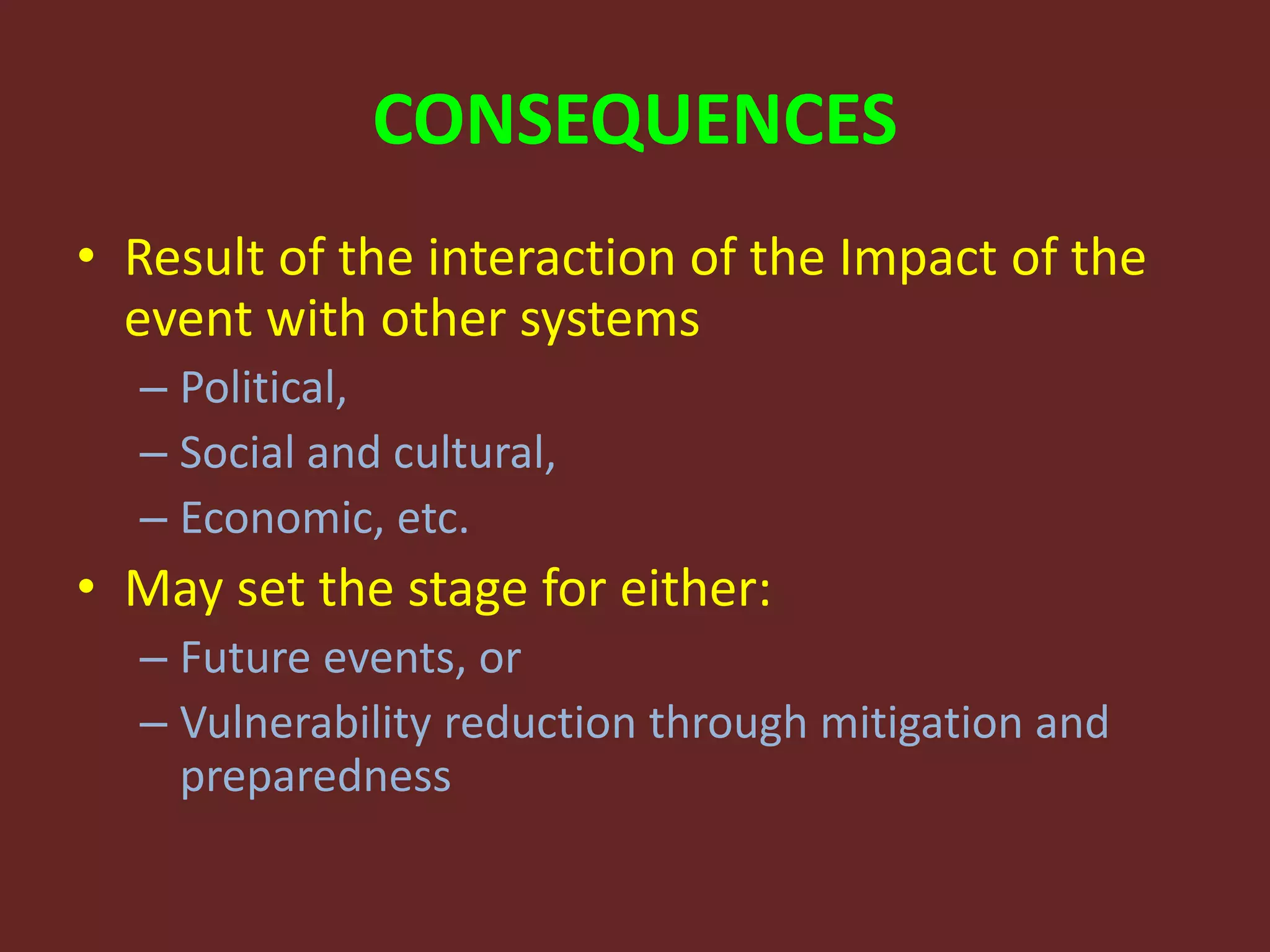
CONSEQUENCES
• Result of the interaction of the Impact of the
event with other systems
– Political,
– Social and cultural,
– Economic, etc.
• May set the stage for either:
– Future events, or
– Vulnerability reduction through mitigation and
preparedness
CONSEQUENCES
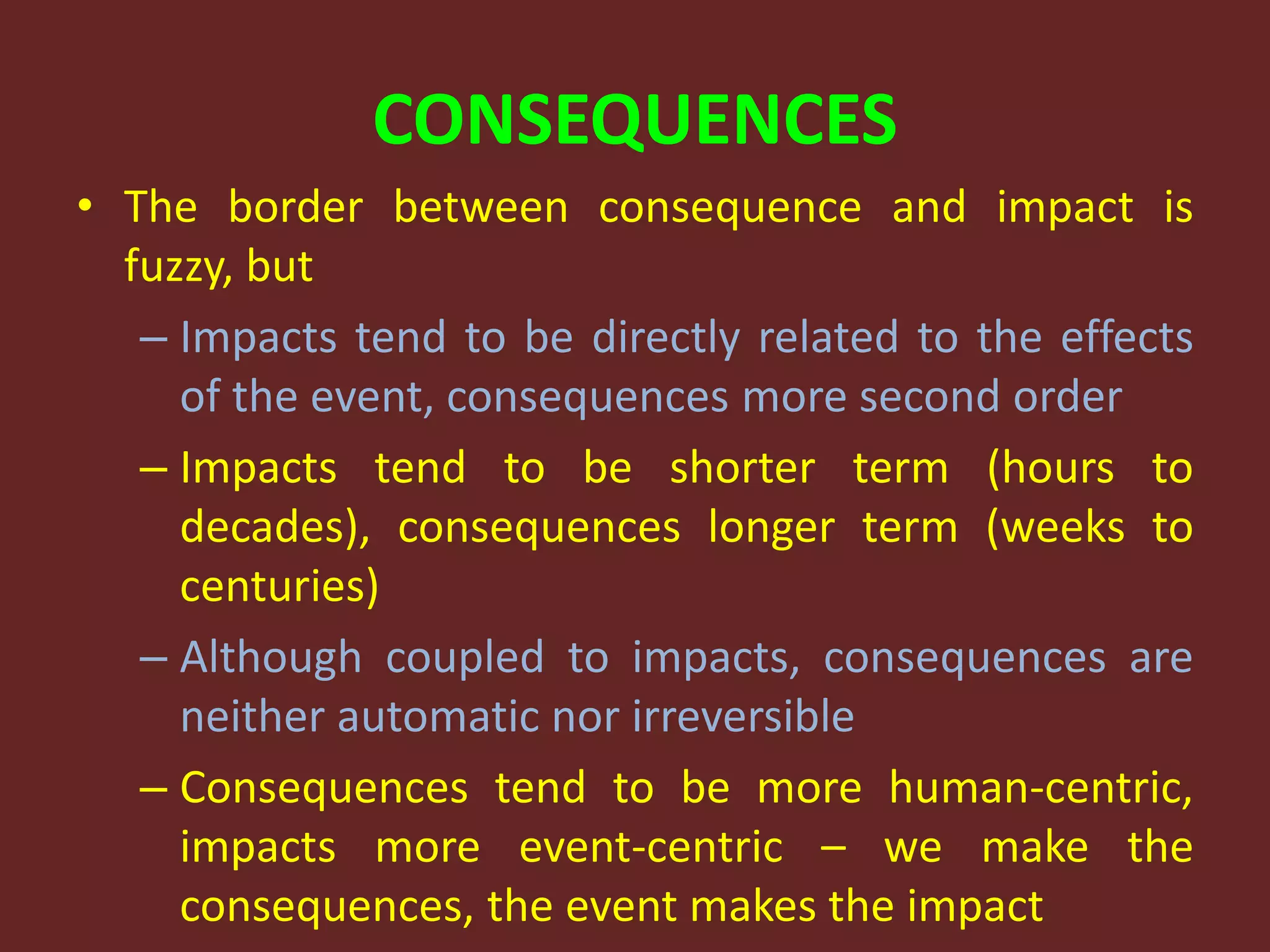
• The border between consequence and impact is
fuzzy, but
– Impacts tend to be directly related to the effects
of the event, consequences more second order
– Impacts tend to be shorter term (hours to
decades), consequences longer term (weeks to
centuries)
– Although coupled to impacts, consequences are
neither automatic nor irreversible
– Consequences tend to be more human-centric,
impacts more event-centric – we make the
consequences, the event makes the impact
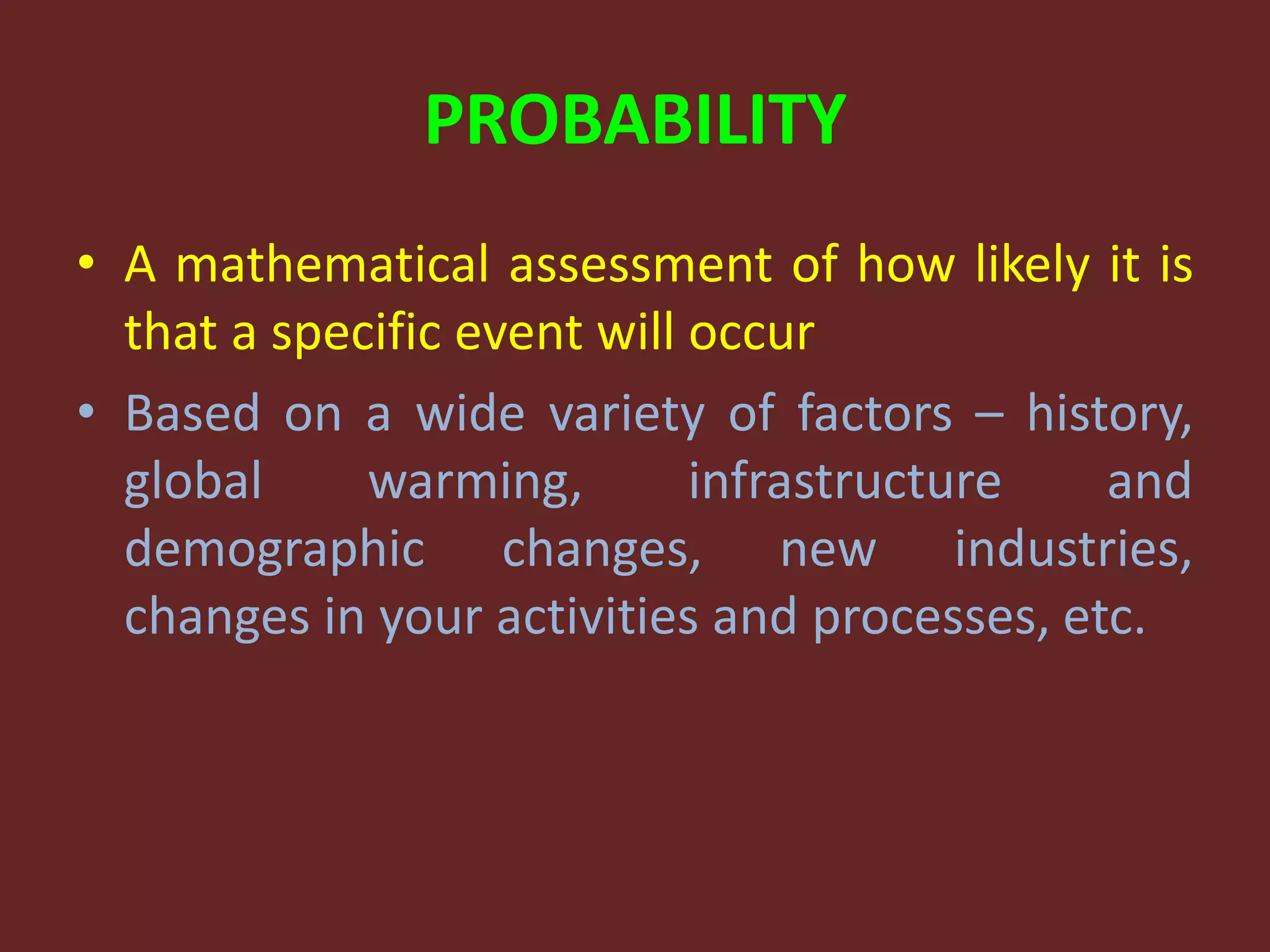
PROBABILITY
• A mathematical assessment of how likely it is
that a specific event will occur
• Based on a wide variety of factors – history,
global warming, infrastructure and
demographic changes, new industries,
changes in your activities and processes, etc.
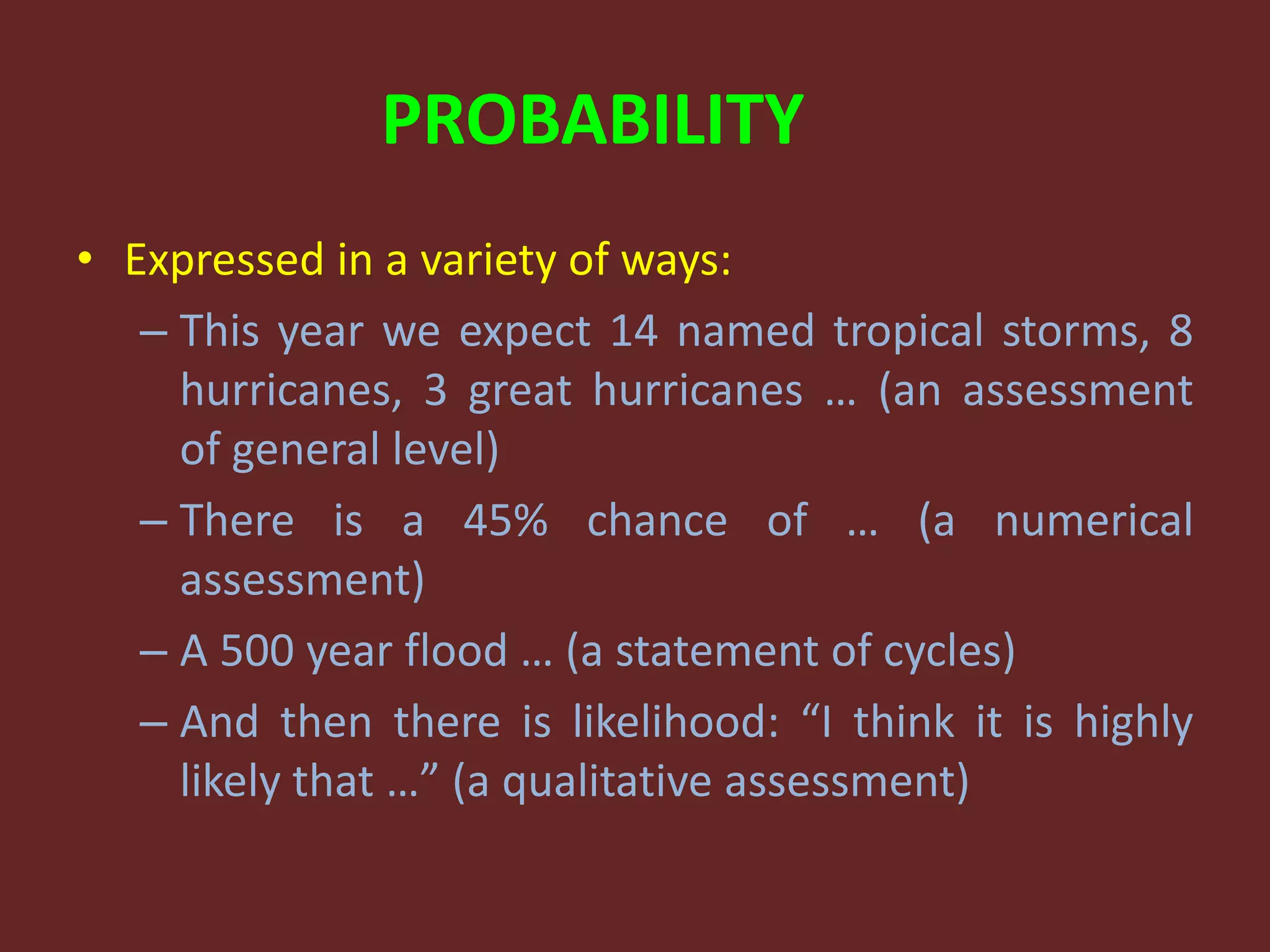
PROBABILITY
• Expressed in a variety of ways:
– This year we expect 14 named tropical storms, 8
hurricanes, 3 great hurricanes … (an assessment
of general level)
– There is a 45% chance of … (a numerical
assessment)
– A 500 year flood … (a statement of cycles)
– And then there is likelihood: “I think it is highly
likely that …” (a qualitative assessment)
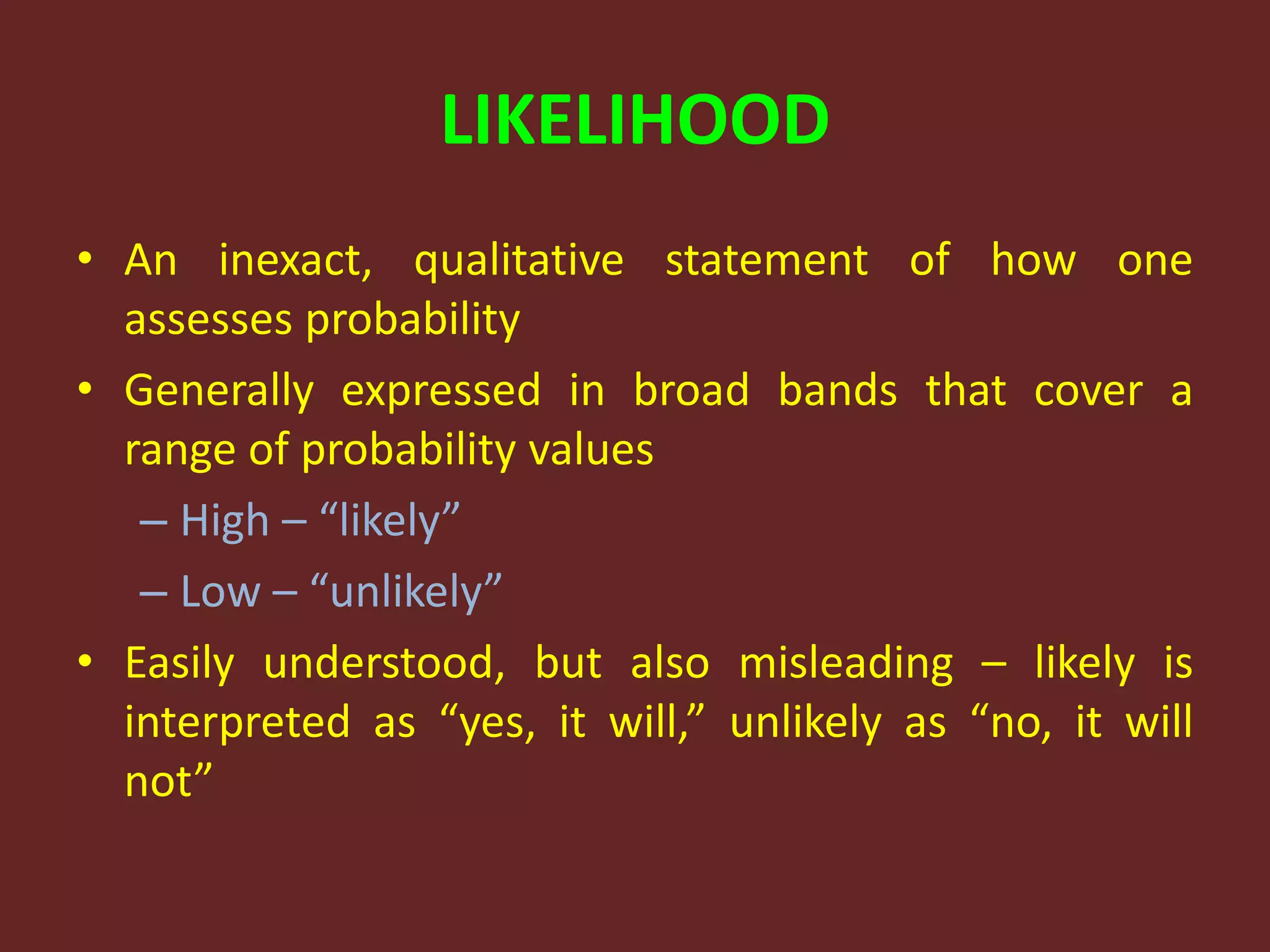
LIKELIHOOD
• An inexact, qualitative statement of how one
assesses probability
• Generally expressed in broad bands that cover a
range of probability values
– High – “likely”
– Low – “unlikely”
• Easily understood, but also misleading – likely is
interpreted as “yes, it will,” unlikely as “no, it will
not”
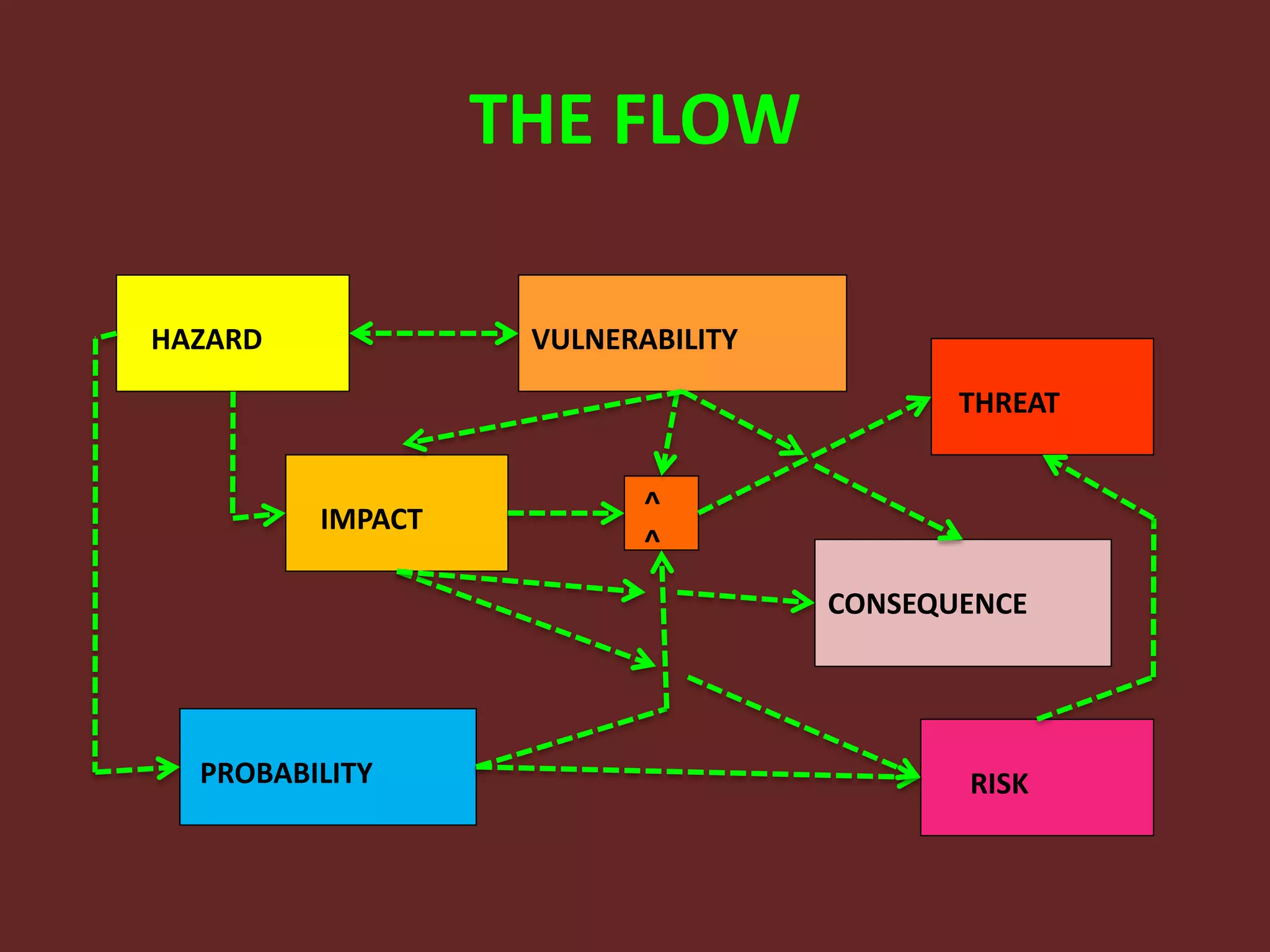
THE FLOW
HAZARD VULNERABILITY
THREAT
IMPACT
PROBABILITY
^
^
RISK
CONSEQUENCE
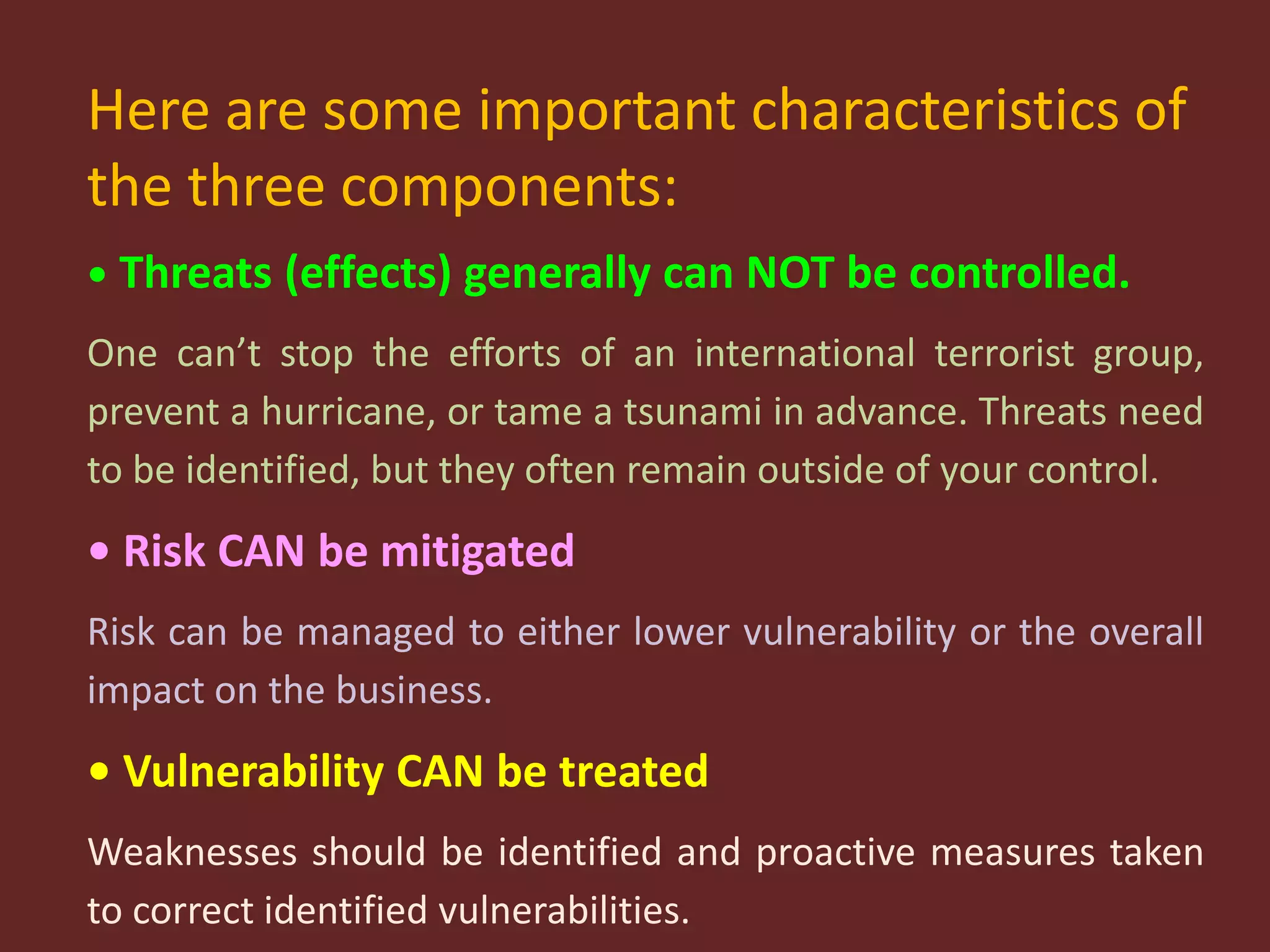
Here are some important characteristics of
the three components:
• Threats (effects) generally can NOT be controlled.
One can’t stop the efforts of an international terrorist group,
prevent a hurricane, or tame a tsunami in advance. Threats need
to be identified, but they often remain outside of your control.
• Risk CAN be mitigated
Risk can be managed to either lower vulnerability or the overall
impact on the business.
• Vulnerability CAN be treated
Weaknesses should be identified and proactive measures taken
to correct identified vulnerabilities.
Risks threats and vulnerabilities

Risks threats and vulnerabilities

  • 1.
    Risks Threats andVulnerabilities The Fundamentals of R-T-A
  • 2.
    Agenda • Analysis vs.Assessment • Risks • Threats • Vulnerability • The Flow of R-T-A
  • 3.
    Analysis vs. Assessment •An assessment is more of a general comparison of something to a standard, or between two something; which is better, more correct, which is closer to the color teal. • An analysis requires deep scrutiny and calculated measuring and recording of criteria. • An assessment is not exact, an analysis is more precise and less general than an assessment.
  • 4.
    HAZARDS • Existing conditionor possible (under current conditions) situation that has the potential to generate a disaster • Natural hazards – naturally occurring phenomena – weather, topographic, geological, hydrological, etc. • Human systems developed – caused by human activity, infrastructure, transportation, etc. • Conflict based – civil war, terrorism, nuclear war, etc.
  • 5.
    HAZARDS - Examples •Hurricanes and tornadoes during their seasons • Earthquakes • High hazard, poorly maintained dams • Airlines with abysmal safety records • Power production systems with either dangerous technologies or poorly maintained transmission systems
  • 6.
    Disasters • The HighestDEGREE of any HAZARD…
  • 7.
    Risk • The probabilitythat a particular threat will exploit a particular vulnerability • Need to systematically understand risks to a system and decide how to control them. • Risk = Probability x Impact
  • 8.
    Examples of Risk •Overreliance on security monitoring software • Inadequate system logging • Technology innovations that outpace security • Outdated operating systems • Lack of encryption • Data on user-owned mobile devices • IT “diplomatic immunity” within your organization • Lack of management support • Challenges recruiting and retaining qualified IT staff • Segregation of duties
  • 9.
    Threat • An expressionof intention to inflict evil injury or damage • Attacks against key security services – Confidentiality, integrity, availability • The operationalization of vulnerability, expected impact of a developing hazard, and the probability that impact will work against your vulnerabilities • Threat means something bad is coming your way – high threat means it is highly likely to hit you and it will be very bad
  • 10.
    Slide #10 Example ThreatList •T01 Access (Unauthorized to System - logical) •T02 Access (Unauthorized to Area - physical) •T03 Airborne Particles (Dust) •T04 Air Conditioning Failure •T05 Application Program Change (Unauthorized) •T06 Bomb Threat •T07 Chemical Spill •T08 Civil Disturbance •T09 Communications Failure •T10 Data Alteration (Error) •T11 Data Alteration (Deliberate) •T12 Data Destruction (Error) •T13 Data Destruction (Deliberate) •T14 Data Disclosure (Unauthorized) •T15 Disgruntled Employee •T16 Earthquakes •T17 Errors (All Types) •T18 Electro-Magnetic Interference •T19 Emanations Detection •T20 Explosion (Internal) •T21 Fire, Catastrophic •T22 Fire, Major •T23 Fire, Minor •T24 Floods/Water Damage •T25 Fraud/Embezzlement •T26 Hardware Failure/Malfunction •T27 Hurricanes •T28 Injury/Illness (Personal) •T29 Lightning Storm •T30 Liquid Leaking (Any) •T31 Loss of Data/Software •T32 Marking of Data/Media Improperly •T33 Misuse of Computer/Resource •T34 Nuclear Mishap •T35 Operating System Penetration/Alteration •T36 Operator Error •T37 Power Fluctuation (Brown/Transients) •T38 Power Loss •T39 Programming Error/Bug •T40 Sabotage •T41 Static Electricity •T42 Storms (Snow/Ice/Wind) •T43 System Software Alteration •T44 Terrorist Actions •T45 Theft (Data/Hardware/Software) •T46 Tornado •T47 Tsunami (Pacific area only) •T48 Vandalism •T49 Virus/Worm (Computer) •T50 Volcanic Eruption
  • 11.
    Slide #11 Characterize Threat-Sources Blackmail Maliciouscode Input of falsified data System bugs Ego, Revenge, Monetary gain Insider Information warfare System attack System tampering Blackmail, Destruction, Revenge Terrorist Hacking Social engineering System intrusion Unauthorized access Challenge, ego, rebellion Hacker Threat ActionsMotivationThreat-source
  • 12.
    VULNERABILITIES • If youhave a hazard you may or may not be vulnerable to it – Live in the flood plain – vulnerable to floods – Live on high ground – not vulnerable to floods • Vulnerability is an assessment of how well or how poorly protected you are against an event • Vulnerabilities are flaws / weaknesses in any system which can be utilized to generate “Threat”
  • 13.
    Slide #13 Vulnerabilities • Flawor weakness in system that can be exploited to violate system integrity. – Security Procedures – Design – Implementation • Threats trigger vulnerabilities – Accidental – Malicious
  • 14.
    VULNERABILITIES • Vulnerabilities maybe reduced by mitigation measures (building construction, land use control, maintenance, etc.) • Or by the level of preparedness you have achieved (well trained and equipped emergency teams, plans, exercises, etc.)
  • 15.
    Factors influencing VULNERABILITY •Three factors may influence the determination of vulnerability – Criticality – how important is the asset or function that is subject to impact – Exposure – to how much of the force of the event is the resource exposed – Time – does vulnerability fluctuate over time of day, month, season?
  • 16.
    Examples of Vulnerabilities •Physical •V01Susceptible to unauthorized building access •V02 Computer Room susceptible to unauthorized access •V03 Media Library susceptible to unauthorized access •V04 Inadequate visitor control procedures •(and 36 more) •Administrative •V41 Lack of management support for security •V42 No separation of duties policy •V43 Inadequate/no computer security plan policy •V47 Inadequate/no emergency action plan •(and 7 more) •Personnel •V56 Inadequate personnel screening •V57 Personnel not adequately trained in job •... •Software •V62 Inadequate/missing audit trail capability •V63 Audit trail log not reviewed weekly •V64 Inadequate control over application/program changes Communications •V87 Inadequate communications system •V88 Lack of encryption •V89 Potential for disruptions •... •Hardware •V92 Lack of hardware inventory •V93 Inadequate monitoring of maintenance personnel •V94 No preventive maintenance program •… •V100 Susceptible to electronic emanations
  • 17.
    IMPACT • Assessment ofinteraction of hazard effects with your vulnerabilities • Scalar based on the two key variables – hazard strength and vulnerability level • Will be hazard specific in aggregate (hurricane impacts), but may be functionally common to a variety of hazards in the specific (power loss)
  • 18.
    IMPACT HIGH Strong Hazard High Vulnerability MODERATE StrongHazard Low Vulnerability MODERATE Weak Hazard High Vulnerability LOW Weak Hazard Low Vulnerability
  • 19.
    Factors influencing IMPACT •Two other factors are related to impact –Magnitude – the absolute size and power of the event –Intensity – the measurement of the effects of the event – how it is felt • All else being equal an event with greater magnitude will tend to be a more intense event and generate greater impacts
  • 20.
    CONSEQUENCES • Result ofthe interaction of the Impact of the event with other systems – Political, – Social and cultural, – Economic, etc. • May set the stage for either: – Future events, or – Vulnerability reduction through mitigation and preparedness
  • 21.
    CONSEQUENCES • The borderbetween consequence and impact is fuzzy, but – Impacts tend to be directly related to the effects of the event, consequences more second order – Impacts tend to be shorter term (hours to decades), consequences longer term (weeks to centuries) – Although coupled to impacts, consequences are neither automatic nor irreversible – Consequences tend to be more human-centric, impacts more event-centric – we make the consequences, the event makes the impact
  • 22.
    PROBABILITY • A mathematicalassessment of how likely it is that a specific event will occur • Based on a wide variety of factors – history, global warming, infrastructure and demographic changes, new industries, changes in your activities and processes, etc.
  • 23.
    PROBABILITY • Expressed ina variety of ways: – This year we expect 14 named tropical storms, 8 hurricanes, 3 great hurricanes … (an assessment of general level) – There is a 45% chance of … (a numerical assessment) – A 500 year flood … (a statement of cycles) – And then there is likelihood: “I think it is highly likely that …” (a qualitative assessment)
  • 24.
    LIKELIHOOD • An inexact,qualitative statement of how one assesses probability • Generally expressed in broad bands that cover a range of probability values – High – “likely” – Low – “unlikely” • Easily understood, but also misleading – likely is interpreted as “yes, it will,” unlikely as “no, it will not”
  • 25.
  • 27.
    Here are someimportant characteristics of the three components: • Threats (effects) generally can NOT be controlled. One can’t stop the efforts of an international terrorist group, prevent a hurricane, or tame a tsunami in advance. Threats need to be identified, but they often remain outside of your control. • Risk CAN be mitigated Risk can be managed to either lower vulnerability or the overall impact on the business. • Vulnerability CAN be treated Weaknesses should be identified and proactive measures taken to correct identified vulnerabilities.