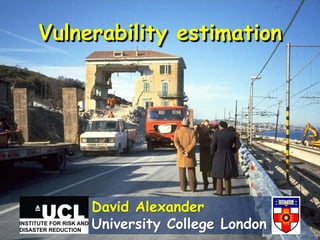
Vulnerability
Analysis
David Alexander
University College London
The components of risk
Physical disaster
Magnitude
Frequency
Duration
Human
vulnerability
Exposure
Location of hazard
Environment
Resistance
Lifestyle and earnings
Health
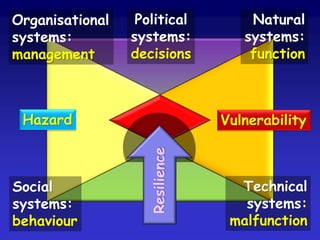
Resilience
Adjustments
Risk reduction activities
Preparations for disaster
After Ian Davis (2005)
Uncertain
future:
long-term
trends
climate
change
capacity
to adapt
Livelihoods:
security and
wealth
generation
Hazards
and risks:
disaster
preparedness
Governance:
democratic
participation
in decision
making
RESILIENCE:
managing risks
adapting to change
securing resources
Vulnerability is constructed socially
• it is mainly the result of social,
economic, political and cultural
factors in decision-making
• it is becoming harder to reduce.
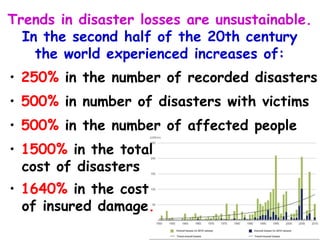
Trends in disaster losses are unsustainable.
In the second half of the 20th century
the world experienced increases of:
• 250% in the number of recorded disasters
• 500% in number of disasters with victims
• 500% in the number of affected people
• 1640% in the cost
of insured damage.
• 1500% in the total
cost of disasters Disasters
1900-2010
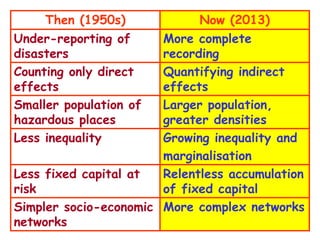
Then (1950s) Now (2013)
Under-reporting of
disasters
More complete
recording
Counting only direct
effects
Quantifying indirect
effects
Smaller population of
hazardous places
Larger population,
greater densities
Less inequality Growing inequality and
marginalisation
Less fixed capital at
risk
Relentless accumulation
of fixed capital
Simpler socio-economic
networks
More complex networks
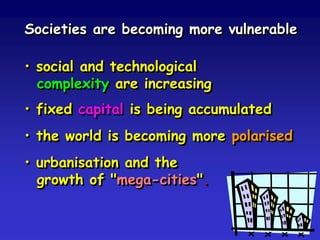
• social and technological
complexity are increasing
• fixed capital is being accumulated
• the world is becoming more polarised
• urbanisation and the
growth of "mega-cities".
Societies are becoming
more vulnerable
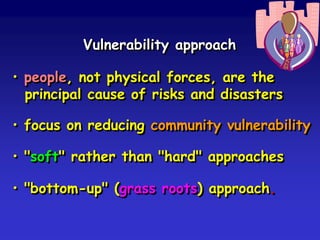
Vulnerability approach
• people, not physical forces, are the
principal cause of risks and disasters
• focus on reducing community vulnerability
• "soft" rather than "hard" approaches
• "bottom-up" (grass roots) approach.
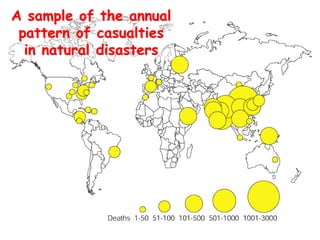
A sample of the annual
pattern of casualties
in natural disasters
A sample of the annual pattern
of losses in natural disasters
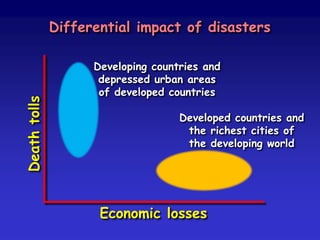
Deathtolls
Economic losses
Differential impact of disasters
Developing countries and
depressed urban areas
of developed countries
Developed countries and
the richest cities of
the developing world
What exactly is vulnerability?
Risk
Civil defence
Hazard
Vulnerability
Threat
Exposure
Response
Mitigation Protection
Civil protection
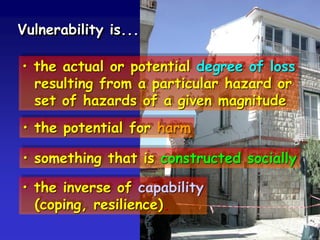
Vulnerability is...
• the potential degree of loss resulting
from a particular hazard or set
of hazards of a given magnitude
• the potential for harm
• something that is constructed socially
• the inverse of capability
(coping, resilience).
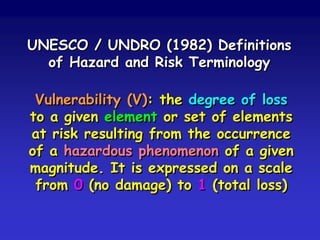
UNESCO / UNDRO (1982) Definitions
of Hazard and Risk Terminology
Vulnerability (V): the degree of loss
to a given element or set of elements
at risk resulting from the occurrence
of a hazardous phenomenon of a given
magnitude. It is expressed on a scale
from 0 (no damage) to 1 (total loss)
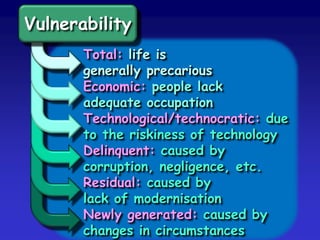
Vulnerability
Total: life is
generally
precarious
Residual: caused by
lack of modernisation
Newly
generated:
caused by
changes in
circumstances
Delinquent:
caused by
corruption,
negligence,
etc.
Economic:
people lack
adequate
occupation
Technological
technocratic:
caused by
the riskiness
of technology
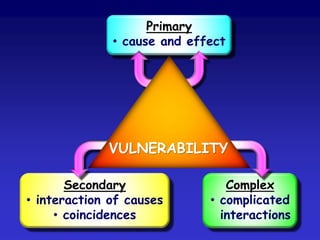
Primary
• cause and effect
Secondary
• interaction of causes
• coincidences
Complex
• complicated
interactions
VULNERABILITY
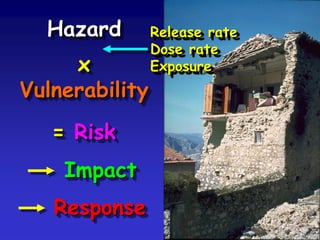
(Hazard x Vulnerability x Exposure)
Resilience
= Risk
[ → Impact → Response]
Hazard x (Vulnerability / Resilience)
[x Exposure]
= Risk
[ → Impact → Response]
....alternatively:-
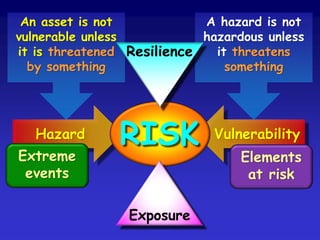
VulnerabilityHazard
An asset is not
vulnerable unless
it is threatened
by something
A hazard is not
hazardous unless
it threatens
something
RISK
Extreme
events
Elements
at risk
Resilience
Exposure
Disaster management
Emergency management
Crisis management
Risk management
Vulnerability management
Hypothetical
Concrete Concentrated
Diffuse
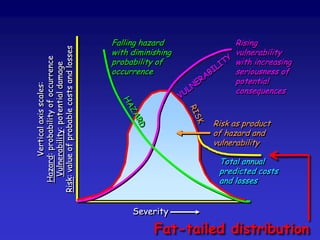
Verticalaxisscales:
Hazard:probabilityofoccurrence
Vulnerability:potentialdamage
Risk:valueofprobablecostsandlosses
Severity
Risk as product
of hazard and
vulnerability
Total annual
predicted costs
and losses
Rising
vulnerability
with increasing
seriousness of
potential
consequences
Falling hazard
with diminishing
probability of
occurrence
Fat-tailed distribution
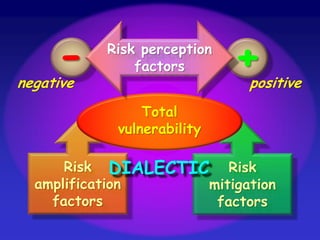
The role of
perception
Risk
amplification
factors
Risk
mitigation
factors
Total
vulnerability
Risk perception
factors- +positivenegative
DIALECTIC
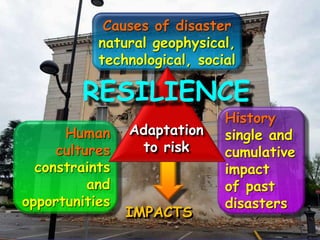
Causes of disaster
natural geophysical,
technological, social
History
single and
cumulative
impact
of past
disasters
Human
cultures
constraints
and
opportunities
IMPACTS
Adaptation
to risk
RESILIENCE
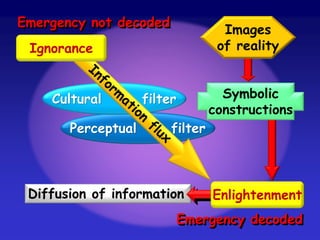
Diffusion of information
Perceptual filter
Cultural filter
Emergency not decoded
Emergency decoded
Ignorance
Images
of reality
Symbolic
constructions
Enlightenment
Long term
Short term
Emic components
Etic components
METAMORPHOSIS
OF CULTURE
Experiences of culture
[mass-media and consumer culture]
Accumulated cultural traits and beliefs
Inherited cultural background
Ideological
(non-scientific)
interpretations
of disaster
Learned
(scientific)
interpretations
of disaster
Value
system
Family
culture
Work
culture
Peer
group
culture
Personal
culture
National culture
Regional culture
Technology
organisations
safety culture
Ethnology
societies
community culture
Psychology
ethnic groups
individual culture
Communication
mass media
multicultural societies
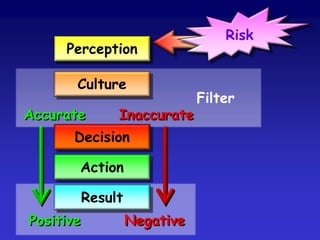
Filter
Perception
Culture
Decision
Action
Result
Positive Negative
Risk
Accurate Inaccurate
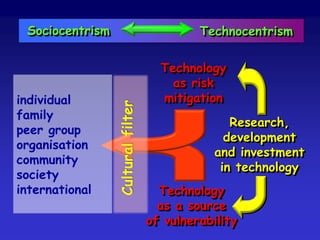
Technology
as risk
mitigation
Technology
as a source
of vulnerability
Research,
development
and investment
in technology
individual
family
peer group
organisation
community
society
international
Culturalfilter
Sociocentrism Technocentrism
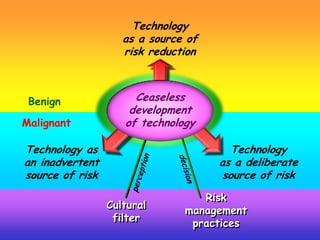
Cultural
filter
Risk
management
practices
Benign
Malignant
Technology
as a source of
risk reduction
Technology as
an inadvertent
source of risk
Technology
as a deliberate
source of risk
Ceaseless
development
of technology
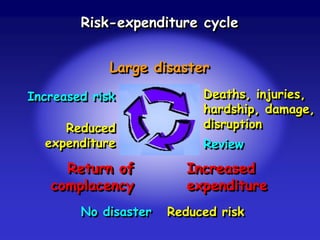
Large disaster
Increased
expenditure
Return of
complacency
Risk-expenditure cycle
Deaths, injuries,
hardship, damage,
disruption
Review
Reduced riskNo disaster
Reduced
expenditure
Increased risk
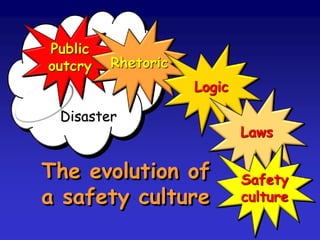
Disaster
Public
outcry Rhetoric
Logic
Laws
Safety
culture
The evolution of
a safety culture
What exactly is resilience?
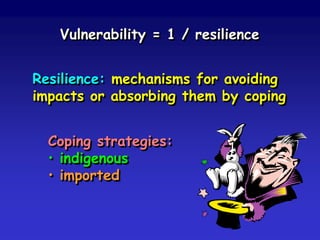
Vulnerability = 1 / resilience
Resilience: mechanisms for avoiding
impacts or absorbing them by coping
Coping strategies:
• indigenous
• imported
What is resilience [resiliency]?
• a combination of resistance and
adaptation (coping, capacity, capability)
• ability to maintain livelihoods and tenor
of life in the face of disaster shocks
• local autonomy and self-sufficiency.
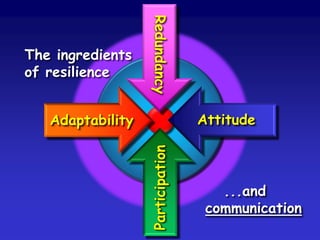
Attitude
The
ingredients
of resilience
• robustness: resist stress
without loss of function
• redundancy: ability to continue
functioning during periods of disruption
• ingenuity: ability to identify
problems and mobilise resources
• rapidity: ability to satisfy objectives
and priorities so as to reduce losses.
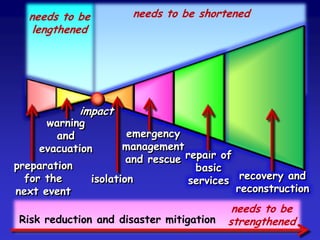
The four dimensions of RESILIENCE:-
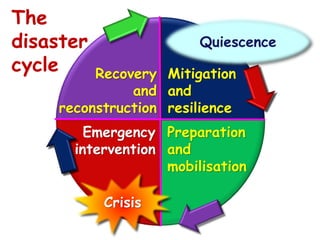
Recovery
and
reconstruction
Mitigation
and
resilience
Preparation
and
mobilisation
Emergency
intervention
Quiescence
Crisis
The
disaster
cycle
needs to be shortenedneeds to be
lengthened
preparation
for the
next event
warning
and
evacuation
recovery and
reconstruction
repair of
basic
services
emergency
management
and rescue
isolation
impact
needs to be
strengthenedRisk reduction and disaster mitigation
Conclusions
Disaster
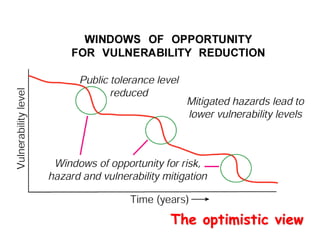
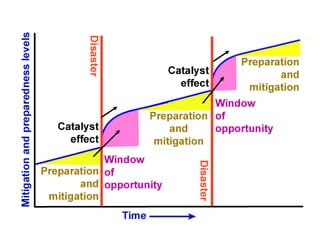
opens a
window of
opportunity
for positive
change and
greater
security
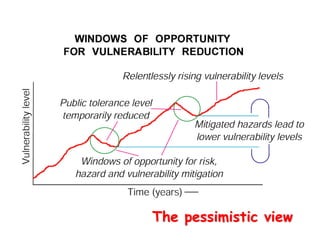
The optimistic view
What is sustainable vulnerability reduction?
• it is centred upon the local level
(but is harmonised from above)
• through consultation it has the support
and involvement of the population
• plans tackle all the phases of the
disaster cycle - in an integrative way
• it is a fundamental, every-day service
for the population and is taken seriously.
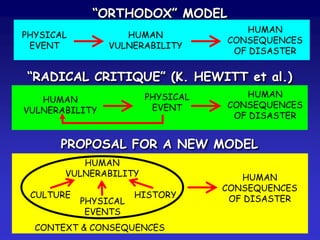
HUMAN
CONSEQUENCES
OF DISASTER
“ORTHODOX” MODEL
PHYSICAL
EVENT
HUMAN
VULNERABILITY
“RADICAL CRITIQUE” (K. HEWITT et al.)
HUMAN
CONSEQUENCES
OF DISASTER
HUMAN
VULNERABILITY
PHYSICAL
EVENT
PROPOSAL FOR A NEW MODEL
HUMAN
CONSEQUENCES
OF DISASTER
HUMAN
VULNERABILITY
CULTURE HISTORY
PHYSICAL
EVENTS
CONTEXT & CONSEQUENCES
Resilience against disasters:
Ten suggestions for action
Organised
non-structural
protection
Enhanced
structural
protection
Planning,
warning and
preparedness
Fusion with
sustainability
agenda
Policy outcomes
Protection strategy
Tell people what to do in a crisis.
Develop urban search and
rescue capacity on site.
Reduce non-structural as
well as structural hazards.
Plan flexibly.
Create networks.
Encourage governance.
Adapt and disseminate good practice.
Ensure that Disaster Risk Reduction
(DRR) programmes are sustainable
Create a strategy for recovering
from the next disaster.
Create a culture of resilience
against disasters.
...and avoid the
myth of panic:
it should not be
treated as a
relevant factor
in emergency
planning
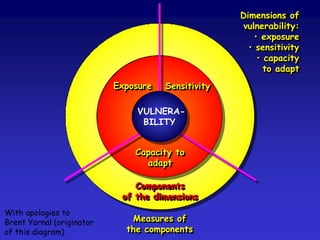
Exposure Sensitivity
Capacity to
adapt
VULNERA-
BILITY
Dimensions of
vulnerability:
• exposure
• sensitivity
• capacity
to adapt
Components of
the dimensions
Measures of the components
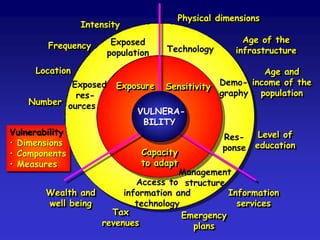
Vulnerability
• Dimensions
• Components
• Measures
Exposure Sensitivity
Capacity
to adapt
VULNERA-
BILITY
Physical dimensions
Age of the
infrastructure
Age and
income of the
population
Demo-
graphy
Technology
Res-
ponse
Management
structureAccess to
information and
technology
Exposed
res-
ources
Exposed
population
Intensity
Frequency
Location
Number
Wealth and
well being
Tax
revenues
Emergency
plans
Level of
education
Information
services
Analysis
• registered
• archived
• forgotten
• ignored
Vulnerability
maintained
-
• utilised
• adopted
• learned
Disaster
risk
reduced
+
Lessons
Past
events
The process of
disaster risk
reduction
(DRR)
A guide to recognizing
vulnerability in the field
How to estimate vulnerability in the field
Elements:
• buildings and physical structures
• lifelines and infrastructure
• patterns of activity
that put people at risk
• perceptions of hazard
• concentrations and patterns
of elements at risk.
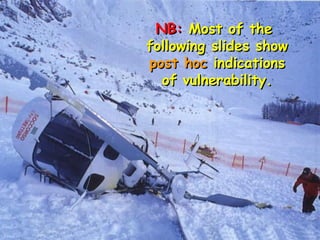
NB: Most of the
following slides show
post hoc indications
of vulnerability.
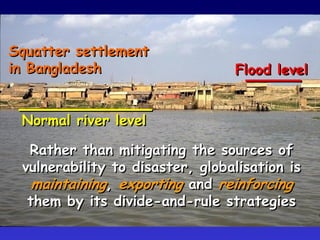
Squatter settlement
in Bangladesh Flood level
Normal river level
Rather than mitigating the sources of
vulnerability to disaster, globalisation is
maintaining, exporting and reinforcing
them by its divide-and-rule strategies
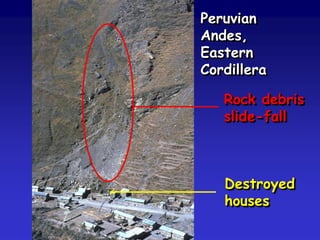
Peruvian
Andes,
Eastern
Cordillera
Rock debris
slide-fall
Destroyed
houses
The 'megacity' problem
Tehran
Tehran
Kathmandu
Kathmandu
İstanbul
İstanbul
Tokyo
Poor building
quality
(low seismic
resistance)
Proximity
to epicentre
and fault
rupture
Topographic
amplification
Sedimentary
amplification
Q E
T S
Concentration
of casualties
C
C = f { E,Q,S,T }
Deaths
Injuries
Q E
T S
Vulnerability
to earthquakes
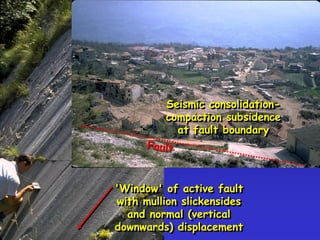
'Window' of active fault
with mullion slickensides
and normal (vertical
downwards) displacement
Seismic consolidation-
compaction subsidence
at fault boundary
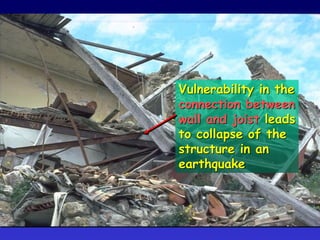
Vulnerability in the
connection between
wall and joist leads
to collapse of the
structure in an
earthquake
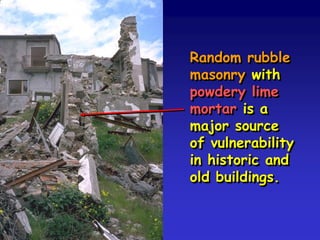
Random rubble
masonry with
powdery lime
mortar is a
major source
of vulnerability
in historic and
old buildings.
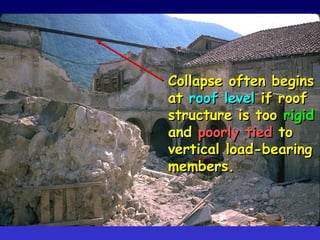
Collapse often begins
at roof level if roof
structure is too rigid
and poorly tied to
vertical load-bearing
members.
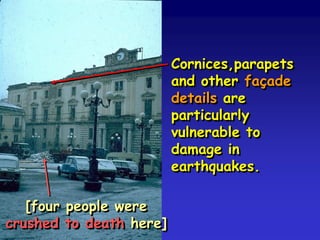
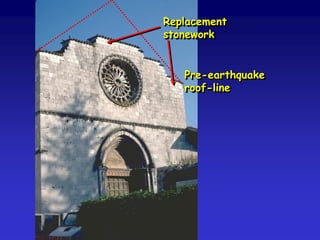
Cornices,parapets
and other façade
details are
particularly
vulnerable to
damage in
earthquakes.
[four people were
crushed to death here]
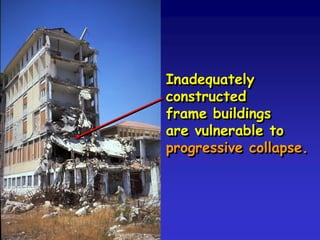
Inadequately
constructed
frame buildings
are vulnerable to
progressive collapse.
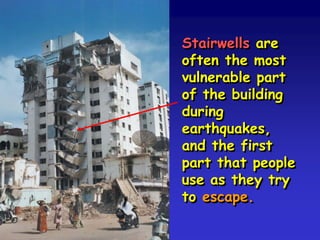
Stairwells are
often the most
vulnerable part
of the building
during
earthquakes,
and the first
part that people
use as they try
to escape.
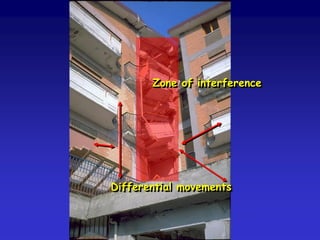
Zone of interference
Differential movements
Pre-earthquake
roof-line
Replacement
stonework
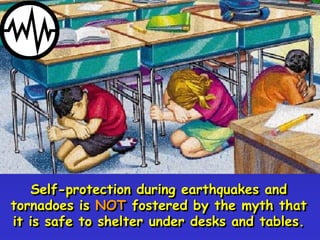
Self-protection during earthquakes and
tornadoes is NOT fostered by the myth that
it is safe to shelter under desks and tables.
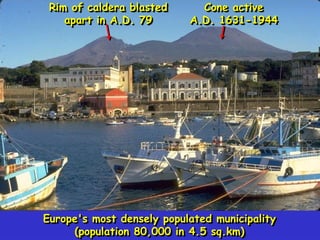
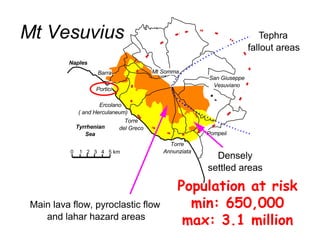
Rim of caldera blasted
apart in A.D. 79
Cone active
A.D. 1631-1944
Europe's most densely populated municipality
(population 80,000 in 4.5 sq.km)
0 1 2 3 4 5 km
Tyrrhenian
Sea
Mt Vesuvius
Portici
Ercolano
( and Herculaneum)
Mt Somma
Naples
Barra
Pompeii
Torre
del Greco
Torre
Annunziata
San Giuseppe
Vesuviano
Main lava flow, pyroclastic flow
and lahar hazard areas
Densely
settled areas
Tephra
fallout areas
Population at risk
min: 650,000
max: 3.1 million
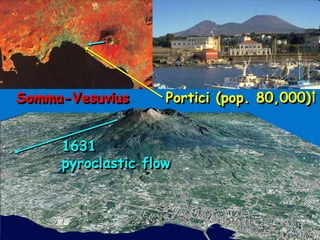
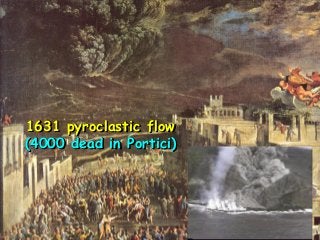
Somma-Vesuvius Portici (pop. 80,000)
1631
pyroclastic flow
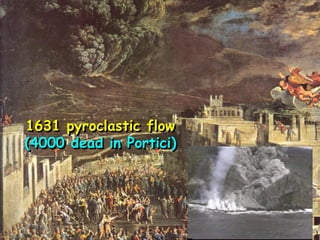
1631 pyroclastic flow
(4000 dead in Portici)
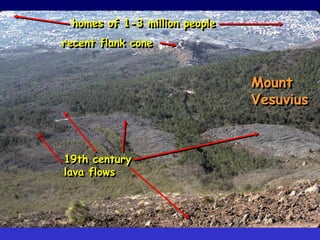
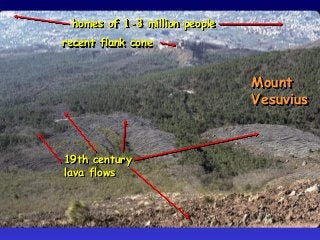
recent flank cone
19th century
lava flows
homes of 1-3 million people
Mount
Vesuvius
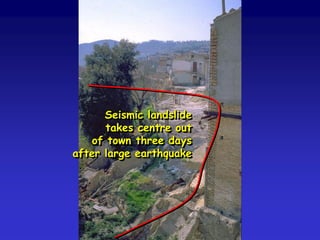
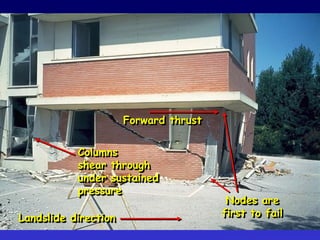
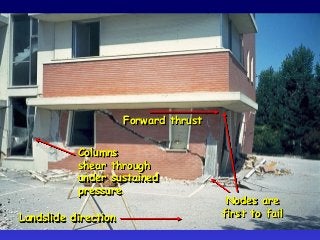
Forward thrust
Nodes are
first to fail
Columns
shear through
under sustained
pressure
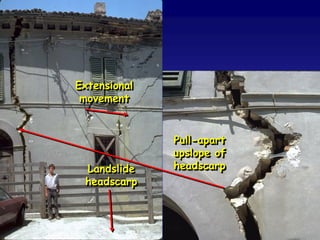
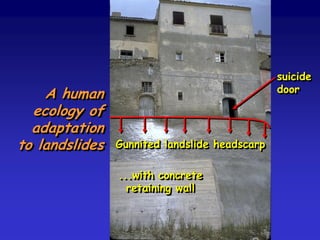
Landslide direction
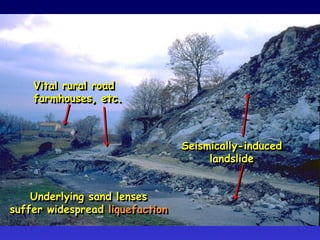
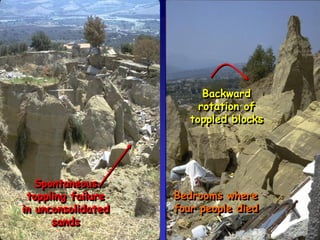
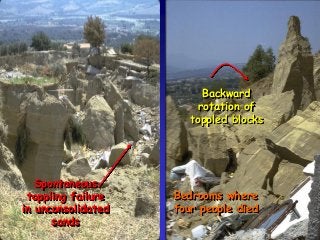
Spontaneous
toppling failure
in unconsolidated
sands
Backward
rotation of
toppled blocks
Bedrooms where
four people died
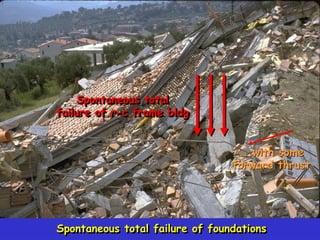
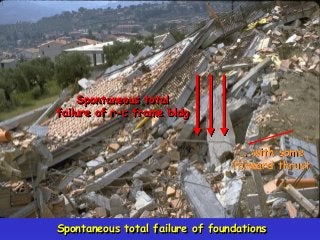
Spontaneous total failure of foundations
Spontaneous total
failure of r-c frame bldg
...with some
forward thrust
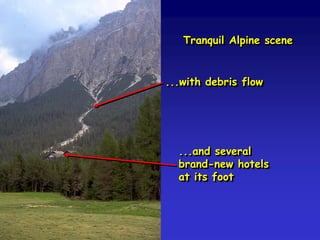
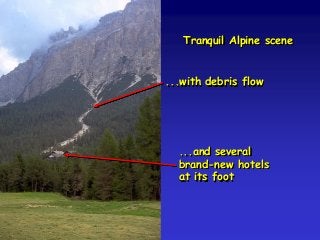
Tranquil Alpine scene
...with debris flow
...and several
brand-new hotels
at its foot
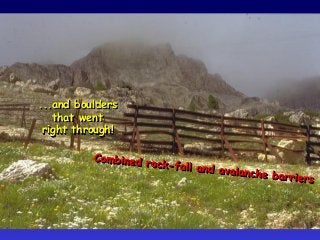
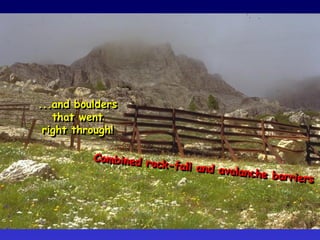
...and boulders
that went
right through!
david.alexander@ucl.ac.uk
emergency-planning.blogspot.com
Presentations can be downloaded from:-
www.slideshare.com/dealexander
Thank you
for your
attention!

Vulnerability to Disasters