UNIT V
1
MR.T.SOMASUNDARAM
ASSISTANT PROFESSOR
DEPARTMENT OF MANAGEMENT
KRISTU JAYANTI COLLEGE,
BANGALORE.
UNIT V
DIRECTING & CONTROLLING
Meaning and nature of directing, leadership
styles, motivation, meaning and
importance, Communication, meaning and
importance, co-ordination, meaning and
importance and techniques of co-
ordination, control, meaning, features,
importance and steps in control process,
essentials of a sound control system,
methods of establishing control (in brief).
2
DIRECTING
Meaning:
Directing is said to be a process in which the managers
instruct, guide and oversee the performance of the workers
to achieve predetermined.
It is said to be the heart of management process.
It is a complex managerial function consisting of al
activities that are designed to encouraged subordinates to
work effectively.
Definition:
"Activating deals with the steps a manager takes to get
sub-ordinates and others to carry out plans"
- Newman and Warren.
Directing concerns the total manner in which a
manager influences the actions of subordinates. 3
Nature (Characteristics) of Directing:
 Initiates Action – key managerial function and manager has
to perform this function.
 Continuing Function – it is a continuous activity
throughout the life of organization.
 Pervasive Function – it is required at all levels of
organization.
 Creative Function – helps in converting plans into
performance.
 Linking function – initiated at top level & flows to bottom
through organization hierarchy.
 Management of Human Factor – it is related to
subordinates and therefore it is related to human factor.
4
Principles of Directing:
• Principle of Maximum Individual contribution.
• Principle of Harmony of objectives.
• Principle of Unity of Command.
• Principle of Appropriateness of Direction technique.
• Principle of Managerial Communication.
• Principle of use of Informal organization.
• Principle of Leadership.
• Principle of follow through.
Elements of Directing:
The three elements of directing are
• Motivation
• Leadership
• Communication
5
LEADERSHIP
Definition:
“Leadership is the art of process of influencing people so
that they will strive willingly towards the achievement of group
goals”.
- Koontz & O’Donnel
“Leadership is the activity of influencing people to strive
willingly for group objectives”. - George R.Terry
“Leadership is defined as influence, the art or process of
influencing people so that they will strive willingly and
enthusiastically toward the achievement of group goals”.
“Leadership is the process of influencing the activities of an
individual or a group in efforts towards goal achievement in a
given situation”. - Heresy & Paul
6
Nature (characteristics) of Leadership:
Involves guiding and motivating.
Needs subordinates and common interests.
Promotes interest in the work.
Needs support from all.
Influences subordinates through personal qualities.
Dynamic and continuous process.
Leadership is situational.
Assumes obligation.
Needs interaction with followers.
Achievement of objectives.
7
Importance of Leadership:
1. Motivating employees:
- Higher motivation will make the employees for higher performance.
2. Leader develops team work:
- leader, subordinates & environment are three vital determinants of
team work & leader should make the environment to work efficiently.
3. Better utilization of Manpower:
- leader implements plans, policies, programmes of organization to
utilize available manpower effectively & get maximum production.
4. Creating confidence to followers:
- leader create confidents in his followers by directing them.
5. Directing group activities:
- leader can direct his follower and takes the lead in all activities.
6. Building morale:
- based on attitudes, voluntary cooperation, high morale.
7. Maintaining discipline:
- prompts individual to observe rules, procedures to achieve goals. 8
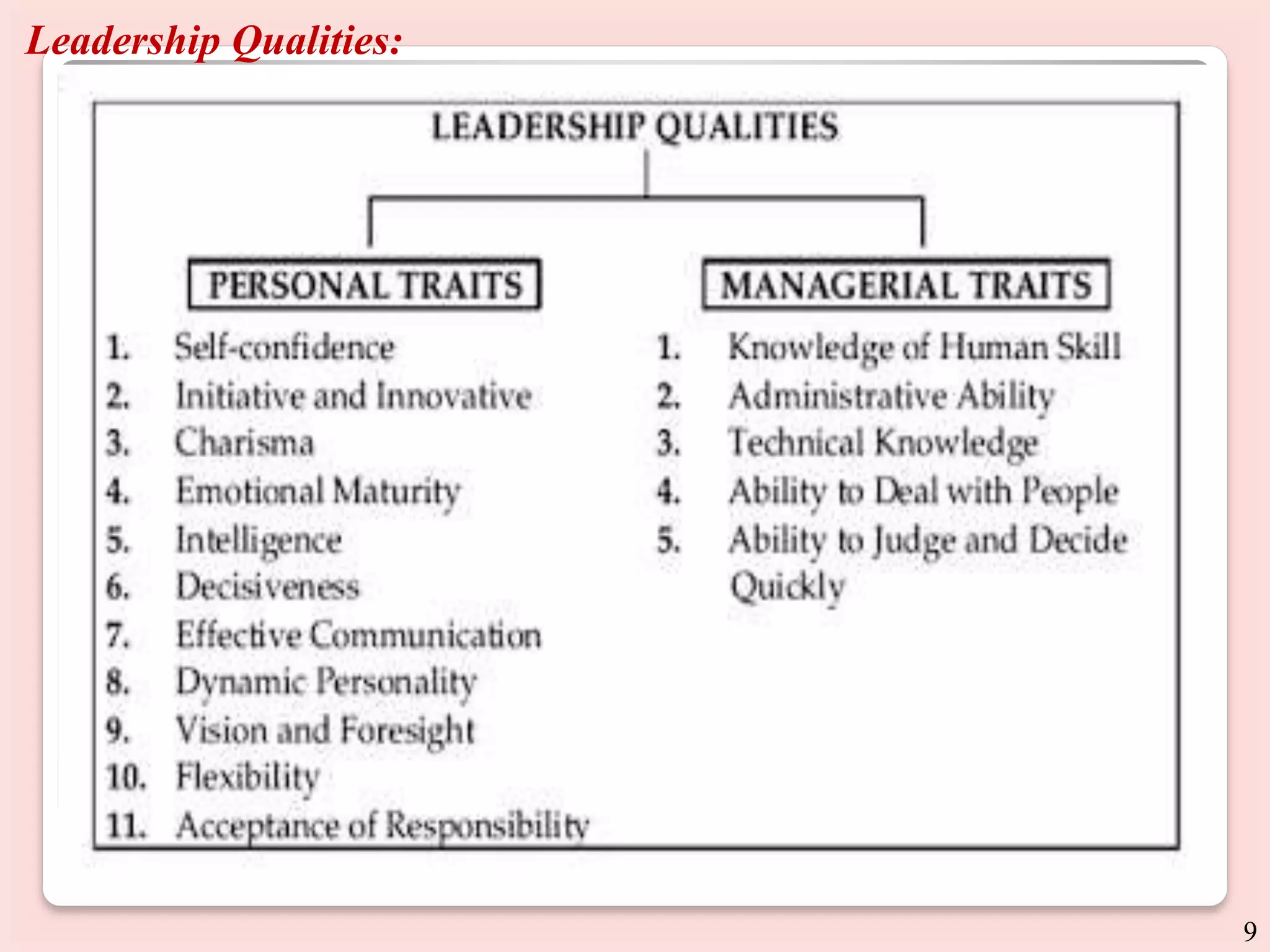
Leadership Qualities:
9
Leadership Styles:
 The behaviour exhibited by a leader during supervision of followers.
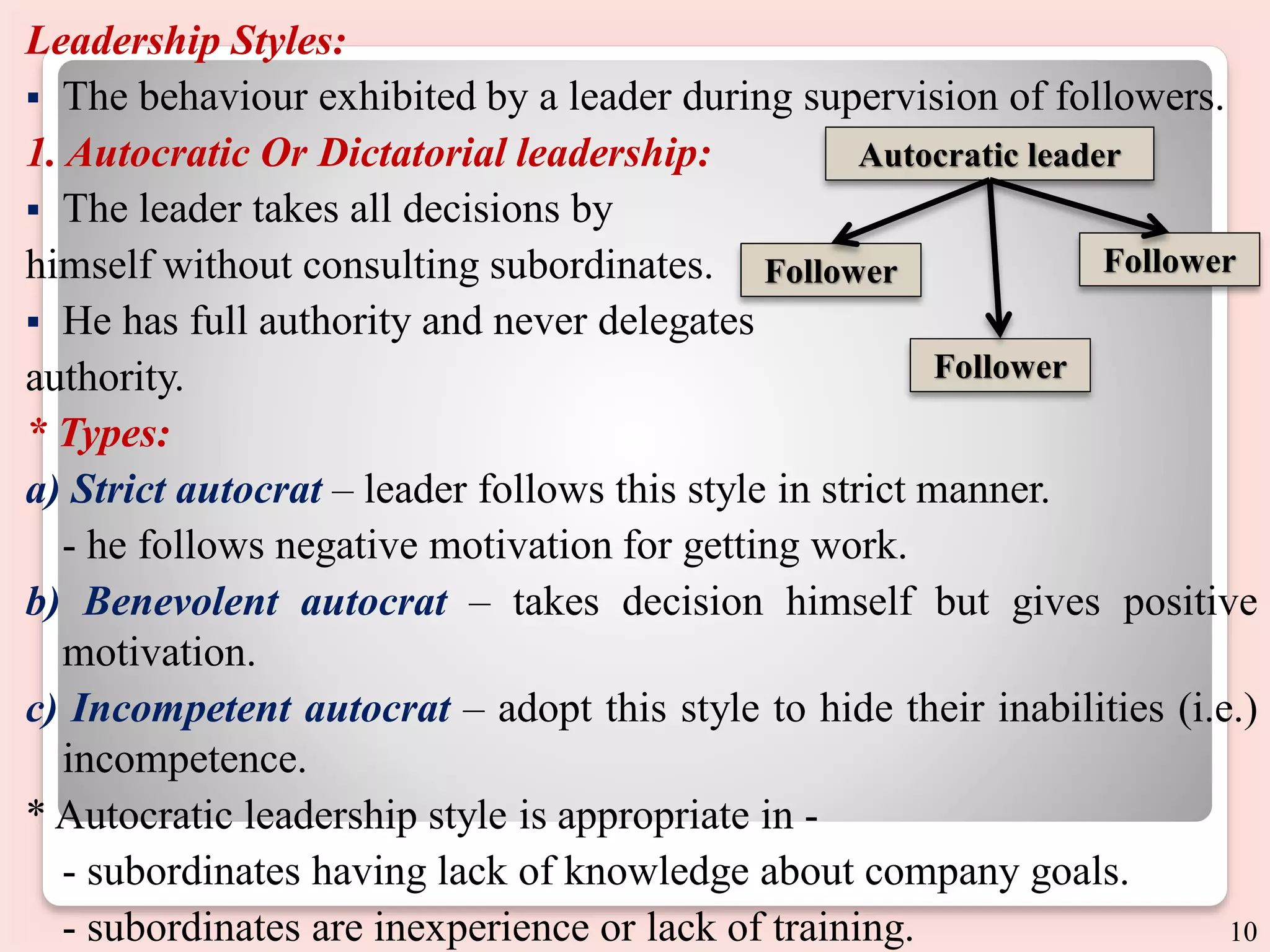
1. Autocratic Or Dictatorial leadership:
 The leader takes all decisions by
himself without consulting subordinates.
 He has full authority and never delegates
authority.
* Types:
a) Strict autocrat – leader follows this style in strict manner.
- he follows negative motivation for getting work.
b) Benevolent autocrat – takes decision himself but gives positive
motivation.
c) Incompetent autocrat – adopt this style to hide their inabilities (i.e.)
incompetence.
* Autocratic leadership style is appropriate in -
- subordinates having lack of knowledge about company goals.
- subordinates are inexperience or lack of training.
Autocratic leader
Follower
Follower
Follower
10
- company indicates fear & punishment as disciplinary techniques.
- leader is active and dominant in decision – making.
- little chance for error in final accomplishment.
Advantages:
- facilitates quick decision making.
- provides strong motivation and satisfaction to leader.
- highest productivity, yield positive outcome.
- less competent subordinates at low levels.
Disadvantages:
- employee morale will be low, absence of leader affect output.
- dissatisfaction will develop among employees.
- employee turnover will be more.
- full potential creative ideas of subordinates are not fully utilized.
- communication without feedback leads to misunderstanding and
communication breakdown.
11
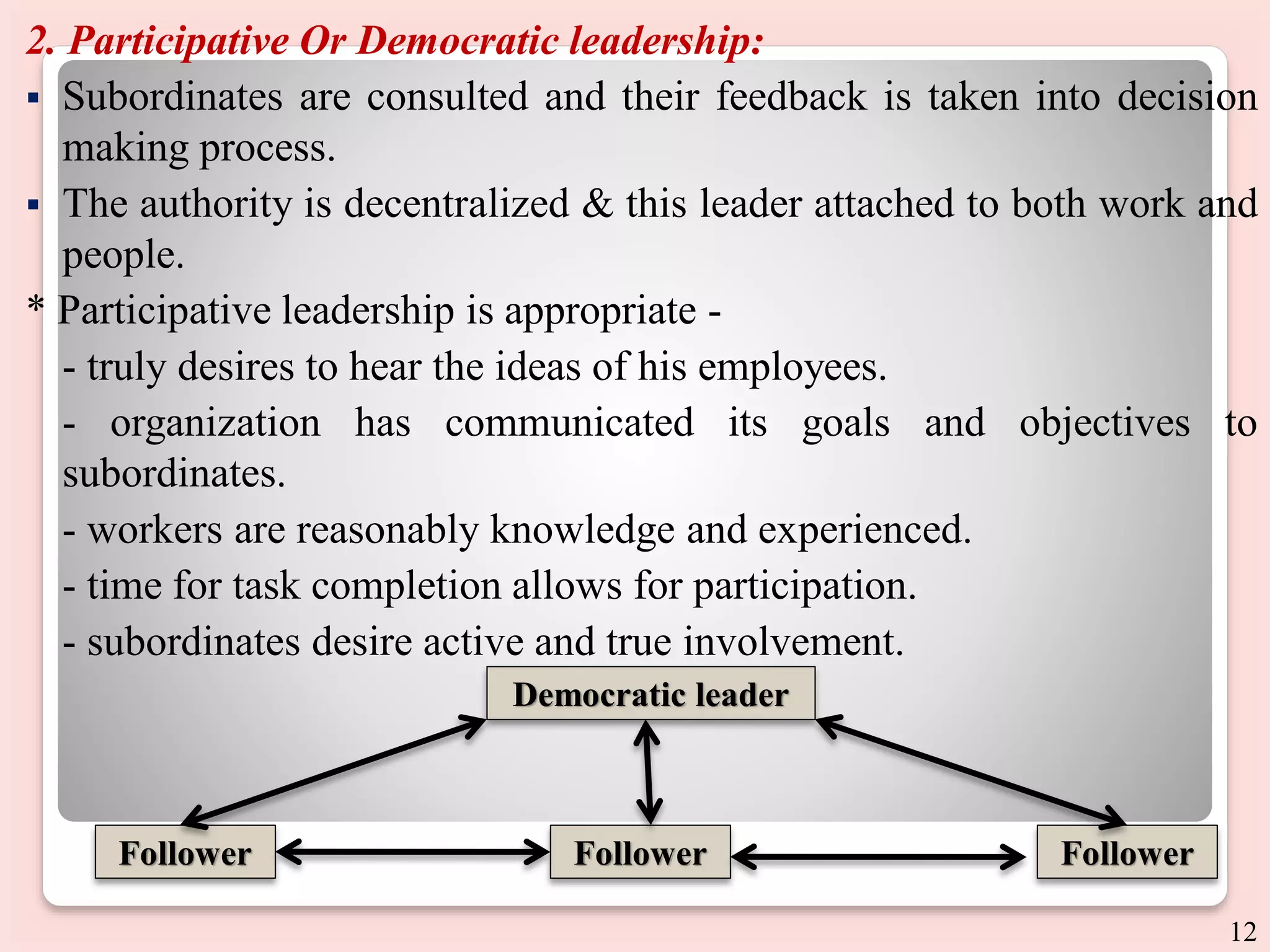
2. Participative Or Democratic leadership:
 Subordinates are consulted and their feedback is taken into decision
making process.
 The authority is decentralized & this leader attached to both work and
people.
* Participative leadership is appropriate -
- truly desires to hear the ideas of his employees.
- organization has communicated its goals and objectives to
subordinates.
- workers are reasonably knowledge and experienced.
- time for task completion allows for participation.
- subordinates desire active and true involvement.
Democratic leader
Follower Follower Follower
12
Advantages:
- subordinates are motivated by participation in decision making
process.
- absence of leader doesn’t affect output.
- labour absenteeism and turn over will be minimum.
- quality is decision is improved.
- leader multiplies his abilities through contribution of his followers.
Disadvantages:
- time consuming, results delay in decision making.
- subordinates are lazy & avoid work, controlling is difficult.
- it can’t applied at lower level of management.
- leaders may be uncomfortable with reduction in power & control
over labour.
- yield positive results when subordinates prefer minimum interaction
with leader.
- leader requires communication and persuasive skill.
13
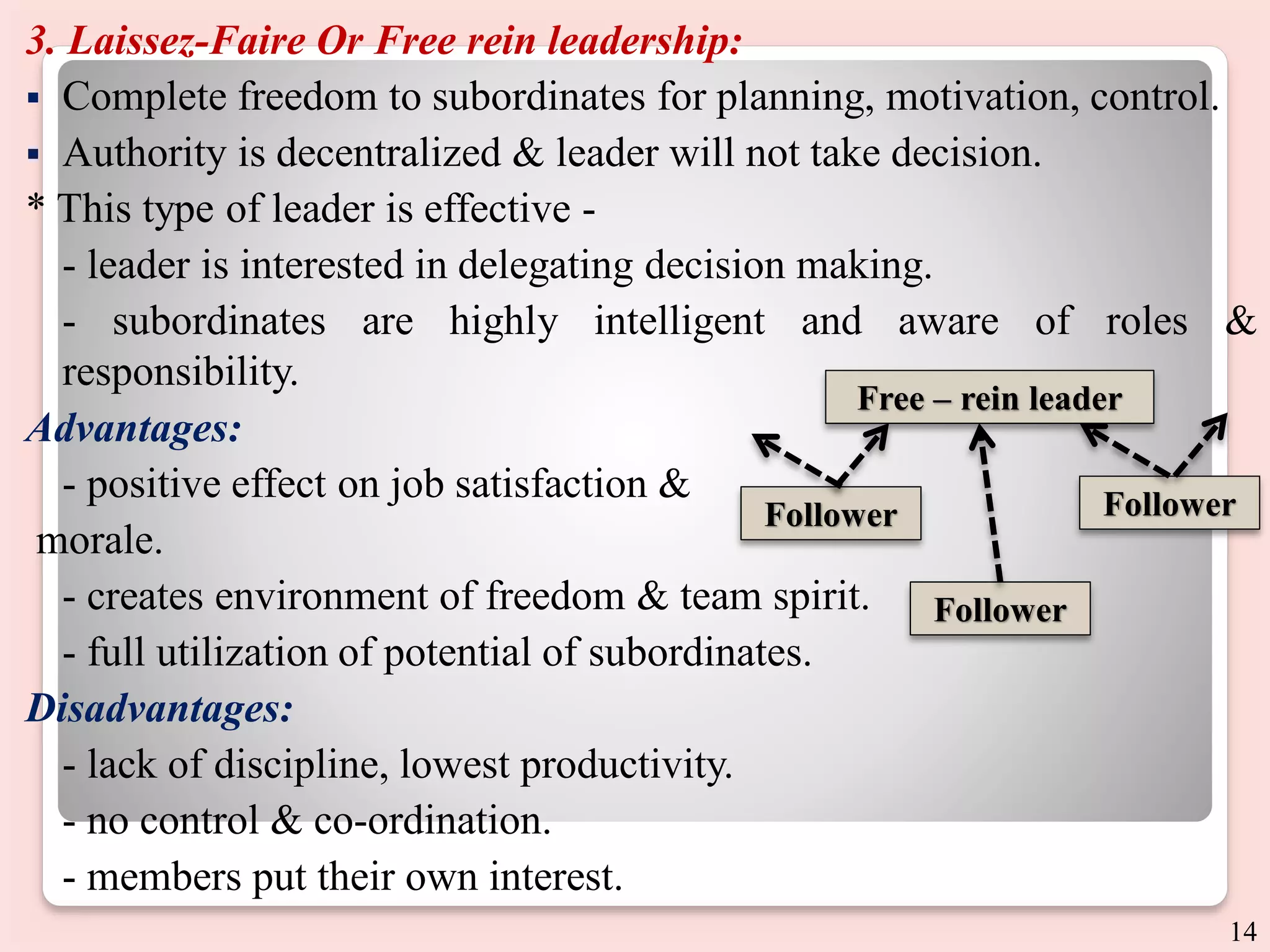
3. Laissez-Faire Or Free rein leadership:
 Complete freedom to subordinates for planning, motivation, control.
 Authority is decentralized & leader will not take decision.
* This type of leader is effective -
- leader is interested in delegating decision making.
- subordinates are highly intelligent and aware of roles &
responsibility.
Advantages:
- positive effect on job satisfaction &
morale.
- creates environment of freedom & team spirit.
- full utilization of potential of subordinates.
Disadvantages:
- lack of discipline, lowest productivity.
- no control & co-ordination.
- members put their own interest.
Free – rein leader
Follower
Follower
Follower
14
4. Bureaucratic leadership:
 They follow rules rigorously and ensure that their staff follows
procedures precisely.
 This is appropriate style for work involving serious safety risks.
5. Charismatic leadership:
 It is similar transformational leadership, because leaders inspire lots
of enthusiasm in their teams and energetic in driving others forward.
 Charismatic leaders can tend to believe more in themselves than in
their teams.
 Charismatic leadership carries great responsibility and needs a long-
term commitment from the leader.
6. Servant leadership:
 Servant leadership is a form of democratic leadership, because the
whole team tends to be involved in decision making.
 Someone, at any level within an organization, leads simply by
meeting needs of team, it is described as ‘Servant Leader”.
7. Transactional leadership:
 It starts with idea that team members agree to obey their leader totally
when they accept a job.
 It is like paying the team members in return for their effort and
compliance.
8. Transformational leadership:
 People with this style are true leaders who inspire their teams
constantly with shared a vision of future.
 This leaders look after initiatives that add new value.
9. Task – Oriented leadership:
 It focus only on getting job done and actively defines work and roles
required, put structures in place, plan, organize and monitor.
10. People – Oriented leadership:
 It totally focus only on organizing, supporting and developing the
people in their teams.
 It is participative style and encourage good teamwork.
MOTIVATION
Definition:
“Motivation” is a Latin word, meaning ‘to move”.
“Motivation is the process of inducing people inner drives and
actions towards certain goals and committing his energies to achieve
these goals”.
“Motivation is a general term applying to the entire class of
drives, desires, needs wishes and similar forces that induce an
individual or a group of people to work”. - Koontz & O’Donnell
“Motivation means a process of stimulating people to action to
accomplish desired goals”. - Scott
“Motivation is the process of attempting to influence others to do
your will through the possibility of reward”. - Edwin B.Flippo
17
Nature (Characteristics) of motivation:
- it is an unending process because human needs are unlimited.
- it is an psychological concept. (inducement of feeling)
- it is behavioural concept that directs human behaviour.
- person can’t be partially motivated, frustrated man can’t be
motivated.
-it can be either positive (incentive, bonus, rewards) & negative
(demotion, penalties).
- it is a complex process & system oriented.
- it depends on 3 factors –
i) influences individual
ii) influences organization and
iii) external environment.
- it is different from satisfaction. (i.e.) Motivation is drive & effort to
satisfy and Satisfaction is experienced, feels when person is satisfied.
18
Importance of Motivation:
Productive use of resources.
Increased efficiency and output.
 Achievement of goals.
Development of friendly relationships.
Stability in workforce.
 Best utilization of resources.
 Will to contribute.
Reduction in labour problems.
 Sizeable increase in production and productivity.
 Basis of cooperation.
Improvement upon skill and knowledge.
Acceptance of organizational change.
 Better image.
19
Types of Motivation (Techniques):
1. Positive motivation:
- proper recognition of employee’s efforts and appreciation of
employee contribution towards goal achievement.
(E.g.) pride, authority, responsibility, economic benefits.
2. Negative motivation:
- this is based on force, fear & threats.
(E.g.) fail to complete the work, demotion, dismissed, pay cut.
3. Extrinsic motivation:
- this is induced by external factors.
(E.g.) higher pay, rest periods, holidays, profit share, health
insurance.
4. Intrinsic motivation:
- this is available at the time of performance of work.
(E.g.) Praise, recognition, power, status, participation.
20
COMMUNICATION
Definition:
"Communication, is an intercourse by words, letters
symbols or messages, and is a way that the organization
members shares meaning and understanding with another".
- Koontz & O’Donnell
Communication function in organizations:
 It is the powerful tool & significant characteristics of man-kind.
 It is success of management depend on ability to communicate
with labour.
 It is the process of interchanging facts, view points and ideas
between persons in different positions by effective
communication.
 This lead to work satisfactorily in the organization.
21
Importance of Communication:
Necessary of Planning.
Basis of Co-ordination.
Establishment of effective leadership.
Increases managerial efficiency.
Promotes Co-operation and Industrial peace.
Basis of Decision – making.
Morale Building and Motivation.
Smooth Working of Enterprise.
Job Satisfaction.
22
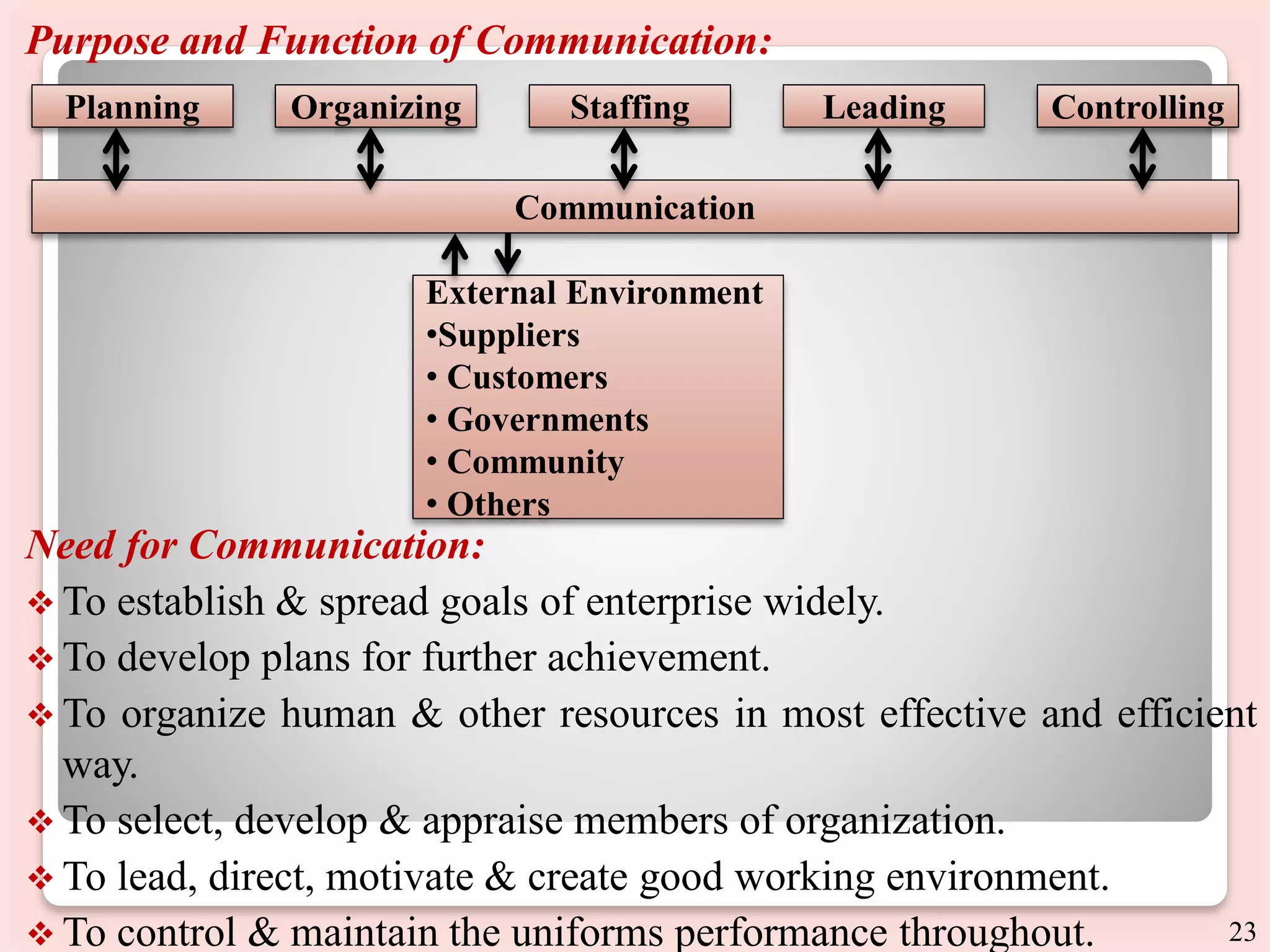
Purpose and Function of Communication:
Need for Communication:
 To establish & spread goals of enterprise widely.
 To develop plans for further achievement.
 To organize human & other resources in most effective and efficient
way.
 To select, develop & appraise members of organization.
 To lead, direct, motivate & create good working environment.
 To control & maintain the uniforms performance throughout.
Planning Controlling
Leading
Staffing
Organizing
Communication
External Environment
•Suppliers
• Customers
• Governments
• Community
• Others
23
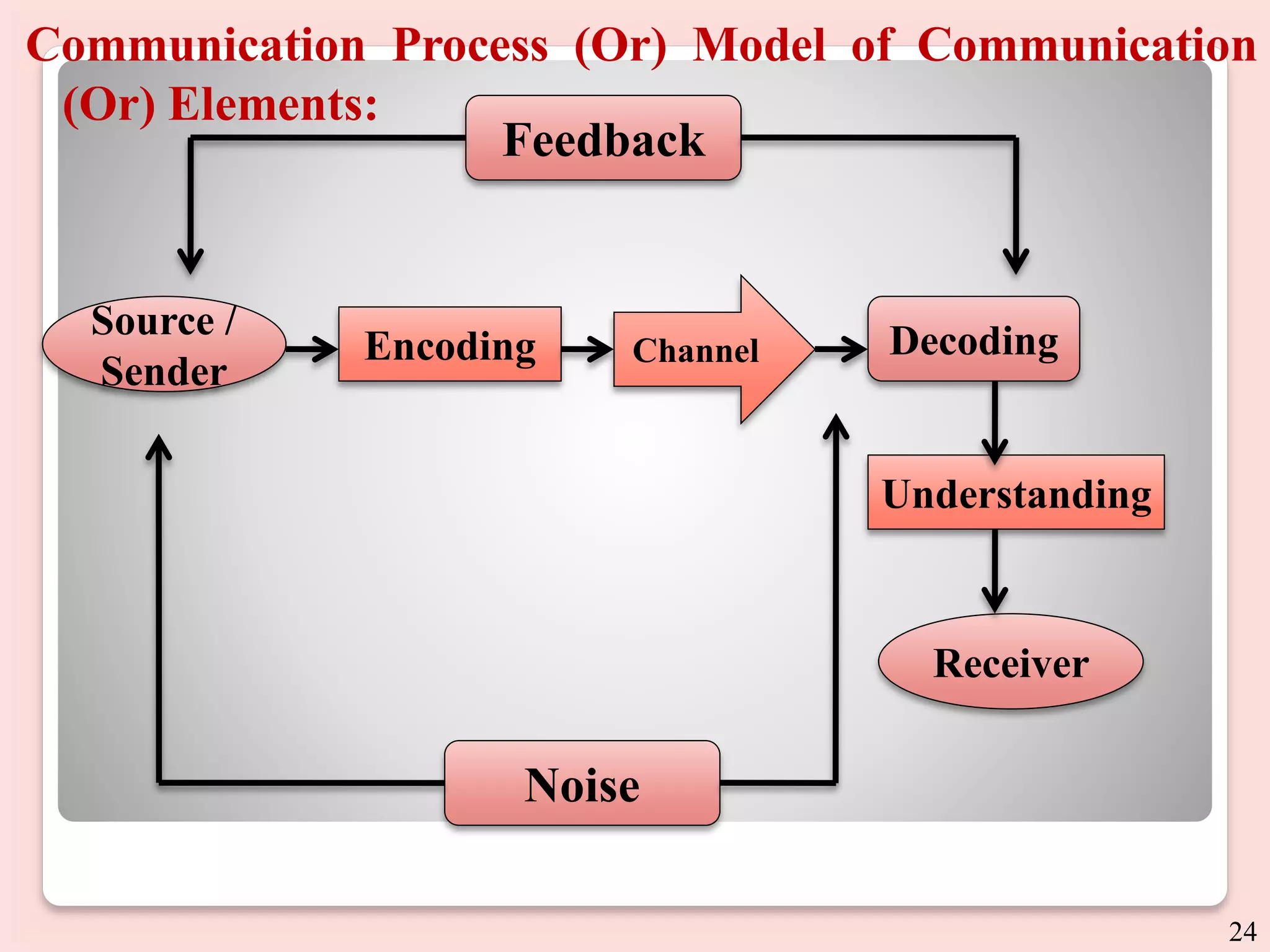
Communication Process (Or) Model of Communication
(Or) Elements:
Feedback
Decoding
Source /
Sender
Encoding Channel
Receiver
Noise
Understanding
24
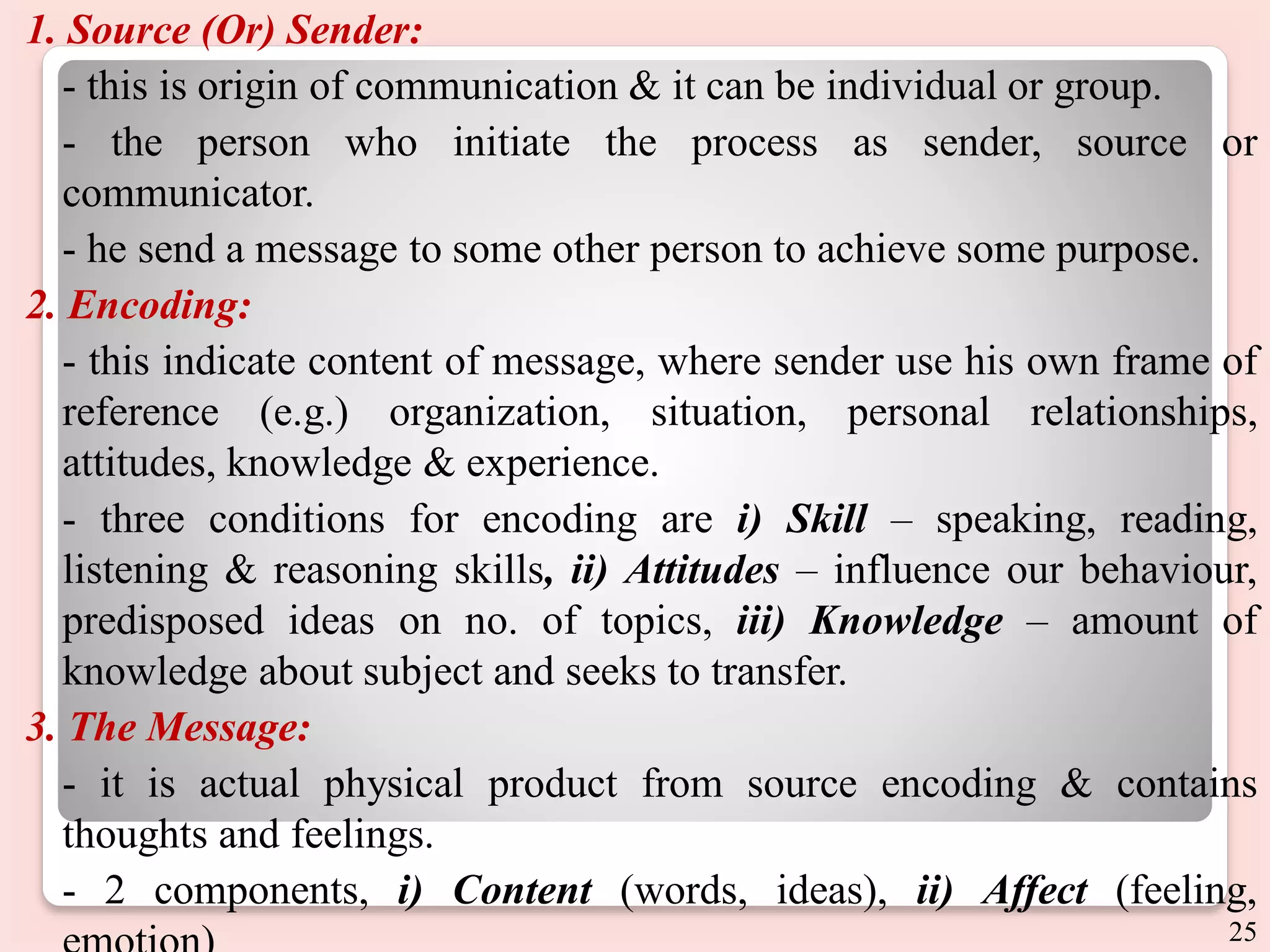
1. Source (Or) Sender:
- this is origin of communication & it can be individual or group.
- the person who initiate the process as sender, source or
communicator.
- he send a message to some other person to achieve some purpose.
2. Encoding:
- this indicate content of message, where sender use his own frame of
reference (e.g.) organization, situation, personal relationships,
attitudes, knowledge & experience.
- three conditions for encoding are i) Skill – speaking, reading,
listening & reasoning skills, ii) Attitudes – influence our behaviour,
predisposed ideas on no. of topics, iii) Knowledge – amount of
knowledge about subject and seeks to transfer.
3. The Message:
- it is actual physical product from source encoding & contains
thoughts and feelings.
- 2 components, i) Content (words, ideas), ii) Affect (feeling,
25
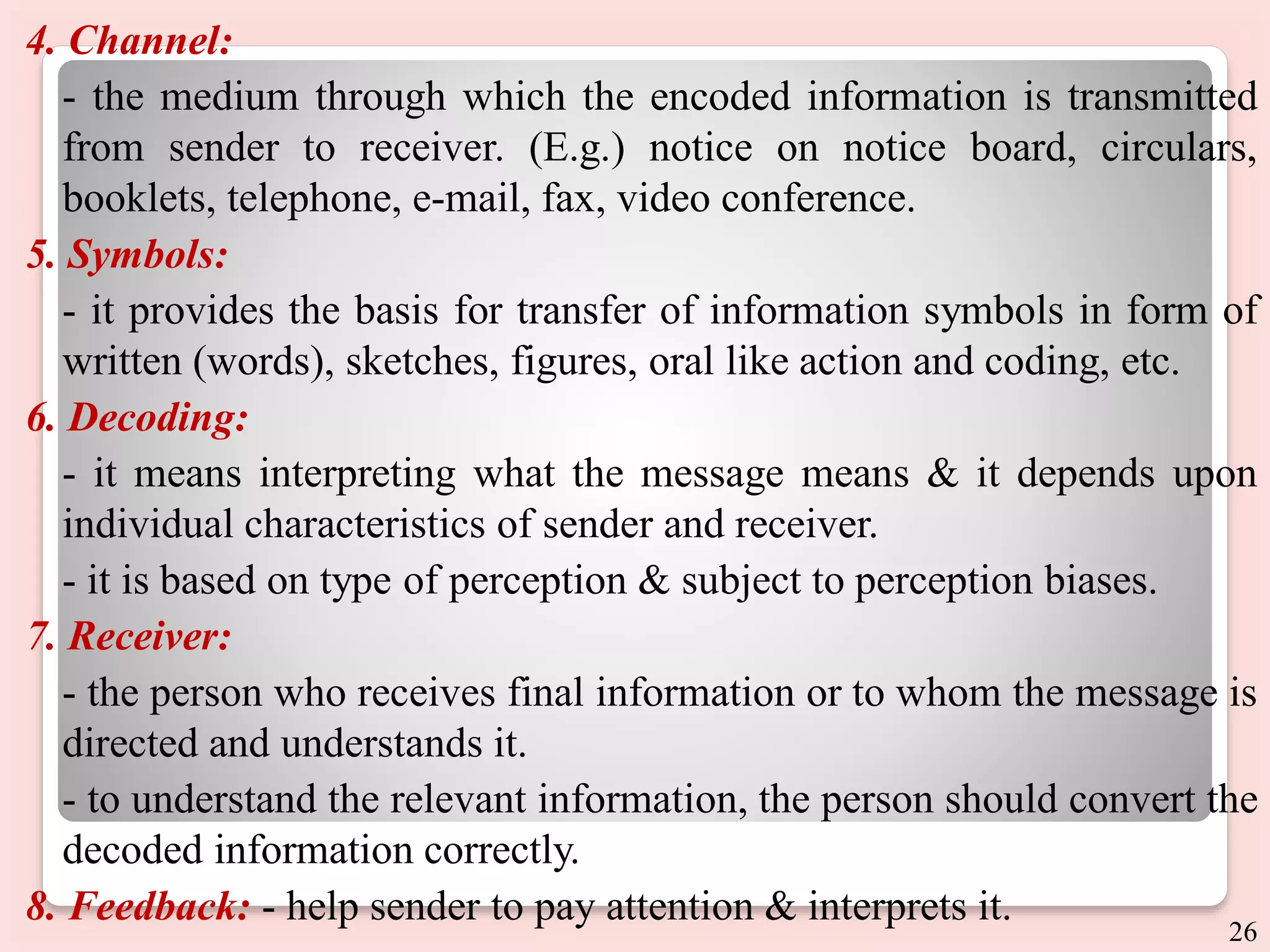
4. Channel:
- the medium through which the encoded information is transmitted
from sender to receiver. (E.g.) notice on notice board, circulars,
booklets, telephone, e-mail, fax, video conference.
5. Symbols:
- it provides the basis for transfer of information symbols in form of
written (words), sketches, figures, oral like action and coding, etc.
6. Decoding:
- it means interpreting what the message means & it depends upon
individual characteristics of sender and receiver.
- it is based on type of perception & subject to perception biases.
7. Receiver:
- the person who receives final information or to whom the message is
directed and understands it.
- to understand the relevant information, the person should convert the
decoded information correctly.
8. Feedback: - help sender to pay attention & interprets it.
26
COORDINATION
Meaning:
 It is unification and integration of the efforts of group members
and to provide unity of action in achievement of common goals.
 Coordination is helpful in achieving the objectives of the
organization.
 It is a process and it is not fixed, it prefers group activities.
Definition:
“Co-ordination is a part of all phases of administration and
that is not a separate and distinct activity". - Newman
“Co-ordination is the integration of several parts into an
orderly whose to achieve the purpose of understanding".
- Charles Worth
27
Elements of Co-ordination:
Co-ordination through Planning.
Co-ordination through Organizing.
Co-ordination through Staffing.
Co-ordination through Directing.
Co-ordination through Controlling.
Importance of Co-ordination:
Backbone of Management.
Unification of Activities.
Creating Healthy Human Relations.
Securing High Employee Morale.
Promoting Efficiency and Economy.
Resolution of Conflict.
Integrating functions of related departments.
28
Core of Group Efforts.
 Interdependence of Work Units.
Techniques of Co-ordination:
1. Chain of Command:
Employee should receive orders from one superior, because
dual command is a continuous source of conflict.
Clear cut authority relationship will reduce conflicts among
different departments.
2. Leadership:
Co-ordination becomes possible through leadership as it
provides individual motivation and persuades group to
identify of interests.
3. Committees:
It helps to promote unity of purpose and uniformity of
action among different departments.
 It provide co-ordination among various activities & persons
through information, advice, etc. 29
Techniques of Co-ordination:
4. Communication:
 Effective communication conveys ideas, opinions or decisions of
managers to subordinate at different levels of organization.
5. Voluntarily Coordination:
 It is possible in a climate of mutual co-operation, when two or
more persons working within same or different departments,
mutually discuss and arrive at coordinated action.
6. Sound Planning and Clear – Cut Objectives:
 Organization objectives and policies must be clearly defined by
management.
 Clear formulation of policies in the field of production, sales,
finance, personnel, etc. must be correlated.
7. Incentives:
 Incentives have a tendency to ignite action and bring about co-
ordination and to reduce conflicts. 30
CONTROLLING
Definition:
“Control is checking current performance against
predetermined standards contained in the plans with a view to
ensuring adequate progress and satisfactory performance”.
- E.F.L. Breach
“Controlling is the measurement and correction of
performance in order to make sure that enterprise objectives and
the plans devised to attain them are accomplished”.
- Harold Koontz
Features of Controlling:
 Managerial function.
 Forward looking.
 Continuous activity.
 Control is related to planning.
31
Characteristics of Controlling:
 It is a universal (essential function in organization).
 It is a continuous process (non-stop process).
 It is action based (ensures performance).
 It is forward looking (lined with future).
 It is closely related to planning (plans in various business activities).
 It is an integrated system & also minimizes errors.
 Control is a management process & embedded in each level of
organization hierarchy.
 Control is a tool for achieving organizational activities.
 Control compares actual performance with planned performance.
 It facilitates optimum utilization of resources.
 It evaluates accuracy of standard and also sets discipline and order.
 It motivates the employees and boosts employee morale.
 It ensures future planning by revising standards.
 It improves overall performance of organization.
32
Importance of Controlling:
1. Accomplishing Organizational goals:
 It helps in comparing the actual performance with the predetermined
standards and take corrective measures to achieve the goals.
2. Judging Accuracy of Standards:
 Efficient control system helps in judging the accuracy of standards.
3. Making efficient use of resources:
 It checks working of employees and ensure effective and efficient use
of all resources in an organization.
4. Improving Employee Motivation:
 Systematic evaluation of performance and rewards in form of
increment, bonus, promotion, etc. motivate employees to put their best
efforts.
5. Ensuring Order and Discipline:
 It ensure a close check on the activities of the employees and create
order and discipline in organization.
33
Importance of Controlling:
6. Facilitating Coordination in Action:
 It helps in providing a common direction to all the activities of
different departments and efforts of individuals for attaining the
organizational objectives.
7. Basis for future action:
 Continuous flow of information about projects keeps the long-range
planning on right track.
8. Facilitates Decision-making:
 Control help in deciding the future course of action, whenever there is
deviation between standard and actual performance.
9. Facilitates Decentralization:
 Decentralization of authority is necessary in big enterprise and various
department use control technique to achieve their target or goals.
10. Helps in Improving Efficiency:
 It helps in improving organizational efficiency through regular
monitoring activities on performance of every person. 34
Limitations of Control:
 It is expensive and time-consuming process.
 It doesn’t consider the external factors like technologies changes,
political, social and government procedures.
 Human behaviour and employee morale can’t be measured.
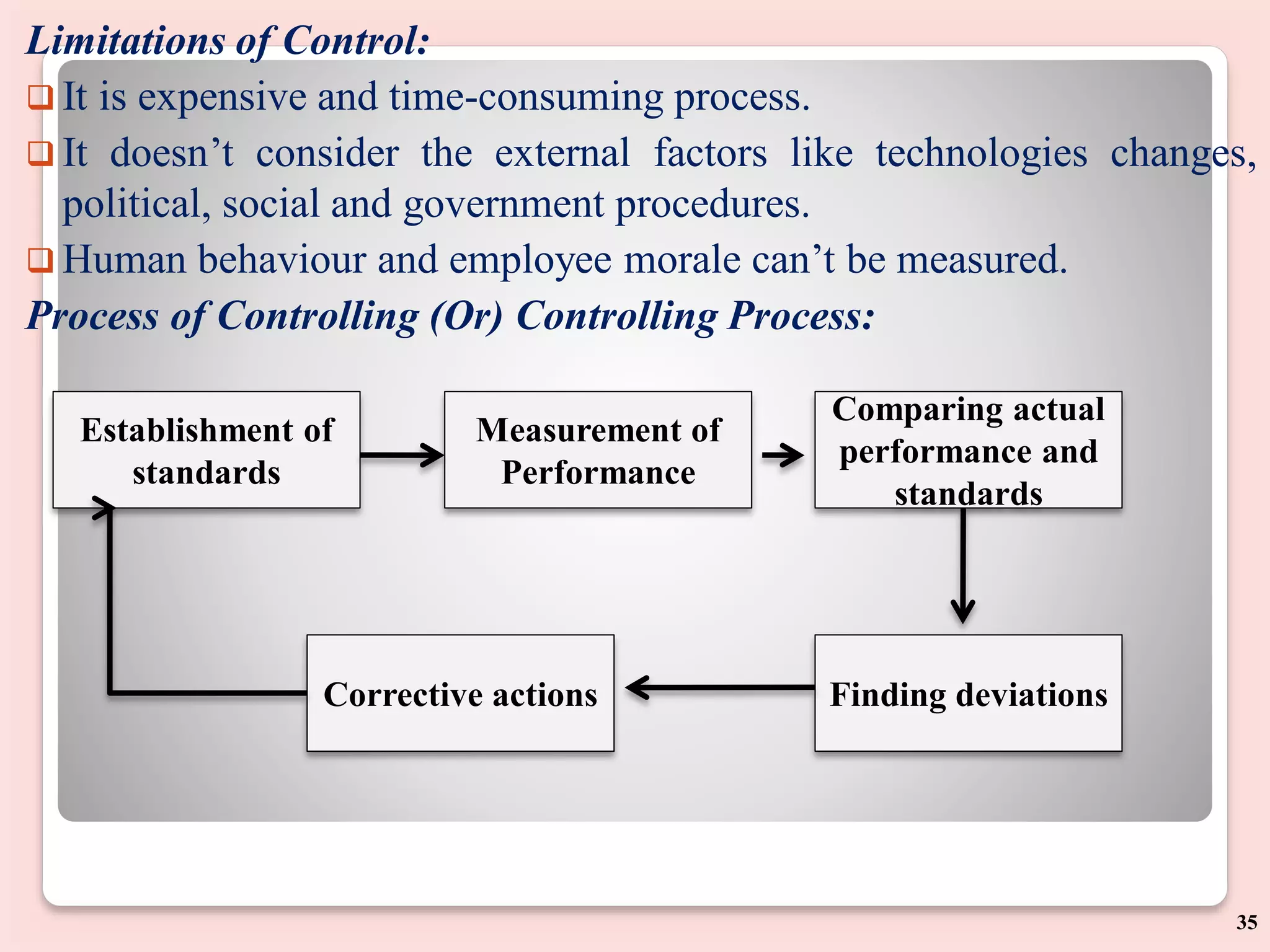
Process of Controlling (Or) Controlling Process:
Establishment of
standards
Measurement of
Performance
Comparing actual
performance and
standards
Finding deviations
Corrective actions
35
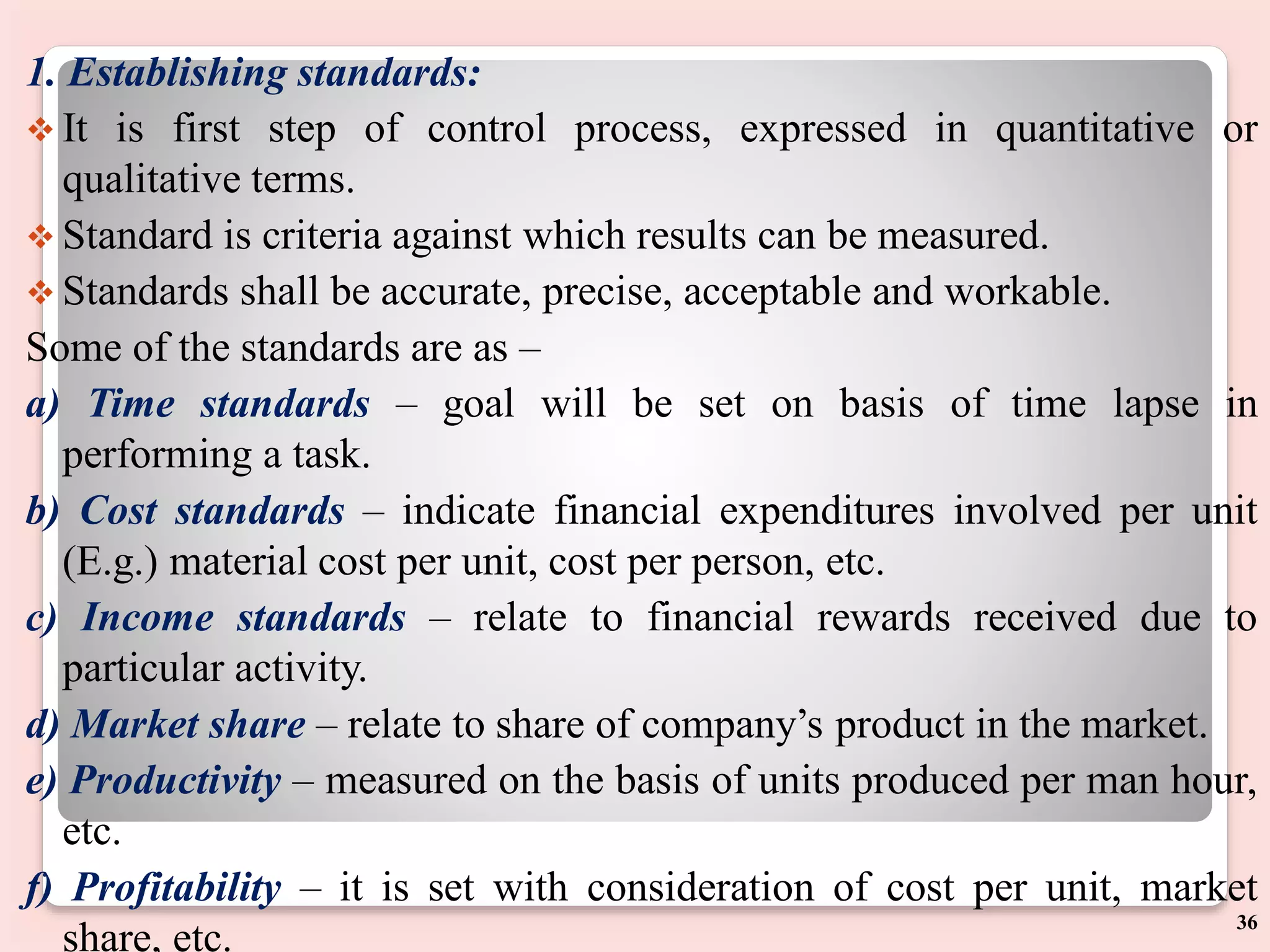
1. Establishing standards:
 It is first step of control process, expressed in quantitative or
qualitative terms.
 Standard is criteria against which results can be measured.
 Standards shall be accurate, precise, acceptable and workable.
Some of the standards are as –
a) Time standards – goal will be set on basis of time lapse in
performing a task.
b) Cost standards – indicate financial expenditures involved per unit
(E.g.) material cost per unit, cost per person, etc.
c) Income standards – relate to financial rewards received due to
particular activity.
d) Market share – relate to share of company’s product in the market.
e) Productivity – measured on the basis of units produced per man hour,
etc.
f) Profitability – it is set with consideration of cost per unit, market
share, etc.
36
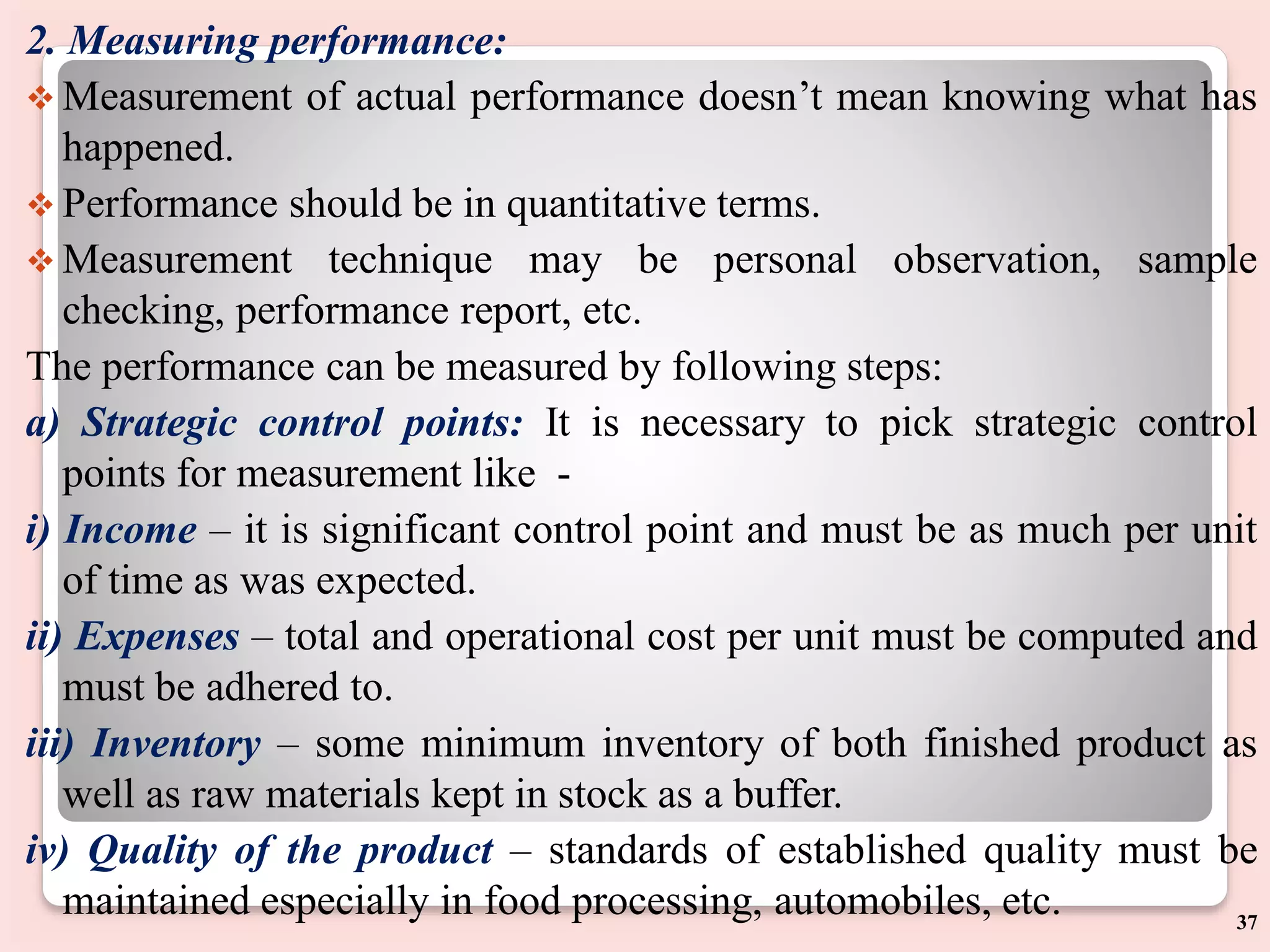
2. Measuring performance:
 Measurement of actual performance doesn’t mean knowing what has
happened.
 Performance should be in quantitative terms.
 Measurement technique may be personal observation, sample
checking, performance report, etc.
The performance can be measured by following steps:
a) Strategic control points: It is necessary to pick strategic control
points for measurement like -
i) Income – it is significant control point and must be as much per unit
of time as was expected.
ii) Expenses – total and operational cost per unit must be computed and
must be adhered to.
iii) Inventory – some minimum inventory of both finished product as
well as raw materials kept in stock as a buffer.
iv) Quality of the product – standards of established quality must be
maintained especially in food processing, automobiles, etc. 37
v) Absenteeism – excessive absenteeism of personnel is a serious
reflection on the environment and working conditions.
b) Mechanized measuring devices: It involves wide variant of technical
instruments used for measurement of machine operations and
production processes. These measurements may be mechanical,
electronic or chemical in nature.
c) Ration Analysis: Ratio analysis is one of the most important
management tools. It describes the relationship of one business
variable to another.
d) Comparative Statistical analysis: The operations of one company
can be usefully compared with similar operations of another company
or with industry averages. It is a very useful performance measuring
device.
e) Personal Observation: It can be used in certain situation as a
measuring device for performances and will have general idea about
how people are working.
38
3. Comparing actual with standards:
 To find out deviation and identify the cause of such deviations.
 Employee morale and effectiveness of human resources statements.
 It gives correct, quick and favourable results.
4. Finding out deviations:
 It is finding out locating the deviations points properly.
 The cause of deviations which depends upon proper accurate and
timely information.
 Deviation between standard and actual performance is beyond the
prescribed limit.
5. Correction of deviations:
 It is essential with correcting deviations from planned performance.
 It may be accurate forecast poor communication, defective machines,
lack of motivation, etc.
 Management should take necessary action for correction of
deviations.
39
Essentials of an Effective and Efficient Control System:
1. Simplicity:
 A good control system must be simple and easily understandable and
managers can apply it effectively.
2. Objectivity:
 Standards of performance should be objective and specific, quantified
and verifiable.
3. Promptness:
 It should provide information soon enough so that the managers can
detect and report and take necessary action in proper time.
4. Economy:
 Control system followed in the organization must justify the expenses
involved.
5. Flexibility:
 Internal goals and strategies must be responsive to changes in
environment and control system should be flexible based on changing
conditions. 40
6. Accuracy:
 Control system should encourage accurate information in order to
detect deviations.
7. Suitability:
 Control must reflect needs and nature of activities of organization.
8. Forward – looking nature:
 Control system must be directed towards the future and it will
conformed with plans adopted.
9. Motivating:
 A good control system should pay due attention to human factor and
designed to secure positive action from workers.
10. Corrective Action:
 Adequate control techniques should not only detect deviations and
failures but should also disclose where they are occurring and
responsible to correct them.
41
Methods of Establishing Control:
1. Direct supervision and Observation:
 It observes the employees and their work and brings them in direct
contact with workers.
 Supervisor get first hand information and better understanding with
the workers.
2. Financial Statements:
 It gives a summary of income and expenses for specified period,
which shows financial position of organization.
 It helps to understand the profitability, liquidity and solvency position
of business.
3. Budgetary Control:
 Budget is a planning and controlling device and it is essence of
financial control.
 It is done for all aspects of business like income, expenditure,
production, capital and revenue.
42
4. Break even analysis:
 Break even analysis or Break even point is point of no profit, no loss.
 It helps to find out company’s performance.
 (E.g.) When organization sells 50K cars, it will break even. (i.e.) any
sale below this point will cause losses and above this point will earn
profits.
5. Return on Investment (ROI):
 It is a tool to improve financial performance and helps business to
compare its present performance with that of previous year’s
performance.
6. Management by Objectives (MBO):
 It facilitates planning and control and fulfill requirements related to
objectives for individuals, periodic evaluation & regular feedback and
achievement of objectives.
7. Management Audit:
 It is an evaluation and examines full management process (i.e.)
planning, organizing, directing and controlling to check company’s
plans, objectives, policies, procedures, etc. 43
8. Self - Control:
 It is Self-directed control and evaluate one’s own performance and
take corrective measures as and when required.
 It control the important activities of the subordinates.
 Control techniques provide managers with type and amount of
information they need to measure and monitor performance.
9. Statistical Data and Reports:
 Statistical Data and Reports Data help in applying statistical
techniques of averages, regression, correlation etc. to predict
company's performance.
10. Quality Control:
 It is used to sustain the quality of product or service to satisfy
customer needs.
11. Total Quality Management (TQM):
 It is focused on every organizational activity and aims at continuous
improvement to focus on total satisfaction of consumers.
44
45
Unit 5 - POM Mr.T.Somasundaram
46
Unit 4 - POM Mr.T.Somasundaram

Directing and Controlling

  • 1.
    UNIT V 1 MR.T.SOMASUNDARAM ASSISTANT PROFESSOR DEPARTMENTOF MANAGEMENT KRISTU JAYANTI COLLEGE, BANGALORE.
  • 2.
    UNIT V DIRECTING &CONTROLLING Meaning and nature of directing, leadership styles, motivation, meaning and importance, Communication, meaning and importance, co-ordination, meaning and importance and techniques of co- ordination, control, meaning, features, importance and steps in control process, essentials of a sound control system, methods of establishing control (in brief). 2
  • 3.
    DIRECTING Meaning: Directing is saidto be a process in which the managers instruct, guide and oversee the performance of the workers to achieve predetermined. It is said to be the heart of management process. It is a complex managerial function consisting of al activities that are designed to encouraged subordinates to work effectively. Definition: "Activating deals with the steps a manager takes to get sub-ordinates and others to carry out plans" - Newman and Warren. Directing concerns the total manner in which a manager influences the actions of subordinates. 3
  • 4.
    Nature (Characteristics) ofDirecting:  Initiates Action – key managerial function and manager has to perform this function.  Continuing Function – it is a continuous activity throughout the life of organization.  Pervasive Function – it is required at all levels of organization.  Creative Function – helps in converting plans into performance.  Linking function – initiated at top level & flows to bottom through organization hierarchy.  Management of Human Factor – it is related to subordinates and therefore it is related to human factor. 4
  • 5.
    Principles of Directing: •Principle of Maximum Individual contribution. • Principle of Harmony of objectives. • Principle of Unity of Command. • Principle of Appropriateness of Direction technique. • Principle of Managerial Communication. • Principle of use of Informal organization. • Principle of Leadership. • Principle of follow through. Elements of Directing: The three elements of directing are • Motivation • Leadership • Communication 5
  • 6.
    LEADERSHIP Definition: “Leadership is theart of process of influencing people so that they will strive willingly towards the achievement of group goals”. - Koontz & O’Donnel “Leadership is the activity of influencing people to strive willingly for group objectives”. - George R.Terry “Leadership is defined as influence, the art or process of influencing people so that they will strive willingly and enthusiastically toward the achievement of group goals”. “Leadership is the process of influencing the activities of an individual or a group in efforts towards goal achievement in a given situation”. - Heresy & Paul 6
  • 7.
    Nature (characteristics) ofLeadership: Involves guiding and motivating. Needs subordinates and common interests. Promotes interest in the work. Needs support from all. Influences subordinates through personal qualities. Dynamic and continuous process. Leadership is situational. Assumes obligation. Needs interaction with followers. Achievement of objectives. 7
  • 8.
    Importance of Leadership: 1.Motivating employees: - Higher motivation will make the employees for higher performance. 2. Leader develops team work: - leader, subordinates & environment are three vital determinants of team work & leader should make the environment to work efficiently. 3. Better utilization of Manpower: - leader implements plans, policies, programmes of organization to utilize available manpower effectively & get maximum production. 4. Creating confidence to followers: - leader create confidents in his followers by directing them. 5. Directing group activities: - leader can direct his follower and takes the lead in all activities. 6. Building morale: - based on attitudes, voluntary cooperation, high morale. 7. Maintaining discipline: - prompts individual to observe rules, procedures to achieve goals. 8
  • 9.
  • 10.
    Leadership Styles:  Thebehaviour exhibited by a leader during supervision of followers. 1. Autocratic Or Dictatorial leadership:  The leader takes all decisions by himself without consulting subordinates.  He has full authority and never delegates authority. * Types: a) Strict autocrat – leader follows this style in strict manner. - he follows negative motivation for getting work. b) Benevolent autocrat – takes decision himself but gives positive motivation. c) Incompetent autocrat – adopt this style to hide their inabilities (i.e.) incompetence. * Autocratic leadership style is appropriate in - - subordinates having lack of knowledge about company goals. - subordinates are inexperience or lack of training. Autocratic leader Follower Follower Follower 10
  • 11.
    - company indicatesfear & punishment as disciplinary techniques. - leader is active and dominant in decision – making. - little chance for error in final accomplishment. Advantages: - facilitates quick decision making. - provides strong motivation and satisfaction to leader. - highest productivity, yield positive outcome. - less competent subordinates at low levels. Disadvantages: - employee morale will be low, absence of leader affect output. - dissatisfaction will develop among employees. - employee turnover will be more. - full potential creative ideas of subordinates are not fully utilized. - communication without feedback leads to misunderstanding and communication breakdown. 11
  • 12.
    2. Participative OrDemocratic leadership:  Subordinates are consulted and their feedback is taken into decision making process.  The authority is decentralized & this leader attached to both work and people. * Participative leadership is appropriate - - truly desires to hear the ideas of his employees. - organization has communicated its goals and objectives to subordinates. - workers are reasonably knowledge and experienced. - time for task completion allows for participation. - subordinates desire active and true involvement. Democratic leader Follower Follower Follower 12
  • 13.
    Advantages: - subordinates aremotivated by participation in decision making process. - absence of leader doesn’t affect output. - labour absenteeism and turn over will be minimum. - quality is decision is improved. - leader multiplies his abilities through contribution of his followers. Disadvantages: - time consuming, results delay in decision making. - subordinates are lazy & avoid work, controlling is difficult. - it can’t applied at lower level of management. - leaders may be uncomfortable with reduction in power & control over labour. - yield positive results when subordinates prefer minimum interaction with leader. - leader requires communication and persuasive skill. 13
  • 14.
    3. Laissez-Faire OrFree rein leadership:  Complete freedom to subordinates for planning, motivation, control.  Authority is decentralized & leader will not take decision. * This type of leader is effective - - leader is interested in delegating decision making. - subordinates are highly intelligent and aware of roles & responsibility. Advantages: - positive effect on job satisfaction & morale. - creates environment of freedom & team spirit. - full utilization of potential of subordinates. Disadvantages: - lack of discipline, lowest productivity. - no control & co-ordination. - members put their own interest. Free – rein leader Follower Follower Follower 14
  • 15.
    4. Bureaucratic leadership: They follow rules rigorously and ensure that their staff follows procedures precisely.  This is appropriate style for work involving serious safety risks. 5. Charismatic leadership:  It is similar transformational leadership, because leaders inspire lots of enthusiasm in their teams and energetic in driving others forward.  Charismatic leaders can tend to believe more in themselves than in their teams.  Charismatic leadership carries great responsibility and needs a long- term commitment from the leader. 6. Servant leadership:  Servant leadership is a form of democratic leadership, because the whole team tends to be involved in decision making.  Someone, at any level within an organization, leads simply by meeting needs of team, it is described as ‘Servant Leader”.
  • 16.
    7. Transactional leadership: It starts with idea that team members agree to obey their leader totally when they accept a job.  It is like paying the team members in return for their effort and compliance. 8. Transformational leadership:  People with this style are true leaders who inspire their teams constantly with shared a vision of future.  This leaders look after initiatives that add new value. 9. Task – Oriented leadership:  It focus only on getting job done and actively defines work and roles required, put structures in place, plan, organize and monitor. 10. People – Oriented leadership:  It totally focus only on organizing, supporting and developing the people in their teams.  It is participative style and encourage good teamwork.
  • 17.
    MOTIVATION Definition: “Motivation” is aLatin word, meaning ‘to move”. “Motivation is the process of inducing people inner drives and actions towards certain goals and committing his energies to achieve these goals”. “Motivation is a general term applying to the entire class of drives, desires, needs wishes and similar forces that induce an individual or a group of people to work”. - Koontz & O’Donnell “Motivation means a process of stimulating people to action to accomplish desired goals”. - Scott “Motivation is the process of attempting to influence others to do your will through the possibility of reward”. - Edwin B.Flippo 17
  • 18.
    Nature (Characteristics) ofmotivation: - it is an unending process because human needs are unlimited. - it is an psychological concept. (inducement of feeling) - it is behavioural concept that directs human behaviour. - person can’t be partially motivated, frustrated man can’t be motivated. -it can be either positive (incentive, bonus, rewards) & negative (demotion, penalties). - it is a complex process & system oriented. - it depends on 3 factors – i) influences individual ii) influences organization and iii) external environment. - it is different from satisfaction. (i.e.) Motivation is drive & effort to satisfy and Satisfaction is experienced, feels when person is satisfied. 18
  • 19.
    Importance of Motivation: Productiveuse of resources. Increased efficiency and output.  Achievement of goals. Development of friendly relationships. Stability in workforce.  Best utilization of resources.  Will to contribute. Reduction in labour problems.  Sizeable increase in production and productivity.  Basis of cooperation. Improvement upon skill and knowledge. Acceptance of organizational change.  Better image. 19
  • 20.
    Types of Motivation(Techniques): 1. Positive motivation: - proper recognition of employee’s efforts and appreciation of employee contribution towards goal achievement. (E.g.) pride, authority, responsibility, economic benefits. 2. Negative motivation: - this is based on force, fear & threats. (E.g.) fail to complete the work, demotion, dismissed, pay cut. 3. Extrinsic motivation: - this is induced by external factors. (E.g.) higher pay, rest periods, holidays, profit share, health insurance. 4. Intrinsic motivation: - this is available at the time of performance of work. (E.g.) Praise, recognition, power, status, participation. 20
  • 21.
    COMMUNICATION Definition: "Communication, is anintercourse by words, letters symbols or messages, and is a way that the organization members shares meaning and understanding with another". - Koontz & O’Donnell Communication function in organizations:  It is the powerful tool & significant characteristics of man-kind.  It is success of management depend on ability to communicate with labour.  It is the process of interchanging facts, view points and ideas between persons in different positions by effective communication.  This lead to work satisfactorily in the organization. 21
  • 22.
    Importance of Communication: Necessaryof Planning. Basis of Co-ordination. Establishment of effective leadership. Increases managerial efficiency. Promotes Co-operation and Industrial peace. Basis of Decision – making. Morale Building and Motivation. Smooth Working of Enterprise. Job Satisfaction. 22
  • 23.
    Purpose and Functionof Communication: Need for Communication:  To establish & spread goals of enterprise widely.  To develop plans for further achievement.  To organize human & other resources in most effective and efficient way.  To select, develop & appraise members of organization.  To lead, direct, motivate & create good working environment.  To control & maintain the uniforms performance throughout. Planning Controlling Leading Staffing Organizing Communication External Environment •Suppliers • Customers • Governments • Community • Others 23
  • 24.
    Communication Process (Or)Model of Communication (Or) Elements: Feedback Decoding Source / Sender Encoding Channel Receiver Noise Understanding 24
  • 25.
    1. Source (Or)Sender: - this is origin of communication & it can be individual or group. - the person who initiate the process as sender, source or communicator. - he send a message to some other person to achieve some purpose. 2. Encoding: - this indicate content of message, where sender use his own frame of reference (e.g.) organization, situation, personal relationships, attitudes, knowledge & experience. - three conditions for encoding are i) Skill – speaking, reading, listening & reasoning skills, ii) Attitudes – influence our behaviour, predisposed ideas on no. of topics, iii) Knowledge – amount of knowledge about subject and seeks to transfer. 3. The Message: - it is actual physical product from source encoding & contains thoughts and feelings. - 2 components, i) Content (words, ideas), ii) Affect (feeling, 25
  • 26.
    4. Channel: - themedium through which the encoded information is transmitted from sender to receiver. (E.g.) notice on notice board, circulars, booklets, telephone, e-mail, fax, video conference. 5. Symbols: - it provides the basis for transfer of information symbols in form of written (words), sketches, figures, oral like action and coding, etc. 6. Decoding: - it means interpreting what the message means & it depends upon individual characteristics of sender and receiver. - it is based on type of perception & subject to perception biases. 7. Receiver: - the person who receives final information or to whom the message is directed and understands it. - to understand the relevant information, the person should convert the decoded information correctly. 8. Feedback: - help sender to pay attention & interprets it. 26
  • 27.
    COORDINATION Meaning:  It isunification and integration of the efforts of group members and to provide unity of action in achievement of common goals.  Coordination is helpful in achieving the objectives of the organization.  It is a process and it is not fixed, it prefers group activities. Definition: “Co-ordination is a part of all phases of administration and that is not a separate and distinct activity". - Newman “Co-ordination is the integration of several parts into an orderly whose to achieve the purpose of understanding". - Charles Worth 27
  • 28.
    Elements of Co-ordination: Co-ordinationthrough Planning. Co-ordination through Organizing. Co-ordination through Staffing. Co-ordination through Directing. Co-ordination through Controlling. Importance of Co-ordination: Backbone of Management. Unification of Activities. Creating Healthy Human Relations. Securing High Employee Morale. Promoting Efficiency and Economy. Resolution of Conflict. Integrating functions of related departments. 28 Core of Group Efforts.  Interdependence of Work Units.
  • 29.
    Techniques of Co-ordination: 1.Chain of Command: Employee should receive orders from one superior, because dual command is a continuous source of conflict. Clear cut authority relationship will reduce conflicts among different departments. 2. Leadership: Co-ordination becomes possible through leadership as it provides individual motivation and persuades group to identify of interests. 3. Committees: It helps to promote unity of purpose and uniformity of action among different departments.  It provide co-ordination among various activities & persons through information, advice, etc. 29
  • 30.
    Techniques of Co-ordination: 4.Communication:  Effective communication conveys ideas, opinions or decisions of managers to subordinate at different levels of organization. 5. Voluntarily Coordination:  It is possible in a climate of mutual co-operation, when two or more persons working within same or different departments, mutually discuss and arrive at coordinated action. 6. Sound Planning and Clear – Cut Objectives:  Organization objectives and policies must be clearly defined by management.  Clear formulation of policies in the field of production, sales, finance, personnel, etc. must be correlated. 7. Incentives:  Incentives have a tendency to ignite action and bring about co- ordination and to reduce conflicts. 30
  • 31.
    CONTROLLING Definition: “Control is checkingcurrent performance against predetermined standards contained in the plans with a view to ensuring adequate progress and satisfactory performance”. - E.F.L. Breach “Controlling is the measurement and correction of performance in order to make sure that enterprise objectives and the plans devised to attain them are accomplished”. - Harold Koontz Features of Controlling:  Managerial function.  Forward looking.  Continuous activity.  Control is related to planning. 31
  • 32.
    Characteristics of Controlling: It is a universal (essential function in organization).  It is a continuous process (non-stop process).  It is action based (ensures performance).  It is forward looking (lined with future).  It is closely related to planning (plans in various business activities).  It is an integrated system & also minimizes errors.  Control is a management process & embedded in each level of organization hierarchy.  Control is a tool for achieving organizational activities.  Control compares actual performance with planned performance.  It facilitates optimum utilization of resources.  It evaluates accuracy of standard and also sets discipline and order.  It motivates the employees and boosts employee morale.  It ensures future planning by revising standards.  It improves overall performance of organization. 32
  • 33.
    Importance of Controlling: 1.Accomplishing Organizational goals:  It helps in comparing the actual performance with the predetermined standards and take corrective measures to achieve the goals. 2. Judging Accuracy of Standards:  Efficient control system helps in judging the accuracy of standards. 3. Making efficient use of resources:  It checks working of employees and ensure effective and efficient use of all resources in an organization. 4. Improving Employee Motivation:  Systematic evaluation of performance and rewards in form of increment, bonus, promotion, etc. motivate employees to put their best efforts. 5. Ensuring Order and Discipline:  It ensure a close check on the activities of the employees and create order and discipline in organization. 33
  • 34.
    Importance of Controlling: 6.Facilitating Coordination in Action:  It helps in providing a common direction to all the activities of different departments and efforts of individuals for attaining the organizational objectives. 7. Basis for future action:  Continuous flow of information about projects keeps the long-range planning on right track. 8. Facilitates Decision-making:  Control help in deciding the future course of action, whenever there is deviation between standard and actual performance. 9. Facilitates Decentralization:  Decentralization of authority is necessary in big enterprise and various department use control technique to achieve their target or goals. 10. Helps in Improving Efficiency:  It helps in improving organizational efficiency through regular monitoring activities on performance of every person. 34
  • 35.
    Limitations of Control: It is expensive and time-consuming process.  It doesn’t consider the external factors like technologies changes, political, social and government procedures.  Human behaviour and employee morale can’t be measured. Process of Controlling (Or) Controlling Process: Establishment of standards Measurement of Performance Comparing actual performance and standards Finding deviations Corrective actions 35
  • 36.
    1. Establishing standards: It is first step of control process, expressed in quantitative or qualitative terms.  Standard is criteria against which results can be measured.  Standards shall be accurate, precise, acceptable and workable. Some of the standards are as – a) Time standards – goal will be set on basis of time lapse in performing a task. b) Cost standards – indicate financial expenditures involved per unit (E.g.) material cost per unit, cost per person, etc. c) Income standards – relate to financial rewards received due to particular activity. d) Market share – relate to share of company’s product in the market. e) Productivity – measured on the basis of units produced per man hour, etc. f) Profitability – it is set with consideration of cost per unit, market share, etc. 36
  • 37.
    2. Measuring performance: Measurement of actual performance doesn’t mean knowing what has happened.  Performance should be in quantitative terms.  Measurement technique may be personal observation, sample checking, performance report, etc. The performance can be measured by following steps: a) Strategic control points: It is necessary to pick strategic control points for measurement like - i) Income – it is significant control point and must be as much per unit of time as was expected. ii) Expenses – total and operational cost per unit must be computed and must be adhered to. iii) Inventory – some minimum inventory of both finished product as well as raw materials kept in stock as a buffer. iv) Quality of the product – standards of established quality must be maintained especially in food processing, automobiles, etc. 37
  • 38.
    v) Absenteeism –excessive absenteeism of personnel is a serious reflection on the environment and working conditions. b) Mechanized measuring devices: It involves wide variant of technical instruments used for measurement of machine operations and production processes. These measurements may be mechanical, electronic or chemical in nature. c) Ration Analysis: Ratio analysis is one of the most important management tools. It describes the relationship of one business variable to another. d) Comparative Statistical analysis: The operations of one company can be usefully compared with similar operations of another company or with industry averages. It is a very useful performance measuring device. e) Personal Observation: It can be used in certain situation as a measuring device for performances and will have general idea about how people are working. 38
  • 39.
    3. Comparing actualwith standards:  To find out deviation and identify the cause of such deviations.  Employee morale and effectiveness of human resources statements.  It gives correct, quick and favourable results. 4. Finding out deviations:  It is finding out locating the deviations points properly.  The cause of deviations which depends upon proper accurate and timely information.  Deviation between standard and actual performance is beyond the prescribed limit. 5. Correction of deviations:  It is essential with correcting deviations from planned performance.  It may be accurate forecast poor communication, defective machines, lack of motivation, etc.  Management should take necessary action for correction of deviations. 39
  • 40.
    Essentials of anEffective and Efficient Control System: 1. Simplicity:  A good control system must be simple and easily understandable and managers can apply it effectively. 2. Objectivity:  Standards of performance should be objective and specific, quantified and verifiable. 3. Promptness:  It should provide information soon enough so that the managers can detect and report and take necessary action in proper time. 4. Economy:  Control system followed in the organization must justify the expenses involved. 5. Flexibility:  Internal goals and strategies must be responsive to changes in environment and control system should be flexible based on changing conditions. 40
  • 41.
    6. Accuracy:  Controlsystem should encourage accurate information in order to detect deviations. 7. Suitability:  Control must reflect needs and nature of activities of organization. 8. Forward – looking nature:  Control system must be directed towards the future and it will conformed with plans adopted. 9. Motivating:  A good control system should pay due attention to human factor and designed to secure positive action from workers. 10. Corrective Action:  Adequate control techniques should not only detect deviations and failures but should also disclose where they are occurring and responsible to correct them. 41
  • 42.
    Methods of EstablishingControl: 1. Direct supervision and Observation:  It observes the employees and their work and brings them in direct contact with workers.  Supervisor get first hand information and better understanding with the workers. 2. Financial Statements:  It gives a summary of income and expenses for specified period, which shows financial position of organization.  It helps to understand the profitability, liquidity and solvency position of business. 3. Budgetary Control:  Budget is a planning and controlling device and it is essence of financial control.  It is done for all aspects of business like income, expenditure, production, capital and revenue. 42
  • 43.
    4. Break evenanalysis:  Break even analysis or Break even point is point of no profit, no loss.  It helps to find out company’s performance.  (E.g.) When organization sells 50K cars, it will break even. (i.e.) any sale below this point will cause losses and above this point will earn profits. 5. Return on Investment (ROI):  It is a tool to improve financial performance and helps business to compare its present performance with that of previous year’s performance. 6. Management by Objectives (MBO):  It facilitates planning and control and fulfill requirements related to objectives for individuals, periodic evaluation & regular feedback and achievement of objectives. 7. Management Audit:  It is an evaluation and examines full management process (i.e.) planning, organizing, directing and controlling to check company’s plans, objectives, policies, procedures, etc. 43
  • 44.
    8. Self -Control:  It is Self-directed control and evaluate one’s own performance and take corrective measures as and when required.  It control the important activities of the subordinates.  Control techniques provide managers with type and amount of information they need to measure and monitor performance. 9. Statistical Data and Reports:  Statistical Data and Reports Data help in applying statistical techniques of averages, regression, correlation etc. to predict company's performance. 10. Quality Control:  It is used to sustain the quality of product or service to satisfy customer needs. 11. Total Quality Management (TQM):  It is focused on every organizational activity and aims at continuous improvement to focus on total satisfaction of consumers. 44
  • 45.
    45 Unit 5 -POM Mr.T.Somasundaram
  • 46.
    46 Unit 4 -POM Mr.T.Somasundaram