MANAGEMENT BY
OBJECTIVES
(MBO)
By/ MahmoudShaqria
‫شقريه‬ ‫محمد‬ ‫محمود‬
OUT LINES
Introduction
 Definition of MBO
 Importance of MBO
 Principles of MBO
 Process of MBO
 How to make MBO effective
 Advantages of MBO
 Disadvantages of MBO
 Limitations of MBO
 Introduction
 Peter Drucker in 1954.
 Concept of planning
 Accomplishment of objectives through participation of all
concerned persons
 Participative and democratic style of management
 The principle behind Management by Objectives (MBO) is
to make sure that everybody within the organization has a
clear understanding of the aims, or objectives, of that
organization, as well as awareness of their own roles and
responsibilities in achieving those aims.
 The complete MBO system is to get managers and
empowered employees acting to implement and achieve
their plans, which automatically achieve those of the
organization.
 Definition of MBO
 MBO is "a dynamic system which seeks to integrate the
company's needs to clarify and achieve its profits and
growth goals with the manager's need to contribute and
develop himself. It is a demanding and rewarding style of
managing a business.“
 MBO is a systematic and organized approach that allows
management to focus on achievable goals and to attain the
best possible results from available resources.
 Management by objective is a philosophy of
management by which every managerial activity
must be directed at a specific objective
 Importance of MBO
1-To increase organizational performance by aligning
goals and subordinate objectives throughout the
organization.
2-Motivation – Involving employees in the whole process of
goal setting and increasing employee empowerment. This
increases employee job satisfaction and commitment.
3-Better communication and Coordination .
4-Clarity of goals and plans at all levels.
5-Subordinates tend to have a higher commitment to
objectives they set for themselves than those imposed on
them by another person.
6-Managers can ensure that objectives of the subordinates
are linked to the organization's objectives.
7-Evaluating employee performance according to
predetermined standard.
 Principles of MBO
 Cascading of organizational vision, goals and objectives
 Specific objectives for each member
 Participative decision making
 Explicit time period
 Performance evaluation and feedback
 Steps of MBO process
STEP 1: SET GOALS
• Corporate Strategic goals
• Departmental goals
• Individual goals
STEP 2: DEVELOP PLANS
-Action Plans
STEP 3: REVIEW PROGRESS
-Review Progress & Take Corrective Action
STEP 4: APPRAISE OVERALL PERFORMANCE
-Appraise Performance
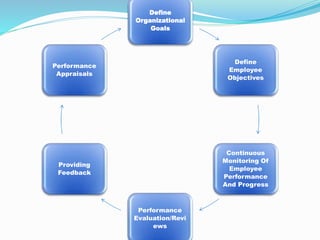
Define
Organizational
Goals
Define
Employee
Objectives
Continuous
Monitoring Of
Employee
Performance
And Progress
Performance
Evaluation/Revi
ews
Providing
Feedback
Performance
Appraisals
1)Goal setting:
 Subordinate should actively participate in goal and objective setting.
 Objective should be (SMART)
 Specific, measurable, achievable, realistic, and time tabled.
2)Develop action plan:
 Goal setting should be translated into action plan. It requires
assignment of specific responsibilities to different departments,
division and individuals.
 It also requires allocation of necessary resources needed to perform the
assigned responsibilities.
 Time dimensions are also to be decided in order that targets are
reached without any delay.
3)Monitor progress:
 Monitor and evaluate employee actual performance against
the set objective at agree interval, the manager and
subordinate meet to discuss progress. At this meeting some
modification can be made to the origin goals.
4)Appraise Overall Performance
 It is the last step to evaluate performance annually and take
corrective actions according to the evaluation to avoid
deviation from predetermined objectives. Also used to
determine targets for next year or modification of goals if
needed.
 And cycle of MBO is repeated.
How to make MBO effective:
 Managers should be trained in MBO philosophy and
procedures before installing the system.
 Effective Feedback.
 Encouraging employee participation.
 Top management support.
 Formulating Clear Objectives
Advantages of MBO
1.Improves employee motivation
2.Improves communication in the organisation
3.Flags up and highlights training needs required to achieve objectives
4.Improves overall performance and efficiency
5.Attainment of goals can lead to the satisfaction of Maslow’s higher
order needs
6.Develops result-oriented philosophy
7.Means of planning and control
8.Facilitates personal leadership.
9.Basis for organizational change
10.Identify problems
11.Increase employee commitment as they participate in goal
setting.
12.Enhance spirit of team work
 Disadvantages of MBO
 1) Subordinate feels uncomfortable
 2) Lacks Objective clarity
 3) Too much multi-tasking !!!
 4) Low initial goal set by subordinates
 5)Requires the cooperation of all employees to succeed
 6)Can be bureaucratic and time consuming (meetings, feedback)
 7)Can encourage short-term rather a more focused long-term growth
 8)Objectives may go out of date and can restrict staff initiative and
creativity
 9)May de-motivate staff if targets are too high and unrealistic, also if
imposed rather than agreed
Limitations of MBO:
 Time-consuming
 Failure to teach MBO philosophy
 Reward-punishment approach
 Increases paper-work
 Creates organizational problems
 Develops conflicting objectives
 Problem of co-ordination
 Inflexibility
Thank you…

Management by objectives

  • 1.
  • 2.
    OUT LINES Introduction  Definitionof MBO  Importance of MBO  Principles of MBO  Process of MBO  How to make MBO effective  Advantages of MBO  Disadvantages of MBO  Limitations of MBO
  • 3.
     Introduction  PeterDrucker in 1954.  Concept of planning  Accomplishment of objectives through participation of all concerned persons  Participative and democratic style of management  The principle behind Management by Objectives (MBO) is to make sure that everybody within the organization has a clear understanding of the aims, or objectives, of that organization, as well as awareness of their own roles and responsibilities in achieving those aims.  The complete MBO system is to get managers and empowered employees acting to implement and achieve their plans, which automatically achieve those of the organization.
  • 4.
     Definition ofMBO  MBO is "a dynamic system which seeks to integrate the company's needs to clarify and achieve its profits and growth goals with the manager's need to contribute and develop himself. It is a demanding and rewarding style of managing a business.“  MBO is a systematic and organized approach that allows management to focus on achievable goals and to attain the best possible results from available resources.  Management by objective is a philosophy of management by which every managerial activity must be directed at a specific objective
  • 5.
     Importance ofMBO 1-To increase organizational performance by aligning goals and subordinate objectives throughout the organization. 2-Motivation – Involving employees in the whole process of goal setting and increasing employee empowerment. This increases employee job satisfaction and commitment. 3-Better communication and Coordination . 4-Clarity of goals and plans at all levels. 5-Subordinates tend to have a higher commitment to objectives they set for themselves than those imposed on them by another person.
  • 6.
    6-Managers can ensurethat objectives of the subordinates are linked to the organization's objectives. 7-Evaluating employee performance according to predetermined standard.  Principles of MBO  Cascading of organizational vision, goals and objectives  Specific objectives for each member  Participative decision making  Explicit time period  Performance evaluation and feedback
  • 7.
     Steps ofMBO process STEP 1: SET GOALS • Corporate Strategic goals • Departmental goals • Individual goals STEP 2: DEVELOP PLANS -Action Plans STEP 3: REVIEW PROGRESS -Review Progress & Take Corrective Action STEP 4: APPRAISE OVERALL PERFORMANCE -Appraise Performance
  • 8.
  • 9.
    1)Goal setting:  Subordinateshould actively participate in goal and objective setting.  Objective should be (SMART)  Specific, measurable, achievable, realistic, and time tabled. 2)Develop action plan:  Goal setting should be translated into action plan. It requires assignment of specific responsibilities to different departments, division and individuals.  It also requires allocation of necessary resources needed to perform the assigned responsibilities.  Time dimensions are also to be decided in order that targets are reached without any delay.
  • 10.
    3)Monitor progress:  Monitorand evaluate employee actual performance against the set objective at agree interval, the manager and subordinate meet to discuss progress. At this meeting some modification can be made to the origin goals. 4)Appraise Overall Performance  It is the last step to evaluate performance annually and take corrective actions according to the evaluation to avoid deviation from predetermined objectives. Also used to determine targets for next year or modification of goals if needed.  And cycle of MBO is repeated.
  • 11.
    How to makeMBO effective:  Managers should be trained in MBO philosophy and procedures before installing the system.  Effective Feedback.  Encouraging employee participation.  Top management support.  Formulating Clear Objectives Advantages of MBO 1.Improves employee motivation 2.Improves communication in the organisation 3.Flags up and highlights training needs required to achieve objectives
  • 12.
    4.Improves overall performanceand efficiency 5.Attainment of goals can lead to the satisfaction of Maslow’s higher order needs 6.Develops result-oriented philosophy 7.Means of planning and control 8.Facilitates personal leadership. 9.Basis for organizational change 10.Identify problems 11.Increase employee commitment as they participate in goal setting. 12.Enhance spirit of team work
  • 13.
     Disadvantages ofMBO  1) Subordinate feels uncomfortable  2) Lacks Objective clarity  3) Too much multi-tasking !!!  4) Low initial goal set by subordinates  5)Requires the cooperation of all employees to succeed  6)Can be bureaucratic and time consuming (meetings, feedback)  7)Can encourage short-term rather a more focused long-term growth  8)Objectives may go out of date and can restrict staff initiative and creativity  9)May de-motivate staff if targets are too high and unrealistic, also if imposed rather than agreed
  • 14.
    Limitations of MBO: Time-consuming  Failure to teach MBO philosophy  Reward-punishment approach  Increases paper-work  Creates organizational problems  Develops conflicting objectives  Problem of co-ordination  Inflexibility
  • 15.